Vue normale

Poland would rather the next Russian missile be downed over Ukraine than over its soil. It may send Kyiv more Patriots

13 août 2026 à 06:18

poland patriot

Poland will decide within days whether to send Ukraine another batch of Patriot interceptor missiles, Deputy Defense Minister Magdalena Sobkowiak-Czarnecka said in a radio interview RMF24. Any transfer, she said, has to be judged first against Poland's own security.

A Russian strike on NATO soil is now moving Warsaw where months of Ukrainian appeals had not. Sobkowiak-Czarnecka said Defense Minister Władysław Kosiniak-Kamysz leans toward sending more interceptors after a Russian missile crashed inside Poland on 30 July, and that he would rather one be shot down over Ukraine than reach Polish soil.

Tusk had signaled at the end of July that Warsaw would soon weigh sending more Patriots. Sobkowiak-Czarnecka's remarks are the first to put a timeline on that decision.

Warsaw had been split for weeks over whether giving up the missiles was the right call. She set that argument aside, saying only that a decision is a matter of the coming days.

A second handover from a thin stock

This would not be the first transfer. In the spring, Poland quietly gave Ukraine five PAC-3 MSE interceptors — the missiles a Patriot battery uses to stop ballistic threats — a move confirmed only in July, when the defense ministry declassified its aid records and Prime Minister Donald Tusk put the number at five.

The disclosure drew sharp criticism at home. Opposition figures noted that the PAC-3 is the only interceptor Poland holds capable of downing Russia's Iskander ballistic missiles — the same class of weapon now crossing into Polish airspace.

Why the interceptors are so scarce

PAC-3 interceptors are among the hardest munitions in NATO to spare. The United States builds them at a rate that does not cover its own needs, and only a handful of alliance members operate them at all.

Ukraine has been pressing for them for months. In early July, after one of the largest air attacks of the war, Kyiv appealed to nearly 40 countries to release Patriot missiles from existing stocks, warning that its air defenses cannot stop Russia's ballistic missiles without them.

Poland holds roughly 200 of the interceptors, by Ukrainian estimates — its own shield against the missiles now reaching its border. Kosiniak-Kamysz's reasoning turns that overlap into the case for giving some away: better the interceptor meets the missile over Ukraine than over Poland.

The transfer would come with Polish-Ukrainian relations at their lowest point in years. In May, Volodymyr Zelenskyy granted a special forces unit the honorary title "Heroes of the UPA" — the wartime insurgent army Poland blames for the Volhynia massacres of the 1940s, which Warsaw recognizes as genocide. Polish President Karol Nawrocki responded in June by stripping Zelenskyy of the Order of the White Eagle, the country's highest honor; three former Ukrainian presidents returned their own in solidarity, and Nawrocki has since tied Ukraine's path into the EU to the unresolved history. Yet the friction runs mostly at the presidential level. The aid decisions sit with the Tusk government, and it has kept the weapons — and now, in all likelihood, the interceptors — moving to Kyiv regardless.
5% of US Patriot stocks gets Ukraine through winter, 10% ends the ballistic threat — and Zelenskyy has just 1%, he tells CNN

13 août 2026 à 05:37

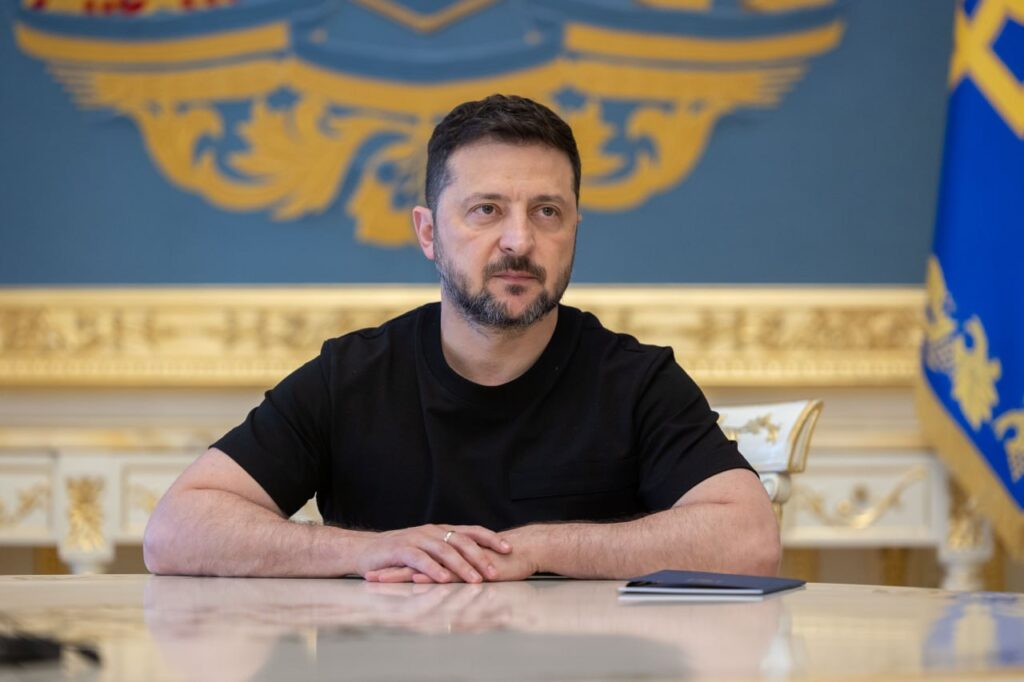
Ukrainian President Volodymyr Zelenskyy, 7 July 2026. Photo: Zelenskyy / Telegram

Ukraine holds only about a tenth of the Patriot interceptor missiles it needs from the United States to stop Russia's surging ballistic strikes, President Volodymyr Zelenskyy told CNN. Selling Kyiv 5% of the current US stockpile would carry the country through winter, he said, and 10% would let it "destroy all the Russians' ballistic missiles" — but he holds 1%.

The plea puts a number on a shortage that has run through Ukraine's diplomacy all summer and left its cities increasingly exposed. It is the concrete cost of near-empty interceptor stocks: on 5 August, Russia fired 28 ballistic and anti-ship missiles at Kyiv and Ukraine intercepted none of them, killing 17 people, and four days earlier launched 27 ballistic missiles with only one stopped. July was the deadliest month for Ukrainian civilians since April 2022, according to the UN.

The arithmetic of a losing race

"This year we have two and a half times less interceptors than we had in 2025," Zelenskyy said, while "Russia has two times more ballistic missiles per month than they had before."

The interceptor that most reliably stops those missiles, the US-made Patriot's PAC-3, is scarce worldwide: the war between the United States and Iran drained stocks as American and Gulf forces spent dozens against Iranian missiles and drones, and the shortage has fallen hardest on Ukraine.

The bottleneck is structural, not budgetary. Only five or six countries build interceptors capable of stopping ballistic missiles, the US makes around 600 Patriots a year, and orders are placed years in advance — so money alone cannot close the gap before winter, defense expert Marc DeVore told Euromaidan Press in June.

A home-built Patriot, still uncertain

Zelenskyy said doubts remain over whether US President Donald Trump's apparent offer to let Ukraine manufacture its own Patriot interceptors will materialize. At the NATO summit in Ankara, Trump said he would license Ukraine to build the missiles, then days later said he was unsure; the Patriot makers have since sent officials to Kyiv, without result so far. "I hope that I will get it," Zelenskyy said, calling it "one of the biggest [challenges] I had from the very beginning of this war."

He described daily, largely private deal-making to close the gap: "million phone calls ... I try to exchange something to missiles ... I do some things which I can't even share. It doesn't mean that it's outside of the law. But I can't speak about it."

Putin, the Donbas, and the next war

On the stalled peace process, Zelenskyy said Kyiv had put new proposals to the Trump administration and needed "more involvement of the American side," adding that Vladimir Putin "doesn't want to stop this war now and (there's) not enough pressure on him now." He rejected ceding the rest of the Donbas that Putin seeks, arguing security guarantees matter more: "Why he will not come again ... to occupy us?"

He confirmed a recent call with Vice President JD Vance but declined to say whether Vance had asked Ukraine to halt strikes on a Russian Black Sea oil port that were hurting US firms and threatening a spike in global energy prices, as the Financial Times reported. Zelenskyy also endorsed Western assessments that Putin could widen the war toward a smaller NATO state, likely in the Baltics: "He wants quick victory ... occupy or destroy or control."

❌