Vue normale

A $20,000 “welcome bonus” that was never paid: how a Colombia-registered recruiter sent Peruvians into Russia’s war
10 août 2026 à 14:58

Illustrative photo. The flag of Peru. Photo: Getty Images

On 9 August, Peru's foreign ministry officially reported that 459 Peruvians had been recruited into the Russian army. Of these soldiers, 11 have been killed, 114 are missing, and three have been captured by the Ukrainian army. Another 31 Peruvians were evacuated: three of them chose to stay in Europe, and the rest returned home.

As of 29 April 2026, Russia had drawn in at least 27,000 foreign nationals from more than 130 countries to take part in its war against Ukraine, the International Federation of Human Rights reports. The Peru case is part of Russia's systematic recruitment of foreigners into its military, often through deception. Some men were offered civilian jobs or roles far from the front, only to end up in the thick of the fighting.

Relatives of the recruited men held demonstrations in Peru

On 29 April 2026, relatives of men recruited into the Russian army demonstrated outside Peru's foreign ministry in Lima, urging the authorities to help bring their family members home, according to SwissInfo.
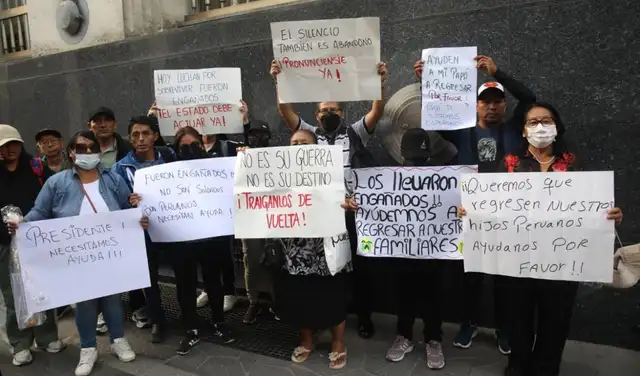
Relatives of Peruvians affected by Russia's war against Ukraine demand urgent repatriation. 2026. Photo: Carlos Félix/LR

On 30 April, the Russian embassy in Peru responded that it agreed some Peruvian men were taking part in the war on Russia's side, but said this was their own voluntary choice. La República, however, reports that before leaving for Russia, the men were made to sign papers in Russian.

On arrival, their documents were taken, after which they underwent brief military training and were ultimately sent to the front. According to media reports, most were former military and police personnel lured by promises of jobs as security guards or civilian specialists, with salaries of $2,600–4,000 a month and bonuses of up to $20,000.

A “rear position” — until it isn’t

First, recruiters promise foreigners high salaries, signing bonuses, and “rear” or civilian positions. Debt traps and threats of deportation are also used. They lure people even through video games and chats. Once in Russia, recruits are forced to sign contracts, after which their documents are confiscated to keep them at the front. The contracts are often written in Russian, a language the foreign recruit does not understand.

Instead of the promised “rear positions,” recruits are thrown into infantry “meat assaults” after just a few days or a week of training. Mercenaries are killed while carrying out missions, while the wounded are often left on the battlefield without evacuation. Some men go missing or flee. Russia treats foreign mercenaries as “expendable labor,” according to leaked recordings cited by Radio Free Europe/Radio Liberty.

This is not an isolated case

Facing losses that now outpace its own mobilization, Russia has turned to citizens of other countries to keep its ranks filled in its war against Ukraine.

Kenya has become one of the largest sources of people recruited through deception. At first, Nairobi believed the number was only a few hundred, but the scale proved much larger. Nairobi thought Russia had recruited around 200 Kenyan citizens, but a new report says the figure is over 1,000. The scheme relied on fake job and education offers, after which recruits had their documents confiscated to keep them on the front line. The European Parliament found that Russia confiscates African recruits' documents and sends them to the front line in Ukraine.

In Cuba, recruiters promised people lucrative jobs, only to lure them into a trap. A Cuban captured near Kupiansk said he joined Russia's war effort under threat of deportation. The scale of the recruitment has been enormous. Ukrainian intelligence estimates that around 20,000 Cuban mercenaries have fought on Russia's side against Ukraine.
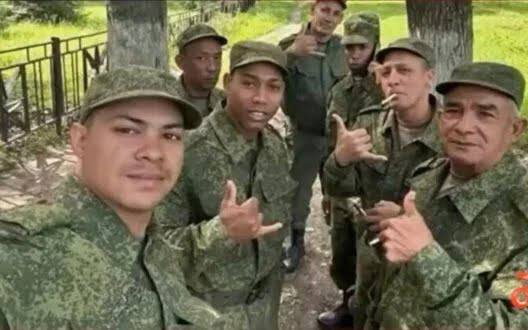
ukrainian intel nearly 20000 cuban mercenaries fighting russia’s side against ukraine nationals wearing russian military uniform 2023 video x/pstyle0ne1 florida lawmakers officials highlighted threat regional security news reports
Cuban nationals wearing Russian military uniforms. 2023. Screenshot from a video, via X/PStyle0ne1

The Philippines case shows what awaits the recruited at the end of this pipeline. Ukrainian military intelligence identified a Filipino named John Patrick among Russian soldiers killed in Donetsk Oblast. He was sent into a "meat assault" after just one week of training. He did not speak Russian and carried only a piece of paper with his unit number and his commander's name. After he was wounded, he was left to die in a tree line without evacuation, and Ukrainian intelligence warned that any work in Russia now carries a real risk of forced deployment into an assault unit. The deception relied on promises of high salaries, non-combat positions in the rear, and fast-tracked Russian citizenship, after which recruits were sent into infantry assaults.
  • ✇Euromaidan Press
  • Ukraine’s cardboard protests look like democracy working. In a war, that’s also the risk.
    On 16 July 2026, protesters took to the squares in Ukrainian cities with cardboard signs bearing the same demand in various forms: to reinstate Ukraine’s Defense Minister Mykhailo Fedorov. The following day, protesters added a new demand: to dismiss Commander-in-Chief of the Armed Forces of Ukraine Oleksandr Syrskyi. A few days later, Zelenskyy met the second demand—but not the first, which the protesters are still waiting on. Since the beginning of the full-scale i
     

Ukraine’s cardboard protests look like democracy working. In a war, that’s also the risk.

10 août 2026 à 13:10

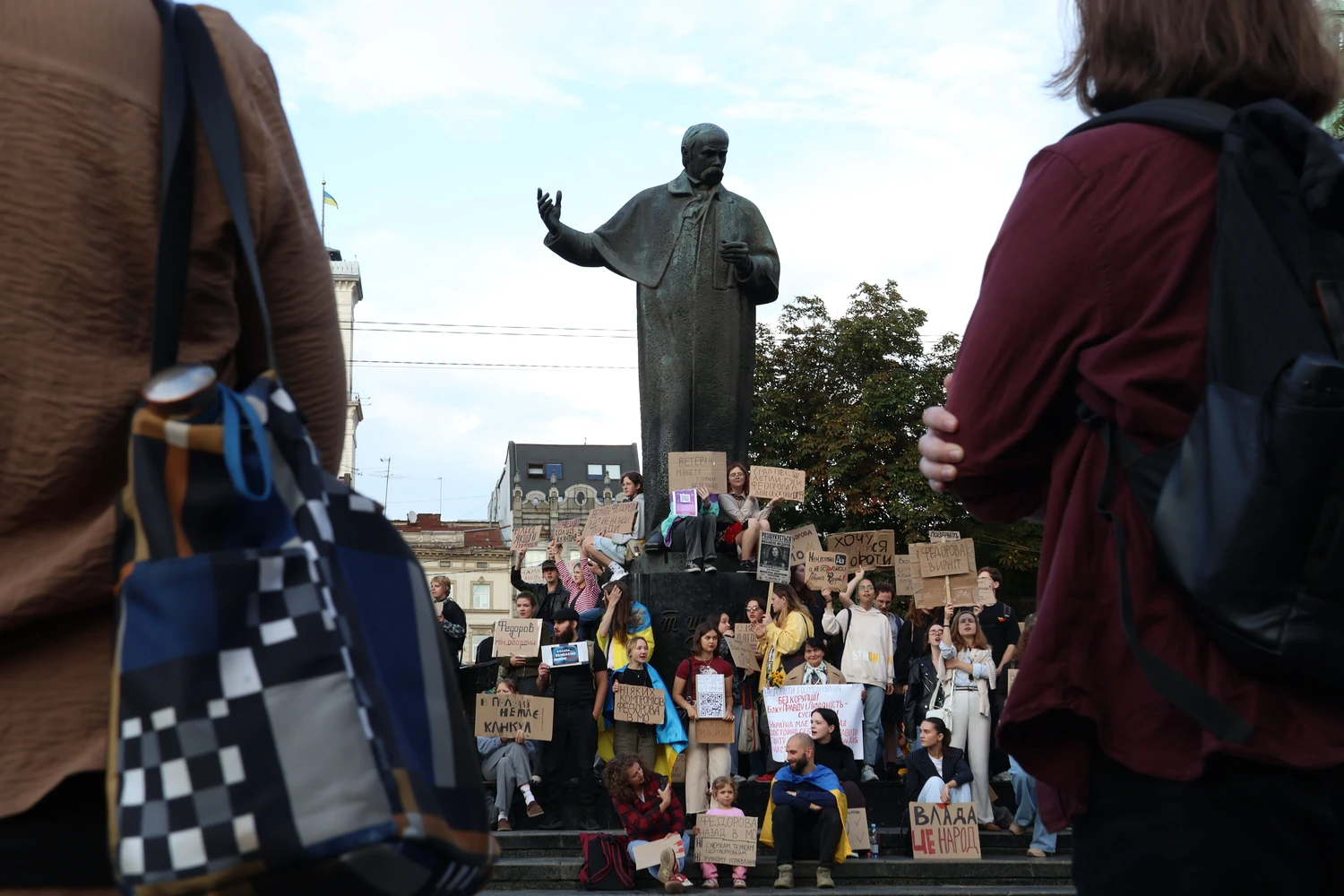
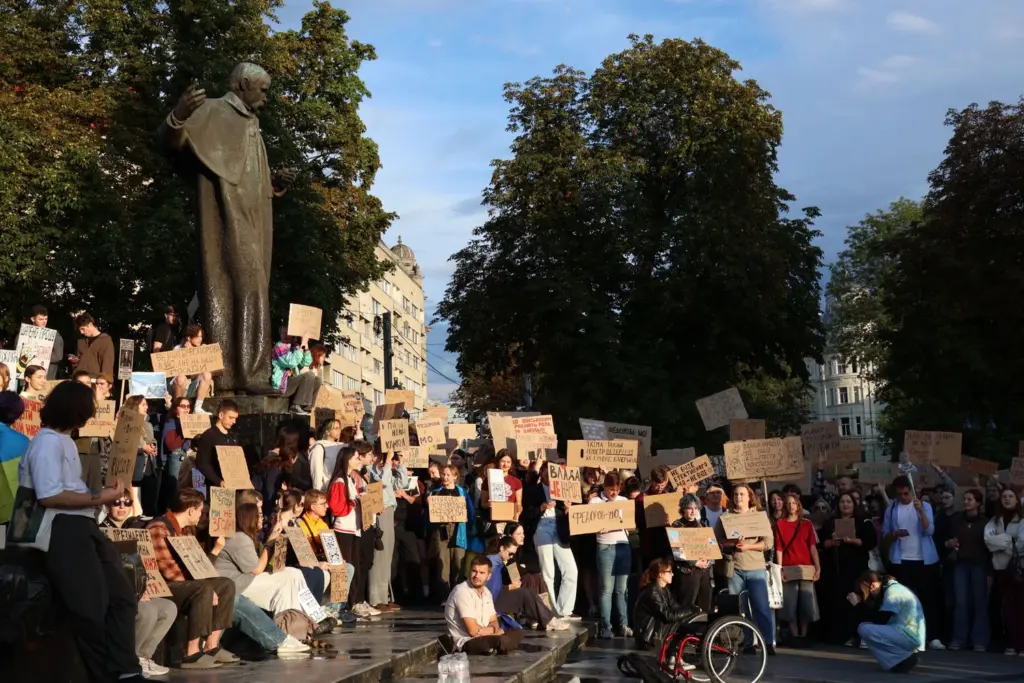
Demonstrators beneath the Taras Shevchenko monument in Lviv hold handwritten cardboard signs during an open-ended protest calling for Mykhailo Fedorov's reinstatement as Ukraine's Minister of Defence. Photo: Solomiia Stanovych/Euromaidan Press.

On 16 July 2026, protesters took to the squares in Ukrainian cities with cardboard signs bearing the same demand in various forms: to reinstate Ukraine’s Defense Minister Mykhailo Fedorov. The following day, protesters added a new demand: to dismiss Commander-in-Chief of the Armed Forces of Ukraine Oleksandr Syrskyi. A few days later, Zelenskyy met the second demand—but not the first, which the protesters are still waiting on.

Since the beginning of the full-scale invasion, Ukraine has been under martial law, which necessarily restricts democracy in order to centralize governance. The country is not holding elections, citizens’ rights are restricted, and the military has become one of the country’s key institutions. Under these circumstances, the President dismissed one of the most important figures in the military at the demand of street protesters.

These centralizing tendencies of wartime rule could lead either to “strengthening democracy” or to “strengthening authoritarianism,” political science professor Anatolii Romaniuk told Euromaidan Press—and this year's protests, he argues, show that society is reaching for more democracy. Ukrainians recognize the cardboard-sign protests as an expression of democracy while also worrying about what such developments mean for a country at war.

What the protests for Fedorov achieved
  • On 14 July, the Verkhovna Rada of Ukraine backed the resignation of Prime Minister Yuliia Svyrydenko and the Cabinet of Ministers;
  • On 15 July, Fedorov confirmed that he was leaving the position of Defense Minister;
  • On 16 July, the first demonstrators gathered on Ivan Franko Square in Kyiv holding handwritten cardboard signs calling for Fedorov’s return. Similar protests soon spread to other Ukrainian cities;
  • On 20 July, Major General Yevhenii Khmara, acting head of the SBU, became acting defense minister—the post the protesters want returned to Fedorov.
  • On 21 July, President Zelenskyy announced that the commander-in-chief would be replaced. The following day, Syrskyi was officially dismissed, with Maj. Gen. Mykhailo Drapatyi appointed as his successor;
  • On 24 July, protesters declared the rallies open-ended until Zelenskyy reinstates Fedorov as Defense Minister.

“The fact that the authorities took the protesters’ demand into account is good,” Romaniuk says. He considers this an important element of political culture.

More than three weeks on, the protests continue—smaller than at their July peak but daily, from Lviv to frontline Dnipro, now under a broader call for "dialogue and reforms" in the defense sector. Fedorov himself has declined to lead them: he told the New York Times he will not go into opposition during the war or be "artificially dragged" into politics, and has turned down every post the president has offered except the one he lost.

We stood, we stand, and we will stand

Not every protester can fully explain every aspect of the issue, but they all recognize a sense of injustice and feel compelled to speak out against it, Ukrainian photojournalist Stas Kozliuk says.

Romaniuk sees these handwritten, highly individual signs as evidence of personal agency.

“This is a form of self-expression—of a person's identity, views, and position. To me, the cardboard sign itself is a powerful marker. Not a professionally printed slogan, because once perfectly designed placards start appearing at protests, it usually means someone has commissioned them,” Romaniuk says.

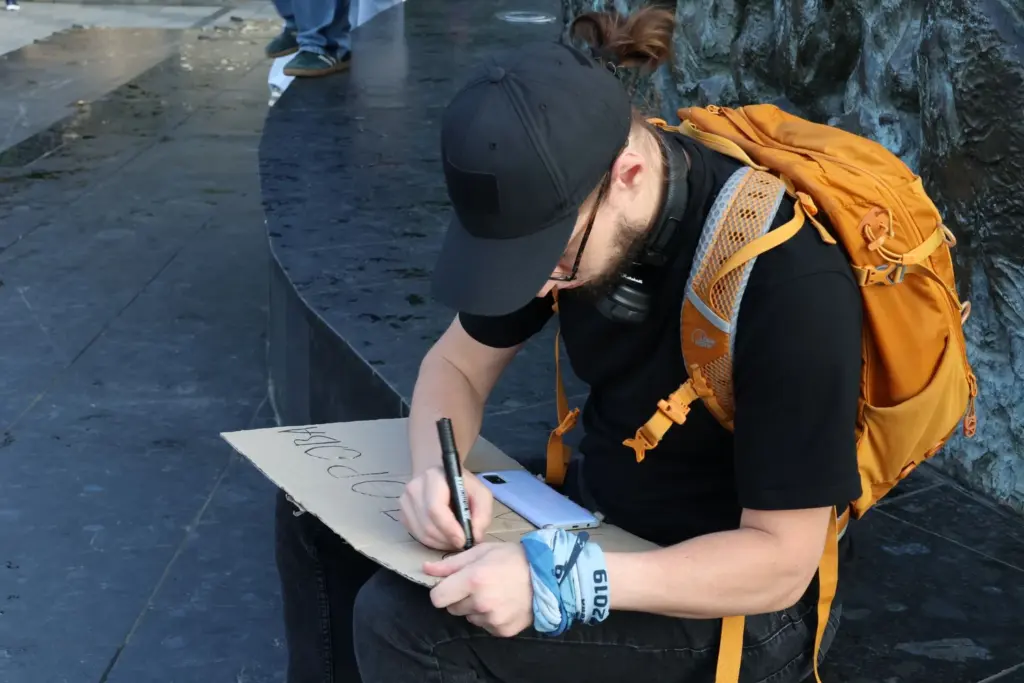
A protester prepares a handwritten cardboard sign before joining the demonstration calling for Mykhailo Fedorov's reinstatement as Minister of Defence. Photo: Euromaidan Press.
A protester prepares a handwritten cardboard sign before joining the demonstration calling for Mykhailo Fedorov's reinstatement as Minister of Defense. Photo: Euromaidan Press.

Do we know who the people holding cardboard signs at the protests are? Probably not. According to Ukrainian analyst Vadym Denysenko, no one really knows who these protesters are. He argues that no comprehensive sociological research has been done on either last year's protests or the current wave.

“Who are these people? Do they have a political program? What is their vision of the future? Ultimately, do they see themselves entering politics? These are basic questions. The answers would cost a few tens of thousands of dollars, yet no political force has been willing to spend that money,” Denysenko wrote on Facebook.

Twenty-two-year-old Dariia, who came to the rally in Lviv on 24 July, believes that the protests will not simply disappear.

“I think people will stay for as long as it takes, until Fedorov is restored to a position where he can genuinely influence the current situation,” she says.

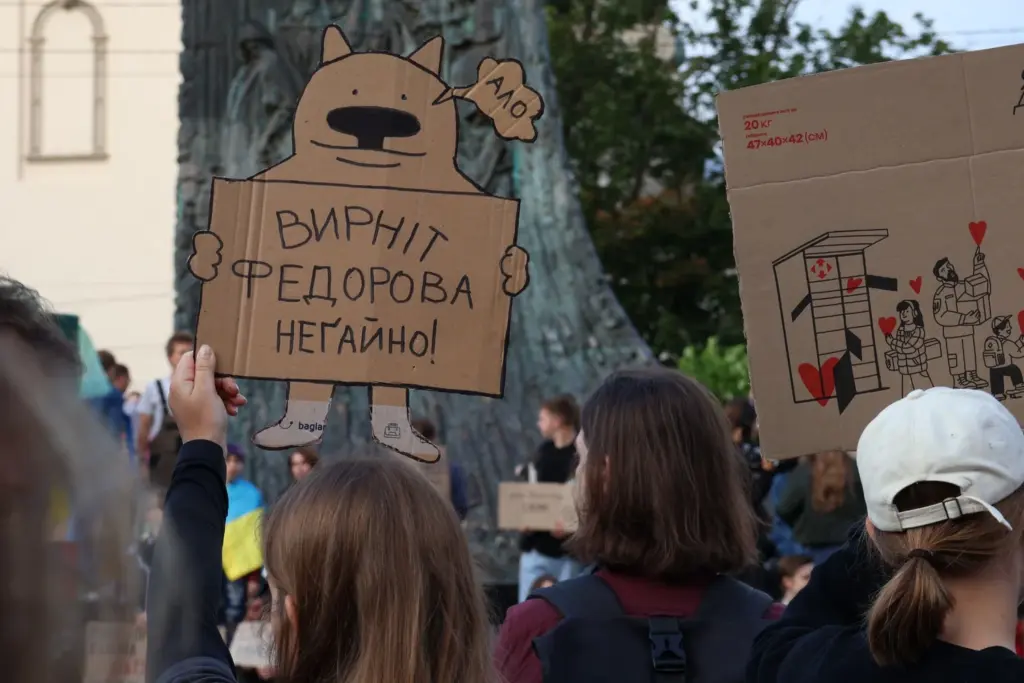
A protester holds a hand-drawn cardboard sign reading “Bring Fedorov back immediately!” during a demonstration in Lviv. Photo: Euromaidan Press.

Among the protesters at the 24 July rally in Lviv was also a woman holding a cardboard sign that read: “Swap the POWs, not Fedorov.” She came there with her husband and child.

“I am originally from Kharkiv. My father is missing, so first of all I was against Syrskyi. Now I am already satisfied. But now we need Fedorov, because he is ‘technology, not people,’” the woman said.

Protesters demand Mykhailo Fedorov is reinstated as defense minister in Lviv. Photo: Solomia Stanovych
Explore further

Ukraine’s Gen Z protested for their anti-corruption agencies last year. Now they’re protesting for one man

Strength and risk at the same time

Russia has sought to exploit the protests for its own purposes. It seizes on the fact that Ukrainians hold different views on the protests, amplifies divisions in public opinion, and presents them as evidence that the country is becoming ungovernable.

Writing for Ukrainska Pravda, media expert Oksana Moroz argues that the Kremlin has attempted to weaponize public discontent through coordinated information campaigns.

According to Moroz, Russia relied not only on artificially generated TikTok videos spreading narratives harmful to Ukrainian society but also on Telegram. There, she says, “a classic network of Russian or pro-Russian bloggers” circulated posts aimed, among other things, at discrediting the demonstrations. These bloggers promoted claims that the protests were orchestrated and that participants were being paid to attend.

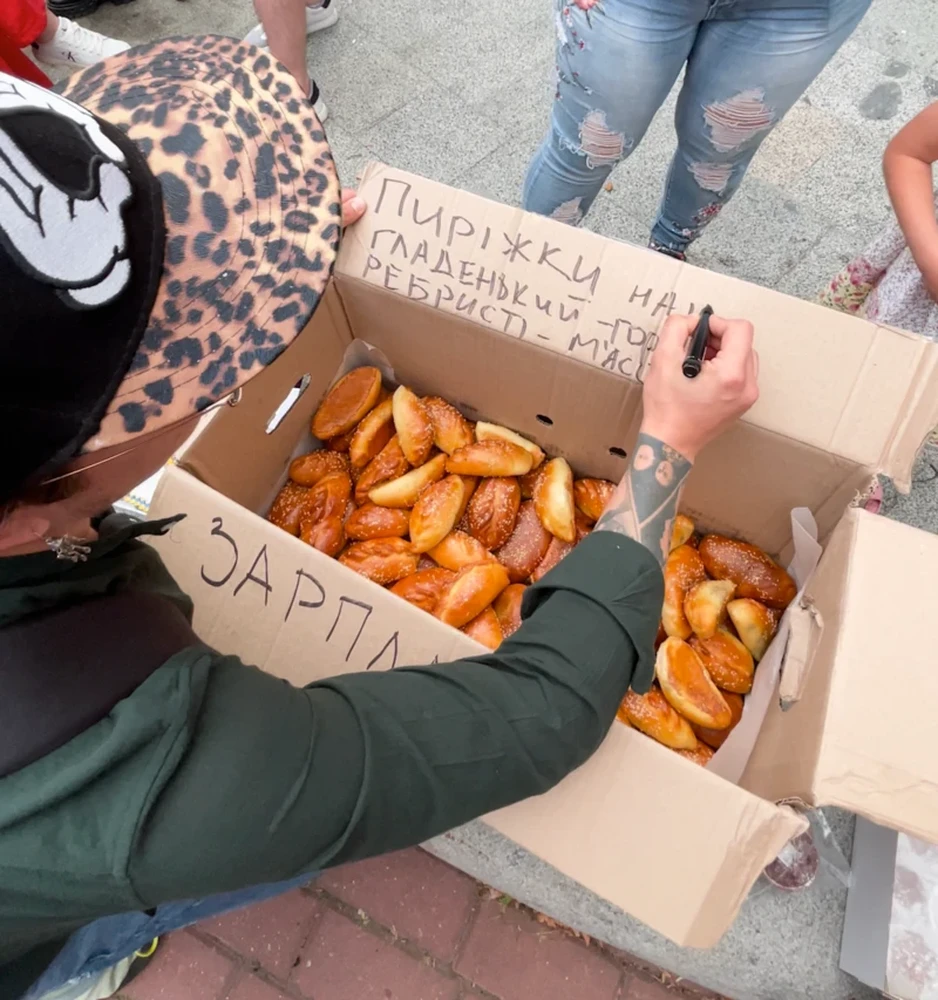
Some demonstrators have responded to those accusations with humor. Protesters voluntarily bring candy, cookies, pastries, and other snacks to share with anyone attending, joking that this is the “salary” they supposedly receive for protesting.

Caption: A box of pastries brought to the protest by participants so anyone could grab a symbolic snack. The word “Salary” is apparently written on the side of the box. Photo: Sofiia Sereda / BBC.

Military Ombudsperson Olha Reshetylova argues that “a sense of injustice in society cannot be bought, fabricated, or created overnight through a social media post. It is the result of accumulated and unresolved problems.”

Where the line has to be drawn

Opinions within the military are divided. Some servicemembers have openly supported the protests despite pressure from their commanders. Others believe demonstrations of this kind are inappropriate and harmful under wartime conditions, says Reshetylova.

“Many people around me today — including combat officers — see the cardboard-sign protests as infantile, detached from reality, and unacceptable while the country is fighting a war. Although I disagree with some of the protesters' demands, I do not share that view,” she says.

Personnel changes in the military should be made in consultation with the officers responsible for the country’s defense, says MP and member of the Verkhovna Rada Committee on National Security, Defense, and Intelligence Oleksandr Fedienko. He emphasizes that this reduces the risk of weakening the country’s defense capabilities due to inappropriate personnel changes.

Despite his positive view of the protests, Romaniuk warns that such pressure is dangerous in a country at war.

“During wartime, changing the military because of protests rather than professional assessments carries obvious risks. In this case, things ended well. But as a mechanism, it is dangerous. Someone could organize demonstrations demanding the dismissal of any official. That is where the line has to be drawn.”

Dariia, back at the Lviv rally, voiced her own doubt about whether President Zelenskyy would meet the demand:

“The pessimistic question arises: are they feeding us these little crumbs so that we calm down and forget about it? Many older people, for example, my parents, think that they will feed us a crumb of honey now, and then start stealing the budget again.”


❌