Vue normale

Under roadblocks and metal detectors, Moscow buries a general likely killed in the Bucha commander’s party bombing
7 août 2026 à 11:30

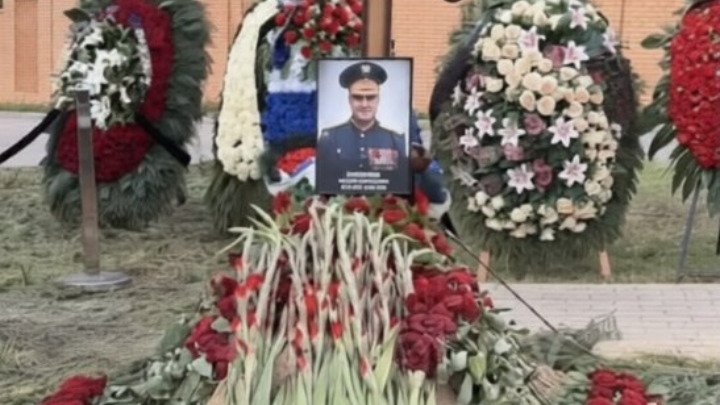
Portrait of Major General Valery Plokhotnyuk surrounded by red flowers and funeral wreaths at his burial site.

Major General Valery Plokhotnyuk was buried in Moscow on 5 August 2026, four days after he reportedly died in a bombing at an Italian restaurant. Security was heavy at the funeral. The ceremony at Troyekurovskoye Cemetery reportedly took place behind roadblocks, metal detectors, and buses carrying Russian National Guard troops.

If he died in the blast, Plokhotnyuk would be at least the fourth senior Russian general killed near Moscow since December 2024. The earlier targets held senior roles in Russia’s war against Ukraine. Moscow has blamed Kyiv for others without presenting public proof. Unlike the three earlier generals, however, independent reporting has not established that Plokhotnyuk himself was the intended target. Responsibility for several of the killings remains disputed or unconfirmed.

The Russian news site Mediazona verified through state registries that Plokhotnyuk died on 1 August 2026, the day of the Moscow bombing. His business partner later confirmed the death after speaking with the general’s father.

Russian officials have not confirmed that Plokhotnyuk died in the blast.

Plokhotnyuk previously commanded Russian troops in Transnistria, a Russian-backed breakaway strip of Moldova. In 2022, he was serving as chief of staff of Russia's 49th Combined Arms Army. Its units attacked southern Ukraine through Kherson and Zaporizhzhia oblasts.

A bomb was brought to the restaurant disguised as a gift

The device that killed Plokhotnyuk exploded at the entrance to Moscow’s Balzi Rossi restaurant on the evening of 1 August. Five people died, and at least 19 suffered injuries.

A woman tried to carry the device inside as a gift but was stopped by a security guard, according to accounts compiled by Sistema, RFE/RL’s Russian investigative unit. The bomb then reportedly detonated remotely.

The woman and the guard both died. Investigators have not said whether she knew that the package contained explosives.

The scene outside Balzi Rossi after the explosion. Source: Baza

Sistema found several signs that the closed restaurant was hosting a belated 55th-birthday celebration for Colonel General Aleksandr Chaiko, appointed head of Russia’s Aerospace Forces in May 2026.

Footage taken before the blast reportedly showed a backdrop reading “Alexander 55.” State registries confirmed that Chaiko’s son-in-law, Daniil Peredriy, died that day. Chaiko’s daughter, Maria, and another relative reportedly suffered injuries.

The presence of several Chaiko relatives indicates that the event was held for him. However, independent reporting has not established whether he was inside when the bomb exploded. Ukraine has not claimed responsibility.

The EU sanctioned Chaiko in March 2026. It identified him as the senior Russian commander on the ground when Russian forces entered Bucha in February 2022. Hundreds of civilians were killed during Russia’s occupation of the Kyiv suburb.

Far from the front, Russia’s generals keep coming under attack

Before Plokhotnyuk’s reported death, bombings had killed at least three senior Russian generals in Moscow and its surrounding region since December 2024.

A bomb hidden in an electric scooter killed chemical warfare commander Igor Kirillov outside his apartment. An SBU source told Reuters that Ukraine organized the operation.

A car bomb later killed General Staff officer Yaroslav Moskalyk near Moscow. Zelenskyy subsequently mentioned an intelligence briefing on the “elimination” of Russian commanders without naming Moskalyk. Kyiv never formally claimed the bombing.

Another vehicle blast killed military planner Fanil Sarvarov in December 2025. Russian investigators considered possible Ukrainian involvement, while Kyiv remained silent.

No public evidence has established who organized the Balzi Rossi bombing.

  • ✇Euromaidan Press
  • Ukraine’s missile, Europe’s sensors—FREYJA enters active development on an early-2027 clock
    Ukraine expects the joint European FREYJA interceptor program to deliver "concrete results" by the turn of 2026–2027, President Volodymyr Zelenskyy said on 6 August. The program "is already actively underway," he added.  Under the program, Ukraine would manufacture the interceptor and launcher, while European partners would provide radars, sensors, and other critical components. Zelenskyy said FREYJA is intended to intercept ballistic missiles and would benefit coun
     

Ukraine’s missile, Europe’s sensors—FREYJA enters active development on an early-2027 clock

7 août 2026 à 10:55

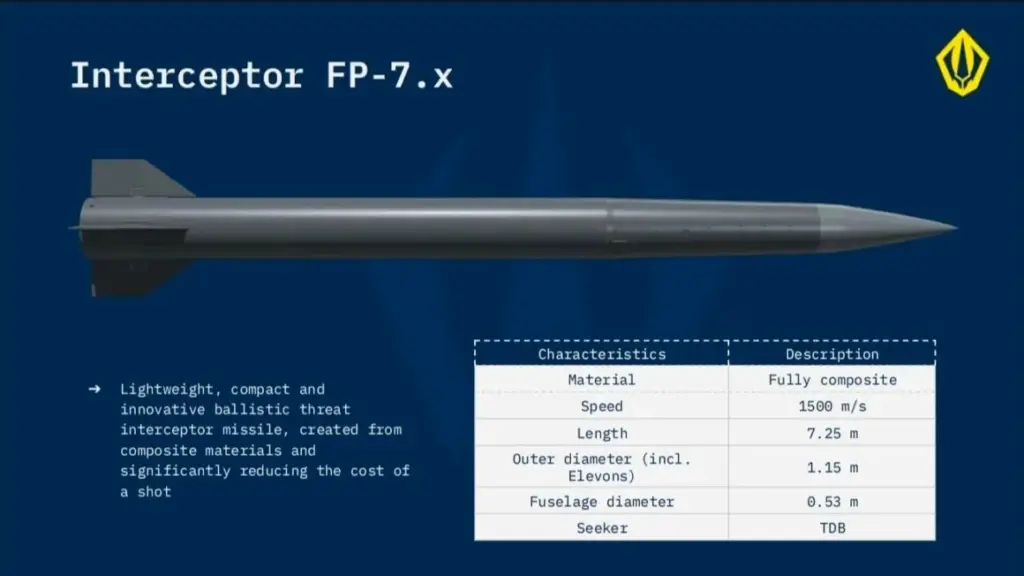
Fire Point concept graphic showing the FP-7.x interceptor missile beside a table of proposed specifications.

Ukraine expects the joint European FREYJA interceptor program to deliver "concrete results" by the turn of 2026–2027, President Volodymyr Zelenskyy said on 6 August. The program "is already actively underway," he added. 

Under the program, Ukraine would manufacture the interceptor and launcher, while European partners would provide radars, sensors, and other critical components.

Zelenskyy said FREYJA is intended to intercept ballistic missiles and would benefit countries across Europe. He said its successful development would place Ukraine among the few countries with an anti-ballistic system of their own.

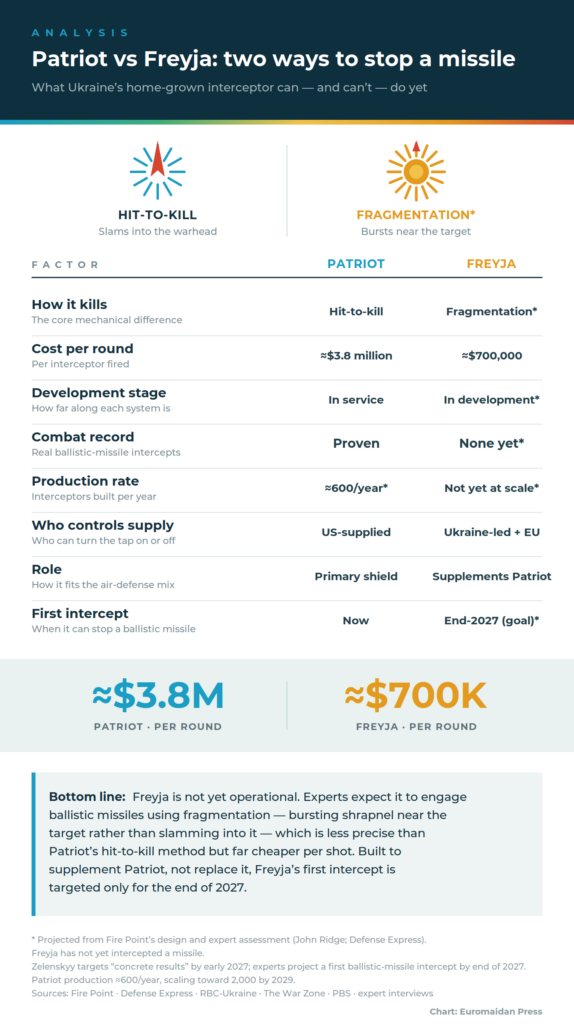
The FREYJA project seeks to address Ukraine's growing shortage of interceptors capable of stopping Russian ballistic missiles. FREYJA will not solve the immediate shortage, but it could reduce Europe's long-term reliance on scarce US-made Patriot interceptors. Recent Russian attacks have shown the consequences of that shortage.

How the FREYJA interceptor would help Ukraine

Ten countries are involved in FREYJA, and Zelenskyy said more partners had agreed to join the effort. Leading European defense companies will contribute the radars, sensors, and other technology the system requires, he said.

This joint venture connects Ukraine's wartime missile production with technologies held by established European manufacturers. Earlier Euromaidan Press reporting described the project as pairing a Ukrainian Fire Point interceptor with European radar, guidance, and sensor technology.

Image: Euromaidan Press

Euromaidan Press noted that each FREYJA round cost about $700,000, compared with roughly $4 million for a PAC-3 interceptor. However, FREYJA is not a one-for-one Patriot equivalent and has not yet demonstrated a ballistic-missile interception. The lower price could matter if Ukraine can manufacture it at scale.

Zelenskyy's timetable concerns "concrete results," not a fully operational or mass-produced system.

Ukraine needs FREYJA amid growing interceptor shortage

The need for FREYJA was on display during Russia's overnight attack on 5 August. Moscow launched 24 ballistic and four anti-ship missiles, and Ukraine reported intercepting none of them. Air defenders neutralized 98 of 115 drones, but missiles and drones still struck 26 locations. 17 people were killed.

July 2026 had already shown the same deterioration. Ukraine only downed two of 36 ballistic missiles in two major attacks, roughly one in eighteen, as Patriot stocks ran low.

Washington offers no quick relief. Trump's July promise of a Patriot production license remains in its early stages, according to the system's manufacturers. Asked about more Patriot interceptors on 6 August, Trump replied that the United States also needed missiles.

The mismatch leaves Ukraine pursuing two tracks: pressing partners for scarce Patriots now while building FREYJA for a less dependent European defense later.

  • ✇Euromaidan Press
  • Bosch is second German brand in one night to lose its Ukraine warehouse to Russian strike
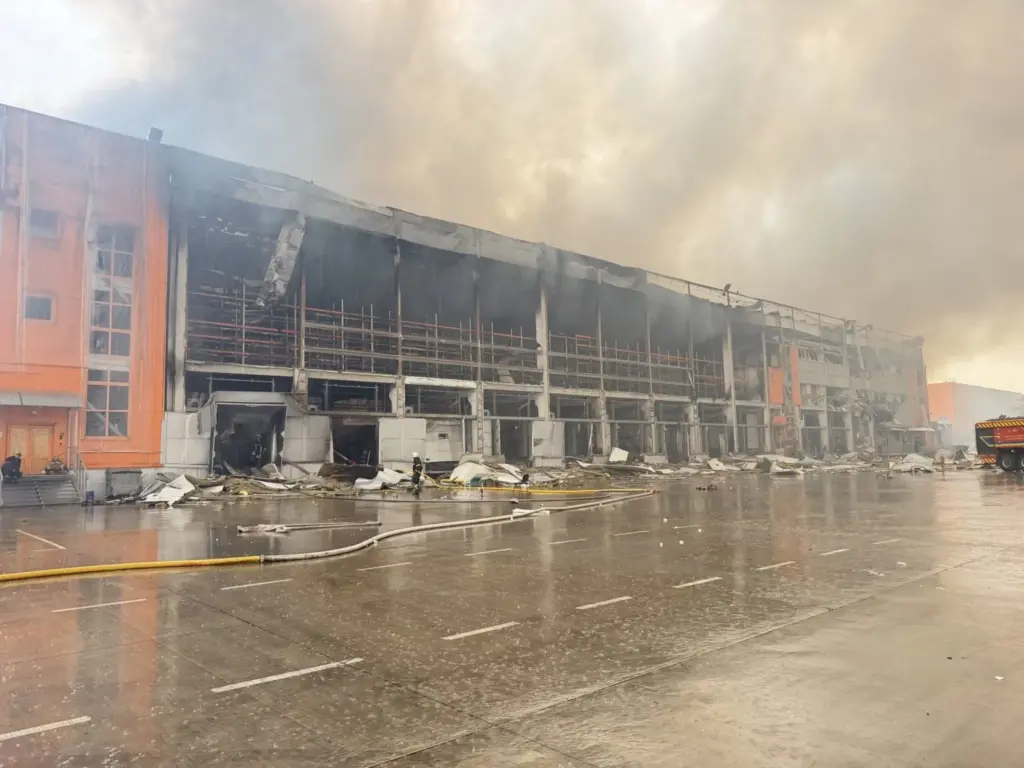
    Russia destroyed a Bosch warehouse in Ukraine overnight into 5 August, the German manufacturer said. The strike wiped out its stock of household goods and industrial technology. No Bosch employee or worker for its logistics partner was injured. The strike was part of Russia's intensified attacks on the warehouses and distribution centers that supply Ukraine. Destroying these facilities eliminates stored goods and disrupts the delivery of food, parcels, equipment, and ot
     

Bosch is second German brand in one night to lose its Ukraine warehouse to Russian strike

7 août 2026 à 07:22

Russia destroyed a Bosch warehouse in Ukraine overnight into 5 August, the German manufacturer said. The strike wiped out its stock of household goods and industrial technology. No Bosch employee or worker for its logistics partner was injured.

The strike was part of Russia's intensified attacks on the warehouses and distribution centers that supply Ukraine. Destroying these facilities eliminates stored goods and disrupts the delivery of food, parcels, equipment, and other essential products. Recent attacks have hit both Ukrainian companies and international brands operating in the country.

Bosch said the warehouse premises belonged to its logistics partner. The company's preliminary assessment found that all Bosch products stored there had been destroyed. It did not disclose the location.

Bosch and its logistics partner are now assessing the damage. They are also seeking ways to maintain operations and meet commitments to customers and business partners.

Russia launches anti-ship missiles on stocks

The Bosch loss came during the same overnight barrage that devastated warehouses and production sites across Kyiv and the surrounding region. Russian strikes destroyed facilities used by Rozetka, Nova Poshta, and Epicentr. The three companies distribute parcels, household goods, and construction supplies across Ukraine.

That attack killed 17 people and wounded 44. Ukraine intercepted none of the 24 ballistic missiles or four anti-ship missiles Russia launched, according to Ukrainian officials.

Ukraine is looking for ways to protect its businesses

The same night, a strike burned down the central Ukraine warehouse of German automotive-products maker Liqui Moly. All employees escaped injury, and the company said it would continue operating.

Russia's overnight barrage burned down the Ukrainian warehouse of a German household brand, Liqui Moly. Source: Liqui Moly

Two nights earlier, a Russian drone attack outside Dnipro set food warehouses ablaze. On 1 August, another Russian drone hit a Rozetka warehouse where 270 people were working, killing one employee.

The campaign comes as Russia launches more missiles than Ukraine can reliably stop. Moscow fired 376 missiles in July, including 126 ballistic weapons, Euromaidan Press previously reported.

Ukrainian presidential adviser Serhii Beskrestnov said Russia had intensified attacks on warehouses and production sites. He warned businesses to disperse their stocks. Russia can sustain about 100 ballistic-missile launches a month and locate commercial targets using cheap local informants, he said.

  • ✇Euromaidan Press
  • Poland’s anti-Ukrainian rhetoric eases online—but hate crime reports climb 
    Radical anti-Ukrainian rhetoric became less prominent across Polish social media in July, according to an analysis published on 3 August by Gremi Personal, a recruitment firm for Ukrainian workers. Gremi Personal researchers monitored public Polish-language posts and comments across Facebook, X, TikTok, YouTube, Instagram, and Wykop, a Polish social news and discussion platform. They recorded less direct ethnic abuse, collective blame, calls to restrict Ukrainians' righ
     

Poland’s anti-Ukrainian rhetoric eases online—but hate crime reports climb 

7 août 2026 à 07:13

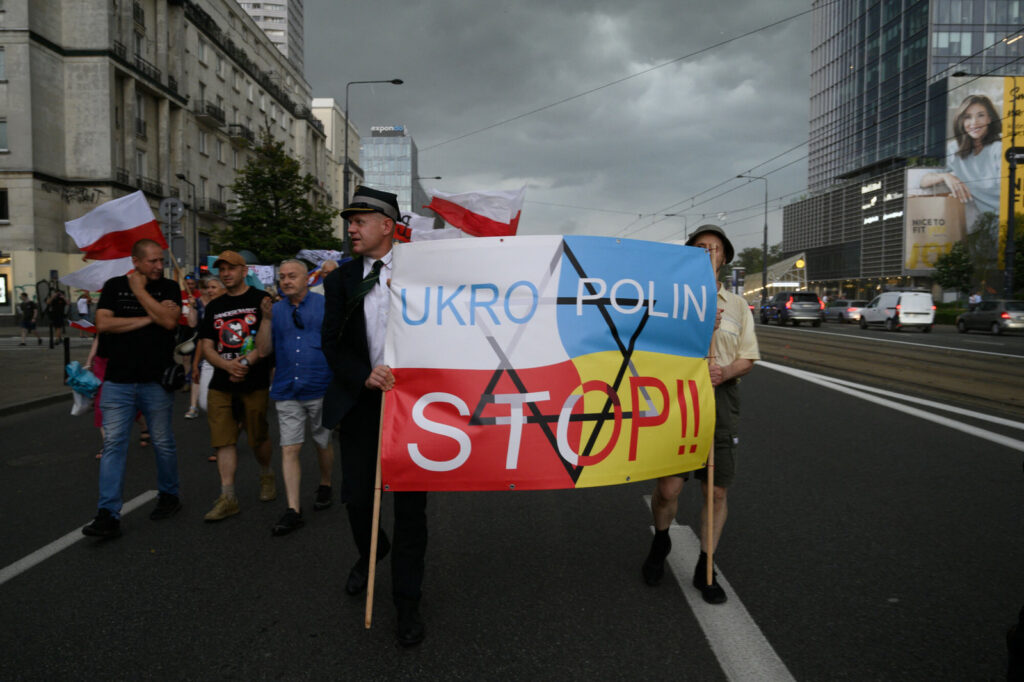
Protesters carrying Polish flags march with an anti-Ukrainian banner reading “UKRO-POLIN STOP!!” in Warsaw.

Radical anti-Ukrainian rhetoric became less prominent across Polish social media in July, according to an analysis published on 3 August by Gremi Personal, a recruitment firm for Ukrainian workers.

Gremi Personal researchers monitored public Polish-language posts and comments across Facebook, X, TikTok, YouTube, Instagram, and Wykop, a Polish social news and discussion platform. They recorded less direct ethnic abuse, collective blame, calls to restrict Ukrainians' rights, and justification of violence than in the previous period.

Polish social media posts condemning xenophobia and attacks on Ukrainians also became more visible.

Still, the result marks a shift in online discourse, not proof that attitudes across Polish society have improved. Gremi said its monitoring was not a representative opinion poll. Negative discussion around Ukrainian migration, welfare, and Polish-Ukrainian historical memory also remained widespread.

Poland's social media may be cooling faster than its streets, but nearly a million Ukrainians still held temporary protection there as of mid-April 2026 amid rising hate crimes and renewed disputes over Ukraine's honoring of the Ukrainian Insurgent Army, blamed by Poland for wartime massacres. Russia exploits the rift with disinformation.

How Polish-Ukrainian relations have worsened

Historical memory has become a sharper political fault line in Polish-Ukrainian relations since President Volodymyr Zelenskyy issued Decree 440/2026 on 26 May. The order gave a Ukrainian special forces unit the honorary title "Heroes of the UPA."

The Ukrainian Insurgent Army is remembered in Ukraine for fighting Soviet rule. Poland holds it responsible for the massacres of Polish civilians during World War II.

Polish President Karol Nawrocki stripped Zelenskyy of Poland's highest honor in June in response to the "Heroes of the UPA" decree. In July, he also sought a legal ban on the UPA's red-and-black flag.

The row followed years of Poland's far right turning Ukrainian refugees and historical grievances into wedge issues, rallying voters against Polish aid to Ukraine.

Hate-crime reports keep climbing

Reports of suspected hate crimes against Ukrainians in Poland have risen since the beginning of 2026. Ukrainians filed 180 reports of suspected hate crimes with Polish police in the first half of 2026, Rzeczpospolita reported. The newspaper cited national police data. The total was more than 30% above the same period in 2025.

These were allegations, not crimes confirmed by investigators or courts. Yet recent attacks show the danger behind the numbers.

In May, 16-year-old Ukrainian refugee Artem suffered a fractured skull in an attack on a Warsaw bridge. Police detained five teenage suspects, while Warsaw's mayor blamed increasingly hostile right-wing rhetoric.

Screenshot from a video of the attack on the Ukrainian couple, Wrocław, 26 July 2026.

On 26 July, three men allegedly beat a young Ukrainian couple in Wrocław after asking whether the woman was Ukrainian. Investigators are treating the assault as a hate crime driven by the victims' nationality.

Days earlier in Poznań, three men beat a 60-year-old Pole after he defended a Ukrainian teenager from abuse on a tram.

❌