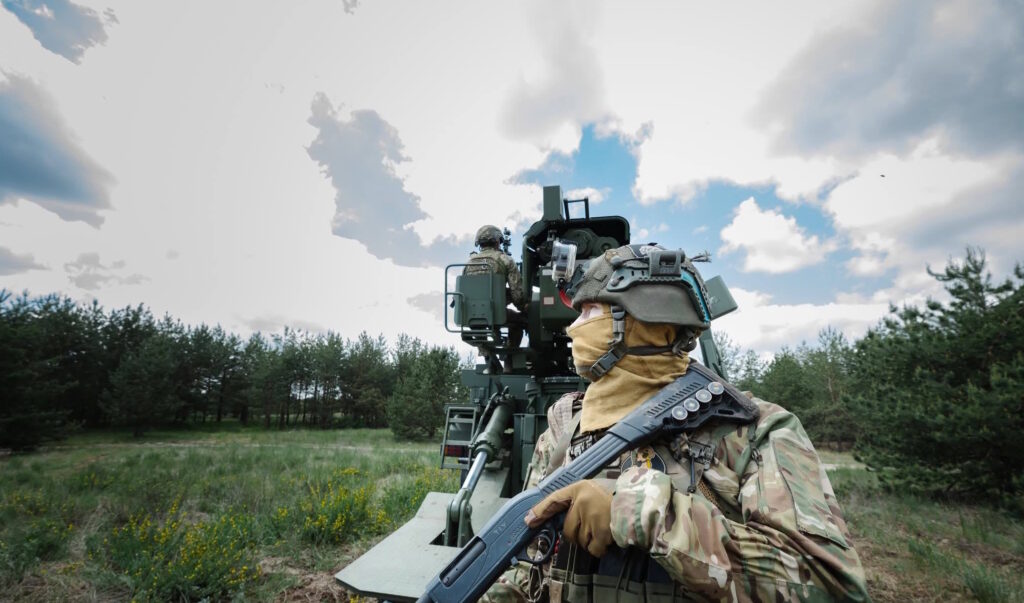
Ukraine is trying to win back the soldiers who walked away by giving them the choice of where to fight. The voluntary return program for service members who went absent without leave is expanding, and those who qualify can now choose from more than 70 units in the Armed Forces, the National Guard, or the State Special Transport Service, the Defense Ministry announces.
The expansion widens a program that answers Ukraine's deepest manpower problem. Soldiers can file a rep
Ukraine is trying to win back the soldiers who walked away by giving them the choice of where to fight. The voluntary return program for service members who went absent without leave is expanding, and those who qualify can now choose from more than 70 units in the Armed Forces, the National Guard, or the State Special Transport Service, the Defense Ministry announces.
The expansion widens a program that answers Ukraine's deepest manpower problem. Soldiers can file a report to return through 20 September 2026, and the simplified program is open to service members whose unauthorized absence, known in Ukraine as SZCh, was recorded on or before 12 June 2026.
The program is a response to a desertion crisis that has grown throughout the war. Some 51,000 Ukrainian soldiers left their units without leave in 2024, more than double the year before, with fatigue cited as a primary cause, bringing the cumulative total to more than 100,000. The root is a service without an end date: soldiers mobilized in 2022 have had no legal pathway home, and exhausted men have left anyway, chaotically, when the state would not release them on a schedule it managed.
What the expanded program offers
The Defense Ministry has widened the list of units to give returning soldiers more say in where and how they serve. The expansion lets them serve in a preferred direction, choose a desired position and commander, and apply their previous experience, the ministry said.
"Drivers, UAV operators, clerks, rifle troops: the army needs everyone," said Deputy Defense Minister Mstyslav Banik.
The list includes mechanized, assault, airborne, drone, artillery, and other units, each requiring soldiers with different experience and specialties, and is viewable on the program's official site and in the Army+ app when filing the report.
The return program is one half of Ukraine's manpower squeeze
The effort to coax back soldiers who left runs alongside a harder push to find and mobilize more, two sides of the same shortage. The return program is part of the reform package the ousted Defense Minister Mykhailo Fedorov launched in June 2026, which also created fixed-term contracts with a guaranteed end date to replace open-ended service.
The army's new leadership is working on the same problem from the other end. Commander-in-Chief Mykhailo Drapatyi has launched a force-wide manning audit to identify soldiers who have been kept away from the front lines, and investigators have swept through recruitment offices nationwide. The return program's logic is the gentler side of that drive: rather than only hunting for manpower through mobilization, the state is trying to make it easy and dignified for the soldiers it has already trained to return on their own terms.
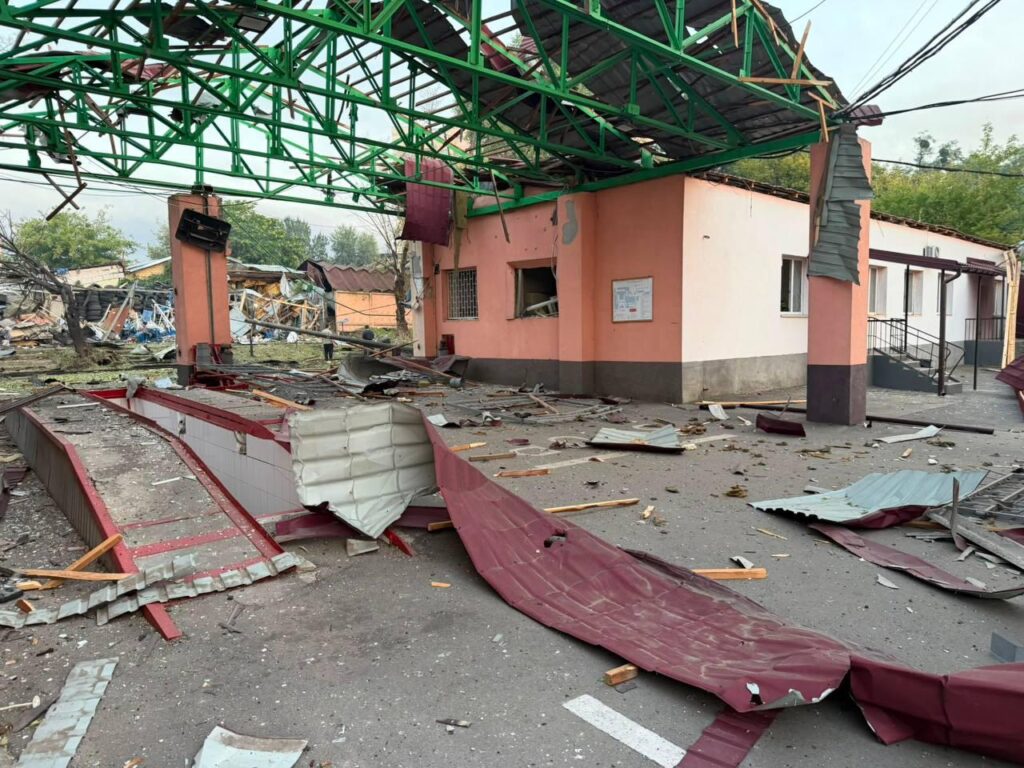
On 1 August, Russia burned the vehicles that rushed to Ukrainian civilians after its terrorist attacks. Russian forces hit the territory of Kyivmedspetstrans twice during their massive strike on Kyiv, and while the workers fortunately escaped injury, five ambulances burned down completely, the Kyiv City State Administration reported.
The strike crippled part of the fleet that responds to exactly these attacks. The double strike on the ambulance depot was part of a combi
On 1 August, Russia burned the vehicles that rushed to Ukrainian civilians after its terrorist attacks. Russian forces hit the territory of Kyivmedspetstrans twice during their massive strike on Kyiv, and while the workers fortunately escaped injury, five ambulances burned down completely, the Kyiv City State Administration reported.
The strike crippled part of the fleet that responds to exactly these attacks. The double strike on the ambulance depot was part of a combined attack that killed at least nine people across Kyiv.
Kyivmedspetstrans is the municipal organization that operates the capital's ambulances and specialized emergency medical transport. The Russian strike partially destroyed four of its buildings while damaging several more premises.
"Twenty vehicles that served the capital's healthcare facilities sustained significant damage," the Ukrainian authorities said.
The barrage that hit the ambulances
The strike on the medical depot came during one of the heaviest ballistic attacks on the capital of the summer. On the night of 1 August, Russian forces launched a combined strike using 35 missiles and 185 attack drones of various types.
The missile mix was overwhelmingly ballistic. Russia fired 27 Iskander-M ballistic missiles, four Zircon anti-ship missiles, two Kh-59/69 guided aviation missiles, and two Kh-31 anti-radar missiles. Ukraine's air defenses managed to shoot down only one Iskander-M ballistic missile and one Kh-59/69.
Against 27 ballistic missiles, Ukraine intercepted only one because the Patriot is the only system that reliably engages Iskander-M, Zircon, and similar high-speed weapons, and Ukraine has run out of Patriot interceptors.
Striking the ambulances twice fits a documented pattern
Hitting a medical-transport depot twice in one attack is not incidental, and it carries the marks of a tactic Ukraine has documented across the war. A second strike on the same site endangers the emergency crews responding to the first, and destroying ambulances degrades the capacity to save the wounded from the very barrage that created them.
Russia has repeatedly used "double-tap" strikes that hit a target, wait for rescuers and medics to arrive, then strike again, a tactic Ukrainian prosecutors and international monitors have flagged as targeting first responders. Ukraine documented the same method days earlier, when Russia struck a passenger train in Zaporizhzhia Oblast twice.
Russia fired 27 ballistic missiles at Kyiv on 1 August, and Ukraine could stop only one. A massive overnight Russian missile and drone attack on Kyiv killed at least nine people, damaged the Lithuanian embassy, and destroyed part of the city's ambulance fleet, according to Kyiv Mayor Vitali Klitschko.
President of Ukraine Volodymyr Zelenskyy said that Ukraine has run out of interceptors for its Patriot systems. Meanwhile, Russia continues to target Kyiv, Dnipropetro
Russia fired 27 ballistic missiles at Kyiv on 1 August, and Ukraine could stop only one. A massive overnight Russian missile and drone attack on Kyiv killed at least nine people, damaged the Lithuanian embassy, and destroyed part of the city's ambulance fleet, according to Kyiv Mayor Vitali Klitschko.
President of Ukraine Volodymyr Zelenskyy said that Ukraine has run out of interceptors for its Patriot systems. Meanwhile, Russia continues to target Kyiv, Dnipropetrovsk, Sumy, Kharkiv, and Poltava oblasts.
The interceptor shortage is now measured in bodies
During the attack, Ukraine's air defenders could engage the drones and the eight non-ballistic missiles, but against 27 ballistic missiles, the weapons, except for the Patriot, could not reliably stop them; they had almost nothing to fire.
"Every package of ballistic missile interceptors saves the lives of our people. Every night without them results in more casualties," Zelenskyy said.
This is the concrete form of a shortage that has run through Ukraine's diplomacy all summer, the 40% ballistic-interception rate in June now fallen closer to zero as stocks run dry.
The strike came days after Zelenskyy met the makers of the Patriot in Washington, where joint production, in the manufacturers' own words, was still in the "early days," and the missiles Ukraine needs tonight still depend on American stocks that are not arriving fast enough.
The strike hit an embassy, a school, and the ambulances
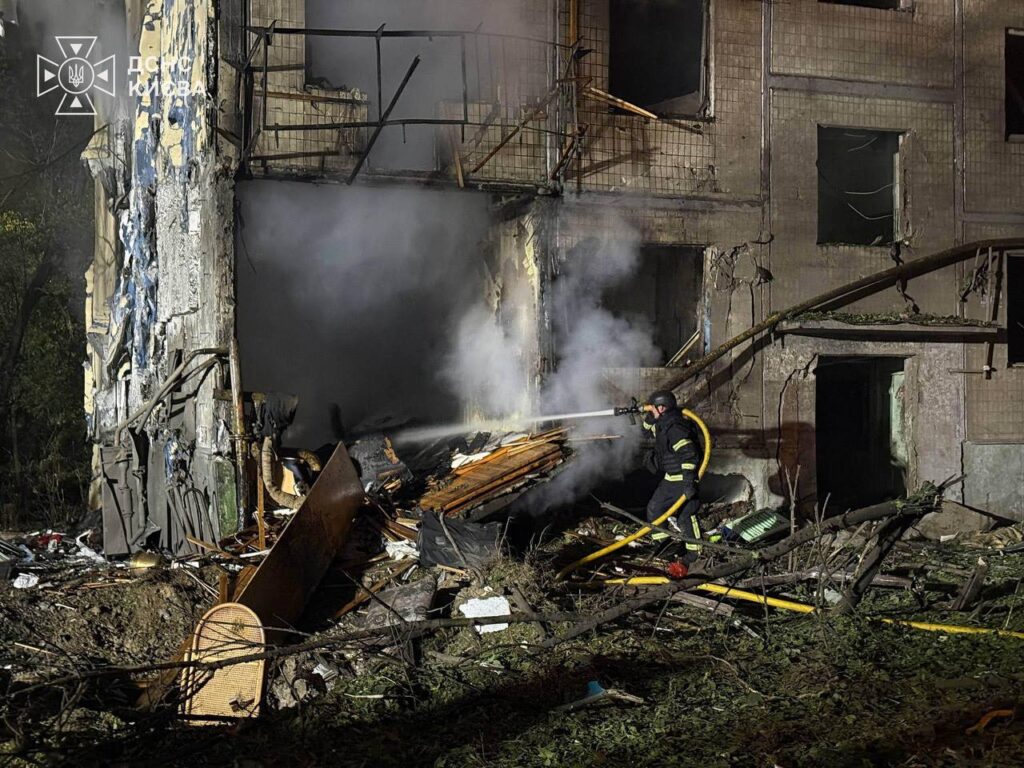
The attack damaged the city's civilian and diplomatic fabric. Russia's attack damaged 18 residential buildings, a school, and critical infrastructure, and the Lithuanian embassy suffered limited damage, though no embassy staff was harmed.
Ukraine's Foreign Minister Andrii Sybiha condemned the embassy strike as a violation of international norms.
"Russian terror spares no one and does not respect any international norms, including the Vienna Convention. It can only be stopped through strength and with sufficient air defense," Sybiha said, thanking Lithuania for standing with Ukraine and offering any help needed.
Russia claimed it hit only military targets
Moscow's account of the night bore no relation to the residential buildings and the dead. Russia's Defense Ministry claimed the strike hit "military-industrial complex facilities and logistics centers" in Kyiv and said nothing about the numerous civilian casualties, per its own statement.
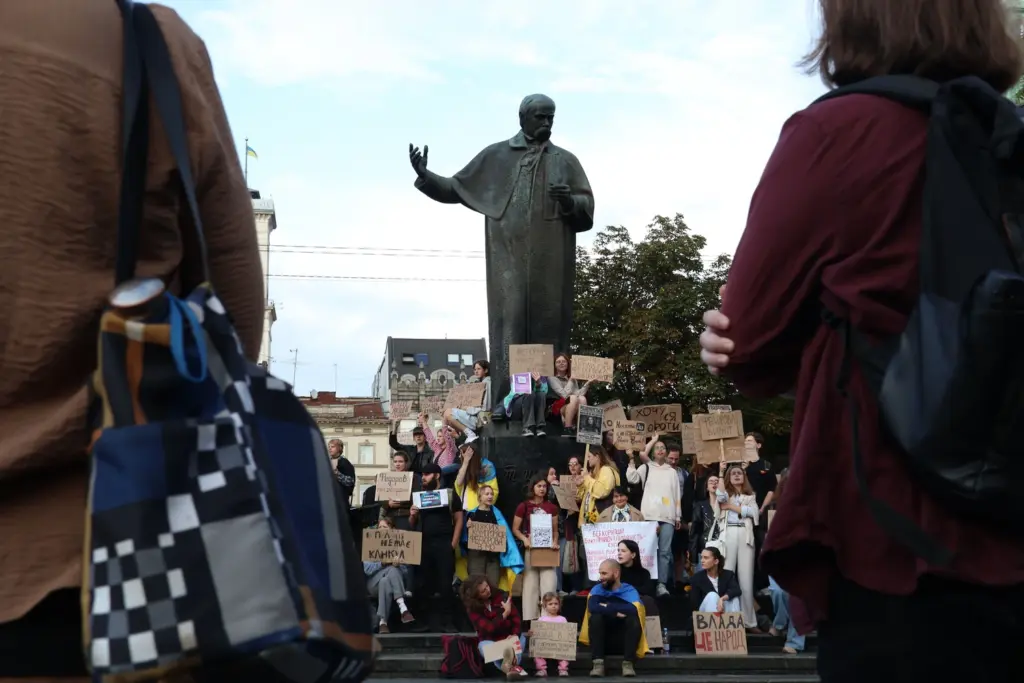
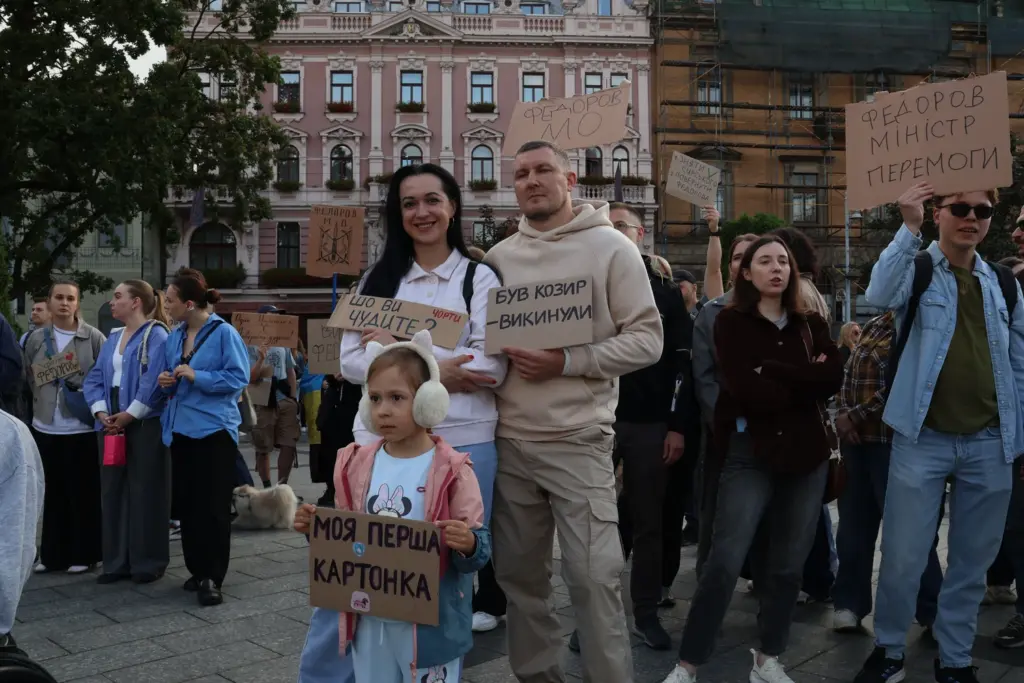
Friday evening, 19:00, they met again. The crowd wasn't uniform: students, pensioners, whole families who'd come with small children, couples. A five-year-old girl in fluffy earmuffs held her own cardboard protest sign. A few soldiers among them. Several hundred people, loose across the steps beneath the Shevchenko monument, the poet's bronze hand open above them.
The mood was quiet, more communion than fury, people just standing together in the fading light. The signs
Friday evening, 19:00, they met again. The crowd wasn't uniform: students, pensioners, whole families who'd come with small children, couples. A five-year-old girl in fluffy earmuffs held her own cardboard protest sign. A few soldiers among them. Several hundred people, loose across the steps beneath the Shevchenko monument, the poet's bronze hand open above them.
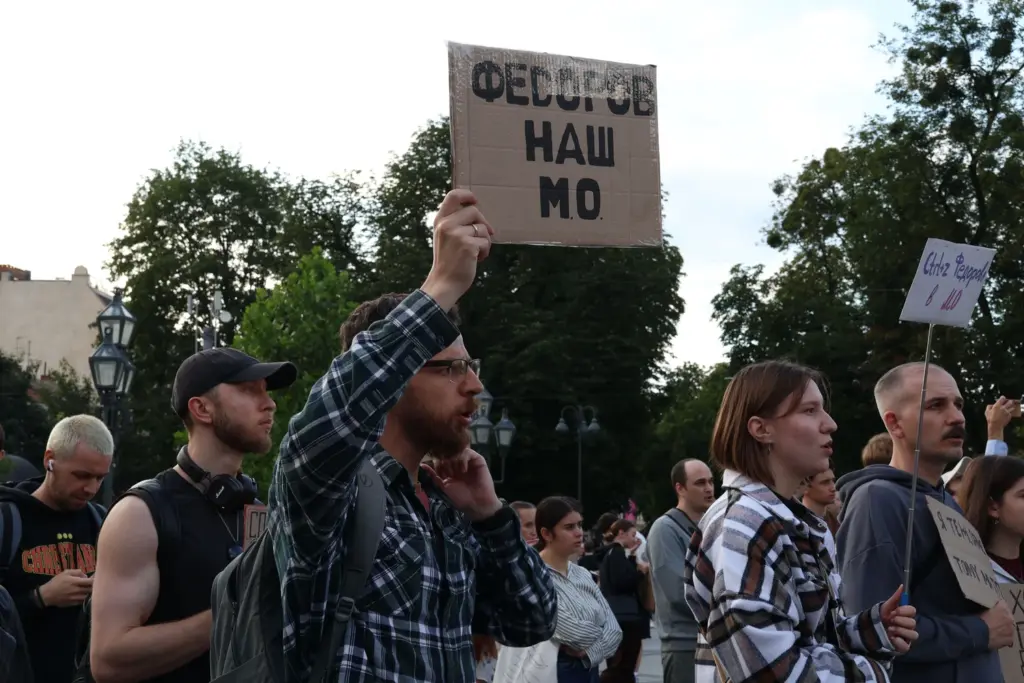
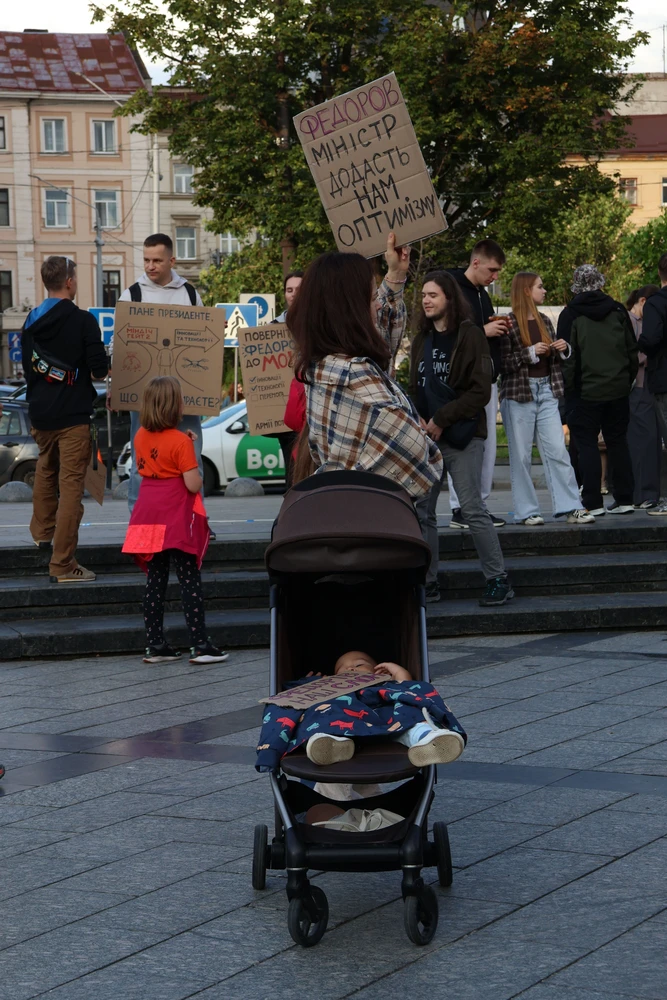
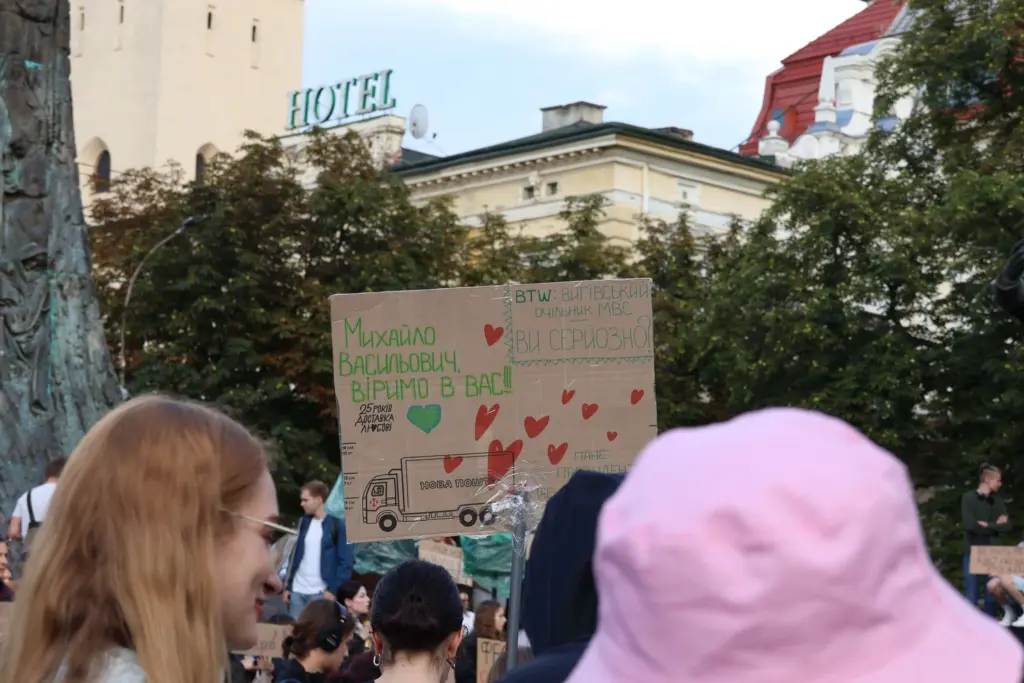
The mood was quiet, more communion than fury, people just standing together in the fading light. The signs were as diverse as the attendees. One sign, in green marker with a row of red hearts, read "Mykhailo Vasyliovych, we believe in you!!!" Another, block letters on brown card: "Fedorov is our Minister of Defense." A third, held high near the scaffolding: "Fedorov, minister of victory." The child's placard read simply: "My first placard."
"Fedorov is our defense minister!" Protesters demand Mykhailo Fedorov is reinstated as defense minister in Lviv. Photo: Solomia Stanovych
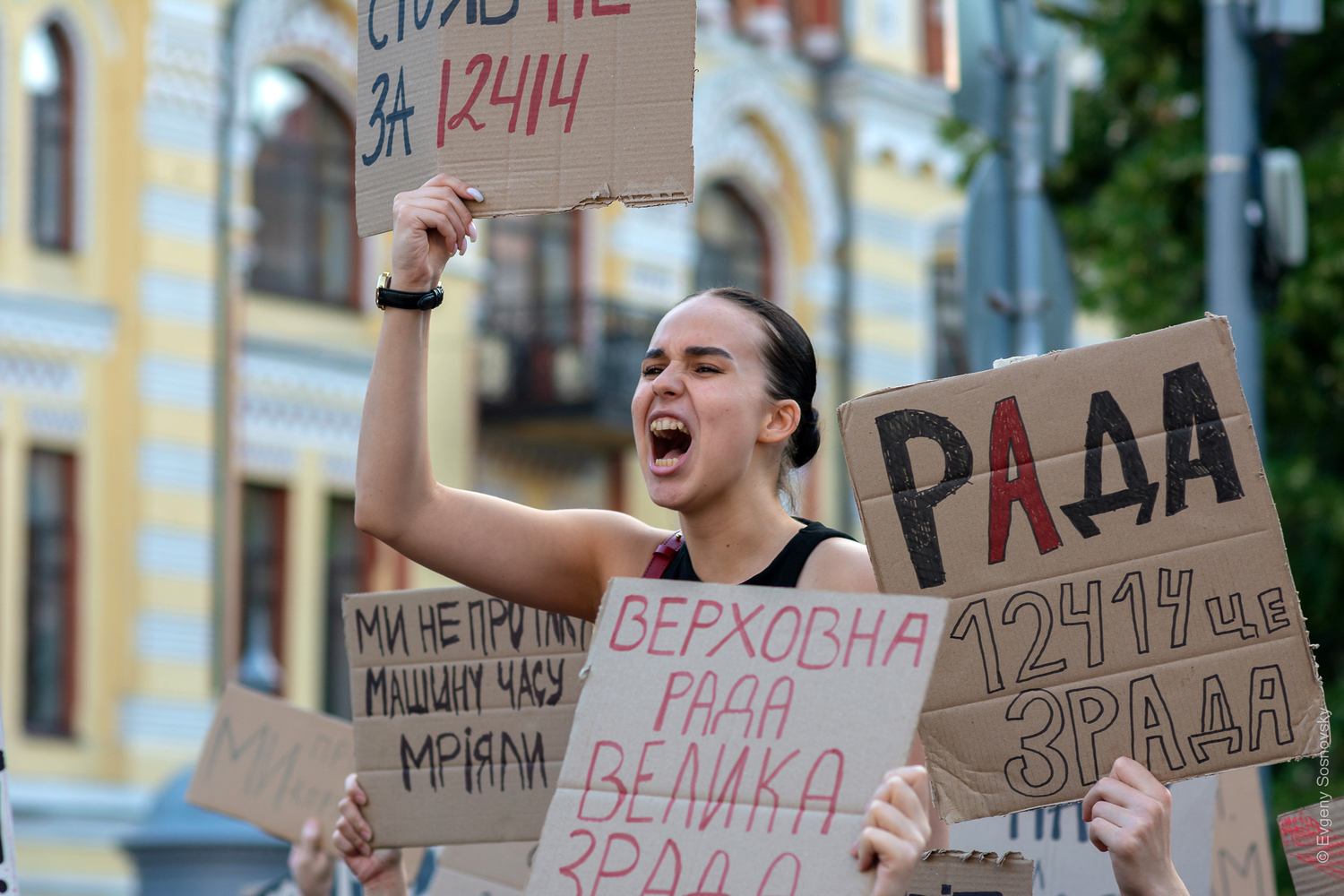
Protests like this have been ongoing in cities across Ukraine since 16 July, amid President Zelenskyy's Cabinet shakeup that had the popular defense minister fired. Participants want Mykhailo Fedorov reinstated and say they will stay until their demand is granted.
Fedorov is not a career soldier: he built Ukraine's Diia digital-state platform and, as digital-transformation minister, drove the drone-procurement push that turned cheap unmanned systems into the country's most-used weapon against Russia's invasion. To the people on the square he is the man who stands for winning the war with technology rather than with bodies—and his removal, after barely six months at the ministry, landed as that bet being called off.
A year ago the same kind of crowd defended institutions: the anti-corruption bureau and prosecutor's office, when the government moved to strip their independence. This time the placards carry one man's surname. The instrument is the same; what it is pointed at has narrowed from a rule to a person.
That 2025 anti-corruption protest
They came. They cussed. They won.
What a passerby would not have guessed is that no one on the square could say who had called it. The rally assembles by loudspeaker and group chat—a woman with a megaphone naming the next time to gather, a Telegram channel filling in the rest.
Kyiv-based Zinaida Averina, who helped launch last year's anti-corruption protests, says this wave has no single leader or even a single group of organizers: each local initiative, she wrote, plugs in and syncs "small pieces" into one shared wave. In the middle of a full-scale war, in roughly twenty cities, Ukrainians are holding open-ended nightly rallies that no party organized and no leader directs.
The demand, and the reason behind it
"Fedorov the minister will give us optimism" says the sign of this protester amid a Lviv crowd demanding Mykhailo Fedorov is reinstated as defense minister. Photo: Solomia Stanovych
Protesters in Lviv began the open-ended rallies on 24 July. "The main demand is the appointment of Fedorov as minister of defense," said Dmytro, 24, who described the dismissal as a violation of a social contract. "This has become a systemic problem when the entire Cabinet of Ministers is dismissed without any explanation given to us."
The crowds made two demands: remove Oleksandr Syrskyi as commander-in-chief, and bring Fedorov back. The first was met within days—Syrskyi was dismissed and replaced by the more popular Mykhailo Drapatyi. The second was refused.
Iryna, 23, said she felt a violation of reciprocity between citizen and state. "Through documentation, taxes, and declarations, we are always accountable to the state, but the state is not as accountable to us as it should be," she said. She had chosen to stay in Ukraine when she could have left abroad as a refugee, she said, and wanted transparency in how personnel decisions are made.
What almost no Gen-Z on the square could say precisely was what, exactly, was being done wrong—only that something was. It is the same barometer that worked a year ago: most of the anti-corruption protesters could not have explained what the bureau adjudicates, but they knew corruption was being shielded, and they acted the only way they knew.
Explore further
“They removed the auditor, not the thieves”: why Ukrainians are protesting Zelenskyy’s reshuffle
Blogger-driven outrage and media bombshells
"My first cardboard" says the sign of the girl. "Fedorov is the minister of victory" says another. Protesters demand Mykhailo Fedorov is reinstated as defense minister in Lviv. Photo: Solomia Stanovych
In many countries, the media struggle to get Gen Zs interested in politics. In Ukraine, bloggers fill that niche. Media activist and volunteer Serhii Sternenko has spent the protest days explaining the firing to a Gen-Z audience—one stream making the case against Syrskyi drew more than 842,000 views.
What they sense, and what Sternenko names for them, is an old-army culture—"sovok," in the protest's own shorthand—of loyalty over competence and lives spent cheaply, against the newer Ukraine Fedorov stood for. Fedorov, in this telling, was pushed out for trying to change it.
The sensing rests on something real. In late June the outlet Babel published a two-month investigation into the 425th "Skelia" assault regiment, reporting at least 25 non-combat deaths of recruits in training over roughly six months—a toll that has since risen past 30 as more families came forward—with accounts of beatings and torture and official causes recorded as illness. State investigators, police, the military prosecutor and the ombudsman have opened proceedings, and the regiment's commander has been suspended. Syrskyi has called it a shameful situation and blamed individual offenders. Sternenko calls it a systemic pattern—a characterization the investigations have not established.
Why the protests went open-ended
The escalation on 24 July followed the president's decision not to nominate Fedorov. "As long as necessary, we will keep coming out until the government hears us," said Yevheniia Kupriienko, 23.
Andrii, 23, rated the government's transparency at one out of ten and said protesters want parliament to act as an independent institution rather than a rubber stamp: "decisions cannot be made by one person in the country without any commentary or communication with the people."
The man at the center of it describes something more tangled than the chant. In an interview on 29 July, Fedorov said the main reason for his removal was not the clash with Syrskyi at all. Reshaping defense procurement and tenders, he said, "stepped on the interests of many people and companies," after which pressure on his team built through the spring. He called the government's collapse a possible "screen" for his dismissal, and said he never fought for the post and would have gone quietly had someone simply explained why.
Explore further
The Syrskyi feud was not it: why Ukraine really dropped its drone-war minister
Even the adulation makes him uneasy. His wife, Anastasia, called the frenzy around him a "sick cult of personality." The crowd chanted his name at a Kyiv music festival anyway, his face on the big screen. The man the movement is built around, and the person closest to him, are both declining the icon it has made of him.
Andrii said he had come to stand up for the voices of Ukraine's soldiers. One serviceman passing by did not recognize himself in that description. "I know neither Drapatyi nor Fedorov. I can talk about my company commander or battalion commander," he said. He questioned how civilians, and young women in particular, could judge how senior officials are appointed, and said of the leadership: "They have big brains, they know what they are doing."
His doubt is not only his. It is the worry named this week by the philosopher Volodymyr Yermolenko, president of PEN Ukraine: that the tech dream the protesters chant for is real but incomplete, and that there is no alternative to massive military mobilization. "Without technology we won't win the war, but with technology alone we won't win it either. We still need people," he said. A street that senses correctly that something is wrong, in his account, is a reliable alarm—not a mechanism for choosing who runs the war.
Yet other soldiers support the protests. Veteran Dmytro Koziatynskyi, one of the Kyiv protest initiators, sparked a march "for dialogue in reform" held on vul. Khreshchatyk on 31 July. He demands Zelenskyy give Fedorov a year to conduct reforms and then "make decisions based on results."
The predictable counter-narratives have arrived too: claims that the rallies are paid, which Fedorov himself has rejected. Ukraine's disinformation center has also flagged Russian attempts to exploit the moment abroad. None of it touches the crowds on Ukraine's own squares.
Is this Euromaidan?
"Mykhailo Vasyliovych, we believe in you!" Protesters demand Mykhailo Fedorov is reinstated as defense minister in Lviv. Photo: Solomia Stanovych
The comparison to the Euromaidan Revolution, in which the Russian-aligned president Yanukovych fled in the winter of 2014 after three months of protests against a rejected EU Association agreement, comes up constantly, and the protesters do not agree on it. One participant argued the mechanism is the same even if the scale is not: "No matter who the president is, if he doesn't listen, that was Yanukovych's mistake."
The serviceman rejected the comparison entirely. In 2013 the choice was between the European Union and Russia, and Russia's response to that choice produced the war Ukraine is now fighting. The present situation—a fired minister—is a different matter entirely, he said.
Halyna, 88, who watched the Euromaidan Revolution from Lviv while her son was in Kyiv, said the two are not comparable in intensity. "In 2013, the Euromaidan was such that I can't even describe it to you," she said. "Well, now the protests are not like that. People are just relaxing."
She supports them anyway. People are tired of lies and tired of a war Russia forced on them, she said, and the worst of it is that young people are dying with no end in sight. She wants to live long enough to see Ukraine at peace and left alone. Whether the rallies continue, she did not know. "I think the clock is ticking."
Explore further
Ukraine’s defense minister explained how the country buys weapons—after he was sacked

 Connexion