District court judge Timothy Kelly was ruling after Trump administration blocked access to three outlets last monthA federal judge ordered the White House on Tuesday to continue allowing journalists from CNN, MS Now and Politico to access the building as the media coalition’s lawsuit against the Trump administration plays out.Timothy Kelly, a district court judge, had on 24 September granted a 14-day reprieve for the news organizations, which six days earlier had been banned by the president in
District court judge Timothy Kelly was ruling after Trump administration blocked access to three outlets last month
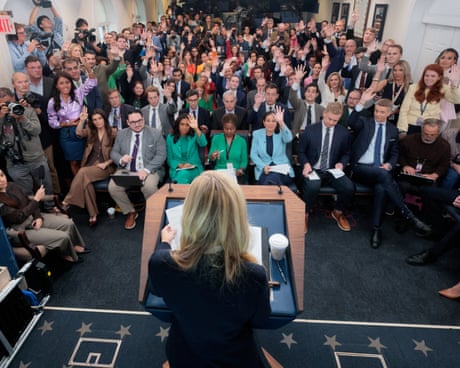
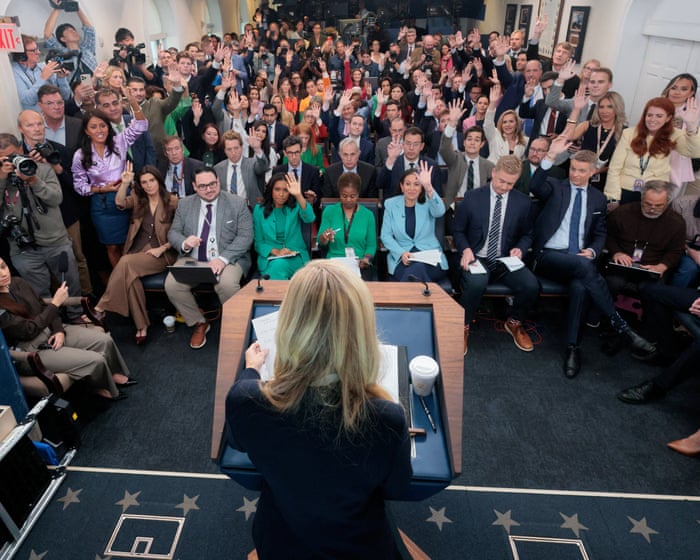
A federal judge ordered the White House on Tuesday to continue allowing journalists from CNN, MS Now and Politico to access the building as the media coalition’s lawsuit against the Trump administration plays out.
Timothy Kelly, a district court judge, had on 24 September granted a 14-day reprieve for the news organizations, which six days earlier had been banned by the president in an extraordinary move from entering the White House grounds “as a result of their constant ‘reporting’ FAKE NEWS”.
On 19 November 2025, Indian police raided the ‘Kashmir Times’ in Jammu. They said they were on an “anti-terror” operation. The offices had been shut since 2022 and were in dilapidated condition, the equipment largely defunct. Yet, the police claimed to have recovered a “pistol and live AK-47 cartridges.”
Since 2018, only five journalists have faced cases under India’s draconian anti-terror Unlawful Activities (Prevention) Act. Trials rarely start, leaving journalists in a state of perpetua
On 19 November 2025, Indian police raided the ‘Kashmir Times’ in Jammu. They said they were on an “anti-terror” operation. The offices had been shut since 2022 and were in dilapidated condition, the equipment largely defunct. Yet, the police claimed to have recovered a “pistol and live AK-47 cartridges.”
Since 2018, only five journalists have faced cases under India’s draconian anti-terror Unlawful Activities (Prevention) Act. Trials rarely start, leaving journalists in a state of perpetual purgatory, even if they are out on bail under onerous conditions.
Before the police came charging into these unused offices last year, the ‘Kashmir Times’, founded by my father in 1954, had long suffered sustained persecution – the seizure of records, of equipment, the harassment of staffers, the use of social media to spread slurs, trumped up charges of tax evasion and the embedding of spies.
The first ever copies of Kashmir Times, initially a weekly, were seized by the government. In 1983, my father survived a murderous assault with serious injuries inflicted by a Hindu nationalist mob. I joined the newspaper in 1989, as the armed militancy, the ‘insurgency’ against the Indian state, became widespread, and experienced firsthand the struggle to report the news accurately and truthfully. The government would frequently withdraw its advertising, which was the main source of funding for most news outlets. We were besieged on several fronts, facing down the state, militants and aggressive Hindu nationalists.
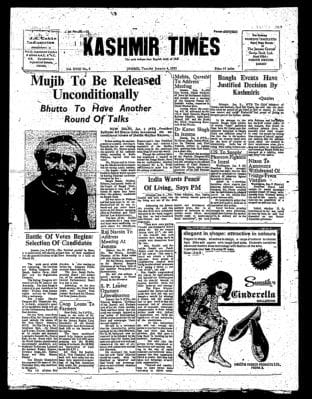
Kashmir Times front page, January 1972. Image courtesy of Kashmir Times / Anuradha Bhasin digitized by Stanford Libraries.
In 2019, as Indian prime minister Narendra Modi began his second term in office, his government removed the special autonomous status granted to Jammu and Kashmir and protections that had existed for nearly 70 years. Once a state, Jammu and Kashmir was split into two federally governed territories. The Indian-administered part of Kashmir – the subject of several military conflicts between India and Pakistan, with both countries claiming the entire disputed territory while controlling a portion of it – had effectively become a police state and control of the media was a critical component of this transformation.
As Executive Editor of the ‘Kashmir Times’, one of the oldest newspapers in the region and the largest, with four editions, I petitioned India’s Supreme Court against the six-month-long internet shutdown that the Modi government imposed in 2019. But by 2020, three editions of the ‘Kashmir Times’ had shut down and the fourth only limped along, a once daily newspaper that was now only occasionally published. By February 2022, even this edition was shut down. I left India with my husband Prabodh Jamwal, the editor of the ‘Kashmir Times’, and revived it as a digital newsroom in exile in the United States in November 2023.
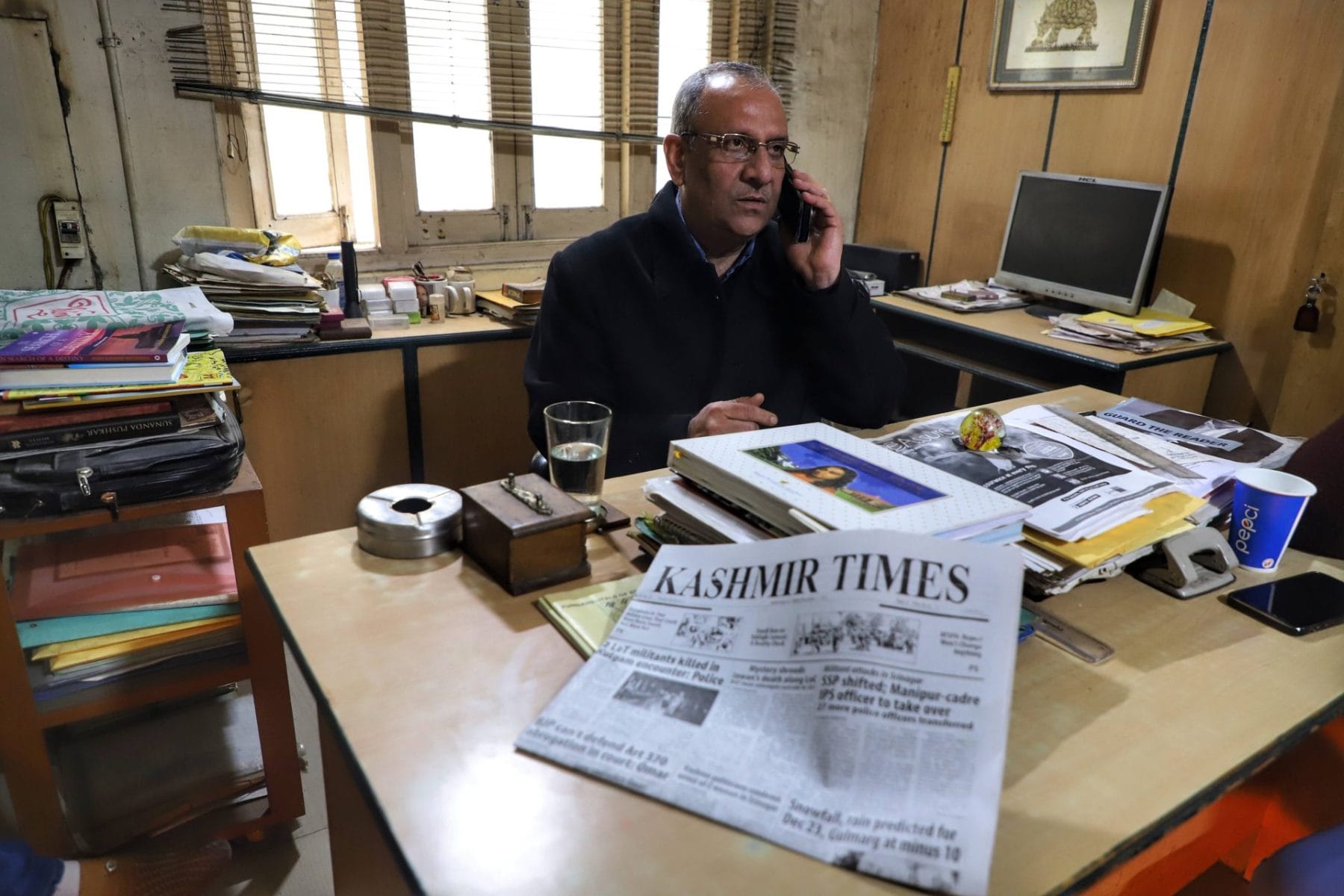
Prabodh Jamwal, Editor of The Kashmir Times, at his office in Srinagar in early 2020. Nasir Kachroo/NurPhoto via Getty Images.
But, as the so-called terror investigation and the mysterious discovery of weapons in our long disused office in 2025 showed, the ‘Kashmir Times’ remained a thorn in the side of the Modi government. The Indian prime minister has frequently presented India on the international stage as the “mother of democracy” and the “Vishwaguru”, a moral exemplar and teacher to the world. Just last week, between September 12 and 13, Delhi hosted Vladimir Putin, Xi Jinping and Iranian president Masoud Pezeshkian as part of the annual BRICS meeting, the global group founded initially by Brazil, Russia, India, China and South Africa (hence the acronym) that is increasingly being presented as an alternative power centre to the American-led Western alliance. For an India seeking to portray itself as not just an emerging superpower but as a democratic force, it is vital that Kashmir remain repressed, hidden away from global scrutiny.
It’s why, even as a newsroom in exile, we continue to be pursued by an Indian government seeking to tarnish our credibility, to deny us the right to report on Kashmir. We are being subject to a vendetta and it represents what has happened to journalism in Kashmir. Journalists have been silenced by the Modi government, Kashmiri voices strangled, and the local media industry deliberately destroyed.
What is happening to journalism in Kashmir is a harbinger of what lies ahead for the rest of India.
A model of suppression
Geeta Seshu of Free Speech Collective, which monitors press freedoms in India, argues that Kashmir is a laboratory where every strategy of media suppression is tested and perfected for use elsewhere. India, which once had a noisy, argumentative press, now ranks at a lowly 157 out of 180 countries in the World Press Freedom Index. Reporters Without Borders, which compiles the ranking, says “press freedom is in crisis” in Modi’s India.
The 2023 Digital Personal Data Protection Act provided a “dangerous framework for expansion of surveillance and censorship” across the country. It empowered the government to demand data from any entity, including journalists, effectively requiring them to reveal their sources. The amendments to the 2020 Information Technology Rules already burden intermediaries with harsh obligations and have been used to arrest journalists, block websites and compel social media platforms to restrict content. Recently, Instagram restricted posts about reports of Kashmiris shot by Indian security forces using pellet guns on unarmed protestors.
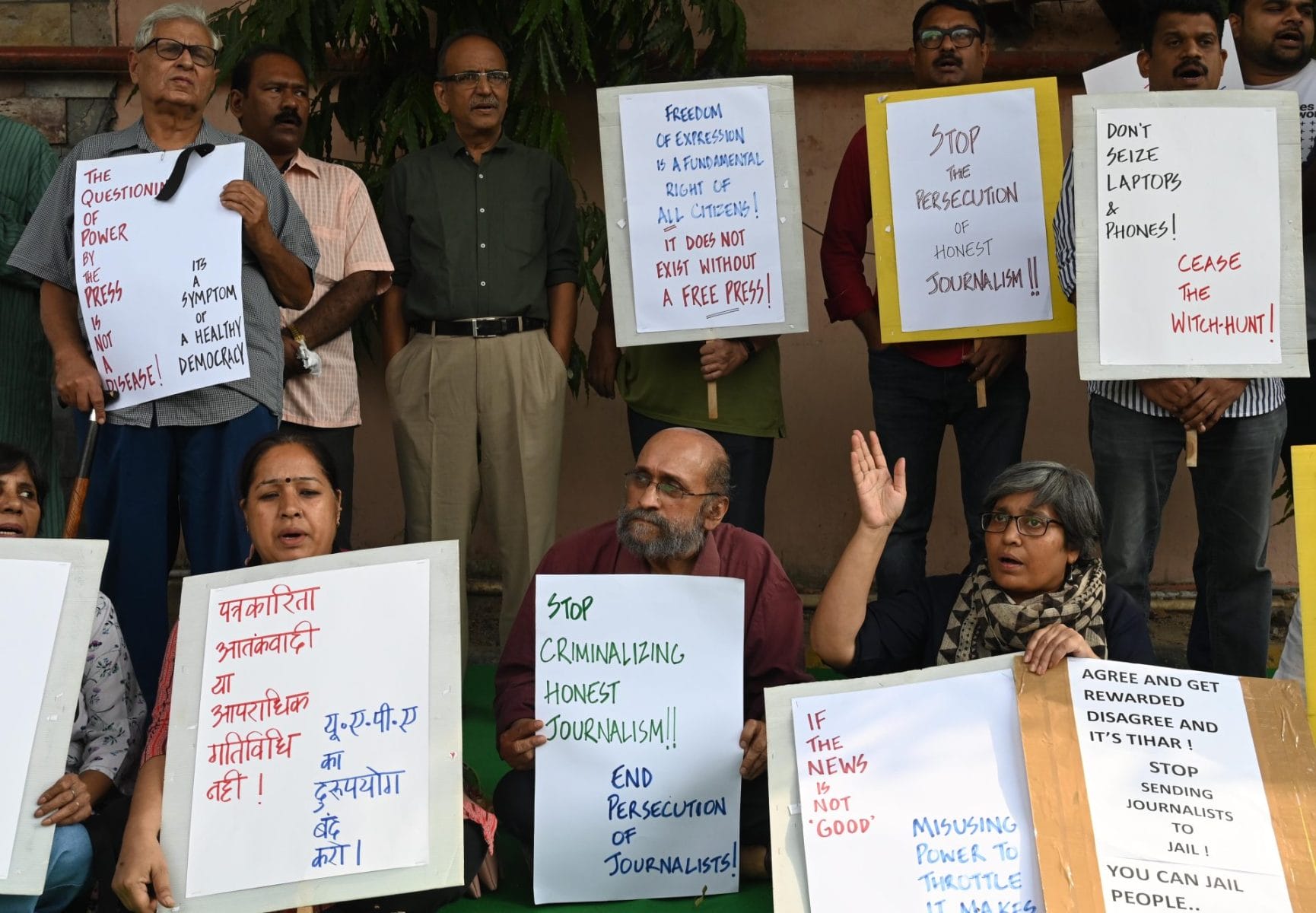
Seshu’s fear that what happens in Kashmir will be replicated in the Indian mainland has largely been borne out. For example, in 2023, nearly 50 journalists associated with the portal ‘NewsClick’ – some only vaguely – were subject to arrests and interrogations. Many had their devices seized without due process. Their alleged crimes were essentially guilt by association, charges manufactured not from evidence but from a, frankly, lazy piece of journalism published in the ‘New York Times’ about NewsClick’s funding. The charges were eventually quashed by an Indian court.
The "To Defend Journalism" protest at New Delhi's Press Club of India, October 2023. Vipin Kumar/Hindustan Times via Getty Images.
Such court rulings are less likely in Kashmir. As a Kashmiri journalist based in Delhi says, “unlike the rest of India, Kashmir is a police state, and state control requires any independent journalism to be shut down.”
In Kashmir, the Indian state has engineered a sophisticated edifice of control through securitization, surveillance and interrogation. It is invisible, intangible, and all-pervasive, a model that extracts quiet surrender and obedience. Unlike the targeted killings of journalists in Gaza, in Kashmir the control of information is seamlessly embedded in everyday life, requiring no enforcement, no traces of brutality. The journalists are essentially cowed into submission.
It began with the world’s longest internet shutdown – a complete lockdown for six months and a partial one for another year. What the shutdown created, despite a court verdict restoring communications, was fear among journalists compelled to work out of a government-surveilled computer facility, and then a perpetuation of that fear through consistent localized and temporary digital shutdowns. So commonplace are these shutdowns that they no longer warrant reporting or commentary.
In June 2020, the Modi government introduced a 53-page document called ‘J&K's Media Policy’ which gave the authorities sweeping powers to monitor, judge, and punish journalists, branding critical reporting as “fake news”, “unethical”, or “anti-national”. The authorities would also routinely remove government advertising from cash-strapped outlets and provide accreditation only to journalists deemed loyal, thus turning bureaucrats into arbiters of what constitutes news and who gets to report it. The effect is chilling.
And then there’s the monitoring of communications.
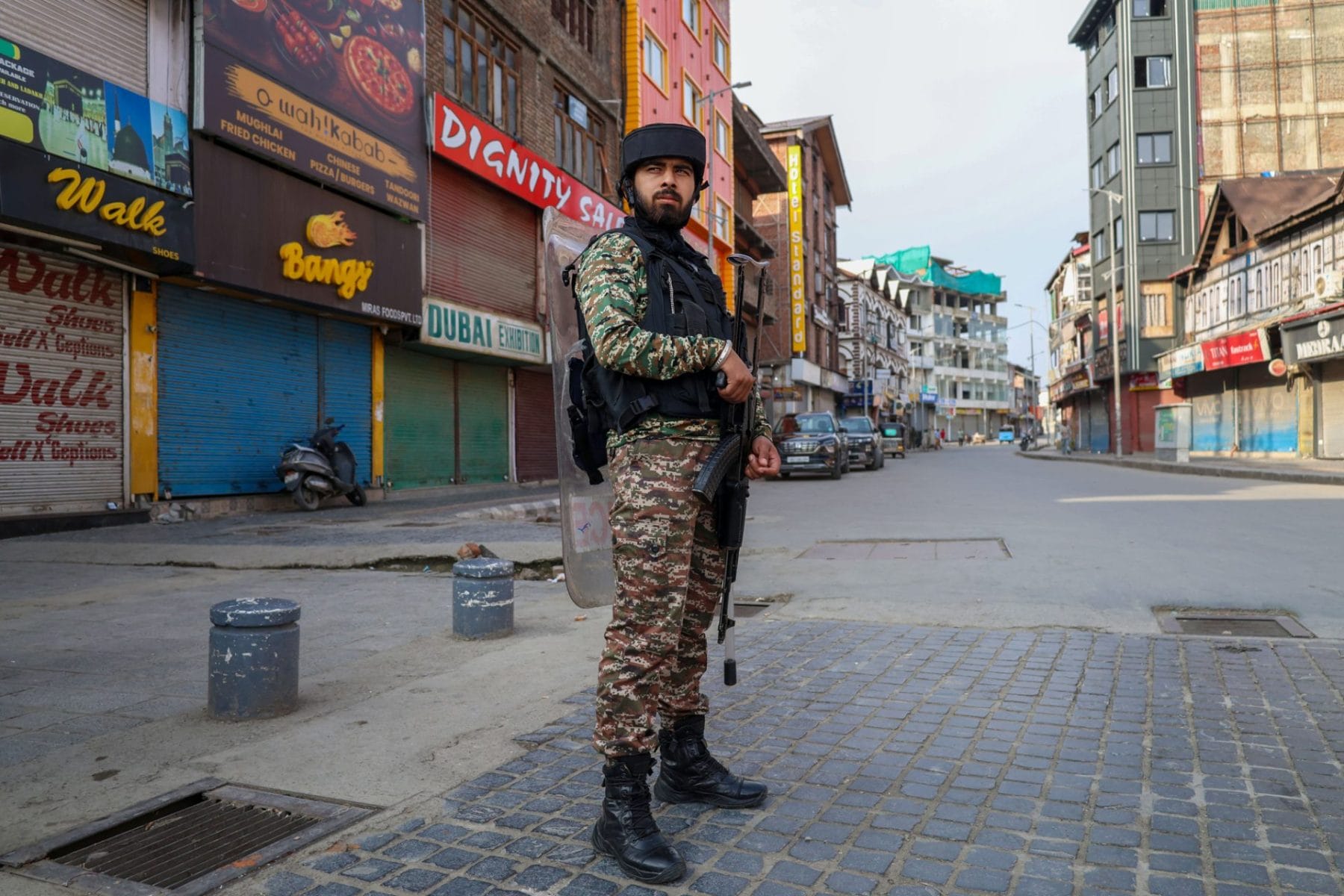
An Indian security personnel in Srinagar, Jammu and Kashmir, August 2026. Firdous Nazir/NurPhoto via Getty Images.
“I can’t say if they’re using Pegasus or some other spyware or technology,” a journalist told me about being interrogated over emails sent to an editor, “but they knew everything about our conversations.” In a 2021 leak, it turned out the Indian government was using Pegasus to spy on at least 40 Indian journalists, only one of who was Kashmiri.
But, a Kashmiri journalist says, “officials have told us ‘nothing in Kashmir is end-to-end encrypted’ and digital activity is clearly being constantly monitored.” No Kashmiri journalist I spoke to for this story, including those who contribute to the ‘Kashmir Times’, have the encrypted messaging Signal app, used worldwide by journalists, on their phones. Devices are routinely checked when journalists are summoned to police stations in Kashmir for questioning. Some said their devices were returned after being tampered with. “You face humiliation and beatings for using Signal and VPNs,” many journalists said. “You can only get away with it if you’re not on their radar,” said one.
In November 2025, the Indian government issued a directive insisting on verifying the “bona fides” of journalists working in Jammu and Kashmir, and the police followed up by requiring journalists to part with personal information including biometrics and bank statements. In January this year, senior journalist Basharat Masood of The Indian Express spent seven hours at a Srinagar police station, then was summoned for three more days and told to sign a bond promising not to “repeat his mistake” – for reporting on the surveillance of mosquea surveillance, even as officials had already admitted to large-scale data collection and verification.
Surveillance normalized
Police also surveil Kashmiris through the use of drone cameras, a network of 1,000 electronic cameras installed at major traffic junctions, and through unrestricted access to people’s social media activity across platforms ostensibly to track anti-India activity. During an illegal “Census 2024” drive, the police collected residents' personal data and GPS-tagged coordinates of homes. And the soon-to-be-rolled-out Jammu and Kashmir-specific digital identity cards that collects the data of entire households, purportedly to ensure the smooth rollout of welfare schemes, has also sparked local anxieties.
Still, as pervasive as the surveillance is, it is journalists that find themselves in the firing line. Any critical word warrants a summons to a police station, interrogation, intimidation and even detention. This happens repeatedly, with journalists never aware of what specific “offence” might trigger a police summons. The reflex, after several such visits to police stations, is self-protection and self-censorship.
A Kashmiri journalist told me that the language the police use to summon journalists for questioning is particularly sinister. It is almost as if the police are enjoying instilling fear. “Aaj dastarkhan par aapki dawat hai”, for instance, is a typical summons. You are invited to a feast, the police say cynically, knowing a journalist is likely to be harshly questioned, even beaten.
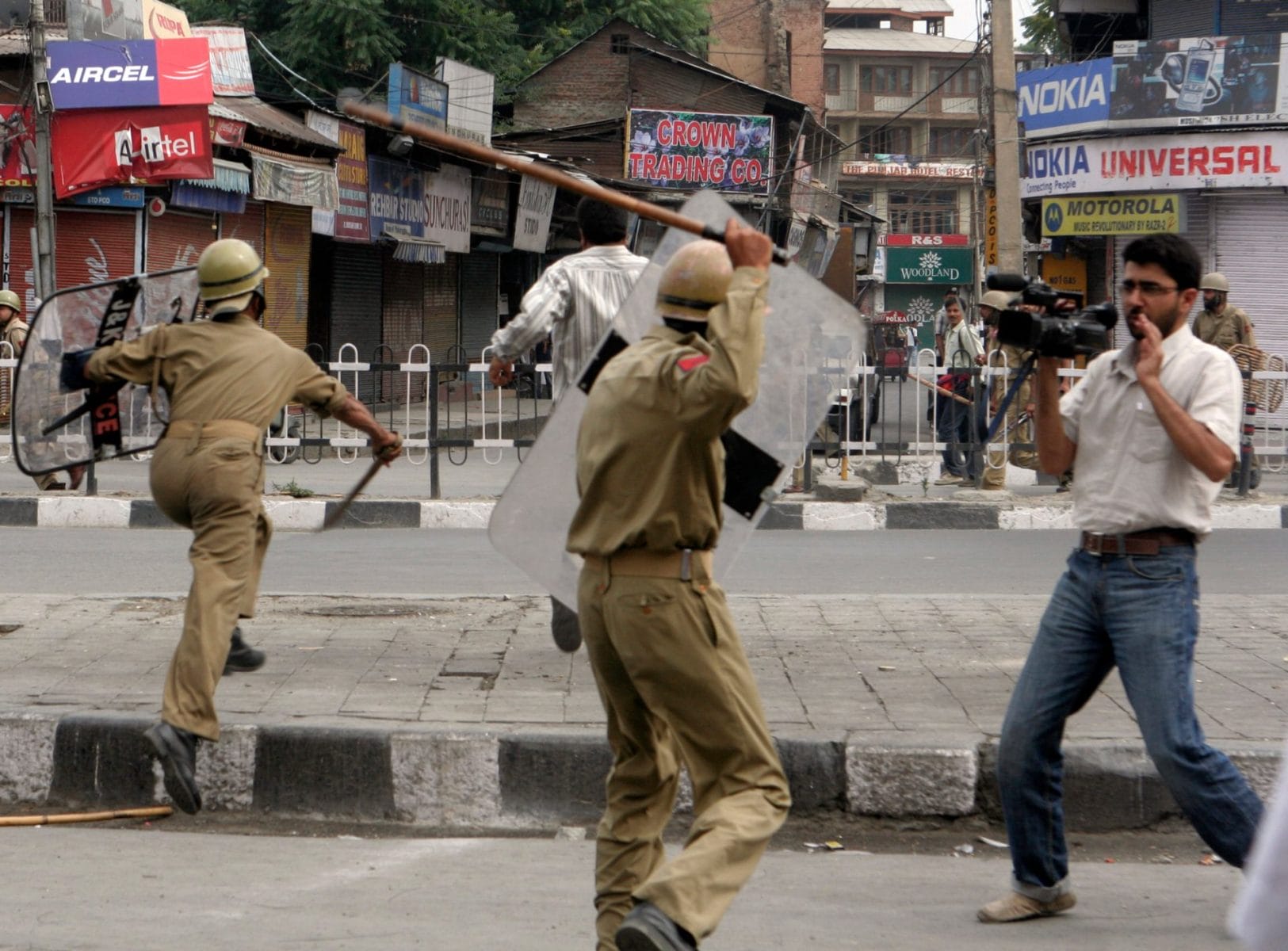
Indian police confront journalists and civilians during a protest on July 10, 2009 in Srinagar in the Indian Administered Kashmir. Yawar Nazir/Getty Images.
Often, Kashmiri journalists, without notice, are placed on no-fly lists. Sanna Irshad Mattoo, a Pulitzer Prize-winning photojournalist, was twice prevented from travelling abroad for exhibitions and award ceremonies, a pointed message that even international recognition offers no protection. At least twelve journalists have had their passports revoked; two of them were already abroad at the time, rendering them stateless.
The Free Speech Collective filed a Right to Information (RTI) query in March 2024 to ascertain exactly how many Kashmiris had had their passports revoked or cancelled. The plea was rejected by the government on grounds of “national security”.
As India continues to press its case as a formidable, if still rising power, citing its 7.8% growth rate over the past quarter, it continues to be defensive and secretive about Kashmir. Foreign journalists are largely barred, or at least heavily restricted, from reporting from both Indian and Pakistani-administered Kashmir. In May, last year, India and Pakistan exchanged air strikes after a terrorist attack in Indian-administered Kashmir and Modi fell out with Donald Trump over the latter’s claim to have stopped both nuclear powers from accelerating towards a disastrous war.
Despite Kashmir being a long-standing issue that merits global attention, reporting from the region has reduced to a trickle.
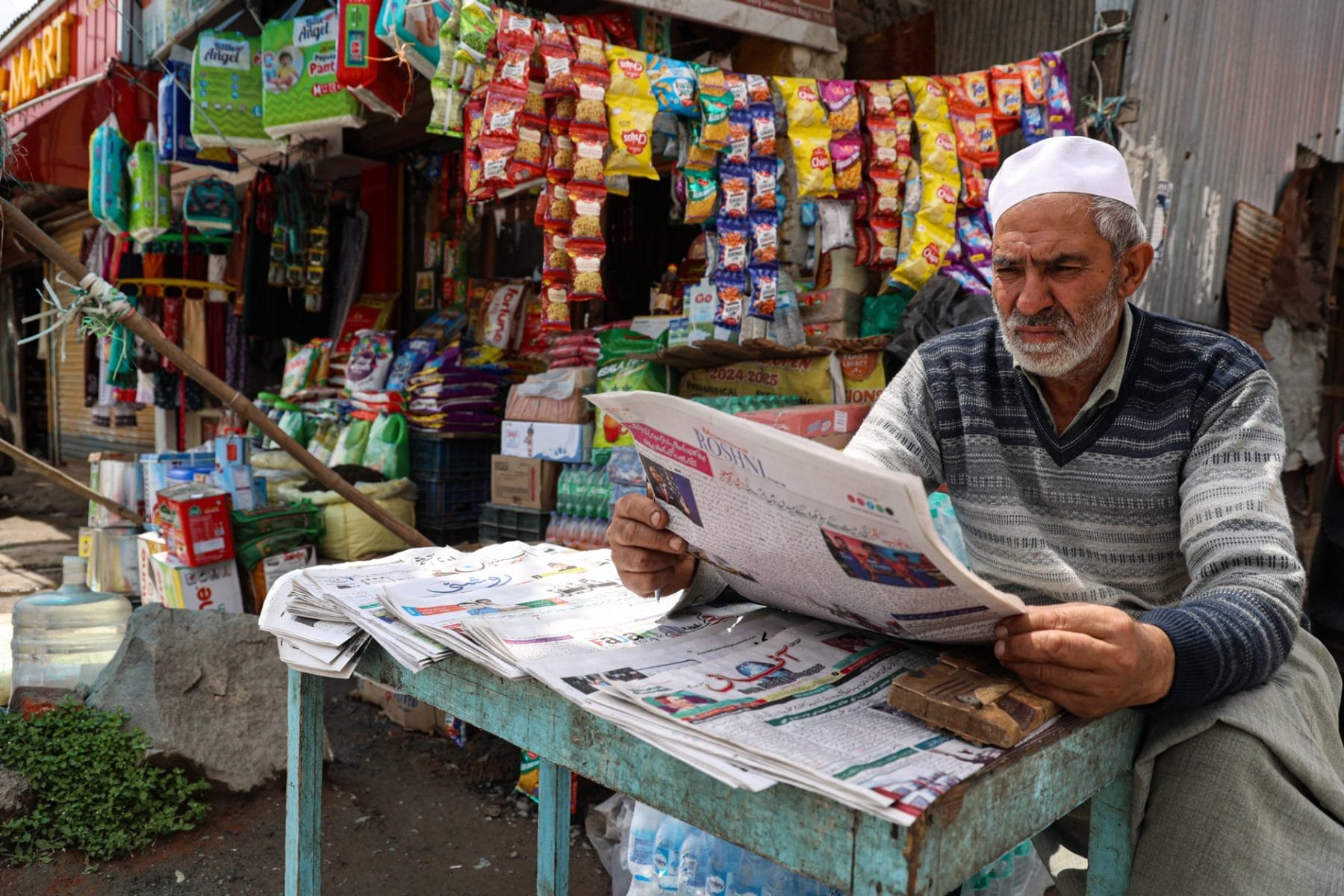
Mohammad Amin Lara outside his shop in Sopore, Jammu and Kashmir. The shop, once a fully occupied newspaper store, is now a grocery store due to the decline in newspaper sales. Nasir Kachroo/NurPhoto via Getty Images.
A Google search of Kashmir-related news floods your screen with links, but it is bulk without substance. Articles read like a log of official announcements and statements, punctuated by the occasional piece on a shrinking water body, a development project, a political tussle over a non-issue, or unemployment figures. Each report floats like a loose, individual particle suspended in air, packaged and presented as definitive. No investigation into context. No excavation of the past. No interrogation of contributing factors. A story about an alleged terrorist’s hair transplant and cosmetic dentistry, based entirely on police sources, is passed off as an investigation into Kashmiri insurgency. A superficially detailed piece on anti-encroachment drives or home demolitions will carry little beyond the grief of the displaced, or the remarks of a politician whose interest in the community begins and ends with votes. A terrorist’s hair transplant story, based on the police version, passes off as an investigation into Kashmir’s complex insurgency dynamic.
Kashmir fell off the radar a long time ago, says Free Speech Collective’s Geeta Seshu.
Even mundane stories are difficult to report. No one wants to be quoted. A university professor said he could once “talk to journalists and trust they understood the context. Now, a single sentence can be pulled out, circulated on WhatsApp, and suddenly I’m either an anti-national or a government stooge. Both sides will use the same quote to attack you differently. Why would I take that risk?”
Tarushi Aswani, an Indian journalist, told me that “a curtain has been pulled over Kashmir by silencing journalists who ask questions.” Instead, she added, “press release journalism fills the vacuum, erasing the truth about Kashmir, its history, its politics, its development, environment and aspirations.” Kashmir is no longer looking at a mirror. The lack of truthful reporting means nothing is reflected back. Instead, Kashmiris are looking into the lens of a surveillance camera.
*The eight Kashmiri journalists interviewed for this story spoke on condition of anonymity.
In 2016, when Peter Thiel killed Gawker, he insisted that he wasn’t attacking journalism writ large.
On the contrary, he told the New York Times, he’d spent $10 million secretly backing Hulk Hogan’s lawsuit against the news outlet because: “I saw Gawker pioneer a unique and incredibly damaging way of getting attention by bullying people even when there was no connection with the public interest… if I didn’t think Gawker was unique, I wouldn’t have done any of this. If the entire media was mo
In 2016, when Peter Thiel killed Gawker, he insisted that he wasn’t attacking journalism writ large.
On the contrary, he told the New York Times, he’d spent $10 million secretly backing Hulk Hogan’s lawsuit against the news outlet because: “I saw Gawker pioneer a unique and incredibly damaging way of getting attention by bullying people even when there was no connection with the public interest… if I didn’t think Gawker was unique, I wouldn’t have done any of this. If the entire media was more or less like this, this would be like trying to boil the ocean.”
10 years later with the aid of an “AI tribunal,” a team of intelligence and law enforcement veterans, and a political climate vastly more hostile to press freedom, he is trying to do exactly that, bypassing the courts, short-circuiting the first amendment, and making it much, much cheaper to indulge in the quasi legal harassment of journalists.
Objection.ai is a new startup funded by Thiel, and cofounded by Aron D’Souza, who worked closely with him on the Gawker case. It promises “a fast affordable way to challenge statements in the media.” Anyone can file an objection, which will trigger an investigation by a team hired, the company says, from the CIA, FBI, and British intelligence agencies. Targeted outlets and reporters will have an opportunity to respond, and the results will be fed to an AI model, which will render a verdict. The complainant, and the target, are asked to agree to binding arbitration, with an unspecified range of potential consequences. Financial details are vague, but the company has said the process will cost around $2,000 — far less than the retainer of a crisis communications expert.
An initial slate of cases includes objections against the New York Times, for reporting on how Thiel’s fellow traveller David Sacks, former PayPal chief operating officer and Donald Trump’s former “AI and Crypto Czar,” uses his White House position to benefit Silicon Valley connections; The Wall Street Journal for its revelations about the doodle contributed by Donald Trump to Jeffrey Epstein’s birthday book (a case recently dismissed by a federal judge); and British reporter Hannah Broughton for an aggregated story in the UK tabloid the Mirror about allegations that Amazon workers were told to continue working while a colleague lay dead on the warehouse floor. A smattering of social media provocateurs (Candace Owens) and politicians (Bernie Sanders) round out the roster, but the aggregate effect is indisputable: Thiel’s animus was about journalism all along. Indeed, the Objection.ai team couldn't be clearer about that.
“Gawker was not unique,” writes D’Souza on the company’s website. “It was simply the first large media company to be tested against reality in the age of clicks, outrage, and algorithmic amplification. Since then, the same structural failure has spread everywhere.”
“Peter Thiel and I … did not just fight Gawker,” he goes on. “ — We demonstrated that facts still mattered if someone was willing to enforce them.”
This is worse than revisionism. D’Souza is banking on everyone having forgotten that the Hulk Hogan case had nothing to do with “reality.” It was undisputed that the sex tape published by Gawker was real. The original suit, which failed, was for copyright infringement and the ultimate $140 million award that bankrupted the company was for invasion of privacy and intentional infliction of emotional harm.
This foundational lie is important, because it is a warning against the temptation to engage Objection.ai on the merits. It would be easy enough to conduct a good faith debate to take at face value D’Souza’s argument that tech platforms and algorithms amplify false claims to millions, that courts are expensive and slow, media ombuds toothless, and fact-checkers partisan. And it would not be hard to demonstrate that he is harnessing widely shared concerns about a disordered information environment to mobilize support for an AI powered justice system controlled by a hyperpartisan private company with a track record of attacking the very institutions that are holding the line on consensus reality.
It would also be a mistake. There is nothing good faith about this effort. Rather, it is classic Thiel: an attempt to hack the principles of accountability, and turn them against journalism. Leave it to his less sophisticated Silicon Valley peers to rail against the media, create in house news outlets or buy them. The PayPal co-founder is going for the heart of the system, and financing infrastructure that will enable anyone who can afford a used Honda Civic to launch a harassment campaign, cloaked in the language of legitimate investigation. James O’Keefe, but with the judicial rather than journalistic process as its governing metaphor.
It will be tempting, too, to question the likely financial sustainability of Objection. That will be the least of its founders' concerns. The for-profit structure supports a story about the company’s purpose. It may work, or not, but its goals are nonfinancial. We reached out to Thiel for comment on Objection.ai before publication and will update this article as soon as he responds.
Providing funding, alongside Thiel, is Balaji Srinivasan, the investor and author of “The Network State,” a book about social networks with “a sense of national consciousness” replacing the nation state. He once outlined an early version of the Objection.ai model in an email to the far right theorist Curtis Yarvin about dealing with critical coverage. "If things get hot,” he suggested “it may be interesting to sic the Dark Enlightenment audience on a single vulnerable hostile reporter to dox them and turn them inside out with hostile reporting sent to *their* advertisers/friends/contacts."
These men understand the limits of the Gawker verdict’s impact. It bankrupted the company, a personal victory for Thiel, but perhaps the least important outcome of the case. At a more systemic level, it struck fear into the hearts of media insurers and newsroom counsel, focusing attention on third party litigation finance as potential threat.
If people with limitless resources could sponsor litigation against news organizations they disliked, constitutional protections would be no match for the sheer cost and complexity of defense.
Now, they’ve found an AI-assisted way to supercharge those effects.
The Gawker case routed around the First Amendment by relying on a privacy claim. Objection.ai does so by building a hallucination of the legal process. Any journalist foolish enough to agree to binding arbitration by the company probably deserves what they get, but that will be a vanishingly small minority. For those who don’t, a phone call, or a knock on the door from a former FBI agent, or defense intelligence operative, will be chilling, and an ex-parte verdict rendered by Thiel’s custom-tuned AI will act as a cudgel on social media and via traditional PR. Journalists will be assigned a “trust score” to act as an additional goad.
In an environment of less peril for press freedom, it might be easy to laugh off Objection.ai as the confection of a thin-skinned millenarian. Right now, with the crony capture of broadcast news far advanced, swathes of the tech community openly hostile to journalism, and the White House onside, it would be wise to take it seriously. That starts with seeing it for what it is, and refusing to engage with a process which, unlike the real courts, Peter Thiel has no legal power to compel.
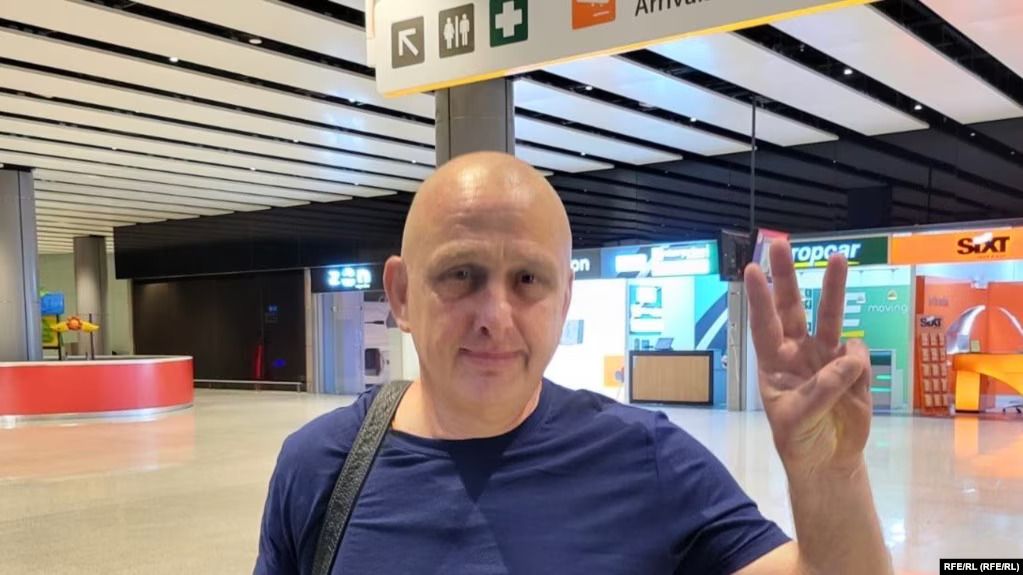
Ukrainian journalist Vladyslav Yesypenko was released on June 20 after more than four years of detention in Russian-occupied Crimea, Radio Free Europe/Radio Liberty reported.Yesypenko, a freelance contributor to Crimea.Realities, a regional project of RFE/RL's Ukrainian Service, reported on various issues in Crimea before being detained by Russia’s FSB in March 2021.He was accused of espionage and possession of explosives, charges he denied, and later sentenced to five years in prison by a Russi
Ukrainian journalist Vladyslav Yesypenko was released on June 20 after more than four years of detention in Russian-occupied Crimea, Radio Free Europe/Radio Liberty reported.
Yesypenko, a freelance contributor to Crimea.Realities, a regional project of RFE/RL's Ukrainian Service, reported on various issues in Crimea before being detained by Russia’s FSB in March 2021.
He was accused of espionage and possession of explosives, charges he denied, and later sentenced to five years in prison by a Russian-controlled court.
Yesypenko said he was tortured, including with electric shocks, to force a confession, and was denied access to independent lawyers for nearly a month after his arrest.
RFE/RL welcomed his release, thanking the U.S. and Ukrainian governments for their efforts. Yesypenko has since left Russian-occupied Crimea.
“Vlad was arbitrarily punished for a crime he didn’t commit… he paid too high a price for telling the truth about occupied Crimea,” said RFE/RL President Steven Kapus.
During his imprisonment, Yesypenko became a symbol of press freedom, receiving several prestigious awards, including the Free Media Award and PEN America’s Freedom to Write Award.
His case drew support from human rights groups, the National Union of Journalists of Ukraine, and international advocates for media freedom.
Russia invaded and unlawfully annexed Crimea in 2014, cracking down violently on any opposition to its regime.
Following Russia's full-scale invasion of Ukraine in February 2022, the Kremlin toughened its grip on dissent, passing laws in March 2022 that prohibit what authorities label as "false" criticism of Russia's war.
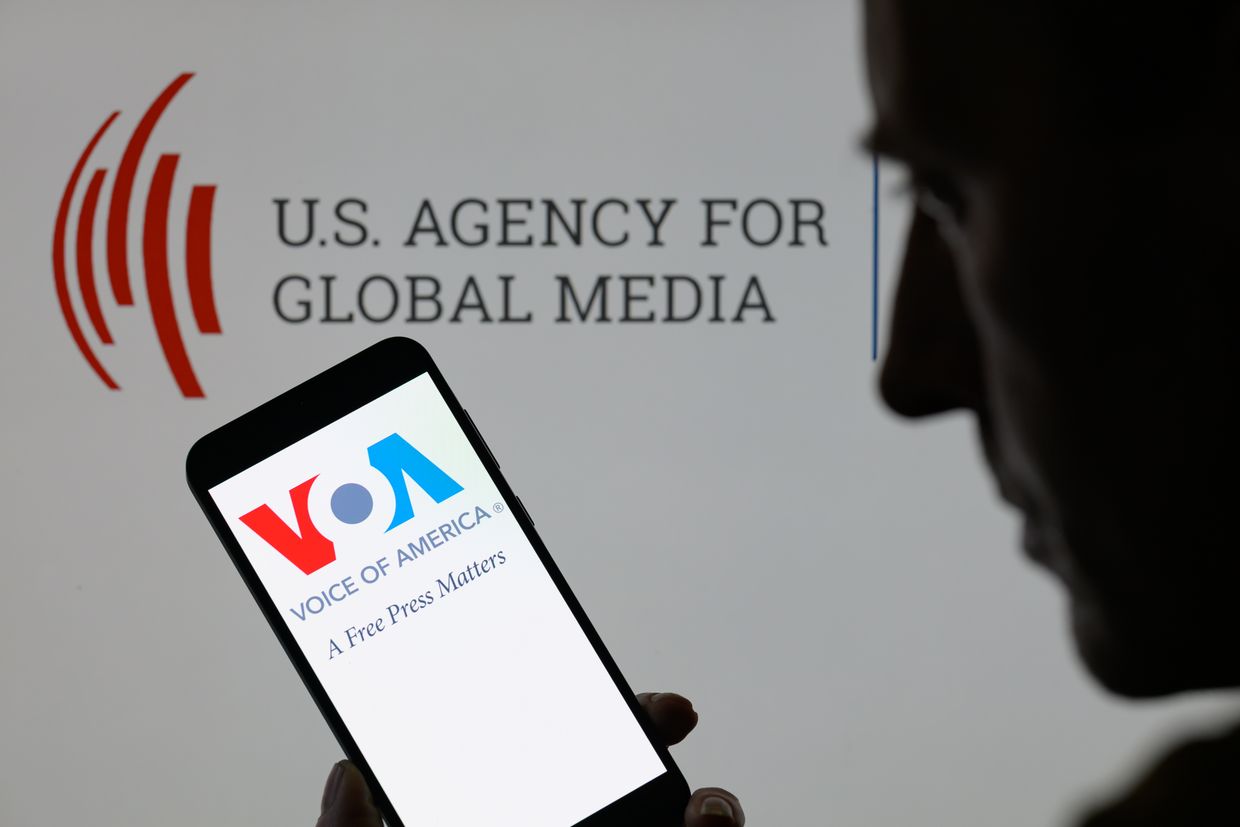
The administration of U.S. President Donald Trump has issued layoff notices to over 600 employees of Voice of America (VOA), dramatically reducing the outlet's staff to fewer than 200, the New York Times (NYT) reported on June 20.VOA, launched in 1942 to counter wartime propaganda, has long been a central pillar of U.S. public diplomacy, broadcasting in 49 languages to more than 360 million people worldwide.Trump's crackdown against Voice of America has been celebrated by Russian propagandists,
The administration of U.S. President Donald Trump has issued layoff notices to over 600 employees of Voice of America (VOA), dramatically reducing the outlet's staff to fewer than 200, the New York Times (NYT) reported on June 20.
VOA, launched in 1942 to counter wartime propaganda, has long been a central pillar of U.S. public diplomacy, broadcasting in 49 languages to more than 360 million people worldwide.
Trump's crackdown against Voice of America has been celebrated by Russian propagandists, who welcomed the cuts to the network.
The dismissals, described as reductions in force, affect both journalists and support staff, who will remain on paid leave until Sept. 1. The cuts are the biggest rollback of the federally funded broadcaster in decades, reducing its staff to one-seventh of what it was at the start of 2025.
The Trump administration's move follows months of attrition at the agency. In February, the outlet employed approximately 1,300 staff. Since then, programming has been slashed, with broadcasts now limited to just four languages.
The decision to dismantle VOA has met legal challenges.
On April 22, a U.S. federal judge ordered the administration to reinstate all employees and contractors, ruling that the mass dismissal likely violated U.S. law. However, a federal appeals court overturned that order, allowing the layoffs to proceed.
The Trump administration temporarily reinstated several staff members from VOA's Persian-language service amid the escalating conflict between Israel and Iran. But at least two of those individuals also received layoff notices on June 20, according to the NYT.
Trump has repeatedly attacked U.S.-funded media outlets over their coverage, often referring to them as "fake news." His administration has framed the VOA cuts as a cost-saving measure and a response to what it views as politically biased reporting.

 Connexion