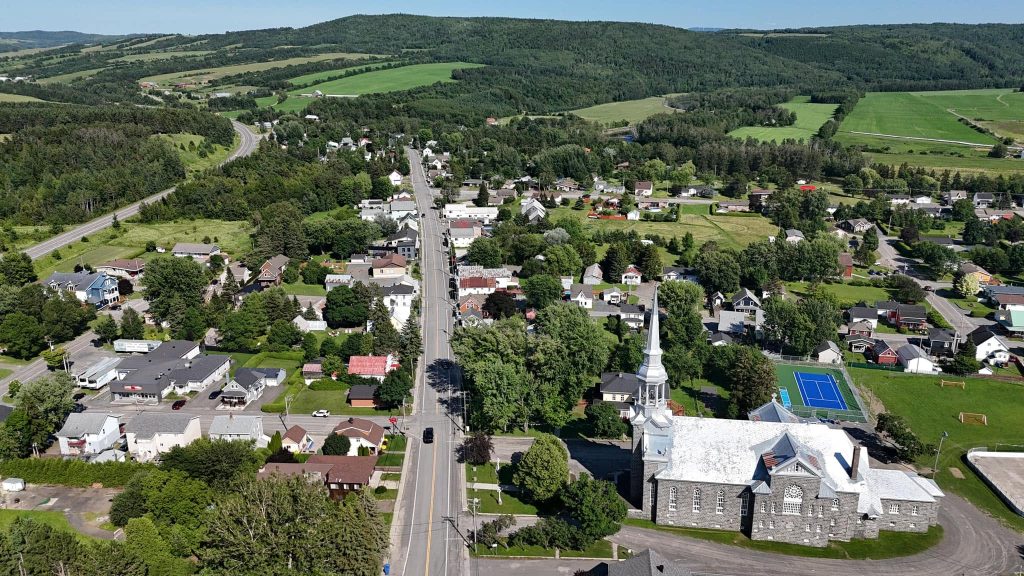
Il y a plusieurs générations, des femmes et des hommes courageux ont défriché les territoires qui nous entourent. Bien entendu, ceux-ci n’étaient pas vierges. Les Premières Nations y pratiquaient la chasse et la pêche depuis des temps immémoriaux. Mais les premiers colons à s’y établir durent, à la sueur de leur front, affronter moult épreuves pour commencer à créer ce qui allait devenir nos régions.
Chronique « La parole aux élus » avec le préfet de la MRC de La Mitis, Bruno Paradis
Il y
Il y a plusieurs générations, des femmes et des hommes courageux ont défriché les territoires qui nous entourent. Bien entendu, ceux-ci n’étaient pas vierges. Les Premières Nations y pratiquaient la chasse et la pêche depuis des temps immémoriaux. Mais les premiers colons à s’y établir durent, à la sueur de leur front, affronter moult épreuves pour commencer à créer ce qui allait devenir nos régions.
Chronique « La parole aux élus » avec le préfet de la MRC de La Mitis, Bruno Paradis
Il y a plusieurs générations, les gouvernements ont encouragé la population à continuer cette colonisation du territoire, à créer de nouveaux villages, à déboiser les forêts pour ouvrir de nouvelles terres à l’agriculture et développer la foresterie.
Les régions ont alors grandi, les rangs se sont remplis, les ressources ont afflué vers les grands centres, le Québec s’est développé.
Il y a quelques générations, les régions se sont en partie vidées au profit des villes, vers les usines et les manufactures. Les gouvernements ont alors cherché à fermer des villages.
Nous avons résisté, nous nous sommes concertés, organisés, nous avons bataillé ferme et les Opérations Dignité nous ont permis de continuer d’exister.
Nous avons ouvert des usines pour scier notre bois, diversifié nos productions agricoles, mis en place des organismes de développement et nous avons réussi!
Mais aujourd’hui, quel avenir se dessine pour nos régions ? De moins en moins de services en santé, de moins en moins d’investissements dans nos infrastructures, dans nos usines, dans notre transport collectif. De plus en plus de terres agricoles accaparées, de plus en plus de milieux dévitalisés, de plus en plus de pauvreté.
Une élection est toujours l’occasion de changer de tangente, de direction.
J’aimerais que non seulement le prochain gouvernement, mais aussi le Québec en entier, collectivement, se pose la question suivante : souhaitons-nous occuper, de façon dynamique, l’ensemble du territoire habité aujourd’hui par les Québécois et Québécoises, du Bas-Saint-Laurent à la Côte-Nord en passant par la Gaspésie, le Saguenay et l’Abitibi-Témiscamingue ?
Si la réponse est OUI, alors je souhaite que le prochain gouvernement s’engage à passer de la parole aux actes. Je rêve, mais… pourquoi ne pas faire du Québec le « Québec des régions » ?
We have come to know the Kremlin's energy playbook well: "Europe will freeze without Russian gas," "sanctions hurt Europe more than Russia," "a managed, indefinite return to Russian supply is simply pragmatic." The respected European project EUvsDisinfo has repeatedly exposed these false narratives, carried by Russian state media, proxy outlets, and paid commentators. But Kremlin-friendly energy narratives do not travel only through obvious propaganda channels. They also enter policy debat
We have come to know the Kremlin's energy playbook well: "Europe will freeze without Russian gas," "sanctions hurt Europe more than Russia," "a managed, indefinite return to Russian supply is simply pragmatic." The respected European project EUvsDisinfo has repeatedly exposed these false narratives, carried by Russian state media, proxy outlets, and paid commentators. But Kremlin-friendly energy narratives do not travel only through obvious propaganda channels. They also enter policy debate through expert commentary, think tanks, media quotes, and institutional platforms, where they are far harder to see.
None of the apocalyptic forecasts came true. Europe cut Russian gas imports from 45% in 2021 to 13% by 2025 without blackouts or economic collapse. Yet the narratives predicting ruin kept circulating, sometimes from unexpected addresses. One of them, in my view, is worth a closer look: the work of Katja Yafimava, of the Oxford Institute for Energy Studies.
Across nearly two decades, in my reading, her analysis has landed with remarkable consistency where Gazprom would want it. Gazprom's trading arm was once among the sponsors of her program. The record is public, and it is worth reading in full.
The narrative you don't notice
The most effective version of Kremlin-friendly energy messaging does not shout. It hedges, reframes, and omits. It raises "legitimate concerns" about sanctions costs, stresses the "legal complexities" of an LNG ban, and warns of "supply disruption risks" from moving too fast, without weighing Ukrainian lives or the cheaper, homegrown clean-energy alternative. Real concerns about European energy security did exist. What is worth noting is how reliably certain voices amplified concerns and how rarely they weighed counter-evidence.
This is not abstract. Surging oil and gas prices since the Iran war have handed Russia windfall revenues averaging, according to the Centre for Research on Energy and Clean Air, €604 million a day, money that funds the missiles falling on Ukrainian cities. Every argument for delay has a price, and Ukrainians pay part of it.
The Oxford label, and the money behind it
Katja Yafimava is a Senior Research Fellow at the OIES, which she joined in 2006. The institute is an independent charity rather than a department of the University of Oxford, which recognizes it as a separate independent research center. It carries the Oxford name, and its researchers appear regularly as authoritative, independent voices in UK and European media.
That independence has been questioned. Democracy for Sale, an investigative outlet, has documented the proximity between Russian oil and gas industry money and OIES, which previously received funding from Gazprom and its subsidiaries. OIES's own website and annual reports up to 2020 list Gazprom Marketing and Trading among over 20 organizations that sponsored equally its Natural Gas Research Programme, where Yafimava works, alongside Nord Stream 2 financiers Shell, OMV, Uniper, and Wintershall.
None of that, on its own, tells you what any individual researcher believes. What makes it worth raising is the alignment between that funding context and a published record that, across nearly two decades, has been remarkably convenient for Gazprom's positions.
Energy Ireland 2022
Croke Park, Dublin 29-30 June
Meet the speakers Dr Katja Yafimava Senior Research Fellow@OxfordEnergy
Consider the pattern. In 2017, Yafimava argued that Poland's legal challenge to the European Commission decision widening Gazprom's access to the OPAL pipeline risked letting political objectives override regulatory rules, a framing that would sit comfortably in Gazprom's own filings. She framed the EU's Gas Directive amendment as an instrument "aimed primarily at Nord Stream 2" in a 2019 paper. Russian state media have quoted her approvingly in pieces casting Brussels or Washington as acting in bad faith.
In September 2021, as suspicion grew that Gazprom was deliberately holding back gas to squeeze Europe before winter, she told Bloomberg she did not subscribe to that view, insisting the company "has not abused" the tight market and "has not manipulated it," and had "honored all of its contractual supply obligations to Europe." Within months, Russia's supply cuts had become the opening move of an energy war. In January 2022, the head of the IEA said Russia's cuts were creating "artificial tightness" in European markets.
Each judgment is defensible in isolation. It is the direction of the whole series that is striking: over years and across cases, the analysis lands where Gazprom would want it to land.
The pattern holds as the war grinds on
Through 2022 and 2023, Yafimava warned that cutting Russian gas too fast risked "unavoidable" blackouts in Central and Eastern Europe. The blackouts never came. In a 2025 paper, she and two OIES colleagues accepted that the phase-out would be manageable for markets, but argued that the EU's proposed ban risked undermining the commercial and legal positions of European importers, and that it was "not obvious" the risk was worth taking to end modest volumes of Russian gas after 2027. A competing Forum Energii report concluded that full EU independence from Russian fuel by 2027 is feasible, and that Russia needs EU markets more than the EU needs Russian supply. In early 2026, she wrote that no complete phase-out "will happen either by 2027 or by 2028."
A forecast is not a crime. But the forecasts, like the analyses, keep pointing one way.
She has also stepped beyond technical commentary. On 27 January 2026, responding to a Financial Times report on US security guarantees for Ukraine, she posted on X that "reliable security guarantees could only be achieved via common European security architecture that would have to include Russia," a framing that mirrors a longstanding Kremlin strategic goal.
The US won't provide *any* security guarantees before peace is reached not to risk its forces to be drawn in combat. Moreover, reliable security guarantees could only be achieved via common European security architecture that would have to include Russia https://t.co/LrY6713dqF
Katja Yafimava's current position as Vice-Chair of the UNECE Group of Experts on Gas gives her a visible role in a UN forum that helps shape discussion on European gas policy, security of supply, and the energy transition. In January 2026 she co-opened and concluded the Group's workshop on implementation of the EU Methane Regulation. The arguments she repeatedly advances can have policy effects closely aligned with Russian commercial and strategic interests. At a UNECE/OIES workshop in 2025, for example, she explicitly examined the possibility of a "limited return" of Russian gas to Europe via Ukraine, while her subsequent OIES paper argued that the EU ban on Russian gas could undermine European importers and security of supply and questioned whether ending the remaining Russian imports after 2027 was worth the associated risks.
The alignment is a matter of record. Why independent analysis, over nearly twenty years, has tracked so reliably the interests of a company that once helped fund her program is a question that deserves an answer.
Here is what the arguments for delay leave out: the alternative to Russian energy is not economic ruin. It is cheaper renewable power. The International Renewable Energy Agency found that in 2024, 91% of new renewable projects were cheaper than any fossil-fuel alternative; solar came in 41% below fossil power, and onshore wind 53% below. Renewables saved $467 billion in fossil-fuel costs in 2024 alone, and battery storage has fallen more than 93% in price since 2010.
This is the point that "supply disruption" warnings tend to bury, and it is why the warnings matter. Every year of delay, justified by the risks of moving too fast, is a year of continued payments to Moscow when a cheaper, domestic, un-weaponizable alternative already exists. Renewables reached 47% of the EU electricity mix in 2025; EU gas demand fell more than 17% between 2022 and early 2025; and the gas import ban agreed in December 2025 phases out Russian pipeline gas and LNG by the end of 2027, precisely the direction the delay arguments have worked against. The transition is not the risk. The delay is.
What should change
Editors, producers, and conference organizers could apply to energy analysts the conflict-of-interest standards already routine for pharmaceutical research: prior employment or program funding from Gazprom, Sberbank, or Russia-linked entities disclosed clearly every time such an analyst is presented as independent. UNECE could ask whether agenda-setting roles over European energy policy are well placed with analysts whose published record aligns so consistently with Kremlin positions. And Europe could close the transparency gaps that let think tanks with Russian-adjacent funding operate without disclosure requirements.
Every euro Russia earns from energy funds the war against Ukraine. The least we can do is know who is arguing for delay, and who once funded the programs they work in.
Disclosure: the author was involved in a March 2026 Razom We Stand research concerning the Oxford Institute for Energy Studies and Katja Yafimava, and works as a strategic advisor to the organization. Euromaidan Press reached out to Dr. Yafimava for a comment, but received no answer at publication date.
Oleh Savytskyi is a world-class climate and energy policy expert. Oleh has ten years of experience in the field – from youth climate activism to consulting the Ministry of Environment of Ukraine to managing international advocacy campaigns at Razom We Stand. Oleh is a fellow of the Michael Succow Nature Conservation Fund and an alumnus of the Agora Energiewende EnerTracks training program for energy transition professionals.
Editor's note. The opinions expressed in our Opinion section belong to their authors. Euromaidan Press' editorial team may or may not share them.
Une campagne électorale est un moment privilégié pour parler de l’avenir du Québec, mais aussi pour rappeler les réalités vécues dans nos régions. Comme maire de Mont-Joli, ville-centre de La Mitis, je considère qu’il est de ma responsabilité de faire entendre les préoccupations de notre population auprès de ceux et celles qui souhaitent former le prochain gouvernement.
Texte par Martin Soucy, maire de Mont-Joli
Les enjeux ne manquent pas. Le transport collectif régional est actuellement s
Une campagne électorale est un moment privilégié pour parler de l’avenir du Québec, mais aussi pour rappeler les réalités vécues dans nos régions. Comme maire de Mont-Joli, ville-centre de La Mitis, je considère qu’il est de ma responsabilité de faire entendre les préoccupations de notre population auprès de ceux et celles qui souhaitent former le prochain gouvernement.
Texte par Martin Soucy, maire de Mont-Joli
Les enjeux ne manquent pas. Le transport collectif régional est actuellement sous-financé. Nos municipalités ont des besoins importants en matière de financement des infrastructures.
La sécurité de l’autoroute 20 entre Mont-Joli et Rimouski demeure préoccupante pour notre population. À Mont-Joli, nous vivons également avec la rupture de service de notre palais de justice depuis plusieurs mois. Ce sont tous des dossiers sur lesquels nous attendons des engagements.
Mais parmi toutes ces priorités, une doit passer devant les autres : la santé et l’avenir de l’urgence de l’Hôpital de Mont-Joli.
La réduction de ses heures d’ouverture et le sous-financement des services connexes tel que le laboratoire et la radiologie préoccupent profondément notre population. Au-delà des horaires, c’est la place même de notre hôpital dans l’organisation des soins de santé régionaux qui est en jeu.
Notre territoire est vaste, notre population vieillit et les distances pour obtenir des soins peuvent être importantes. Pour une ville-centre comme Mont-Joli et pour l’ensemble de La Mitis, pouvoir compter sur des services de santé de proximité est essentiel et vital.
Depuis plusieurs mois, les élus de La Mitis et les intervenants du milieu se mobilisent. Nos démarches se poursuivent, mais pas d’écho du CISSS et de nos élus.
Êtes-vous prêts à vous engager?
En cette campagne électorale, j’interpelle donc, sans partisanerie, tous les partis politiques et tous les candidats de notre circonscription : êtes-vous prêts à vous engager pour que notre population retrouve une véritable urgence à l’Hôpital de Mont-Joli?
Après l’élection, nous travaillerons avec le gouvernement choisi par la population. Mais aujourd’hui, ceux et celles qui sollicitent notre confiance doivent nous dire clairement ce qu’ils proposent.
Notre priorité est claire : retrouver une véritable urgence avec tous les services qui s’y rattachent à l’Hôpital de Mont-Joli.
Nous ne demandons pas un privilège. Nous demandons un service essentiel pour notre population.
On 6 May 2022, I began using the term tsunami of ripple effects to describe the cost of not intervening in a war that threatens the security of the Alliance. That was NATO's own strategic ambition—right up until the Madrid Summit in June 2022, where it found its political will and military capabilities wanting, deterred by Russia.
The latest wave of that tsunami reached American voters this month, in the price of diesel—and the US President's response shows exactly how the refusa
On 6 May 2022, I began using the term tsunami of ripple effects to describe the cost of not intervening in a war that threatens the security of the Alliance. That was NATO's own strategic ambition—right up until the Madrid Summit in June 2022, where it found its political will and military capabilities wanting, deterred by Russia.
The latest wave of that tsunami reached American voters this month, in the price of diesel—and the US President's response shows exactly how the refusal to end the war keeps compounding its costs.
Diesel, and the president who blamed the victim
President Trump has urged President Zelenskyy to stop targeting Russian oil refineries, saying the attacks are "hurting the world" as fuel-supply disruptions from the Ukraine and Iran wars propel US diesel prices to a record high, according to CNBC.
"Mr. Zelenskyy has to do one thing. He has to stop knocking out diesel fuel in Russia," Trump said during an official visit to Ireland. "Let him go after targets but not diesel fuel because he's causing a shortage of diesel. This isn't done by the Middle East; this is done by what's happening with Russia and Ukraine."
The claim inverts the evidence. The latest IEA assessment is unusually clear: the US-Iran war and the disruption of Middle Eastern flows are the dominant shock, with Gulf refined-product exports down almost 60% since February.
Disruptions to Russia's refining system and the near-halt in Russian product exports following intensified Ukrainian attacks, the IEA says, "have compounded these losses." The aggressor is responsible for the dominant shock; the war Trump himself helped start accounts for most of the rest; and the victim's attempt to force Russia toward peace has only reinforced the consequences of that aggression.
Yet Trump singled out Zelenskyy—not Putin for starting the war, not himself and Prime Minister Netanyahu for the war against Iran.
Ukraine has intensified the tempo of its refinery-strike campaign and improved its targeting to cause maximum pain to the Russian oil industry, striking at least 26 different Russian oil refineries since the beginning of 2026, according to ISW. The strikes have put roughly half of Russia's refining capacity offline and prompted widespread fuel shortages, with Moscow recently extending a ban on diesel exports through the end of September to stabilize domestic supplies.
The lie, the contradiction, and the lack of credibility
Trump's statement is an outright lie—the link to the US/Israel war on Iran is clear for anyone to see—and it is in direct contradiction with US and European policy.
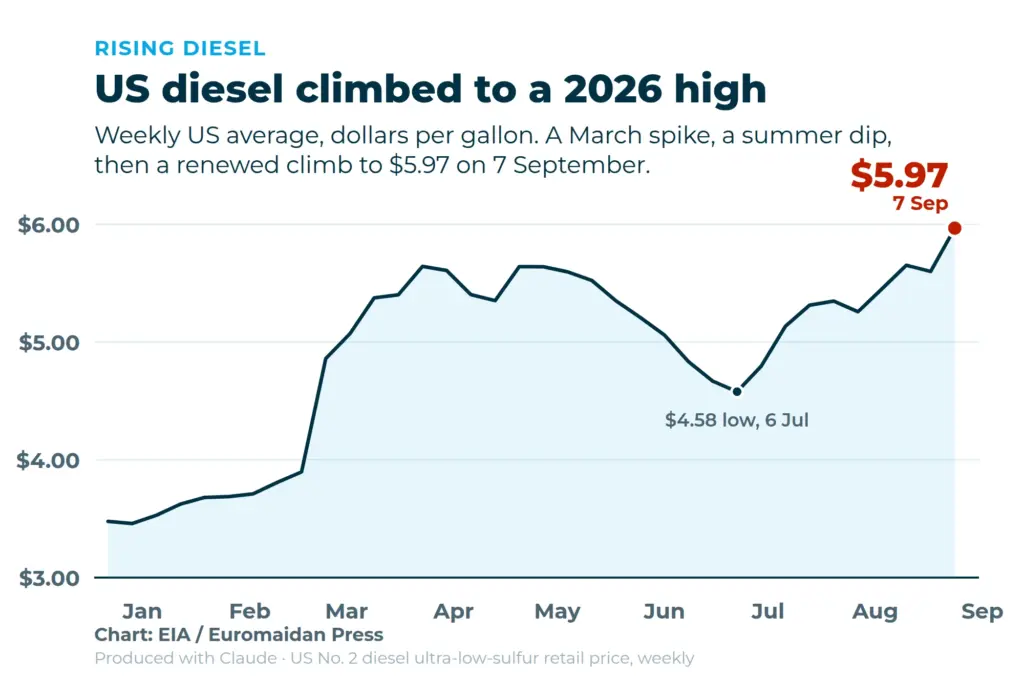
As late as early July, Trump noted that Ukrainian strikes on Russian oil refineries were an escalation capable of bringing the war to an end. The reversal appears driven primarily by the fuel-price shock and its political consequences—not by any change in his assessment of the strikes' military value. US consumers have seen a roughly 20% increase in diesel prices in a matter of weeks, midterms are seven weeks away, and the Republican Party is struggling in the polls.
Line chart of the weekly US average retail diesel price in dollars per gallon through 2026. Source: EIA.
And Ukraine's strikes aim at the exact effect Western sanctions were designed to achieve: ensuring Russia cannot afford to continue the war by undermining its economy. Neither the US nor Europe is supposed to import Russian crude or refined products—the EU banned them, cutting Russia's share of EU oil imports from 25.8% in 2021 to 2.2% in 2025, and the US prohibited them in March 2022.
"The United States is taking sweeping action against Russia's key source of revenue for funding its brutal and illegal war against Ukraine," Treasury Secretary Janet Yellen said in January 2025. That is exactly what Ukraine is doing—with the difference that when Ukraine does it, Trump calls it "hurting the world."
Explore further
NATO’s generals warn of war by 2029. Europe won’t be ready until 2035.
The tsunami of ripple effects
Diesel is only the latest wave. During the year after Madrid, I watched the West take the role of bystander to a war that is all about us—a Russian ever-escalating hybrid war against European NATO members—seemingly accepting the global consequences.
I say seemingly because it makes no sense to sit idle while the tsunami grows to the point where it causes political, economic, and geopolitical chain reactions impossible to predict and difficult to control.
Inaction is not neutral. It is also a choice, and it carries the consequences of engagement with one crucial difference: inaction makes us react to the strategic environment, whereas action lets us shape it.
Aid without an endpoint is not a policy for ending the war; it is a policy for enduring it.
Enduring it is what produced the tsunami: the reverberations that raise the cost of living, undermine food and energy security, and spread famine, recession, inflation, and rising interest rates—increasing the risk of social unrest, extremism, and, ultimately, the fall of governments. Europe is living through the biggest refugee crisis since the Second World War.
he international security architecture is being dismantled, the institutions meant to unite us are discredited, and NATO no longer deters Russia—raising the risk of direct conflict between Russia and Europe.
Inaction is not neutral. It is also a choice, making us react to the strategic environment instead of choosing it through action.
In June 2023, I argued this would likely change the political landscape in the US and Europe—as in the 1930s—as political forces sought to exploit voters' frustration over the war's global effects. It produced President Trump and a rising tide of right-wing forces across Europe—the leading edge of what Canadian Prime Minister Mark Carney called, at Davos, a rupture the world hasn't yet reckoned with: "We understand that this rupture calls for more than adaptation. It calls for honesty about the world as it is... We know the old order is not coming back." Its consequences for Europe have not yet dawned on us.
Explore further
NATO no longer deters Russia. A new coalition could
How to end it
The only way to end the tsunami of ripple effects is to end the war. Waiting only lets it reach the scale where it produces chain reactions impossible to control.
Since 2014, the West has tried to stop Russia's war through diplomacy, negotiations and ceasefires; sanctions and economic pressure; diplomatic isolation; military aid, training and intelligence; NATO deterrence and reinforcement; and humanitarian and financial assistance. More than 200 negotiations were held to stop the war from happening.
They were all futile, because Russia was never negotiating in good faith—it sees negotiation as a means to defeat its opponents. Insanity is doing the same thing over and over and expecting different results.
For a negotiation to succeed, it must solve the cause of the war: Russia's Great Power ambitions, its pursuit of strategic parity with the US and China at the expense of its neighbours. Until that is checked, there will be no peace—and those ambitions are not negotiable. They can only be denied through military power.
The West has done everything short of military intervention. It is time to employ military power, because the cost of continuing the present path is far too high. If Europe wants to turn the tide, it must become proactive. Instead of waiting for the war more intelligence services are warning about, Europe—or rather a Coalition of Like-Minded European countries—must help shift Russia's appraisal of the strategic environment. We need to intervene militarily to end the war, and the tsunami of ripple effects with it.
Hans Petter Midttun, independent analyst on hybrid warfare, Non-Resident Fellow at the Centre for Defense Strategies, board member of the Ukrainian Institute for Security and Law of the Sea, former Defense Attaché of Norway to Ukraine, and officer (R) of the Norwegian Armed Forces.
Editor's note. The opinions expressed in our Opinion section belong to their authors. Euromaidan Press' editorial team may or may not share them.

 Connexion



 Croke Park, Dublin
 29-30 June