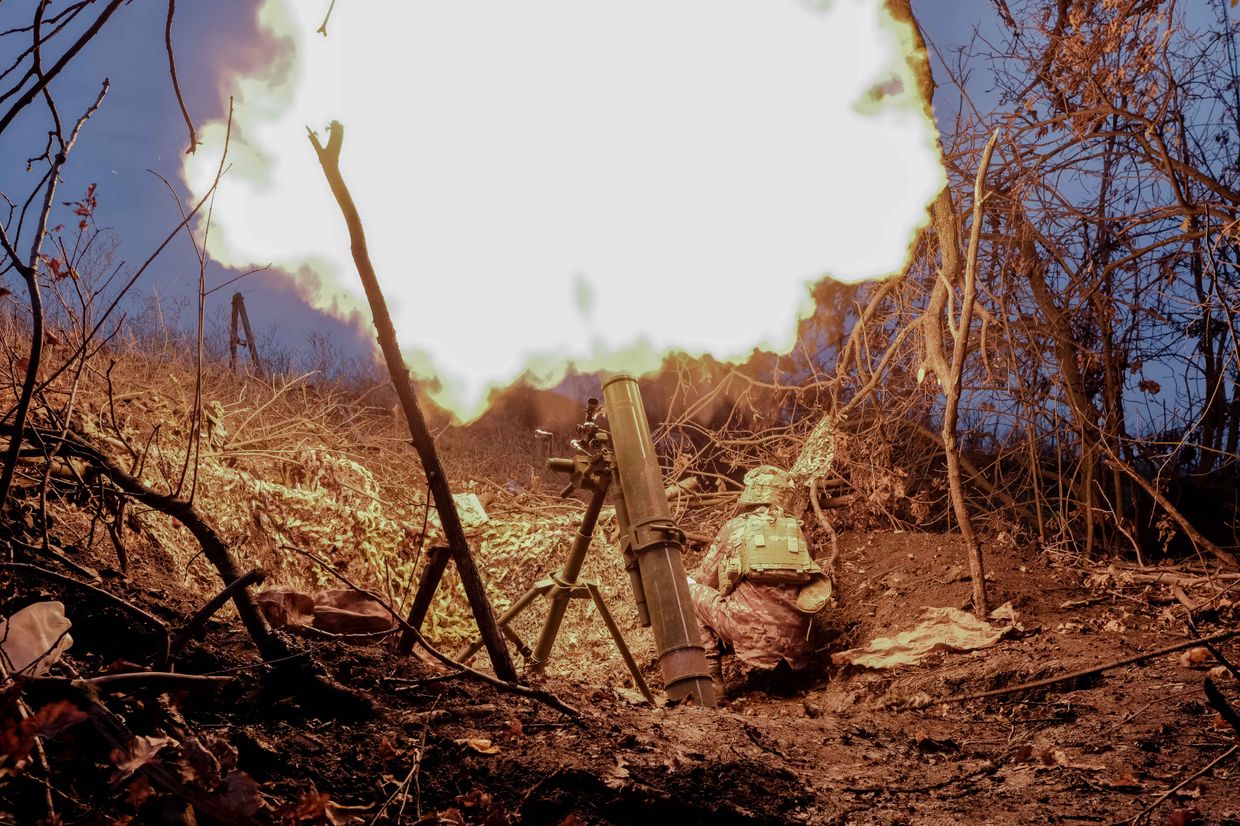
Russia has lost around 1,020,010 troops in Ukraine since the beginning of its full-scale invasion on Feb. 24, 2022, the General Staff of Ukraine's Armed Forces reported on June 30.The number includes 1,070 casualties that Russian forces suffered just over the past day.According to the report, Russia has also lost 10,980 tanks, 22,922 armored fighting vehicles, 53,593 vehicles and fuel tanks, 29,718 artillery systems, 1,427 multiple launch rocket systems, 1,190 air defense systems, 420 airplanes,
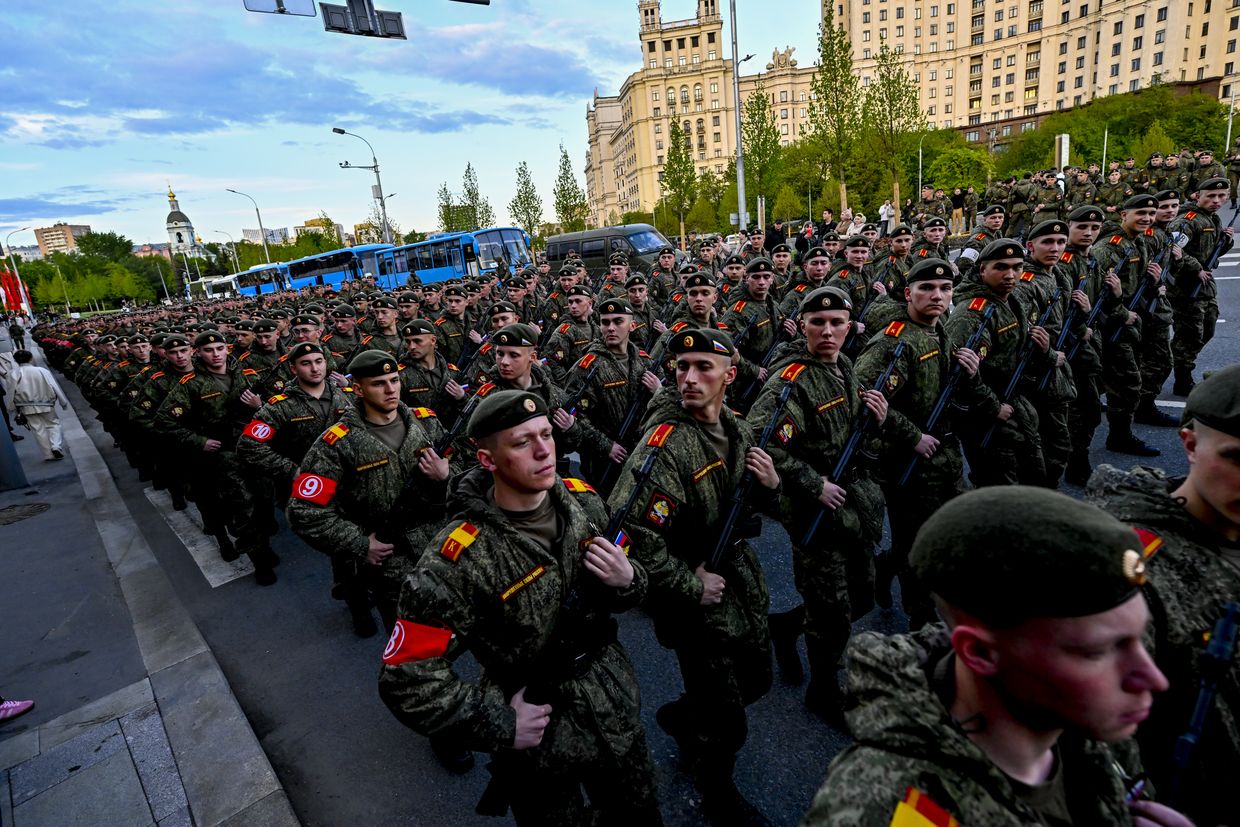
Russia has lost around 1,020,010 troops in Ukraine since the beginning of its full-scale invasion on Feb. 24, 2022, the General Staff of Ukraine's Armed Forces reported on June 30.
The number includes 1,070 casualties that Russian forces suffered just over the past day.
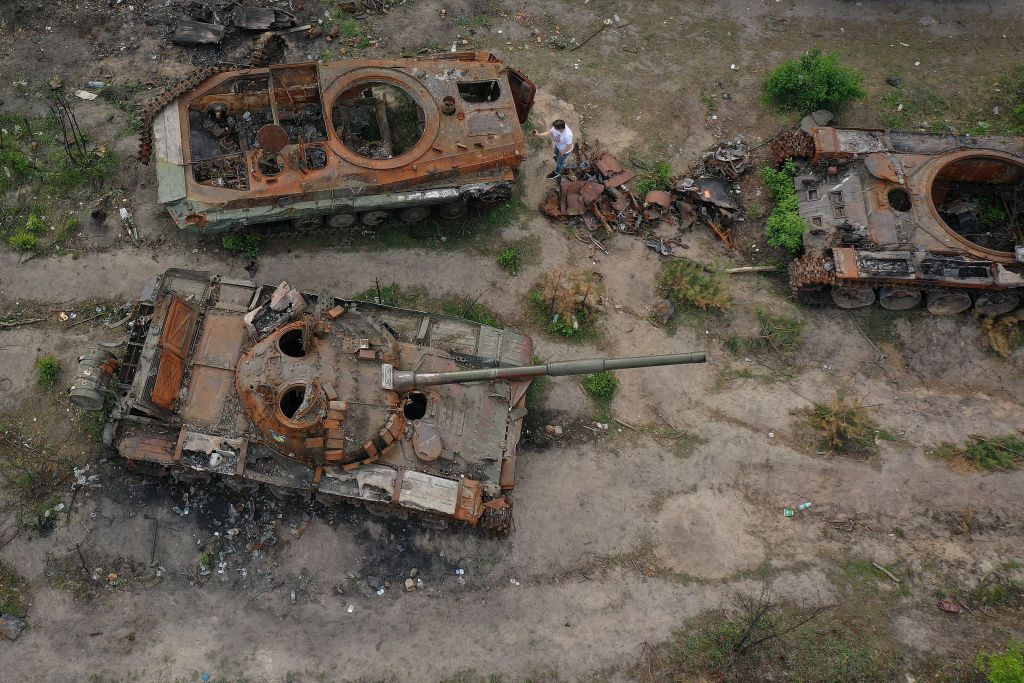
According to the report, Russia has also lost 10,980 tanks, 22,922 armored fighting vehicles, 53,593 vehicles and fuel tanks, 29,718 artillery systems, 1,427 multiple launch rocket systems, 1,190 air defense systems, 420 airplanes, 340 helicopters, 42,796 drones, 28 ships and boats, and one submarine.
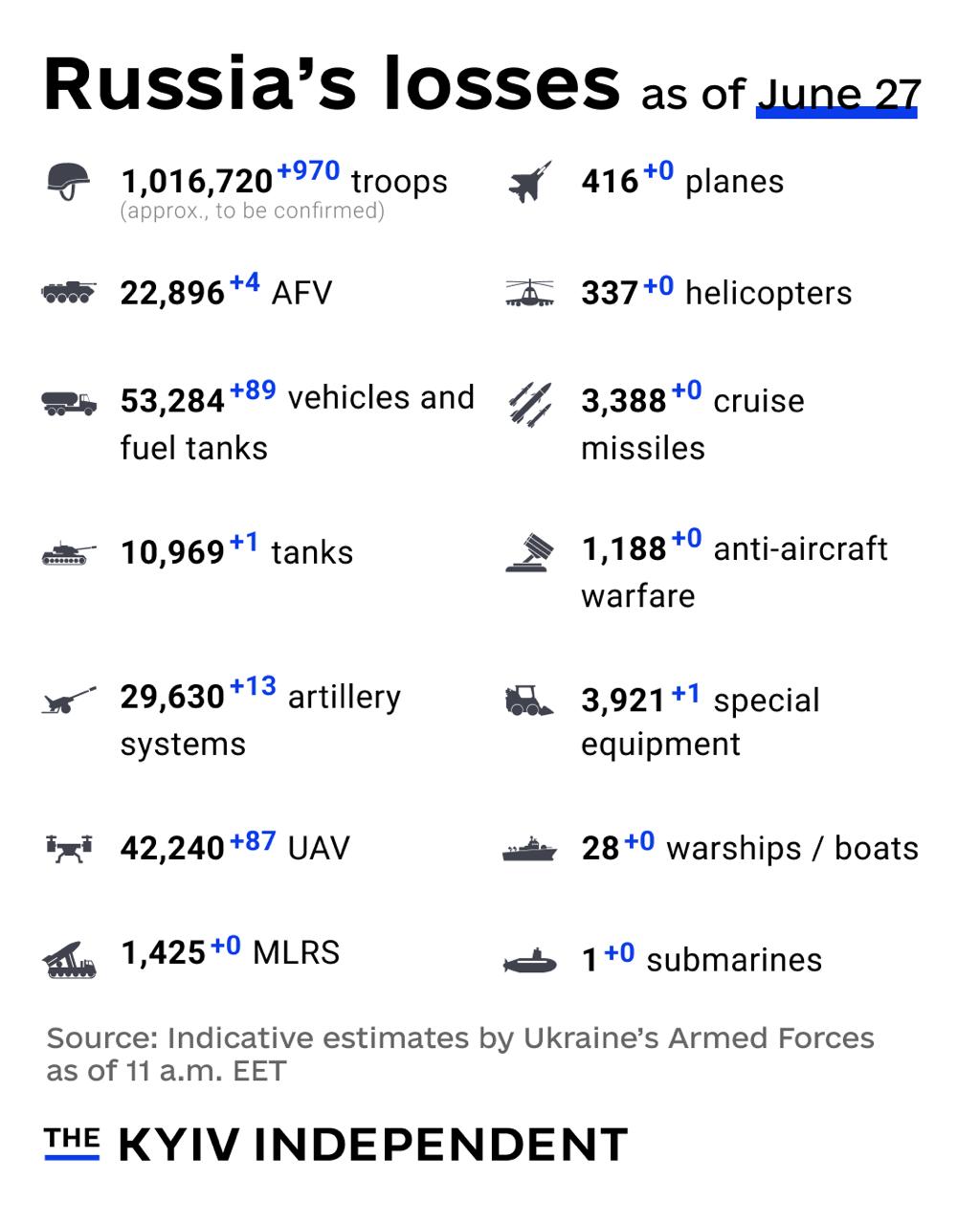
Russia has lost 1,016,720 troops in Ukraine since the beginning of its full-scale invasion on Feb. 24, 2022, the General Staff of Ukraine's Armed Forces reported on June 27.The number includes 970 casualties that Russian forces suffered just over the past day.These are the indicative estimates of Russia’s combat losses as of June 27, 2025, according to the Armed Forces of Ukraine.According to the report, Russia has also lost 10,969 tanks, 22,896 armored fighting vehicles, 53,284 vehicles and fue
Russia has lost 1,016,720 troops in Ukraine since the beginning of its full-scale invasion on Feb. 24, 2022, the General Staff of Ukraine's Armed Forces reported on June 27.
The number includes 970 casualties that Russian forces suffered just over the past day.
These are the indicative estimates of Russia’s combat losses as of June 27, 2025, according to the Armed Forces of Ukraine.
According to the report, Russia has also lost 10,969 tanks, 22,896 armored fighting vehicles, 53,284 vehicles and fuel tanks, 29,630 artillery systems, 1,425 multiple launch rocket systems, 1,188 air defense systems, 416 airplanes, 337 helicopters, 42,240 drones, 3,388 cruise missiles, 28 ships and boats, and one submarine.
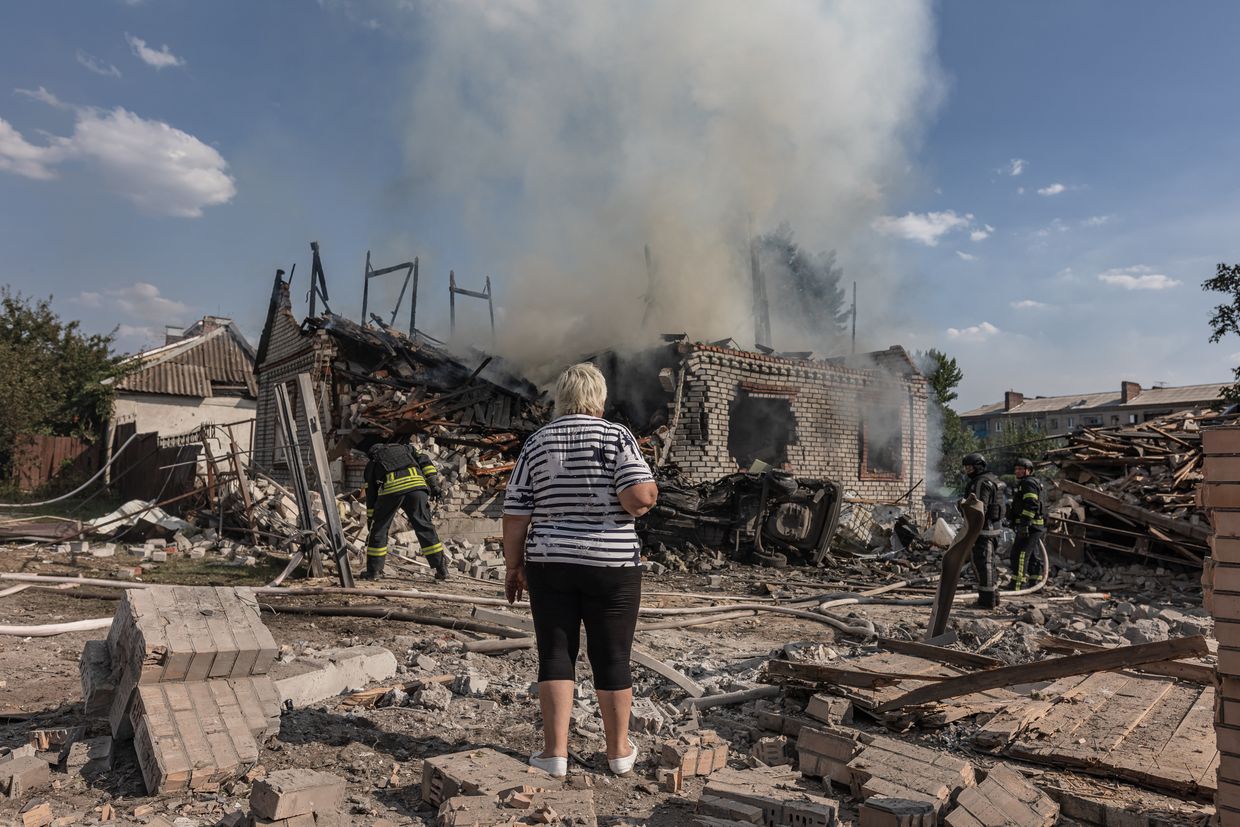
The front-line city of Kostiantynivka in Ukraine's Donetsk Oblast is facing a looming "humanitarian catastrophe" as ongoing Russian strikes destroy critical infrastructure and leave thousands without basic services, Governor Vadym Filashkin said on June 25.Kostiantynivka, in eastern Donetsk Oblast, lies just 10 to 15 kilometers (6 to 9 miles) from several areas currently occupied by Russian forces, according to battlefield mapping site DeepState. The city has come under intensified attack in rec
The front-line city of Kostiantynivka in Ukraine's Donetsk Oblast is facing a looming "humanitarian catastrophe" as ongoing Russian strikes destroy critical infrastructure and leave thousands without basic services, Governor Vadym Filashkin said on June 25.
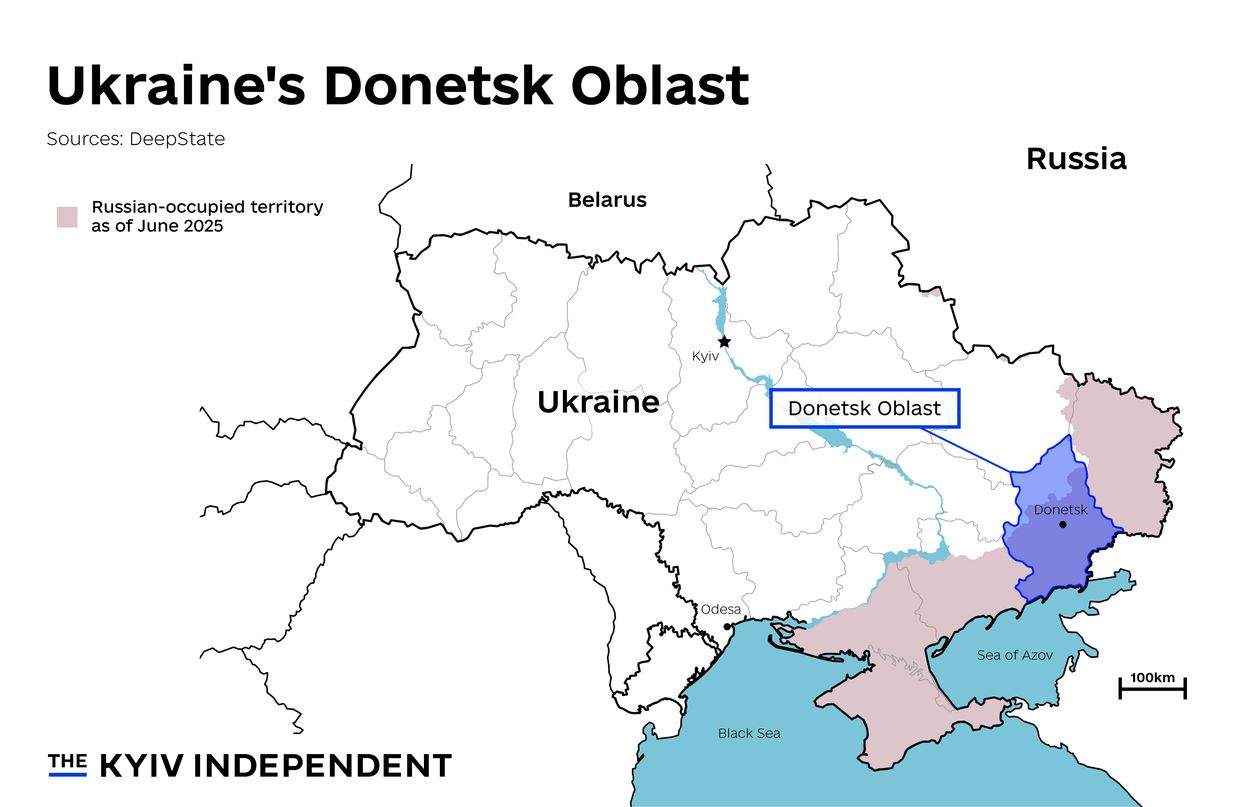
Kostiantynivka, in eastern Donetsk Oblast, lies just 10 to 15 kilometers (6 to 9 miles) from several areas currently occupied by Russian forces, according to battlefield mapping site DeepState. The city has come under intensified attack in recent months as Moscow pushes westward beyond its gains around other nearby towns.
According to Filashkin, nearly half the city is without electricity due to shelling, and 1,900 households in the Santurynivka district have no access to gas, with restoration currently impossible. Water is supplied just once a day from 5 p.m. to 8 p.m., meeting only 20–25% of the city's needs.
Drone strikes have halted all city bus operations, while the suburban route to Druzhkivka, a nearby town, is operating on a limited basis, Filashkin said.
Yevhen Alkhimov, press officer of Ukraine's 28th Mechanized Brigade, which is fighting near Kostiantynivka, told the Kyiv Independent that "the greatest danger at the moment comes from first person view (FPV) drones, including fiber optic models."
"The enemy is trying to control all logistics and communication routes," he said, adding: "The Russians’ goal right now is not so much to destroy the city as it is to make it unsuitable for defense by controlling all the roads."
Alkhimov said Russian forces were deliberately targeting vehicles including civilian buses.
"They are trying to fully control all movement in the city using their drones," he said.
Ukraine's Donetsk Oblast (Nizar al-Rifai/The Kyiv Independent)
Authorities have installed seven large water tanks and 11 smaller containers throughout the city, in addition to 12 wells, six of which are equipped with filtration systems. Five "Points of Invincibility," Ukraine's emergency support hubs, are operational, with two more on standby.
Despite the risks, emergency crews, doctors, utility workers, and local officials continue to work in the city.
"Civilians still remain in the city, and life is becoming more and more difficult for them," Alkhimov said.
"There are fewer people left, the curfew is now longer, but nonetheless, people are still there, and it is truly very dangerous for them to stay in the city."
Filashkin urged those still in the city to evacuate.
Russia has intensified its offensive in eastern Ukraine while insisting that any peace negotiations must recognize its claimed annexation of four Ukrainian oblasts and Crimea. Russian forces do not fully control any of the four regions it seeks to claim.
Ukraine has ruled out ceding its territory as part of any peace agreement.
Russia has lost 1,013,700 troops in Ukraine since the beginning of its full-scale invasion on Feb. 24, 2022, the General Staff of Ukraine's Armed Forces reported on June 24.The number includes 1,200 casualties that Russian forces suffered just over the past day.According to the report, Russia has also lost 10,966 tanks, 22,879 armored fighting vehicles, 52,961 vehicles and fuel tanks, 29,511 artillery systems, 1,424 multiple launch rocket systems, 1,188 air defense systems, 416 airplanes, 337 he
Russia has lost 1,013,700 troops in Ukraine since the beginning of its full-scale invasion on Feb. 24, 2022, the General Staff of Ukraine's Armed Forces reported on June 24.
The number includes 1,200 casualties that Russian forces suffered just over the past day.
According to the report, Russia has also lost 10,966 tanks, 22,879 armored fighting vehicles, 52,961 vehicles and fuel tanks, 29,511 artillery systems, 1,424 multiple launch rocket systems, 1,188 air defense systems, 416 airplanes, 337 helicopters, 41,915 drones, 3,388 cruise missiles, 28 ships and boats, and one submarine.
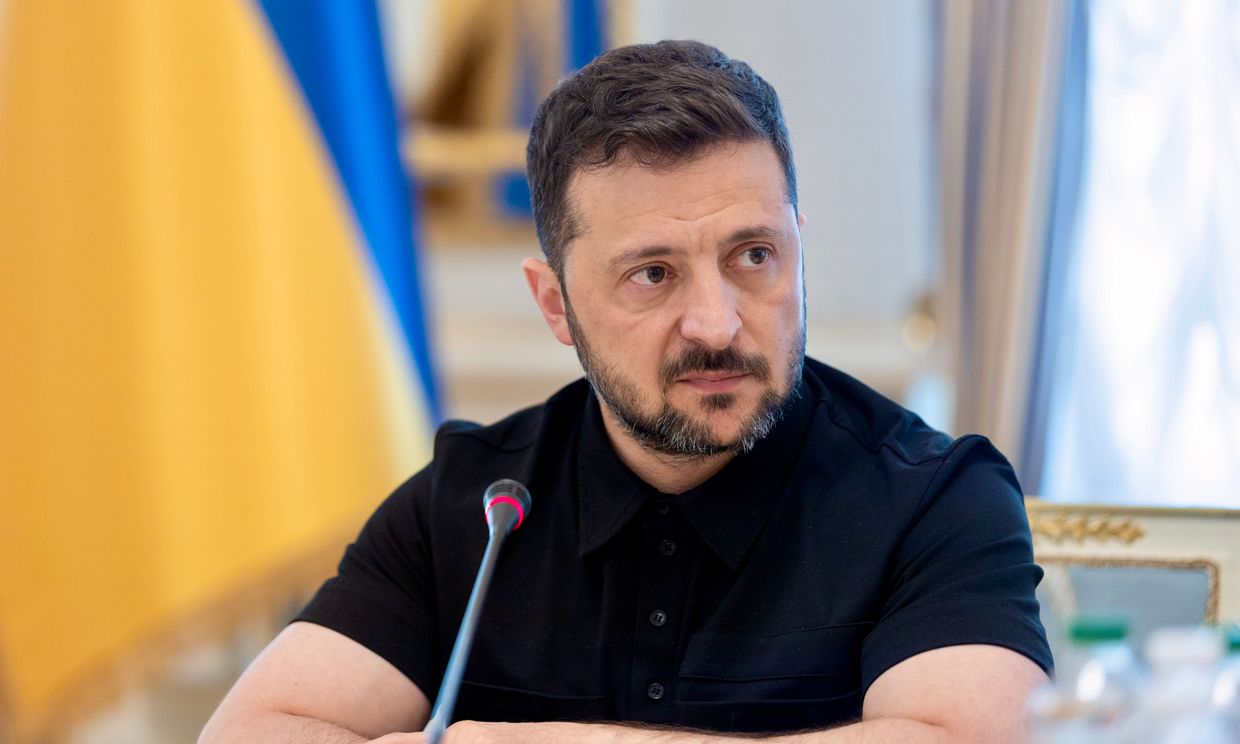
Russia is using the return of war dead as a tool for manipulation to obscure the scale of its military losses from the public, President Volodymyr Zelensky said during a briefing on June 20 attended by the Kyiv Independent.According to Zelensky, Ukrainian authorities have confirmed that at least 20 of the bodies Russia returned as Ukrainian were actually Russian soldiers."Sometimes these bodies even have Russian passports," Zelensky said. He also cited the case of a deceased Israeli citizen figh
Russia is using the return of war dead as a tool for manipulation to obscure the scale of its military losses from the public, President Volodymyr Zelensky said during a briefing on June 20 attended by the Kyiv Independent.
According to Zelensky, Ukrainian authorities have confirmed that at least 20 of the bodies Russia returned as Ukrainian were actually Russian soldiers.
"Sometimes these bodies even have Russian passports," Zelensky said. He also cited the case of a deceased Israeli citizen fighting on Russia's side, whom Moscow had passed off as a Ukrainian soldier.
"Putin is afraid to admit how many people have died. Because if the moment comes when he needs to mobilize, his society will be afraid," he said.
Zelensky's remarks follow the June 2 prisoner and body exchange agreement in Istanbul, the most extensive of the full-scale war. Under that deal, Ukraine recovered 6,057 bodies of its fallen soldiers. Russia, according to Kremlin aide Vladimir Medinsky, took back only 78.
Explaining the difference between the two numbers, Zelensky said that the bodies of the vast majority of Russian soldiers currently killed on the battlefield remain in Russian hands.
"They were advancing, and their dead remained in the territory where they were," he said.
According to the president, exchanges of bodies and even severely wounded soldiers have taken place on the battlefield, but such exchanges are typically not publicized.
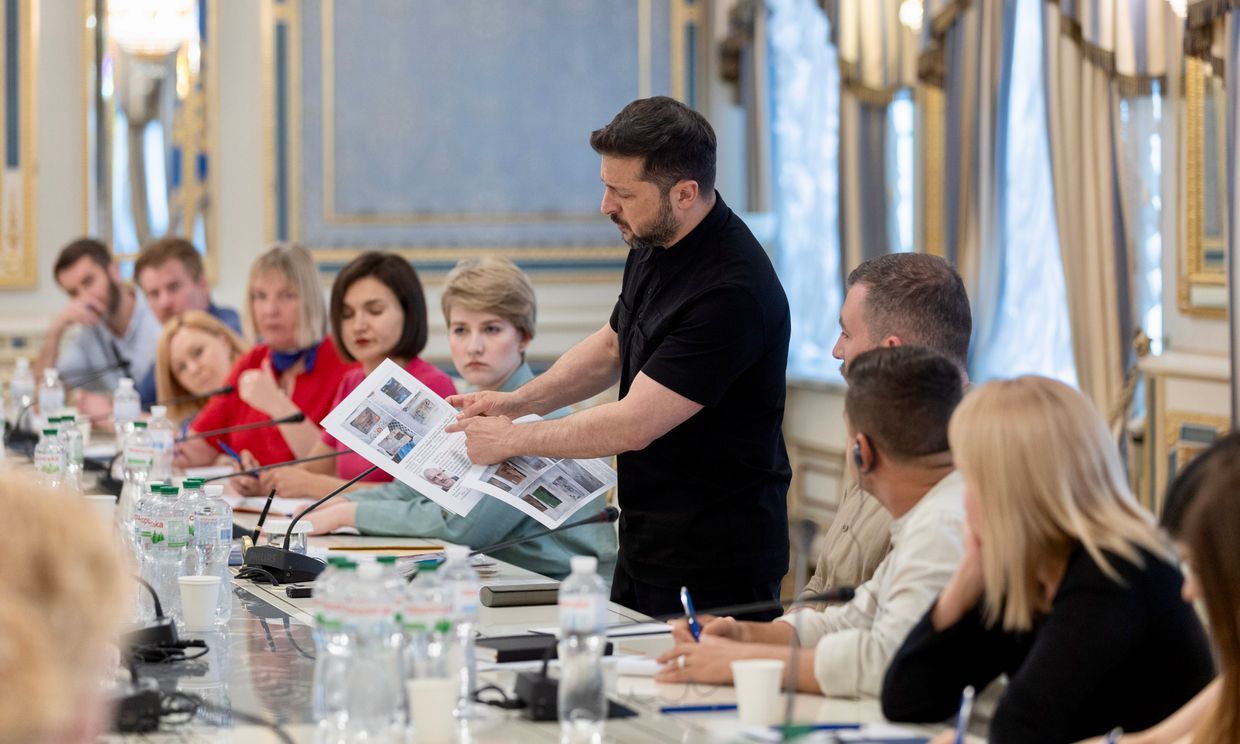
President Volodymyr Zelensky presents evidence to the media in Kyiv on June 21, 2025, showing that Russia handed over the bodies of its own soldiers during exchanges. (Presidential Office)
President Volodymyr Zelensky presents evidence to the media in Kyiv on June 21, 2025, showing that Russia handed over the bodies of its own soldiers during exchanges. (Presidential Office)
Interior Minister Ihor Klymenko earlier confirmed a case in which the remains of Alexander Viktorovich Bugaev, a Russian soldier from the 39th Separate Guards Motorized Rifle Brigade, were returned to Ukraine disguised as a Ukrainian casualty.
"This shows how little human life means to Russia. Or maybe it's just a way to avoid paying compensation to the families. But they will have to pay anyway: we are returning these bodies," Klymenko said on June 19.
Ukraine's General Staff said on June 21 that Russian forces have sustained over 1,010,000 casualties — killed and wounded — since launching the full-scale invasion in February 2022.
Independent Russian outlet Mediazona, along with the BBC Russian Service, has verified the identities of 111,387 Russian soldiers killed, emphasizing that the actual number is likely much higher.
Russia has continued to deny the scale of its losses, often inflating Ukrainian casualties and spreading false narratives. Zelensky warned that this is part of a broader propaganda effort to "break the reality in which we live," in which Russian forces are suffering far greater losses.
The June 2 negotiations in Istanbul led to the most extensive prisoner and body exchange agreement of the full-scale war, although no ceasefire was achieved.
On June 7, Russia accused Kyiv of rejecting a proposed body return, releasing footage that allegedly showed Ukrainian corpses stored in refrigeration units. Ukraine dismissed these claims, saying that the footage was shot on Russian territory, not at a designated handover site.
Kyiv has consistently called for an "all-for-all" exchange of prisoners of war, but Moscow has so far refused to agree to a comprehensive swap.
Russia is systematically recruiting migrant workers from Central Asia to fight in its war against Ukraine as "cannon fodder," Ukraine's military intelligence (HUR) reported on June 21. Citizens of Uzbekistan, Tajikistan, and other countries in the region are increasingly being drawn into Russia's war effort under duress or with misleading promises, HUR said. Many of those recruited are reportedly killed on the front lines.According to HUR, Russia's security services target migrant workers who ar
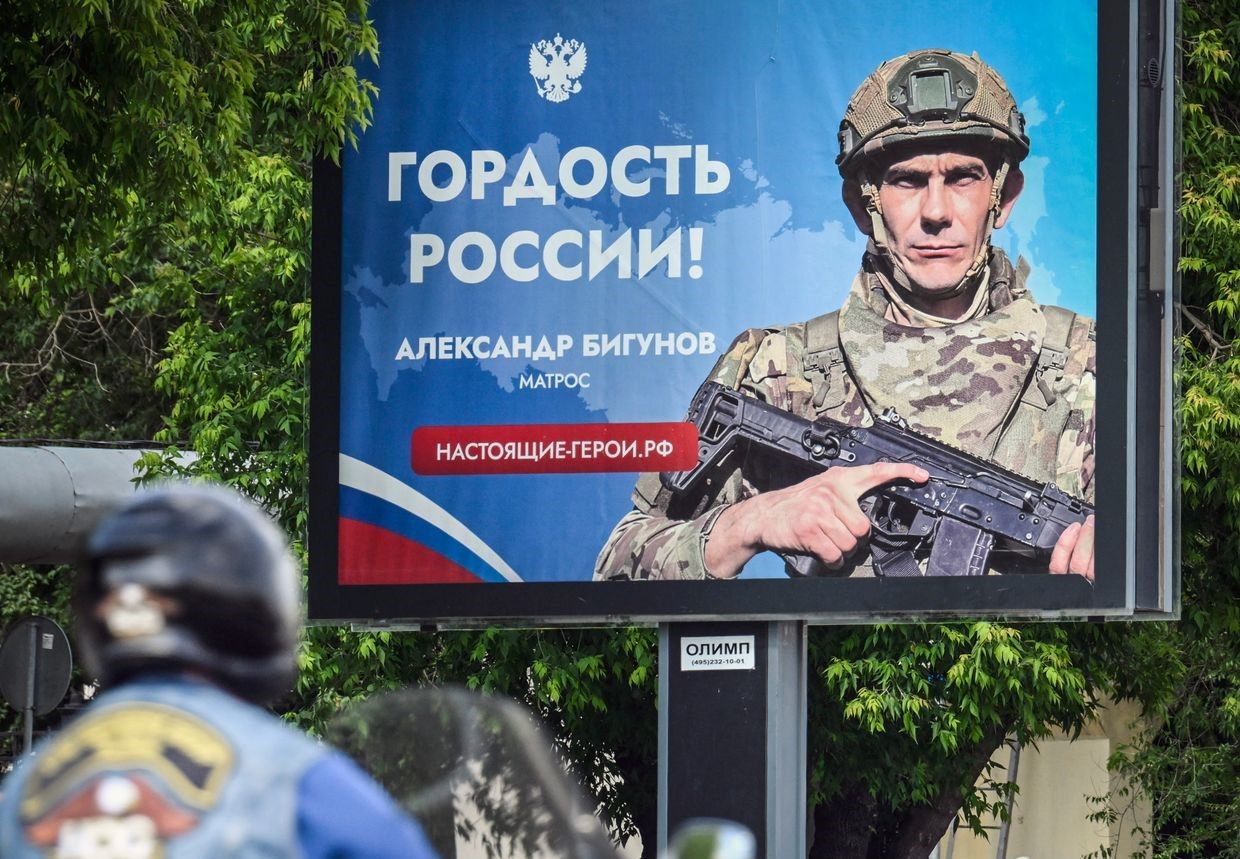
Russia is systematically recruiting migrant workers from Central Asia to fight in its war against Ukraine as "cannon fodder," Ukraine's military intelligence (HUR) reported on June 21.
Citizens of Uzbekistan, Tajikistan, and other countries in the region are increasingly being drawn into Russia's war effort under duress or with misleading promises, HUR said.
Many of those recruited are reportedly killed on the front lines.
According to HUR, Russia's security services target migrant workers who arrive in the country seeking employment, offering short-term military contracts with promises of fast cash. These individuals often lack legal protections and face coercion, with few realistic alternatives.
Among the identified victims are Uzbek nationals Umarov Syroziddin Sabirjanovich and Kholbuvozoda Muhammad Faizullo, who served in motorized rifle units and died during combat operations in Ukraine.
"Mobilized migrants are formed into separate units, which are mainly used in the most dangerous areas of the front line," HUR said. Survivors may face criminal charges in their home countries for serving in a foreign military, carrying the risk of long prison sentences.
Radio Free Europe/Radio Liberty previously reported that migrant workers are funneled into combat roles for financial reasons, with recruitment networks offering salaries unattainable in civilian life.
Russia has also intensified pressure on its naturalized migrant population.
On May 20, Investigative Committee head Alexander Bastrykin said that 20,000 naturalized migrants had been dispatched to Ukraine for failing to register for military service.
With public memory raw from the unpopular 2022 partial mobilization that prompted over 261,000 Russians to flee, the Kremlin has refrained from another mass draft.
Instead, it is relying on a combination of forced recruitment, enlistment bonuses, and targeted campaigns among vulnerable communities.
A Russian soldier deployed in Ukraine may have been involved in an act of cannibalism, audio intercepted by Ukraine's military intelligence agency (HUR) and released on June 20 suggests. In the recording posted by HUR on Telegram, a Russian commander is heard telling a subordinate that one soldier, referred to by the call sign "Brelok," killed and consumed his fellow service member "Foma" over a two-week period.Ukraine's military intelligence described the alleged incident as further evidence of
A Russian soldier deployed in Ukraine may have been involved in an act of cannibalism, audio intercepted by Ukraine's military intelligence agency (HUR) and released on June 20 suggests.
In the recording posted by HUR on Telegram, a Russian commander is heard telling a subordinate that one soldier, referred to by the call sign "Brelok," killed and consumed his fellow service member "Foma" over a two-week period.
Ukraine's military intelligence described the alleged incident as further evidence of what it called the "moral and psychological collapse" of Russian forces.
"Nobody ran away. 'Brelok' took him out and then ate him for two f*cking weeks," a speaker identified by HUR as a commander of a reconnaissance unit from Russia's 68th Motorized Rifle Division can be heard saying in the intercept.
According to HUR, both soldiers served in the 52nd Separate Reconnaissance Battalion, which is reportedly operating near the villages of Zapadne and Lyman Pershyi in the Kupiansk direction of Kharkiv Oblast.
The intercepted speaker adds that "Brelok" was later found dead himself.
"They say he was a 200 (military slang for a killed soldier), f*ck. Well, he ate his comrade, so that's something to think about," the voice says.
The Kyiv Independent cannot independently verify the authenticity of the leaked recording or confirm the events described in it. No visual or documentary evidence has been presented to support the claims, which are based solely on the intercepted audio provided by HUR.
But Russia's recruitment system for the war in Ukraine has heavily relied on the country's prisons as a source of manpower, leading to its ranks being filled by all manner of criminals, even cannibals.
Moscow has been recruiting convicts for its war since the summer of 2022, first under the auspices of the Wagner Group and later under the Russian Defense Ministry.
Initially, prisoners, even those convicted of violent crimes, were promised a pardon after completing a six-month military contract. Since January 2024, Russian army recruits drawn from prisons no longer receive pardons but are released on parole, and are expected to fight until the war is over.
In May 2024, the Moscow Times reported that Russian cannibal Dmitry Malyshev, who was sentenced to 25 years in prison for murder and several other serious crimes, joined one of Russia’s Storm V penal military units.
Malyshev was reportedly recruited to the army together with serial killer Aleksandr Maslennikov, sentenced to 23 years in prison for the "double murder and dismemberment of women."
Previously, Ukraine said there were cases of mistreatment and breakdown of discipline within Russia's own ranks. A group of Russian soldiers fighting near Kursk Oblast surrendered to Ukrainian paratroopers in May, saying abuse within their own units was "worse than captivity," according to a video posted by Ukraine's Airborne Assault Forces.
The soldiers said they had been subjected to inhumane treatment, psychological pressure, and threats while still inside Russian territory.
Reporting by investigative outlets, the Insider and Foreign Policy, has documented systemic abuse of Russian troops throughout the full-scale invasion.
These include so-called "punishment squads," beatings, confinement pits, and hazing that borrows heavily from Soviet-era gulag practices.
Russia handed over some bodies of its own soldiers to Ukraine under the guise of Ukrainian casualties during a recent exchange of the deceased, Interior Minister Ihor Klymenko announced on June 19."Yes, we have facts. We have established the names of these soldiers and officers who are unwanted by their homeland," Klymenko wrote on Telegram.The discovery was made after the handover of remains under an agreement reached during the June 2 talks in Istanbul. In total, Ukraine received 6,057 bodies
Russia handed over some bodies of its own soldiers to Ukraine under the guise of Ukrainian casualties during a recent exchange of the deceased, Interior Minister Ihor Klymenko announced on June 19.
"Yes, we have facts. We have established the names of these soldiers and officers who are unwanted by their homeland," Klymenko wrote on Telegram.
The discovery was made after the handover of remains under an agreement reached during the June 2 talks in Istanbul. In total, Ukraine received 6,057 bodies of its fallen soldiers as part of the phased exchange. Russia, according to Kremlin aide and negotiator Vladimir Medinsky, took back 78.
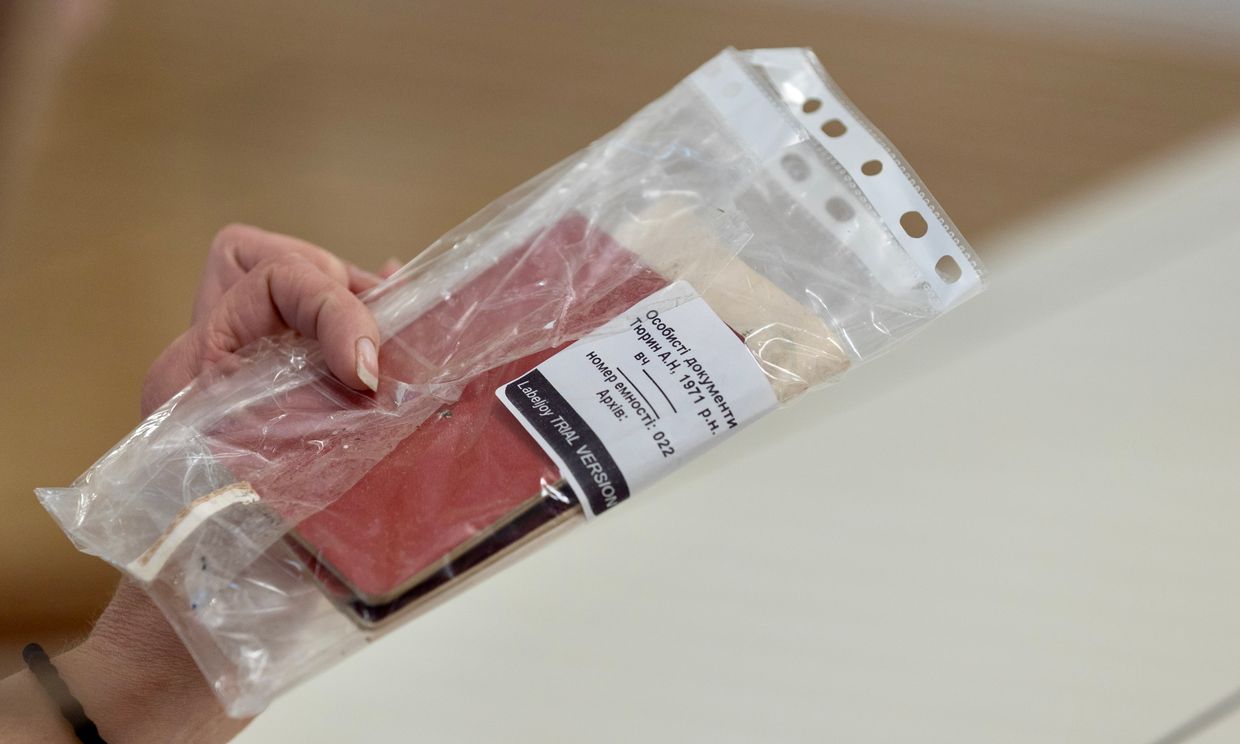
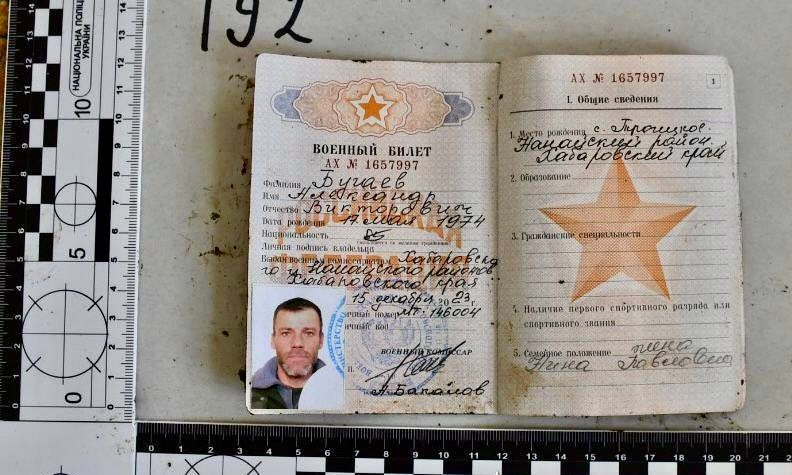
One of the bodies returned to Ukraine, labeled No. 192/25, was dressed in a Russian military uniform and carried a Russian passport issued to Alexander Viktorovich Bugaev, born in 1974.
Alongside the passport, officials found a military ID indicating Bugaev had served in the 1st Battalion of the 39th Separate Guards Motorized Rifle Brigade.
According to Klymenko, Bugaev went missing during heavy fighting near Novomykhailivka in Donetsk Oblast in March 2025. His family had been searching for him for months. Klymenko said Russia had located Bugaev's body but chose to "dump" it among the Ukrainian dead.
"This is yet another proof of how Russia treats its people with contempt, throwing their bodies onto the bodies of Ukrainian soldiers," Klymenko said.
"This shows how little human life means to Russia. Or maybe it's just a way to avoid paying compensation to the families. But they will have to pay anyway: we are returning these bodies."
The official has not mentioned the total number of Russian soldiers' bodies given to Ukraine.
The June 2 negotiations in Istanbul resulted in the most expansive prisoner and body exchange agreement of the full-scale war, although no ceasefire was reached.
Russia accused Kyiv on June 7 of rejecting a proposed body return, publishing footage allegedly showing Ukrainian corpses stored in refrigeration units. Ukraine dismissed the claims, saying the footage was filmed on Russian territory, not at a designated handover site.
Kyiv has consistently called for an "all-for-all" exchange of prisoners of war, but Moscow has so far refused to agree to a comprehensive swap.
Russia has lost 1,005,060 troops in Ukraine since the beginning of its full-scale invasion on Feb. 24, 2022, the General Staff of Ukraine's Armed Forces reported on June 16.The number includes 1,200 casualties that Russian forces suffered just over the past day.According to the report, Russia has also lost 10,939 tanks, 22,811 armored fighting vehicles, 52,096 vehicles and fuel tanks, 29,208 artillery systems, 1,418 multiple launch rocket systems, 1,187 air defense systems, 416 airplanes, 337 he
Russia has lost 1,005,060 troops in Ukraine since the beginning of its full-scale invasion on Feb. 24, 2022, the General Staff of Ukraine's Armed Forces reported on June 16.
The number includes 1,200 casualties that Russian forces suffered just over the past day.
According to the report, Russia has also lost 10,939 tanks, 22,811 armored fighting vehicles, 52,096 vehicles and fuel tanks, 29,208 artillery systems, 1,418 multiple launch rocket systems, 1,187 air defense systems, 416 airplanes, 337 helicopters, 40,804 drones, 3,337 cruise missiles, 28 ships and boats, and one submarine.
Russia has lost 1,001,560 troops in Ukraine since the beginning of its full-scale invasion on Feb. 24, 2022, the General Staff of Ukraine's Armed Forces reported on June 13.The number includes 1,220 casualties that Russian forces suffered just over the past day.According to the report, Russia has also lost 10,934 tanks, 22,791 armored fighting vehicles, 51,821 vehicles and fuel tanks, 29,105 artillery systems, 1,416 multiple launch rocket systems, 1,184 air defense systems, 416 airplanes, 337 he
Russia has lost 1,001,560 troops in Ukraine since the beginning of its full-scale invasion on Feb. 24, 2022, the General Staff of Ukraine's Armed Forces reported on June 13.
The number includes 1,220 casualties that Russian forces suffered just over the past day.
According to the report, Russia has also lost 10,934 tanks, 22,791 armored fighting vehicles, 51,821 vehicles and fuel tanks, 29,105 artillery systems, 1,416 multiple launch rocket systems, 1,184 air defense systems, 416 airplanes, 337 helicopters, 40,507 drones, 3,337 cruise missiles, 28 ships and boats, and one submarine.
Russia will establish a dedicated military branch for unmanned systems, President Vladimir Putin said on June 12 during a meeting on the state armament program."We have accumulated a great deal of experience to create this branch of the armed forces," Putin said, noting the move includes personnel training, manufacturing, and deployment of modern equipment. The announcement comes as both Russia and Ukraine increasingly use drones for strike missions and surveillance. Unmanned systems have become
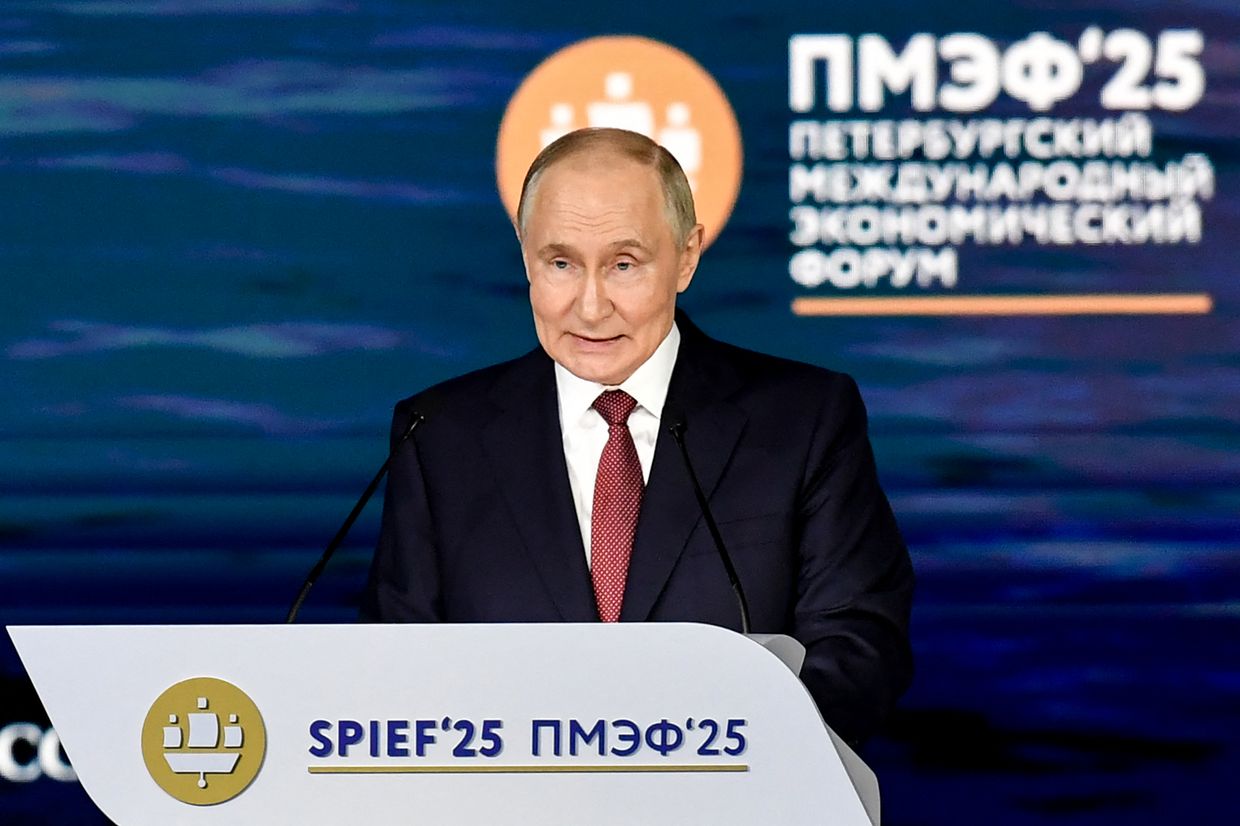
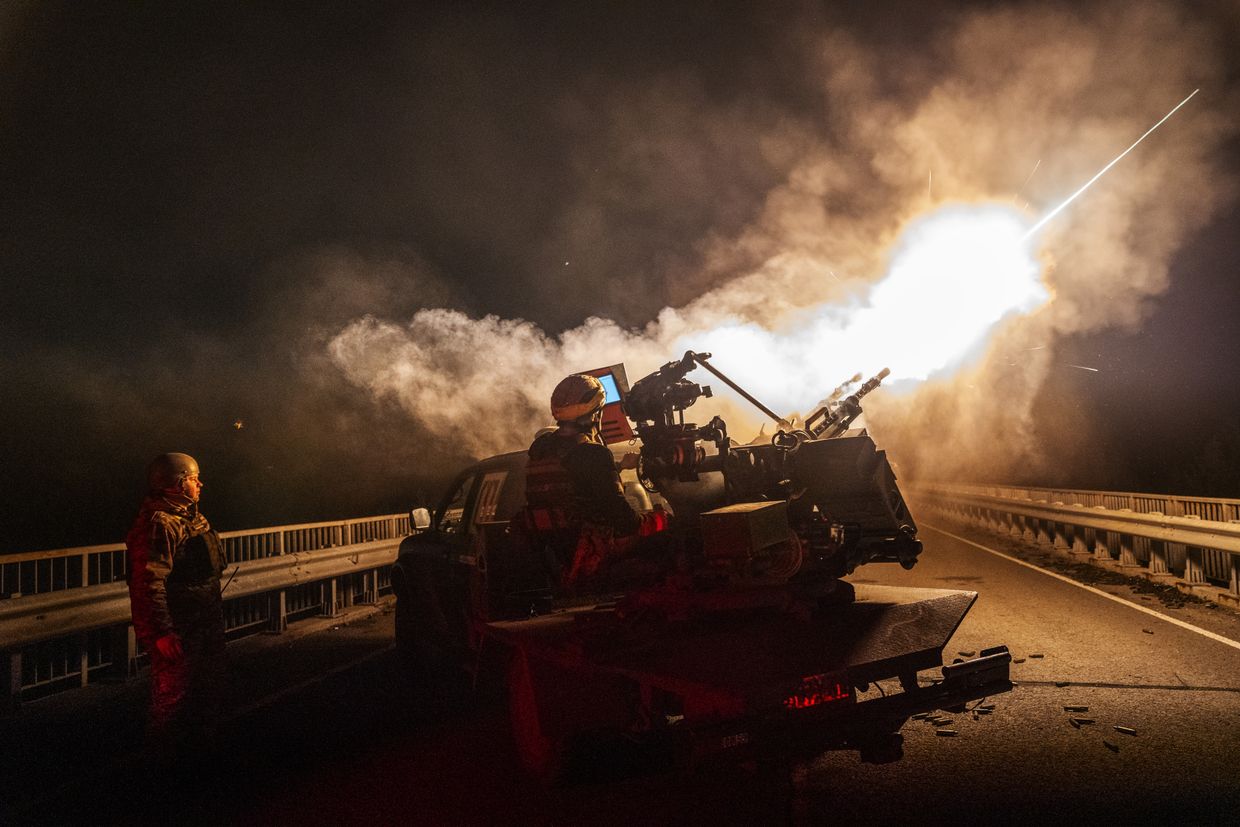
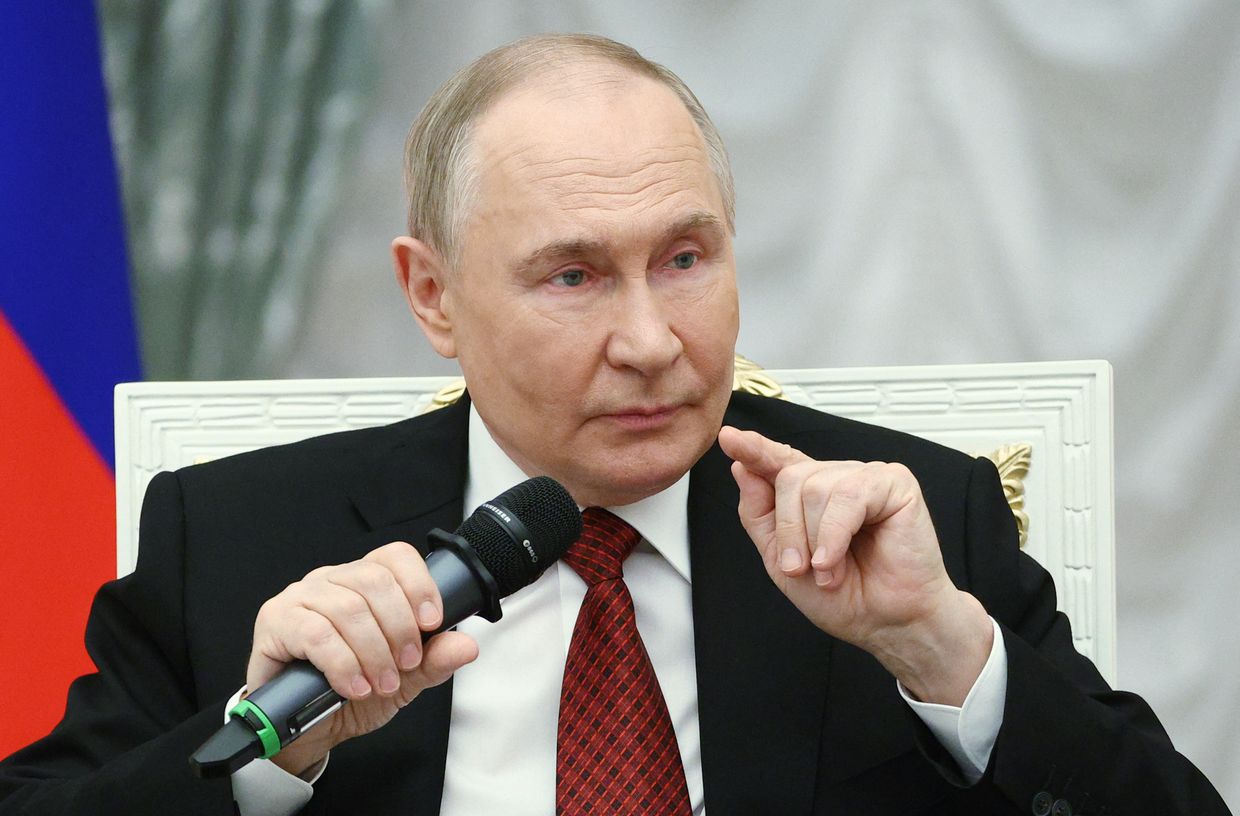
Russia will establish a dedicated military branch for unmanned systems, President Vladimir Putin said on June 12 during a meeting on the state armament program.
"We have accumulated a great deal of experience to create this branch of the armed forces," Putin said, noting the move includes personnel training, manufacturing, and deployment of modern equipment.
The announcement comes as both Russia and Ukraine increasingly use drones for strike missions and surveillance. Unmanned systems have become central to battlefield operations and enabling deep strikes.
Ukraine established its own Unmanned Systems Forces (USF) in June 2024 to formalize and scale its drone-based operations on the battlefield. The USF has since launched hundreds of deep strikes into Russian territory and worked to integrate drone technology across combat units.
Russia, meanwhile, has ramped up drone production over the past year, launching waves of Iranian-designed Shahed-type suicide drones in near-daily attacks on Ukrainian cities.
President Volodymyr Zelensky said on May 27 that Moscow intends to produce up to 500 drones daily, with Russian manufacturers gearing up to manufacture 300-350 drones each day.
Russian drone production has been supported by a steady flow of components from China and a workforce that includes teenagers and foreign laborers from African countries.
The Kremlin's move mirrors Kyiv's earlier military reform and signals Russia's recognition of drones as a critical pillar of modern warfare.

 Connexion
 The Kyiv IndependentKateryna Denisova