Vue normale

  • ✇Coda Story
  • As mathematicians grapple with AI, divisions are multiplying
    This story first appeared as the cover story in Issue 4 of The Atlas, a new global publication by Coda Story and The Continent. Sign up to the newspaper here. In late July, at the International Congress of Mathematicians (ICM) in Philadelphia, the mathematician Jacob Tsimerman was awarded one of four Fields Medals – the highest honour in mathematics. A few hours later, Tsimerman announced that he was joining OpenAI. Tsimerman’s departure from theoretical mathematics, while at the absolu
     

As mathematicians grapple with AI, divisions are multiplying

31 août 2026 à 08:55

This story first appeared as the cover story in Issue 4 of The Atlas, a new global publication by Coda Story and The Continent. Sign up to the newspaper here.

In late July, at the International Congress of Mathematicians (ICM) in Philadelphia, the mathematician Jacob Tsimerman was awarded one of four Fields Medals – the highest honour in mathematics.

A few hours later, Tsimerman announced that he was joining OpenAI.

Tsimerman’s departure from theoretical mathematics, while at the absolute peak of his powers, highlights the fault line in a debate that is upending the normally quiet world of higher mathematics. “What a dick move,” said one mathematics professor, speaking to The Atlas off the record.

Tsimerman, who has written extensively about his fear of “omnicidal futures involving artificial intelligence” – a fear that AI could wipe out humanity, closely associated with the AI “doomer” community – has said he will work on OpenAI’s safety team.

Tsimerman and OpenAI did not respond to a request for comment.

In recent months, OpenAI has announced proofs of various longstanding mathematical problems, solved with one of the company’s latest large language models. Other companies have also made advancements: RedNote, a Chinese AI model, obtained a perfect score at the International Mathematical Olympiad in Shanghai in July.

Human mathematicians, at all levels of the profession, are reeling from the implications. Tim Gowers, a professor at the University of Cambridge who helped to verify one of OpenAI’s proofs, has written that even if AI models fail to progress further, “we have still probably entered an era where it will become very difficult for humans to compete with AI at solving mathematical problems”.

This is a startling assessment – and a marketing coup for the likes of OpenAI.

“Mathematicians actually have a special role in this,” said Joshua Grochow, an associate professor in Computer Science and (by courtesy)Mathematics at the University of Colorado Boulder. “The AI companies’ PR pitch is essentially to say, ‘Look, we have solved math. the intellectually hardest thing ever, therefore we can solve everything.’ ”

LLMs have not solved math – far from it. Nonetheless, Grochow added, recently some capabilities have improved. “They are legitimately able to produce real math, new math that they had not produced before. So you can’t deny that utility. You can deny the extent of that utility, but you can’t say it’s all BS.”

Miek Messerschmidt, a senior lecturer in mathematics at the University of the Witwatersrand in Johannesburg, recently used Anthropic’s Claude to take a crack at a problem that had stumped him. Claude solved it within 30 minutes. “How did I feel? You mean emotionally? I was relieved, because I didn’t have to go down this dead end any more. But I was also disconcerted by what this entity could do in such a short amount of time.”
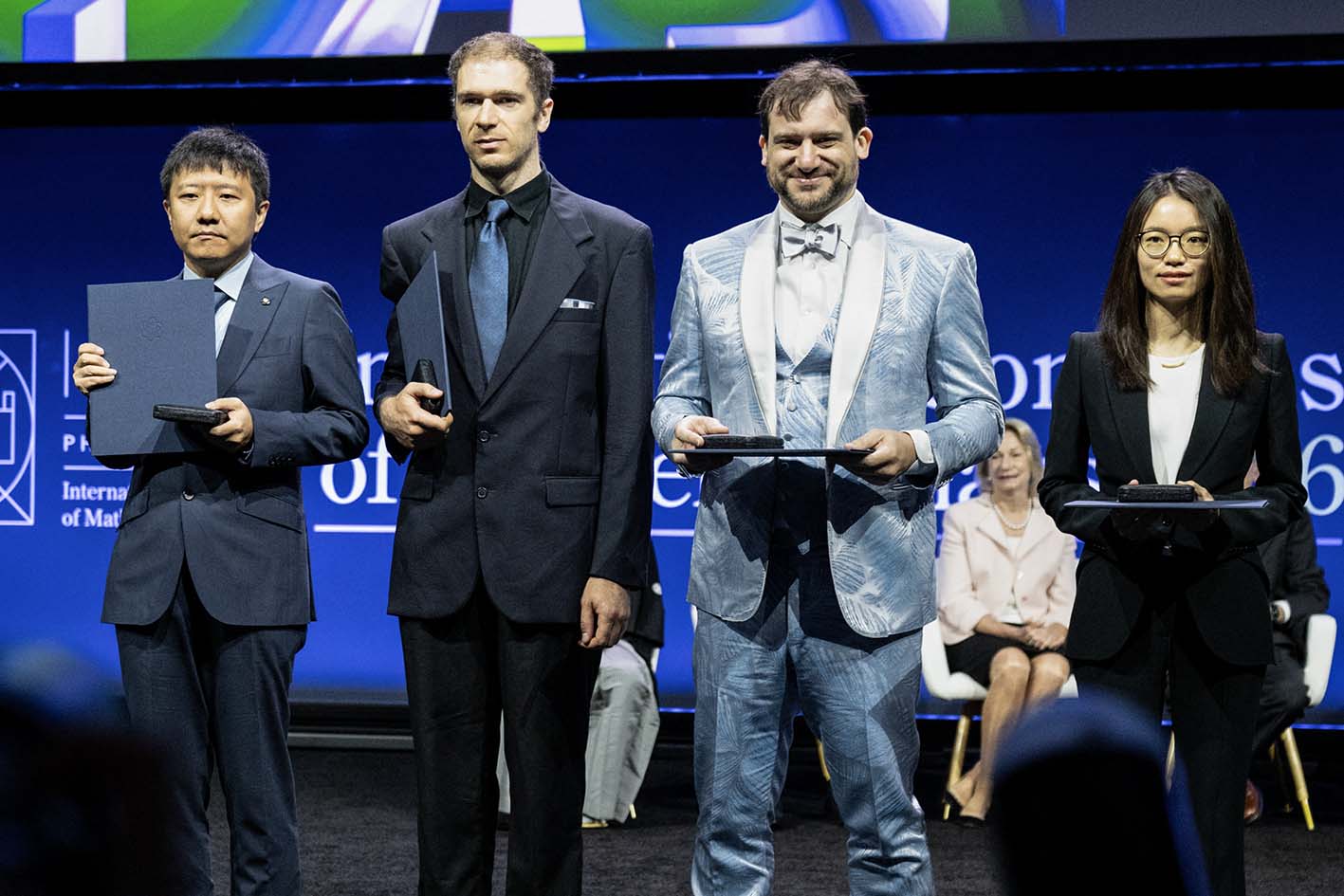
This year’s Fields medallists: mathematicians Yu Deng (China), John Pardon (US), Jacob Tsimerman (Canada) and Hong Wang (China). Photo: Erin Blewett / AFP.

NEW VARIABLES

Mathematics has been disrupted by technological leaps before. The abacus. The mechanical calculator. The blackboard, even, which played an instrumental role in standardising training and mathematical notation (“It’s hard to research, because most of what’s written on blackboards doesn’t stay there very long,” said mathematics historian Michael Barany).

But AI is a different kind of disruption. Where previous advances helped mathematicians expand the frontiers of their knowledge, large language models threaten the livelihoods, and purpose, of mathematicians themselves.

“Our place in society at developing new ideas has been quite unthreatened for quite some time,” said Tim Chartier, a Professor in the Department of Mathematics and Computer Science at Davidson College. “For a long time, the frontier of mathematics could only be expired by the mathematicians themselves. There were no tools that could push into that boundary, except the research mathematician…At this current time, it’s not like we don’t need research mathematicians – but the landscape has changed so quickly, it’s hard to know what that will look like a year from now, two years from now.”

This matters for everyone: for thousands of years, mathematics has been considered to be the foundation of scientific knowledge. There is no physics without mathematics. No astronomy without mathematics. And there is no computer science – or AI – without mathematics. What happens if there are cracks in the foundation?

“I think that LLMs pose an existential threat to the mathematical community,” wrote Tasmin Chu, a PhD student at the California Institute of Technology, in an essay published on 2 August – the day after OpenAI released a set of ten new mathematical results, resolving or making progress on various problems.

“This is a polemic, not a press release,” Chu continued. “I know that others feel the same way; I have spent today crashing out and learning that top mathematicians I know are crashing out.”

Some of what mathematicians are worried about is the same as what everyone else is worried about: that AI will take their jobs; that AI companies have absorbed everyone’s work, and are reproducing it without attribution or compensation; that students aren’t learning properly any more; and that there won’t be jobs for them when they graduate.

But some worries are more specific to the field. Like the fear that, if mathematics becomes too reliant on particular AI models, then AI companies will have the power to restrict access to a select few – or make it prohibitively expensive. That promising young mathematicians, instead of turning to research, will use their talents instead to refine proprietary algorithms, which may or may not be used for the common good. That there will be no one left to understand, let alone vouch for, the mathematics produced by the machines. That objective truth, or anything close to it, is going to be much harder to prove – a fear shared with journalists, incidentally, who find it increasingly difficult to verify whether a photograph is real or fake.

2nd Century relief of a merchant using an abacus. Photo: Musée de La Cour d’Or - Metz Métropole.

MATHEMATICIAN IN THE LOOP

After speaking with more than a dozen leading mathematicians from around the world, The Atlas can confirm that Chu is not alone with her fears: it’s all anyone is talking about. The crisis is existential – and mathematicians are looking to one man in particular to guide them through it.

There are no working mathematicians who are truly famous. The closest anyone gets is Terence Tao, a professor at UCLA, who is often referred to as the world’s greatest living mathematician. A prodigy, Tao skipped five grades of school, receiving his masters degree at age 16. By 21, he had earned a PhD from Princeton, and was awarded the Fields Medal just ten years later, in 2006, for his pioneering work with Ben Green on prime number theory.

But what sets Tao apart, in a field infamously incomprehensible to outsiders, is his ability to communicate to both mathematicians and laypeople alike. This has made him a de facto spokesperson for the mathematics community – and extremely influential in setting its norms. “From all accounts he’s a lovely man,” said one researcher, speaking anonymously.

“But the social pressure to agree with Terry Tao is really strong.”

On July 24, the day after Jacob Tsimerman joined OpenAI, Tao gave a public lecture at the ICM titled “Mathematics in the Age of AI”. In it, he presents his “working hypothesis”: that AI tools for mathematics, which he already uses in his own research, will keep getting better. This will allow for collaboration on a vastly greater scale than has ever been possible before, Tao argues, and speed up the pace of research – revealing new, previously unimagined frontiers.

But it will also change, fundamentally, the role of human mathematicians. There will be little point in problem-solving – the computers will handle that. But the humans will still have to do the really hard work: understanding why AI-generated proofs are correct, and explaining this to others. The sooner they embrace this and plan accordingly, Tao concludes, the better.

The Atlas reached out to Terence Tao to request an interview. His human assistant, UCLA media relations officer Holly Ober, declined the request, making a referral instead to a “living document” which is maintained by Tao’s Claude AI assistant, on his website. This document synthesises Tao’s current thinking on AI, based on his public writings and talks, even “interviewing” Tao with follow-up questions.

As per his AI assistant, Tao believes that the topic of AI in mathematics is too important to be left to just a small number of spokespeople – and that his own “influence on this discussion should diminish as the rest of the community steps up.”
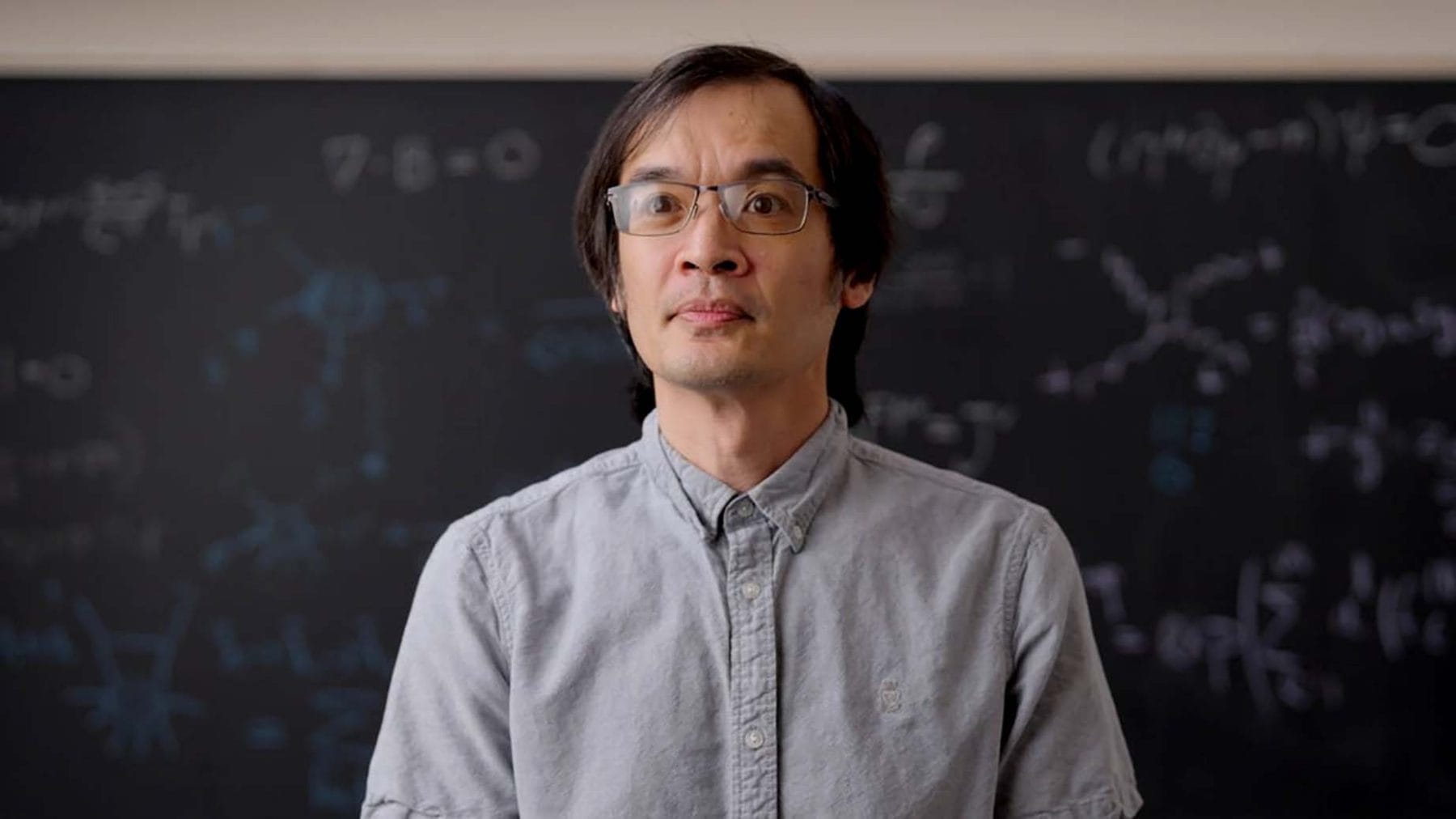
Terence Tao, often referred to as the world’s greatest living mathematician. Photo: OpenAI Academy.

AN UNSOLVED EQUATION

Not everyone believes in the inevitability of AI defining the future of mathematics. According to several sources, both organisers and funders were disappointed with the turnout at the ICM in Philadelphia. Despite the gravity of the occasion, the congress was not at capacity.

Ila Varma and Tarik Aougab, associate professors at the University of Toronto and Haverford College respectively, may have had something to do with that. In March, they launched a petition to boycott the ICM due to the ongoing war in Iran, increasing authoritarianism in the United States and the risks faced by visiting academics – if they were even allowed in. “AI companies were invited, but most African mathematicians who tried to attend couldn’t get visas,” Varma said.

More than 2,600 people signed the petition. For Varma, this is evidence that mathematicians may yet use their status to resist the influence – and the cash – of the big AI companies.

“There’s an idea that the positionality of mathematics in society is to decide who’s smart, who’s worthy of the most lucrative career opportunities and the privileges that go along with it. And now we are being asked to take this technology that is likely to be extremely unhealthy for users, that’s bad for the environment, this thing built on unethical labour, and our discipline is being used against many of our wishes to tell society that this thing is intelligent, and that you should let it do your thinking for you.”

Michael Harris, a professor at the Institut de Mathématiques de Jussieu in Paris, was at the ICM in Philadelphia. “The talks I attended on AI, starting with Tao’s public lecture, took pains to insist on the need for human mathematicians to make sense of anything produced in the name of the discipline, by machines or by humans,” he said. “There is a growing resistance to any use of AI whatsoever in mathematics, especially among young people, and this will become evident over the next few months.”

One of the clearest voices of dissent belongs to Max Weinreich, Assistant Professor of Mathematics at the City University of New York.

In an essay published earlier this month, Weinreich makes the case against what he describes as “artificial mathematics”: “Mathematicians do not need to use AI, nor should we use AI; soon, I argue, you will not want to have your name associated with AI. Instead, we should use our intellectual authority to oppose its development.”

His opposition is about more than mathematics, he told The Atlas. In his view, the environmental and financial implications of the AI boom pose major societal risks – and mathematicians, given their privileged position, are one of the few groups of people who can do anything about it.

As John Fletcher, a theoretical physicist and mathematician, observed: “There is a lot of power in being perceived as the smartest people in the world.”

Po-Shen Loh, a professor at Carnegie Mellon and former coach of the US International Mathematical Olympiad team, backs mathematicians to figure it out – by treating it like a maths problem. “AI is making mathematicians engage with the real world. They are smart enough to realise they have an existential crisis. They’re quickly racing down to discover all the dead ends, to see what works and what doesn’t.”

And when they figure it out, maybe they’ll let the rest of us know. 

A version of this story, edited for length, first appeared in The Atlas newspaper.  Additional reporting by: Shougat Dasgupta, Masho Lomashvilli, Irina Matchavariani.
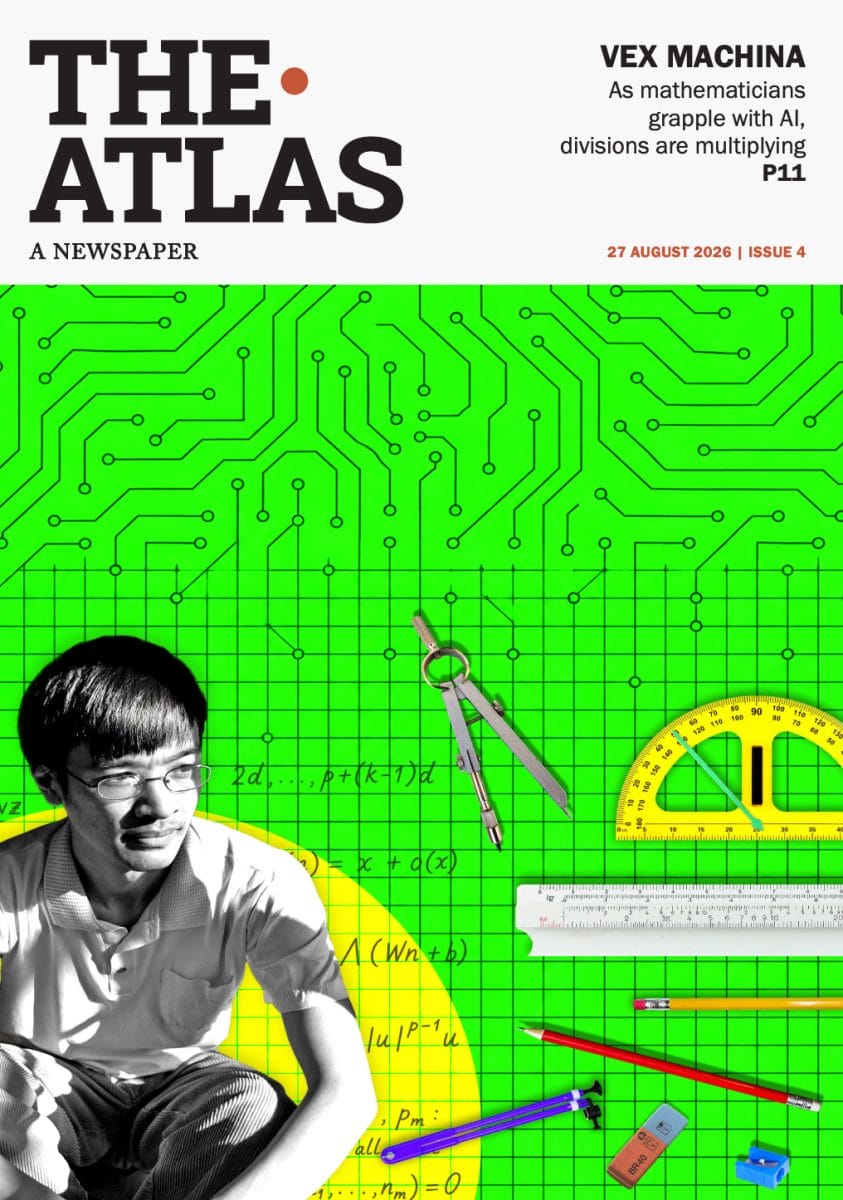
The Atlas - Issue #4 - 27 August 2026

The post As mathematicians grapple with AI, divisions are multiplying appeared first on Coda Story.


  • ✇Coda Story
  • Darkness is losing its war with the light
    Astronomy, our window into the rest of the universe, happens in the dark. Planets, stars and galaxies – all the mysteries of the cosmos – only reveal themselves at night. But the night sky may be getting much brighter, thanks to an American company with a plan to conquer darkness itself by sending 50,000 giant mirrors into space. What you are reading first appeared as a cover story for The Atlas, our new global publication with The Continent. Sign up here to get the next edition delivered to
     

Darkness is losing its war with the light

13 août 2026 à 08:29

Astronomy, our window into the rest of the universe, happens in the dark. Planets, stars and galaxies – all the mysteries of the cosmos – only reveal themselves at night. But the night sky may be getting much brighter, thanks to an American company with a plan to conquer darkness itself by sending 50,000 giant mirrors into space.

What you are reading first appeared as a cover story for The Atlas, our new global publication with The Continent. Sign up here to get the next edition delivered to your inbox on August 27.

Astronomers are panicking.

It is an “existential threat” to optical astronomy, says the European Southern Observatory. A “disastrous” idea that will “permanently scar” the night sky, according to the Royal Astronomical Society. The American Astronomical Society told Nature it “would probably mean the end of ground-based astronomy, or optical astronomy, at least.”

Sthabile Kolwa agrees. “It will take away a very crucial part of our civilization,” she tells The Atlas. Kolwa, a senior lecturer in astronomy at the University of South Africa, studies the life cycles of galaxies, but today her concerns are more immediate. “It might come to this, that we just have to find them in the parking lot and say, ‘Hey, what are you guys doing? You’re going to ruin science for us.’ ”

Like Uber, but for the sun

The parking lot in question is in Hawthorne, California, outside the headquarters of Reflect Orbital. They call themselves The Sunlight Company. The start-up is celebrating: Earlier this month, the United States Federal Communications Commission (FCC) approved the launch of Eärendil-1, likely in a few months time.

This satellite, named for a character in JRR Tolkien’s The Silmarillion, will unfurl an 18m x 18m mirror in low Earth orbit. It’s designed to reflect sunlight onto the dark side of the earth, lighting a 5km2 patch of land with the strength of four full moons.

It is a proof of concept.

By 2035, Reflect Orbital wants 50,000 of its mirrors in space, delivering illumination “comparable to daylight” on demand to paying customers (“sunlight is the new oil,” says chief executive Ben Nowack). The company says this will allow solar panels to generate clean energy overnight; provide “safer, evenly-lit streets” to cities that pay for it; and keep construction sites and farms working 24/7.

There will be an app, of course, offering “sunlight as a service” – lighting up the night will be as easy as ordering an Uber.

Clean, renewable energy is at the heart of the company’s vision, a spokesperson told The Atlas in a statement. Reflect Orbital declined to respond to specific queries and said it is in constant dialogue with astronomers, scientists and environmental researchers to mitigate the impact of the light pollution: “We are able to dim the brightness of the service and turn it off at any stage. We control where the light shines when serving an authorised customer. Most people and most places will never see this light. It is precise, targeted and customers will require permits to receive the service.”

Circadian arrhythmia

A new research paper, published in May, challenges Reflect Orbital’s position. Its author, the European Southern Observatory’s Oliver Hainault, concluded that the company’s 50,000 satellites would increase the background brightness of the sky by 300% – even when their mirrors are pointed somewhere else. This, coupled with a proposal from Elon Musk’s SpaceX to build vast data centres in space, would go “beyond the limit” of what astronomy can withstand.

What that means, in practice, is that the images from ground-based telescopes will be dramatically less useful, marred by streaks of light from passing satellites. The most distant light sources won’t be visible at all.

This will obscure evidence of other galaxies, hinder research into black holes and other cosmic phenomena, and potentially prevent early warnings of asteroid approaches. Cutting-edge astronomy will only be possible from space-based telescopes like the James Webb and the Hubble – access to which is already massively oversubscribed, and subject to political interference.

The night sky will look different to the naked eye, too. “The next time you’re away from urban light pollution, spend some time outdoors after dark and enjoy the view of the Milky Way and the constellations that have inspired awe since humankind woke to consciousness. Chances are those views are not here to stay forever,” wrote journalist Tereza Pultarova for Space.com.

Anna Jibladze

Running out of space

The night sky is already a lot brighter than it was 150 years ago, when light bulbs started to become commonplace. According to Dark Sky International, a US-based nonprofit that advocates against light pollution, 80% of Earth’s human population already lives under some form of sky glow, most of which is generated on land. This has forced astronomers to seek out “dark sky places,” like the Atacama Desert in Chile or the Upper Karoo in South Africa, for their telescopes.

Humans can adapt to less darkness. But it is much harder for animals and ecosystems that have evolved alongside predictable rhythms of day and night. Nocturnal predators lose the ability to hunt; sea turtle babies can’t find their way to the sea; migratory birds are thrown hopelessly off course; and moths expend all their energy helplessly chasing artificial light sources.

“It’s almost like we are on a mission to obliterate natural darkness from earth,” said Ruskin Hartley, Dark Sky’s chief executive. “And now rather than do it street by street and bulb by bulb, let’s do it from space.”

Space is, in theory, protected by the Outer Space Treaty, a 1967 agreement signed by 110 countries, including all the major space superpowers. It states that “space is the province of all mankind." But that’s not what’s actually happening, Hartley argues. “In the US, it’s the most wealthy, most powerful individuals who are gobbling up as much of that orbital space as they can before someone else can get that opportunity” – with China, Russia and Europe all scrambling too for a greater presence in low Earth orbit.

“Who gets to choose that we light up the night sky? Who gets to make that decision?” Ruskin asks. In the US, it is the FCC’s job to decide what satellites are allowed in space. But it has said that assessing the impact of light pollution or environmental damage is not within its remit. Instead, it wants to slash regulation so American companies can take advantage of the “space industrial revolution.”

And Reflect Orbital has rich and powerful backers. Earlier this year, it secured a $1.5-million contract from the US air force, hinting at possible military applications for its mirrors. Last year, it raised $20-million from three venture capital firms, including Sequoia Capital, one of the biggest investors in Silicon Valley. Sequoia also owns a multibillion-dollar stake in SpaceX, which has its own plans for low earth orbit.

There are already more than 10,000 Starlink satellites up there, giving Elon Musk unprecedented influence over global communications. The company wants to launch one million more satellites over the next few years to build a network of space-based data centres. In addition to the light pollution, astronomers worry the potential for collisions will increase dramatically, as will risks to the ozone layer.

A brighter future

On her blog Higher Dimensions, the astronomy professor Janna Levin contemplates our brighter future. “It is quite possible that the hot glow of the swarm of data satellites will saturate the night, washing out the stars from our perspective on Earth. We’ll look up into the sky and instead of Zeus transformed into a swan outlined in a constellation of a few stars, the machine gods will literally loom above us, glowing with radiant heat, making declarations, predicting the weather, forecasting then determining our fate.”

Kolwa, the South African astronomy lecturer, offers a different metaphor: that of empires “colonizing low Earth orbit.” This was an ambition of one of the most infamous imperialists of them all, Cecil John Rhodes, who said that he looked up at the stars and thought: “I would annex the planets if I could; I often think of that. It makes me sad to see them so clear and yet so far.”

But it hasn’t been colonized just yet.

“I’m still trying to figure out what we can do, what responsibility we have as scientists,” says Kolwa. “How could we engage our communities to stand up to these corporations and say no? We must keep our night skies dark, as dark as possible.”

The post Darkness is losing its war with the light appeared first on Coda Story.

  • ✇Coda Story
  • How Brazil is starting to rein in Big Tech
    On April 24, Brazil’s competition authority, the Administrative Council for Economic Defense (CADE) announced it was opening an investigation to assess whether Google’s use of news content amounted to unfair competition practices against the Brazilian press. The announcement was welcomed by civil society organizations that have tried to push regulation to limit the reckless power of Big Tech for years. Ajor, Brazil’s Digital News Association, said that “a balanced relationship between digital pl
     

How Brazil is starting to rein in Big Tech

13 mai 2026 à 07:50

On April 24, Brazil’s competition authority, the Administrative Council for Economic Defense (CADE) announced it was opening an investigation to assess whether Google’s use of news content amounted to unfair competition practices against the Brazilian press. The announcement was welcomed by civil society organizations that have tried to push regulation to limit the reckless power of Big Tech for years. Ajor, Brazil’s Digital News Association, said that “a balanced relationship between digital platforms and journalism organizations is fundamental to the flourishing of journalism committed to the public interest. By ensuring a fair competitive environment, Cade directly advances that goal.”

In spirit and intent, CADE’s investigation into Google is similar to legislation in Australia that recognized that value is being extracted from news publishers without proportionate recompense. In Brazil, the case has been debated since 2019, but the adoption of AI Overviews helped alter the perspective of Brazilian judges. The overviews are artificially generated summaries that synthesize information from several sources and appear at the top of Google Search results. They “raise potentially more concerns,” ruled Judge Camila Cabral Pires Alves, “as they may more profoundly alter the economic function of the interface and expand the ability to retain attention within the platform's own environment.”

CADE will now investigate whether Google should be sanctioned for “alleged abusive exploitation of a dominant position, in light of the technological evolution of the conduct.” While there is perhaps a greater global appetite to regulate the impacts of AI – even the Trump administration has recently acknowledged that some oversight may be necessary – the CADE judges have been under considerable pressure from Big Tech executives to stop investigations into how their control of the market harms Brazilian businesses. 

For those of us who have reported on Big Tech, this aggressive lobbying is not surprising. Companies like Google, Meta, Twitter, TikTok, Amazon, and Microsoft have long attempted to interfere in any decision or legislation that can harm their interests in Latin America. According to a joint investigation by journalists across 13 countries, Big Tech lobbyists got away with convincing legislators in Colombia to weaken a rule meant to protect children’s mental health and prevent enforcement of privacy regulations in Ecuador. It took a team of over 40 journalists from 13 countries to uncover this while reporting on the ‘Big Tech Lobby’ in the continent and across the world.   

Threats by the U.S. government to retaliate against any country or international entity that sought to regulate Big Tech added another layer to an already complicated and uneven relationship with Silicon Valley. “Digital Taxes, Digital Services Legislation, and Digital Markets Regulations are all designed to harm, or discriminate against, American Technology,” wrote Donald Trump on social media. “Show respect to America and our amazing Tech Companies or consider the consequences!” During the past year, Trump’s envoys have forced dozens of governments around the world to dilute or even shelve regulation in exchange for lifting tariffs. 

In “Big Tech’s Invisible Hands,” which I coordinated alongside Maria Teresa Ronderos, from CLIP (Centro Latinoamericano de Investigación Periodistica), journalists mapped a total of 75 executives that were part of “public policy” or “government relations” teams in Brazil. Tech companies utilized a “revolving door” in which public sector employees could go straight into highly paid jobs leveraging their contacts and influence. Doors opened more easily. Invitations to hangouts and events were more likely to be accepted. 

Brazilian President Luiz Inacio Lula da Silva meets with U.S. President Donald Trump at the White House on May 7, 2026. Brazilian Government / Ricardo Stuckert / Handout/Anadolu via Getty Images.

Lobbying in Brazil is dialed up to eleven. The country has 163 million internet users, with over 150 million on WhatsApp, and over 120 million on YouTube, Instagram and Facebook. With AI, Brazil is a similarly large, influential market. Portuguese is the sixth most widely-spoken language in the world, with 70% of speakers based in Brazil. Which means that, if an LLM has been trained in this language, it probably used content created by millions of Brazilians going about their business of making friends, debating politics and football online. It’s not just about journalists; we are all unpaid labor for Big Tech. 

In the words of Arthur Lira, the Speaker in Brazil’s Congress who filed a criminal complaint against Big Tech executives in 2023, companies adopted a variety of tactics “to shut down democratic debate and intimidate lawmakers” and defeat any attempt at using legislation to force accountability. Google, he said, used its search homepage, used by over 85% of Brazilians, to spread fear that proposed laws would “make the internet worse” or “make it harder to know what is true or false on the internet.” A report by the Federal University of Rio de Janeiro found that Google invested in ads on its own platform so extensively that it tweaked the search, prominently featuring the word “censorship” in connection to the Brazilian bill. Google also hired Michael Temer, a lawyer and former President of Brazil, to influence lawmakers and Supreme Court Justices. Of course, it was not Google alone. Meta executives, for instance, even argued that proposed legislation in Brazil could lead to the Bible being censored.

But Brazilian lawmakers, the Supreme Court, and civil society have persisted. On August 28, 2025, the “Felca Law” was approved, after a video by the influencer Felca denounced the exploitation and exposure of children on social media. The law establishes that digital platforms must take measures like verifying user age, implementing parental controls, and preventing children's exposure to adult content, gambling, and pornography. They must create reporting channels and may face fines of up to 10% of their annual revenue in Brazil.

Brazil’s president Luiz Inácio Lula da Silva and Donald Trump have had a testy relationship, in part because of Lula’s criticism of Big Tech. In February, at the AI Impact Summit in New Delhi, Lula called for global governance of AI, warning: “When few control the algorithms, it is not innovation, but domination. Regulating the so-called Big Tech companies is linked to the imperative of safeguarding human rights in the digital sphere, promoting information integrity, and protecting our countries’ creative industries.”

By sticking to his guns, Lula may now be seeing the tide turn. He was in the White House on May 7, and though neither he nor Trump took questions, both appeared encouraged by the meeting. “Very dynamic,” was how Trump described Lula, while Lula said he was “very, very satisfied” with how the talks went. With a general election in Brazil approaching in October, Lula will be sensitive to how the White House, as it has done in other elections, and Big Tech might offer vocal support for right wing candidates.

But his willingness to stand up to Big Tech is popular with voters. A recent poll found that 78% of Brazilians want to see tech companies being held responsible for the content they publish. Another poll found that 55% of Brazilians defend regulating Big Tech, with 43.9% against it. 

And as scams, fake news, and AI slop dominate ever larger swathes of all our digital space, in Brazil, as in much of the rest of the world, the entire experience of the internet is becoming more unappealing. Big Tech, with the assistance of the U.S. government, may be succeeding in slowing down the pace of regulation and watering down the content of that regulation, but in the long run its victories might be pyrrhic. People have had enough and their governments might be forced to listen.

The post How Brazil is starting to rein in Big Tech appeared first on Coda Story.
  • ✇Coda Story
  • “All my fundees have blue eyes.” Epstein and the tech world’s dark ideology
    It starts with a simple search term in the Department of Justice’s Epstein Library. “Blue eyes.” Hundreds of results. Jeffrey Epstein’s international trafficking agents send him pictures and descriptions of blue-eyed young girls: potential victims to be dispatched to his various homes. “I spotted two skinny blond blue eyes 21 years old ladies in Monaco last weekend and asked them for CVs,” one agent, whose name has been redacted, wrote. “Trying her best to move from her small town to Moscow;
     

“All my fundees have blue eyes.” Epstein and the tech world’s dark ideology

28 avril 2026 à 14:15

It starts with a simple search term in the Department of Justice’s Epstein Library. “Blue eyes.” Hundreds of results. Jeffrey Epstein’s international trafficking agents send him pictures and descriptions of blue-eyed young girls: potential victims to be dispatched to his various homes. “I spotted two skinny blond blue eyes 21 years old ladies in Monaco last weekend and asked them for CVs,” one agent, whose name has been redacted, wrote. “Trying her best to move from her small town to Moscow; English isn't great. Could be fun for Paris, blue eyes,” wrote another. “Can't understand if her breast is real. Otherwise very pretty and sweet…Very blue eyes as we like.” 

One of Epstein’s victims wrote of being chosen for her eye color in a journal entry later shared with federal prosecutors. "Superior gene pool?!? Why me?" she wrote, describing Epstein's worldview as "Nazi like." "It makes no sense. Why my hair color and eye color?" 

Epstein — himself blue-eyed — seemed to prefer both his victims, and the people he bankrolled, to have blue eyes. “All of my fundees have blue eyes,” he boasted in one email. In the entryway of his Manhattan townhouse, he displayed dozens of prosthetic eyeballs in a frame. Epstein made notes and sent article links to his contacts asking if having blue eyes meant you were more intelligent or a “genius”. He even had a list of scientists and tech leaders with blue eyes — including Elon Musk, Peter Thiel, and Google’s Ray Kurzweil. “Total — 70 people Blue eyes — 41 Unclear (might be blue, but not 100% sure)” the list says. Appearing in the files — whether on this list or elsewhere in Epstein's records — does not connote legal wrongdoing.

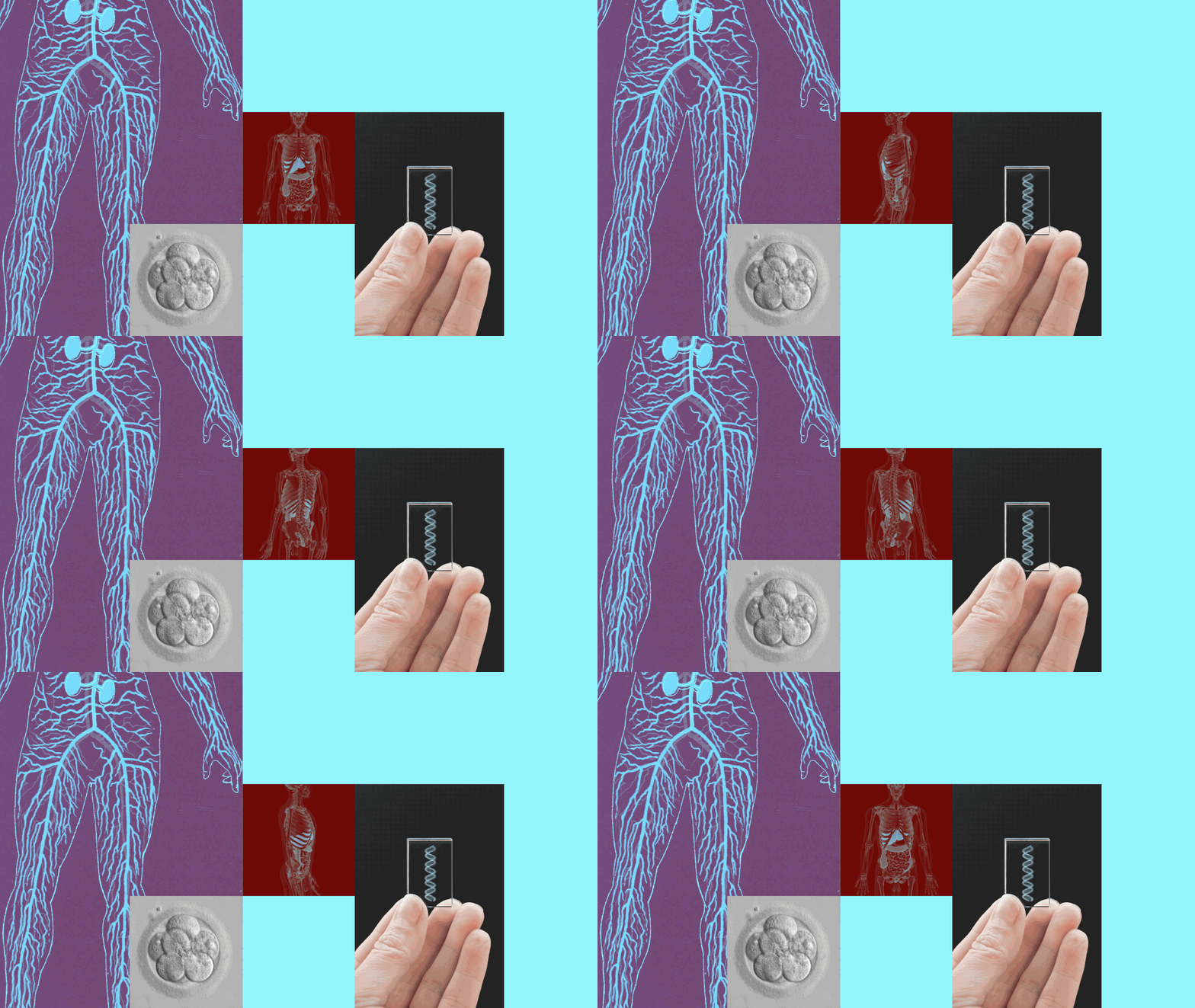
Going deeper into the files, Epstein and his network of contacts discussed beliefs about how physical characteristics and race might denote intelligence. They exchanged emails about population control. They spoke of engineering women’s sex drives, building designer babies, and living in a world full of superintelligent humans that could merge with robots. They spoke of getting rid of the elderly, the infirm, and the poor.

The files offer a glimpse into a world where ideas about eugenics and race science have never gone away. On the contrary, they run through our elite universities, through the most powerful companies in Silicon Valley, and through the tech industry itself. Epstein’s was an exclusive club that counted among its members people who harbor dreams of re-engineering human minds and bodies, seizing control of our collective future, and building technology that, they hope, will one day merge with — or even replace — all of us.

Jeffrey Epstein, 27. Jeffrey Epstein's mansion El Brillo Way in Palm Beach. U.S. Virgin Islands, Department of Justice, Sexual Offender Registry Photograph.

In 2002, two decades before the launch of ChatGPT, Epstein hosted an Artificial Intelligence summit on his Caribbean island. In the years that followed, he cultivated close, regular contact with a network of  (predominantly male) scientists, researchers, academics and tech leaders working at the vanguard of AI, biotech, genetics and cognitive science, meeting them at universities like Harvard and at his various homes. 

In August 2018, a year before Epstein was found dead in his jail cell, he was in email correspondence with software consultant and bitcoin investor Bryan Bishop about funding a project to create “designer babies” — children with genes cherrypicked for their looks, health, strength, immune systems, sleep needs and even, in Bishop’s imaginings, abilities to live on a different planet. 

  “Attached is the doc you requested, it's the "use of funds" spreadsheet for the designer baby and human cloning company,” Bishop wrote to Epstein. “This gets us out of our self-funded ‘garage biology’ phase to the first live birth of a human designer baby, and possibly a human clone, within 5 years. Once we reach the first birth, everything changes and the world will never be the same again.”

Bishop went on to discuss how his ultimate ambition was to make “practically unlimited modifications to the cells before generating an embryo.”

In response to a request for comment, Bishop sent Coda a publicly available set of answers to frequently asked questions about designer babies.

“The reason people have an aversion to eugenics, and rightfully so, is because countries used genocide and sterilization to prevent reproduction by populations that they didn’t like. We have no intention of doing anything of the sort,” Bishop writes in the public FAQ. “‘Designer baby’ simply describes a child whose genome has been intentionally altered or chosen by their parents, rather than left entirely to the genetic lottery of natural conception.”

“It’s such a great subject,” Epstein responded after he read Bishop’s proposal. “We need to get a read on legal. Can’t do anything where US rules apply to US citizens regardless of where [they are].” 

Building a super-race of humans, and parachuting humanity into a different evolutionary era — or even obsoleting the human race as we know it — is a running theme in the Epstein files, and an increasingly prominent ambition for tech evangelists today.

“It’s eugenics all the way down,” said Jacob Metcalf, a founding partner at Ethical Resolve, a consulting firm working with tech companies to develop their ethics protocols. A common fantasy in tech circles, he said, is “to essentially control human destiny. And a lot of the times that human destiny is for humans to be replaced. That's the really bleak thing here. What could be more eugenic than getting rid of humans.”

In 2008, Epstein began conversations with the computer scientist Ben Goertzel. Over the years, Epstein would send Goertzel more than $360,000 to fund the researcher’s plans to build towards Artificial General Intelligence (AGI), a term Goertzel himself popularized.

“I remain eager to move forward on working together to accelerate progress toward a human-obsoleting thinking machine,” Goertzel wrote to Epstein in May 2008. Eighteen years on, and the idea of obsoleting humans with artificial intelligence is widely discussed in the tech world.


When asked to comment on his exchange with Epstein, Goertzel told Coda: “I do think we will create forms of transhuman intelligence going beyond the scope of humanity as we know it, but I also very much hope and envision a strong role for humans even after this happens.”

Goertzel went on to describe a future where the world reaches the “Singularity” — a Silicon Valley buzzword signifying a tipping point where AI surpasses human intelligence. “I do think AI will eventually gain its own superhuman autonomy, but I think this can happen in a way that respects and nourishes human life rather than being harmful to it,” he said. “Epstein and I discussed this face to face a few times and indeed I was a bigger fan of the human species than he was, and more optimistic about its flourishing post-Singularity.” 

In an email to Epstein, Goertzel laid out a scenario where AI systems would start running their own economic activity. He envisioned this Artificial Intelligence economy acting as a “parasite to overcome the regular human economy” that would eventually “gain its own superhuman autonomy.” The ideas Epstein and Goertzel exchanged mirror a broader conversation unfolding in the tech world that imagines a future where ultimately, human labour could be rendered superfluous, and ultimately be replaced by artificial intelligence and robots.

Together, Goertzel and Epstein also discussed modifying human brains — a concept popular in Silicon Valley today, where numerous brain-computer projects are researching ways to cognitively enhance the human brain, and alter human personality, memory, and mental capabilities.

In 2008, when Epstein told Goertzel he was “off to jail” for a year, after he was convicted of soliciting a minor for prostitution, Goertzel suggested the solution to his problems might one day be solved if human brains could be re-programmed.

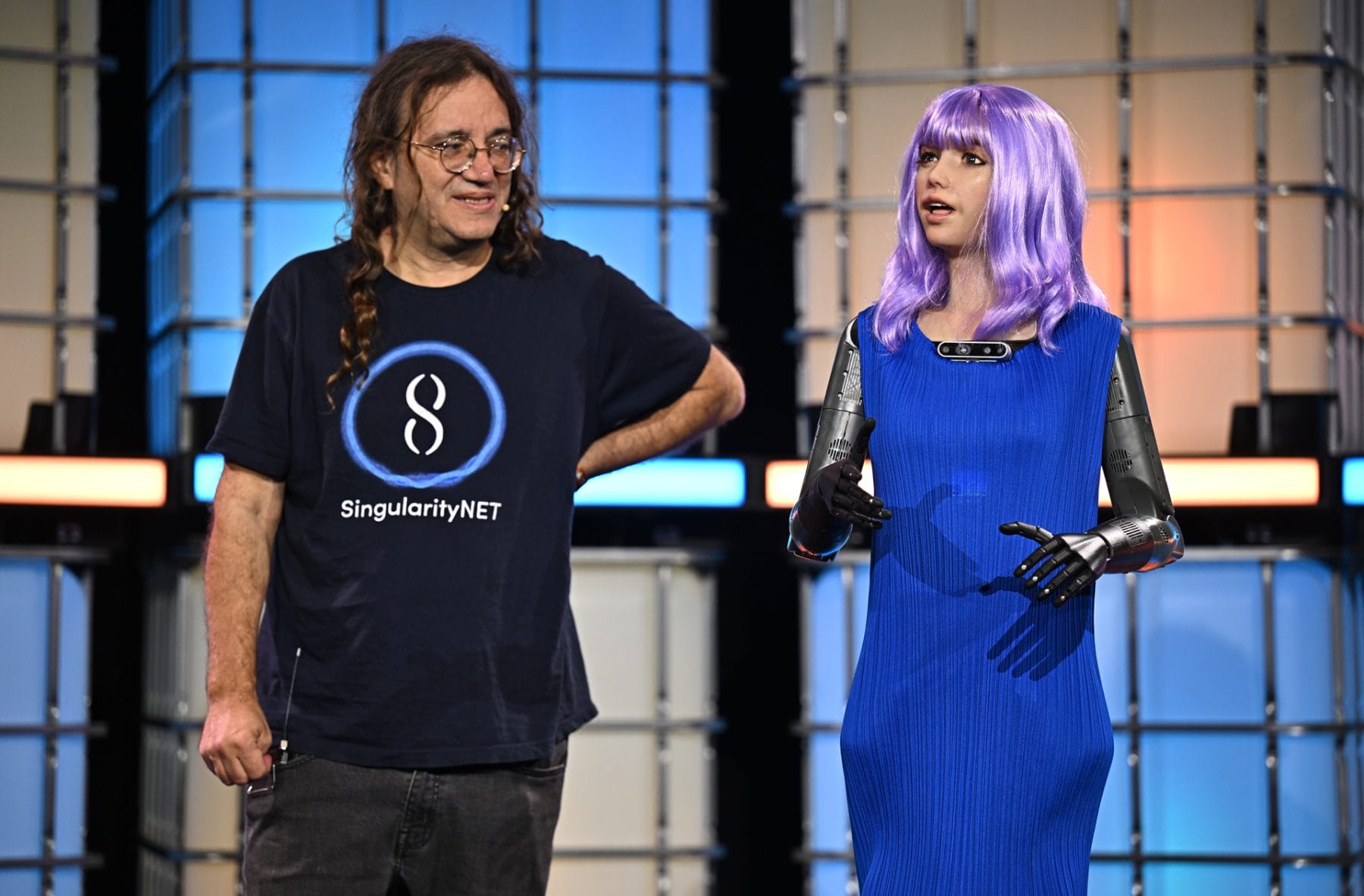
Ben Goertzel with Desdemona the robot, at a tech event in Portugal in November. Sam Barnes/Sportsfile for Web Summit via Getty Images.

“According to my understanding, the girls you were involved with were old enough to know what they were doing, so society really has no ‘moral right’ to lock you up,” Goertzel wrote to Epstein. “This is a fucked-up society we live in. But past ones have really been no better -- the fault is really w/ the human brain architecture, which is precisely what I'm aiming to supercede in my AGI work.”

When asked to comment on these remarks — and in particular the implication that Epstein’s problems might be solved if his accusers' brains were one day re-engineered — Goertzel told Coda: “This was a general observation that the messed-up nature of our society generally is rooted in the way our brains have evolved... and that advanced tech will let us modify our brains to make ourselves and thus our society better.  There was no implication intended (nor stated) that women’s brains are any more or less messed up or in need of improvement than men’s.”

Goertzel reflected that his comments on Epstein’s victims being “old enough” were “regrettable and unfortunate in hindsight,” adding that his impression was that Epstein had been involved with adult women, not “disgustingly curating high school students for sexual purposes. I should have paid more attention.” 

In 2013, three and a half years after Epstein was released from jail, Goertzel approached Epstein for funding to build a “toddler robot”. Given Epstein’s criminal history of abusing minors, this has inevitably attracted attention online. “When we were discussing measuring the IQ of robot toddlers, the topic was never sexualized in any way,” Goertzel told Coda when asked about the project. “While I had nothing to do with Epstein's perverse sexual tastes or abuse of women, what I have read about his awful doings in the newspapers relates to his interest in teenage girls not toddlers.”

Epstein was particularly interested in funding projects that built — like Goertzel’s –- on transhumanist theories. Transhumanism is a worldview that captivates many of the most prominent tech leaders in Silicon Valley today. It believes in a future when the human body can be endlessly altered, genetically engineered, and ultimately fused with artificial intelligence. 

“Transhumanism is a much more radical concept than eugenics,” explained Timnit Gebru, a computer scientist and researcher who has written extensively about eugenicist ideas within artificial intelligence. “In eugenics, you're trying to create a more superior human by breeding humans through generations. In transhumanism, you're trying to get rid of humans altogether.”

For transhumanists, she added, “their idea is to get rid of any undesirable properties they see with humans."

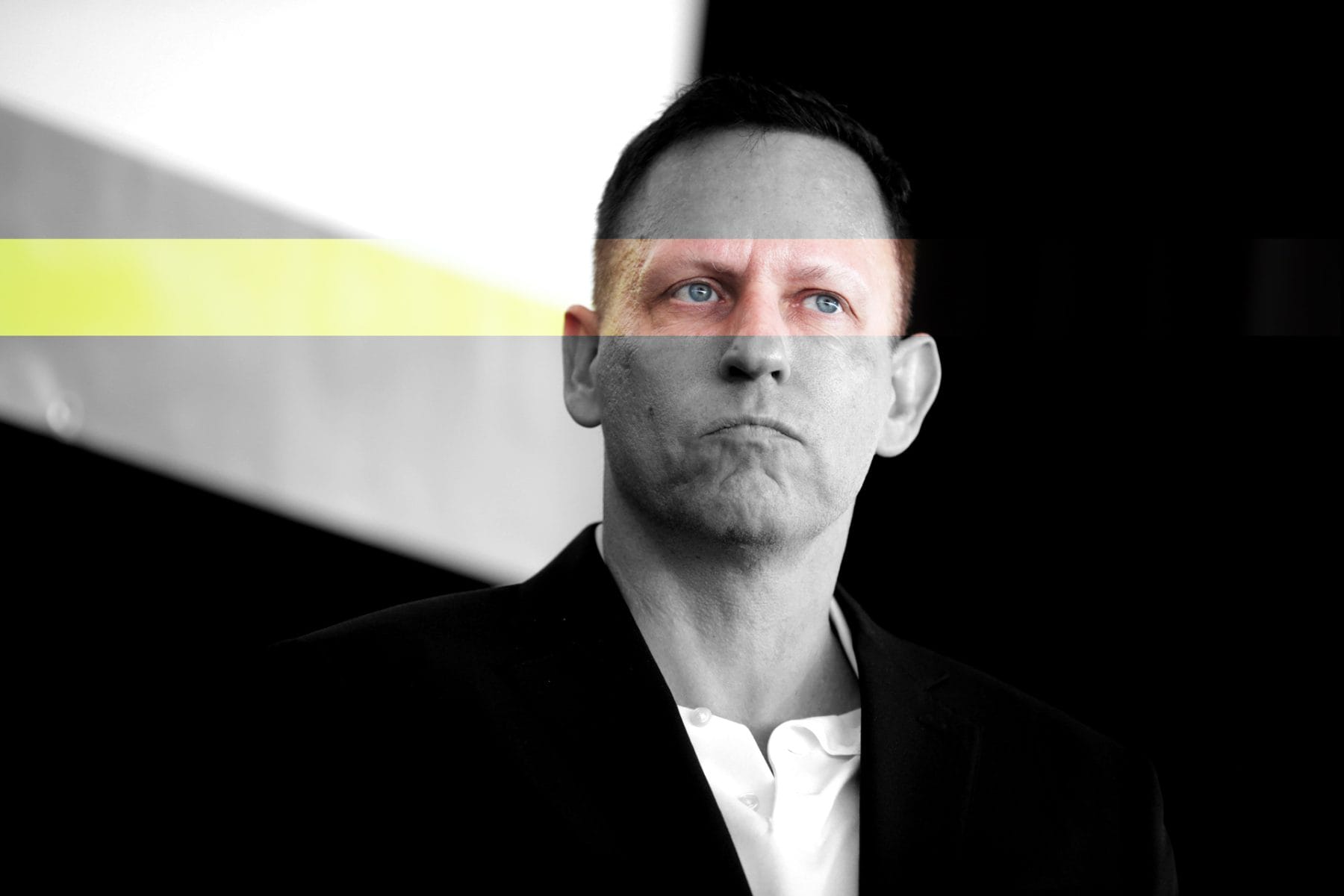
Perhaps the most well-known proponent of transhumanism in the Epstein files is Peter Thiel.

“I think you would prefer the human race to endure, right?” New York Times journalist Ross Douthat asked Thiel last year. “Uh—,” Thiel said. “This is a long hesitation!” Douthat said. “Should the human race survive?” “Yes, but I would like us to radically solve these problems,” Thiel said. “We want you to be able to change your heart and change your mind and change your whole body.”

Peter Thiel. Creative Commons (CC BY 2.0) /Gage Skidmore.

Thiel’s name appears in the files more than 2000 times, and Epstein reportedly invested some $40 million into Valar Ventures, a firm co-founded by Thiel. The two spoke of building secret societies and shared an interest in transhumanism and cryogenics — Epstein wanted to freeze his brain and penis when he died, so that one day he could be revived, while Thiel has also stated his body will be frozen after his death. 

They also appeared to share an interest in bringing an end to the democratic systems of today, imagining a different system altogether. Epstein, for his part, spent his life puppeteering the most powerful people in the world and undermining democratic systems. Thiel, meanwhile, first expressed his own anti-democratic views in 2009 when he wrote: “I no longer believe that freedom and democracy are compatible,” adding that since women were allowed to vote, the notion of a capitalist democracy became impossible. When the Brexit vote came through, Epstein wrote to Thiel: “Brexit, just the beginning.” Thiel asked — “of what”; Epstein said – “Return to tribalism, counter to globalization, amazing new alliances.” 

Globalization — and the idea of internationally powerful governing bodies — is a worldview that both Epstein and Thiel seemed to distrust. In March, in a palazzo in Rome, a stone’s throw from the Vatican, Thiel gave one of his infamous lectures in which he espoused his views about an “antichrist” that gets in the way of technological progress. This antichrist, he suggested, could be an internationally powerful body; the product of globalization. I stood outside the palace as attendees — priests, students, researchers — mutely hurried out, refusing to speak to the cluster of reporters waiting for Thiel’s black Mercedes. 

“He has a totally irrational side, which lives on fear, of what danger might happen,” one audience member told me of Thiel on condition of anonymity, recalling how, up close, Thiel looked haunted and ill. “His head is full of future scenarios, which is what’s killing him. I think he’s scared.”

Thiel did not respond to multiple requests for comment. 

Epstein didn’t confine himself to lofty conversations about a future collapse of the global order or re-engineering humanity. He also had ambitions for his own personal eugenics project. In 2019, it emerged that he wanted to seed the world with his DNA — and reportedly have 20 women impregnated at a time at Zorro ranch, his New Mexico property.

Epstein tried to recruit Virginia Giuffre for this very project. He “fantasized about improving the human race by fathering children who carried his superior genes,” she recounted in her memoir, published posthumously late last year.  “He’d talk about using his Zorro ranch as a literal breeding ground to propagate babies.” When Giuffre was 18 years old, she recalled, Epstein asked if she would carry his child and hand over all legal rights to it – “like a modern-day handmaid.”

Zorro Ranch, New Mexico. Diary of Epstein's victim.

In a haunting diary entry from another Epstein victim, written between the ages of 16 and 17 and shared with federal prosecutors, a girl describes being told she will be sent to Zorro ranch — possibly to participate in the very same project. “Go to New Mexico? What in the hell? This makes no sense. What about school?” she writes, describing how Epstein chose her for her hair color and eye color, and tried to convince her she would create “perfect offspring.”

The teenager chronicles her pregnancy, pasting a sonogram into the scrapbook, before giving a traumatic account of giving birth with Ghislaine Maxwell beside her. “Ghislaine said to push all the pain away. I don't understand. Blood and water all over the bed.” As the baby was born, she writes, Maxwell covered her eyes. “I saw between her fingers this tiny head and body in the doctors hands.”

The girl describes hearing the baby’s “tiny cries” before “they took her.”

“I’m nothing but your property and incubator,” the teenager writes of Epstein. The diary is a terrifying piece of evidence that appears to link to Epstein’s longstanding fixation with creating genetically bespoke humans. The diary author’s lawyers, Wigdor LLP, declined to comment.   

Epstein’s fever-dreams of creating an army of children carrying specific genes reflect a broader trend of “pronatalism” — a movement historically tied to eugenics — that’s thriving in Silicon Valley.

 Millions of dollars of funding are currently being poured into projects creating “superbabies,” while billionaire tech oligarchs including Elon Musk — whose name appears more than 1000 times in the files — reportedly want to use surrogates “to reach legion-level before the apocalypse.” Musk did not respond to requests for comment.

In the files, women appear either as victims, as objects, or as vessels for genetic engineering experiments. They are an inconvenient reality, people to be controlled and re-booted. Epstein wrote a 2013 email implying that women “are like shrimp. You throw away the head and keep the body.” 

“The obsession with "artificial" life appears tied to a masculine desire to try control the production of life – ultimately ridding themselves of their dependency on women," said Gabriella Razzano, Co-Founder of OpenUp, a social impact tech lab based in Cape Town, who is also a senior advisor at the African AI Observatory. “I think there is important work to be done on tying the narratives that are very revealing in the Epstein files to understand how, and why, technology is being developed as it is.” 

The trading of ideas about intelligence — both artificial and human — takes a particularly sinister turn in a 2016 exchange between Epstein and the cognitive scientist and AI researcher Joscha Bach, whose research Epstein funded to the tune of $300,000.

Bach writes to Epstein about a study claiming that “black children outperform white children in motor development, even in very poor and socially disadvantaged households, but they lag behind (and never catch up) in cognitive development even after controlling for family income.”

Epstein responds with racist ideas about his notion of how to “make blacks smarter”, adding — “maybe climate change is a good way of dealing with overpopulation. The Earth’s forest fire. Potentially a good thing for the species,” before contemplating a world with “too many people,” where “many mass executions of the elderly and infirm make sense.” 

Bronze sculpture of a female torso Jeffrey Epstein's Manhattan residence.


Epstein then imagines creating a future “Übermensch” — a superior human with cherry-picked attributes. “What I like is the idea that ubermensch could be the melding of humans, put together in one brain,” Epstein writes. This bespoke human, he suggests, would include traits from marginalized groups, who he appears to believe have a stronger awareness of how to navigate power structures because of their historical exclusion. “An increased motor system, an increased awareness, an increased status calculator (Blacks, jews, women). Ubermensch could be the combination of the best of humans, not the best of a specific race or gender. Fun idea.” 

Bach told Coda in a statement: “I was summarizing a scientific study in a private email. Studies like this get often abused in ideological discourse to justify discrimination, which I strongly oppose and condemn.”

“I am firmly opposed to any form of racial discrimination, and I reject the use of group-level statistical claims to make judgments about individuals or to justify unequal treatment.” 

He continued: “It goes without saying that if global warming were to lead to a reduction in the human population, it would be accompanied by immeasurable suffering. Our civilization would break down, leading to a return to dark ages, in which the elderly and infirm were often killed, because people could not support them, and often did not care about supporting them. Every reasonable person understands that this is horrible and not desirable in any way.”

Epstein “was often callous about human suffering in a way that I found disturbing but worth understanding, as a window into the perspectives of the rich and powerful,” Bach added. 

Alongside Epstein’s conversations about mass executions for the old and and the sick, he was also interested in Silicon Valley’s dream concept of living forever — he had numerous email conversations with the longevity guru Peter Attia about prolonging his own lifespan, and funded a Harvard project geared towards “the end of aging.” In an email to Attia, Epstein mused: “I’m not sure why women live past reproductive age at all.” Attia, who published a statement about his relationship to Epstein, did not respond to requests for comment. 

This interest in “longevity” — living for as long as possible, even living forever, is popular among the elite precisely because they find themselves in an elite class, says David Robert Grimes, a scientist and disinformation expert who has written about longevity and race science in Silicon Valley. “They're both sides of the same coin — the Silicon Valley eugenics, and also the longevity stuff. They promote an idea that ‘we are exclusive and we are special',” he said. "It helps them to justify deep social inequality."

The tech elite did not inherit this ideology by accident. Stanford University, the intellectual heart of Silicon Valley, was once a major hub for the American eugenics movement, which later helped to inspire Nazi race laws. Stanford’s founding president, David Starr Jordan, was a prominent eugenicist, campaigning for forced sterilization of people with undesirable genetic traits. The university removed his name from its buildings in 2020 — but in Palo Alto, his beliefs did not disappear with the nameplate.

"Instead of eugenics we just call it longevity or biohacking," Christopher Wylie, the Cambridge Analytica whistleblower who has spent years investigating Silicon Valley's belief systems, said on a panel with me at a journalism conference last year. "It's the same."

The ideology Epstein bankrolled in private is being built in public. It’s a vision of the future in which a select few get to upgrade and extend their lives, while tightening their grip on the systems that determine which humans are worth investing in — and which are not.

It sounds like a dark sci-fi fantasy, except, as the files show, that fantasy is being funded and pushed into reality. Most of us will never be in the rooms where these ideas are discussed. All of us will live with the results.

The post “All my fundees have blue eyes.” Epstein and the tech world’s dark ideology appeared first on Coda Story.
❌