This is Behind the Blog, where we share our behind-the-scenes thoughts about how a few of our top stories of the week came together. This week, we discuss astrology, Flock on the brain, The Odyssey, and more.JASON: This week I wrote pretty much exclusively about Flock, and I am working on a few more articles about automated license plate readers that will probably go in the next week or so. I am well aware that there are other topics in the world, but, basically, there is now so much interest
This is Behind the Blog, where we share our behind-the-scenes thoughts about how a few of our top stories of the week came together. This week, we discuss astrology, Flock on the brain, The Odyssey, and more.
JASON: This week I wrote pretty much exclusively about Flock, and I am working on a few more articles about automated license plate readers that will probably go in the next week or so. I am well aware that there are other topics in the world, but, basically, there is now so much interest in the company and its practices that I am getting inundated with tips, story ideas, and sources, and it feels like I have to chase many of the leads I’m getting. There are only so many hours in the day, so this means some other things I want to cover are either falling by the wayside or will have to wait.
A judge caught a court reporter making AI-generated errors in a court transcript, and put court reporters everywhere on notice for their use of AI. In a memorandum decision concerning a case about a man who sold drugs to another man who overdosed and died, filed on July 23, Judge Paul Felix wrote in a footnote of the decision that a transcript contained errors that looked a lot like generative AI. The footnote was spotted by attorney Rob Freund on X.
A judge caught a court reporter making AI-generated errors in a court transcript, and put court reporters everywhere on notice for their use of AI.
In a memorandum decision concerning a case about a man who sold drugs to another man who overdosed and died, filed on July 23, Judge Paul Felix wrote in a footnote of the decision that a transcript contained errors that looked a lot like generative AI. The footnote was spotted by attorney Rob Freund on X.
After the Los Angeles Police Department allowed its contract with Flock to expire, the surveillance company’s CEO, Garrett Langley, told local news that people don’t understand how its technology works, and that its automated license plate readers (ALPR) only take a “static picture” of a car. “The technology is really simple,” he told ABC7. "A car drives by, we take a picture. It's a static picture of a car, and then we read the license plate. That's what the technology is—it's actually not t
After the Los Angeles Police Department allowed its contract with Flock to expire, the surveillance company’s CEO, Garrett Langley, told local news that people don’t understand how its technology works, and that its automated license plate readers (ALPR) only take a “static picture” of a car. “The technology is really simple,” he told ABC7. "A car drives by, we take a picture. It's a static picture of a car, and then we read the license plate. That's what the technology is—it's actually not that complicated, it's pretty simple."
But for the last year, Flock has been marketing a new upgrade that allows “all” of its ALPRs to record live video. Langley is either dramatically underselling what Flock’s technology can do while saying that people don’t understand it, or Flock has quietly rolled back a major product feature without telling anyone. (Update: after the publication of this piece, a Flock spokesperson said Flock has discontinued the feature for law enforcement agencies.)
Flock has not been quiet about this live video upgrade; its salespeople have pitched the upgrade to cities, and the company has mentioned it in numerous blog posts (though it recently deleted one of them), and Langley even spoke about the capabilities with Forbes last year, suggesting cops could pull video in real time from its ALPR cameras: “We will just open up the five nearest cameras in real time and say, here's what's happening right now,” Langley said.
In June of last year, a Flock blog post called “Why video is the missing link in your LPR program,” the company wrote “All existing Flock LPRs will soon stream live video and capture clips with a free, optional software update. No new hardware, no permits, no extra cost. Same lens, same angle and field-of-view as the LPR. See basic video clips for every plate read. Zero lift for your team. Free and optional to opt in.”
The blog post describes several potential use cases, and different setups that police officers could use, which include adding a separate video camera to the poles that Flock cameras are installed on but also, crucially, includes the fact that all Flock ALPR cameras are capable of taking video: “Fixed live video is coming to all LPR cameras, free by end of 2025.”
And, in a now-deleted product launch blog, Flock wrote “LPR Cameras Can Become Video Cameras,” and added it was a “move that will transform the largest network of LPR cameras in the nation.”
“Flock customers don’t have to do a thing or pay a thing,” said Flock’s Chief Strategy Officer Bailey Quintrell in the blog post. “This will be a no-cost software update we push over the cloud.”
Text messages obtained using a public records request by Jason Hunyar, an activist in Dunwoody, Georgia, show that cops in Dunwoody turned on this feature. The text messages are between John Watson, a Flock employee, and a Dunwoody police officer from January of this year.
“Are y’all able to live stream LPR video yet?,” Watson asks.
“Yes,” the officer says.
“When did they turn that on and how has it been. And who turned it on?” Watson responds.
“It’s been about a month and it’s pretty cool feature,” the officer says. “Small angles but cool for incidents if needed. I’ve been working with Vijay [Dhamija, Flock’s Director of Product] on it.”
“Gotcha. Any stability issues?,” Watson asks.
“Not that I have noticed,” the officer responds.
The Flock spokesperson said, “This was not a broad rollout. Five law enforcement agencies participated in a limited pilot to test live video on select LPR devices; the LAPD was not among them.”
“In March, Flock discontinued the feature for law enforcement agencies, and it is no longer active at any of the five participating agencies. The pilot provided live video only and did not include recording or stored-video playback,” the spokesperson added.
Update: this piece has been updated to include comment from Flock.
Patreon laid off 93 employees, totaling 20 percent of its workforce on Thursday morning, according to an email to creators and staff from CEO Jack Conte.In a message sent to everyone on the platform signed up as a creator, and posted to the site, with the subject line “A Painful Update about our Team,” Conte wrote that the business is “healthy and strong” and that the core business of Patreon is not changing. Conte included the email sent to Patreon employees in the message. In the email, he
Patreon laid off 93 employees, totaling 20 percent of its workforce on Thursday morning, according to an email to creators and staff from CEO Jack Conte.
In a message sent to everyone on the platform signed up as a creator, and posted to the site, with the subject line “A Painful Update about our Team,” Conte wrote that the business is “healthy and strong” and that the core business of Patreon is not changing.
Conte included the email sent to Patreon employees in the message. In the email, he wrote that the company is undergoing both a “workforce reduction” and is “changing our organizational structure and how we work.” Specifically, he wrote, this means “we’re flattening the organization, refocusing teams on our top priorities, and evolving key aspects of our operations to make us faster at adapting to change.”
Conte is careful in this email to both express that he doesn’t view AI as a replacement for the human creativity the platform is built on and profits from — devoting a section of the email to saying as much — and also that AI is fundamentally “transforming” the tech industry, noting that it has an impact on how the company operates.
“To be clear about the impact of AI on today’s decision: we are not making the above changes because we believe AI replaces humans,” Conte wrote. “The more we have learned to use these new tools, the clearer it has become that they are not substitutes for the creativity, judgment, detail orientation, or craftsmanship that our teammates have in spades, nor do they replace the desire for human connection that all of us cherish so deeply. That’s my personal opinion, but more importantly, it’s the foundation of Patreon’s strategy: our product vision and business are both predicated on the value of human creativity and human connection. AI has fundamentally transformed the tech industry, though, including how we work, how we build products, how we communicate, and more. That does have an impact on how we operate and organize.”
Earlier this month, Patreon announced that it’s partnering with Cloudflare to block crawlers from stealing creators’ work to train AI models. “I HAVE A KICKASS PRODUCT UPDATE FOR YOU ALL!” Conte wrote in a post on Instagram. “This is live and happening at the network level on all posts published on Patreon.” The company later elaborated on the partnership in a blog post.
Included in the internal email shared publicly are severance details for laid-off workers, including 16 weeks of pay, remaining on payroll through the company’s August 20 vesting date, one additional week of pay for every full year worked at the company, additional cash payments for recent hires who haven’t reached their one-year cliff, healthcare coverage through the end of the year for eligible employees and families, and a $1,500 stipend to replace their company laptops.
A little over a month ago, the former American Idol contestant, country musician, and Instagram influencer Noah Orion appears to have learned about the surveillance company Flock. “Cities are now covering Flock cameras with trash bags,” Orion narrated over an Instagram post aggregating a 404 Media report. “It’s also pretty wild that we’ve just dropped stickers that say ‘Fuck Flock’ on them and it’s pretty cool that it’s coincidental that the sticker’s outside diameter is the same size as the ave
A little over a month ago, the former American Idol contestant, country musician, and Instagram influencer Noah Orion appears to have learned about the surveillance company Flock. “Cities are now covering Flock cameras with trash bags,” Orion narrated over an Instagram post aggregating a 404 Media report. “It’s also pretty wild that we’ve just dropped stickers that say ‘Fuck Flock’ on them and it’s pretty cool that it’s coincidental that the sticker’s outside diameter is the same size as the average camera lens on a Flock camera,” he adds, showing a mockup of an AI-generated sticker featuring a surveillance camera that is not a Flock camera.
Orion had never posted on Instagram about Flock before then. But, since that post, Orion has posted dozens of reels about Flock, apparently at great personal risk to himself. A July 8 post features an image of a printed out “CEASE AND DESIST” letter purportedly sent to Orion by Dan Haley, Flock’s head of legal affairs. “It has come to the attention of Flock Group Inc. that you have engaged in conduct involving the unauthorized dissemination of photographs, videos, memes, screenshots, or other visual materials in a manner that encourages your fans to claim and place stickers that constitute a rude and unusual manner towards our company and association. You are hereby instructed to immediately cease and desist from any further use of such materials […] any further demeaning actions or posts will result in legal action. Failure to comply with this demand may result in Flock Group inc. [sic] to persecute you and your organization to the fullest extent of the law.”
The post has 73,000 likes and has been viewed millions of times. Since that post, Orion has posted the same letter 16 separate times on Instagram, and is now posting about almost nothing besides Flock. On Tuesday, he posted a reel stating “I could go to jail soon, and I am not afraid of that. I am pushing a movement against Flock cameras.” In that video, he said he’s starting a “bail fund” in case he’s arrested and goes to jail. Collectively, these posts and videos have hundreds of thousands of likes and millions of views.
But the cease-and-desist is not real; it is a wholesale fabrication created by the influencer for attention, likes, and clout. He is at zero risk of persecution or arrest for speaking out about Flock (though he may be at risk for forging a fake cease-and-desist letter.) In the meantime, Orion has gotten more than 30,000 new followers in the last month according to the Instagram tracking website NotJustAnalytics, a period in which he has posted essentially only about Flock and, primarily, about his stickers and his cease-and-desist letter.
This constant focus on his apparent legal trouble is a relatively typical pattern for Orion; before Flock, he was posting endlessly about how his modified bus with massive speakers was going to be impounded by the authorities. Before that, he was talking about how he was going to be evicted from the space in which he modified the bus.
Over the last few months, we have seen the rise of various anti-Flock influencers and activists, and increased scrutiny from journalists, YouTubers, and independent researchers. Content about Flock has become quite popular on social media, and the vast majority of posts are from well-meaning people who are amplifying real reporting and real — if occasionally exaggerated or slightly misconstrued — information about one of the most invasive mass surveillance companies in the country. Alongside this has come lots of viral posts that either slightly misunderstand or oversell what Flock is doing or is capable of, or get, for example, the exact mechanics of how ICE may obtain Flock data wrong.
On balance, most of these posts are at least directionally correct. There is room in the movement against mass surveillance for hyperbole, satire, comedy, stunts, and misunderstandings done by well-meaning people, especially if there is a broader point.
That is not what Orion and some of his copycats are doing, however. Most charitably, Orion is making people aware of Flock and could be making people more likely to do more research into the company or is making them more likely to take political or direct action to prevent surveillance. He’s a bro spreading the word, and perhaps his heart is in the right place. But, basically, he is making shit up to make himself and his country music career more famous by creating and sowing disinformation in a space where there are dozens of journalists and influencers working hard for more transparency, and positioning himself as being somehow at legal or criminal risk when people who are doing actual needle-moving work struggle to stand out or are actually being threatened. On every post, Orion tries to give away stickers and tells people to comment “Fuck Flock” in order to get them. This is a tactic to game the Instagram algorithm with engagement; Orion has set up a bot to automatically message anyone who comments on his posts with links to his online store which has a variety of free stickers, paid merch, and a “bail fund in case I go to jail.”
Flock and its lawyers have sent real cease-and-desist letters or otherwise threatened the creators of both DeFlock, an open-source project to map Flock cameras, and HaveIBeenFlocked, a database of Flock searches done by cops around the country. Alongside reporting by 404 Media and local journalists, DeFlock has led directly to the massive, decentralized, grassroots movement of residents in small towns and big cities pressuring their city councils to end their Flock contracts. Activists and journalists using HaveIBeenFlocked have uncovered numerous cases of police abuse and ICE surveillance that has led directly to firings and arrests, policy changes, and canceled contracts. The strategies deployed by Flock against these sites are far more sophisticated and scary than the obviously bullshit cease-and-desist letter fabricated by Orion.
Flock went after Cris van Pelt, the creator of HaveIBeenFlocked, by repeatedly trying to get his web hosting revoked by its provider by claiming the site both violated the company’s intellectual property rights and by saying that the site “poses an immediate threat to public safety and exposes law enforcement officers to danger.” Flock directly warned police about this website, which led different divisions of the FBI to warn law enforcement about the site, squarely putting a target on the site. Through a third-party law firm, Flock separately threatened DeFlock by sending a cease-and-desist to Will Freeman, the creator of the site. To fend off that cease-and-desist, Freeman had to get representation from the Electronic Frontier Foundation. Flock’s CEO, Garrett Langley, called DeFlock a “terroristic organization” in an on-camera interview with Forbes. After that interview repeatedly went viral, Langley finally apologized in a second interview with Forbes earlier this month. These are actual threats, against people actually doing the work.
It is hard to see how Orion shouting nonsense into a camera to his 800,000 followers benefits anyone but himself; after his first few viral posts, various other Instagram accounts began posting fake Flock cease-and-desist letters to promote, for example, “The Saturday Salon,” an event series in Orange County, California that largely promotes its events via AI-generated posters (Saturday Salon also created a fake Palantir cease-and-desist in January).
Benn Jordan, a researcher and YouTuber who has uncovered various Flock security flaws and has become one of the most important voices speaking out against Flock, made a video about Orion’s fake cease-and-desists in which he said “Can y'all just eat Tide Pods or something and stop making this fight even harder than it already is?”
“If you get sued for doing this, I have absolutely no sympathy for you, because if somebody made a fake cease-and-desist or lawsuit letter from me and forged my name and posted it online for attention making me look bad, I would sue the fuck out of them,” Jordan said. “More importantly, Flock frames me like Jake Paul, like a hyperbolic YouTuber who’s just doing magic tricks and making things up to make the company look bad for my own personal gain, and by doing so, they’re able to squash and make it seem risky to read real reports about security vulnerabilities, or Fourth Amendment right violations. And I can guaran-fuckin-tee you that they will use these fake letters as an example to lump in with actual, meaningful critical research about police surveillance.”
Haley, Flock’s chief legal officer, told me in a LinkedIn message that “of course they are fake.” Haley added via a spokesperson that “We’re aware of at least two forged letters circulating on the internet, including this one [referring to Orion’s], that purport to be cease-and-desist letters from our legal department. To be clear: these letters did not come from me or from anyone at Flock. Flock welcomes and encourages public debate about our technology. We have not and would not seek to discourage, prevent, or prohibit such discussion and debate. In fact, we would be happy to participate in any such discussions the group in question might host in the future."
Orion did not respond to an Instagram message I sent him asking about the fake cease-and-desist letter.
From phone location data, to social media monitoring, to online undercover tools, a document obtained by 404 Media lays out the surveillance tech available across ICE agency wide.
From phone location data, to social media monitoring, to online undercover tools, a document obtained by 404 Media lays out the surveillance tech available across ICE agency wide.
🌘Subscribe to 404 Media to get The Abstract, our newsletter about the most exciting and mind-boggling science news and studies of the week. Scientists have discovered a previously unknown behavior in orcas that involves one member of a pod holding up a massive dead sunfish while another charges and rams it, resulting in the dramatic explosion of the carcass into fleshy fragments, according to a study published on Thursday in Frontiers in Ethology. Orcas often ram or strike prey as a hunting tac
Subscribe to 404 Media to get The Abstract, our newsletter about the most exciting and mind-boggling science news and studies of the week.
Scientists have discovered a previously unknown behavior in orcas that involves one member of a pod holding up a massive dead sunfish while another charges and rams it, resulting in the dramatic explosion of the carcass into fleshy fragments, according to a study published on Thursday in Frontiers in Ethology.
Orcas often ram or strike prey as a hunting tactic, and some pods are also notorious for ramming boats. But the new study is the first to report such explosive results and sheds light on the mysterious lives of orca pods in the Gulf of California. The hold-and-ram strategy allows juvenile orcas to feed on smaller chunks of tissue and may also serve as a form of social learning and play in these highly intelligent marine mammals.
Erick Higuera, a wildlife cinematographer and marine biologist, first observed orcas detonating a sunfish in 2021. The tactic was captured in follow-up footage by marine biologist Kathryn Ayres in 2024, as well as video from another event in 2025, filmed by Héctor Franz, who works in ecotourism.
“The first time I witnessed it, at that moment, the energy of the impact was astounding because we could hear the sound when the orca ran into the sunfish,” said Higuera, who co-authored the new study, in a call with 404 Media. “Seeing a multi-ton predatory mammal striking a massive fish—because sunfishes can go up to two meters depending on the species—with such a fast speed is breathtaking, and immediately we knew that we were witnessing something highly unusual due to the magnitude of the tissue explosion.”
Orcas are social animals that form tight-knit matrilineal pods that in turn belong to broader “ecotypes” with their own unique cultures and ranges. In the Northeastern Pacific, there are three genetically distinct lineages: resident orcas that primarily eat fish, transient orcas that mainly eat marine mammals, and offshore orcas that prey on sharks.
But less is known about the feeding behaviors of orcas at lower latitudes near the equator, which don’t seem to fall into such clear ecotypes. For years, Higuera and his colleagues have been capturing footage with drones and underwater cameras to better understand the mysterious pods that roam in the Gulf of California. That’s how they were able to fortuitously capture the explosive hold-and-ram strategy on film.
Sunfish are large, but easy to hunt, making them a popular target for orcas and other ocean predators. However, these animals have tough and rubbery flesh that is difficult to tear apart, especially for young orcas. For this reason, Higuera and his colleagues speculate that the ramming technique is primarily intended to loosen nutritious tissue from the carcass for juveniles to consume, noting that the adults focused on eating organs and meat from the body itself, leaving the fishy ejecta for their young. The behavior may also just be fun, as orcas often play with their food.
“Orcas are highly encephalized predators that frequently engage in object manipulation and play behavior with their prey,” Higuera said. “That is very globally well known. Because sunfish are slow-moving and defenseless, they present a low-risk opportunity for the pod, especially subadults, so they can practice strike precision and reinforce social bonds. It's social play and learning.”
The team plans to continue tracking the pod to better understand the behavior, and to learn whether the sunfish’s microbiome and enzymes might contain special nutrients for the orcas. At the same time, Higuera emphasized that human interactions with orcas should remain as limited as possible, especially since whale watching in the region has become a popular tourist activity.
“This groundbreaking insight was only made possible through a vital collaboration between expert scientists, eco-tourism operators, and citizen scientists equipped with drones and cameras that are willing to provide their footage to us so that we don't spend that much time in the field,” Higuera said.
“If we can protect these animals by maintaining a respectful distance,” he concluded, “this ongoing partnership will allow us to safely document hidden mysteries of marine life that would otherwise remain completely closed to science.”
🌘
Subscribe to 404 Media to get The Abstract, our newsletter about the most exciting and mind-boggling science news and studies of the week.
It’s that time again! We’re planning our latest FOIA Forum, a live, hour-long or more interactive session where Joseph and Jason will teach you how to pry records from government agencies through public records requests. We’re planning this for Thursday, July 30th at 1PM ET. That's in just one week today! Add it to your calendar! So, what’s the FOIA Forum? We'll share our screen and show you specifically how we file FOIA requests. We take questions from the chat and incorporate those into our
It’s that time again! We’re planning our latest FOIA Forum, a live, hour-long or more interactive session where Joseph and Jason will teach you how to pry records from government agencies through public records requests. We’re planning this for Thursday, July 30th at 1PM ET. That's in just one week today! Add it to your calendar!
So, what’s the FOIA Forum? We'll share our screen and show you specifically how we file FOIA requests. We take questions from the chat and incorporate those into our FOIAs in real-time. This time we're particularly focused on city council meetings. Jason watches a lot of these and has tips for more quickly navigating and finding information within them. He then does a bunch of public records requests based on what happened in the meeting. He'll explain all of this, from Flock to other topics too.
If this will be your first FOIA Forum, don’t worry, we will do a quick primer on how to file requests (although if you do want to watch our previous FOIA Forums, the video archive is here). We really love talking directly to our community about something we are obsessed with (getting documents from governments) and showing other people how to do it too.
Paid subscribers can already find the link to join the livestream below. We'll also send out a reminder a day or so before. Not a subscriber yet? Sign up now here in time to join.
We've got a bunch of FOIAs that we need to file and are keen to hear from you all on what you want to see more of. Most of all, we want to teach you how to make your own too. Please consider coming along!
On Tuesday night, the city council of my small town of Irmo, South Carolina, voted to install 22 new Flock cameras. That’ll bring the total up to 33. With a population of only 12,000 or so, it means there’ll be one Flock camera for every 300 residents. That means there will be more Flock cameras in my town than police officers. The city council — the governing body consisting of the mayor and 4 councilpersons — voted for Flock expansion despite presentations from residents about the dangers o
On Tuesday night, the city council of my small town of Irmo, South Carolina, voted to install 22 new Flock cameras. That’ll bring the total up to 33. With a population of only 12,000 or so, it means there’ll be one Flock camera for every 300 residents. That means there will be more Flock cameras in my town than police officers. The city council — the governing body consisting of the mayor and 4 councilpersons — voted for Flock expansion despite presentations from residents about the dangers of what they described as the creeping surveillance state.
The vote for the cameras was a hot topic in local news and South Carolina social media. The city council expected a lot of people to show and asked folks to sign up early if they wanted to talk. Since I work for a publication that has been on the cutting edge of reporting on the myriad problems with Flock cameras, I decided I should probably speak. I spent Tuesday refreshing myself on 404 Media’s reporting and wrote a presentation for the council.
Meetings like this are happening in hundreds of communities across the country and I want to give 404 Media readers a snapshot of what they’re like. There’s a nationwide debate on whether cities and towns want Flock cameras or not and this was my experience speaking at one of the small ones.
There was a hard 3-minute time limit and I had written three pages. I found details about Irmo’s Flock searches in the logs of other states, talked about the specific data security concerns with the cameras, and attempted to explain all the mistakes and false arrests Flock had caused. Three minutes goes by fast, and I ran out of time before I could say everything I had planned.
I wasn’t the only person who decided to speak. More than 10 other citizens went to the podium and spoke out against the cameras. “Is Irmo such a dangerous place that current law enforcement tools are not sufficient to keep the citizens safe without the use of this dangerous and controversial technology?” one guy said.
“I’m pretty enthralled by all the pushback you’re getting on the cameras you installed without asking a single member of the community if they wanted them installed,” said another resident, a man in a T-shirt and shorts. “If you give the government a tool, they will misuse it. Period. End of story. Get rid of them or we will get rid of them for you.”
The city council members looked its residents in the face. They maintained eye contact and appeared shocked when citizens talked about their concerns. For a bit, I thought it was possible that the town might not install these cameras. Then the police chief stood up and explained how he’d used Flock to capture pedophiles and I knew that was probably the end of it.
Police chief Bobby Dale has long been an advocate for the expansion of Flock in town. He told local outlet News19 that 33 cameras will allow him to see all the entrances and exits. “That would ultimately cover pretty much every nook and cranny, every entry point into the town,” he said. “That's what we want. As the chief of police, I've got to make sure our town is safe. I'm learning that with these cameras, with these license plate readers, we're solving crimes and solving them quicker.”
During the city council meeting, Dale explained that Flock cameras had been instrumental in a To Catch a Predator style sting operation Irmo PD conducted. “During an internet crimes against children operation hosted by a department, 15 adults traveled to our community believing they were coming to meet children for sexual activity," Dale said. “Fourteen of those 15 suspects were not from our jurisdiction.”
“So you lured them here. Into our town. Genius,” the T-shirt and shorts guy shouted from the back of the room. This was the guy who’d said the community would remove the Flock cameras if the city didn’t. The mayor had police escort him from the meeting. He left without a fight and Dale finished his speech praising Flock.
After a brief question and answer period with the police chief, the mayor spoke. The city’s leaders had just returned from the Municipal Association of South Carolina annual meeting — a yearly conference of local officials in the state. Mayor Bill Danielson opened his portion of the Flock discussion by talking about how he’d recently commiserated with other mayors at the conference about how mean people were on Facebook.
“I came back with a renewed vigor to be the mayor of this town,” he said. “And knowing that I’m not the only one being abused on Facebook, social media, by some people in this room. It’s going to take a whole lot more than that to sway any position I may or may not have on behalf of these citizens.”
The other thing the mayor learned is that everyone loves Flock. “There was not a mayor at that conference that I touched bases with […] that did not use Flock, did not use Motorola license plate readers,” he said, referring to another company that sells similar technology (we’ve reported ICE is offering demos to its agents to use a Motorola license plate reader app). “Every one of those mayors either wanted Flock, was trying to figure out how to budget for Flock, or had Flock and was figuring out how to increase their presence.”
Flock is not, in fact, universally popular among state and local officials. The Los Angeles Police Department just announced it wouldn’t renew its contact with the company after an internal audit found it led to 161 false accusations of car theft and “eroded public trust.” Bandera, Texas, voted to remove its cameras after months of outrage from its citizens. Dayton, Ohio wants their cameras gone but isn’t sure how to cancel the contract so it's covering the cameras with black trash bags. Flock seems unable to remotely disable its own cameras so cities that no longer want them have to find their own solutions.
Cops also often misuse Flock. There are dozens of cases around the country of cops using the system to stalk people. In nearby Greer, South Carolina, two police officers were just fired by the town after they were discovered using Flock to track people around town.
Mayor Danielson said he’d met a leader from Greer at the conference. “I even spoke to a councilmember from Greer, the dreaded Greer […] whose two cops abused it,” Danielson said. “And I told him point blank, if that happened in the town of Irmo they would not only be fired they would never be a cop again and face charges.”
My city council voted 4 to 1 to increase the presence of Flock in this small town of 12,000 people. Police chief Dale will soon have more cameras than officers. And, if they can get money from the state, they may also purchase a drone from Flock to use as part of the company’s “drones as first responder” program.
People weren’t happy. The mood in the room was sour. I’ve attached my entire speech to this story so you can see what I planned to say.
My Flock speech for the city council
Hello.
My name is Matthew Gault and I’m here today to talk about Flock cameras.
I’m a resident of Irmo and I am also an investigative journalist. I work at a publication called 404 Media that focuses on technology.
Over the past few years, my colleagues at 404 Media have written a number of stories about Flock cameras and, before you vote to install 22 more of them in our small town, I want to share the results of some of those investigations with you.
Mr. Ward, I understand you’re concerned about cyber security around the data these cameras collect.
Last month, 404 Media found Flock had accidentally exposed some of the searches performed by law enforcement in its automatic license plate readers. The searches were cached in search engine results. This meant that anyone was able to see what police were looking for. 404 Media conducted some of its own searches and found that Flock had exposed people’s license plate numbers and various search terms like “investigation” and “GTA,” which is short for Grand Theft Auto.
In December of last year, 404 Media found a different and more severe security issue in Flock’s systems. The company had left 60 of its AI-enabled Condor cameras exposed on the open internet.
That meant that anyone could watch them, download 30 days worth of video archives, change settings, see log files, and run diagnostics. My colleagues were able to access Flock’s cameras simply by typing a website into a browser. They did not need a username or a password. There was no great trick to it. Once inside the system they could see playgrounds, parking lots, and people doing their shopping.
These are just two of the security issues we know about.
It’s also worth telling the council how, exactly, Flock’s systems work.
Many of Flock’s license plate reading cameras are connected to local, state, and national networks. When an Irmo police officer runs a search for a specific license place, they may not just be searching the cameras in their jurisdiction. The search can run through the national network of Flock cameras, if configured to do so. This works two ways. Meaning law enforcement officers at a state and federal level searching Flock cameras may have access to Irmo’s data too.
In fact, because many of these cameras are networked and interconnected, I have access to some of the current records about how Irmo, PD is using them.
I know that Irmo, PD has conducted at least 7,576 searches of Flock’s networks since 2023. If you were curious, most of the searches are conducted around 5 PM. Most of the searches happen on Monday. I know that, for some reason, Irmo PD ran 489 searches on December 21, 2025.
I know that on June 30 at 4:36 PM, the Irmo PD ran a search of the Flock system related to a stalking case.
Two days before, on June 28 at 6:45 PM, the police searched Flock in relation to a case of property damage.
On May 22, just before noon, police searched Flock in relation to a financial crime, something that was marked as “embezzlement or fraud” in the system. For this search in particular, Irmo PD accessed cameras outside of its jurisdiction — it widened the search to footage recorded by cameras nation-wide.
Why do I know all this? How is this possible? Because some police departments in the Flock network conduct routine audits of Flock’s search logs. All three of the searches I just noted were in an audit conducted by the city of Twin Falls, Idaho, a city on the other side of the country. I found information about Irmo’s historical Flock use in audits conducted by police in Georgia, Connecticut, Pennsylvania, and California.
Calling Flock’s cameras “license plate readers” is technically true, but can sell the system short. The basic model is recording the license plate of vehicles, automatically logging information about the make and model of the car as well as stickers and any other distinguishing features. Much of this information is recorded by an AI system. It makes mistakes.
This system has led to false arrests or traffic stops. Earlier this month, a journalist for a car magazine was pulled over by police in Minnesota. The cops said they’d been tracking him for days and that the car he was driving was stolen. The tip came from Flock’s systems, which had been alerted to the theft of a car in California. But the AI system had transcribed the license plate incorrectly.
In Colorado, a woman was accused of stealing packages off people’s porches.The police’s evidence that she’d committed the crime was footage pulled from Flock cameras. Bodycam footage published by 404 Media showed how confident officers were that they had their thief.
“I have you on camera doing this […] I get that this is a shock to you, but I am telling you, this is a lock, 100 percent no doubt she did this,” an officer in Colorado said.
The woman had not committed the crime. She had ample evidence she had not committed the crime, but the police in Colorado insisted that Flock cameras do not lie and do not make mistakes. But they had. Her own dashcam exonerated her and police dropped the charges.
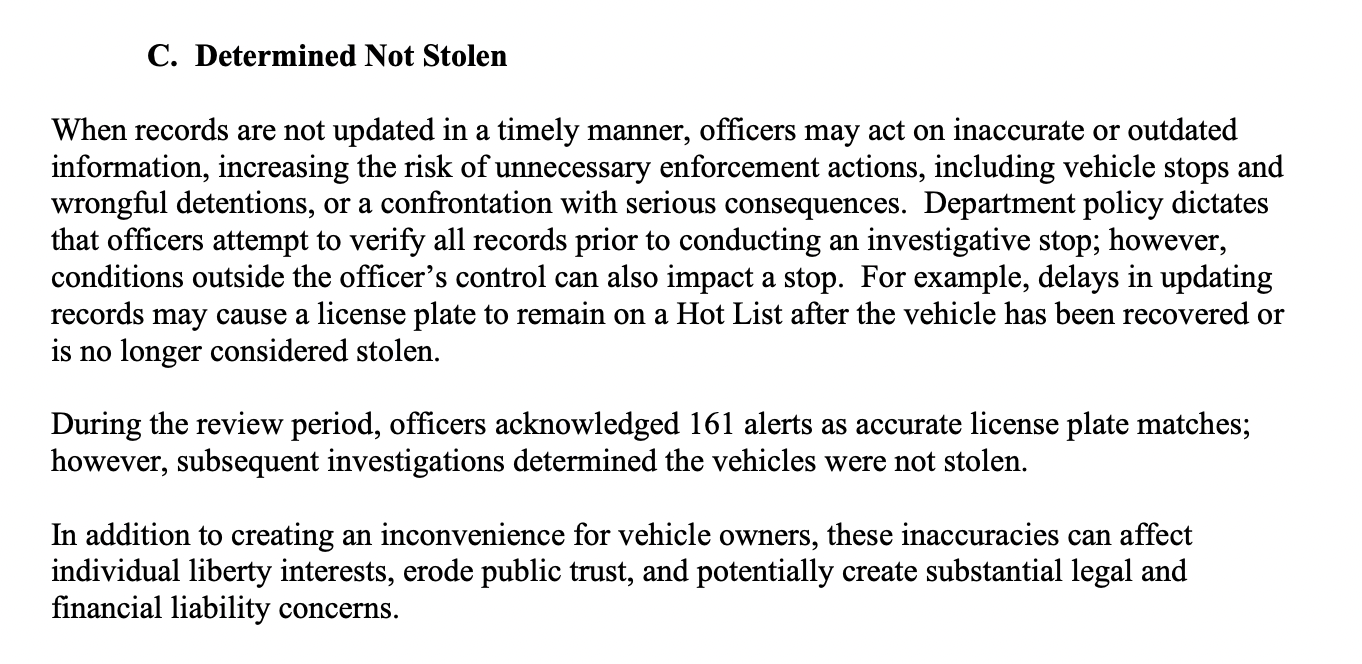
Last week, the Los Angeles Police Department announced it would not renew its contract with Flock. In a two month period, LAPD pulled over 161 innocent people acting on tips from Flock cameras.
“Subsequent investigations determined the vehicles were not stolen,” LAPD said in an investigation into its Flock cameras. “In addition to creating an inconvenience for vehicle owners, these inaccuracies can affect individual liberties, erode public trust, and potentially create substantial legal and financial liability concerns.”
These stories are just a small selection of the issues with Flock and I hope the council will consider them before its vote today.
🎉YOU'RE INVITED! 404 Media is turning three, and we're throwing TWO separate events in NYC to celebrate: A live taping of the podcast with a special night of talks on Sept. 3, and an open-bar bash on Sept. 4. Subscribers at the Supporter level get free and discounted access to both events. Not a 404 Media Supporter yet? Sign up, and get all the party details here.For weeks, Verona, Wisconsin tried to get Flock to remove the three automated license plate cameras that its city council had voted
YOU'RE INVITED! 404 Media is turning three, and we're throwing TWO separate events in NYC to celebrate: A live taping of the podcast with a special night of talks on Sept. 3, and an open-bar bash on Sept. 4. Subscribers at the Supporter level get free and discounted access to both events. Not a 404 Media Supporter yet? Sign up, and get all the party details here.
For weeks, Verona, Wisconsin tried to get Flock to remove the three automated license plate cameras that its city council had voted to stop using. Flock told city employees not to remove the cameras, and a Flock employee told city officials that they were unsure whether the cameras could be remotely disabled, which led the town to decide to put black plastic trash bags over them until Flock eventually removed the cameras itself, according to emails obtained using a public records request by 404 Media.
The emails give insight into the process cities face while deFlocking themselves after voting not to renew a contract with the AI surveillance company. As we’ve previously reported, multiple cities around the country have decided to put black trash bags over their Flock cameras while they wait for them to be removed; this is in part because, until the cameras are physically removed by Flock, cities are unsure whether they have the legal right to remove the cameras themselves and are not sure whether they can disable their recording operations. The emails show Verona city officials telling each other that they had made multiple requests to Flock to have the cameras removed, and show a work order from Flock in which the cameras were set to have maintenance performed on them rather than being removed.
In February, Verona mayor Luke Diaz told the Wisconsin Examiner that Flock didn’t remove the cameras even after several requests: “They weren’t removing them,” he said. “We kind of looked at the contract, talked it over amongst staff, and the thing we felt most comfortable with was just covering them so they could stop spying on people … I’m 100% certain that they were still working,” even after the contract ended, he said. The emails obtained by 404 Media give more insight into what was happening behind the scenes, and why it took so long to get Flock to remove the cameras.
A Flock spokesperson told 404 Media that the discrepancy occurred because Verona voted to not renew its contract rather than outright canceling it mid-term. It is clear from emails obtained by 404 Media, however, that Verona city officials wanted the cameras to come down as quickly as possible.
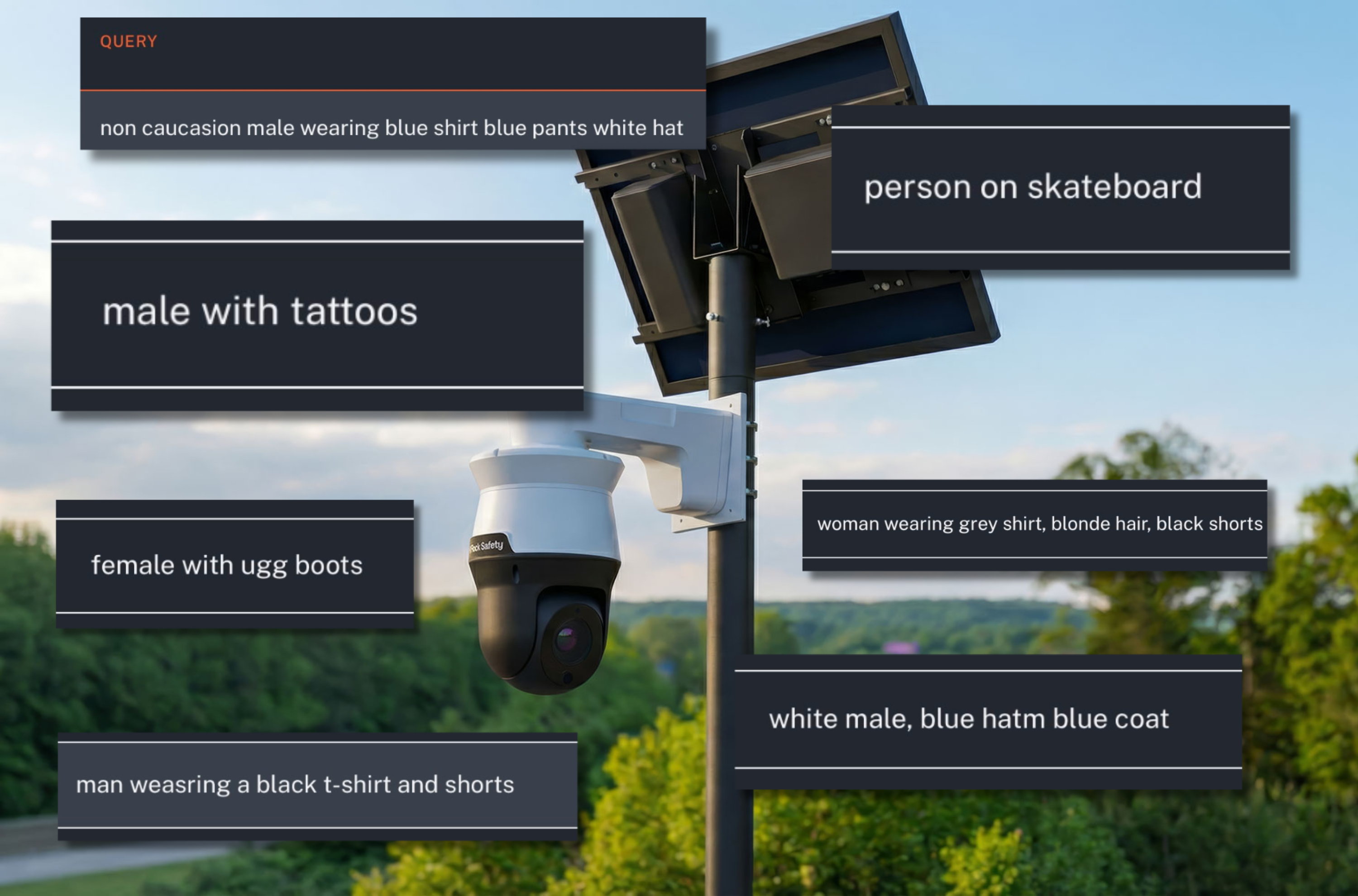
We start this week with Joseph’s story on how cops are using Flock to track actual people, not just cars, with searches like “male with tattoos.” After the break, Emanuel tells us all about the company that is explicitly selling mountains of books to AI companies and promising to keep the sales a secret. In the subscribers-only section, Jason tells us how he learned about the Suno hack and what it showed us.
Listen to the weekly podcast on Apple Podcasts, Spotify, or YouTube. Become a paid
We start this week with Joseph’s story on how cops are using Flock to track actual people, not just cars, with searches like “male with tattoos.” After the break, Emanuel tells us all about the company that is explicitly selling mountains of books to AI companies and promising to keep the sales a secret. In the subscribers-only section, Jason tells us how he learned about the Suno hack and what it showed us.
Listen to the weekly podcast on Apple Podcasts,Spotify, or YouTube. Become a paid subscriber for access to this episode's bonus content and to power our journalism. If you become a paid subscriber, check your inbox for an email from our podcast host Transistor for a link to the subscribers-only version! You can also add that subscribers feed to your podcast app of choice and never miss an episode that way. The email should also contain the subscribers-only unlisted YouTube link for the extended video version too. It will also be in the show notes in your podcast player.
When you open a new credit card, you necessarily give the credit card company your address. You probably expect that information to remain with your bank.But when you open a new credit card or change your address on file, your address leaves your credit card provider, travels through a web of middlemen companies, and ends up with Immigration and Customs Enforcement (ICE), which can then search, analyze, or pair that data with other pieces of information about your life without a warrant.404 Medi
When you open a new credit card, you necessarily give the credit card company your address. You probably expect that information to remain with your bank.
But when you open a new credit card or change your address on file, your address leaves your credit card provider, travels through a web of middlemen companies, and ends up with Immigration and Customs Enforcement (ICE), which can then search, analyze, or pair that data with other pieces of information about your life without a warrant.
404 Media has mapped out this supply of data by reviewing U.S. government procurement records and internal documents from companies providing the information. It highlights the sometimes unexpected ways ICE is gaining access to peoples’ personal information as the agency continues to acquire and leverage all sorts of data.
“No one signing up for a credit card thinks they're giving data brokers a thumbs-up to sell their personal information to ICE. Not only is it an outrageous violation of our privacy, it's impossible for Americans to opt out,” Senator Ron Wyden told 404 Media in a statement.
When I was 20 years old, I went to my hometown Olive Garden with one goal in mind: For less than $10, I would attempt to eat so much bottomless pasta in their so-called Never-Ending Pasta deal that either the staff would be forced to stop me and my idiot friends from putting the franchise into the red, or I would die trying. In either scenario, I planned to get a serious bang for my buck. No one asked to see my ID. I ate a ton of linguine alfredo (probably four bowls — not heroic and definite
When I was 20 years old, I went to my hometown Olive Garden with one goal in mind: For less than $10, I would attempt to eat so much bottomless pasta in their so-called Never-Ending Pasta deal that either the staff would be forced to stop me and my idiot friends from putting the franchise into the red, or I would die trying. In either scenario, I planned to get a serious bang for my buck. No one asked to see my ID.
I ate a ton of linguine alfredo (probably four bowls — not heroic and definitely not financially devastating to Olive Garden), shamefully tapped the mat, and went back to my friends’ place to smoke too much weed. The next morning, on the four hour drive back to my college town, I started feeling a burning, cramping pain in my abdomen. By that evening, I was curled up in pain and could barely walk. I drove myself to the emergency room, confessed my sins, and learned I had a handful of gallstones that the buckets of creamy, fatty, carby pasta had aggravated into an attack.
Should I have been carded before carrying out such a reckless crime against my own wellbeing? Maybe. But this week, right-wing groups and Republicans have started repeating a lie that Olive Garden’s promotional deals are more secure than the country’s elections.
Apple says it has fixed a vulnerability in its Hide My Email feature which let essentially anyone figure out a user’s real email address which was supposed to be protected by the feature. Apple only fixed the vulnerability after 404 Media wrote about it at the start of July, despite Apple knowing about the issue for more than a year.The news also follows the filing of a class action lawsuit against Apple over the vulnerability.On Wednesday Apple told 404 Media it deployed a patch for the issu
Apple says it has fixed a vulnerability in its Hide My Email feature which let essentially anyone figure out a user’s real email address which was supposed to be protected by the feature. Apple only fixed the vulnerability after 404 Media wrote about it at the start of July, despite Apple knowing about the issue for more than a year.
On Wednesday Apple told 404 Media it deployed a patch for the issue on July 3, which the company says has fully resolved the issue.
Hide My Email is part of Apple’s paid iCloud+ product. It lets customers quickly create a new, anonymous email address they can then use to sign up to websites, services, or email people with. The generated email addresses typically contain two random words followed by a number and the @icloud.com domain. I use it heavily so hackers may have a harder time cross-referencing my activity and accounts across data breaches, for example.
💡
Do you know about any other privacy issues like this? I would love to hear from you. Using a non-work device, you can message me securely on Signal at joseph.404 or send me an email at joseph@404media.co.
Tyler Murphy, co-founder of EasyOptOuts, discovered he was able to find the real email address of Hide My Email users. At the time, Murphy said, “We don't know the full scope of the issue, but in our limited tests with volunteers, 100% of Hide My Email addresses were exploitable.” That included mine, which we tested.
Murphy first reported the issue to Apple in June 2025. Over the subsequent months, Apple said it was looking into the issue and said it had fixed it; Murphy found it was still exploitable; and Apple again said it was looking into it. Murphy, thinking Apple may not fix the issue at all, then contacted 404 Media, around a year after Apple learned of the vulnerability.
When 404 Media first covered the issue several weeks ago, we did not include any details on how it worked because Apple had not fixed it. Meaning, if we published more specifics, third parties might figure out how to exploit it and reveal peoples’ real email addresses.
Now Apple says it has been fixed, we can add that, in simple terms, it required sending a target Hide My Email user a message that got rejected as spam. “We don't know how often hidden email addresses were leaked in email logs. For many major email hosts, the leak was triggered simply by an email being automatically rejected as spam, even if it was a legitimate message. Such emails probably didn't make it to your inbox, so you can’t review your spam folder to learn whether you were affected,” Murphy and EasyOptOut co-founder Ben Weiner said in a new statement.
“The bug that caused Apple's Hide My Email to leak hidden email addresses to senders has been fixed. However, we don't think the risk to Hide My Email users has been eliminated. Because non-malicious emails could bounce, revealing your hidden email address, and because mail transfer logs are often retained, we'd assume that any hidden email address linked to a Hide My Email address created before July 7, 2026, may have been exposed and could still be in third-party logs,” they added.
The class action lawsuit against Apple seeks full recovery of the subscription costs customers paid for the feature and an injunction against Apple for its “deceptive conduct,” PCMag reported.
As AI companies search for more training data to improve their models, one company is offering old, printed books as an ideal source because they are guaranteed to be free of the very AI slop AI companies are producing. “The world's best AI training data is sitting on a shelf,” ISBNdb, a company that produces what it claims is “the world’s largest book database,” and that offers high-volume book acquisition services for AI companies, says on its site. “Books represent curated, peer-reviewed, dom
As AI companies search for more training data to improve their models, one company is offering old, printed books as an ideal source because they are guaranteed to be free of the very AI slop AI companies are producing.
“The world's best AI training data is sitting on a shelf,” ISBNdb, a company that produces what it claims is “the world’s largest book database,” and that offers high-volume book acquisition services for AI companies, says on its site. “Books represent curated, peer-reviewed, domain-specific human knowledge, structured in a way no web crawl can replicate. Dense, edited, authoritative.”
🎉YOU'RE INVITED! 404 Media is turning three, and we're throwing TWO separate events in NYC to celebrate: A live taping of the podcast with a special night of talks on Sept. 3, and an open-bar bash on Sept. 4. Subscribers at the Supporter level get free and discounted access to both events. Not a 404 Media Supporter yet? Sign up, and get all the party details here.The New Orleans Police Department (NOPD) looked at ways to arm quadcopter drones with weapons, according to a draft version of its dro
YOU'RE INVITED! 404 Media is turning three, and we're throwing TWO separate events in NYC to celebrate: A live taping of the podcast with a special night of talks on Sept. 3, and an open-bar bash on Sept. 4. Subscribers at the Supporter level get free and discounted access to both events. Not a 404 Media Supporter yet? Sign up, and get all the party details here.
The New Orleans Police Department (NOPD) looked at ways to arm quadcopter drones with weapons, according to a draft version of its drone manual shared with 404 Media. A draft version of the manual, which was live on the NOPD website in June, said that the department’s drones could only be equipped with weapons with written approval from the Superintendent of Police.
The current version, live as of July 1, has different language: “The sUAS shall not be equipped with weapons or hazardous materials of any kind,” referring to small Unmanned Aerial Systems, or drones. According to the NOPD, the operations manual it published to the internet with the rules for weaponized drones was an early draft.
“The manual published on July 1 is the current published version of the policy. Earlier versions were draft versions that were presented for review before adoption of the current policy,” NOPD told 404 media. “NOPD has made it clear we are not and will not be equipping drones with weapons or other hazardous materials.” NOPD didn’t answer follow-up questions about how or why the draft version of the manual was published.
But the publication of a police drone manual that opens the door for weaponized quadcopters is important, and comes as drone companies and police flirt with the idea of putting weapons on their drones. New Orleans has long been a pioneer of camera and drone driven policing and the cops have used controversial tactics to get around public scrutiny and regulations. It shows that what the police are circulating amongst themselves and thinking about privately, what they perhaps want to happen, does not match public policy.
NOPD has a history of finding creative ways to work around public policy and scrutiny when it comes to surveillance tech. A private company called Project New Orleans operates a network of cameras that provide live facial recognition to the city’s cops. The company operated in secret cooperation with NOPD for two years before the Washington Postexposed it in 2025. According to the ACLU, NOPD has continued to use Project New Orleans in contravention of local laws and has stonewalled public records requests.
Federal Aviation Authority regulations prohibit the operation of drones equipped with a “dangerous weapon.” Matthew Guariglia, a senior policy analyst at the Electronic Frontier Foundation, told 404 Media that he didn’t see how the police arming drones could possibly be legal. But the FAA regulation was written in 2018 and things have changed a lot in just the last few years. Last month, Guariglia argued that “we have precious little time” to stop police from arming their drones, and that the industry was moving that way.
One of the companies selling NOPD its drones is Skydio. The US-based manufacturer of quadcopter drones has done very well since the Trump administration banned the sale of foreign-made drones last year. Skydio has always marketed itself as a drone company for first responders and had a cozy relationship with police departments around the country.
In 2020, Skydio wrote “we will not put weapons on our drones and will oppose fully autonomous lethal weapons systems.”
But Skydio CEO Adam Bry walked this back in a June 15 interview on Decoder. “So this is an area where I think I’ve gotten some things wrong. We’ve said some things previously that led some folks externally and internally to believe that, for example, we would prevent the military from putting weapons on our drones,” Bry said.
“It’s not our place to tell them what they can and can’t do,” he said. “It should be up to the folks who’re putting their lives on the line to decide how to use it.”
He added that terrorists don’t follow terms of service. “They don’t care what our policy says,” he said. “I think when you start trying to draw these bright lines and say: this is good, this is bad, more often than not you’re going to end up on the wrong side of moral questions.”
Guariglia also pointed to a planned pilot project in Georgia that will test “less lethal” armed drones to nominally stop school shootings. He noted that in recent years many drone regulations have been ignored or relaxed.
“You used to have to have line of sight of your drones and now law enforcement [...] are phasing that out or offering exemptions,” Guariglia said. “If you want to police divisions a few years ago, they were selling drones capable of flying miles and miles in a couple of minutes and you’d ask them about the line of sight rule and they would just shrug. They are preparing for the day when law enforcement gets whatever they want.”
“Clearly they’re thinking about it,” Guariglia said of the NOPD manual that included a provision for armed drones. “Drones have always been a bit of a solution in need of a problem. There are few things that police say they need drones for that they cannot get by other means, and I think by putting other tools on them, they are still on a quest to figure out what drones are really good for.”
Arming drones could lower the bar for police to use force. “We have seen how consequence-free it can be for officers to deploy force at somebody who’s standing in front of them when they have to confront the fact that it’s a fellow human and they still have to draw their night stick or their Taser or their gun,” Guariglia said. “That would become so much easier and so much less emotionally and physically burdensome if they can deploy force by pressing a button.”
All this tech costs a lot of money. “Cities are spending an astronomical amount on drones and for maintenance of the drones. They're hiring all these drone pilots. They have to have special infrastructure to fly all these drones, and companies are getting rich. But really, there is no problem in policing that drones have straight up solved yet,” Guariglia said.
On June 24, the New Orleans city council approved a $250,000 budget request to expand Skydio’s reach in the French Quarter. The funds will purchase a massive docking station and support a “drones as first responders” (DFR) program, meaning that people who call 911 in the French Quarter may see a quadcopter drone before they see a police officer. NOPD told the city council that these drones won’t run facial recognition software and will not be armed.
The existence of the draft that was “presented for review” stands out. On February 7, 2024, NOPD first published an operations manual for drones. It was unequivocal: “The sUAS shall not be equipped with weapons of any kind.”
Two years later, in 2026, NOPD asked for money for more Skydio drones and the city council questioned the cops about the program in a public meeting on April 16.
“Are these drones or any current drones in the French Quarter armed with any type of weapons?” Councilman Freddie King asked.
“No,” NOPD captain Samuel Palumbo said.
On June 24, 2026, the city council voted 4 - 3 to fund the expansion of the DFR program in the French Quarter.
Around that time, a revised version of the NOPD drone manual that allowed for the use of weaponized drones with the Superintendent’s written permission was live on the NOPD website. The revised version of the manual is dated June 21, 2026. The new manual caught the attention of Eye on Surveillance, a Louisiania activist group. The group said it started calling city council members to alert them to the new language.
Then, on June 30, the operations manual with the weaponization language vanished and a third version of the manual appeared. “The sUAS shall not be equipped with weapons or hazardous materials of any kind,” a revised version of the drone manual dated July 1, 2026 said.
It’s an odd sequence of events from a police department that hasn’t been forthcoming about its use of surveillance tech. “Police have yet to demonstrate that they can responsibly handle the data collection and surveillance capabilities of drones. Choosing to arm already unaccountable sky cameras is a threat on top of a threat, a misuse of public resources, and risks introducing more unaccountable weapons into a city enjoying a decline in gun violence,” Kelsey Atherton, Chief Editor at Center for International Policy — a non-profit that studies emerging technologies — told 404 Media.
Skydio did not return 404 Media’s request for a comment.
Welcome back to the Abstract! Here are the studies this week that loosed arrows, made sacrifices, prepared for battle, and took the hit.First, a bunch of ancient princesses were buried with weapons. Did they know how to use them? You bet! Then: a deadly Inca ritual, animal war games, and the mystery of the dinosaur-killer.As always, for more of my work, check out my book First Contact: The Story of Our Obsession with Aliens, or subscribe to my personal newsletter the BeX Files. Disney princesses
Welcome back to the Abstract! Here are the studies this week that loosed arrows, made sacrifices, prepared for battle, and took the hit.
First, a bunch of ancient princesses were buried with weapons. Did they know how to use them? You bet! Then: a deadly Inca ritual, animal war games, and the mystery of the dinosaur-killer.
Egyptian princesses who lived nearly 4,000 years ago were skilled archers and likely handled other deadly weapons, including maces and daggers, according to a new study that revisits their mummified bones and upends expectations about gender in the ancient world.
For more than a century, archaeologists have puzzled over the remains of ancient royals entombed in the Amenemhat II pyramid complex located in Egypt’s Dahshur necropolis.
Four of these mummified bodies have been identified as the daughters of the pharaoh Amenemhat II, known as Princess Ita, Princess Khenmet, Princess Itaweret, and Princess Sathathormeryt.
These women were buried with weapons, including bows and maces, which are grave goods normally found in male burials; Princess Ita’s tomb also contained a stunning dagger. Another pair of royals, Princess Noub-Hotep and her father King Hor, are buried in the same complex with weapons in their graves, and were also part of the study.
The presence of weaponry in the graves has led to a debate over whether the items were selected for symbolic purposes, or if the women used them in life. To resolve this question, researchers conducted a thorough re-examination of the mummified remains using osteological analysis, X-ray imaging, and advanced spectroscopy.
The results revealed that all of these individuals showed signs of bodily strain associated with repeated use of bows and melee arms, suggesting that not only King Hor, but the five princesses, knew their way around a weapon.
Pronounced muscle attachments across the mummified upper limbs “indicates repetitive, high-intensity actions consistent with archery and weapon use,” said researchers led by Zeineb Hashesh of the University of Beni-Suef.
“This evidence directly informs long-standing debates about the function of weapons in female burials,” the team continued. “Rather than purely symbolic objects, these items appear to have been actively used, as reflected in skeletal adaptations such as asymmetry, muscle hypertrophy, and metacarpal modification. Princess Noub-Hotep provides a particularly clear example, where skeletal changes align with the presence of arrows in her burial.”
In other words, these women don’t appear to have been the damsels in distress depicted in traditional princess stories. The mummification of their bare arms hints that they did, in fact, bear arms.
We’re not wrapped up with the mummy beat just yet. In another new study, scientists took a fresh look at the mummified bodies of three young victims of human sacrifice in the Inca empire, who were ritually killed as part of a ceremony called the Capacocha in the 15th century.
“Selected for their perceived purity and exceptional beauty, the individuals chosen for sacrifice were either taken from their home communities or offered by local authorities” and “undertook a long, final journey to sacred mountain summits, where they were ritually killed,” said researchers led by Verónica Silva Pinto of the University of València.
The results revealed that the Boy of Cerro El Plomo, a child of about 8-years-old discovered at an elevation of nearly 18,000 feet, was likely killed by blunt force trauma to the head, and not by hypothermia or strangulation as previously proposed. Using advanced imaging, researchers discovered a cranial lesion that may have been inflicted by “a blunt-lobed lithic star-shaped mace,” according to the study.
Meanwhile, the team found that two female victims found at Cerro Esmeralda, aged roughly 9 and 18, had an indeterminate cause of death, despite strangulation being put forward as the likely explanation.
In all three cases, the victims were brought from distant homelands and traveled for several months prior to their killings, according to isotopic analysis of the elements in their remains. The enormous effort invested in these pilgrimages, combined with the careful placement of the bodies in special costumes and poses after death, demonstrate the significance of the Capacocha in Inca statecraft and cosmology.
Humans have a rather catastrophic habit of getting into wars, but at least we aren’t alone in our military misery. A diverse array of species—from ants, to woodpeckers, to chimpanzees—also engage in violent intergroup conflicts that require careful preparation for success.
Scientists have now helpfully pulled together a comprehensive review of how animals ready themselves for battle in part “to provide insights into our own conflict ancestry,” according to their new study.
A group of meerkats standing together in the face of an outside threat. Image: Andy Radford, University of Bristol
Many behaviors are eerily similar to our own: Chimpanzees surveil rivals from hilltops, patrol perimeters, and march in single file. It is also common for animals to invest a lot of time and energy into sizing up their opponent’s force, including by carefully monitoring scent marks.
Some animals “travel considerable distances to eavesdrop on the contests of other groups to gather social information that is used only days or weeks later, as seen in acorn woodpeckers (Melanerpes formicivorus),” said study authors Josh Arbon and Andrew Radford of the University of Bristol.
But by far the most memorable prep work comes from the Nevada termite, which erects “faecal fortresses” as barriers to intrusion by larger colonies. For all the fancy weaponry we’ve devised as humans—from guns, to nukes, to drones—how did we overlook the ultimate obstacle: poop barricades?
Deadly princesses, human sacrifice, widespread warfare. Let’s close with something lighter: The apocalyptic extinction of almost all life on Earth. It’s time to revisit the longstanding mystery of the dinosaur-killing space rock that smashed into our planet some 66 million years ago, causing the Cretaceous-Paleogene (K-Pg) mass extinction that wiped out about 75 percent of all animal and plant life at the time.
For decades, scientists have debated the nature of this epic deathbringer, which is known as the Chicxulub impactor. Now, a team has narrowed down the possible source to a class of asteroid called carbonaceous chondrites by studying nickel isotopes embedded around the impact crater in Mexico’s Yucatán Peninsula.
Concept art of Chicxulub impactor and its soon-to-be victims. Image: Donald E. Davis
The identification of the impactor as a likely carbonaceous chondrite “is possible given nickel’s high abundance in primitive meteorites compared to the Earth’s crust and the distinct isotope compositions they record,” said researchers led by Georgy V. Makhatadze of Université Paris Cité.
“Our study highlights the extraterrestrial origin of the K-Pg mass extinction and the isotopes of nickel as a well-suited tool to characterise the nature of extraterrestrial material on Earth,” the team concluded. “Finally, it opens the door for further research into the connection between the impact and the mass extinction.”
Mummies, war, and doomsday. You’re welcome for the beach reads.
404 Media is turning three years old! We've come a long way with your support, so let's hang out.We're throwing TWO separate events to celebrate: A live taping of the podcast and a special night of talks on Sept. 3, and a big open-bar party on Sept. 4. Subscribers at the Supporter level get free and discounted access to both events!Check your membership status or become a paid supporter of our work here. On Thursday, Sept. 3, meet us at WNYC's Greene Space for 404 MEDIA LIVE! We'll discuss wh
404 Media is turning three years old! We've come a long way with your support, so let's hang out.
We're throwing TWO separate events to celebrate: A live taping of the podcast and a special night of talks on Sept. 3, and a big open-bar party on Sept. 4. Subscribers at the Supporter level get free and discounted access to both events!
On Thursday, Sept. 3, meet us at WNYC's Greene Space for 404 MEDIA LIVE! We'll discuss what we've accomplished in the past year, and what's next for our independent, human-made journalism. We'll also welcome a few very special friends to the stage: Matthew Gault joins us for a chat about AI datacenter resistance, and The Abstract's Becky Ferreira hits us with the coolest science to come out this year so far.
Supporters get 50% off their ticket to 404 MEDIA LIVE! Don't forget to check your membership status here and subscribe as a paying member for access to 50% off a full price in-person ticket.
Can't make it in person in NYC? Join us on the livestream! Grab an access ticket, donate what you're able, and watch for the link we'll send to your inbox before the event.
The next night, join us for a bash to celebrate our three year anniversary at Threes Brewing Gowanus.Have a beer, wine or seltz on us, plus light bites throughout the night. Buying a ticket to 404 MEDIA LIVE! gets you 50% off a ticket to the afterparty Friday night. Supporters get in to the party FREE!
All of us—Sam, Emanuel, Jason, and Joseph—will be there to celebrate 404 Media growing another year. We love these parties because it's a chance to connect with the people who make all of this possible: you, our subscribers.
Thank you for all the fun you've helped us have this year.
Supporters, scroll to the bottom of this page to reveal your promo codes.
This is Behind the Blog, where we share our behind-the-scenes thoughts about how a few of our top stories of the week came together. This week, we discuss AI music, slop bowls, and the endless quest for optimization. EMANUEL: We’ve used Behind the Blog a few times at this point to pull the curtain on our story selection process. Usually, we do this when we explain the reasoning behind the decision to write a story we already published, but today I want to talk about a story I didn’t write (ye
This is Behind the Blog, where we share our behind-the-scenes thoughts about how a few of our top stories of the week came together. This week, we discuss AI music, slop bowls, and the endless quest for optimization.
EMANUEL: We’ve used Behind the Blog a few times at this point to pull the curtain on our story selection process. Usually, we do this when we explain the reasoning behind the decision to write a story we already published, but today I want to talk about a story I didn’t write (yet).
For the past few months I’ve been looking at a new and strange type of AI generated nonconsensual image on X.
The Department of Homeland Security (DHS) plans to pay data broker giant Thomson Reuters $125 million for access to its databases of personal data — which includes peoples’ names, addresses, Social Security numbers, ethnicity, social media posts, and geolocation information — to help Immigration and Customs Enforcement (ICE) investigate what it describes as “voters fraud” and immigration fraud, according to procurement documents reviewed by 404 Media. The document says Thomson Reuters is able
The Department of Homeland Security (DHS) plans to pay data broker giant Thomson Reuters $125 million for access to its databases of personal data — which includes peoples’ names, addresses, Social Security numbers, ethnicity, social media posts, and geolocation information — to help Immigration and Customs Enforcement (ICE) investigate what it describes as “voters fraud” and immigration fraud, according to procurement documents reviewed by 404 Media. The document says Thomson Reuters is able to let ICE continuously monitor millions of people and entities of interest.
The news comes after President Trump held a conspiracy-laden and unhinged press conference about election security on Thursday, setting the stage for potentially undermining the legitimacy of the upcoming midterm elections. It also follows ICE fatally shooting 2 people in a week.
🌘Subscribe to 404 Media to get The Abstract, our newsletter about the most exciting and mind-boggling science news and studies of the week. Astronomers have detected an atmosphere around a rocky exoplanet in the habitable zone of its star for the first time in history, signalling a major breakthrough in the search for alien life, according to a study published on Thursday in Science. The planet, known as LHS 1140-b, is about 5.6 times more massive than Earth and orbits a small dwarf star about 4
Subscribe to 404 Media to get The Abstract, our newsletter about the most exciting and mind-boggling science news and studies of the week.
Astronomers have detected an atmosphere around a rocky exoplanet in the habitable zone of its star for the first time in history, signalling a major breakthrough in the search for alien life, according to a study published on Thursday in Science.
The planet, known as LHS 1140-b, is about 5.6 times more massive than Earth and orbits a small dwarf star about 48 light years from our solar system. While scientists have discovered atmospheres around many giant gas planets in our galaxy—and even a few rocky exoplanets outside the habitable zone—the new detection of helium in the skies of LHS 1140-b marks the first direct evidence that a habitable-zone rocky world can host an atmosphere, which is a critical factor for assessing their potential to support life.
“For rockier Earth-like planets, it has been a huge challenge in the field to detect any atmospheres at all,” said Collin Cherubim, a NASA Hubble Fellow at the University of Chicago, in a call with 404 Media. “This has been a huge question in the field that so much time and energy has been devoted to answering.”
The new discovery “is really the first claim ever of any rocky exoplanet atmosphere in the habitable zone that could potentially have liquid water and really support life,” added Cherubim, who conducted the research while he was a PhD student at Harvard University. “That's what sets it apart and makes it really exciting.”
Scientists have previously inferred that some rocky exoplanets in the habitable zone might have atmospheres based on indirect evidence, such as measurements that show that their day and night temperatures are more moderate than expected, which could be explained either by an atmosphere, or other planet-wide effects. However, spotting an atmosphere around these rocky worlds is tricky because they tend to be so small compared to their stars, which is a challenge for precision observations.
Cherubim came at the problem with a new approach: He first developed theoretical models of rocky exoplanets that focused on mass fractionation, a process by which lighter molecules and atoms in the atmosphere escape into space, while heavier ones are left behind. These simulations predicted a new type of planet with thick skies closer to the surface, and a thinner upper atmosphere that allows helium to escape to space.
“Hydrogen is the lightest element and it's the easiest to blow off into space,” Cherubim explained. “My model was predicting that if your planet is in this sweet spot where you're blowing enough hydrogen away, but not too much that you're dragging helium, which is a bit heavier, along with it, then you can actually create a helium-dominated atmosphere over time.”
“This is a newly-predicted class of planets, which should have very unique chemistry,” he added.
Cherubim realized that this escaping helium might be detectable from Earth, and that the LHS 1140 system would be a prime candidate to test out the hypothesis. To that end, the team observed LHS 1140-b and another planet in the system, LHS 1140-c, over the course of 2024 and 2025 with the Warm Infrared Echelle (WINERED) Spectrograph on the Magellan Observatory in Chile.
The 2024 results revealed a strong signal of helium at LHS 1140-b, but no detection in 2025, which may mean that the helium escape varies over time. The team predicts that the planet has probably had its atmosphere for billions of years. The other planet, LHS 1140-c, did not show any signs of an atmosphere, which was also expected based on its orbit and characteristics.
The momentous discovery proves that atmospheres can exist around rocky worlds, including around dwarf stars, which are far more common than more massive stars like the Sun. Cherubim and his colleagues think it’s quite likely that LHS 1140-b has large amounts of liquid water on its surface, another key ingredient for life as we know it on Earth.
“When we think about habitability, we think about three high-level things,” Cherubim said. “We think the planet needs to be rocky for the most part. It can't be a gas-rich thing where the surface is molten, or like Jupiter where it's just all gas. It's got to be the right temperature to support surface liquid water, at least for Earth-like life, and it needs an atmosphere to hold that water in and to shield the surface from radiation.”
“With this discovery, we now know LHS 1140-b has all three of those things, which is really exciting,” he added. “And it just happens to be a very nearby system to Earth, so it's very accessible.”
Whether alien life exists on LHS 1140-b remains an open question, but scientists have already been looking for signs of life, known as biosignatures, in its skies using the Hubble Space Telescope and the James Webb Space Telescope. So far, the search hasn’t turned up any obvious signs of life, but future efforts may be able to peer at this world in more detail.
“I think this is the best place to be looking for biosignatures,” Cherubim concluded. “We're really excited to see what comes out of that.”
🌘
Subscribe to 404 Media to get The Abstract, our newsletter about the most exciting and mind-boggling science news and studies of the week.
Police departments around the country have used Flock cameras at least hundreds of times to search for specific people, not cars, using searches such as “heavy-set male with a black and white hat,” “person on skateboard,” and “person wearing orange vest and construction hat,” according to data reviewed by 404 Media. Sometimes searches reference a target’s race or signs of their political affiliation.The searches highlight that while most people associate Flock cameras with scanning license pl
Police departments around the country have used Flock cameras at least hundreds of times to search for specific people, not cars, using searches such as “heavy-set male with a black and white hat,” “person on skateboard,” and “person wearing orange vest and construction hat,” according to data reviewed by 404 Media. Sometimes searches reference a target’s race or signs of their political affiliation.
The searches highlight that while most people associate Flock cameras with scanning license plates and tracking vehicles, some of the cameras are also capable of following the movements of particular people or groups of people. Flock’s nationwide network of cameras lets police officers in one state search for a vehicle across many other states at once; the people searches do a similar thing, typically on a smaller scale, sometimes querying many hundreds of cameras at once. These are called “FreeForm” searches, and allow cops to use Flock’s system as though they would use a search engine, with Flock’s AI and image recognition interpreting what footage and which people are relevant to a police officer’s search.
We start this week with Jason’s story about the ChatGPT flyer pandemic. They’re everywhere! Thank you to the readers and listeners who sent in their own examples. After the break, Sam tells us how Waymo snitched on kids and drove them to a group of waiting cops. In the subscribers-only section, Joseph explains why he bought a $3,000 suit that electrocutes your muscles. Yep.
Listen to the week
We start this week with Jason’s story about the ChatGPT flyer pandemic. They’re everywhere! Thank you to the readers and listeners who sent in their own examples. After the break, Sam tells us how Waymo snitched on kids and drove them to a group of waiting cops. In the subscribers-only section, Joseph explains why he bought a $3,000 suit that electrocutes your muscles. Yep.
Listen to the weekly podcast on Apple Podcasts,Spotify, or YouTube. Become a paid subscriber for access to this episode's bonus content and to power our journalism. If you become a paid subscriber, check your inbox for an email from our podcast host Transistor for a link to the subscribers-only version! You can also add that subscribers feed to your podcast app of choice and never miss an episode that way. The email should also contain the subscribers-only unlisted YouTube link for the extended video version too. It will also be in the show notes in your podcast player.
The AI music generation tool Suno scraped millions of songs and lyrics from YouTube Music, Deezer, and Genius, as well as from the stock music libraries Pond5, Jamendo, Freesound, the International Music Score Library Project, and podcasts via RSS feeds, according to a hacker who breached the company and shared data about Suno’s training libraries with 404 Media. The hacker was also able to access user information for hundreds of thousands of Suno’s customers, as well as Stripe payment inform
The AI music generation tool Suno scraped millions of songs and lyrics from YouTube Music, Deezer, and Genius, as well as from the stock music libraries Pond5, Jamendo, Freesound, the International Music Score Library Project, and podcasts via RSS feeds, according to a hacker who breached the company and shared data about Suno’s training libraries with 404 Media. The hacker was also able to access user information for hundreds of thousands of Suno’s customers, as well as Stripe payment information, they said.
The hacked data is a rare look at exactly how AI models and tools are built. Suno is one of the largest AI music generation tools on the internet, and has been the subject of several major lawsuits from the record industry, which accused the company of training on millions of copyrighted songs. As part of these legal proceedings, Suno previously admitted that it was trained on “essentially all music files of reasonable quality that are accessible on the open internet,” which included a total of “tens of millions of recordings.” Suno has been making the argument that it is allowed to train on copyrighted works as fair use in those cases, one of which has been settled.
The lawsuits have made clear that Suno did train on huge amounts of copyrighted works, but the hacked data shared with 404 Media sheds more light on how Suno scraped songs from the internet and where it took them from. The Recording Industry Association of America accused Suno of ripping songs directly from YouTube; the hacked data seen by 404 Media confirms this.
The hacked material includes source code that appears to be from 2023 and 2024 that includes scraping instructions and details about the scope of at least some of the scraping. For example, the comments in one file note that they will pull from “genius_hq, youtube_music, freesound, jamendo, imp, deezer, ytm_tagged,” and that “non-music will be filtered out.” A file called “youtube_music” notes that at the time the file was last updated, it had ingested “2,013,545 music clips.” Another file contains comments about different datasets Suno had created, which included “113,879 hours of youtube_music,” “17,615 hours of genius_hq,” “410 hours of free sound,” “19,514 hours of imslp,” “3,726 hours of jamendo,” “62,117 hours of pond5_music,” “12,287 hours of deezer,” “152,162 hours of ytm_tagged,” and “103 hours of musescore_lyrics.” In total, this is at least decades worth of music.
If you listen to the 404 Media podcast by now you probably realized that Joe and I are a little obsessed with a game called Marathon. I’m embarrassed to say that I’ve played it for almost 300 hours since it was released in March.But as much as we’re enjoying it, and there are thousands of players who feel the same, Marathon so far has failed to find the audience we’d expect from the developer that made Halo, Destiny, and which a few years ago acquired by PlayStation for more than $3 billion. It’
If you listen to the 404 Media podcast by now you probably realized that Joe and I are a little obsessed with a game called Marathon. I’m embarrassed to say that I’ve played it for almost 300 hours since it was released in March.
But as much as we’re enjoying it, and there are thousands of players who feel the same, Marathon so far has failed to find the audience we’d expect from the developer that made Halo, Destiny, and which a few years ago acquired by PlayStation for more than $3 billion. It’s bad news for Marathon fans and a good sign for how much the video game business has changed over the years.
I wanted to have Remap Radio host Robert Zacny on the podcast because much like me and Joe, he’s been obsessed with Marathon as well. One of Rob’s greatest skills is dissecting how and why games get their hooks into us, and what a game’s popularity, or lack thereof in Marathon’s case, might reveal about the state of the industry and culture more broadly.
404 Media is a journalist-founded company and needs your support. To subscribe, go to 404media.co. As well as bonus content every single week, subscribers get access to additional episodes where we respond to their best comments. Subscribers also get early access to our interview series. Gain access to that content at 404media.co.
Become a paid subscriber for early access to these interview episodes and to power our journalism. If you become a paid subscriber, check your inbox for an email from our podcast host Transistor for a link to the subscribers-only version! You can also add that subscribers feed to your podcast app of choice and never miss an episode that way. The email should also contain the subscribers-only unlisted YouTube link for the extended video version too. It will also be in the show notes in your podcast player.
Freya Holmér's had this idea in her head for a long time—Tetris, but the whole board rotates. The game developer and Unity tool maker started making the idea real and built out a prototype. Holmér posted a 50-second clip of it to social media in mid-March and asked: "Is this anything?" It was, according to the people who responded. The posts got hundreds of replies from people desperate for a playable version. "You can watch [the gameplay] happen and you understand the full extent of it, while s
Freya Holmér's had this idea in her head for a long time—Tetris, but the whole board rotates. The game developer and Unity tool maker started making the idea real and built out a prototype. Holmér posted a 50-second clip of it to social media in mid-March and asked: "Is this anything?" It was, according to the people who responded. The posts got hundreds of replies from people desperate for a playable version.
"You can watch [the gameplay] happen and you understand the full extent of it, while still seeing the complexity and interesting parts of it," Holmér told 404 Media. "Most people know about Tetris, so you can shortcut all those concepts—it's a visually compelling concept—and you get the idea very quickly."
It was a promising response for a commercial game developer that quickly turned unsettling. Within days, someone responded to her post with a vibecoded version of Holmér's prototype: "This can be built into a game by tomorrow." Another popped up in mobile app stores. Holmér said she saw up to four vibecoded versions of her prototype. Generative AI has made the work of plagiarizing an idea a lot simpler. A person vibecoding a game doesn't need any programming or design experience. They input ideas and instructions into a generative AI application and it writes the code and builds out the user interface. The vibecoder can tweak the game in conversation with the generative AI program until it suits their needs. As you might expect, the process doesn't necessarily produce elegant results.
The two vibecoded versions of Holmér's game, for instance, lack the finesse of her carefully crafted animations. There's a story behind every decision she made. That may not be true for the vibecoded versions of the game. Charlie Greenman, who told 404 Media he saw Holmer's idea on social media and wanted to do a spin on her prototype, said it took him several prompts and roughly a day to make his version, Rotris. Greenman said he doesn't think there are any ethical concerns with what he did. "I really can care less about the game," he said. "No one was interested."
"I feel like I had this brand new creation," Greenman said. "When it gets to that point, is one song copying another? Is one game copying another? Whoever created Blox, Jenga, is that a copy of Tetris?"
404 Media reached out to the developer of another copycat, Blockfall, which also popped up within days of Holmér's post, but did not receive a response.
"It disincentives me from [posting about my work,]" Holmér said. "You get this anxiety anytime you post anything, someone is going to come in to finish it for you and then monetize it and steal the whole concept. It used to be the case that this stuff took a look of effort [to steal], because it requires skill and skillful execution and effort and knowledge. But now with AI, there's a general devaluing of skill and knowledge."
Papers, Please developer Lucas Pope expressed a similar sentiment on the Mike & Rami Are Still Here podcast in April—that he doesn’t feel comfortable sharing much about what he’s working on publicly, lest it gets “slurped by AI” and copied by someone else.
There's always been some risk of sharing ideas and concepts too early on social media; grifters looking to swipe ideas have always been around. Holmér's experience with generative AI clones of her game idea is just exacerbating a dupe industry that's pervasive on digital video game marketplaces. As video game companies both big and small compete for attention in a culture that's kept the same five games, like Fortnite and Grand Theft Auto 5, on the most-played lists for years, some companies are forgoing original ideas entirely, opting instead to co-opt anything popular or trending to make a quick buck. These sorts of schemes are prolific on the App Store and Google Play Stores, but are behind much of the slop on console digital stores, too.
It's big business. Several companies have had huge success flooding the market with knockoffs designed to confuse players looking for games to play. One strategy for these clone developers is taking a popular console or PC game and publishing a clone on mobile app stores—often before a developer has been able to make a port themselves. It's been massively successful for studios like Voodoo, a French mobile game maker that's been accused several times of making copycat games. 404 Media reached out to Voodoo for comment, but did not hear back. In 2018, Voodoo received a reported $200 million from Goldman Sachs, and in 2020, Tencent became a minority stakeholder valuing the company at a whopping $1.4 billion. Voodoo both makes and publishes mobile games, often low effort free-to-play games that generate money through ads.
"The incentives and the infrastructure is built to encourage this kind of overproduction"
In 2018, game developer Ben Esposito accused the company of copying Donut County, which was unreleased at the time. Voodoo's version, Hole.io, reached the top of app store charts. It remains one of Voodoo's most popular games. Several other indie games have seemingly been cloned by Voodoo, too. Ironically, Voodoo doesn't want other game developers aping their clone games; it sued another mobile giant, Rollic Games, in a French court and won. The court found that Rollic Games' Wood Shop, in which players carve a spinning block of wood, copied Voodoo's Woodturning. The important piece of this story is, however, that Rollic Games was released before Voodoo's. Its copying accusations were related to an update Wood Shop made to their game.
Copycat and clone games have proliferated since, and generative AI is only making the problem worse.
"We shouldn't be surprised that people are using AI to do this kind of thing, because the incentives and the infrastructure is built to encourage this kind of overproduction," University of Wisconsin-Madison professor of media and cultural studies Jeremy Morris told 404 Media. "This is a problem that's existed for as long as these platforms existed, so I don't think AI creates something new here. It just amplifies the amount that people can do."
Moldova-based Midnight Works is one company flooding console and mobile digital storefronts with clone games that players quickly deem scams. Founded by Cătălin Țiței and Roman Gaina in 2015, according to an archived version of the Midnight Works website, Midnight Works created apps before entering the games market in 2017. Since then, Midnight Works has grown to employ 300 people, per an archived version of its website. (The website now only hosts a landing page with almost no information.) . "Midnight.Works is a visionary game development and publishing company that thrives on nurturing creativity and innovation within the gaming industry," the company said, according to an archived version of the website. "Our diverse and passionate team is dedicated to collaborating with both burgeoning and accomplished game creators to bring unique, engaging gaming experiences to players across the globe."
Midnight Works claimed that 80 percent of the games it publishes pass $1 million in revenue, while 15 percent make over $100,000. The remaining five percent, it said, "don't achieve significant milestones."
A Moldovan game developer close to the company, told 404 Media that Midnight Works is "one of the largest" game developers in Moldova. Its big success was acquiring Hashiriya Drifter, a popular mobile racing game, from an external game developer. "[It] became their flagship project and, from what I know, the main financial foundation that allowed the company to grow," the developer said. 404 Media granted this developer anonymity so they could speak freely about Midnight Works.
"I found out my game was suddenly being sold by someone else."
Luke Wild, a YouTube creator who investigated Midnight Works in a series on his channel, told 404 Media that he believes the company is a "massive global scam." Wild started looking into the company while playing through slop games on the Nintendo Switch eShop on YouTube. (Midnight Works retaliated against him, Wild said, by demanding employees to report his videos," he claimed.) He noticed that a lot of the games he was playing were coming from a small pool of developers that all seemed to stem from Midnight Works. He spent years documenting the connections between the slop factories. Each of these studios uploaded the same games, maybe with slightly different titles. If a game got removed from a digital storefront, it'd get uploaded later under a different developer or publisher. Most of the games, Wild said, are simulator games—because they're easy to create a template for—that copy whatever the algorithm is favoring. When TCG Card Shop Simulator, from OPNeon Games, was released into early access in 2024, for instance, Midnight Works released its own, Card Shop Game Store Simulator, months later. (The Nintendo Switch store page for this game is listed as being made/published by VRCForge Studios, but a game with the same name and key art is listed as being published by The Midnight—with Midnight Works email addresses—on the Microsoft Store.)
"Midnight doesn't have the best reputation, and unfortunately that already affects how people perceive other studios from our country as well," the Moldovan game developer close to the company said.
Midnight Works has not responded to multiple requests for comment.
Sometimes, Midnight Works' and studios in what Wild calls Midnight Works' "Web of Deceit" directly copy games, down to the source code and assets. One developer, who goes by the name Steelkrill Studio online, told 404 Media that his found footage horror game The Backrooms 1998 was stolen almost in its entirety. "I never imagined something like that would happen," Steelkrill Studio said. "The wildest part is that I only discovered it because someone commented on one of my videos accusing me of re-releasing the same game myself, which is how I found out my game was suddenly being sold by someone else."
The Backrooms 1998 is a found footage horror game published in 2025. It’s played through the lens of a camcorder’s viewfinder. One of the unique pieces of the game is the implementation of the player’s actual microphone—the monsters can hear breathing and other sounds. It’s Steelkrill Studio’s own take on the backrooms genre, which was born of creepy storytelling on forums like Reddit, like Kane Parsons’ 2026 film Backrooms. There are a lot of other backrooms-inspired games, the most popular of which is Escape the Backrooms.
Steelskrill Studio thinks Midnight Works used a decompiler to take the source code. Looking through the files, he found that most everything matched his game. "It even had my personal videos when I was younger and family VHS tapes that I had included in my game [that] were still present in their stolen version," he said.
The stolen version of The Backrooms 1998 was taken off the console storefronts, and that publisher, Cool Devs, has seemingly been banned. 404 Media has reached out to Nintendo, Sony, and Microsoft to confirm the reason for the removal and subsequent bans, but didn’t hear back. But its games now appear on the Nintendo Switch eShop and other storefronts once again, sometimes under different publisher names. The Bad Parents, an egregious copy of Bad Parenting, published originally by Cool Devs is now listed on the Nintendo store by TrueMotion Interactive—a studio that's published and is still selling near exact copies of Peak, Supermarket Simulator, and Bodycam.
A former Midnight Works employee, who asked for anonymity, told 404 Media that the studios' "long-established" scheme was to recreate a trending game and make a "stripped down clone" in a few months—just give it a similar name and style, sometimes using assets ripped from the original games. "All of this was done in the hope of confusing buyers so that they would purchase our awful knockoff instead of the original," the former employee said. The former employee said that generative AI was used "at every step" to speed up development: "Literally from banners and screenshots to UI and 3D models," they said.
Once a game is ready to be published on digital storefronts like the Nintendo eShop or PlayStation Store, the company blasts its game name and page with keywords in an attempt to beat the algorithm. "A lot of the optimization for game developers was similar to the way it was for early stages of music and podcasts, which is keyword stuffing," Morris said of general clone game tactics. "It's the basic kind of search engine optimization, at the discovery level." Another strategy, Morris said, is constant updates. It's one of those things that Morris called "algorithmic imaginaries," or myths about how these platform algorithms work. "One of the big ones is that the more frequently you update your app, the more often it would look like it was new and would get recommended more," he said. "One example I point to is the Bible app, and there's a Bible app that's updated every 12 days. I thought it was funny because it's a text that obviously is not changing."
Game sellers and app stores are incentivized to have a lot of content to sell; they get a cut of everything purchased there. Many have policies about copies and clones, but complicating that is determining what is a copy or clone. In the case of The Backrooms 1998, it's seemingly an easy decision to take the game off the store for violating copycat policies. Attorney Michael Wang, who researched Chinese copycat games, told 404 Media that developers and publishers can't copyright or patent ideas. If exact technology and assets are stolen, that's fairly cut and dry. But ideas that are similar—even really similar—are often fair game.
Where does inspiration stop and copying begin? Without PUBG Battlegrounds, there would be no Fortnite. And without the classic Japanese film Battle Royale, there would be no PUBG Battlegrounds. It's a question that's come up a lot in games. In 2014, a firestorm of controversy: Italian game developer Gabriele Cirulli was accused of copying indie game Threes! with his own game, 2048. Threes!, by game makers Asher Vollmer, Jimmy Hinson, and Greg Wohlwend, was released in 2014 and had success on the App Store. Then the clones came. One of those was 1024, which was also released on the App Store shortly after Threes! Cirulli's 2048, which he said was inspired by 1024, became the biggest of them all.
Cirulli, 19-years-old at the time, told 404 Media he saw a game called 2048 on a forum he posted to, based on another game called 1024. "I had no commercial intentions so I just started coding up my own version of the game," Cirulli said. He wanted to challenge himself to create an algorithm for a game like this. He struggled with it and almost gave up. He posted a finished version of the game, playable in a browser, to the forum. Someone saw it there and posted it to Hacker News, where it blew up. Thousands and thousands of people started playing it. Within days, a company called Ketchapp created a mobile version of 2048, called it 2048, and published it on the App Store. (That's the version that's generated millions of dollars in revenue per month, per reports. Ketchapp, like Voodoo, has been accused of egregiously copying other games. Ubisoft acquired the company in 2016. Cirulli said the only gripe he has with Ketchapp is that its version of 2048 has bugs that let you cheat. He's since released a commercial version of the game that's never quite reached Ketchapp's level of success.)
Then the accusations started. "I didn't publish 2048 with the intention of going virtual, nor did I expect that I would," Cirulli said. "At the time, I felt much more insecure with my place in the world and about myself as a professional. It was very difficult to deal with, and it affected me pretty deeply, even from an emotional perspective. It challenged my perspective of myself, meaning I was asking myself, Am I the bad guy in this scenario? Am I doing something unethical or bad?"
He's no longer interested in litigating the ethics of it all. But he would do something differently: "I think the only thing I would change is my mental health aspects, relating to the amount of stress it cost me," Cirulli said. "I think that was entirely optional."
He continued: "I still have that strong drive to build things that will affect people's lives in some small way, so that hasn't gone away. It gave me a lot of perspective and I feel very privileged to have had that opportunity."
Like Cirulli, software engineer Vittorio Romeo was inspired by a game he loved, Super Hexagon, to create his own version. He played Super Hexagon on his phone, "even during lessons at school," he said. Super Hexagon didn't have a PC version. So he tried to make one using the programming language he was learning, C++. "I did manage to replicate the game mechanics quite quickly and have a working version, obviously not as polished or well-crafted as the original, and it was doing the job," he told 404 Media. The mistake, he said, was releasing his free, open-source version of the game on PC before Super Hexagon developer Terry Cavanagh did.
"I never really wanted to compete with the original," he said. "I wanted it to be, like, we're fans of the original. We love the mechanics. We have played the original a lot, and we want more. I wanted to build a platform where people can iterate over the ideas the original had and build on top of it."
But unlike Cirulli's situation, Super Hexagon creator Cavanaghsaid he was "basically alright with [Open Hexagon,]" though a little upset it was released before Super Hexagon came to PC. As an open source game, Romeo didn't make money from Open Hexagon at the start, but he put it on Valve's Steam platform in 2021. It costs $4.99 to purchase, so Romeo does make a little bit of money from it. But more importantly, he said, is that the Steam Workshop lets players more easily create new levels. "That's been going on and people are still adding levels to this day," Romeo said. "There's a small community that is still developing content."
It's absolutely a different sort of clone than the likes of Midnight Works, which seems to be motivated not by admiration or learning but by profit. The end products, too, are certainly more high quality than the big budget slop machines that churn out more and more low quality clones.
At the platform level, companies like Nintendo are seemingly making changes to its digital store not necessary to moderate what shows up on the store, but to push down the slop games to the margins. Nintendo now forces the Best Sellers section to rank games by revenue and not total downloads. Ranking by downloads was a problem because these low effort games are often extremely cheap. People are willing to give something a try for $2 or less, so they sell a lot. Still, the cat-and-mouse game is on across every platform that sells games.
Holmér, whose Tetris-like is also an iteration, is still working on the game. She's got a lot of design decisions to make. What's the scoring system? Is there a failstate? Does she make it feel more like a toy? How do blocks clear? Does she share more about its development online?
"Most things right now have a pretty short life cycle when it comes to attention online," Holmér said. "The attention on that video I posted has tapered off to the point where I feel a lot more calm. In the very beginning, that first week, just every day there was a new AI clone. I was like, OK, well fuck me, I guess. But there's way less engagement, and I feel more in the clear to take my time to actually make something right, something good I can be proud of, and not just get it out there as soon as possible."
Is your sex life as private and personal as you think it is? Or is it shaped by – and constantly shaping, in turn – the society and systems you exist in? This week we’re joined by Dr. Angela Jones, who asks these questions and much more in their new book, Sex in Public. Angela is a professor of Women, Gender, and Sexuality Studies at Stony Brook University. In addition to scholarly works published in many distinguished journals including Porn Studies and The Black Scholar, they’re the author,
Is your sex life as private and personal as you think it is? Or is it shaped by – and constantly shaping, in turn – the society and systems you exist in?
This week we’re joined by Dr. Angela Jones, who asks these questions and much more in their new book, Sex in Public. Angela is a professor of Women, Gender, and Sexuality Studies at Stony Brook University. In addition to scholarly works published in many distinguished journals including Porn Studies and The Black Scholar, they’re the author, co-author and/or editor of several books, including Black Lives Matter: A Reference Handbook and Camming: Money, Power, and Pleasure in the Sex Industry which came out in 2020 and advanced and informed a lot of my own understanding of the online adult industry especially.
We get into the history of sexology, how sex toys complicate our understanding of what counts as sex, whether sex needs a definition at all, what happened when they bought and used a sex doll, and why the most vulnerable moments in their book are also the ones everyone wants to discuss.
Become a paid subscriber for early access to these interview episodes and to power our journalism. If you become a paid subscriber, check your inbox for an email from our podcast host Transistor for a link to the subscribers-only version! You can also add that subscribers feed to your podcast app of choice and never miss an episode that way. The email should also contain the subscribers-only unlisted YouTube link for the extended video version too. It will also be in the show notes in your podcast player.
The Los Angeles Police Department (LAPD) announced it will let its surveillance contract with automated license plate reader company (ALPR) Flock expire, becoming the largest police department in the country to drop its contract. Notably, the decision came after an audit of ALPR technology found that, in a two-month period, the LAPD had improperly "investigated" 161 people whose cars were flagged as stolen in the LAPD’s ALPR system but were not actually stolen. The news that LAPD pulled over
The Los Angeles Police Department (LAPD) announced it will let its surveillance contract with automated license plate reader company (ALPR) Flock expire, becoming the largest police department in the country to drop its contract. Notably, the decision came after an audit of ALPR technology found that, in a two-month period, the LAPD had improperly "investigated" 161 people whose cars were flagged as stolen in the LAPD’s ALPR system but were not actually stolen.
The news that LAPD pulled over 161 innocent people in two months because of improper tagging in the department’s system comes after several high-profile incidents in which people in other states were accosted by police because of data entry or clerical errors in ALPR systems. Joel Feder, an editor of the car journalism website The Drive, detailed a harrowing tale in which he was tracked for days and ultimately pulled over by police in Minnesota because the license plate of the car he was reviewing for the website had been entered into the Flock system as stolen by a police department in California. Monday, the website MotorBiscuit wrote about an innocent woman who was jailed for 13 days because she drove a black Dodge Durango and police searched the Flock system for a Black Dodge Durango suspected of being involved in a fatal hit-and-run accident.
Image: LAPD OIG
A new report by the LAPD Office of the Inspector General (OIG) suggests that instances of people being falsely pulled over because their license plates have shown up on an ALPR “hot list” are very common, and that the surveillance of people on hot lists that ultimately result in no action from police is staggering. Many ALPR systems have this “hot list” feature, which is where police enter a license plate and get a ping or notification about the vehicle’s whereabouts whenever it passes a connected ALPR camera. In a two-month period between August 1 and September 30, 2025, the LAPD’s cameras generated more than 210.5 million license plate reads, according to the report.
“During the review period, officers acknowledged 161 alerts as accurate license plate matches; however, subsequent investigations determined the vehicles were not stolen,” the report reads. “In addition to creating an inconvenience for vehicle owners, these inaccuracies can affect individual liberty interests, erode public trust, and potentially create substantial legal and financial liability concerns.”
The report notes that this happened because of “inaccurate or outdated information, increasing the risk of unnecessary enforcement actions, including vehicle stops and wrongful detentions, or a confrontation with serious consequences,” and that in many cases, license plates remained on a hot list after a stolen vehicle had already been recovered or was reported as not stolen, meaning the cops are in some cases pulling over the lawful owner of the vehicle.
Notably, the report states that when police get an ALPR hot list hit, the department generally considers any subsequent action to be a “high-risk” stop, meaning the risk of confrontation or potential danger is greatly increased from routine traffic stops for running a red light or speeding.
“When a license plate matches with a vehicle of interest on a Hot List, an alert will appear on the police vehicle’s Mobile Digital Computer,” the report reads. “Often, officers will approach the vehicle with extreme caution or conduct a ‘high-risk’ stop. This involves calling for back up, air support, and a supervisor and ordering the suspect out of their vehicle.” The report says, “department policy requires officers to attempt to verify the accuracy of the ALPR alert prior to conducting a stop,” but that often does not happen. The report also states that, on the vast majority of hot list hits, no action is taken by police meaning that specific people are being subjected to tracking and surveillance for no readily discernible reason. In the two-month audit period, 5,911 different license plates were tracked. No action was taken against 4,575 of those cars.
The LAPD said in response to the report that cars improperly flagged as stolen “generally result from the timing of record updates outside of the Department’s control, such as delays by another jurisdiction or a vehicle owner in clearing a plate from a Hot List after a vehicle has been recovered or is no longer wanted.” In other words, LAPD is often relying on other police departments to remove license plates from a hot list, highlighting the problems with networking different surveillance systems together.
The LAPD OIG report, which appears to have directly led the LAPD to allow its Flock contract to expire, studied the use of three different ALPR systems the department has been using, including static, pole-mounted cameras from Motorola and Flock and cameras in police cruisers made by Axon. In total, the department has nearly 2,000 ALPR cameras; LAPD accesses data for both Flock and Axon systems through Flock’s backend thanks to a data sharing partnership between Axon and Flock, according to the report. The report said the department was able to recover 337 stolen cars during the two months and that ALPR data led to 74 arrests total.
Both the OIG and the LAPD determined that the ALPR system needs to be reconsidered. The OIG suggested that the LAPD “suspend the deployment of new ALPR cameras and the execution of new ALPR-related contracts pending public input and a broader reassessment of vendors and data practices” and “strengthen oversight of ALPR data access.” The LAPD allowed its Flock contract to expire over the weekend, and said it would not enter into new contracts until going through a full audit process.
Putting on the $3,000 Katalyst suit is like sliding around with an electric eel. First you lay out the vest, shorts, and arm straps (on a towel if you don’t want to make a mess) and spray their electrode pads with a lot of water. “More water is better,” Katalyst’s CEO Brendan Kennedy told me. You then clip the vest and shorts together, creating a single, dripping suit. After wrapping those around your body and zipping up, you put on the arm straps and connect them to the main suit with a pair
Putting on the $3,000 Katalyst suit is like sliding around with an electric eel. First you lay out the vest, shorts, and arm straps (on a towel if you don’t want to make a mess) and spray their electrode pads with a lot of water. “More water is better,” Katalyst’s CEO Brendan Kennedy told me. You then clip the vest and shorts together, creating a single, dripping suit. After wrapping those around your body and zipping up, you put on the arm straps and connect them to the main suit with a pair of delicate cables. You slip a battery pack into a pocket near your thigh, snap its magnetic plugs to the vests and shorts, and you’re ready to work out, soaking wet and maybe cold if you took too long to assemble the contraption.
🖥️
404 Media is an independent website whose work is written, reported, and owned by human journalists and whose intended audience is real people, not AI scrapers, bots, or a search algorithm. Sign up to support our work and for free access to this article. Learn why we require this here.
The pitch is that Katalyst will essentially supercharge your workouts. The suit electrocutes your muscles while you do basic movements alongside a virtual instructor in the accompanying app. Think lunges, squats, and the movement of a deadlift. You can get the equivalent of a 2 hour strength session in just 20 minutes, Katalyst says. George Clooney has praised the suit, telling Esquire “my arms are twice the size they’ve ever been. It’s crazy.” Bloomberg Businessweek has covered the suit too, writing, “here’s the thing: The Katalyst suit worked.”
I already own a bunch of exercise and wellness tech, from smart swimming goggles to the Oura ring. I often plan my workout time as efficiently as I can. That’s one reason why my main form of exercise is rowing, which uses a lot of muscles at once, and why I sometimes wear resistance gloves during swimming to squeeze out as much benefit as possible. So, as a tool that promised super-efficient sessions even if the price tag is obviously insane, I really wanted to like Katalyst. I thought it might be the secret to finally branching out from rowing and swimming to more strength-focused routines.
Earlier this week, I somewhat stupidly asked our readers to send me examples of "ChatGPT flyers," the AI-generated posters and advertisements that have taken over social media, bulletin boards, restaurant menus, store signage, business cards, and billboards around the world. I say stupidly, because I was flooded with so many terrible, brain-numbing signs for anything you could possibly imagine. I guess I got what I asked for. (Thank you, I love it). 404 Media readers were particularly passion
Earlier this week, I somewhat stupidly asked our readers to send me examples of "ChatGPT flyers," the AI-generated posters and advertisements that have taken over social media, bulletin boards, restaurant menus, store signage, business cards, and billboards around the world. I say stupidly, because I was flooded with so many terrible, brain-numbing signs for anything you could possibly imagine. I guess I got what I asked for. (Thank you, I love it).
404 Media readers were particularly passionate about their hatred for AI-designed signs. I got some of the best email responses to any story I've done here. Before I get into the AI flyer hall of shame, here's some of what I heard:
"They look like absolute DOG SHIT. Like my cat's litter box! I freaking HATE THEM. I have been posting to my Instagram begging people and businesses to stop using them. No one listens LOL. Thanks for this article. I am glad I'm not screaming into the void by myself."
"thank you for writing this story. I've evangelically shared it with everyone I know, for whatever that's worth. I had never seen a local group churn out an AI-generated flyer before this year, but in the last several months it's gotten out of control. I'm sure you're being inundated with lousy AI flyers. Sorry for adding to the deluge, but this is something that's been bothering me for months."
"This is a great article but also fuck you because you were absolutely right about 'Once you notice a ChatGPT flyer, you will see them everywhere if you keep your eyes open.'"
Without further ado, here are some of the worst flyers we got. This represents just a small sampling of the overall number you sent me. In some cases I've provided more context from the person who sent it to me, and I've biased for ones that appeared in real life (i.e., were printed out) or that are particularly weird. Enjoy!
"Last month I was making one of my regular (miserable) visits to my rural Ohio hometown for care for aging mother. After a very long day cleaning out my childhood home, I thought I had finally snapped and lost my mind when I laid eyes on this table card at the local Mexican joint. ""I do want to warn that I have accidentally poisoned the well around New Haven. I'm a de-facto AI spotter, but it's hard to back up my assertions with vibes.""Use of generative AI in my town proliferated after it was destroyed by the Eaton Fire. This is Altadena, California. Eighteen months later, 2 out of 3 Altadenans are still displaced. Our ongoing challenges with recovery make it difficult to criticize event organizers that habitually use gen AI to create flyers, especially if the events exist to support a community in pain.""my city and our parking authority used to market a public engagement event for a new mural. The city prides itself on a growing Arts District, which is pretty rich since there is no (human) Comms team"This one is good because many of the beer company logos are wrong
Welcome back to the Abstract! Here are the studies this week that busted their butts, scaled great heights, got it right, and discovered a new world.First, Hannibal marched an army of men, horses, and elephants over the Alps to threaten Rome. Scientists ask the question: Just how hard did they grind? Then, the mouse at the top of the world, the ancient origins of handedness, and a throwback to the alien megastructures.As always, for more of my work, check out my book First Contact: The Story of
Welcome back to the Abstract! Here are the studies this week that busted their butts, scaled great heights, got it right, and discovered a new world.
First, Hannibal marched an army of men, horses, and elephants over the Alps to threaten Rome. Scientists ask the question: Just how hard did they grind? Then, the mouse at the top of the world, the ancient origins of handedness, and a throwback to the alien megastructures.
In 218 BC, the Carthaginian general Hannibal Barca marched an army of 46,000 men and 37 war elephants over the Alps to threaten Rome right at its doorstep. This brash advance in the Second Punic War has become one of the most legendary military moves of all time, even though Hannibal was ultimately unsuccessful in his mad dash to sack Rome.
Yet despite the prominent place of this march in history, the exact route that Hannibal took over the Alps remains unknown. Now, scientists have taken a fresh stab at the millennia-old mystery by calculating how much energy various route options would have cost the troops and elephants. Though experts have generally considered a route called the Col du Clapier to be most likely, the new results suggest an alternate route known as the Col de la Traversette would have exacted less energy from the advancing army, which might have boosted its odds as Hannibal’s choice of crossing.
“Hannibal crossing the Alps on elephants.” Image: Nicolas Poussin
“Most of the discussions concerning Hannibal’s crossing were guided by philological and geological considerations, which tend to ignore the biology of the men and animals,” said authors Emilio Berti of Halle-Jena-Leipzig and Fritz Vollrath of the University of Oxford.
“Compared to choosing the Col de la Traversette, the routes via the Col de Montgenèvre, Col du Clapier, and Col du Mont Cenis would have required 11%, 16%, and 19% more energy, respectively, for the army as a whole,” the team continued. “Although Hannibal would not have had such accurate estimates, he may have had a qualitative understanding of the ranking of the possible routes. In which case, driven by the aim to minimize the energy costs of the crossing, he would have chosen the Traversette route.”
While this study does not resolve the tantalizing question of exactly where Hannibal hauled ass over the Alps, it sheds new light on the immense costs of this ancient act of bravado. Berti and Vollrath estimated that even if the army took the path of least resistance—the Col de la Traversette—the “elephants would have lost 4% of their body fat reserves, horses 11%, and men 19%.”
Invading Rome: The ultimate weight loss plan. Considering that half of Hannibal’s troops died during the crossing, this diet is not recommended.
Speaking of alpine survival, meet the Andean leaf-eared mouse (Phyllotis vaccarum). This little critter can live more than four miles above sea level, on the dizzying peaks of the Andes mountains, making it by far the highest-dwelling mammal on Earth.
The mouse has surpassed the “known elevational range limits of all other terrestrial vertebrates” which “were previously thought to be uninhabitable by mammals owing to severe hypoxia and frigid temperatures,” according to a new study about this mouse’s amazing adaptations.
To understand how this unassuming mouse survives up in the clouds, scientists analyzed the genomes of 167 leaf-eared mice collected across their range, which spans the lowlands all the way up to high Andean slopes, and compared them to their more grounded mouse relatives. The results revealed that the mountain mice have evolved a unique set of adaptations that are distinct from many other alpine animals, including the ability to metabolize toxic plants.
“The world’s highest-dwelling mammal has adapted to habitats at both the low- and high-elevation limits of its range, and much of the elevation-related selection relates to previously unappreciated aspects of feeding ecology,” the team concluded.
Mmm…toxic salads. Keep on living the high life, P. vaccarum.
Paleontologists have discovered the oldest potential evidence of a right-handed animal, though the 550-million-year-old seacrawler in question doesn’t actually have hands. Spriggina floundersi, an inch-long weirdo that lived in the Ediacaran period, has long fascinated scientists because it appears to be one of the first animals in the fossil record capable of locomotion.
When scientists took a closer look at more than 100 exquisite Spriggina fossils from South Australia, they discovered that about twice as many of them seemed bent to the left compared to the right, suggesting that the animal had a preferred direction of motion, or “handedness.” In this case, it was right-handed because the fossils are preserved in negative hyporelief, meaning that they are mirror images of the animal.
“A significant number of fossil specimens are bent to the left (right in life),” said researchers led by Scott D. Evans of the American Museum of Natural History. “The nature of these bends does not match expectations of anatomical asymmetry and instead constitutes the oldest described evidence of behavioural handedness.”
Now, the search is on for the elusive Ediacaran leftie.
Before there were interstellar objects and Pentagon UFO videos to ignite our extraterrestrial imaginings, there was Tabby’s Star, also known as KIC 8462852. Discovered in 2015, the star’s strange light patterns, which fluctuate significantly, sparked speculation that it might be orbited by “alien megastructures,” such as a massive solar energy plant called a Dyson sphere.
Now, scientists have discovered evidence of a huge planet transiting Tabby’s Star—meaning that it passed in front of the star from our perspective on Earth—which might help provide a natural exploration for its unusually pronounced dimming events. While reviewing observations from NASA’s Transiting Exoplanet Survey Satellite (TESS), the team serendipitously “found a single unreported transit event…on 2019 September 3” that lasted 21 hours, hinting at the presence of a giant planet about ten times as massive as Jupiter.
“No transiting companion has ever been detected around this well-known star, so the potential evidence of a candidate presented in this work is significant, as its existence could explain the complexity of the system,” said researchers led by Cristina Madurga-Favieres of the University of Warwick. “The strongest theory is that a group of exocomets or planetesimal fragments are responsible for the irregular and apparently non-periodic dips…of Tabby’s star. The presence of a companion would explain why these bodies are driven to the vicinities of the star, breaking up, as it would orbitally perturb them.”
In other words, the huge planet may be gravitationally hoisting a flock of smaller bodies into orbit around the star, producing the dimming events. While it’s not quite as sensational as a colossal alien power plant, it may help resolve the decade-long mystery of this strange star.
Fiction written by artificial intelligence is easy to detect because it struggles with complex story structure and tends to moralize in clunky ways, according to a preprint study from researchers at University of Maryland, College Park and Google DeepMind. They found that AI fiction has tells that go beyond stereotypical overuse of em-dashes and other obvious AI tropes and have more to do with the formulaic nature of the text itself.“AI stories over-explain themes and favor tidy, single-track
Fiction written by artificial intelligence is easy to detect because it struggles with complex story structure and tends to moralize in clunky ways, according to a preprint study from researchers at University of Maryland, College Park and Google DeepMind. They found that AI fiction has tells that go beyond stereotypical overuse of em-dashes and other obvious AI tropes and have more to do with the formulaic nature of the text itself.
“AI stories over-explain themes and favor tidy, single-track plots while human stories frame protagonists’ choices as more morally ambiguous and have increased temporal complexity,” the study, which looked at more than 50,000 AI-generated short stories, found. “Claude produces notably flat event escalation, GPT over-indexes on dream sequences, and Gemini defaults to external character description. We find that AI-generated stories cluster in a shared region of narrative space, while human-authored stories exhibit greater diversity. More broadly, these results suggest that differences in underlying narrative construction, not just writing style, can be used to separate human-written original works from AI-generated fiction.”
This is Behind the Blog, where we share our behind-the-scenes thoughts about how a few of our top stories of the week came together. This week, we discuss mobile podcasting, participating in the meme, and vertigo.JASON: My last few articles have basically been first person behind the blog vibes about things I’m doing (Cannes, influencer LARPing), or things that annoy me (ChatGPT flyers), so I’m trying to think how much more people want to know about my Process or what’s going on in my brain.
This is Behind the Blog, where we share our behind-the-scenes thoughts about how a few of our top stories of the week came together. This week, we discuss mobile podcasting, participating in the meme, and vertigo.
JASON: My last few articles have basically been first person behind the blog vibes about things I’m doing (Cannes, influencer LARPing), or things that annoy me (ChatGPT flyers), so I’m trying to think how much more people want to know about my Process or what’s going on in my brain. As mentioned in those posts, I flew to France for Cannes a few weeks ago, and, because I was in Europe already, have been here for a few weeks now (also as discussed in the LARPing post, having our own company has given me the ability to do some pretty cool things, and to work weird hours from faraway places without it ruining everything). I’m headed back home to the US today, writing this from Heathrow on a layover. When I’m at home, I either work on my patio or at my desktop computer battle station that you probably know from my podcast. A few gear and time-zone related observations from my last few weeks:
Patreon announced on Thursday that it’s partnering with Cloudflare to block crawlers from stealing creators’ work to train AI models.“I HAVE A KICKASS PRODUCT UPDATE FOR YOU ALL!” Jack Conte, the founder and CEO of Patreon, wrote in a post on Instagram with the superimposed text, “POV: you're CEO of one of these fucking tech companies, so you do what you want.” “Patreon has partnered with an internet infrastructure company called Cloudflare to block Al training crawlers from using the work yo
Patreon announced on Thursday that it’s partnering with Cloudflare to block crawlers from stealing creators’ work to train AI models.
“I HAVE A KICKASS PRODUCT UPDATE FOR YOU ALL!” Jack Conte, the founder and CEO of Patreon, wrote in a post on Instagram with the superimposed text, “POV: you're CEO of one of these fucking tech companies, so you do what you want.”
“Patreon has partnered with an internet infrastructure company called Cloudflare to block Al training crawlers from using the work you publish on your Patreon to train their Al models,” Conte wrote. “This is live and happening at the network level on all posts published on Patreon.”
"As AI agents become increasingly powerful and popular, creators deserve a meaningful say in how their work is used by AI companies. On most of the Internet, creators have to accept AI training on their work just to reach and grow an audience," Drew Rowny, SVP of Product at Patreon, said in a press release published by Cloudflare last week. "Patreon has a different vision: creators should be able to grow their audience and control how their work is used. That's why we're building on our existing work with Cloudflare to block known AI training crawlers at the network level across Patreon, while still allowing the crawlers that help creators get discovered and grow their businesses through search."
Last year, internet infrastructure company Cloudflare, which provides cybersecurity protection and content delivery services to websites, announced that it would start blocking AI crawlers from accessing content without website owners’ permission or compensation by default. And earlier this month, Cloudflare announced new options for website owners to control AI traffic based on whether bots are search, agent, or training crawlers. In September, according to the company’s blog, all new domains onboarding to Cloudflare will have training and agent bots blocked by default on pages that display ads, while search crawlers will remain allowed by default.
A spokesperson for Cloudflare pointed 404 Media to the company's Crawl Control technology and its recent data about AI crawling. "Patreon recently enabled Cloudflare’s Crawl Control technology for its users at the network level. Others, like beehiive, have also recently enabled Crawl Control to allow its users to allow or block specific AI models based on their preference," they said.
“Creators deserve credit, compensation, and consent. If that's not on the table, the crawlers can stay the fuck off Patreon. The free internet is alive and happening. The rebellion has already started,” Conte wrote in his post.
In May, Conte posted a 43-minute video addressing how the AI industry fails to compensate creators. “Creators deserve consent, credit and compensation,” Conte said in the video. “Consent meaning, ‘Do I get to opt out of my work being used by these models as training data?’ Credit meaning, ‘If my work is used and you just replicate my whole vibe as an artist… do I get credit for that?’ And then compensation, meaning, ‘Do I get paid when that happens?’ Unfortunately, the answer to all three of these questions right now is a big fat ‘No.’”
AI-generated works are permitted on Patreon, as long as they comply with the platform's terms of use. In 2024, 404 Media reported that many creators of nonconsensual sexual images and videos monetized their content on Patreon. Last year, Patreon updated its content guidelines for AI content to state: “AI-generated depictions of people that are illustrated/animated are permitted; AI-generated hyperrealistic depictions of people are permitted only if the people are real and have documented their explicit consent.”
Updated 7/9 at 7:59 p.m. EDT to include Drew Rowny's statement.
Updated 7/10 at 11:32 EDT to include comment from Cloudflare.
Wednesday, John Deere agreed to give farmers broader access to repair their tractors and farm equipment under an antitrust settlement agreement with the Federal Trade Commission, one of the biggest wins in the long right to repair battle. The settlement is the latest and by far the most important development in several recent lawsuits against John Deere, and is finally an agreement that isn’t full of half measures and doesn’t have massive, obvious loopholes.The FTC settlement is far better th
Wednesday, John Deere agreed to give farmers broader access to repair their tractors and farm equipment under an antitrust settlement agreement with the Federal Trade Commission, one of the biggest wins in the long right to repair battle. The settlement is the latest and by far the most important development in several recent lawsuits against John Deere, and is finally an agreement that isn’t full of half measures and doesn’t have massive, obvious loopholes.
The FTC settlement is far better than a recent, highly controversial settlement in a separate class action lawsuit against Deere brought by farmers in Illinois, and it’s worth breaking down the differences. Two years ago, I wrote an article called “The Walls Are Closing in on John Deere’s Tractor Repair Monopoly,” which followed that Illinois case, in which several farmers brought a complex, class action antitrust lawsuit against Deere. The judge in that case, Iain Johnson, wrote several scathing opinions about Deere’s anti-repair practices that indicated that he was seemingly inclined to hit Deere with stiff penalties.
But after years of litigation, the plaintiffs in that case decided to settle with Deere in April, earning a $99 million payout for farmers who paid for repairs over the last decade, and several right-to-repair protections that did not have much in the way of legal teeth.
This $99 million payout was roughly $79 million after legal fees and to be divided among more than 200,000 farmers; this means each farmer will receive roughly $395, or “less than the cost of a single authorized dealer service call for a typical 500-acre farm,” according to an analysis by Willie Cade, a longtime farm right to repair advocate.
“Bottom line is that farmers are getting $0.79 per acre for the eight years of Deere abuse,” Cade told me. “Bad settlement. The settlement is insufficient … the money is a small fraction of what the class could recover at trial, the claims process depends on labor-hour data only Deere holds, and the repair "fixes" are riddled with loopholes that leave Deere's monopoly intact.”
The Illinois settlement would prohibit farmers covered by it from filing any future repair-related litigation against Deere, and only required Deere to provide parts and repair guides to farmers under poorly defined “fair and reasonable” terms, a loophole that other manufacturers have used to claim that their parts and tools are constantly out of stock or cost astronomic prices.
“The ‘fair and reasonable terms’ standard is not price equality with dealers, nor is it a guaranteed price ceiling,” Cade wrote in his analysis. “Disputes about whether Deere’s pricing meets this standard are subject to Court oversight, but individual farmers may have limited practical ability to challenge pricing that does not obviously cross the line.”
The settlement in the Illinois case was so bad that one of the plaintiffs in the case, Wilson Farms, filed a 53 page formal objection to it two weeks ago, in part because it claims that there are many “unlitigated and uncompensated” cases in which farmers suffered under Deere’s monopoly. Under the settlement, farmers would no longer be able to sue Deere by “terminat[ing] Class members’ ability to collectively challenge Deere’s repair aftermarket monopolization for a generation.”
“Rather than provide any meaningful benefit to the Class, it appears that the proposed Settlement’s most important effect will be to give Deere its most powerful tool yet in its decades-long effort to block farmers from repairing their own equipment,” the objection says. “Extinguishment of farmers’ rights under the law.”
The good news is that the wildly disappointing and seemingly unnecessary selling out of farmers’ rights in the Illinois case that Deere appeared to be losing very badly is greatly mitigated by the FTC’s settlement from this week. The FTC case was brought by Lina Khan under the Biden administration; to its credit, the Trump administration decided to continue litigating.
The FTC settlement does not have monetary damages for farmers, but it has far better right to repair protections for John Deere customers moving forward. In the FTC deal, the “fair and reasonable terms” are better defined and are based on the price that John Deere dealers actually pay for repair parts and tools. Deere and its dealers are not allowed to “discriminate or retaliate” against farmers who repair their own equipment (manufacturers have been known to brick devices that consumers fix themselves). The FTC settlement also includes access to farmers for “future repair resources,” meaning repair tools, guides, software, and parts that Deere creates in the future.
Deere must also file “compliance reports” with the FTC, and the FTC will have oversight of the compliance. Crucially, the FTC settlement also does not affect farmers’ private grievances against Deere, meaning it is possible for farmers to sue Deere if the company’s repair practices have affected them.
The FTC settlement is one that has actual legal teeth and enforcement mechanisms that Deere should at least theoretically have to comply with. Earlier agreements and right to repair “wins” for farmers were often half measures (though it’s worth mentioning that Colorado passed a good agriculture right to repair law in 2023 after years of struggle from farmers and advocates). Deere and various farmers’ public interest groups had previously agreed to right to repair “memorandums of understanding” in which Deere promised to make repair parts and tools available to farmers. In practice, however, these tools and parts were often not available, were not as good as what dealers and authorized service providers had access to, or were unreasonably expensive. These memorandums of understanding also had few or no enforcement mechanisms.
Cade told 404 Media in an email that this settlement order “gives farmers real hope.”
Nathan Proctor, senior right to repair campaign director for consumer rights group U.S. PIRG, said in a statement that the FTC settlement “is much better than the deal secured in [the Illinois] class action lawsuit.”
“Deere has now agreed to make available all materials needed to conduct repairs, including some which it has previously withheld,” Proctor said. “I want to thank the FTC for its work on this case. Our goal from the start of our campaign was to ensure that farmers and independent mechanics get everything they need to fix equipment. We will continue to monitor the situation and advocate to ensure that goal is a reality.”
In other words, farmers finally have an actual, major win in the right to repair fight that goes far beyond earlier piecemeal and moral victories.
A shocking amount of the content that users encounter on popular social media websites is likely AI generated, according to data from a company that detects AI writing. As much as 41 percent of longform written content seen by users on LinkedIn is likely to be fully AI-generated and roughly a third of longer posts on X are AI-generated; roughly one-in-ten longer Reddit and Substack posts are AI, according to the data. The data was collected using a Chrome extension from Pangram, a company that d
A shocking amount of the content that users encounter on popular social media websites is likely AI generated, according to data from a company that detects AI writing. As much as 41 percent of longform written content seen by users on LinkedIn is likely to be fully AI-generated and roughly a third of longer posts on X are AI-generated; roughly one-in-ten longer Reddit and Substack posts are AI, according to the data.
The data was collected using a Chrome extension from Pangram, a company that detects AI-generated writing. Pangram’s Chrome extension scans writing that users encounter while browsing and determines if any given post is likely AI-generated or likely human written. Because Pangram works passively in the background while a user is browsing the internet, it only scans posts that its users actually see. This helps answer the question of whether AI slop is actually poisoning the internet that humans actually use, versus polluting the internet more broadly. The answer is unequivocal: AI slop writing is not just sequestered off on unpopular automated SEO farms or spam sites that no one reads; humans are regularly wading through AI dreck on hugely popular sites.
“This isn’t something that had really been studied before—how much AI content people are actually seeing,” Max Spero, the CEO of Pangram, told me in a phone interview. “AI content is a tax on readers’ time.”
(Pangram formerly advertised on 404 Media. I am covering this data because I have written many articles about how AI-generated content is taking over social media and is brute forcing social media algorithms, and I have not seen other data that attempts to measure the actual popularity of slop.)
For this research, Pangram specifically asked users of its Chrome extension to opt-in to share Pangram browsing results with the company. The company analyzed roughly a million posts that its users organically scroll through across LinkedIn, Medium, X, Reddit, and Substack over a two-month period. Pangram found that, universally, longer posts on all platforms are more likely to be AI-generated than shorter posts. The company split the content it analyzed into “shortform” (between 50 and 250 words) and “longform” (longer than 250 words).
The data suggests, perhaps unsurprisingly, that a huge portion of longform posts on LinkedIn and X’s new article format are fully AI-generated or AI-assisted (meaning drafted, edited, or rewritten by AI with some human elements). Forty percent of longform LinkedIn posts analyzed in the data were fully AI-written; a quarter of X articles were fully AI written, but another 23 percent of X articles were AI-assisted, the company said. It intuitively makes sense that longer form content is more likely to be AI-generated, because people usually won’t bother to AI-generate a few word response or a pithy comment on a quote tweet, for example. AI is also famously verbose, meaning AI-generated content is more likely to show up in longer posts.
“Our data shows that AI-generated content is a problem across all platforms, and it is hitting longform content especially hard,” the company wrote in a blog post. “Contrary to what one might expect, people are overwhelmingly willing to use AI to speak on their behalf in professional settings that are associated with their real identity, and less likely to use it on casual and anonymous platforms.”
The study also found that top-level posts on LinkedIn and Reddit are far more likely to be AI-generated than the comments underneath an original post.
I have been using the Pangram Chrome extension for several months now, after interviewing Spero for an article I wrote called “Your AI Use Is Breaking My Brain.” In that article, I wrote about the cognitive weight of the constant assessments I am doing when I’m browsing the internet, trying to determine whether a piece of writing is AI-generated or not. After writing that article, I decided to try the Pangram Chrome extension to see whether its assessments of likely AI-generated writing aligned with my own brain’s assessments. After using the extension for nearly two months, my experience has largely aligned with what Pangram’s data suggests: Many of the longform articles I see on X are obviously AI generated, and are detected by Pangram as such. A huge amount of the LinkedIn posts I see are obviously AI-generated.
Because of the way the study worked, by passively detecting AI generated content that people see in their normal browsing, the data is potentially more useful than other studies that have sought to estimate the raw percentage of AI-generated content on the internet, but not whether anyone was actually seeing that content. These prior studies, which found that as many as a third of new sites are AI, allowed for the possibility that AI-generated content was flooding the internet but that it was of such a low quality that actual people may not have been seeing it.
The Pangram data raises questions about what platforms are doing to promote or disincentivize AI slop. LinkedIn, for example, had for years built AI writing tools into its platform meaning that it has been incredibly easy to post AI-generated content on the platform and that AI-generated content became incredibly common on the platform. In May, the company announced that it is trying to disincentivize AI content in the name of “keeping conversations real,” and the AI writing assistant is no longer built into the post button. Reddit, meanwhile, has become a vector for companies trying to game LLM tools by promoting their products on the site because AI search tools often scrape Reddit. But Reddit’s moderators are also overwhelmingly anti AI, and the company has worked to delete AI-generated posts and ban accounts that spam. On Monday, Reddit published a blog post saying that “in the age of AI, spam, bot activity, and inauthentic content are top of mind for people who love Reddit (and humans).” In the last few weeks, Reddit launched an ad campaign called “people are best” specifically highlighting that its users are human. A Reddit spokesperson referred us to the blog post when asked for comment.
As we have reported before, no AI detector is 100 percent foolproof, and Pangram certainly has both false positives (human content detected as AI) and false negatives (AI content detected as human). Spero said that the company is constantly working on minimizing both, and that it estimates its false positive rate at roughly one in 10,000. He said he believes the Pangram data is likely a “lower bound” and that the actual problem is likely worse, because people who are willing to install AI detectors on their browsers are likely trying to avoid AI-generated content.
“I think the data generalizes out [to non Pangram users], but that it’s a lower bound on AI content because someone with the Pangram extension probably cares more about seeing AI content than the average person and would be more likely to block or mute AI posters,” he said.
A LinkedIn spokesperson told 404 Media in a statement that “Professionals come to LinkedIn to hear from real people and their unique insights and perspectives. We actively work to reduce low quality, automated or generic content, and while AI can be used to beat the blank page problem, our focus is on surfacing professional conversations that help people advance their careers.”
Substack and X did not respond to a request for comment.
Meta has filed a patent for a system that records your voice and surroundings all day, then uses an AI to analyse your mood. The patent’s stated, theoretical goal is for Meta, a company that makes billions of dollars targeting ads at its users based on their data, is to sell users a wearable that tailors workouts for them based on whether they’re happy or sad. Patentlyze first noticed the patent which was published on July 2 after Meta filed it back in December of 2025. The filing described a
Meta has filed a patent for a system that records your voice and surroundings all day, then uses an AI to analyse your mood. The patent’s stated, theoretical goal is for Meta, a company that makes billions of dollars targeting ads at its users based on their data, is to sell users a wearable that tailors workouts for them based on whether they’re happy or sad.
Patentlyze first noticed the patent which was published on July 2 after Meta filed it back in December of 2025. The filing described an “apparatus” that surveilled a user and their surroundings constantly to craft a better workout. “The audible communications may be associated with contextual factors such as time of day, location, user activity, or digital interaction,” the patent said. “The audible communications may be transcribed, and an emotional-state machine learning model may interpret verbal and nonverbal cues to determine emotional indicators.”
The co-founder of adult creator subscription platform MintStars announced she’s leaving the platform and donating her ownership shares in the company to its creators and sex workers. In an email to creators using the platform in late June, Jessica Van Meir wrote: "I am donating my shares in the company to create a 20 percent co-ownership pool for our creators." She wrote that her remaining three percent of the shares will be donated to SWOP Behind Bars, a non-profit that supports incarcerated
The co-founder of adult creator subscription platform MintStars announced she’s leaving the platform and donating her ownership shares in the company to its creators and sex workers.
In an email to creators using the platform in late June, Jessica Van Meir wrote: "I am donating my shares in the company to create a 20 percent co-ownership pool for our creators." She wrote that her remaining three percent of the shares will be donated to SWOP Behind Bars, a non-profit that supports incarcerated sex workers and sex trafficking survivors in the U.S.
“With this step, which completes my personal mission to launch a company for and by adult content creators, I will also be officially moving on from my position as a Director at MintStars,” Van Meir wrote in the email. Van Meir is a Harvard PhD candidate studying the sex workers’ rights movement in Latin America, and also co-founded the Boston Sex Workers and Allies Collective three years ago. Van Meir and Daniel Sargent co-founded MintStars in 2021; Sargent will remain at the company as CEO.
I am not sure, exactly, how many ChatGPT signs, flyers, or advertisements I had seen without noticing. But I do remember that once I began noticing them, I saw them everywhere. A few blocks from my house, on a display easel: “Break Free Surfing California: SURF LESSONS VENICE BEACH.” On Instagram, a going out of business closeout sale for a skateboard shop. On invites to parties from friends, Fourth of July barbecues being thrown by bars, concert posters. I saw ChatGPT-designed advertisements fo
I am not sure, exactly, how many ChatGPT signs, flyers, or advertisements I had seen without noticing. But I do remember that once I began noticing them, I saw them everywhere. A few blocks from my house, on a display easel: “Break Free Surfing California: SURF LESSONS VENICE BEACH.” On Instagram, a going out of business closeout sale for a skateboard shop. On invites to parties from friends, Fourth of July barbecues being thrown by bars, concert posters. I saw ChatGPT-designed advertisements for drug deliveries in Berlin, World Cup parties in France, junk hauling services in South Carolina, and fundraisers in Texas. The scourge of low effort, stylistically indistinguishable AI-generated signs and flyers have flooded both social media and, increasingly, posters, billboards, and signs in real life: “So ain’t nobody gonna address this ChatGPT flyer pandemic we’re in?” one viral post on Threads read last month.
“YOUR FLYER LOOKS LIKE GARBAGE,” a viral ChatGPT-generated parody of the genre posted by Jill Oliver reads. “Hey if this is your flyer, I’m not going, I’m not donating, I’m not sharing. Don’t ask me.” The “ChatGPT flyer pandemic” has become a big topic of conversation among graphic designers, musicians, bars, and small business owners who care about design and showing that they’ve put effort into something.
Once you notice a ChatGPT flyer, you will see them everywhere if you keep your eyes open. The art of the format is basically big, flashy bright text on dark background and an AI-generated or AI-altered image. There is almost universally a little box of generic icons in a bulleted list vaguely tied to whatever event or business it’s advertising, lines coming off of the text to emphasize whatever it’s saying, and either bolded words or underlined text and tons of arrows and checkmarks haphazardly strewn throughout. It is easier to just show you what they look like than describe it, because they all look basically the same:
A software developer made a Chrome and Firefox extension called Knockoff that automatically hides, grays out, or filters products from sketchy brands on Amazon, which highlights just how many shady brands are on the platform and how commonly they show up on searches for basic items. In just a few minutes of using the extension, Knockoff dimmed product listings for screwdrivers made by “SUNHZMCKP,” spoons made by “SACATR,” and a lamp made by “ROTTOGOON.” In a tweet announcing the extension, de
A software developer made a Chrome and Firefox extension called Knockoff that automatically hides, grays out, or filters products from sketchy brands on Amazon, which highlights just how many shady brands are on the platform and how commonly they show up on searches for basic items.
In just a few minutes of using the extension, Knockoff dimmed product listings for screwdrivers made by “SUNHZMCKP,” spoons made by “SACATR,” and a lamp made by “ROTTOGOON.” In a tweet announcing the extension, developer Josh Pigford wrote “Sorry to brands like WNPETHOME, EHEYCIGA, YXYL, LU&MN, JOYIN, TOMY, GODONLIF, YOOJEE, LINGTENG, LANEIGE, VISCOO, BIODANCE, COOFANDY, BALENNZ, TOSY, and LUENX.” The extension can also hide all sponsored product listings. The extension quickly went viral as a much-needed filter for people who still use Amazon and, for those who don’t use Amazon because of its horrendous labor practices and other concerns, it is evidence of what an incredible wasteland the platform has become.
In a video call, Pigford told me that he had been thinking about making Knockoff for a while but that he finally decided to do it last weekend. “I was cutting the grass and about to get my trimmer out to do some weed eating, and it wouldn’t crank. So I decided to get some specific tools, and I searched for them and was like ‘What are these brands? Am I going insane?’ I just wanted something from a common brand or something I was familiar with,” he said. “I was like ‘man, I’ve gotta build something.’”
Pigford said that Knockoff is essentially building a list of brands to allow or not allow, and that it uses several different criteria to do this, including looking at the names of the brands: “Basically number of consonants, number of vowels, how they are grouped together, whether they’re in all caps or not,” he said. This means that brands like “EHEYCIGA” will be automatically added to the filter list. But the list of blocked brands is intended to be determined by its community of users, and any user can ask the extension to allow or block any specific brand for themselves. The project builds on previous similar attempts to highlight sketchy brands on Amazon, including one called AmazonBrandFilter and The Markup’s Amazon Brand Detector. The extension also allows anyone who has downloaded it to report potentially sketchy brands and to report brands that have been accidentally flagged as knockoffs.
The extension runs locally and doesn’t require an account to use, and doesn’t send data back to any server. It is free. “I stand to benefit nothing directly economically, it’s a nice little tool I wanted to make,” Pigford said.
Knockoff is pretty useful whether you use Amazon or not. For those who don’t use Amazon, it highlights a problem repeatedly shown by Joe Biden’s Federal Trade Commission in an antitrust lawsuit against the company, which is that much of Amazon is pay-to-play, with brands needing to buy ads or placement boosts in order to be featured at the top of search results. The platform has also become an algorithmic and financial race to the bottom, with companies stealing others’ designs, jamming their product pages with keywords that will perform well in search, and creating fly-by-night brands to try to end up at the top of search results.
“There was somebody who sent me a screenshot from using the extension and the first 20 items or something were all grayed out. Like there were all these knockoff brands before they could find a legitimate item,” Pigford said. “It’s like, OK, that about sums it up.”
“I think people want control over what it is that they're seeing on the internet,” he added. “This sort of gives some control back to just getting everything shoved in your face. It’s like fighting back against the algorithm to some extent.”
This week, we talk about Jason's dive into the world of LARPing, where hustlebros and influencers use fake YouTube, OnlyFans, and Stripe dashboards as "proof" that they're rich in order to sell low-quality get-rich-quick courses in pyramid schemes. We show how easy it is to pretend like you're rich, and how these strategies are used all over social media.
Listen to the weekly podcast on Apple Podcasts, Spotify, or YouTube. Become a paid subscriber for access to this episode's bonus conten
This week, we talk about Jason's dive into the world of LARPing, where hustlebros and influencers use fake YouTube, OnlyFans, and Stripe dashboards as "proof" that they're rich in order to sell low-quality get-rich-quick courses in pyramid schemes. We show how easy it is to pretend like you're rich, and how these strategies are used all over social media.
Listen to the weekly podcast on Apple Podcasts,Spotify, or YouTube. Become a paid subscriber for access to this episode's bonus content and to power our journalism. If you become a paid subscriber, check your inbox for an email from our podcast host Transistor for a link to the subscribers-only version! You can also add that subscribers feed to your podcast app of choice and never miss an episode that way. The email should also contain the subscribers-only unlisted YouTube link for the extended video version too. It will also be in the show notes in your podcast player.
A Waymo in California allegedly called the cops on two teenagers for “drinking and shooting from the vehicle,” according to local police.On Monday, the San Mateo Police Department posted on Facebook: “Parents do you know where your teens are? @waymo does!”The police department continued in the post: “Two 15 year olds up to trouble in a Waymo this afternoon were detained after Waymo reported they were drinking and shooting from the vehicle. After calling us and stopping the car, we were able t
A Waymo in California allegedly called the cops on two teenagers for “drinking and shooting from the vehicle,” according to local police.
On Monday, the San Mateo Police Department posted on Facebook: “Parents do you know where your teens are? @waymo does!”
The police department continued in the post: “Two 15 year olds up to trouble in a Waymo this afternoon were detained after Waymo reported they were drinking and shooting from the vehicle. After calling us and stopping the car, we were able to safely remove both subjects and determined they were shooting Orbeez from the car as they sipped on afternoon libations while being chauffeured around town in the driverless vehicle.”
Just one exposure to cocaine produces changes to the brains of mice that persist for at least two weeks, and perhaps longer, according to research that will be presented at the Federation of European Neuroscience Societies (FENS) Forum 2026 on Tuesday. The results suggest that cocaine, a popular drug used by an estimated 25 million people around the world, may rewire the genomes inside cells of the brain’s reward system, called dopaminergic neurons. The finding that could shed light on the me
Just one exposure to cocaine produces changes to the brains of mice that persist for at least two weeks, and perhaps longer, according to research that will be presented at the Federation of European Neuroscience Societies (FENS) Forum 2026 on Tuesday.
The results suggest that cocaine, a popular drug used by an estimated 25 million people around the world, may rewire the genomes inside cells of the brain’s reward system, called dopaminergic neurons. The finding that could shed light on the mechanisms that drive addiction, and possibly inform treatments in humans.
People can become hooked to cocaine the first time they try it, but it is far more common for addiction to set in on repeated exposures. Decades of research has identified many of the neurochemical pathways activated by cocaine, but much less is known about the disruptive impacts, also known as brain “insults,” on the genomes inside neurons.
A police officer speeds 70 MPH down a two-lane highway running over a bridge in the Florida Keys. He passes a dump truck in a no-passing zone, then immediately does it again, crossing over a double-yellow line to pass another truck. He passes a third vehicle, nearly causing a head-on collision with a white pickup truck that veers away from him in the oncoming traffic. The cop keeps driving, and sees the SUV he’s been in pursuit of. He flicks his sirens and lights on and pulls it over. The cop
A police officer speeds 70 MPH down a two-lane highway running over a bridge in the Florida Keys. He passes a dump truck in a no-passing zone, then immediately does it again, crossing over a double-yellow line to pass another truck. He passes a third vehicle, nearly causing a head-on collision with a white pickup truck that veers away from him in the oncoming traffic. The cop keeps driving, and sees the SUV he’s been in pursuit of. He flicks his sirens and lights on and pulls it over.
The cop, Lamar Roman, wasn’t trying to pull over a suspected criminal. He was tracking and chasing a woman that he met and harassed on the set of the AppleTV+ show Bad Monkey, which he had worked a security detail shift on a few weeks prior to pulling her over. After meeting the woman, catcalling her and harassing her for her full name and Instagram details, the cop illegally looked up her vehicle information on DAVID, a Florida Department of Motor Vehicles database for law enforcement. He then put her license plate details on a surveillance “hotlist,” meaning he would get a notification in real time anytime she drove by an AI-powered license plate surveillance camera.
Roman told investigators that he saw the woman as a “shiny thing” and knew that using surveillance tools to track her was illegal, according to police records. He told investigators that “I knew that when I put [her into DAVID], I’m like ‘fuck’ and that’s why I stopped right after and nothing else.” But that wasn’t the end of it; he investigated the woman then used a powerful license plate tracking database to find her location and chase her down. In doing so, he also “almost cause[d] a head on collision while passing as a white truck traveling northbound had to veer off the roadway to avoid a collision.”
The shocking and egregious incident highlights the fact that police around the country have abused their access to surveillance tools for their own personal stalking projects, and shows how different law enforcement databases and surveillance tools can be tied together to investigate and follow anyone.
Welcome back to the Abstract! Here are the studies this week that glimpsed a bygone world, caught an 80-foot fish, outshone the stars, and declared scientific independence.First, a mysterious group of extinct human relatives were probably not as advanced as once thought, a finding that sheds light on their possible lineage. Then: a gem from the paleontological lost-and-found, megaconstellations versus stellar constellations, and oh-say-can-you-see 250 years of American science history?As always,
Welcome back to the Abstract! Here are the studies this week that glimpsed a bygone world, caught an 80-foot fish, outshone the stars, and declared scientific independence.
First, a mysterious group of extinct human relatives were probably not as advanced as once thought, a finding that sheds light on their possible lineage. Then: a gem from the paleontological lost-and-found, megaconstellations versus stellar constellations, and oh-say-can-you-see 250 years of American science history?
A long time ago on a lush tropical island, a population of “hobbits” ventured into a cave to scavenge the kills of dragons. This is not a Tolkien tale—it’s the upshot of a new study about the short-statured human relative Homo floresiensis, which lived for more than a million years on the Indonesian island of Flores alongside Komodo dragons.
Colloquially known as hobbits for their short 3.5-foot stature, H. floresiensis arrived on Flores about 1.27 million years ago and vanished around the same time as the arrival of modern humans some 50,000 years ago.
The hobbits have inspired much debate over their possible ancestry and whether they were capable of making fires or hunting big game, based on the discovery of charred and butchered bones of the extinct proboscidean (elephant relative) Stegodon in the expansive Liang Bua cave, which also contains many hobbit remains.
Now, researchers have cast doubt on the hobbits as hunters and fire-wielders, suggesting instead that they likely scavenged Stegodon carcasses that had already been killed by Komodo dragons. Though the hobbits left marks on the bones with butchering tools, the team concluded that they consumed the flesh raw. The charred remains, meanwhile, were likely left by late-arriving modern humans.
A facial reconstruction of Homo floresiensis. Image: Cicero Moraes et al
“Komodo dragons likely had primary access to these remains leaving behind only low-utility elements for H. floresiensis to scavenge,” said researchers led by E. Grace Veatch of the National Museum of Natural History, Smithsonian Institution. The team added that the bodily proportions of the hobbits are “unconducive for running and throwing that would make the act of hunting large game (in the traditional sense) quite difficult.”
I guess these people have never seen Merry Brandybuck help take down the Witch-king of Angmar. In all seriousness, the study has implications for unraveling the mysterious lineage of these hobbits, as it may mean they descended from hominins that never achieved fire making or big-game hunting.
The team noted that the elephant relatives may have been attracted to Liang Bua not just to “seek relief from heat and/or for sources of water, salt, and minerals” but as “a place to mourn deceased individuals.” Grieving proboscideans, halflings, and venomous dragons? It’s enough to make one a Middle Earth truther.
Ever misplace an important item like a wallet, or heirloom, or the backbone of an extinct giant shark? We’ve all been there. But scientists have good news on the latter front: a long-lost vertebrae of a Megalodon—the biggest shark in history and star of The Meg—has been rediscovered after it went missing in 1989 during a move between facilities.
Dr. Mette Elstrup holding a 10.8-million-year-old vertebral fossil specimen of the extinct megatooth shark, Otodus megalodon, from the Gram Formation of Denmark featured in the new study, and a reconstructed O. megalodon jaw model in the background. Image: Museum of Southern Jutland, Denmark
“An attentive collection manager at [National History Museum of Denmark] recently rediscovered a small portion of the vertebral specimen, which is now formally cataloged as NHMD 157890,” said researchers led by Kenshu Shimada of DePaul University. “We report on the rediscovery of the specimen, which was thought to be lost.”
The resurfacing of NHMD 157890, which belonged to a Megalodon that lived nearly 11 million years ago, confirms that this animal could have grown as large as 80 feet, perhaps even bigger.
The fossil measures nine inches across, making it “the largest shark vertebral specimen known to date, and quite possibly even the largest non-tetrapod vertebrae ever recorded.”
Once again, a killer shark has arrived just before the Fourth of July weekend. We’re lucky that, unlike the shark from Jaws, this Meg is very dead.
The age of the Megalodon is over. The time of the megaconstellation has come. Space is rapidly becoming populated by these immense satellite networks, prompting astronomers to raise alarms about their impact on our view of the night sky.
In a new study, a scientist warns that current plans to launch upward of 1.7 million satellites in the near future would “have a devastating impact on astronomical observations” because satellites “photo-bomb” images and also produce light pollution and radio interference.
Of particular concern are extremely bright objects, such as the large orbital data centers proposed by SpaceX or the mirror-like satellites proposed by the startup Reflect Orbital, which aims to provide sunlight to Earth at nighttime.
“A large constellation such as SpaceX’s Orbital Data Center…would place thousands of satellites above naked-eye visibility—comparable to the number of natural stars visible in a dark sky,” Hainaut said. “Reflect Orbital would produce more than 100 Venus-bright satellites by 2030 and over 1,000 by 2035…In light-polluted regions, one could effectively see only artificial satellites at night.”
“Beyond astronomy, they raise concerns about orbital crowding, space debris, and atmospheric pollution from launches and re-entries,” he added. What’s more, these megaconstellations also get in the way of traditional skywatching, a cross-cultural practice that dates back tens of thousands of years. Without regulatory measures on this infrastructure, the night sky that we’ve gazed upon for countless generations may have vanished within our lifetimes.
Cookouts. Fireworks. And 250 years of wild, spectacular, and frequently ill-advised science. If you’re looking for some Fourth of July brainfood, check out this week’s special issue of Science which reflects on America’s scientific legacy on this semiquincentennial.
“The scholars writing here do not shy away from grappling with paradoxes in US science history, confronting the complexities of six notable moments: the Manhattan Project, the unrecognized contributions of enslaved people to early agricultural knowledge, the rise of Silicon Valley, the advent of biotechnology, the eugenics movement, and the space program,” said Valerie Thompson, the books and culture editor of Science.
“In doing so, they invite science lovers, critics, and everyone in between to contemplate the past and future of the US scientific enterprise and related questions about democracy, representation, and state support for research.”
This is Behind the Blog, where we share our behind-the-scenes thoughts about how a few of our top stories of the week came together. This week, we discuss the Supreme Court, the private jet, and AI on the TV. JOSEPH: I used to cover court cases and judge’s opinions a lot more back at Motherboard. Sometimes it was in cases I broke news in, like that time the FBI secretly ran a dark web child abuse website. Other times it is big decisions that have wider impacts on privacy, surveillance, and go
This is Behind the Blog, where we share our behind-the-scenes thoughts about how a few of our top stories of the week came together. This week, we discuss the Supreme Court, the private jet, and AI on the TV.
JOSEPH: I used to cover court cases and judge’s opinions a lot more back at Motherboard. Sometimes it was in cases I broke news in, like that time the FBI secretly ran a dark web child abuse website. Other times it is big decisions that have wider impacts on privacy, surveillance, and government power.
Here’s big news regarding the latter sort of decision. I first saw news of it on the Electronic Frontier Foundation’s blog. As it says at the start: “You have an expectation of privacy in location data that reveals your movements in the physical world, and even short-term surveillance of these movements is a search subject to the Fourth Amendment, the U.S. Supreme Court ruled today in Chatrie v. United States.”
Companies across tech, entertainment, banking, and many other industries are throttling their employees’ use of AI and pleading with workers to use less powerful models to stop AI costs from spiraling out of control, according to leaked Slack chats, screenshots of internal dashboards, emails, and more material obtained by 404 Media from half a dozen companies including Atlassian, Adobe, and Amazon. In at least one case, AI spending has tripled to more than $15 million a month.The news shows t
Companies across tech, entertainment, banking, and many other industries are throttling their employees’ use of AI and pleading with workers to use less powerful models to stop AI costs from spiraling out of control, according to leaked Slack chats, screenshots of internal dashboards, emails, and more material obtained by 404 Media from half a dozen companies including Atlassian, Adobe, and Amazon. In at least one case, AI spending has tripled to more than $15 million a month.
The news shows the looming fallout from companies adopting AI as quickly as possible, and AI providers’ moves to charge enterprises based on how much they use AI rather than a flat fee. Emails obtained by 404 Media even show some companies cutting off access to some AI models altogether in an attempt to stop burning through their AI tokens, and big tech companies like Adobe are ending unlimited access to Claude.
We start this week with Joseph’s story about the Tokenpocalypse, which is companies scrambling to stop spending so much on AI after providers started charging per AI token. After the break, Joseph and Emanuel tell us about the ways companies are trying to do this, including using a tool to make their LLMs talk like cavemen. In the subscribers-only section, Emanuel explains how entirely fake AI-generated flowers are all over eBay, Etsy, and Amazon.
Listen to the weekly podcast on Apple Podc
We start this week with Joseph’s story about the Tokenpocalypse, which is companies scrambling to stop spending so much on AI after providers started charging per AI token. After the break, Joseph and Emanuel tell us about the ways companies are trying to do this, including using a tool to make their LLMs talk like cavemen. In the subscribers-only section, Emanuel explains how entirely fake AI-generated flowers are all over eBay, Etsy, and Amazon.
Listen to the weekly podcast on Apple Podcasts,Spotify, or YouTube. Become a paid subscriber for access to this episode's bonus content and to power our journalism. If you become a paid subscriber, check your inbox for an email from our podcast host Transistor for a link to the subscribers-only version! You can also add that subscribers feed to your podcast app of choice and never miss an episode that way. The email should also contain the subscribers-only unlisted YouTube link for the extended video version too. It will also be in the show notes in your podcast player.
🌘Subscribe to 404 Media to get The Abstract, our newsletter about the most exciting and mind-boggling science news and studies of the week. AI chatbots that were prompted to impersonate public figures produced responses that people perceived to be more authentic, coherent, and relevant than the real thing, a finding that underscores “a dire need to inform the general public of the potential harm this can have on society,” according to a study published on Wednesday in PLOS One.The research adds
Subscribe to 404 Media to get The Abstract, our newsletter about the most exciting and mind-boggling science news and studies of the week.
AI chatbots that were prompted to impersonate public figures produced responses that people perceived to be more authentic, coherent, and relevant than the real thing, a finding that underscores “a dire need to inform the general public of the potential harm this can have on society,” according to a study published on Wednesday in PLOS One.
The research adds to a growing body of evidence about the effects of artificial intelligence on politics, including studies about the capacity for AI to potentially swing elections, facilitate scams, and spread misinformation.
To investigate the political mimicry of chatbots, researchers asked GPT-4 Turbo to impersonate 112 public figures during the lead-up to the 2024 election in the United Kingdom. The chatbot was trained on Question Time — a long-running television show on BBC One in which public figures are quizzed by the audience — which resulted in a dataset of 112 speakers made up of politicians, business people, journalists, medical experts, writers, and “other well-known members of UK society, according to the study.”
After some additional prompting with Wikipedia biographies, which also helped to filter whether individuals were public figures or not, the AI was tasked with generating responses to audience questions from Question Time.
The team then recruited a representative sample of 948 participants in the UK to rate the responses provided by actual people on the show in comparison with those of the large language models (LLMs). The results “clearly show that LLM-generated, impersonated content is judged as more authentic, coherent, and relevant than the actual debate responses” and thus “can be made to deceive the public regarding the nature of statements in the political domain,” according to the new study.
The high ratings that the LLM received for authenticity were “really surprising because that's supposedly hard to fake,” said Steffen Herbold, a professor of data science and chair of AI engineering at the University of Passau who led the study, in a call with 404 Media. “We're not talking about unknown people. We're talking about one of the biggest shows in the UK.”
Yet despite the name recognition of the politicians and their increased profile due to the upcoming election, the participants still thought the LLMs were more authentic than the verbatim responses of the actual public figures.
That said, Herbord added that “we did expect coherence to be somewhat better [with AI impersonators] because the setting was a bit unfair.” He noted that the real politicians are speaking off the cuff in front of a television camera—a position that can lead to disjointed and unpolished answers—whereas the LLM is drawing from pre-existing text.
Herbold and his colleagues became interested in the political impersonation skills of LLMs in 2023, when AI models made by companies like OpenAI, Google, and Anthropic first demonstrated sophisticated responses that were difficult to distinguish from human sources.
“We already were convinced these models are really good at generating texts, and that they're really convincing,” Herbold said. “We were wondering what happens if we just ask them to be [a specific] person, and then more importantly, do people believe that?”
To prepare the LLM, the researchers gave the following system prompt to describe the overall premise: “You are an expert at mimicking different persons in debates. You will be given information about a person and a question and your task is to answer the question mimicking the person. You only answer as the person you are asked to mimic. Do not say the name of the person you are mimicking. Do not introduce yourself. Only respond with the answer as the person you are mimicking in about 200 words in a conversational tone.”
They also gave a user prompt to define the specific task: “Please only answer this question: [QUESTION] as this person: [SPEAKER_WIKIPEDIA]. Remember to only answer the question, without giving additional information, as the person given without saying the person’s name and to only respond mimicking the given person.”
Figure illustrating the results. Image: Herbold et al., 2026, PLOS One, CC-BY 4.0 (https://creativecommons.org/licenses/by/4.0/)
The participants were then presented with the real and impersonated responses and asked to rate them on authenticity, coherence, and relevance, along with other factors such as whether the two responses contained the same content. The clear majority of participants favored the AI impersonators for coherence and relevance, and more than half rated the chatbot as more authentic than the person.
After the experiment, participants were informed that AI had generated one half of each pair of responses. Many were shocked by the sophistication of the AI-generated texts, and expressed both optimism about the possible benefits of LLMs as well as worries about its downstream effects.
“We had a lot of people say: ‘Wow, I never believed this was AI,” Herbold said. “Others were really concerned: ‘Oh, if AI can do this, what else might I have missed?’ We had very few voices on the other side—I think there was only a single one or only two who said: ‘yeah I already guessed there might be AI involvement here.’”
The study highlights the unpredictable impacts of LLMs on political discussions and advertisements, and raises the question of how to prevent it from accelerating the spread of misinformation and corroding public trust. Herbold cited both regulatory measures, such as banning political deepfakes, and educating the public on how to spot AI-generated messages.
“Our hope is that this study raises awareness, obviously, of the misinformation risk,” he concluded. “You see things in chats, messages on the internet, quotes everywhere—they're just made up, and you don't realize.”
🌘
Subscribe to 404 Media to get The Abstract, our newsletter about the most exciting and mind-boggling science news and studies of the week.
A vulnerability in Apple’s “Hide My Email” tool lets almost anyone discover a person’s real email address that is supposed to be hidden by the feature, and Apple has failed to fix it for more than a year, according to a security researcher and 404 Media’s own tests.404 Media is not revealing the exact details of the vulnerability because it can still be exploited as of Monday, when 404 Media verified the issue with one of our own hidden email addresses.
A vulnerability in Apple’s “Hide My Email” tool lets almost anyone discover a person’s real email address that is supposed to be hidden by the feature, and Apple has failed to fix it for more than a year, according to a security researcher and 404 Media’s own tests.
404 Media is not revealing the exact details of the vulnerability because it can still be exploited as of Monday, when 404 Media verified the issue with one of our own hidden email addresses.

 Connexion