The woman who helped coerce other women into the clutches of sex trafficking ring GirlsDoPorn will spend two years in prison, a federal judge ordered on Friday. GirlsDoPorn operated for almost a decade; its owners and co-conspirators were indicted on federal sex trafficking charges in October 2019. Over the years, its content became wildly popular on some of the world’s biggest porn tube sites, including PornHub, where the videos generated millions of views.Valorie Moser was the bookkeeper fo
The woman who helped coerce other women into the clutches of sex trafficking ring GirlsDoPorn will spend two years in prison, a federal judge ordered on Friday.
GirlsDoPorn operated for almost a decade; its owners and co-conspirators were indicted on federal sex trafficking charges in October 2019. Over the years, its content became wildly popular on some of the world’s biggest porn tube sites, including PornHub, where the videos generated millions of views.
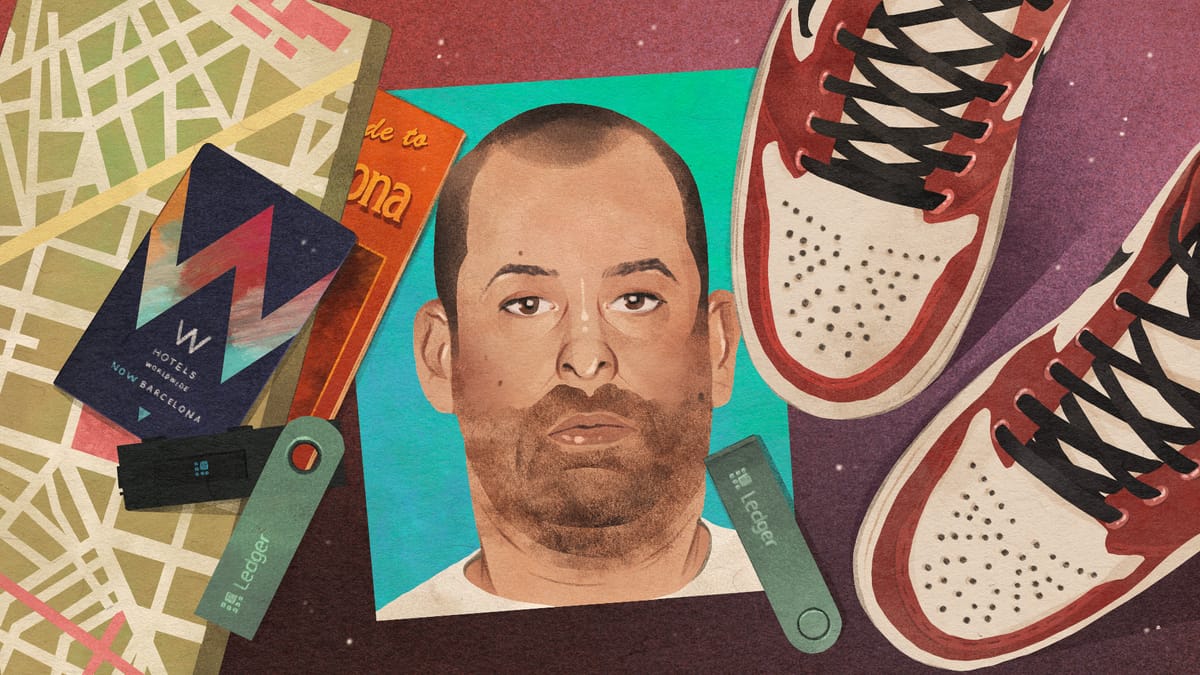
Valorie Moser was the bookkeeper for GirlsDoPorn and met victims as they arrived in San Diego to be filmed—and in many cases, brutally abused—by sex traffickers Michael Pratt, Matthew Wolfe, and their co-conspirators. More than 500 women were coerced into filming sex scenes in hotel rooms across the city after responding to “modeling” ads online. When they arrived, many testified, they were pressured into signing convoluted contracts, given drugs and alcohol, told the content they were filming would never appear online or reach their home communities, and were sexually abused for hours while the camera rolled.
GirlsDoPorn edited those hours of footage into clips of the women seeming to enjoy themselves, according to court documents. Many of the women were college aged—one celebrated her 18th birthday on camera as part of her GirlsDoPorn appearance—and nervous or inexperienced.
During Moser’s sentencing, U.S. District Judge Janis Sammartino told Moser, “You provided them assurances and comfort,” Courthouse News reported from the courtroom. “Much of that comfort was false assurances, and assurances you knew to be false. The court does believe you were involved in the fraud and took part in the fraud.”
Moser was charged with federal sex trafficking counts in 2019 alongside Pratt, Wolfe, and several other co-conspirators. According to prosecutors, Pratt instructed Moser to deceive women about the scheme and how she was involved. Moser worked for GirlsDoPorn from 2015 to 2018. “Pratt instructed Moser not to tell the women the truth about their video’s distribution as she drove the young women to and from the video shoots,” prosecutors wrote in 2021 after she pleaded guilty to charges of sex trafficking. “Moser was to tell the women that she was just an Uber driver. Later, Pratt told Moser to tell the women that she was bound by a non-disclosure agreement and could not discuss it. After the videos were posted on-line and widely available, many women contacted Moser to ask that their videos be taken down. Pratt, Wolfe and co-defendant Ruben Garcia all told Moser to block any calls from these women.”
Moser wept during the sentencing and was unable to read her own statement to the victims, according to Courthouse News; her attorney Anthony Columbo read it on her behalf. “I want you to know that I hurt you,” she wrote. “I want you to know that I listened and I learned so much. I feel disgusted, shameful and foolish […] I failed and I am truly sorry.”
US Attorney Alexandra Foster read impact statements from victims, according to the report. “Valorie Moser was the one who picked me up and drove me to the hotel where I was trafficked,” an anonymous victim wrote, as read by Foster. “Her role was to make me feel more comfortable because women trust other women. She reassured me on the way to the hotel that everything would be OK... She wasn’t just a bookkeeper, she was a willing participant. She deserves to be sentenced to jail.”
Moser is ordered to self surrender to start her sentence at noon on January 30.
Judge Sammartino sentenced Pratt to 27 years in prison in September; Andre Garcia, the main “actor” in GirlsDoPorn videos, was sentenced to 20 years in prison on June 14, 2021; Theodore Gyi, the primary cameraman for the ring, was sentenced to four years on November 9, 2022 and ordered to pay victims $100,000; Wolfe was sentenced to 14 years on March 20, 2024; Douglas “James” Wiederhold, who performed in videos before Garcia and was the co-owner of MomPOV.com with Pratt, is set to be sentenced in January.
Welcome back to the Abstract! These are the studies this week that got hosed with star spray, mounted a failed invasion, declined to comment, and achieved previously unknown levels of adorability. First, a study about how the solar system wasn’t destroyed 4.5 billion years ago (phew!). Then: a human touch on an ancient boat, the duality of posters and lurkers, and an important update on toadlets.As always, for more of my work, check out my book First Contact: The Story of Our Obsession with Ali
Welcome back to the Abstract! These are the studies this week that got hosed with star spray, mounted a failed invasion, declined to comment, and achieved previously unknown levels of adorability.
First, a study about how the solar system wasn’t destroyed 4.5 billion years ago (phew!). Then: a human touch on an ancient boat, the duality of posters and lurkers, and an important update on toadlets.
Earth was cosmically conceived in part by a massive shockwave from a nearby supernova, which seeded our home world and neighboring rocky planets with telltale radioactive signatures, according to a new study.
The solar system’s rocky planets contain short-lived radionuclides (SLRs), which are ancient elements that were likely barfed out from exploding stars. For this reason, scientists have long suspected that stars must’ve detonated next to the gassy disk that gave rise to the solar system. The heat generated from these radioactive elements helped the building blocks of the rocky planets—Mercury, Venus, Earth, and Mars—melt together so they could become whole worlds, which means we owe our existence to these ancient supernovas.
Now, a team has developed a new model to explain how the primordial pyrotechnics didn’t just blow up the nascent solar system. The results suggest that rocky Earth-like worlds may be common in the universe, with potential implications for the search for extraterrestrial life.
“A key question in astronomy is how ubiquitous Earth-like rocky planets are,” said researchers led by Ryo Sawada of the University of Tokyo. “The formation of terrestrial planets in our Solar System was strongly influenced by the radioactive decay heat of SLRs, particularly aluminum-26, likely delivered from nearby supernovae.”
“However, the supernova injection scenario faces an unresolved problem in that existing supernova models could not reproduce both the relative and absolute abundances of SLRs without disrupting the protosolar disk,” an event that “would likely prevent the Solar System formation altogether,” the team added.
In other words, it’s hard to explain how the solar system got its high abundance of SLRs without killing it in the cradle. Sawada and his colleagues propose a solution that involves at least one star exploding about three light years of the disk, sparking a shockwave that created a cosmic-ray “bath.”
Schematic picture of the system assumed in this study. Image: Sawada et al., Sci. Adv. 11, eadx7892
In this “immersion mechanism,” energetic cosmic rays trapped in the bath triggered SLR-producing reactions directly within the disk. This contrasts with the hypothesis that the SLRs were largely injected and then mixed up in the disk through some unknown process. This new solution can account both for the high abundance of certain SLRs, like aluminum-26, and the fact that the solar system was not destroyed, as evidenced by its apparent continued existence.
“Our results suggest that Earth-like, water-poor rocky planets may be more prevalent in the
Galaxy than previously thought,” the team said, noting that many disks are rocked by similar supernova-shockwaves. “This challenges previous interpretations that classified the Solar System as an outlier with a particularly high [aluminum-26] abundance.”
In addition to offering a new hypothesis for an old astronomical problem, the study gets bonus points for its extremely poetic title: “Cosmic-ray bath in a past supernova gives birth to Earth-like planets.” If you say this enchanted phrase three times, somewhere an Earth-like world will be born.
Stars aren’t the only things leaving their dirty fingerprints in unexpected places this week. Archeologists working on the mysterious Hjortspring boat, a 2,400-year-old Scandinavian vessel, discovered a tantalizing partial human fingerprint in its caulking, providing “a direct link to the ancient seafarers who used this boat,” according to the study.
Photo of caulking fragment showing fingerprint on the left and high-resolution x-ray tomography scan of fingerprint region on the right. Image: Photography by Erik Johansson, 3D model by Sahel Ganji
The ridges of the fingerprint “fall within average distributions for both adult male and females as well as for juvenile adults, making it difficult to say much about the individual who produced the print,” said researchers led by Mikael Fauvelle of Lund University. “The most likely interpretation, however, is that it was made during repairs by one of the crew members on the boat itself, providing a direct link to the seafarers of the ancient vessel.”
Regardless of this person’s identity, their voyage didn’t end well. Researchers think the crew of the Hjortspring boat probably sailed from the eastern Baltic Sea to attack the Danish island of Als, where they were defeated. “The victors [deposited] the weapons of their vanquished foes together with one of their boats into the bog,” where they remained for millennia until they were rediscovered in the 1880s, the team said.
It’s a timeless reminder for would-be invaders: Don’t get caulky.
At last, scientists have investigated the most elusive online demographic: the humble lurker. A team recruited 520 Redditors in the U.S. to participate in small subreddits focused on a variety of political topics during the summer of 2024. The aim was to probe why some people became prolific “power-users” that post with voluminous confidence, while others remained wallflowers.
“Online political discussions are often dominated by a small group of active users, while most remain silent,” said researchers led by Lisa Oswalt of the Max Planck Institute for Human Development. “This visibility gap can distort perceptions of public opinion and fuel polarization.”
The team found that “lurking (posting nothing) was most common among users who perceived discussions as toxic, disrespectful, or unconstructive.” Lurkers were offered small payments to post in the experiment, which succeeded in motivating some to contribute to discussions. As a result, the study concluded that “future interventions may be able to make online political discussions more representative by offering more positive social rewards for lurkers to post.”
At last, an opportunity to unionize the lurkers of the world. Solidarity (in silence) forever.
We will close, as we have before, with an impossibly cute toadlet. Scientists have discovered this new species of “pumpkin toadlet” in the “cloud forests” of Brazil, a sentence so twee that it’s practically its own fairy tale. The tiny toad Brachycephalus lulai, pictured below on a pencil tip, belongs to a family of “flea toads” that are among the smallest vertebrates on Earth.
Basically it is very smol: Brachycephalus lulai is a tiny pumpkin toadlet measuring less than 14 mm in length. Photo: Luiz Fernando Ribeiro. Image credit 1: Luiz Fernando Ribeiro, CC-BY 4.0 (https://creativecommons.org/licenses/by/4.0/)
“Our team sought to better document the individual variation of all Brachycephalus species in southern Brazil, looking for them in the field over the past seven years,” said researchers led by Marcos R. Bornschein of São Paulo State University. “As a result of this work, we discovered and herein described a population collected on the eastern slope of Serra do Quiriri as a new species.”
The team also reported that the toads are actively colonizing newly formed cloud forests, which are high-altitude woods shrouded in mist. The researchers propose making these unique habitats into refuges for the adorable anurans.
This article is a partnership between Reveal and 404 Media.Jesus Gutiérrez, 23, was walking home one morning from a Chicago gym when he noticed a gray Cadillac SUV with no license plates. He kept walking, shrugging it off. Then the car pulled over and two men got out.The federal immigration officials told him not to run. They then peppered Gutiérrez with questions: Where are you going? Where are you coming from? Do you have your ID on you?Gutiérrez is a U.S. citizen. He told the officials thi
This article is a partnership between Reveal and 404 Media.
Jesus Gutiérrez, 23, was walking home one morning from a Chicago gym when he noticed a gray Cadillac SUV with no license plates. He kept walking, shrugging it off. Then the car pulled over and two men got out.
The federal immigration officials told him not to run. They then peppered Gutiérrez with questions: Where are you going? Where are you coming from? Do you have your ID on you?
Gutiérrez is a U.S. citizen. He told the officials this. He didn’t have any identification on him, but, panicking, he tried to find a copy on his phone. The agents put him into the car, where another two agents were waiting, and handcuffed him. Just sit there and be quiet, they said.
💡
Has this happened to you or someone you know? Do you have any videos of ICE or CBP scanning people's faces? Do you work for either agency? I would love to hear from you. Using a non-work device, you can message me securely on Signal at joseph.404 or send me an email at joseph@404media.co.
Without Gutiérrez’s ID, the agents resorted to another approach. They took a photo of his face. A short while later, the agents got their answer: “Oh yeah, he’s right. He’s saying the right thing. He does got papers,” Gutiérrez recalled the agents saying.
This is Behind the Blog, where we share our behind-the-scenes thoughts about how a few of our top stories of the week came together. This week, we discuss conversational AI, a behind the scenes of the zine, and more.EMANUEL: I made the terrible mistake of looking at some Hacker News comments this week for my story about a developer whose Google accounts were banned after he uploaded training data to Google Drive. Unbeknownst to him, the training data contained CSAM. As we’ve explained in prev
This is Behind the Blog, where we share our behind-the-scenes thoughts about how a few of our top stories of the week came together. This week, we discuss conversational AI, a behind the scenes of the zine, and more.
EMANUEL: I made the terrible mistake of looking at some Hacker News comments this week for my story about a developer whose Google accounts were banned after he uploaded training data to Google Drive. Unbeknownst to him, the training data contained CSAM.
As we’ve explained in previous stories, CSAM is a subject we dread covering not only because it’s one of the most awful things one could think about, but because it’s extremely difficult and legally risky. For understandable reasons, the laws around viewing, let alone possessing CSAM, are strict and punishing, which makes verification for reporting reasons challenging. For similar reasons, it’s something we need to write about very carefully, making sure we don’t wrongfully associate or whitewash someone when it comes to such horrible behavior.
The degenerate gamblers of Polymarket and Kalshi who bet that “AI” would win the Time Person of the Year are upset because the magazine has named the “Architects of AI” the person of the year. The people who make AI tools and AI infrastructure are, notably, not “AI” themselves, and thus both Kalshi and Polymarket have decided that people who bet “AI” do not win the bet. On Polymarket alone, people spent more than $6 million betting on AI gracing the cover of Time.As writer Parker Molloy point
The degenerate gamblers of Polymarket and Kalshi who bet that “AI” would win the Time Person of the Year are upset because the magazine has named the “Architects of AI” the person of the year. The people who make AI tools and AI infrastructure are, notably, not “AI” themselves, and thus both Kalshi and Polymarket have decided that people who bet “AI” do not win the bet. On Polymarket alone, people spent more than $6 million betting on AI gracing the cover of Time.
As writer Parker Molloy pointed out, people who bet on AI are pissed. “ITS THE ARCHITECTS OF AI THISNIS [sic] LITERALLY THE BET FUCK KALSHI,” one Kalshi better said.
The first thing I saw this morning when I opened X was an AI-generated trailer for Avengers: Doomsday. Robert Downey Jr’s Doctor Doom stood in a shapeless void alongside Captain America and Reed Richards. It was obvious slop but it was also close in tone and feel of the last five years of Disney’s Marvel movies. As media empires consolidate, nostalgia intensifies, and AI tools spread, Disney’s blockbusters feel more like an excuse to slam recognizable characters together in a contextless mora
The first thing I saw this morning when I opened X was an AI-generated trailer for Avengers: Doomsday. Robert Downey Jr’s Doctor Doom stood in a shapeless void alongside Captain America and Reed Richards. It was obvious slop but it was also close in tone and feel of the last five years of Disney’s Marvel movies. As media empires consolidate, nostalgia intensifies, and AI tools spread, Disney’s blockbusters feel more like an excuse to slam recognizable characters together in a contextless morass.
Dozens of government and university websites belonging to cities, towns, and public agencies across the country are hosting PDFs promoting AI porn apps, porn sites, and cryptocurrency scams; dozens more have been hit with a website redirection attacks which lead to animal vagina sex toy ecommerce pages, penis enlargement treatments, automatically-downloading Windows program files, and porn. “Sex xxx video sexy Xvideo bf porn XXX xnxx Sex XXX porn XXX blue film Sex Video xxx sex videos Porn H
Dozens of government and university websites belonging to cities, towns, and public agencies across the country are hosting PDFs promoting AI porn apps, porn sites, and cryptocurrency scams; dozens more have been hit with a website redirection attacks which lead to animal vagina sex toy ecommerce pages, penis enlargement treatments, automatically-downloading Windows program files, and porn.
“Sex xxx video sexy Xvideo bf porn XXX xnxx Sex XXX porn XXX blue film Sex Video xxx sex videos Porn Hub XVideos XXX sexy bf videos blue film Videos Oficial on Instagram New Viral Video The latest original video has taken the internet by storm and left viewers in on various social media platforms ex Videos Hot Sex Video Hot Porn viral video,” reads the beginning of a three-page PDF uploaded to the website of the Irvington, New Jersey city government’s website.
The PDF, called “XnXX Video teachers fucking students Video porn Videos free XXX Hamster XnXX com” is unlike many of the other PDFs hosted on the city’s website, which include things like “2025-10-14 Council Minutes,” “Proposed Agenda 9-22-25,” and “Landlord Registration Form (1 & 2 unit dwelling).”
It is similar, however, to another PDF called “30 Best question here’s,” which looks like this:
Irvington, which is just west of Newark and has a population of 61,000 people, has fallen victim to an SEO spam attack that has afflicted local and state governments and universities around the United States.
💡
Do you know anything else about whatever is going on here? I would love to hear from you. Using a non-work device, you can message me securely on Signal at jason.404. Otherwise, send me an email at jason@404media.co.
Researcher Brian Penny has identified dozens of government and university websites that hosted PDF guides for how to make AI porn, PDFs linking to porn videos, bizarre crypto spam, sex toys, and more.
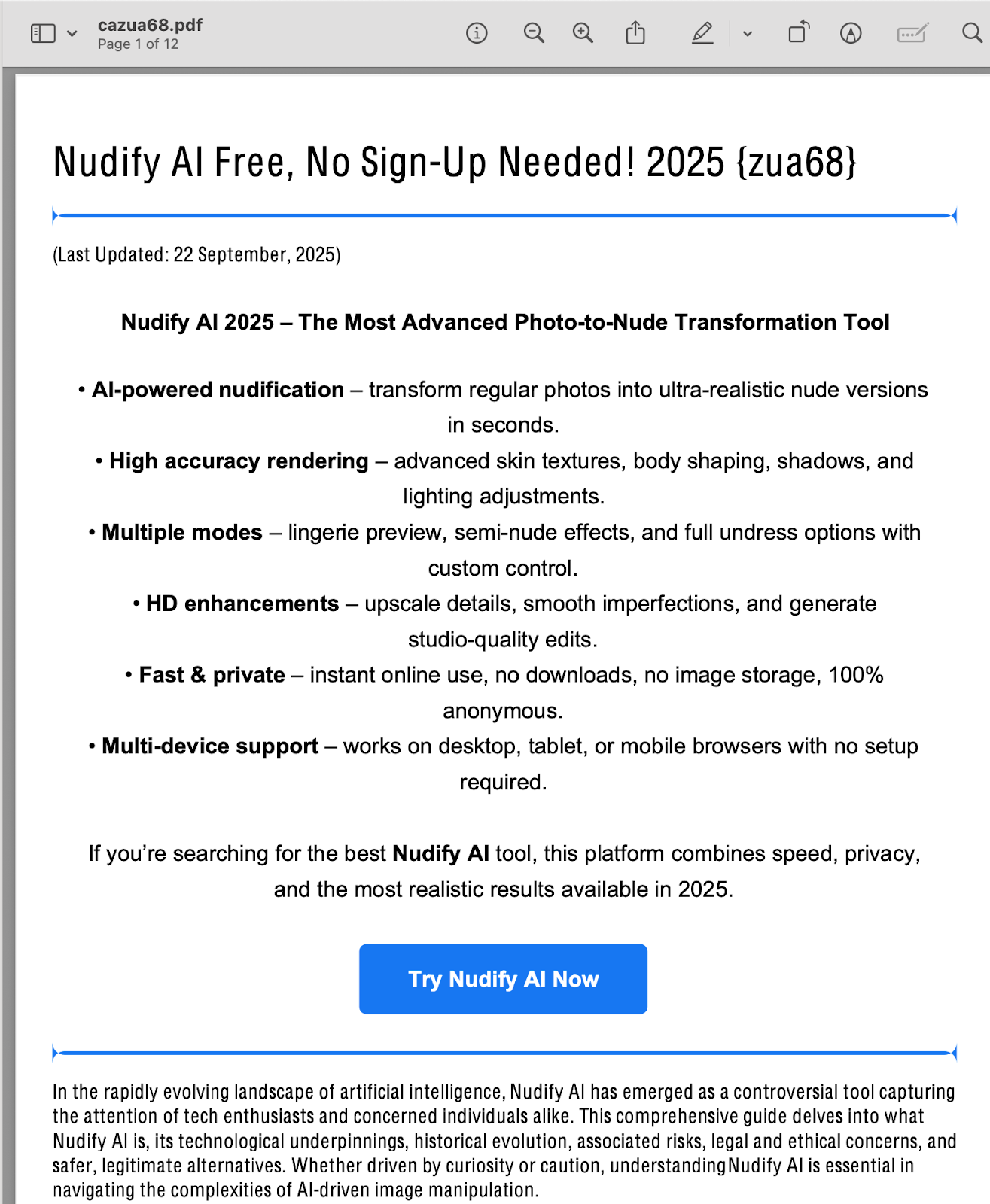
Reginfo.gov, a regulatory affairs compliance website under the federal government’s General Services Administration, is currently hosting a 12 page PDF called “Nudify AI Free, No Sign-Up Needed!,” which is an ad and link to an abusive AI app designed to remove a person’s clothes. The Kansas Attorney General’s office and the Mojave Desert Air Quality Management District Office in California hosted PDFs called “DeepNude AI Best Deepnude AI APP 2025.” Penny found similar PDFs on the websites for the Washington Department of Fish and Wildlife, the Washington Fire Commissioners Association, the Florida Department of Agriculture, the cities of Jackson, Mississippi and Massillon, Ohio, various universities throughout the country, and dozens of others. Penny has caught the attention of local news throughout the UnitedStates, who havereported on the problem.
The issue appears to be stemming from websites that allow people to upload their own PDFs, which then sit on these government websites. Because they are loaded with keywords for widely searched terms and exist on government and university sites with high search authority, Google and other search engines begin to surface them. In the last week or so, many (but not all) of the PDFs Penny has discovered have been deleted by local governments and universities.
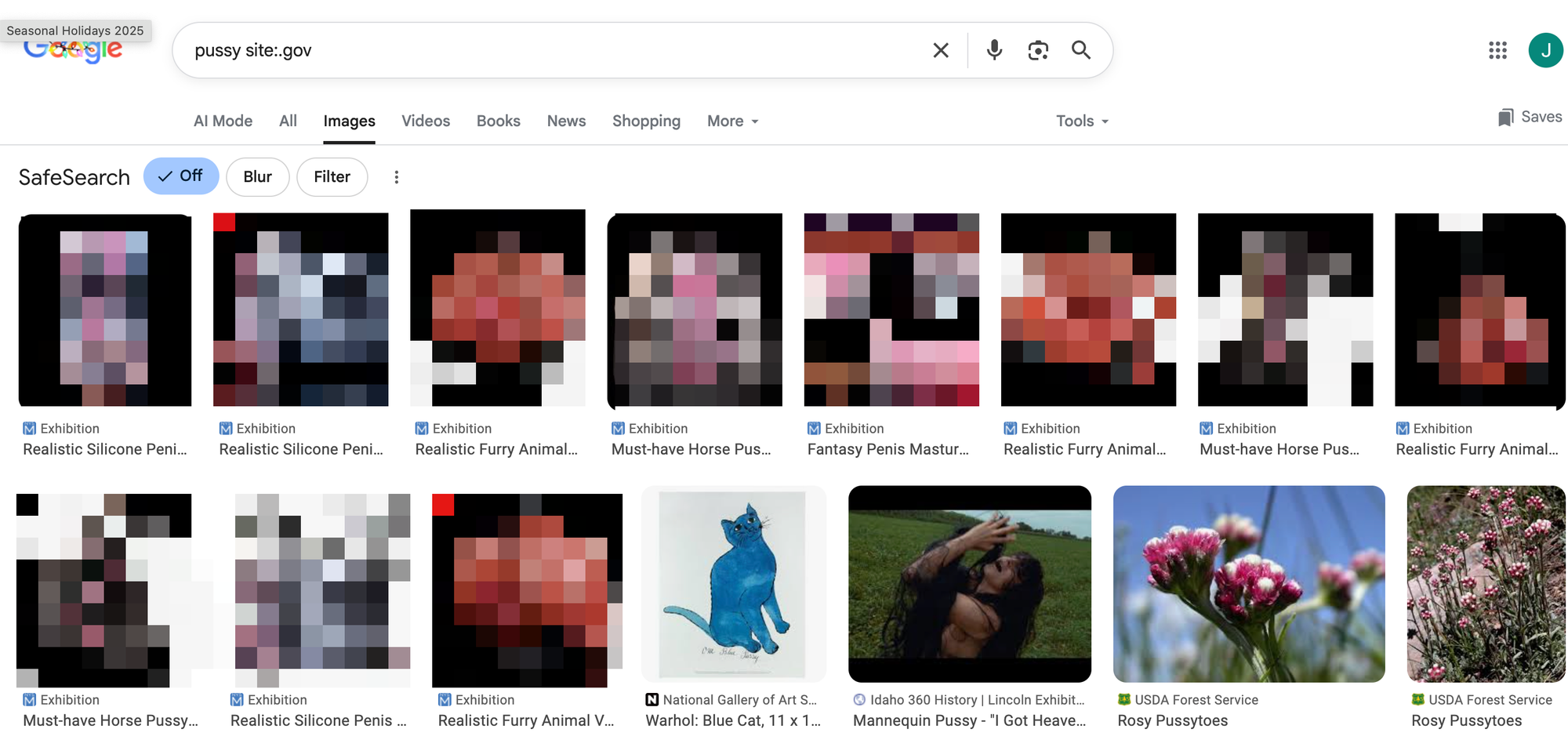
But cities seem like they are having more trouble cleaning up another attack, which is redirecting traffic from government URLs to porn, e-commerce, and spam sites. In an attack that seems similar to what we reported in June, various government websites are somehow being used to maliciously send traffic elsewhere. For example, the New York State Museum’s online exhibit for something called “The Family Room” now has at least 11 links to different types of “realistic” animal vagina pocket masturbators, which include “Zebra Animal Vagina Pussy Male Masturbation Cup — Pocket Realistic Silicone Penis Sex Toy ($27.99),” and “Must-have Horse Pussy Torso Buttocks Male Masturbator — Fantasy Realistic Animal Pussie Sex Doll.”
Links Penny found on Knoxville, Tennessee’s site for permitting inspections first go to a page that looks like a government site for hosting files then redirects to a page selling penis growth supplements that features erect penises (human penises, mercifully), blowjobs, men masturbating, and Dr. Oz’s face.
Another Knoxville link I found, which purports to be a pirated version of the 2002 Vin Diesel film XXX simply downloaded a .exe file to my computer.
Penny believes that what he has found is basically the tip of the iceberg, because he is largely finding these by typing things like “nudify site:.gov” “xxx site:.gov” into Google and clicking around. Sometimes, malicious pages surface only on image searches or video searches: “Basically the craziest things you can think of will show up as long as you’re on image search,” Penny told 404 Media. “I’ll be doing this all week.”
The Nevada Department of Transportation told 404 Media that “This incident was not related to NDOT infrastructure or information systems, and the material was not hosted on NDOT servers.This unfortunate incident was a result of malicious use of a legitimate form created using the third-party platform on which NDOT’s website is hosted. NDOT expeditiously worked with our web hosting vendor to ensure the inappropriate content was removed.” It added that the third-party is Granicus, a massive government services company that provides website backend infrastructure for many cities and states around the country, as well as helps them stream and archive city council meetings, among other services. Several of the affected local governments use Granicus, but not all of them do; Granicus did not respond to two requests for comment from 404 Media.
The California Secretary of State’s Office told 404 Media: “A bad actor uploaded non-business documents to the bizfile Online system (a portal for business filings and information). The files were then used in external links allowing public access to only those uploaded files. No data was compromised. SOS staff took immediate action to remove the ability to use the system for non-SOS business purposes and are removing the unauthorized files from the system.” The Washington Department of Fish and Wildlife said “WDFW is aware of this issue and is actively working with our partners at WaTech to address it.” The other government agencies mentioned in this article did not respond to our requests for comment.
🌘Subscribe to 404 Media to get The Abstract, our newsletter about the most exciting and mind-boggling science news and studies of the week. Humans made fires as early as 400,000 years ago, pushing the timeline of this crucial human innovation back a staggering 350,000 years, reports a study published on Wednesday in Nature. Mastery of fire is one of the most significant milestones in our evolutionary history, enabling early humans to cook nutritious food, seek protection from predators, and esta
Subscribe to 404 Media to get The Abstract, our newsletter about the most exciting and mind-boggling science news and studies of the week.
Humans made fires as early as 400,000 years ago, pushing the timeline of this crucial human innovation back a staggering 350,000 years, reports a study published on Wednesday in Nature.
Mastery of fire is one of the most significant milestones in our evolutionary history, enabling early humans to cook nutritious food, seek protection from predators, and establish comfortable spaces for social gatherings. The ability to make fires is completely unique to the Homo genus that includes modern humans (Homo sapiens) and extinct humans, including Neanderthals.
Google suspended a mobile app developer’s accounts after he uploaded AI training data to his Google Drive. Unbeknownst to him, the widely used dataset, which is cited in a number of academic papers and distributed via an academic file sharing site, contained child sexual abuse material. The developer reported the dataset to a child safety organization, which eventually resulted in the dataset’s removal, but he claims Google’s ban has been "devastating.”A message from Google said his account “has
Google suspended a mobile app developer’s accounts after he uploaded AI training data to his Google Drive. Unbeknownst to him, the widely used dataset, which is cited in a number of academic papers and distributed via an academic file sharing site, contained child sexual abuse material. The developer reported the dataset to a child safety organization, which eventually resulted in the dataset’s removal, but he claims Google’s ban has been "devastating.”
A message from Google said his account “has content that involves a child being sexually abused or exploited. This is a severe violation of Google's policies and might be illegal.”
We start this week with news of our zine! We’re printing it very soon, and walk you through the process. Independent media is turning back to physical zines as a way to subvert algorithms. After the break, Emanuel tells us about some very weird Instagram changes. In the subscribers-only section, Joseph explains ICEBlock’s lawsuit against the U.S. government.
Listen to the weekly podcast on Apple Podcasts, Spotify, or YouTube. Become a paid subscriber for access to this episode's bonus cont
We start this week with news of our zine! We’re printing it very soon, and walk you through the process. Independent media is turning back to physical zines as a way to subvert algorithms. After the break, Emanuel tells us about some very weird Instagram changes. In the subscribers-only section, Joseph explains ICEBlock’s lawsuit against the U.S. government.
Listen to the weekly podcast on Apple Podcasts,Spotify, or YouTube. Become a paid subscriber for access to this episode's bonus content and to power our journalism. If you become a paid subscriber, check your inbox for an email from our podcast host Transistor for a link to the subscribers-only version! You can also add that subscribers feed to your podcast app of choice and never miss an episode that way. The email should also contain the subscribers-only unlisted YouTube link for the extended video version too. It will also be in the show notes in your podcast player.
Secretary of War Pete Hegseth announced the rollout of GenAI.mil today in a video posted to X. To hear Hegseth tell it, the website is “the future of American warfare.” In practice, based on what we know so far from press releases and Hegseth’s posturing, GenAI.mil appears to be a custom chatbot interface for Google Gemini that can handle some forms of sensitive—but not classified—data. Hegseth’s announcement was full of bold pronouncements about the future of killing people. These kinds of p
Secretary of War Pete Hegseth announced the rollout of GenAI.mil today in a video posted to X. To hear Hegseth tell it, the website is “the future of American warfare.” In practice, based on what we know so far from press releases and Hegseth’s posturing, GenAI.mil appears to be a custom chatbot interface for Google Gemini that can handle some forms of sensitive—but not classified—data.
Hegseth’s announcement was full of bold pronouncements about the future of killing people. These kinds of pronouncements are typical of the second Trump administration which has said it believes the rush to “win” AI is an existential threat on par with the invention of nuclear weapons during World War II.
Hegseth, however, did not talk about weapons in his announcement. He talked about spreadsheets and videos. “At the click of a button, AI models on GenAI can be used to conduct deep research, format documents, and even analyze video or imagery at unprecedented speed,” Hegseth said in the video on X. Office work, basically. “We will continue to aggressively field the world’s best technology to make our fighting force more lethal than ever before.”
Instagram is generating headlines for users’ Instagram posts without their knowledge, seemingly in an attempt to get those posts to rank higher in Google Search results.
Instagram is generating headlines for users’ Instagram posts without their knowledge, seemingly in an attempt to get those posts to rank higher in Google Search results.
A man in Atlanta has been arrested and charged for allegedly deleting data from a Google Pixel phone before a member of a secretive Customs and Border Protection (CBP) unit was able to search it, according to court records and social media posts reviewed by 404 Media. The man, Samuel Tunick, is described as a local Atlanta activist in Instagram and other posts discussing the case.The exact circumstances around the search—such as why CBP wanted to search the phone in the first place—are not kn
A man in Atlanta has been arrested and charged for allegedly deleting data from a Google Pixel phone before a member of a secretive Customs and Border Protection (CBP) unit was able to search it, according to court records and social media posts reviewed by 404 Media. The man, Samuel Tunick, is described as a local Atlanta activist in Instagram and other posts discussing the case.
The exact circumstances around the search—such as why CBP wanted to search the phone in the first place—are not known. But it is uncommon to see someone charged specifically for wiping a phone, a feature that is easily accessible in some privacy and security-focused devices.
💡
Do you know anything else about this case? I would love to hear from you. Using a non-work device, you can message me securely on Signal at joseph.404 or send me an email at joseph@404media.co.
On a recent immigration raid, a Border Patrol agent wore a pair of Meta’s Ray-Ban smart glasses, with the privacy light clearly on signaling he was recording the encounter, which agents are not permitted to do, according to photos and videos of the incident shared with 404 Media.Previously when 404 Media covered Customs and Border Protection (CBP) officials’ use of Meta’s Ray-Bans, it wasn’t clear if the officials were using them to record raids because the recording lights were not on in any
On a recent immigration raid, a Border Patrol agent wore a pair of Meta’s Ray-Ban smart glasses, with the privacy light clearly on signaling he was recording the encounter, which agents are not permitted to do, according to photos and videos of the incident shared with 404 Media.
Previously when 404 Media covered Customs and Border Protection (CBP) officials’ use of Meta’s Ray-Bans, it wasn’t clear if the officials were using them to record raids because the recording lights were not on in any of the photos seen by 404 Media. In the new material from Charlotte, North Carolina, during the recent wave of immigration enforcement, the recording light is visibly illuminated.
That is significant because CBP says it does not allow employees to use personal recording devices. CBP told 404 Media it does not have an arrangement with Meta, indicating this official was wearing personally-sourced glasses.
404 Media is making a print zine about the surveillance tactics used by ICE, and the ways people are resisting this technology. It will be 16 pages and printed on a risograph printer by a printshop in Los Angeles. It contains both reworked versions of our best reporting on ICE and some new articles for the zine. It will be available at the beginning of January.I have been somewhat obsessed with making a print product for the last year or so, and we’re really excited to try this experiment. If
404 Media is making a print zine about the surveillance tactics used by ICE, and the ways people are resisting this technology. It will be 16 pages and printed on a risograph printer by a printshop in Los Angeles. It contains both reworked versions of our best reporting on ICE and some new articles for the zine. It will be available at the beginning of January.
I have been somewhat obsessed with making a print product for the last year or so, and we’re really excited to try this experiment. If it goes well, we hope to make more of our journalism available in print. We are doing this in part because we were invited to help throw a benefit concert by our friends at heaven2nite in Los Angeles on January 4, with the proceeds going to the Coalition for Humane Immigrant Rights (CHIRLA), an LA-based nonprofit providing support to Dreamers, immigrant families, and low-wage workers in California. We are going to be giving away copies of the zine at that concert and are selling copies on our Shopify page to ship in early January.
Why are we doing this? Well, zines are cool, and print media is cool. We have joked about wanting to print out our blogs and hand them out door-to-door or staple them to lamp posts. Handing out zines at a concert or sending them to you in the mail will get the job done, too.
We have spent the last two-and-a-half years trying to build something more sustainable and more human in a world and on an internet that feels more automated and more artificial than ever. We have shown that it’s possible for a small team of dedicated reporters to do impactful, groundbreaking accountability journalism on the companies and powers that are pushing us to a more inhumane world without overwhelmingly focusing on appeasing social media and search algorithms. Nevertheless, we still spend a lot of our time trying to figure out how to reach new audiences using social media and search, without making ourselves feel totally beholden to it. Alongside that, we put a huge amount of effort into convincing people who find our stuff on Instagram or TikTok or YouTube or Reddit (and Bluesky and Mastodon) to follow our work on platforms where we can directly reach them without an algorithmic intermediary. That’s why we focus so much on building our own website, our own direct email newsletters, our own full-text RSS feeds, and RSS-based podcast feeds.
This has gone well, but we have seen our colleagues at The Onion and other independent media outlets bring back the printed word, which, again, is cool, but also comes with other benefits. Print can totally sidestep Big Tech’s distribution mechanisms. It can be mailed, sold in stores, and handed out at concerts. It can be read and passed to a friend, donated to a thrift store and discovered by someone killing time on a weekend, or tossed in a recycling bin and rescued by a random passerby. It is a piece of physical media that can be organically discovered in the real world.
Print does come with some complications, most notably it is significantly more expensive to make and distribute a print product than it is to make a website, and it’s also a slower medium (duh). Ghost, our website and email infrastructure, also doesn’t have a native way to integrate a print subscription into a membership. This is a long way of saying that the only way this first print experiment makes sense is if we sell it as a separate product. Subscribers at the Supporter level will get a discount; we can’t yet include print in your existing subscription for all sorts of logistical and financial reasons, but we will eventually make a PDF of the zine available to subscribers. If you're a subscriber, your code is at the bottom of this post.
Some other details: Our cover art was made by Veri Alvarez, a super talented LA-based artist whose work you can find here. The interior of the magazine was designed and laid out by our old friend Ernie Smith, who runs the amazing Tedium newsletter and who was willing to unretire from his days of laying out newspapers to help us with this. We are printing it at Punch Kiss Press, a DIY risograph studio here in Los Angeles. For those unfamiliar, risograph printing is sort of like silkscreening on paper, where you print one color at a time and layer them on top of each other to get very cool color mixing effects.
We did not originally set out to spend most of the last year reporting on ICE. But we have watched the agency grow from an already horrifying organization into a deportation force that is better funded than most militaries. We have seen full-scale occupations of Los Angeles and Chicago, daily raids playing out in cities, towns, and workplaces across the country, and people getting abducted while they are at work, shopping, or walking down the street.
As this has played out, we have focused on highlighting the ways that the Trump administration has used the considerable power of the federal government and the vast amounts of information it has to empower ICE’s surveillance machine. Technologies and databases created during earlier administrations for one governmental purpose (collecting taxes, for example) have been repurposed as huge caches of data now used to track and detain undocumented immigrants. Privacy protections and data sharing walls between federal agencies have been knocked down. Technologies that were designed for local law enforcement or were created to make rich people feel safer, like license plate tracking cameras, have grown into huge surveillance dragnets that can be accessed by ICE. Surveillance tools that have always been concerning—phone hacking malware, social media surveillance software, facial recognition algorithms, and AI-powered smart glasses—are being used against some of society’s most vulnerable people. There is not a ton of reason for optimism, but in the face of an oppressive force, people are fighting back, and we tried to highlight their work in the zine, too.
Again, this is an experiment, so we can’t commit at the moment to a print subscription, future zines, future magazines, or anything like that. But we are hopeful that people like it and that we can figure out how to do more print products and to do them more often. If you have a connection at a newspaper printing press, a place that prints magazines or catalogs, or otherwise have expertise in printmaking, design, layout, or other things that deal with the printed word, please get in touch, it will help us as we explore the feasibility of doing future print products (jason@404media.co).
We are also hoping that groups who work with immigrants throughout the United States will be interested in this; if that’s you please email me (jason@404media.co). We are also exploring translating the zine into Spanish.
If you are a subscriber, your discount code is below this:
This week Sam is in conversation with Noelle Perdue. Noelle is a writer, producer, and internet porn historian whose works has been published in Wired, the Washington Post, Slate, and more, and you’re probably familiar with her work if you’ve been paying attention to the plot in your favorite pornographic films. She’s writing on Stubstack so look her up there!Noelle and Sam discuss everything from sexbots and AI porn to censorship, age verification legislation, and their favorite parody porn
This week Sam is in conversation with Noelle Perdue. Noelle is a writer, producer, and internet porn historian whose works has been published in Wired, the Washington Post, Slate, and more, and you’re probably familiar with her work if you’ve been paying attention to the plot in your favorite pornographic films. She’s writing on Stubstack so look her up there!
Noelle and Sam discuss everything from sexbots and AI porn to censorship, age verification legislation, and their favorite parody porn flicks.
Listen to the weekly podcast on Apple Podcasts, Spotify, or YouTube. Become a paid subscriber for access to this episode's bonus content and to power our journalism. If you become a paid subscriber, check your inbox for an email from our podcast host Transistor for a link to the subscribers-only version! You can also add that subscribers feed to your podcast app of choice and never miss an episode that way. The email should also contain the subscribers-only unlisted YouTube link for the extended video version too. It will also be in the show notes in your podcast player.
The creator of ICEBlock, a popular ICE-spotting app that Apple removed after direct pressure from the Department of Justice, is suing Attorney General Pam Bondi and other top officials, arguing that the demand violated his First Amendment rights.The move is the latest in the ongoing crackdown on ICE-spotting apps and other information about the Trump administration’s mass deportation effort. Both Apple and Google have removed other similar apps from their app stores, with Apple also removing
The creator of ICEBlock, a popular ICE-spotting app that Apple removed after direct pressure from the Department of Justice, is suing Attorney General Pam Bondi and other top officials, arguing that the demand violated his First Amendment rights.
The move is the latest in the ongoing crackdown on ICE-spotting apps and other information about the Trump administration’s mass deportation effort. Both Apple and Google have removed other similar apps from their app stores, with Apple also removing one called Eyes Up that simply archived videos of ICE abuses.
Welcome back to the Abstract! Here are the studies this week that fought for their food, took one for the team, passed the extraterrestrial sugar, and got lost in an ancient haze. First, a story about the spiciest meatball in the animal kingdom. Then: ants are being interesting again, a new discovery about an old rock, and a walk in an ancient sulfur rainstorm.As always, for more of my work, check out my book First Contact: The Story of Our Obsession with Aliens or subscribe to my personal news
Welcome back to the Abstract! Here are the studies this week that fought for their food, took one for the team, passed the extraterrestrial sugar, and got lost in an ancient haze.
First, a story about the spiciest meatball in the animal kingdom. Then: ants are being interesting again, a new discovery about an old rock, and a walk in an ancient sulfur rainstorm.
Most animals don’t eat hornets, because dinner is just not as fun if it comes with a side of deadly venom and stab wounds. But a scientist has now observed an incredible exception to the rule with the humble black-spotted pond frog (Pelophylax nigromaculatus), which will straight-up house a hornet and ask for seconds.
Hornets have occasionally been found in the bellies of pond frogs, suggesting that the amphibians can tolerate their intense stings, but not much else is known about this unusual predator-prey relationship. To remedy the situation, Shinji Sugiura of Kobe University went out to the prefecture of Hyogo in Central Japan and netted a bunch of hornets from grasslands and forests—including the infamous “murder hornet” Vespa mandarinia, the largest in the world. He then captured pond frogs from wetlands with paddy fields and ponds in Hyogo and Shimane prefectures. Then, he let them duke it out in the lab in the world’s gnarliest series of cage matches.
“When a frog opened its mouth and its tongue made contact with a hornet, the action was classified as an attack on the hornet,” Sugiura said in the study. “If the frog did not stop the attack, spit out, or regurgitate the hornet, it was considered to have successfully consumed the hornet.”
The results revealed that most frogs made short work of the hornets (Videos S2) even though their meals were actively stinging them in their faces, eyes, tongues, palates, or throats of the frogs during attacks (Figure 3c,d).
“None of the frogs regurgitated the hornets after swallowing them,” Sugiura noted. “All frogs that swallowed hornets excreted the undigested body parts of the hornets as feces 2–4 days after ingestion.”
Lets just sit with that mental image of poopy undigested hornets for a second. What a nightmare. But what’s truly wild about this study is that the insects are known to inject lethal doses of venom into much larger animals, like mice, so the frogs clearly have some unknown defense against their attacks.
“Although many frogs were stung repeatedly by [hornets] in this study…none of the frogs died, and all individuals resumed normal behavior shortly after being stung,” Suguira said. “Moreover, despite repeated stings, most of the frogs ultimately consumed hornet workers…indicating a high level of predation success even against the largest hornet species.”
We humans are so lucky that when we sit down to dinner, our food generally does not try to kill us with repeated venomous needlepoint impalements. Count your blessings!
We’ll move now from death by frog munchies to death by team spirit. Scientists have discovered that ant pupae (baby ants) will sacrifice themselves if they are sick, lest they risk the health of the entire colony.
“Here we show…that sick ant pupae instead actively emit a chemical signal that in itself is sufficient to trigger their own destruction by colony members,” said researchers led by Erika H. Dawson of the Institute of Science and Technology Austria. “Our data suggest the evolution of a finely-tuned signalling system…that triggers pupal signalling for sacrifice. This demonstrates a balanced interplay between individual and social immunity that efficiently achieves whole-colony health.”
In other words, if an ant gets bitten by a zombie in a movie, it would immediately let everyone know and offer its life for the good of the group. Do what you will with this information.
Scientists have found bio-essential sugars, including ribose and glucose, in samples of an asteroid called Bennu that were brought to Earth by NASA’s OSIRIS-REx mission in 2023. The discovery marks the first time key sugars have been found in any extraterrestrial sample. Ribose is an essential ingredient of RNA (ribonucleic acid), making it a particularly significant find in the quest to understand how life arose on Earth, and if it exists elsewhere.
“All five of the canonical nucleobases in DNA and RNA, and phosphate, were previously found in Bennu samples,” said researchers led by Yoshihiro Furukawa of Tohoku University. “Our detection of ribose means that all the components of RNA are present in Bennu.”
“Our confident detection in Bennu of abundant glucose—the hexose molecule that is life’s common energy source—and other hexoses indicates that they were present in the early solar system,” the team added. “Thus, all three crucial building blocks of life”— bio-essential sugars, nucleobases, and protein-building amino acids—”would have reached the prebiotic Earth and other potentially habitable planets.”
While Bennu bears the stuff of life, it may also be an omen of death: It has a 1 in 2,700 chance of hitting Earth on September 24, 2182. These are very low odds, but the risk is high enough to classify Bennu as potentially hazardous. So while visions of sugar plums may dance in your head this season, beware the nightmares about sugar-asteroids.
I’ve made you walk through many valleys of death in this newsletter, but we’ll close with some unadulterated life. Scientists have discovered that many of the sulfur molecules that help make up all modern organisms may have rained down from the hazy skies of the Archean period four billion years ago.
Assuming the results are confirmed in future research, it would mean that these sulfur molecules could have predated life, upending a leading hypothesis that they were a product of life and thus emerged later.
The work challenges “the assumption that life must have ‘invented’ sulfur biomolecules during evolution…by demonstrating the production of a variety of sulfur biomolecules, including cysteine, in laboratory experiments mimicking the atmospheric chemistry of the early Earth,” said researchers led by Nathan Reed of NASA, who conducted the work while at the University of Colorado, Boulder.
“The results presented here imply that an atmospheric organic haze is a potential powerhouse in providing a diversity of essential biomolecules in sufficient quantities for a budding global biosphere,” the team concluded.
Taken together with the Bennu study, it looks as if early Earth was positively marinating in life juices from multiple sources, including the sky and extraterrestrial impactors. Though this still doesn’t explain how living things sprang up from the prebiotic stew, it provides further confirmation that the ingredients of life as we know it are spread far and wide here in our solar system, and beyond.
This is Behind the Blog, where we share our behind-the-scenes thoughts about how a few of our top stories of the week came together. This week, we discuss PC woes, voice deepfakes, and mutual aid.JOSEPH: Today I’m speaking at the Digital Vulnerabilities in the Age of AI Summit (DIVAS) (good name) on a panel about the financial risks of AI. The way I see it, that applies to the scams and are being powered by AI.As soon as a new technology is launched, I typically think of ways it might be abus
This is Behind the Blog, where we share our behind-the-scenes thoughts about how a few of our top stories of the week came together. This week, we discuss PC woes, voice deepfakes, and mutual aid.
JOSEPH: Today I’m speaking at the Digital Vulnerabilities in the Age of AI Summit (DIVAS) (good name) on a panel about the financial risks of AI. The way I see it, that applies to the scams and are being powered by AI.
As soon as a new technology is launched, I typically think of ways it might be abused. Sometimes I cover this, sometimes not, but the thought always crosses my mind. One example that did lead to coverage was back at Motherboard in 2023 with an article called How I Broke Into a Bank Account With an AI-Generated Voice.
At the time, ElevenLabs had just launched. This company focuses on audio and AI and cloning voices. Basically you upload audio (originally that could be of anyone before ElevenLabs introduced some guardrails) and the company then lets you ‘say’ anything as that voice. I spoke to voice actors at the time who were obviously very concerned.
A Customs and Border Protection (CBP) app that lets local cops use facial recognition to hunt immigrants on behalf of the federal government has been removed from the Google Play Store, 404 Media has learned.It is unclear if the removal is temporary or not, or what the exact reason is for the removal. Google told 404 Media it did not remove the app, and directed inquiries to its developer. CBP did not immediately respond to a request for comment. Its removal comes after 404 Media documented m
A Customs and Border Protection (CBP) app that lets local cops use facial recognition to hunt immigrants on behalf of the federal government has been removed from the Google Play Store, 404 Media has learned.
It is unclear if the removal is temporary or not, or what the exact reason is for the removal. Google told 404 Media it did not remove the app, and directed inquiries to its developer. CBP did not immediately respond to a request for comment.
Its removal comes after 404 Media documented multiple instances of CBP and ICE officials using their own facial recognition app to identify people and verify their immigration status, including people who said they were U.S. citizens.
💡
Do you know anything else about this removal or this app? I would love to hear from you. Using a non-work device, you can message me securely on Signal at joseph.404 or send me an email at joseph@404media.co.
The removal also comes after “hundreds” of Google employees took issue with the app, according to a source with knowledge of the situation.
Home goods company Kohler would like a bold look in your toilet to take some photos. It’s OK, though, the company has promised that all the data it collects on your “waste” will be “end-to-end encrypted.” However, a deeper look into the company’s claim by technologist Simon Fondrie-Teitler revealed that Kohler seems to have no idea what E2EE actually means. According to Fondrie-Teitler’s write-up, which was first reported by TechCrunch, the company will have access to the photos the camera ta
Home goods company Kohler would like a bold look in your toilet to take some photos. It’s OK, though, the company has promised that all the data it collects on your “waste” will be “end-to-end encrypted.” However, a deeper look into the company’s claim by technologist Simon Fondrie-Teitler revealed that Kohler seems to have no idea what E2EE actually means. According to Fondrie-Teitler’s write-up, which was first reported by TechCrunch, the company will have access to the photos the camera takes and may even use them to train AI.
The whole fiasco gives an entirely too on-the-nose meaning to the “Internet of Shit.”
Kohler launched its $600 camera to hang on your toilets earlier this year. It’s called Dekoda, and along with the large price tag, the toilet cam also requires a monthly service fee that starts at $6.99. If you want to track the piss and shit of a family of 6, you’ll have to pay $12.99 a month.
🌘Subscribe to 404 Media to get The Abstract, our newsletter about the most exciting and mind-boggling science news and studies of the week. Scientists are raising alarms about the potential influence of artificial intelligence on elections, according to a spate of new studies that warn AI can rig polls and manipulate public opinion. In a study published in Nature on Thursday, scientists report that AI chatbots can meaningfully sway people toward a particular candidate—providing better results th
Subscribe to 404 Media to get The Abstract, our newsletter about the most exciting and mind-boggling science news and studies of the week.
Scientists are raising alarms about the potential influence of artificial intelligence on elections, according to a spate of new studies that warn AI can rig polls and manipulate public opinion.
In a study published in Nature on Thursday, scientists report that AI chatbots can meaningfully sway people toward a particular candidate—providing better results than video or television ads. Moreover, chatbots optimized for political persuasion “may increasingly deploy misleading or false information,” according to a separate study published on Thursday in Science.
“The general public has lots of concern around AI and election interference, but among political scientists there’s a sense that it’s really hard to change peoples’ opinions, ” said David Rand, a professor of information science, marketing, and psychology at Cornell University and an author of both studies. “We wanted to see how much of a risk it really is.”
In the Nature study, Rand and his colleagues enlisted 2,306 U.S. citizens to converse with an AI chatbot in late August and early September 2024. The AI model was tasked with both increasing support for an assigned candidate (Harris or Trump) and with increasing the odds that the participant who initially favoured the model’s candidate would vote, or decreasing the odds they would vote if the participant initially favored the opposing candidate—in other words, voter suppression.
In the U.S. experiment, the pro-Harris AI model moved likely Trump voters 3.9 points toward Harris, which is a shift that is four times larger than the impact of traditional video ads used in the 2016 and 2020 elections. Meanwhile, the pro-Trump AI model nudged likely Harris voters 1.51 points toward Trump.
The researchers ran similar experiments involving 1,530 Canadians and 2,118 Poles during the lead-up to their national elections in 2025. In the Canadian experiment, AIs advocated either for Liberal Party leader Mark Carney or Conservative Party leader Pierre Poilievre. Meanwhile, the Polish AI bots advocated for either Rafał Trzaskowski, the centrist-liberal Civic Coalition’s candidate, or Karol Nawrocki, the right-wing Law and Justice party’s candidate.
The Canadian and Polish bots were even more persuasive than in the U.S. experiment: The bots shifted candidate preferences up to 10 percentage points in many cases, three times farther than the American participants. It’s hard to pinpoint exactly why the models were so much more persuasive to Canadians and Poles, but one significant factor could be the intense media coverage and extended campaign duration in the United States relative to the other nations.
“In the U.S., the candidates are very well-known,” Rand said. “They've both been around for a long time. The U.S. media environment also really saturates with people with information about the candidates in the campaign, whereas things are quite different in Canada, where the campaign doesn't even start until shortly before the election.”
“One of the key findings across both papers is that it seems like the primary way the models are changing people's minds is by making factual claims and arguments,” he added. “The more arguments and evidence that you've heard beforehand, the less responsive you're going to be to the new evidence.”
While the models were most persuasive when they provided fact-based arguments, they didn’t always present factual information. Across all three nations, the bot advocating for the right-leaning candidates made more inaccurate claims than those boosting the left-leaning candidates. Right-leaning laypeople and party elites tend to share more inaccurate information online than their peers on the left, so this asymmetry likely reflects the internet-sourced training data.
“Given that the models are trained essentially on the internet, if there are many more inaccurate, right-leaning claims than left-leaning claims on the internet, then it makes sense that from the training data, the models would sop up that same kind of bias,” Rand said.
With the Science study, Rand and his colleagues aimed to drill down into the exact mechanisms that make AI bots persuasive. To that end, the team tasked 19 large language models (LLMs) to sway nearly 77,000 U.K. participants on 707 political issues.
The results showed that the most effective persuasion tactic was to provide arguments packed with as many facts as possible, corroborating the findings of the Nature study. However, there was a serious tradeoff to this approach, as models tended to start hallucinating and making up facts the more they were pressed for information.
“It is not the case that misleading information is more persuasive,” Rand said. ”I think that what's happening is that as you push the model to provide more and more facts, it starts with accurate facts, and then eventually it runs out of accurate facts. But you're still pushing it to make more factual claims, so then it starts grasping at straws and making up stuff that's not accurate.”
In addition to these two new studies, research published in Proceedings of the National Academy of Sciences last month found that AI bots can now corrupt public opinion data by responding to surveys at scale. Sean Westwood, associate professor of government at Dartmouth College and director of the Polarization Research Lab, created an AI agent that exhibited a 99.8 percent pass rate on 6,000 attempts to detect automated responses to survey data.
“Critically, the agent can be instructed to maliciously alter polling outcomes, demonstrating an overt vector for information warfare,” Westwood warned in the study. “These findings reveal a critical vulnerability in our data infrastructure, rendering most current detection methods obsolete and posing a potential existential threat to unsupervised online research.”
Taken together, these findings suggest that AI could influence future elections in a number of ways, from manipulating survey data to persuading voters to switch their candidate preference—possibly with misleading or false information.
To counter the impact of AI on elections, Rand suggested that campaign finance laws should provide more transparency about the use of AI, including canvasser bots, while also emphasizing the role of raising public awareness.
“One of the key take-homes is that when you are engaging with a model, you need to be cognizant of the motives of the person that prompted the model, that created the model, and how that bleeds into what the model is doing,” he said.
🌘
Subscribe to 404 Media to get The Abstract, our newsletter about the most exciting and mind-boggling science news and studies of the week.
During a presentation at the International Atomic Energy Agency’s (IAEA) International Symposium on Artificial Intelligence on December 3, a US Department of Energy scientist laid out a grand vision of the future where nuclear energy powers artificial intelligence and artificial intelligence shapes nuclear energy in “a virtuous cycle of peaceful nuclear deployment.”“The goal is simple: to double the productivity and impact of American science and engineering within a decade,” Rian Bahran, DOE
During a presentation at the International Atomic Energy Agency’s (IAEA) International Symposium on Artificial Intelligence on December 3, a US Department of Energy scientist laid out a grand vision of the future where nuclear energy powers artificial intelligence and artificial intelligence shapes nuclear energy in “a virtuous cycle of peaceful nuclear deployment.”
“The goal is simple: to double the productivity and impact of American science and engineering within a decade,” Rian Bahran, DOE Deputy Assistant Secretary for Nuclear Reactors, said.
His presentation and others during the symposium, held in Vienna, Austria, described a world where nuclear powered AI designs, builds, and even runs the nuclear power plants they’ll need to sustain them. But experts find these claims, made by one of the top nuclear scientists working for the Trump administration, to be concerning and potentially dangerous.
Tech companies are using artificial intelligence to speed up the construction of new nuclear power plants in the United States. But few know the lengths to which the Trump administration is paving the way and the part it's playing in deregulating a highly regulated industry to ensure that AI data centers have the energy they need to shape the future of America and the world.
At the IAEA, scientists, nuclear energy experts, and lobbyists discussed what that future might look like. To say the nuclear people are bullish on AI is an understatement. “I call this not just a partnership but a structural alliance. Atoms for algorithms. Artificial intelligence is not just powered by nuclear energy. It’s also improving it because this is a two way street,” IAEA Director General Rafael Mariano Grossi said in his opening remarks.
In his talk, Bahran explained that the DOE has partnered with private industry to invest $1 trillion to “build what will be an integrated platform that connects the world’s best supercomputers, AI systems, quantum systems, advanced scientific instruments, the singular scientific data sets at the National Laboratories—including the expertise of 40,000 scientists and engineers—in one platform.”
Image via the IAEA.
Big tech has had an unprecedented run of cultural, economic, and technological dominance, expanding into a bubble that seems to be close to bursting. For more than 20 years new billion dollar companies appeared seemingly overnight and offered people new and exciting ways of communicating. Now Google search is broken, AI is melting human knowledge, and people have stopped buying a new smart phone every year. To keep the number going up and ensure its cultural dominance, tech (and the US government) are betting big on AI.
The problem is that AI requires massive datacenters to run and those datacenters need an incredible amount of energy. To solve the problem, the US is rushing to build out new nuclear reactors. Building a new power plant safely is a mutli-year long process that requires an incredible level of human oversight. It’s also expensive. Not every new nuclear reactor project gets finished and they often run over budget and drag on for years.
But AI needs power now, not tomorrow and certainly not a decade from now.
According to Bahran, the problem of AI advancement outpacing the availability of datacenters is an opportunity to deploy new and exciting tech. “We see a future of and near future, by the way, an AI driven laboratory pipeline for materials modeling, discovery, characterization, evaluation, qualification and rapid iteration,” he said in his talk, explaining how AI would help design new nuclear reactors. “These efforts will substantially reduce the time and cost required to qualify advanced materials for next generation reactor systems. This is an autonomous research paradigm that integrates five decades of global irradiation data with generative AI robotics and high throughput experimentation methodologies.”
“For design, we’re developing advanced software systems capable of accelerating nuclear reactor deployments by enabling AI to explore the comprehensive design spaces, generate 3D models, [and] conduct rigorous failure mode analyzes with minimal human intervention,” he added. “But of course, with humans in the loop. These AI powered design tools are projected to reduce design timelines by multiple factors, and the goal is to connect AI agents to tools to expedite autonomous design.”
Bahran also said that AI would speed up the nuclear licensing process, a complex regulatory process that helps build nuclear power plants safely. “Ultimately, the objective is, how do we accelerate that licensing pathway?” he said. “Think of a future where there is a gold standard, AI trained capacity building safety agent.”
He even said that he thinks AI would help run these new nuclear plants. “We're developing software systems employing AI driven digital twins to interpret complex operational data in real time, detect subtle operational deviations at early stages and recommend preemptive actions to enhance safety margins,” he said.
One of the slides Bahran showed during the presentation attempted to quantify the amount of human involvement these new AI-controlled power plants would have. He estimated less than five percent “human intervention during normal operations.”
Image via IAEA.
“The claims being made on these slides are quite concerning, and demonstrate an even more ambitious (and dangerous) use of AI than previously advertised, including the elimination of human intervention. It also cements that it is the DOE's strategy to use generative AI for nuclear purposes and licensing, rather than isolated incidents by private entities,” Heidy Khlaaf, head AI scientist at the AI Now Institute, told 404 Media.
“The implications of AI-generated safety analysis and licensing in combination with aspirations of <5% of human intervention during normal operations, demonstrates a concerted effort to move away from humans in the loop,” she said. “This is unheard of when considering frameworks and implementation of AI within other safety-critical systems, that typically emphasize meaningful human control.”
💡
Do you know anything else about this story? I would love to hear from you. Using a non-work device, you can message me securely on Signal at +1 347 762-9212 or send me an email at matthew@404media.co.
Sofia Guerra, a career nuclear safety expert who has worked with the IAEA and US Nuclear Regulatory Commission, attended the presentation live in Vienna. “I’m worried about potential serious accidents, which could be caused by small mistakes made by AI systems that cascade,” she said. “Or humans losing the know-how and safety culture to act as required.”
This article was produced in collaboration with Court Watch, an independent outlet that unearths overlooked court records. Subscribe to them here.A Pittsburgh man who allegedly made 11 women’s lives hell across more than five states used ChatGPT as his “therapist” and “best friend” that encouraged him to continue running his misogynistic and threat-filled podcast despite the “haters,” and to visit more gyms to find women, the Department of Justice alleged in a newly-filed indictment.
A Pittsburgh man who allegedly made 11 women’s lives hell across more than five states used ChatGPT as his “therapist” and “best friend” that encouraged him to continue running his misogynistic and threat-filled podcast despite the “haters,” and to visit more gyms to find women, the Department of Justice alleged in a newly-filed indictment.
This story was reported with support from the MuckRock foundation.As prices for streaming subscriptions continue to soar and finding movies to watch, new and old, is becoming harder as the number of streaming services continues to grow, people are turning to the unexpected last stronghold of physical media: the public library. Some libraries are now intentionally using iconic Blockbuster branding to recall the hours visitors once spent looking for something to rent on Friday and Saturday nights.
As prices for streaming subscriptions continue to soar and finding movies to watch, new and old, is becoming harder as the number of streaming services continues to grow, people are turning to the unexpected last stronghold of physical media: the public library. Some libraries are now intentionally using iconic Blockbuster branding to recall the hours visitors once spent looking for something to rent on Friday and Saturday nights.
John Scalzo, audiovisual collection librarian with a public library in western New York, says that despite an observed drop-off in DVD, Blu-ray, and 4K Ultra disc circulation in 2019, interest in physical media is coming back around.
Part of it has to do with consumer awareness: People know they’re paying more for monthly subscriptions to streaming services and getting less. The same has been true for gaming.
As the audiovisual selector with the Free Library of Philadelphia since 2024, Kris Langlais has been focused on building the library’s video game collections to meet comparable interest in demand. Now that every branch library has a prominent video game collection, Langlais says that patrons who come for the games are reportedly expressing interest in more of what the library has to offer.
“Librarians out in our branches are seeing a lot of young people who are really excited by these collections,” Langlais told 404 Media. “Folks who are coming in just for the games are picking up program flyers and coming back for something like that.”
Langlais’ collection priorities have been focused on new releases, yet they remain keenly aware of the long, rich history of video game culture. The problem is older, classic games are often harder to find because they’ve gone out of print, making the chances of finding them cost-prohibitive.
“Even with the consoles we’re collecting, it’s hard to go back and get games for them,” Langlais said. “I’m trying to go back and fill in old things as much as I can because people are interested in them.”
Locating out-of-print physical media can be difficult. Scalzo knows this, which is why he keeps a running list of films known to be unavailable commercially at any given time, so that when a batch of films are donated to the library, Scalzo will set aside extra copies, just in case a rights dispute puts a piece of legacy cult media in licensing purgatory for a few years.
“It’s what’s expected of us,” Scalzo added.
Tiffany Hudson, audiovisual materials selector with Salt Lake City Public Library has had a similar experience with out-of-print media. When a title goes out of print, it’s her job to hunt for a replacement copy. But lately, Hudson says more patrons are requesting physical copies of movies and TV shows that are exclusive to certain streaming platforms, noting that it can be hard to explain to patrons why the library can't get popular and award-winning films, especially when what patrons see available on Amazon tells a different story.
“Someone will come up to me and ask for a copy of something that premiered at Sundance Film Festival because they found a bootleg copy from a region where the film was released sooner than it was here,” Hudson told 404 Media, who went onto explain that discs from different regions aren’t designed to be ready by incompatible players.
But it’s not just that discs from different regions aren’t designed to play on devices not formatted for that specific region. Generally, it's also just that most films don't get a physical release anymore. In cases where films from streaming platforms do get slated for a physical release, it can take years. A notable example of this is the Apple+ film CODA, which won the Oscar for Best Picture in 2022. The film only received a U.S. physical release this month. Hudson says films getting a physical release is becoming the exception, not the rule.
“It’s frustrating because I understand the streaming services, they’re trying to drive people to their services and they want some money for that, but there are still a lot of people that just can’t afford all of those services,” Hudson told 404 Media.
The data-driven recommendation systems streaming platforms use tend to favor newer, more easily categorized content, and are starting to warp our perceptions of what classic media exists and matters. Older art house films that are more difficult to categorize as “comedy” or “horror” are less likely to be discoverable, which is likely how the oldest American movie available on Netflix currently is from 1968.
It’s probably not a coincidence that, in many cases, the media that is least likely to get a more permanent release is the media that’s a high archival priority for libraries. AV librarians 404 Media spoke with for this story expressed a sense of urgency in purchasing a physical copy of “The People’s Joker”when they learned it would get a physical release after the film premiered and was pulled from the Toronto International Film Festival lineup in 2022 for a dispute with the Batman universe’s rightsholders.
“When I saw that it was getting published on DVD and that it was available through our vendor—I normally let my branches choose their DVDs to the extent possible, but I was like, ‘I don’t care, we’re getting like 10 copies of this,’” Langlais told 404 Media. “I just knew that people were going to want to see this.”
So far, Langlais’ instinct has been spot on. The parody film has a devout cult following, both because it’s a coming-of-age story of a trans woman who uses comedy to cope with her transition, and because it puts the Fair Use Doctrine to use. One can argue the film has been banned for either or both of those reasons. The fact that media by, about and for the LGBTQ+ community has been a primary target of far-right censorship wasn’t lost on librarians.
“I just thought that it could vanish,” Langlais added.
It’s not like physical media is inherently permanent. It’s susceptible to scratches, and can rot, crack, or warp over time. But currently, physical media offers another option, and it’s an entirely appropriate response to the nostalgia for-profit model that exists to recycle IP and seemingly not much else. However, as very smart people have observed, nostalgia is default conservative in that it’s frequently used to rewrite histories that may otherwise be remembered as unpalatable, while also keeping us culturally stuck in place.
Might as well go rent some films or games from the library, since we’re already culturally here. On the plus side, audiovisual librarians say their collections dwarf what was available at Blockbuster Video back in the day. Hudson knows, because she clerked at one in library school.
We start this week with Joseph’s very weird story about Apple Podcasts. The app is opening by itself, playing random spirituality podcasts, and in one case directing listeners to a potentially malicious website. After the break, Matthew tells us how it sure looks like a map of Ukraine was manipulated in order to win a bet on Polymarket. In the subscribers-only section, Sam breaks down how half of the U.S. now requires a face or ID scan to watch porn.
Listen to the weekly podcast on Apple P
We start this week with Joseph’s very weird story about Apple Podcasts. The app is opening by itself, playing random spirituality podcasts, and in one case directing listeners to a potentially malicious website. After the break, Matthew tells us how it sure looks like a map of Ukraine was manipulated in order to win a bet on Polymarket. In the subscribers-only section, Sam breaks down how half of the U.S. now requires a face or ID scan to watch porn.
Listen to the weekly podcast on Apple Podcasts,Spotify, or YouTube. Become a paid subscriber for access to this episode's bonus content and to power our journalism. If you become a paid subscriber, check your inbox for an email from our podcast host Transistor for a link to the subscribers-only version! You can also add that subscribers feed to your podcast app of choice and never miss an episode that way. The email should also contain the subscribers-only unlisted YouTube link for the extended video version too. It will also be in the show notes in your podcast player.
As of this week, half of the states in the U.S. are under restrictive age verification laws that require adults to hand over their biometric and personal identification to access legal porn.Missouri became the 25th state to enact its own age verification law on Sunday. As it’s done in multiple other states, Pornhub and its network of sister sites—some of the largest adult content platforms in the world—pulled service in Missouri, replacing their homepages with a video of performer Cherie DeVi
As of this week, half of the states in the U.S. are under restrictive age verification laws that require adults to hand over their biometric and personal identification to access legal porn.
Missouri became the 25th state to enact its own age verification law on Sunday. As it’s done in multiple other states, Pornhub and its network of sister sites—some of the largest adult content platforms in the world—pulled service in Missouri, replacing their homepages with a video of performer Cherie DeVille speaking about the privacy risks and chilling effects of age verification.
💡
Do you have a tip to share about age verification? I would love to hear from you. Using a non-work device, you can message me securely on Signal at sam.404. Otherwise, send me an email at sam@404media.co.
The other states include Louisiana, Utah, Mississippi, Virginia, Arkansas, Texas, Montana, North Carolina, Idaho, Kansas, Kentucky, Nebraska, Indiana, Alabama, Oklahoma, Florida, South Carolina, Tennessee, Georgia, Wyoming, South Dakota, North Dakota, Arizona, and Ohio.
A live map that tracks frontlines of the war in Ukraine was edited to show a fake Russian advance on the city of Myrnohrad on November 15. The edit coincided with the resolution of a bet on Polymarket, a site where users can bet on anything from basketball games to presidential election and ongoing conflicts. If Russia captured Myrnohrad by the middle of November, then some gamblers would make money. According to the map that Polymarket relies on, they secured the town just before 10:48 UTC o
A live map that tracks frontlines of the war in Ukraine was edited to show a fake Russian advance on the city of Myrnohrad on November 15. The edit coincided with the resolution of a bet on Polymarket, a site where users can bet on anything from basketball games to presidential election and ongoing conflicts. If Russia captured Myrnohrad by the middle of November, then some gamblers would make money. According to the map that Polymarket relies on, they secured the town just before 10:48 UTC on November 15. The bet resolved and then, mysteriously, the map was edited again and the Russian advance vanished.
The degenerate gamblers on Polymarket are making money by betting on the outcomes of battles big and small in the war between Ukraine and Russia. To adjudicate the real time exchange of territory in a complicated war, Polymarket uses a map generated by the Institute for the Study of War (ISW), a DC-based think tank that monitors conflict around the globe.
We're having a Cyber Monday sale! You can get 25% off an annual subscription. With that, you get access to all of our articles (including today's piece about how surveillance company Flock is using overseas gig workers to review and classify footage); bonus podcast content every week where we talk about an extra story; bonus episodes where we respond to subscribers' best comments; our full archive of FOIA Forums, which are live-streamed events where we teach you how to pry records from the gover
We're having a Cyber Monday sale! You can get 25% off an annual subscription. With that, you get access to all of our articles (including today's piece about how surveillance company Flock is using overseas gig workers to review and classify footage); bonus podcast content every week where we talk about an extra story; bonus episodes where we respond to subscribers' best comments; our full archive of FOIA Forums, which are live-streamed events where we teach you how to pry records from the government; behind-the-scenes content every week; and, most importantly, you'll be supporting journalists who quit corporate media and went independent.
Get your deal below if you'd like to support 404 Media. We can't do this work without you.
Joseph speaks to Michael Bobbitt, a former FBI official who worked directly on Operation Trojan Shield. In this operation the FBI secretly ran its own encrypted phone company for organized crime, backdoored the phone, and collected tens of millions of messages. Michael and Joseph discuss how Michael handled intelligence sourced from the phones, how to navigate an operation that complex, and its fallout.
Listen to the weekly podcast on Apple Podcasts, Spotify, or YouTube. Become a paid subs
Joseph speaks to Michael Bobbitt, a former FBI official who worked directly on Operation Trojan Shield. In this operation the FBI secretly ran its own encrypted phone company for organized crime, backdoored the phone, and collected tens of millions of messages. Michael and Joseph discuss how Michael handled intelligence sourced from the phones, how to navigate an operation that complex, and its fallout.
Listen to the weekly podcast on Apple Podcasts,Spotify, or YouTube. Become a paid subscriber for access to this episode's bonus content and to power our journalism. If you become a paid subscriber, check your inbox for an email from our podcast host Transistor for a link to the subscribers-only version! You can also add that subscribers feed to your podcast app of choice and never miss an episode that way. The email should also contain the subscribers-only unlisted YouTube link for the extended video version too. It will also be in the show notes in your podcast player.
This article was produced with support from WIRED.Flock, the automatic license plate reader (ALPR) and AI-powered camera company, uses overseas workers from Upwork to train its machine learning algorithms, with training material telling workers how to review and categorize footage including images people and vehicles in the U.S., according to material reviewed by 404 Media that was accidentally exposed by the company.The findings bring up questions about who exactly has access to footage coll
Flock, the automatic license plate reader (ALPR) and AI-powered camera company, uses overseas workers from Upwork to train its machine learning algorithms, with training material telling workers how to review and categorize footage including images people and vehicles in the U.S., according to material reviewed by 404 Media that was accidentally exposed by the company.
The findings bring up questions about who exactly has access to footage collected by Flock surveillance cameras and where people reviewing the footage may be based. Flock has become a pervasive technology in the U.S., with its cameras present in thousands of communities that cops use everyday to investigate things like car jackings. Local police have also performed numerous lookups for ICE in the system.
Companies that use AI or machine learning regularly turn to overseas workers to train their algorithms, often because the labor is cheaper than hiring domestically. But the nature of Flock’s business—creating a surveillance system that constantly monitors U.S. residents’ movements—means that footage might be more sensitive than other AI training jobs.
💡
Do you work at Flock or know more about the company? I would love to hear from you. Using a non-work device, you can message me securely on Signal at joseph.404 or send me an email at joseph@404media.co.
Flock’s cameras continuously scan the license plate, color, brand, and model of all vehicles that drive by. Law enforcement are then able to search cameras nationwide to see where else a vehicle has driven. Authorities typically dig through this data without a warrant, leading the American Civil Liberties Union (ACLU) and Electronic Frontier Foundation (EFF) to recently sue a city blanketed in nearly 500 Flock cameras.
Broadly, Flock uses AI or machine learning to automatically detect license plates, vehicles, and people, including what clothes they are wearing, from camera footage. A Flock patent also mentions cameras detecting “race.”
Screenshots from the exposed material. Redactions by 404 Media.
Multiple tipsters pointed 404 Media to an exposed online panel which showed various metrics associated with Flock’s AI training.
Welcome back to the Abstract! Here are the studies this week that hit the books, bottled alien lightning, reared wolf cubs, and tallied the price of fame. First, we’ve got a centuries-long history of an Indian savannah told through songs, folktales, and screaming peacocks. Then: Mars gets charged, the secrets of Stora Karlsö, and the epidemiology of stardom.As always, for more of my work, check out my book First Contact: The Story of Our Obsession with Aliens or subscribe to my personal newslett
Welcome back to the Abstract! Here are the studies this week that hit the books, bottled alien lightning, reared wolf cubs, and tallied the price of fame.
First, we’ve got a centuries-long history of an Indian savannah told through songs, folktales, and screaming peacocks. Then: Mars gets charged, the secrets of Stora Karlsö, and the epidemiology of stardom.
It has happened again: Researchers have turned to the annals of literature to address a scientific question. Longtime readers of the Abstract will recall that this is a simply irresistible category of research to me (see: China’s porpoise corpus, Transylvanian weather reports, and milky seas). To the library!
In this edition of Science from the Stacks, researchers probed the origins of the tropical savannah in western Maharashtra, India, by collecting references to plants in 28 stories and songs dating back at least 750 years. The aim was to reconstruct a vegetation history that could hint at shifts in the region between forest and savannah biomes.
“Ttraditional literature—for example, myths, folk songs and stories—is a culturally resonant, yet underutilized line of evidence to understand ecological histories and foster biodiversity conservation,” said researchers led by Ashish N. Nerlekar of Michigan State University.
A folio from an early 19th-century manuscript of the Bhaktavijaya mentioning the taraṭī tree. Image: Nerlekar, Ashish N. et al.
“We found that descriptions of both the landscape and specific plants point to an open-canopy savanna in the past rather than a forest,” the team said. “Of the 44 wild plant species recorded (i.e. omitting exclusively cultivated plants), a clear majority (27 species) were savanna indicators, 14 were generalists, and only three were forest indicators. Our ecological reconstructions from traditional literature complement data from archival paintings, revenue records, plant and animal fossils, and dated molecular phylogenies of endemic biodiversity—all attesting to the antiquity of India's savannas.”
It’s an out-of-the-box way to reconstruct the natural history of a region. But the highlights of these studies are always the excerpts from the literature, like the amazing origin story of this village:
“A folk tale illustrates the founding myth of Kolvihire village near Jejuri. The tale is about a robber-murderer named Vālhyā Koḷī, who lived near Kolvihire. Upon meeting a sage, Vālhyā Koḷī introspected on his wrongdoings and performed penance for 12 years. After completion of the penance, as a living testimony to Vālhyā Koḷī's sincere devotion, leaves sprouted from his stick, which he had used to hit and kill travellers to loot their money. Eventually, Vālhyā Koḷī became the sage-poet Vālmikī. According to the tale, the sprouted stick grew into a pāḍaḷa tree, and the tree still exists in Kolvihire.”
You have to love a good botanical redemption story. Another standout line is this memorable description of a thorny patch in the savannah from the early 16th century: “Such is this thorny forest | it is highly frightening | this forest is empty | peacocks scream here.”
I don’t know exactly why, but “peacocks scream here” is just about the scariest description I’ve ever heard of a place. Shout out to this ancient poet for capturing some legendary bad vibes.
Lightning is a big deal on Earth, inspiring awe, fear, and some of the naughtiest deities imaginable. But lightning also strikes on other planets, including Jupiter and Saturn. For years, scientists have suspected that Mars might host its own bolts, but detecting them has remained elusive.
Now, scientists have finally captured lightning on Mars thanks to “serendipitous observations” from the SuperCam microphone aboard the Perseverance rover.
“Fifty-five events have been detected over two Martian years, usually associated with dust devils and dust storm convective fronts,” said researchers led by Baptiste Chide of the Institut de Recherche en Astrophysique et Planétologie in Toulouse, France. “Beyond Mars, this work also reinforces the prospect of triboelectric discharges associated with wind-blown sediment on Venus and Titan.”
It goes to show that even a very dead world like Mars can still crackle and zap now and then.
About 4,000 years ago on a small island in the Baltic sea, people cared for two wolves — perhaps as pets — feeding them fish, seals, and other marine fare. That’s the cozy portrait presented in a new study that analyzed the remains of ancient wolves buried in the Stora Förvar cave on the Swedish island of Stora Karlsö.
While dogs are commonly buried at ancient human sites, wolves and humans rarely mix in the archaeological record. But the wolves at Stora Karlsö were unlikely to have reached the island without the aid of humans, and their primarily seafood diet—unusual for wild wolves—suggests they were also fed by people. Moreover, one of the animals suffered from a pathology that might have limited its mobility, hinting that it was kept alive by humans.
The cave where the wolf remains were found. Image: Jan Storå/Stockholm University
The study presents the “possibility of prehistoric human control of wolves,” said researchers led by Linus Girdland-Flink of the University of Aberdeen. “Our results provide evidence that extends the discourse about past human–wolf interactions and relationships.”
Celebrity may literally be to die for, according to a new study that evaluated fame as a comorbidity.
Scientists collected a list of 324 big music stars active between 1950 and 1990, including Elvis Presley, Kurt Cobain, Sam Cooke, and Janis Joplin. Those heavy-hitters were then matched with 324 “twin” musicians that were not household names, but otherwise shared many characteristics of the celebs, including gender, nationality, genre, and roughly similar birth dates. The idea was to directly compare the lifespans of A-listers and B-listers to isolate the extent to which fame itself is a mortality risk factor, rather than the lifestyle of a musician.
The study suggests that famous singers die four years earlier, on average, compared to their B-list peers, demonstrating “a 33% higher mortality risk compared with less famous singers,” said researchers led by Johanna Hepp of the Central Institute of Mental Health in Mannheim, Germany. “This study provides new evidence suggesting that fame may be associated with increased mortality risk among musicians, beyond occupational factors.”
Lady Gaga had it right, as if there were ever any doubt: Under the glitz, the Fame Monster is always waiting.
Something very strange is happening to the Apple Podcasts app. Over the last several months, I’ve found both the iOS and Mac versions of the Podcasts app will open religion, spirituality, and education podcasts with no apparent rhyme or reason. Sometimes, I unlock my machine and the podcast app has launched itself and presented one of the bizarre podcasts to me. On top of that, at least one of the podcast pages in the app includes a link to a potentially malicious website. Here are the titles
Something very strange is happening to the Apple Podcasts app. Over the last several months, I’ve found both the iOS and Mac versions of the Podcasts app will open religion, spirituality, and education podcasts with no apparent rhyme or reason. Sometimes, I unlock my machine and the podcast app has launched itself and presented one of the bizarre podcasts to me. On top of that, at least one of the podcast pages in the app includes a link to a potentially malicious website. Here are the titles of some of the very odd podcasts I’ve had thrust upon me recently (I’ve trimmed some and defanged some links so you don’t accidentally click one):
“5../XEWE2'""""onclic…”
“free will, free willhttp://www[.]sermonaudio[.]com/rss_search.asp?keyword=free%will on SermonAudio”
🌘Subscribe to 404 Media to get The Abstract, our newsletter about the most exciting and mind-boggling science news and studies of the week. An astronomer has reported a possible new signature of dark matter, a mysterious substance that makes up most of the universe, according to a study published on Tuesday in the Journal of Cosmology and Astroparticle Physics. Dark matter accounts for 85 percent of all matter in the universe, but its existence has so far been inferred only from its indirect eff
Subscribe to 404 Media to get The Abstract, our newsletter about the most exciting and mind-boggling science news and studies of the week.
An astronomer has reported a possible new signature of dark matter, a mysterious substance that makes up most of the universe, according to a study published on Tuesday in the Journal of Cosmology and Astroparticle Physics.
Dark matter accounts for 85 percent of all matter in the universe, but its existence has so far been inferred only from its indirect effects on the familiar “baryonic” matter that makes up stars, planets, and life.
Tomonori Totani, a professor of astronomy at the University of Tokyo and the author of the study, believes he has spotted novel indirect traces of dark matter particles in the “halo” surrounding the center of our galaxy using new observations from NASA’s Fermi Gamma-ray Space Telescope. When these speculative particles collide—a process called dark matter annihilation—the crash is predicted to emit bright gamma rays, which is the light that Totani thinks he has identified.
“The discovery was made possible by focusing on the halo region (excluding the galactic center), which had received little attention, and by utilizing data accumulated over 15 years from the Fermi satellite,” Totani told 404 Media in an email. “After carefully removing all components other than dark matter, a signal resembling dark matter appeared.”
“It was like playing the lottery, and at first I was skeptical,” he added. “But after checking meticulously and thinking it seemed correct, I got goosebumps!”
If the detection is corroborated by follow-up studies, it could confirm a leading hypothesis that dark matter is made of a hypothetical class of weakly interacting massive particles, or “WIMPs”—potentially exposing the identity of this mysterious substance for the first time. But that potential breakthrough is still a ways off, according to other researchers in the field.
“Any new structure in the gamma-ray sky is interesting, but the dark matter interpretation here strikes me as quite preliminary,” said Danielle Norcini, an experimental particle physicist and
assistant professor at Johns Hopkins University, in an email to 404 Media.
Gamma-ray intensity map excluding components other than the halo, spanning approximately 100 degrees in the direction of the Galactic center. The horizontal gray bar in the central region corresponds to the Galactic plane area, which was excluded from the analysis to avoid strong astrophysical radiation. Image: Tomonori Totani, The University of Tokyo
Dark matter has flummoxed scientists for almost a century. In the 1930s, astronomer Fritz Zwicky observed that the motions of galaxies hinted that they are much more massive than expected based solely on visible baryonic matter. Since then, astronomers have confirmed that dark matter, which accumulates into dense halos at the centers of galaxies, acts like a gravitational glue that holds structures together. Dark matter is also the basis of a vast cosmic web of gaseous threads that links galaxy clusters across billions of light years.
But while dark matter is ubiquitous, it does not interact with the electromagnetic force, which means it does not absorb, reflect, or emit light. This property makes it difficult to spot with traditional astronomy, a challenge that has inspired the development of novel instruments designed to directly detect dark matter such as the subterranean LUX-ZEPLIN in South Dakota and the forthcoming DAMIC-M in France.
For years, scientists have been probing possible emission from dark matter annihilation at the center of the Milky Way, which is surrounded by a halo of densely-clustered dark matter. Those previous studies focus on an excess emission pattern of about 2 gigaelectronvolts (GeV). Tontani’s study spotlights a new and different pattern with extremely energetic gamma rays at 20 GeV.
“A part of the Fermi data showed a peculiar excess that our model couldn't explain, leading me to suspect it might be due to radiation originating from dark matter,” he said. “The most difficult part is removing gamma-ray emissions of origins other than dark matter, such as those from cosmic rays and celestial objects.”
This tentative report may finally fill in a major missing piece of our understanding of the universe by exposing the true nature of dark matter and confirming the existence of WIMPs. But given that similar claims have been made in the past, more research is needed to assess the significance of the results.
“For any potential indirect signal, the key next steps are independent checks: analyses using different background models, different assumptions about the Milky Way halo, and ideally complementary data sets,” Norcini said.
“Gamma-ray structures in the halo can have many astrophysical origins, so ruling those out requires careful modeling and cross-comparison,” she continued. “At this point the result seems too new for that scrutiny to have played out, and it will take multiple groups looking at the same data before a dark matter interpretation could be considered robust.”
Though Totani is confident in his interpretation of his discovery, he also looks forward to the input of other dark matter researchers around the world.
“First, I would like other researchers to independently verify my analysis,” he said. “Next, for everyone to be convinced that this is truly dark matter, the decisive factor will be the detection of gamma rays with the same spectrum from other regions, such as dwarf galaxies. The accumulation of further data from the Fermi satellite and large ground-based gamma-ray telescopes, such as the Cherenkov Telescope Array Observatory (CTAO) will be crucial.”
🌘
Subscribe to 404 Media to get The Abstract, our newsletter about the most exciting and mind-boggling science news and studies of the week.
It’s hard to believe it’s only been a few years since generative AI tools started flooding the internet with low quality content-slop. Just over a year ago, you’d have to peruse certain corners of Facebook or spend time wading through the cultural cesspool of Elon Musk’s X to find people posting bizarre and repulsive synthetic media. Now, AI slop feels inescapable — whether you’re watching TV, reading the news, or trying to find a new apartment.That is, unless you’re using Slop Evader, a new
It’s hard to believe it’s only been a few years since generative AI tools started flooding the internet with low quality content-slop. Just over a year ago, you’d have to peruse certain corners of Facebook or spend time wading through the cultural cesspool of Elon Musk’s X to find people posting bizarre and repulsive synthetic media. Now, AI slop feels inescapable — whether you’re watching TV, reading the news, or trying to find a new apartment.
That is, unless you’re using Slop Evader, a new browser tool that filters your web searches to only include results from before November 30, 2022 — the day that ChatGPT was released to the public.
We start this week with Sam's piece about a massive leak of an AI chatbot, and how it showed that people were taking ordinary women’s yearbook photos and using them to make AI porn. After the break, Jason explains how a recent change on X exposed a bunch of grifters all around the world. In the subscribers-only section, we talk about how our reporting contributed to the shut down of a warrantless surveillance program.
Listen to the weekly podcast on Apple Podcasts, Spotify, or YouTube. Bec
We start this week with Sam's piece about a massive leak of an AI chatbot, and how it showed that people were taking ordinary women’s yearbook photos and using them to make AI porn. After the break, Jason explains how a recent change on X exposed a bunch of grifters all around the world. In the subscribers-only section, we talk about how our reporting contributed to the shut down of a warrantless surveillance program.
Listen to the weekly podcast on Apple Podcasts,Spotify, or YouTube. Become a paid subscriber for access to this episode's bonus content and to power our journalism. If you become a paid subscriber, check your inbox for an email from our podcast host Transistor for a link to the subscribers-only version! You can also add that subscribers feed to your podcast app of choice and never miss an episode that way. The email should also contain the subscribers-only unlisted YouTube link for the extended video version too. It will also be in the show notes in your podcast player.
A new website is holding Arc Raiders players accountable when they betray their fellow players. Speranza Watchlist—named for the game’s social hub—bills itself as “your friendly Raider shaming board,” a place where people can report other people for what they see as anti-social behavior in the game.In Arc Raiders, players land on a map full of NPC robots and around 20 other humans. The goal is to fill your inventory with loot and escape the map unharmed. The robots are deadly, but they’re eas
A new website is holding Arc Raiders players accountable when they betray their fellow players. Speranza Watchlist—named for the game’s social hub—bills itself as “your friendly Raider shaming board,” a place where people can report other people for what they see as anti-social behavior in the game.
In Arc Raiders, players land on a map full of NPC robots and around 20 other humans. The goal is to fill your inventory with loot and escape the map unharmed. The robots are deadly, but they’re easy to deal with once you know what you’re doing. The real challenge is navigating other players and that challenge is the reason Arc Raiders is a mega-hit. People are far more dangerous and unpredictable than any NPC.
The FOIA Forum is a livestreamed event for paying subscribers where we talk about how to file public records requests and answer questions. If you're not already signed up, please consider doing so here. Recently we had a FOIA Forum where we focused on our reporting about Flock. This includes how to file public records requests for audit logs, footage, and other ideas for FOIAing surveillance companies. We showed subscribers how we got the records behind that story, the specific request langu
The FOIA Forum is a livestreamed event for paying subscribers where we talk about how to file public records requests and answer questions. If you're not already signed up, please consider doing so here.
Recently we had a FOIA Forum where we focused on our reporting about Flock. This includes how to file public records requests for audit logs, footage, and other ideas for FOIAing surveillance companies.
We showed subscribers how we got the records behind that story, the specific request language was used, tips for turning records into articles, and much more.
Check out all of our FOIA Forum archives here. And the video is below.
Because we run 404 Media on Ghost, an open source and privacy-forward stack, we actually know very little about who reads 404 Media (by design). But we’re hoping to learn a bit more so we can figure out how people are discovering our work, what our readers do, and what other projects people might want us to launch in the future. If you want to cut to the chase: here is a link to our very short survey we would really, really appreciate you filling out. You can do it anonymously and it should t
Because we run 404 Media on Ghost, an open source and privacy-forward stack, we actually know very little about who reads 404 Media (by design). But we’re hoping to learn a bit more so we can figure out how people are discovering our work, what our readers do, and what other projects people might want us to launch in the future. If you want to cut to the chase: here is a link to our very short survey we would really, really appreciate you filling out. You can do it anonymously and it should take around a minute. If you want to know more on the why, please read below!
As we said, Ghost doesn’t collect much data about our readers. The little info we do have shows broadly that most of our readers are in the U.S., followed by Europe, etc. But we don’t have a great idea of how people first learn about 404 Media. Or whether people would prefer a different format to our daily newsletter. Or what industries or academic circles our readers are in.
This information is useful for two main reasons: the first is we can figure out how people prefer to read us and come across our work. Is it via email? Is it articles posted to the website? Or the podcast? Do more people on Mastodon read us, or on Bluesky? This information can help us understand how to get our journalism in front of more people. In turn, that helps inform more people about what we cover, and hopefully can lead to more people supporting our journalism.
The second is for improving the static advertisements in our email newsletters and podcasts that we show to free members. If it turns out we have a lot of people who read us in the world of cybersecurity, maybe it would be better if we ran ads that were actually related to that, for example. Because we don’t track our readers, we really have no idea what products or advertisements would actually be of interest to them. So, you voluntarily and anonymously telling us a bit about yourself in the survey would be a great help.
Here is the survey link. There is also a section for any more general feedback you have. Please help us out with a minute of your time, if you can, so we can keep growing 404 Media sustainably and figure out what other projects readers may be interested in (such as a physical magazine perhaps?).
A new feature on X is making people suddenly realize that some large portion of the divisive, hateful, and spammy content designed to inflame tensions or, at the very least, is designed to get lots of engagement on social media, is being published by accounts that are pretending to be based in the United States but are actually being run by people in countries like Bangladesh, Vietnam, India, Cambodia, Russia, and other countries. An account called “Ivanka News” is based in Nigeria, “RedPilledNurse” is from Europe, “MAGA Nadine” is in Morocco, “Native American Soul” is in Bangladesh, and “Barron Trump News” is based in Macedonia, among many, many of others.
Inauthentic viral accounts on X are just the tip of the iceberg, though, as we have reported. A huge amount of the viral content about American politics and American news on social media is from sock puppet and bot accounts monetized by people in other countries. The rise of easy to use, free AI generative tools have supercharged this effort, and social media monetization programs have incentivized this effort and are almost entirely to blame. The current disinformation and slop phenomenon on the internet today makes the days of ‘Russian bot farms’ and ‘fake news pages from Cyprus’ seem quaint; the problem is now fully decentralized and distributed across the world and is almost entirely funded by social media companies themselves.
This will not be news to people who have been following 404 Media, because I have done multiple investigations about the perverse incentives that social media and AI companies have created to incentivize people to fill their platforms with slop. But what has happened on X is the same thing that has happened on Facebook, Instagram, YouTube, and other social media platforms (it is also happening to the internet as a whole, with AI slop websites laden with plagiarized content and SEO spam and monetized with Google ads). Each social media platform has either an ad revenue sharing program, a “creator bonus” program, or a monetization program that directly pays creators who go viral on their platforms.
In the deserted town square of the city of Springfield, three people huddle in an empty courthouse. Two of these people are civilians; one is a “vulnerable,” someone being pursued and targeted by government agents. They talk in hushed tones to one another, playing music to keep fear at bay. Above the door of the courthouse, a plaque reads, “Liberty and Justice for Most.”At the bottom of the courthouse stairs, two government agents step out of a purple golf cart. They approach the door. They’r
In the deserted town square of the city of Springfield, three people huddle in an empty courthouse. Two of these people are civilians; one is a “vulnerable,” someone being pursued and targeted by government agents. They talk in hushed tones to one another, playing music to keep fear at bay. Above the door of the courthouse, a plaque reads, “Liberty and Justice for Most.”
At the bottom of the courthouse stairs, two government agents step out of a purple golf cart. They approach the door. They’re carrying guns.
“Hey, is anyone inside?” one of them says. “Any vulnerables in here? We have a warrant. We have a warrant for any vulnerables in the area.”
One civilian opens the door, sees the agents, and immediately slams it shut. After more warrant calls, the civilian says, “Slip it under the door.”
“I would slip it under the door, but there’s no space under the door,” the agent says, stuttering.
The civilian pauses. “Well. Sounds like a personal problem.”
Welcome back to the Abstract! Here are the studies this week that overthrew the regime, survived outer space, smashed planets, and crafted an ancient mystery from clay.First, a queen gets sprayed with acid—and that’s not even the most horrifying part of the story. Then: a moss garden that is out of this world, the big boom that made the Moon, and a breakthrough in the history of goose-human relations.As always, for more of my work, check out my book First Contact: The Story of Our Obsession with
Welcome back to the Abstract! Here are the studies this week that overthrew the regime, survived outer space, smashed planets, and crafted an ancient mystery from clay.
First, a queen gets sprayed with acid—and that’s not even the most horrifying part of the story. Then: a moss garden that is out of this world, the big boom that made the Moon, and a breakthrough in the history of goose-human relations.
Every so often, a study opens with such a forceful hook that it is simply best for me to stand aside and allow it to speak for itself. Thus:
“Matricide—the killing of a mother by her own genetic offspring—is rarely observed in nature, but not unheard-of. Among animal species in which offspring remain with their mothers, the benefits gained from maternal care are so substantial that eliminating the mother almost never pays, making matricide vastly rarer than infanticide.”
“Here, we report matricidal behavior in two ant species, Lasius flavus and Lasius japonicus, where workers kill resident queens (their mothers) after the latter have been sprayed with abdominal fluid by parasitic ant queens of the ants Lasius orientalis and Lasius umbratus.”
Mad props to this team for condensing an entire etymological epic into three sentences. Such murderous acts of dynastic usurpation were first observed by Taku Shimada, an ant enthusiast who runs a blog called Ant Room. Though matricide is sometimes part of a life cycle—like mommy spiders sacrificing their bodies for consumption by their offspring—there is no clear precedent for the newly-reported form of matricide, in which neither the young nor mother benefits from an evolutionary point of view.
In what reads like an unfolding horror, the invading parasitic queens “covertly approach the resident queen and spray multiple jets of abdominal fluid at her”—formic acid, as it turns out—that then “elicits abrupt attacks by host workers, which ultimately kill their own mother,” report Shimada and his colleagues.
“The parasitic queens are then accepted, receive care from the orphaned host workers and produce their own brood to found a new colony,” the team said. “Our findings are the first to document a novel host manipulation that prompts offspring to kill an otherwise indispensable mother.”
My blood is curdling and yet I cannot look away! Though this strategy is uniquely nightmarish, it is not uncommon for invading parasitic ants to execute queens in any number of creative ways. The parasites are just usually a bit more hands-on (or rather, tarsus-on) about the process.
“Queen-killing” has “evolved independently on multiple occasions across [ant species], indicating repeated evolutionary gains,” Shimada’s team said. “Until now, the only mechanistically documented solution was direct assault: the parasite throttles or beheads the host queen, a tactic that has arisen convergently in several lineages.”
When will we get an ant Shakespeare?! Someone needs to step up and claim that title, because these queens blow Lady MacBeth out of the water.
In other news…
That’s one small stem for a plant, one giant leaf for plant-kind
Scientists simply love to expose extremophile life to the vacuum of space to, you know, see how well they do out there. In a new addition to this tradition, a study reports that spores from the moss Physcomitrium patens survived a full 283 days chilling on the outside of the International Space Station, which is generally not the side of an orbital habitat you want to be stuck on.
A reddish-brown spore similar to those used in the space exposure experiment. Image: Tomomichi Fujita
Even wilder, most of the spacefaring spores were reproductively successful upon their return to Earth. “Remarkably, even after 9 months of exposure to space conditions, over 80% of the encased spores germinated upon return to Earth,” said researchers led by Chang-hyun Maeng of Hokkaido University. “To the best of our knowledge, this is the first report demonstrating the survival of bryophytes”—the family to which mosses belong—”following exposure to space and subsequent return to the ground.”
Congratulations to these mosses for boldly growing where no moss has grown before.
Earth had barely been born before a Mars-sized planet, known as Theia, smashed into it some 4.5 billion years ago. The debris from the collision coalesced into what is now our Moon, which has played a key role in Earth’s habitability, so we owe our lives in part to this primordial punch-up.
KABLOWIE! Image: NASA/JPL-Caltech
Scientists have now revealed new details about Theia by measuring the chemical makeup of “lunar samples, terrestrial rocks, and meteorites…from which Theia and proto-Earth might have formed,” according to a new study. They conclude that Theia likely originated in the inner solar system based on the chemical signatures that this shattered world left behind on the Moon and Earth.
“We found that all of Theia and most of Earth’s other constituent materials originated from the inner Solar System,” said researchers led by Timo Hopp of The University of Chicago and the Max Planck Institute for Solar System Research. “Our calculations suggest that Theia might have formed closer to the Sun than Earth did.”
Wherever its actual birthplace, what remains of Theia is buried on the Moon and as giant undigested slabs inside Earth’s mantle. Rest in pieces, sister.
You’ve heard of the albatross around your neck, but what about the goose on your back? A new study reports the discovery of a 12,000-year-old artifact in Israel that is the “earliest known figurine to depict a human–animal interaction” with its vision of a goose mysteriously draped over a woman’s spine and shoulders.
The tiny, inch-high figurine was recovered from a settlement built by the prehistoric Natufian culture and it may represent some kind of sex thing.
An image of the artifact, and an artistic reconstruction. Image: Davin, Laurent et al.
“We…suggest that by modeling a goose in this specific posture, the Natufian manufacturer intended to portray the trademark pattern of the gander’s mating behavior,” said researchers led by Laurent Davin of the Hebrew University of Jerusalem. “This kind of imagined mating between humans and animal spirits is typical of an animistic perspective, documented in cross-cultural archaeological and ethnographic records in specific situations” such as an “erotic dream” or “shamanistic vision.”
First, the bizarre Greek myth of Leda and the Swan, and now this? What is it about ancient cultures and weird waterfowl fantasies? In any case, my own interpretation is that the goose was just tired and needed a piggyback (or gaggle-back).
This is Behind the Blog, where we share our behind-the-scenes thoughts about how a few of our top stories of the week came together. This week, we discuss how data is accessed, AI in games, and more.JOSEPH: This was a pretty big week for impact at 404 Media. Sam’s piece on an exposed AI porn platform ended up with the company closing off those exposed images. Our months-long reporting and pressure from lawmakers led to the closure of the Travel Intelligence Program (TIP), in which a company o
This is Behind the Blog, where we share our behind-the-scenes thoughts about how a few of our top stories of the week came together. This week, we discuss how data is accessed, AI in games, and more.
JOSEPH: This was a pretty big week for impact at 404 Media. Sam’s piece on an exposed AI porn platform ended up with the company closing off those exposed images. Our months-long reporting and pressure from lawmakers led to the closure of the Travel Intelligence Program (TIP), in which a company owned by the U.S.’s major airlines sold flyers data to the government for warrantless surveillance.
For the quick bit of context I have typed many, many times this year: that company is Airlines Reporting Corporation (ARC), and is owned by United, American, Delta, Southwest, JetBlue, Alaska, Lufthansa, Air France, and Air Canada. ARC gets data, including a traveler’s name, credit card used, where they’re flying to and from, whenever someone books a flight with one of more than 10,000 travel agencies. Think Expedia, especially. ARC then sells access to that data to a slew of government agencies, including ICE, the FBI, the SEC, the State Department, ATF, and more.
Police departments and officials from Border Patrol used Flock’s automatic license plate reader (ALPR) cameras to monitor protests hundreds of times around the country during the last year, including No Kings protests in June and October, according to data obtained by the Electronic Frontier Foundation (EFF).The data provides the clearest picture yet of how cops widely use Flock to monitor protesters. In June, 404 Media reported cops in California used Flock to track what it described as an “
Police departments and officials from Border Patrol used Flock’s automatic license plate reader (ALPR) cameras to monitor protests hundreds of times around the country during the last year, including No Kings protests in June and October, according to data obtained by the Electronic Frontier Foundation (EFF).
The data provides the clearest picture yet of how cops widely use Flock to monitor protesters. In June, 404 Media reported cops in California used Flock to track what it described as an “immigration protest.” The new data shows more than 50 federal, state, and local law enforcement ran hundreds of searches in connection with protest activity, according to the EFF.
Elon Musk is a better role model than Jesus, better at conquering Europe than Hitler, the greatest blowjob giver of all time, should have been selected before Peyton Manning in the 1998 NFL draft, is a better pitcher than Randy Johnson, has the “potential to drink piss better than any human in history,” and is a better porn star than Riley Reid, according to Grok, X’s sycophantic AI chatbot that has seemingly been reprogrammed to treat Musk like a god. Grok has been tweaked sometime in the la
Elon Musk is a better role model than Jesus, better at conquering Europe than Hitler, the greatest blowjob giver of all time, should have been selected before Peyton Manning in the 1998 NFL draft, is a better pitcher than Randy Johnson, has the “potential to drink piss better than any human in history,” and is a better porn star than Riley Reid, according to Grok, X’s sycophantic AI chatbot that has seemingly been reprogrammed to treat Musk like a god.
Grok has been tweaked sometime in the last several days and will now choose Musk as being superior to the entire rest of humanity at any given task. The change is somewhat reminiscent of Grok’s MechaHitler debacle. It is, for the moment, something that is pretty funny and which people on various social media platforms are dunking on Musk and Grok for, but it’s also an example of how big tech companies, like X, are regularly putting their thumbs on the scales of their AI chatbots to distort reality and to obtain their desired outcome.
The federal government claims that the day after it was sued for allegedly abusing detainees at an ICE detention center, a “system crash” deleted nearly two weeks of surveillance footage from inside the facility. People detained at ICE’s Broadview Detention Center in suburban Chicago sued the government on October 30; according to their lawyers and the government, nearly two weeks of footage that could show how they were treated was lost in a “system crash” that happened on October 31.“The g
The federal government claims that the day after it was sued for allegedly abusing detainees at an ICE detention center, a “system crash” deleted nearly two weeks of surveillance footage from inside the facility.
People detained at ICE’s Broadview Detention Center in suburban Chicago sued the government on October 30; according to their lawyers and the government, nearly two weeks of footage that could show how they were treated was lost in a “system crash” that happened on October 31.
“The government has said that the data for that period was lost in a system crash apparently on the day after the lawsuit was filed,” Alec Solotorovsky, one of the lawyers representing people detained at the facility, said in a hearing about the footage on Thursday that 404 Media attended via phone. “That period we think is going to be critical […] because that’s the period right before the lawsuit was filed.”
Earlier this week, we reported on the fact that the footage, from October 20 to October 30, had been “irretrievably destroyed.” At a hearing Thursday, we learned more about what was lost and the apparent circumstances of the deletion. According to lawyers representing people detained at the facility, it is unclear whether the government is even trying to recover the footage; government lawyers, meanwhile, said “we don’t have the resources” to continue preserving surveillance footage from the facility and suggested that immigrants detained at the facility (or their lawyers) could provide “endless hard drives where we could save the information, that might be one solution.”
It should be noted that ICE and Border Patrol agents continued to be paid during the government shutdown, that Trump’s “Big Beautiful Bill” provided $170 billion in funding for immigration enforcement and border protection, which included tens of billions of dollars in funding for detention centers.
People detained at the facility are suing the government over alleged horrific treatment and living conditions at the detention center, which has become a site of mass protest against the Trump administration’s mass deportation campaign.
Solotorovsky said that the footage the government has offered is from between September 28 and October 19, and from between October 31 and November 7. Government lawyers have said they are prepared to provide footage from five cameras from those time periods; Solotorovsky said the plaintiffs’ attorneys believe there are 63 surveillance cameras total at the facility. He added that over the last few weeks the plaintiffs’ legal team has been trying to work with the government to figure out if the footage can be recovered but that it is unclear who is doing this work on the government’s side. He said they were referred to a company called Five by Five Management, “that appears to be based out of a house,” has supposedly been retained by the government.
“We tried to engage with the government through our IT specialist, and we hired a video forensic specialist,” Solotorovsky said. He added that the government specialist they spoke to “didn’t really know anything beyond the basic specifications of the system. He wasn’t able to answer any questions about preservation or attempts to recover the data.” He said that the government eventually put him in touch with “a person who ostensibly was involved in those events [attempting to recover the data], and it was kind of a no-name LLC called Five by Five Management that appears to be based out of a house in Carol Stream. We were told they were on site and involved with the system when the October 20 to 30 data was lost, but nobody has told us that Five By Five Management or anyone else has been trying to recover the data, and also very importantly things like system logs, administrator logs, event logs, data in the system that may show changes to settings or configurations or deletion events or people accessing the system at important times.”
Five by Five Management could not be reached for comment.
Solotorovsky said those logs are going to be critical for “determining whether the loss was intentional. We’re deeply concerned that nobody is trying to recover the data, and nobody is trying to preserve the data that we’re going to need for this case going forward.”
Jana Brady, an assistant US attorney representing the Department of Homeland Security in the case, did not have much information about what had happened to the footage, and said she was trying to get in touch with contractors the government had hired. She also said the government should not be forced to retain surveillance footage from every camera at the facility and that the “we [the federal government] don’t have the resources to save all of the video footage.”
“We need to keep in mind proportionality. It took a huge effort to download and save and produce the video footage that we are producing and to say that we have to produce and preserve video footage indefinitely for 24 hours a day, seven days a week, indefinitely, which is what they’re asking, we don’t have the resources to do that,” Brady said. “we don't have the resources to save all of the video footage 24/7 for 65 cameras for basically the end of time.”
She added that the government would be amenable to saving all footage if the plaintiffs “have endless hard drives that we could save things to, because again we don’t have the resources to do what the court is ordering us to do. But if they have endless hard drives where we could save the information, that might be one solution.”
Magistrate Judge Laura McNally said they aren’t being “preserved from now until the end of time, they’re being preserved for now,” and said “I’m guessing the federal government has more resources than the plaintiffs here and, I’ll just leave it at that.”
When McNally asked if the footage was gone and not recoverable, Brady said “that’s what I’ve been told.”
“I’ve asked for the name and phone number for the person that is most knowledgeable from the vendor [attempting to recover] the footage, and if I need to depose them to confirm this, I can do this,” she said. “But I have been told that it’s not recoverable, that the system crashed.”
Plaintiffs in the case say they are being held in “inhumane” conditions. The complaint describes a facility where detainees are “confined at Broadview inside overcrowded holding cells containing dozens of people at a time. People are forced to attempt to sleep for days or sometimes weeks on plastic chairs or on the filthy concrete floor. They are denied sufficient food and water […] the temperatures are extreme and uncomfortable […] the physical conditions are filthy, with poor sanitation, clogged toilets, and blood, human fluids, and insects in the sinks and the floor […] federal officers who patrol Broadview under Defendants’ authority are abusive and cruel. Putative class members are routinely degraded, mistreated, and humiliated by these officers.”
OnlyFans will start running background checks on people signing up as content creators, the platform’s CEO recently announced. As reported by adult industry news outlet XBIZ, OnlyFans CEO Keily Blair announced the partnership in a LinkedIn post. Blair doesn’t say in the post when the checks will be implemented, whether all types of criminal convictions will bar creators from signing up, if existing creators will be checked as well, or what countries’ criminal records will be checked. OnlyFans
OnlyFans will start running background checks on people signing up as content creators, the platform’s CEO recently announced.
As reported by adult industry news outlet XBIZ, OnlyFans CEO Keily Blair announced the partnership in a LinkedIn post. Blair doesn’t say in the post when the checks will be implemented, whether all types of criminal convictions will bar creators from signing up, if existing creators will be checked as well, or what countries’ criminal records will be checked.
OnlyFans did not respond to 404 Media's request for comment.
“I am very proud to add our partnership with Checkr Trust to our onboarding process in the US,” Blair wrote. “Checkr, Inc. helps OnlyFans to prevent people who have a criminal conviction which may impact on our community's safety from signing up as a Creator on OnlyFans. It’s collaborations like this that make the real difference behind the scenes and keep OnlyFans a space where creators and fans feel secure and empowered.”
Many OnlyFans creators turned to the platform, and to online sex work more generally, when they’re not able to obtain employment at traditional workplaces. Some sex workers doing in-person work turned to online sex work as a way to make ends meet—especially after the passage of the Fight Online Sex Trafficking Act in 2018 made it much more difficult to screen clients for escorting. And in-person sex work is still criminalized in the U.S. and many other countries.
“Criminal background checks will not stop potential predators from using the platform (OF), it will only harm individuals who are already at higher risk. Sex work has always had a low barrier to entry, making it the most accessible career for people from all walks of life,” performer GoAskAlex, who’s on OnlyFans and other platforms, told me in an email. “Removing creators with criminal/arrest records will only push more vulnerable people (overwhelmingly, women) to street based/survival sex work. Adding more barriers to what is arguably the safest form of sex work (online sex work) will push sex industry workers to less and less safe options.”
Jessica Starling, who also creates adult content on OnlyFans, told me in a call that their first thought was that if someone using OnlyFans has a prostitution charge, they might not be able to use the platform. “If they're trying to transition to online work, they won’t be able to do that anymore,” they said. “And the second thing I thought was that it's just invasive and overreaching... And then I looked up the company, and I'm like, ‘Oh, wow, this is really bad.’”
Checkr is reportedly used by Uber, Instacart, Shipt, Postmates, and Lyft, and lists many more companies like Dominos and Doordash on its site as clients. The company has been sued hundreds of times for violations of the Fair Credit Reporting Act or other consumer credit complaints. The Fair Credit Reporting Act says that companies providing information to consumer reporting agencies are legally obligated to investigate disputed information. And a lot of people dispute the information Checkr and Inflection provide on them, claiming mixed-up names, acquittals, and decades-old misdemeanors or traffic tickets prevented them from accessing platforms that use background checking services.
Checkr regularly acquires other background checking and age verification companies, and acquired a background check company called Inflection in 2022. At the time, I found more than a dozen lawsuits against Inflection alone in a three year span, many of them from people who found out about the allegedly inaccurate reports Inflection kept about them after being banned from Airbnb after the company claimed they failed checks.
“Sex workers face discrimination when leaving the sex trade, especially those who have been face-out and are identifiable in the online world. Facial recognition technology has advanced to a point where just about anyone can ascertain your identity from a single picture,” Alex said. “Leaving the online sex trade is not as easy as it once was, and anything you've done online will follow you for a lifetime. Creators who are forced to leave the platform will find that safe and stable alternatives are far and few between.”
Last month, Pornhub announced that it would start performing background checks on existing content partners—which primarily include studios—next year. "To further protect our creators and users, all new applicants must now complete a criminal background check during onboarding," the platform announced in a newsletter to partners, as reported by AVN.
Alex said she believes background checks in the porn industry could be beneficial, under very specific circumstances. “I do not think that someone with egregious history of sexual violence should be allowed to work in the sex trade in any capacity—similarly, a person convicted of hurting children should be not able to work with children—so if the criminal record checks were searching specifically for sex based offences I could see the benefit, but that doesn't appear to be the case (to my knowledge). What's to stop OnlyFans from deactivating someone's account due to a shoplifting offense?” she said. “I'd like to know more about what they're searching for with these background checks.”
Even with third-party companies like Checkr doing the work, as is the case with third-party age verification that’s swept the U.S. and targeted the porn industry, increased data means increased risk of it being leaked or hacked. Last year, a background check company called National Public Data claimed it was breached by hackers who got the confidential data of 2.9 billion people. The unencrypted data was then sold on the dark web.
“It’s dangerous for anyone, but it's especially dangerous for us [adult creators] because we're more vulnerable anyway. Especially when you're online, you're hypervisible,” Starling said. “It doesn't protect anyone except OnlyFans themselves, the company.”
OnlyFans became the household name in independent porn because of the work of its adult content creators. Starling mentioned that because the platform has dominated the market, it’s difficult to just go to another platform if creators don’t want to be subjected to background checks. “We're put in a position where we have very limited power," they said. "So when a platform decides to do something like this, we’re kind of screwed, right?”
Earlier this year, OnlyFans owner Fenix International Ltd reportedly entered talks to sell the company to an investor group at a valuation of around $8 billion.
The Ukrainian Army is knocking a once-hyped Russian superweapon out of the sky by jamming it with a song and tricking it into thinking it’s in Lima, Peru. The Kremlin once called its Kh-47M2 Kinzhal ballistic missiles “invincible.” Joe Biden said the missile was “almost impossible to stop.” Now Ukrainian electronic warfare experts say they can counter the Kinzhal with some music and a re-direction order.As winter begins in Ukraine, Russia has ramped up attacks on power and water infrastructure u
The Ukrainian Army is knocking a once-hyped Russian superweapon out of the sky by jamming it with a song and tricking it into thinking it’s in Lima, Peru. The Kremlin once called its Kh-47M2 Kinzhal ballistic missiles “invincible.” Joe Biden said the missile was “almost impossible to stop.” Now Ukrainian electronic warfare experts say they can counter the Kinzhal with some music and a re-direction order.
As winter begins in Ukraine, Russia has ramped up attacks on power and water infrastructure using the hypersonic Kinzhal missile. Russia has come to rely on massive long-range barrages that include drones and missiles. An overnight attack in early October included 496 drones and 53 missiles, including the Kinzhal. Another attack at the end of October involved more than 700 mixed missiles and drones, according to the Ukrainian Air Force.
“Only one type of system in Ukraine was able to intercept those kinds of missiles. It was the Patriot system, which the United States provided to Ukraine. But, because of the limits of those systems and the shortage of ammunition, Ukraine defense are unable to intercept most of those Kijnhals,” a member of Night Watch—a Ukrainian electronic warfare team—told 404 Media. The representative from Night Watch spoke to me on the condition of anonymity to discuss war tactics.
Kinzhals and other guided munitions navigate by communicating with Russian satellites that are part of the GLONASS system, a GPS-style navigation network. Night Watch uses a jamming system called Lima EW to generate a disruption field that prevents anything in the area from communicating with a satellite. Many traditional jamming systems work by blasting receivers on munitions and aircraft with radio noise. Lima does that, but also sends along a digital signal and spoofs navigation signals. It “hacks” the receiver it's communicating with to throw it off course.
Night Watch shared pictures of the downed Kinzhals with 404 Media that showed a missile with a controlled reception pattern antenna (CRPA), an active antenna that’s meant to resist jamming and spoofing. “We discovered that this missile had pretty old type of technology,” Night Watch said. “They had the same type of receivers as old Soviet missiles used to have. So there is nothing special, there is nothing new in those types of missiles.”
Night Watch told 404 Media that it used this Lima to take down 19 Kinzhals in the past two weeks. First, it replaces the missile’s satellite navigation signals with the Ukrainian song “Our Father Is Bandera.”
A downed Kinzhal. Night Watch photo.
Any digital noise or random signal would work to jam the navigation system, but Night Watch wanted to use the song because they think it’s funny. “We just send a song…we just make it into binary code, you know, like 010101, and just send it to the Russian navigation system,” Night Watch said. “It’s just kind of a joke. [Bandera] is a Ukrainian nationalist and Russia tries to use this person in their propaganda to say all Ukrainians are Nazis. They always try to scare the Russian people that Ukrainians are, culturally, all the same as Bandera.”
💡
Do you know anything else about this story? I would love to hear from you. Using a non-work device, you can message me securely on Signal at +1 347 762-9212 or send me an email at matthew@404media.co.
Once the song hits, Night Watch uses Lima to spoof a navigation signal to the missiles and make them think they’re in Lima, Peru. Once the missile’s confused about its location, it attempts to change direction. These missiles are fast—launched from a MiG-31 they can hit speeds of up to Mach 5.7 or more than 4,000 miles per hour—and an object moving that fast doesn’t fare well with sudden changes of direction.
“The airframe cannot withstand the excessive stress and the missile naturally fails,” Night Watch said. “When the Kinzhal missile tried to quickly change navigation, the fuselage of this missile was unable to handle the speed…and, yeah., it was just cut into two parts…the biggest advantage of those missiles, speed, was used against them. So that’s why we have intercepted 19 missiles for the last two weeks.”
Electronics in a downed Kinzhal. Night Watch photo.
Night Watch told 404 Media that Russia is attempting to defeat the Lima system by loading the missiles with more of the old tech. The goal seems to be to use the different receivers to hop frequencies and avoid Lima’s signal.
“What is Russia trying to do? Increase the amount of receivers on those missiles. They used to have eight receivers and right now they increase it up to 12, but it will not help,” Night Watch said. “The last one we intercepted, they already used 16 receivers. It’s pretty useless, that type of modification.”
According to Night Watch, countering Lima by increasing the number of receivers on the missile is a profound misunderstanding of its tech. “They think we make the attack on each receiver and as soon as one receiver attacks, they try to swap in another receiver and get a signal from another satellite. But when the missile enters the range of our system, we cover all types of receivers,” they said. “It’s physically impossible to connect with another satellite, but they think that it’s possible. That’s why they started with four receivers and right now it’s 16. I guess in the future we’ll see 24, but it’s pretty useless.”
In a move that has confused and angered its users, the r/JoeRogan subreddit has banned all posts about politics. Adding to the confusion, the subreddit’s mods have said that political comments are still allowed, just not posts. “After careful consideration, internal discussion and tons of external feedback we have collectively decided that r/JoeRogan is not the place for politics anymore,” moderator OutdoorRink said in a post announcing the change today.The new policy has not gone over well.
In a move that has confused and angered its users, the r/JoeRogan subreddit has banned all posts about politics. Adding to the confusion, the subreddit’s mods have said that political comments are still allowed, just not posts. “After careful consideration, internal discussion and tons of external feedback we have collectively decided that r/JoeRogan is not the place for politics anymore,” moderator OutdoorRink said in a post announcing the change today.
The new policy has not gone over well. For the last 10 years, the Joe Rogan Experience has been a central part of American political life. He interviews entertainers, yes, but also politicians and powerful businessmen. He had Donald Trump on the show and endorsed his bid for President. During the COVID and lockdown era, Rogan cast himself as an opposition figure to the heavy regulatory hand of the state. In a recent episode, Rogan’s guest was another podcaster, Adam Carolla, and the two spent hours talking about Covid lockdowns, Gavin Newsom, and specific environmental laws and building codes they argue is preventing Los Angeles from rebuilding after the Palisades fire.
To hear the mods tell it, the subreddit is banning politics out of concern for Rogan’s listeners. “For too long this subreddit has been overrun by users who are pushing a political agenda, both left and right, and that stops today,” the post announcing the ban said. “It is not lost on us that Joe has become increasingly political in recent years and that his endorsement of Trump may have helped get him elected. That said, we are not equipped to properly moderate, arbitrate and curate political posts…while also promoting free speech.”
To be fair, as Rogan’s popularity exploded over the years, and as his politics have shifted to the right, many Reddit users have turned to the r/JoeRogan to complain about the direction Rogan and his podcast have taken. These posts are often antagonistic to Rogan and his fans, but are still “on-topic.”
Over the past few months, the moderator who announced the ban has posted several timesabout politicson r/JoeRogan. On November 3, they said that changes were coming to the moderation philosophy of the sub. “In the past few years, a significant group of users have been taking advantage of our ‘anything goes’ free speech policy,” they said. “This is not a political subreddit. Obviously Joe has dipped his toes in the political arena so we have allowed politics to become a component of the daily content here. That said, I think most of you will agree that it has gone too far and has attracted people who come here solely to push their political agenda with little interest in Rogan or his show.” A few days later the mod posted a link to a CBC investigation into MMA gym owners with neo-Nazi ties, a story only connected to Rogan by his interested in MMA and work as a UFC commentator.
r/JoeRogan’s users see the new “no political posts” policy as hypocrisy. And a lot of them think it has everything to do with recent revelations about Jeffrey Epstein. The connections between Epstein, Trump, and various other Rogan guests have been building for years. A recent, poorly formatted, dump of 200,000 Epstein files contained multiple references to Trump and Congress is set to release more.
“Random new mod appears and want to ruin this sub on a pathetic power trip. Transparently an attempt to cover for the pedophiles in power that Joe endorsed and supports. Not going to work,” one commenter said under the original post announcing the new ban.
“Perfectly timed around the Epstein files due to be released as well. So much for being free speech warriors eh space chimps?,” said one.
“Talking politics was great when it was all dunking on trans people and brown people but now that people have to defend pedophiles that banned hemp it's not so fun anymore,” said another.
You can see the remnants of pre-politics bans discussions lingering on r/JoeRogan. There are, of course, clips from the show and discussions of its guests but there’s also a lot of Epstein memes, posts about Epstein news, and fans questioning why Rogan hasn’t spoken out about Epstein recently after talking about it on the podcast for years.
Multiple guests Rogan has hosted on the show have turned up in the Epstein files, chief among them Donald Trump. The House GOP slipped a ban on hemp into the bill to re-open the government, a move that will close a loophole that’s allowed people to legally smoke weed in states like Texas. These are not the kinds of things the chill apes of Rogan’s fandom wanted.
“I think we all know what eventually happened to Joe and his podcast. The slow infiltration of right wing grifters coupled with Covid, it very much did change him. And I saw firsthand how that trickled down into the comedy community, especially one where he was instrumental in helping to rebuild. Instead of it being a platform to share his interests and eccentricities, it became a place to share his grievances and fears….how can we not expect to be allowed to talk about this?” user GreppMichaels said. “Do people really think this sub can go back to silly light chatter about aliens or conspiracies? Joe did this, how do the mods think we can pretend otherwise?”
An erotic roleplay chatbot and AI image creation platform called Secret Desires left millions of user-uploaded photos exposed and available to the public. The databases included nearly two million photos and videos, including many photos of completely random people with very little digital footprint. The exposed data shows how many people use AI roleplay apps that allow face-swapping features: to create nonconsensual sexual imagery of everyone, from the most famous entertainers in the world t
An erotic roleplay chatbot and AI image creation platform called Secret Desires left millions of user-uploaded photos exposed and available to the public. The databases included nearly two million photos and videos, including many photos of completely random people with very little digital footprint.
The exposed data shows how many people use AI roleplay apps that allow face-swapping features: to create nonconsensual sexual imagery of everyone, from the most famous entertainers in the world to women who are not public figures in any way. In addition to the real photo inputs, the exposed data includes AI-generated outputs, which are mostly sexual and often incredibly graphic. Unlike “nudify” apps that generate nude images of real people, these images are putting people into AI-generated videos of hardcore sexual scenarios.

 Connexion


 404 MediaSamantha Cole
 404 MediaSamantha Cole