Vue normale

Reçu — 9 juillet 2026 Euromaidan Press

CEO of one of Ukraine’s biggest drone makers just got raided. He also owns outlet that exposed 25 non-combat deaths at military unit
9 juillet 2026 à 13:11

Oleksii Babenko. Photo: Babel

Ukraine's State Bureau of Investigations (SBI) raided drone manufacturer Vyriy Industries on 7 July after its CEO, Oleksii Babenko, whose media outlet, Babel, published an investigation into the Skelia unit. The investigative article has exposed numerous non-combat deaths in it two weeks before the raids.

The scandal has grown so large that it even prompted investigations by the Ukrainian ombudsman, while Commander-in-Chief of the Armed Forces Oleksandr Syrskyi described the situation as "a disgrace," per Hromadske. 

Babel editor-in-chief Kateryna Kobernyk said the timing "leads us to very bad conclusions." She added that "the accusations against Babenko will change nothing in our work in general, and with this topic in particular."

The SBI said it is investigating possible artificial inflation of drone prices in $157 million worth of 2025 state contracts. Babenko, at a press conference held more than 12 hours after searches began, called the allegation "absurd", as his drones sell for roughly 26% below market price on platforms where military units choose their own suppliers.

From Babel's investigation to raids

EP covered both prior episodes in this sequence. On 23 June, Babel published an investigation documenting 25 non-combat deaths among Skelia recruits, triggering an SBI criminal case, the commander's suspension, and a General Staff commission.

On 25 June, a serving Skelia soldier publicly called an author a "media killer" and accused Babel of working for Russia. A coalition of Ukrainian media organizations demanded criminal proceedings under Article 345-1—threats against a journalist—on 1 July. On 7 July, the SBI raided Babenko's home, his family members' homes, and the company.

According to Kobernyk, Babenko had been named in anonymous Telegram channels as the alleged financial backer of the Skelia investigation, accused of "encroaching on state security" and being "at war with the General Staff." A fake report claiming $5 million had been found at his home circulated days before the actual raids. The SBI has not named a suspect. Babenko is currently a witness.

This is not the only recent case of pressure on Ukrainian outlets reporting on state institutions.

What Vyriy is and what's at stake

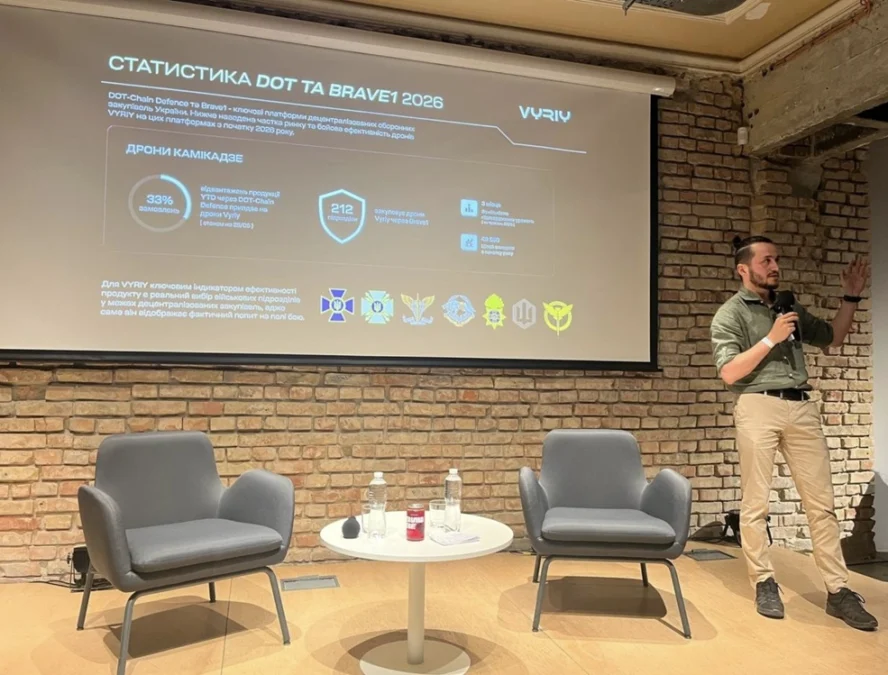
Around a quarter of the Ukrainian army's first-person-view (FPV) drones are manufactured by Vyriy Industries, Babenko said. The company works with 212 military units. On the Brave1 Market and DOT-Chain defense procurement platforms, where units choose their own suppliers, Vyriy holds 33% of orders through DOT-Chain. The company says it has delivered 70,000 drones funded by European partner countries and has passed the strict compliance and ownership verification checks required by those international contracts.

The SBI stated its basis for the investigation: prices may have been inflated through the unjustified inclusion of production and administrative costs. Ukraine's State Financial Monitoring Service also flagged more than $4.4 million in suspicious financial transactions at Vyriy. The company said the 150 individual entrepreneurs flagged by investigators are legitimate component manufacturers—small, specialized producers standard across Ukraine's defense industry.

The searches caused Vyriy's daily drone deliveries to dip, though Babenko said the company would continue delivering tens of thousands of drones a day. The company said it would revise its security policy to protect production data, given that investigative materials could become public.

Broader warning

"I very much hope this case is genuinely a misunderstanding and not the beginning of a broader campaign against Ukraine's miltech companies," Maria Berlinska, a Ukrainian veteran and co-founder of the Victory Drones initiative, said.

Vyriy's statement said the company "does not rule out" that the simultaneous information campaign and investigative actions "may be part of attempts to discredit Vyriy Industries"—actions that "could benefit both the enemy and unscrupulous market participants."
  • ✇Euromaidan Press
  • Ukraine rewrote the Patriot playbook—but it’s still running out of missiles
    At the 8 July NATO summit in Ankara, US President Donald Trump told his Ukrainian counterpart, Volodymyr Zelenskyy, that the US will license Ukraine to build its own Patriot interceptors—the only tool Ukraine has to counter Russian ballistic missiles. The US President added that this would end complaints that Washington was not supplying enough of them. The announcement comes at a dire moment: Ukraine has gone several nights without shooting down Russian ballistic missiles,
     

Ukraine rewrote the Patriot playbook—but it’s still running out of missiles

9 juillet 2026 à 11:36

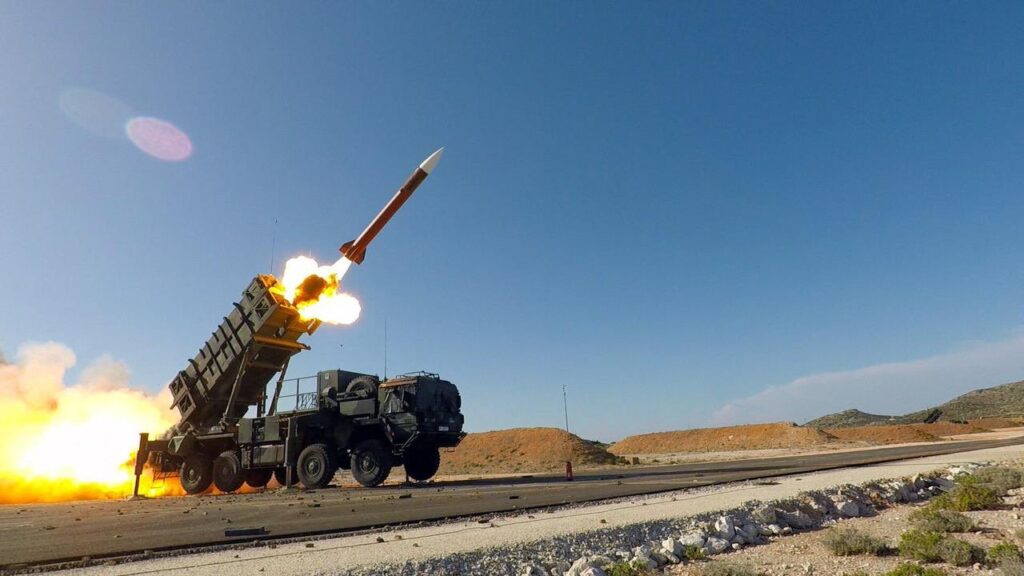
Patriot air defense system

At the 8 July NATO summit in Ankara, US President Donald Trump told his Ukrainian counterpart, Volodymyr Zelenskyy, that the US will license Ukraine to build its own Patriot interceptors—the only tool Ukraine has to counter Russian ballistic missiles. The US President added that this would end complaints that Washington was not supplying enough of them. The announcement comes at a dire moment: Ukraine has gone several nights without shooting down Russian ballistic missiles, targeting Ukrainian cities.

It is a real shift in tone—and, for now, little more. Lockheed Martin and RTX, the two companies that build the system, had not been informed of the decision. There is no timeline, no named manufacturer, and no confirmation that the missiles would be built in Ukraine at all. It was Trump's third positive signal on the license in three weeks, none of them binding. A Patriot made under that license is, at best, many months away.

The shortage is structural

The interceptor crunch is bigger than Ukraine. During its 39-day war with Iran this spring, the US may have burned through over half of its Patriot missile stockpile, by CSIS's estimate—and rebuilding the depleted munitions to pre-war levels will take one to four years.

The US now has to replenish its own magazines, defend against a possible war in the Western Pacific, and supply Ukraine and 18 other Patriot-using countries from the same slow production line.

Ukraine's Defense Ministry has written to nearly 40 partner countries asking for interceptors from existing stocks, warning that faster decisions are critical after one of the largest Russian air attacks of the war.

The ballistic gap is where people die

May 2026 saw the highest civilian killed-and-injured total since April 2022: at least 274 killed and 1,763 injured, a 93% increase over May 2025, the UN human rights mission found, driven primarily by long-range missiles and drones striking cities far from the front. Ukraine shot down roughly 91% of Russian drones in May, but a far lower share of ballistic missiles—Russia's most dangerous strike weapon, which Ukraine's depleted Patriot stocks have been unable to stop consistently. The ballistic ones are the killers, and the Patriot is the only thing Ukraine has that can stop them.

Russia has launched 521 ballistic missiles at Ukraine this year—more than twice as many as in the same period of 2025—of which Ukraine has downed 164, according to a New York Times data set.

What Ukraine has done—and why it isn't enough

Under that pressure, Ukrainian operators rewrote the Western manual for using the Patriot, the New York Times reported from interviews with air-defense commanders.

  • They learned to fire a single interceptor at a ballistic missile instead of the standard two or more.
  • They switched systems to manual mode to avoid wasting interceptors on cheap drones, which are better handled by machine guns and interceptor drones.
  • They developed "shoot and scoot" tactics, moving batteries the moment they fire, and fielded decoys costing around $30,000 each to draw Russian targeting away from billion-dollar systems, the NYT says. 

That ingenuity now travels. Ukrainian soldiers have deployed to the Gulf to train local forces in cheaper drone-interception tactics, and several countries have asked to buy Ukraine's interceptor drones, according to the NYT. Ukraine's Lima electronic warfare system—which spoofs incoming missiles' navigation systems for a fraction of the cost of a single PAC-3 interceptor—has jammed more than 20,500 Shahed drones over 18 months.

But every one of these innovations stretches a scarce resource further. None of them makes more interceptors. They buy time, they do not fill the gap.

The slow paths out

Zelenskyy has framed the production license as a mutual benefit: Ukraine builds interceptors, and allied partners gain supply when they need it. The US currently shares Patriot production rights only with Germany and Japan, and the most advanced radar seekers are still made only in the United States. So even a licensed Ukrainian line would depend on American components.

Kyiv is assembling a European coalition to build an anti-ballistic shield independent of scarce US interceptors, with Sweden the first confirmed partner, and signed an agreement with Germany to jointly develop Freya, its own ballistic-missile interceptor—though that system is unlikely to be operational before late 2027 at the earliest. Ukraine is also exploring the domestic development of ballistic defenses.
  • ✇Euromaidan Press
  • Russia attacks Ukraine’s civilians at a scale few people realize. Kyiv reveals number at UN
    Since February 2022, Russia has carried out more than 167,000 attacks on civilian targets in Ukraine—more than 100 a day, every day, for over four years. Civilian casualties in December 2025–May 2026 rose 40% compared to the same period the previous year, the UN Human Rights Monitoring Mission reported in late June. On 1 July, Ukraine put those numbers on the record of the UN General Assembly— and made a specific argument about what they mean. "Russia systematically uses t
     

Russia attacks Ukraine’s civilians at a scale few people realize. Kyiv reveals number at UN

9 juillet 2026 à 06:55

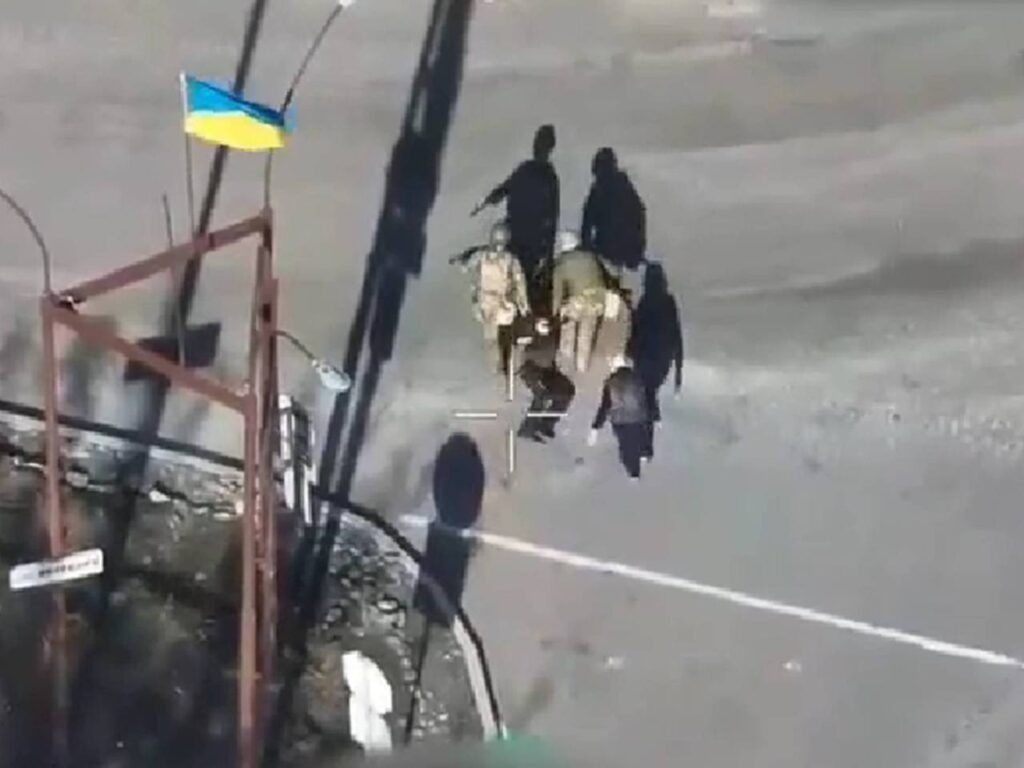
russians murder two women shoot civilian car ukrainian prosecutors say soldiers evacuating man injured selydove donetsk oblast 24 october 2024 earlier

Since February 2022, Russia has carried out more than 167,000 attacks on civilian targets in Ukraine—more than 100 a day, every day, for over four years. Civilian casualties in December 2025–May 2026 rose 40% compared to the same period the previous year, the UN Human Rights Monitoring Mission reported in late June. On 1 July, Ukraine put those numbers on the record of the UN General Assembly— and made a specific argument about what they mean.

"Russia systematically uses terrorist methods as an instrument of state policy."  Said Artem Bondarenko, chief of staff of the SBU Anti-Terrorist Center, on the 95th plenary meeting of the 80th General Assembly 

The forum mattered: the 95th plenary was the ninth review of the UN Global Counterterrorism Strategy, a framework adopted by all 193 member states that is explicitly about state policy, not individual commanders. Ukraine was not filing a war crimes complaint. It was arguing that Russia's conduct fits a category the entire international community has already agreed to condemn.

Bondarenko described energy strikes designed to deprive millions of people of heat and water in extreme cold, the recruitment of Ukrainian minors for sabotage through online platforms, and the occupation of the Zaporizhzhia Nuclear Power Plant combined with Russia's deployment of nuclear weapons in Belarus," an unprecedented environment of nuclear pressure and intimidation affecting the entire European continent," he told the Assembly.

At the same session, Russia took the floor—in the explanation-of-vote phase, before Ukraine's speech in the general debate. Its delegate said Moscow was "prepared to have mutually respectful cooperation with all states who really are interested in an effective, uncompromising fight against terrorism," and named as a priority the need "to protect civilian objects, in particular energy facilities." Russia was not acknowledging a contradiction. It was claiming the same language, inside the same framework, as a co-author of international counterterrorism norms.

Earlier that morning, the United States had voted against the resolution that Ukraine welcomed. The US delegation called it "not fit for purpose"—"bloated, outdated, and lacking focus." The resolution passed 140–3. It is non-binding.

The General Assembly cannot enforce. The Security Council can—but Russia holds a veto. What Ukraine is building is a legal and political record: testimony, ICC arrest warrants already issued against two Russian commanders for energy strikes, UN human rights findings that those strikes "appear to have violated fundamental principles of international humanitarian law." The record feeds proceedings that may take years. On 1 July, the room where that record was made included the country that filled it.

  • ✇Euromaidan Press
  • Russia’s AI drone can’t be jammed or detected—so Ukraine shot it down
    Ukraine has shot down an autonomous version of Russia's Molniya strike drone. It is the first confirmed intercept of the AI-equipped variant, which cannot be jammed by electronic warfare, Ivan Fedorov, head of the Zaporizhzhia Oblast Military Administration, announced.  Russia's pivot toward autonomous and fiber-optic drone variants is part of a broader effort to neutralize the electronic warfare advantage that has been one of Ukraine's key equalizers in the drone war—forci
     

Russia’s AI drone can’t be jammed or detected—so Ukraine shot it down

9 juillet 2026 à 06:11

Molniya drone carrier

Ukraine has shot down an autonomous version of Russia's Molniya strike drone. It is the first confirmed intercept of the AI-equipped variant, which cannot be jammed by electronic warfare, Ivan Fedorov, head of the Zaporizhzhia Oblast Military Administration, announced. 

Russia's pivot toward autonomous and fiber-optic drone variants is part of a broader effort to neutralize the electronic warfare advantage that has been one of Ukraine's key equalizers in the drone war—forcing Ukraine to develop kinetic intercept at scale as the primary answer to threats that jamming cannot touch.

What makes it different

The standard Molniya—a plywood-and-simple-parts aircraft-type kamikaze drone with a declared range of up to 40 km—normally requires an operator and a radio control link, both of which Ukraine's jammers and drone detectors can target. The AI variant removes both. It carries only a camera and an onboard computer; navigation, target search, and the final attack run are all handled autonomously. With no control antenna, there is no operator link to sever and no radio emissions for Ukraine's electronic warfare systems to lock onto.

Serhii "Flash" Beskrestnov, adviser to Ukraine's defense minister on electronic warfare, noted that the intercepted drone also carries a separate detonation circuit—triggered when the top cover is opened—designed to destroy the drone before it can be examined. He noted that the AI Molniya flies with a low radar cross-section and a reduced infrared signature on top of its near-silent electronics, which can delay detection until the drone is nearly on top of its target.

How Ukraine brought it down

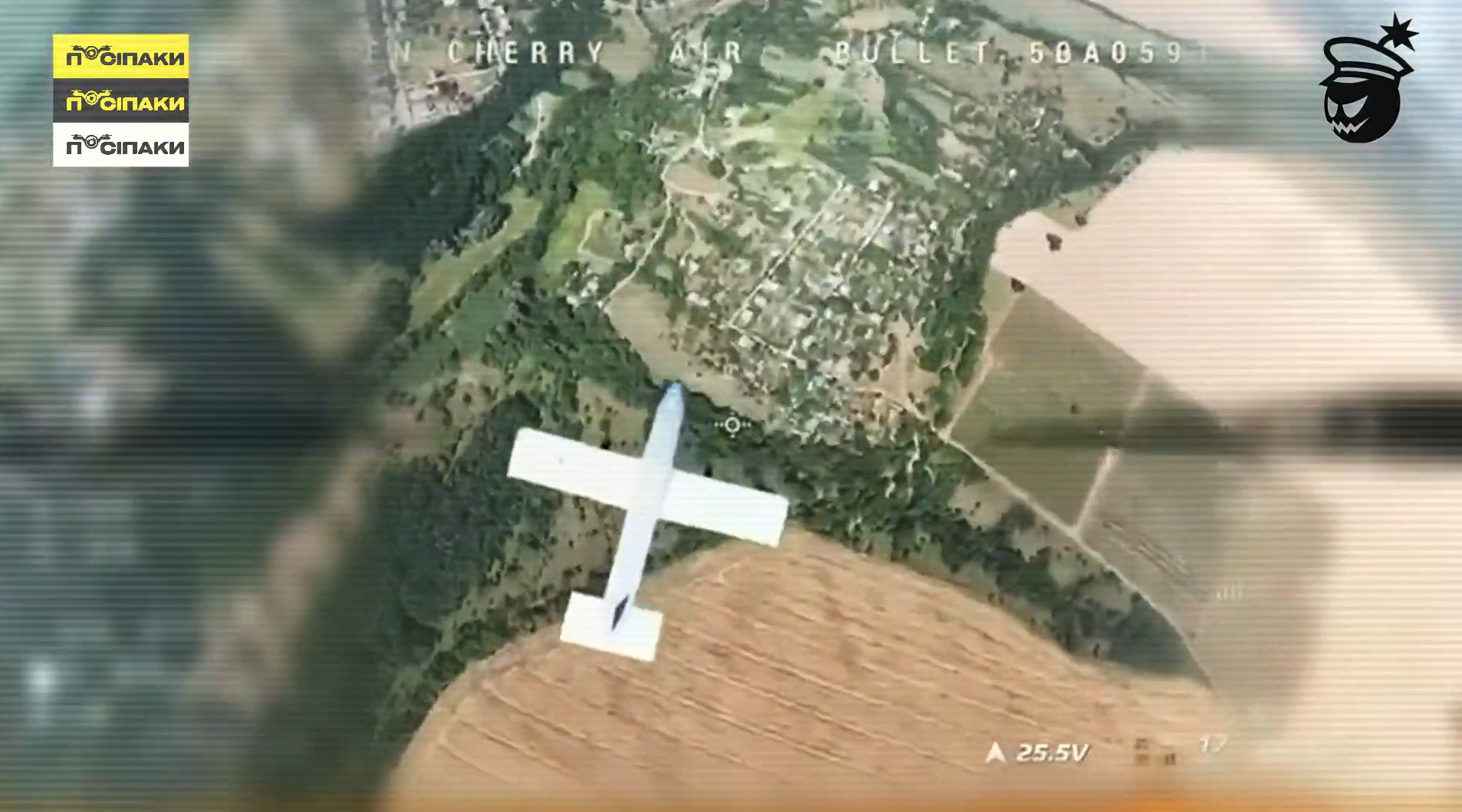
Over Zaporizhzhia, a joint effort by Zaporizhzhia police, National Guard, and interceptor crews brought down the AI Molniya for the first time. The drones were destroyed with domestically produced General Cherry AIR and Bullet interceptors—the same kinetic systems that accounted for 43% of all Molniyas Ukraine brought down in March 2026.

A Molniya drone equipped with artificial intelligence was shot down over Zaporizhzhia
A Molniya drone equipped with artificial intelligence was shot down over Zaporizhzhia. Screenshot from a General Cherry video

The drone and its operators

The Molniya is among the cheapest weapons in Russia's arsenal—a low-cost kamikaze built close to the front, reliable and ubiquitous. Russia launches up to 10 a day in the Zaporizhzhia direction alone, sometimes fitting one with an anti-tank mine or flying it as a mothership for FPV drones. In June, Russia's Rostec presented the drone for export under the name Lightning 13 at the National Security. Belarus-2026 exhibition.

Preliminary Ukrainian assessments point to Russia's 50th Varyag Unmanned Systems Brigade as the main operator of the AI variant, operating alongside the Rubicon unit—two of the formations Russia uses to trial its newest drone technologies on the Zaporizhzhia axis.

What comes next

Beskrestnov has already warned that this may not be the end of the trend. The next step, he says, is a fiber-optic version of the Molniya that is already being tested. Tethered to its operator by a glass fiber rather than relying on radio communications, it would emit no radio signal at all, making it invisible to Ukraine's electronic reconnaissance and immune to jamming.

Fiber-optic FPV drones have already reached the battlefield around Kharkiv. A fiber-optic Molniya-class aircraft would extend the same challenge over much greater distances, further eroding the effectiveness of electronic warfare.

Inexpensive electronic warfare has been one of the defining equalizers of the war, allowing defenders to disable expendable drones without firing far more expensive interceptors. As drones become autonomous or fiber-optic controlled, that advantage begins to disappear. Autonomous target-selection systems are already undergoing combat testing by both Russia and Ukraine.

Ukraine's response is increasingly shifting toward kinetic interception—and that solution is already attracting Western interest. General Cherry, whose interceptors brought down this Molniya, has reached the final stage of the Pentagon's Drone Dominance Program, a Hegseth-era initiative to field low-cost drones capable of operating in contested electronic warfare environments.

The company has also signed a joint venture to manufacture its Bullet interceptors in New Hampshire. Ukraine is becoming the proving ground not only for the drones that future wars may rely on, but also for the systems designed to defeat them.

❌