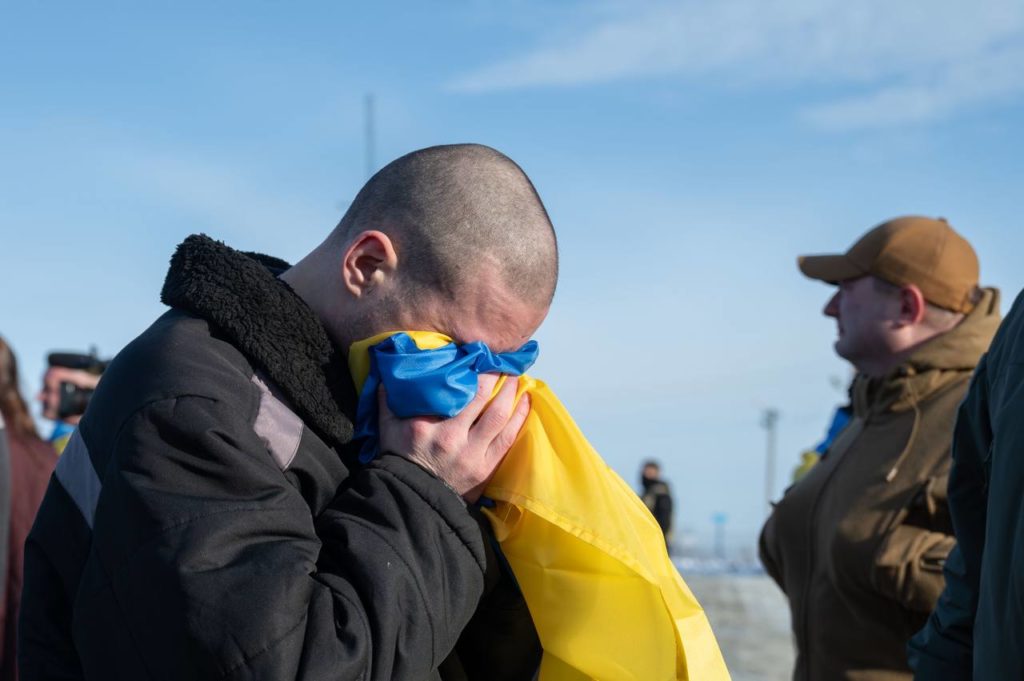
Russian forces have executed at least 345 Ukrainian soldiers who surrendered since the start of the full-scale war, Ukrainian Ombudsperson Dmytro Lubinets said at a press conference at Ukrinform.
The figure is the latest point on a documented and rising curve of a systematic war crime. Ukraine's prosecutors and international monitors have tracked these killings from 268 confirmed by July 2025 to over 330 by March 2026. Financial Times investigation found the executions
Russian forces have executed at least 345 Ukrainian soldiers who surrendered since the start of the full-scale war, Ukrainian Ombudsperson Dmytro Lubinets said at a press conference at Ukrinform.
The figure is the latest point on a documented and rising curve of a systematic war crime. Ukraine's prosecutors and international monitors have tracked these killings from 268 confirmed by July 2025 to over 330 by March 2026. Financial Times investigation found the executions appear to be systematic military policy directed from Russian command, with intercepted orders to "shoot prisoners on the spot."
The victims had surrendered
Lubinets described people killed after they had given up.
"It means that they laid down their weapons, came out with raised hands, lay on the ground, and showed they were no longer fighting," he said, and Russian soldiers examined them and confirmed they were unarmed.
Then the soldiers killed them.
"We have recorded cases where they fully demand that the clothes be removed. And after that, they force them to lie on the ground the same way, and shoot the Ukrainian soldiers at point-blank range," Lubinets added.
Killing a surrendered soldier is a war crime
Lubinets stressed the legal character of the act. The killing of soldiers who have surrendered is a distinct war crime, he said.
The prohibition is absolute. Under the Geneva Conventions, a soldier who lays down arms and surrenders is protected, and killing a prisoner of war is a grave breach of international law. Common Article 3 of the Third Geneva Convention prohibits "violence to life and person, in particular murder of all kinds" against those who have laid down their arms, with no battlefield circumstance that permits it, per the ICRC.
The count keeps rising and accountability lags
Ukraine documents each case for eventual prosecution, but most perpetrators are in Russia, beyond reach, and Russian courts and media have glorified the killings rather than punished them.
Ukrainian investigators have published a framework that challenges Russia’s standard justification for missile strikes on civilian places: that a precision weapon hit a legitimate military target. Precision settles nothing, they argue, when the missile takes 10 minutes or more to arrive, and the target is a gathering of people who can leave, disperse, or be warned before it lands.The report, titled “Out of Control” and published on 28 July by the documentation group Truth
Ukrainian investigators have published a framework that challenges Russia’s standard justification for missile strikes on civilian places: that a precision weapon hit a legitimate military target. Precision settles nothing, they argue, when the missile takes 10 minutes or more to arrive, and the target is a gathering of people who can leave, disperse, or be warned before it lands.
The report, titled “Out of Control” and published on 28 July by the documentation group Truth Hounds and Project Expedite Justice, builds the argument on four strikes and calls the pattern a “moving target attack.”
The report reaches a war crime conclusion for only one of the four—the 2023 strike on a Kramatorsk cafe. The other three are offered as variations on the same problem, not as verdicts. The framework itself is new: a test the authors want courts and investigators to apply to a kind of attack that existing law, they say, has addressed without enough rigor.
A missile can hit its programmed coordinates exactly and still land where no military objective remains.
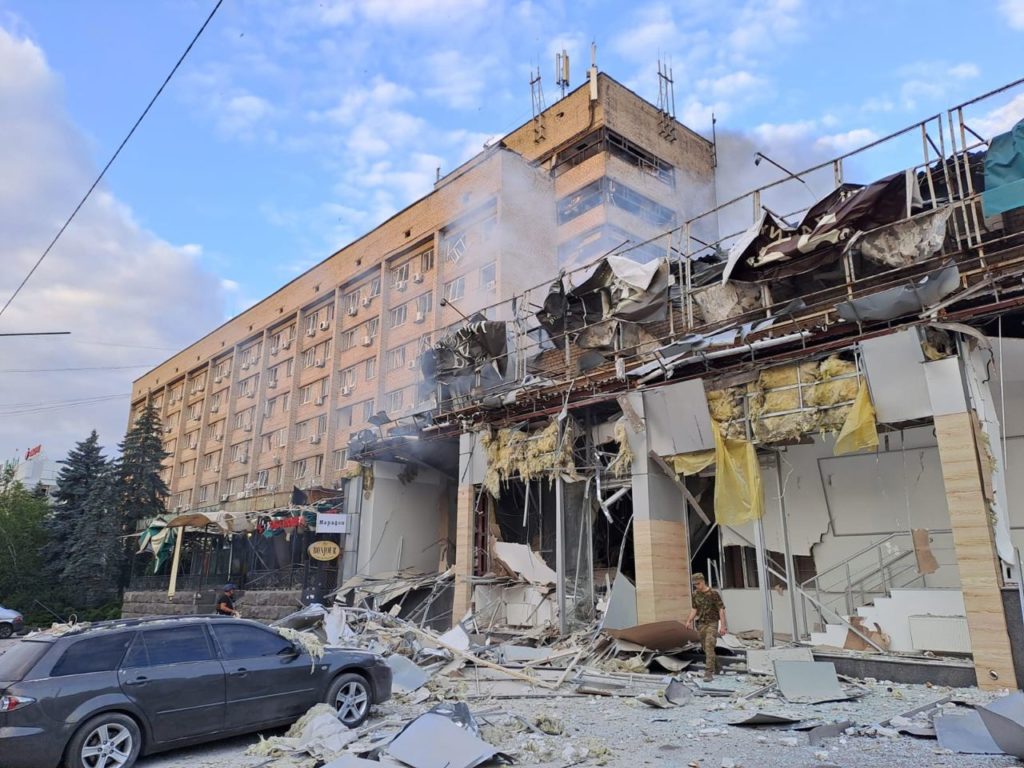
The diagnostic case is the strike on the Ria Lounge cafe in central Kramatorsk on 27 June 2023, which killed 13 people and injured 60. A Russian informant last watched the site at around 17:00. The missile arrived at 19:29, after a flight of nine to 15 minutes. In the interval, no one on the Russian side could see who was inside, and once the missile was launched, no one could call it back.
Russia’s Defense Ministry said it had destroyed a temporary command post of the 56th Motorized Infantry Brigade, killing two generals, up to 50 officers, and up to 20 foreign mercenaries.
The evidence describes an ordinary pizza restaurant instead: 40 to 50 customers, around half civilians and half off-duty soldiers in mixed dress, unarmed, out with friends and family. A basement room had been booked a month ahead for an officer’s birthday. No one outside could tell the place was military.
The missile struck the public level. The basement that Russia said it was aiming at came through essentially intact. Of the 13 killed, two were serving soldiers. Among the dead was Victoria Amelina, a novelist who had retrained as a war crimes documenter and worked with Truth Hounds itself. The organization concluded in 2023 that the strike was a war crime in the form of an indiscriminate attack under the Rome Statute.
Explore further
Award-winning Ukrainian writer who uncovered Russian atrocities dies in missile attack
The gap the weapon leaves open
The framework turns that single case into a test. A moving target attack, as the authors define it, combines three features: a military rationale resting on a temporary presence of personnel, a location of civilian character where civilians are foreseeably present, and a weapon whose flight time is long enough that the situation on the ground can change before impact.
A missile can hit its programmed coordinates exactly and still land where no military objective remains.
The authors selected three further strikes that met the same criteria and examined them through open sources.
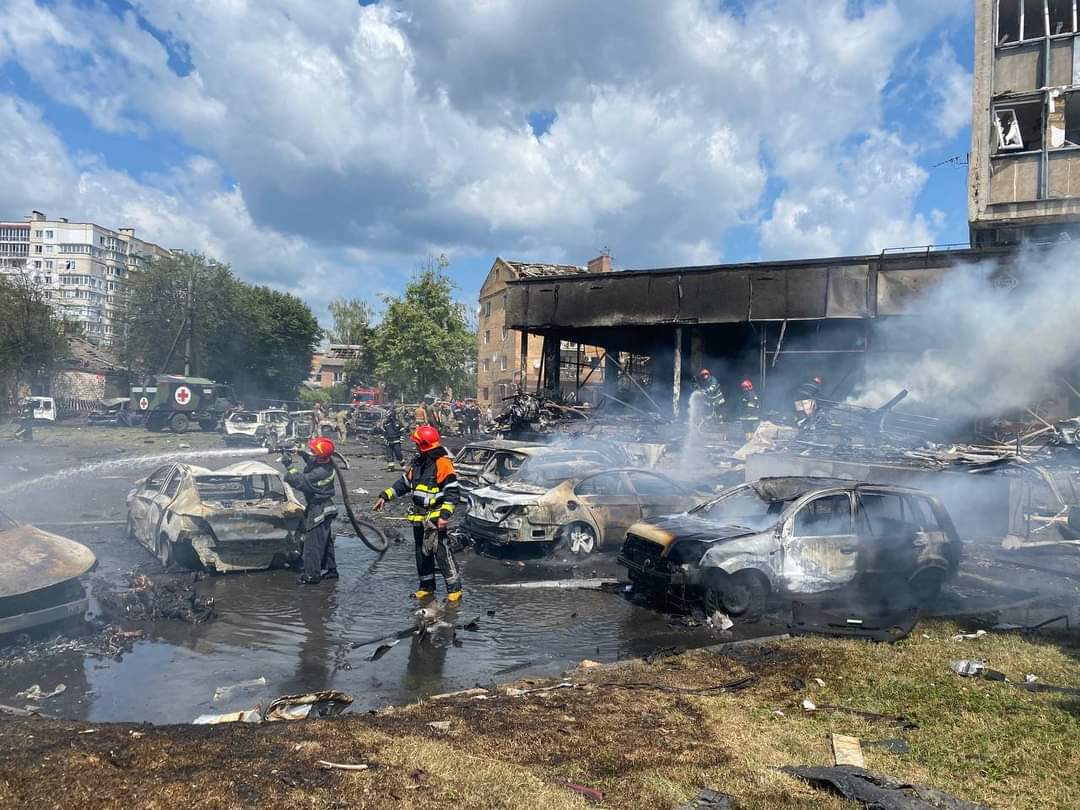
In Vinnytsia on 14 July 2022, the report finds, three Kalibr missiles killed 29 people, including three children and five servicemen, and wounded at least 154. Russia said the target was a scheduled Air Force command meeting. The air raid alert sounded at 10:12; the missiles hit at 10:41, about 40 to 50 minutes after launch.
Explore further
Ukraine calls to brand Russia a terrorist state after missile strike kills 21 in Vinnytsia
In Zlatopil on 4 July 2023, the report documents, a missile landed 800 meters from a serviceman’s funeral, in a residential area, wounding 42 civilians including 12 children. Organizers had asked mourners to shelter from the heat about 10 minutes earlier, leaving the square nearly empty.
In Chernihiv on 19 August 2023, a missile fitted with a proximity fuse detonated in the air above the Drama Theatre, where NGOs were running a defense-tech exhibition inside. All seven people killed were outside the building.
For these three, the report states that the evidence does not support conclusions equivalent to Kramatorsk.
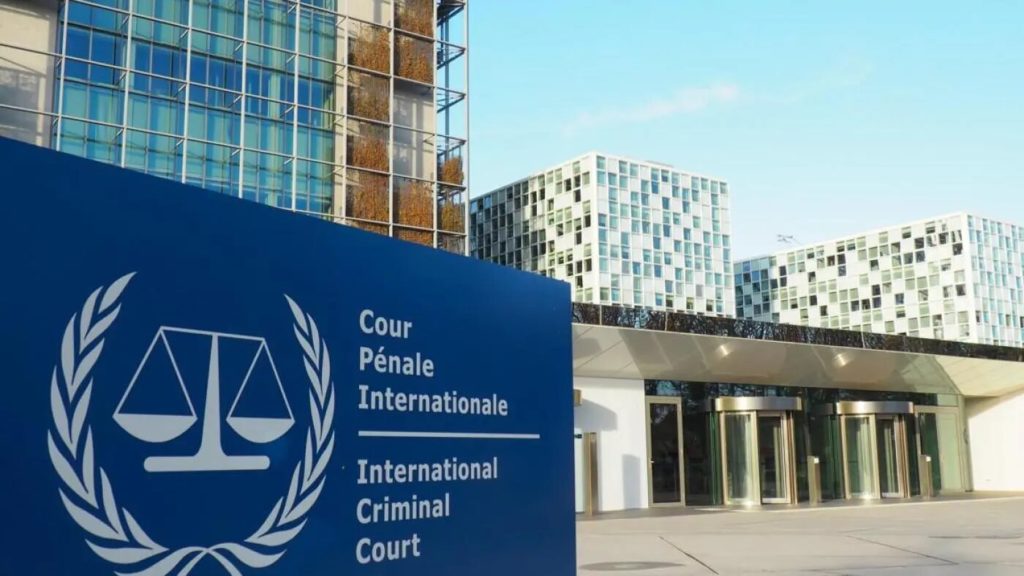
The International Criminal Court in The Hague, Credit: Marina Riera/Human Rights Watch
What the report asks investigators to do
The recommendations run to the International Criminal Court, the ICRC, the UN human rights office, and prosecutors working under universal jurisdiction.
They ask that the launch-to-impact interval be treated as a working indicator, that technical precision no longer be read as evidence that a strike was lawful, and that the presence of soldiers in a civilian place not be taken to strip it of protection.
One question the report raises and declines to settle is whether the four strikes are a run of targeting failures or a method. Answering it needs orders and targeting packages that only investigators with coercive powers can reach—at a moment when Truth Hounds is working on a budget cut by a third after the US withdrew funding, Reuters reported in May.
Ukraine has arrested Ruslan Kuchynskyi, the head of an enterprise in Vyshneve in Kyiv Oblast, suspected of involvement in the improper storage of ammunition at warehouses near civilian settlements, UNIAN reports. A Kyiv court is choosing a pre-trial restraint for him after a Russian attack triggered a massive detonation that damaged 13 hectares of residential development.
The 6 July strike killed 11 people in Kyiv itself and drove the citywide toll to 19. In Vyshneve, the s
Ukraine has arrested Ruslan Kuchynskyi, the head of an enterprise in Vyshneve in Kyiv Oblast, suspected of involvement in the improper storage of ammunition at warehouses near civilian settlements, UNIAN reports. A Kyiv court is choosing a pre-trial restraint for him after a Russian attack triggered a massive detonation that damaged 13 hectares of residential development.
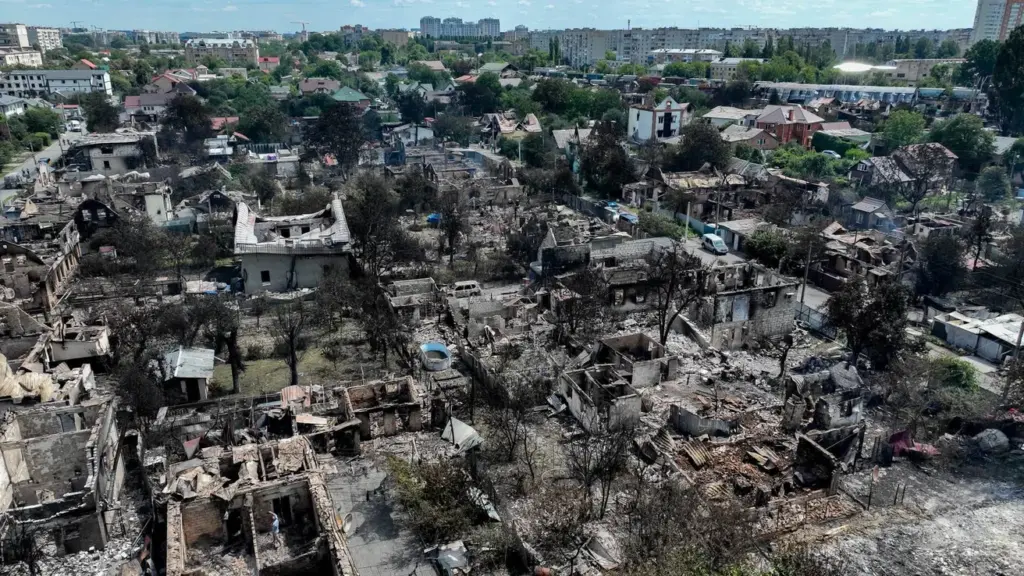
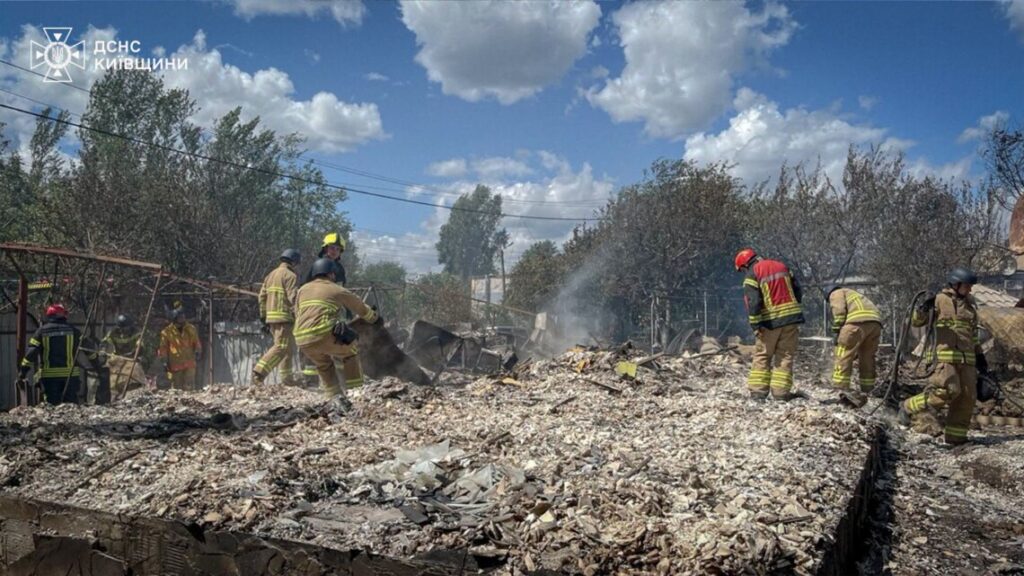
The 6 July strike killed 11 people in Kyiv itself and drove the citywide toll to 19. In Vyshneve, the secondary detonation burned for hours, and more than 600 residents were evacuated over the risk of further explosions.
Kuchynskyi is the first individual to face a court over the depot. The case will be heard behind closed doors because state-secret material will be disclosed, the prosecutor requested it, and the suspect's lawyer did not object. The remaining suspects will likely also have their restraint hearings held in closed session.
Russia fired missile, but depot should not have been there
Former Prime Minister Yuliia Svyrydenko called it the largest destruction of the residential sector in the entire full-scale war.
Earlier, SBU Deputy Head Major General Oleksandr Poklad reported to Zelenskyy on who inside Ukroboronprom allowed the storage, and Zelenskyy said on 11 July that the directors of two state enterprises had acted in defiance of both the law and a decision of the Supreme Commander-in-Chief's Staff.
Russia launched the strike, but the depot's location is what turned it into a neighborhood-leveling event.
"There was a direct ban on this, both under the law and under the Staff's decision, and all of it was violated," Zelenskyy said on 11 July.
He said the specific officials are known, and the state's position is that each of them must be brought to fair justice.
"Every director must feel that people's lives depend on his decisions or his inaction," Zelenskyy stated.
General Staff spokesman Dmytro Lykhovii has confirmed the Commander-in-Chief's order banning the siting of ammunition depots near civilian buildings remains in force, per Euromaidan Press.
Case sits amid defense-industry reckoning
Kuchynskyi's hearing lands in the middle of a wider shake-up of Ukraine's defense-industrial leadership. Ukroboronprom chief Herman Smetanin resigned on 15 July, days after the Vyshneve tragedy, and Defense Minister Mykhailo Fedorov confirmed his own departure the same day.
Ukroboronprom, also known as the Ukrainian Defense Industry, groups roughly 100 enterprises that produce missiles, drones, armored vehicles, and ammunition.
The head of Ukraine's state defense conglomerate is out. Herman Smetanin announced on social media that he is leaving the post of director general of Ukroboronprom, the state joint-stock company that groups roughly 100 enterprises producing missiles, drones, armored vehicles, and ammunition. The resignation follows the Vyshneve tragedy.
On 6 July, a Russian strike detonated munitions at a depot in Vyshneve, in Kyiv Oblast's Bucha district, destroying almost five streets and
The head of Ukraine's state defense conglomerate is out. Herman Smetanin announced on social media that he is leaving the post of director general of Ukroboronprom, the state joint-stock company that groups roughly 100 enterprises producing missiles, drones, armored vehicles, and ammunition. The resignation follows the Vyshneve tragedy.
On 6 July, a Russian strike detonated munitions at a depot in Vyshneve, in Kyiv Oblast's Bucha district, destroying almost five streets and damaging around 280 houses.
The depot belonged to one of Ukroboronprom's enterprises. Russia fired the missile, but the depot should not have been where it was.
President Volodymyr Zelenskyy said on 11 July that the directors of two state enterprises had stored weapons and ammunition next to residential buildings in defiance of both the law and a decision of the Supreme Commander-in-Chief's Staff.
"There was a direct ban on this — both under the law and under the Staff's decision — and all of it was violated," Zelenskyy stressed.
Ukroboronprom fired two enterprise directors before its chief left
After the tragedy, Ukroboronprom dismissed the heads of two state enterprises, along with other officials whose action or inaction may have caused the grave consequences, according to UNIAN. The company said all those responsible would bear criminal liability under Ukrainian law. The SBU has identified the officials who allowed the storage to take place.
Zelenskyy signaled the accountability would not stop at the enterprise level.
"It is a large structure, it includes dozens of enterprises, one of which is situated at that depot in Vyshneve," he said.
Days later, the person at the top of that structure was gone.
Smetanin led Ukroboronprom twice
Smetanin had headed Ukroboronprom on two separate occasions. He was first appointed director general of the joint-stock company on 28 June 2023. From 5 September 2024 to 17 July 2025, he served as Ukraine's Minister for Strategic Industries. In July 2025, he returned to Ukroboronprom as acting head, and in August 2025, he took charge of the defense-industrial group for the second time.
His exit leaves Ukroboronprom without a director general at a moment when Ukraine's defense industry is scaling faster than at any point in the war.
Vyshneve strike was part of Russia's largest attack on Kyiv in months
The depot detonation did not happen in isolation. Russia struck Kyiv and Kyiv Oblast with a massive combined barrage overnight on 6 July, firing 68 missiles and 351 drones, including 23 Iskander-M and S-400 ballistic missiles and six Zircon or Oniks missiles. Air defenses downed 363 of 419 targets, but not one ballistic or Zircon missile was intercepted. The attack killed 11 people in Kyiv.

 Connexion