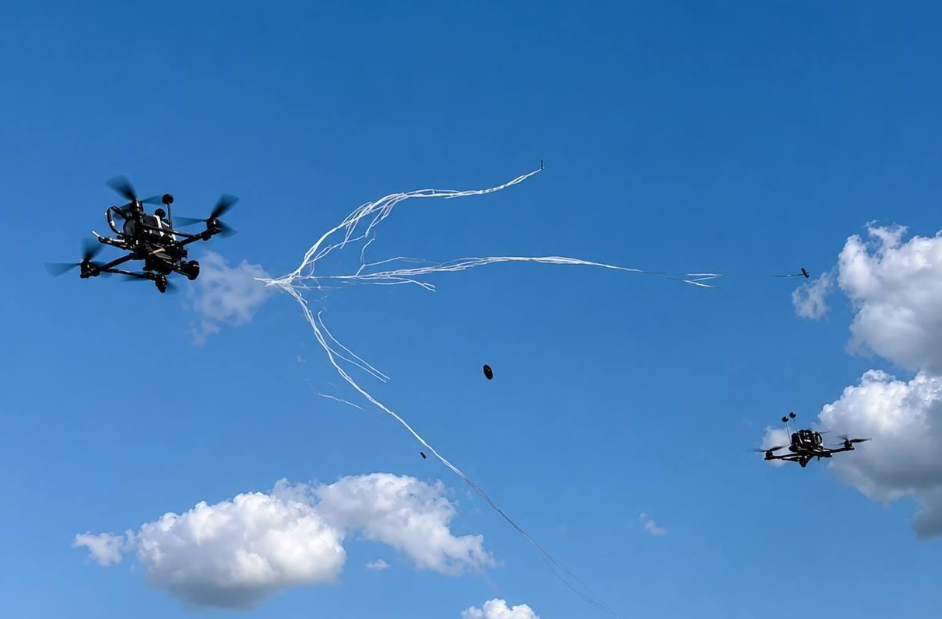
A Ukrainian defense company has shown a new way to knock FPV drones out of the sky, unveiling a net-firing interceptor at the IT Arena tech conference in Lviv, dev.ua reported. The system, called Mangal and developed by Phantom Defense, is still a prototype—the company says the first production units could reach the market in a few months.
Ukraine's counter-drone work has turned into a crowded contest, with firms racing to field jammers, interceptor drones, and net-throwers that can blunt Russia's growing use of cheap FPVs.
What Mangal does
Phantom Defense designed the modular launcher to defend positions, vehicles, and other targets against enemy drones. It fires a special net weighted with sinkers. The net opens the moment it fires, tangling the drone and dragging it down. One module holds six charges. Two cameras give the crew a clearer view, and the system can detect targets on its own, which speeds up how fast an operator spots a threat. Crews can fix Mangal in place to guard checkpoints, trenches, or infrastructure, or bolt it onto a vehicle.
Why a net
FPV drones—aircraft a pilot flies straight into a target—have become a routine danger along the front. A small, fast drone is hard to hit with a single round. A net spreads as it travels, so it is more forgiving to aim. Neither Phantom Defense nor the outlets covering the launch have said how far Mangal's net can reach.
Explore further
Ukraine’s newest interceptor doesn’t ram its target. It nets it for $27, then flies home to catch another
Other net-based counters
Other developers are turning to nets too. The WINFLY Spider is an interceptor drone that snares a target in a net and returns to its launch point intact, at about $27 a shot. That lets one aircraft make repeated intercepts instead of being spent on a single kill. Scan Horizon comes from Postup Solutions, a firm registered in Wrocław, Poland, and pairs a net launcher from Ukrainian company Ptashka Drones. Its net reaches about 30 meters. Contra Drone, meanwhile, has shown interceptor missiles that can reportedly carry net warheads alongside other options.

 Connexion