❌

Vue lecture

Ukraine’s new drone ferries FPV drones deep behind Russian lines and releases them there. It costs about $9,900 and does three other jobs too

Kara, Ukraine's new drone ferries FPV drones deep behind Russian lines. Source: Defender Media

A Ukrainian company has disclosed a small aircraft that can bomb a target, relay radio signals, carry FPV drones behind enemy lines, or strike on its own. The KARA, a fixed-wing drone made by Ukrskytechnology, is listed on Ukraine's state Brave1 Market in three tiers, from a bare airframe to a ready-to-fly aircraft, Defender Media reported.

One airframe does the work of several, and it goes for some $9,900. The marketplace it sits on, Brave1 Market, has processed more than $235 million in orders, lists over a thousand products, and lets frontline units buy gear even before a weapon clears formal codification.

One airframe does four jobs

What the KARA does depends on how it is kitted out. Fitted one way, it drops cargo; another, it works as a signal repeater to extend a unit's radio reach; another, it ferries FPV drones deep into the enemy rear to be released; and another, it carries out strikes itself. Buyers choose among an empty glider they equip themselves, a Plug-N-Play version with basic electronics installed, and a Ready-To-Fly model.

The drone flies light and far

The specifications are modest but flexible, according to Ukrskytechnology. The KARA has a tactical radius of 70 kilometers, and a stated endurance of 2.5 hours, cruises at 90 kilometers per hour and tops out at 120, and works at 200 meters but can climb to 3,000.

It runs on either an electric motor or a combustion engine, and carries two payload blocks of up to three kilograms each under the wing. Launched by catapult and landing like a plane, it takes 10 minutes to set up.

The marketplace lists it now

The KARA is being prepared for codification, the formal approval that clears a weapon for standard state procurement, but it does not have to wait for that to reach the front. Brave1 Market was built precisely so that units can buy proven kit fast, without waiting on the slow pipelines of the past, and the KARA is already there for the price of a used car.

  •  

A former US nuclear-sub commander, a Ukrainian fund, and a plan to shield Odesa with drone swarms

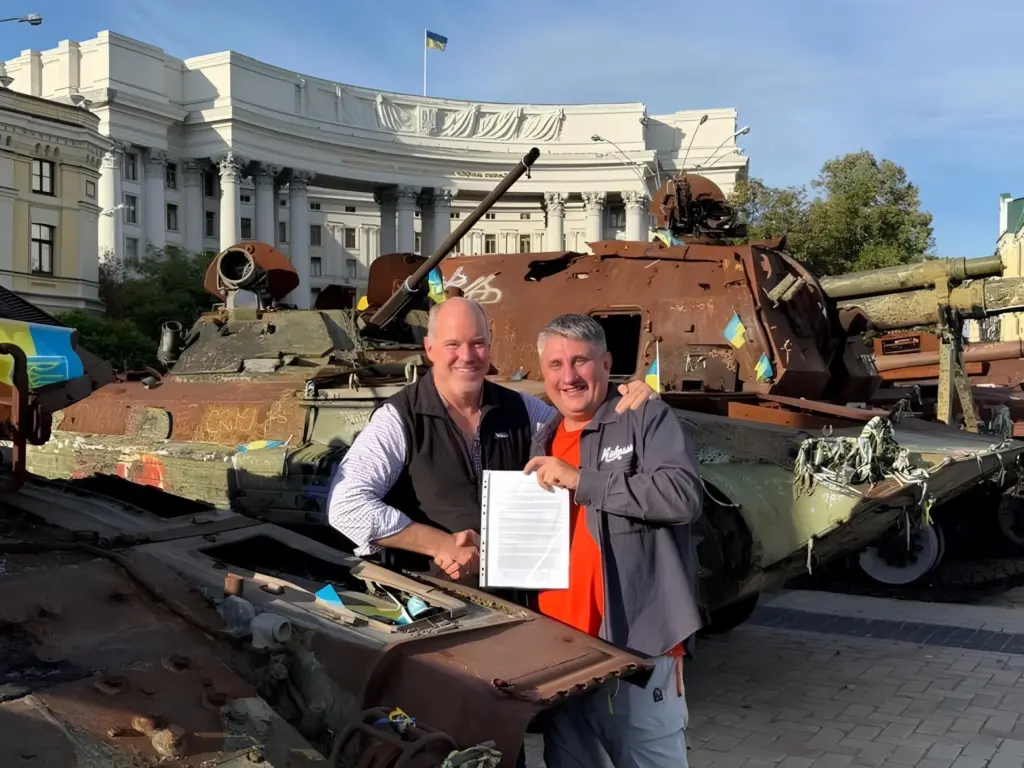
CEO of BlueShadow Charlie Maher with Resist.UA founder Roman Sulzhyk.

TAF Industries signed a joint-venture memorandum with Danish firm Upteko for production but says bureaucracy is slowing the process. Meanwhile, Resist.UA agreed to invest in BlueShadow, a Danish maritime-defense startup whose founder commanded a US nuclear submarine and whose engineering team works largely in Ukraine, Defender Media reported.

Ukraine's defense industry has outgrown much of its own 2022-era hardware in two years of rapid wartime iteration, but a government fee of 20-30% on export permits and over 200 stalled co-production bids have left the country's foreign arms sales far behind battlefield demand. Deals like the two in Denmark route Ukrainian technology into allied markets without waiting for Kyiv's export apparatus to catch up.

Ukrainian first-person-view drones, made on Danish soil

Drone maker TAF Industries plans to produce its first batch in Denmark by the end of 2026, through a joint venture with local firm Upteko. The two signed a memorandum in August 2026, but paperwork on both sides has slowed things down.

"We need to pass a fairly large number of bureaucratic procedures to make it possible," chief business development officer Mykhailo Diachenko told NordicDefenceWatch.

He called the year-end target reachable, "though maybe it will look more like a miracle."

TAF wants footholds in other countries that support Ukraine. It has started the process in Norway and is negotiating with Sweden's Recas. Diachenko said the goal is local production plus sharing Ukrainian combat experience and technology with European partners. TAF builds FPV drones, with capacity near 1 million units a year.

A Ukrainian fund bets on Odesa's sea defense

Ukrainian fund Resist.UA signed a letter of intent to invest an undisclosed sum in Danish maritime-defense startup BlueShadow's €2 million ($2.29 million) pre-seed round, the company announced. BlueShadow's software collects data from maritime sensors, commercial feeds, and open sources, merges them into a single operational picture, and uses AI to detect threats, Defender Media reported.

The company has also built an open software platform it says can help intercept Shahed-type drones. BlueSentry, designed to protect ports, offshore wind farms, undersea cables, and maritime borders from hybrid attack, is one product that the company plans to launch in the Baltic and North seas in October. BlueDragon, now in prototype testing with Defense Ministry certification targeted for late 2026 and deployment planned for spring 2027, is designed to defend Odesa with autonomous swarms of armed sea drones meant to shoot down Russian attack drones.

Founder Charles Maher is a former US Navy submarine commander who ran a nuclear-powered boat, Defender Media reported. Almost his entire engineering team works in Ukraine, drawing on more than 15 Ukrainian suppliers. Resist.UA this summer launched Resist 2.0, an Estonia-based fund aiming to raise €50 million for Ukrainian defense-tech companies.

  •  
❌