
 Connexion
Ukraine’s Vivaldi counteroffensive disrupts Russia’s plan to encircle Donetsk Fortress Belt – ISW

Ukraine’s Operation Vivaldi has disrupted Russia’s plan to encircle Ukraine’s heavily fortified “Fortress Belt” in Donetsk Oblast, the Institute for the Study of War (ISW) assessed, adding that Ukrainian forces have likely made additional gains beyond those publicly disclosed by Kyiv.
The assessment comes a day after Ukraine’s Third Army Corps publicly confirmed that it is conducting a counteroffensive against Russian forces north and northwest of Lyman. ISW said the Ukrainian gains have rendered Russia's plan to encircle the Fortress Belt from the north and south unfeasible.
Third Army Corps commander Brigadier General Andrii Biletskyi said on 15 September that Ukrainian forces had cleared Russian infiltrators from several settlements and liberated Serednie. The corps said its forces had cleared 75 square kilometers of Russian infiltrators and de-occupied another 10 square kilometers during the first phase of the operation.
Biletskyi said the operation, dubbed “Vivaldi,” was conducted under information silence and warned that the first phase was only one of four planned “seasons.”
Ukraine’s gains appear larger than initially disclosed
ISW assessed that Ukrainian forces have likely made additional gains beyond those announced by Biletskyi, with Russian sources beginning to acknowledge the deterioration of their position in the area.
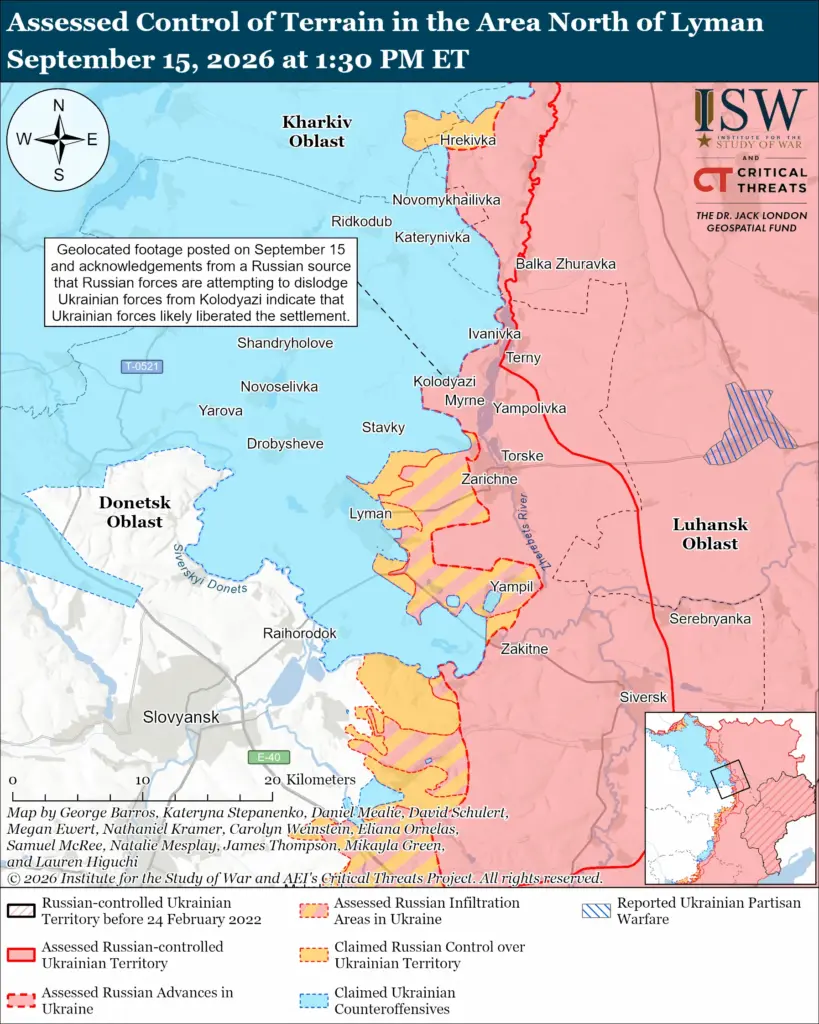
In particular, Russian forces have been shelling Ukrainian positions in Kolodyazi, northeast of Lyman, according to geolocated footage. A prominent Russian milblogger also acknowledged that Russian forces were trying to push Ukrainian troops out of Kolodyazi – what ISW described as a “coy acknowledgement” that Ukrainian forces have likely liberated the settlement.
Russian sources have continued to report worsening conditions for Russian forces both north and south of Kolodyazi.
ISW also corroborated the Third Army Corps’ account of growing Russian logistical problems, noting that Ukrainian strikes have disrupted supplies for Russian forces in the Borova and Lyman directions. The corps said the pressure was severe enough that Russia moved some logistics and support elements across the state border into Russia’s Voronezh Oblast.
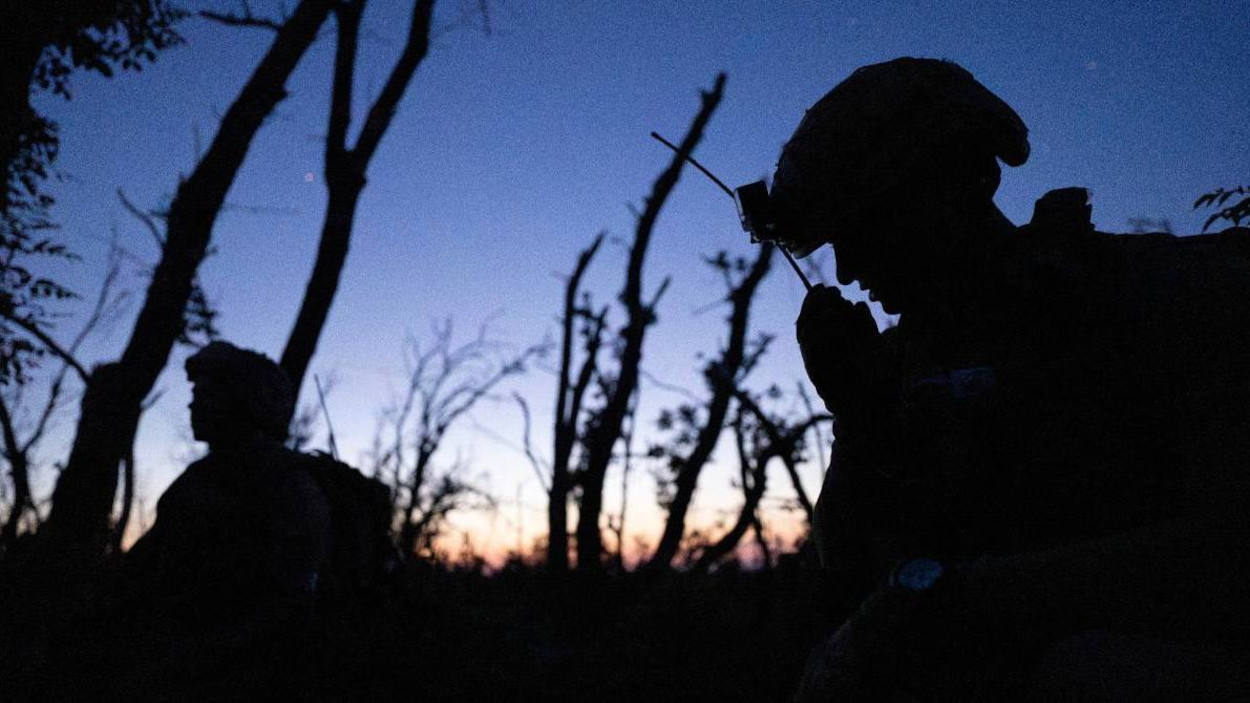
“Only the first season” – Ukraine unveils secret counteroffensive in a region Russia has been trying to seize for 12 years
Vivaldi disrupts Russia’s plan for the Fortress Belt
The operation’s broader significance lies in its effect on Russia’s campaign in Donetsk.
Russia has made capturing the remaining Ukrainian-held parts of Donetsk Oblast a central military objective, with its forces seeking to advance toward the heavily fortified cities of the Donetsk “Fortress Belt” from several directions.
The Russian military had also sought to create a northern route around the Fortress Belt through the Lyman area. ISW now assesses that Ukraine’s gains north of Lyman have made that plan unfeasible.
The institute said the Ukrainian counteroffensive will delay Russia’s planned offensive toward Sloviansk, the major objective Moscow had been expected to pursue after capturing Lyman.
Russian sources acknowledge setbacks
According to ISW, a prominent Kremlin-affiliated Russian milblogger similarly acknowledged that Ukraine’s gains will delay the Russian offensive toward Sloviansk and warned that the northern flank of Russian forces operating southeast of Lyman and east of Kramatorsk is now vulnerable to Ukrainian counterattacks and interdiction.
The Russian milblogger also claimed that Russian forces had lost positions south of Lyman and were struggling to recapture positions inside the city itself.
Russian sources have blamed the setbacks on the military’s culture of producing “beautiful reports” – exaggerated accounts of battlefield advances that can distort higher-level operational planning.
Another prominent milblogger reportedly claimed that some Russian commanders were attempting to conceal losses by rapidly assembling assault groups from inadequately trained personnel to retake lost positions.
Russia still presses its offensive elsewhere
Despite the setbacks around Lyman, ISW said Russian forces continue prioritizing frontal attacks against the Fortress Belt from the south and efforts to encircle it from the southwest, rather than advancing toward the cities from the east.
The institute said Russia may still be adjusting to the loss of the Lyman salient and the initiative in the area. It also assessed that Russian forces could seek to cut Ukrainian ground lines of communication to the Fortress Belt from the west.
For Ukraine, meanwhile, the counteroffensive is also undermining Russia’s ability to present advances in Donetsk as evidence of battlefield momentum.
And the full extent of Vivaldi remains unknown.
Biletskyi said the 85 square kilometers publicly disclosed by the corps represented only the first “season” of the operation, invoking Vivaldi’s Four Seasons.
“Vivaldi, as is known, has four seasons. And this is only the first one,” Biletskyi said on 15 September.
Read also
-
Belarus holds military drills around the Suwalki Gap, NATO’s only land link to the Baltics
-
Russia kills captain of Tanzanian-flagged ship in latest attack on civilian shipping in Black Sea
-
“What Ukraine needs right now”: Poland to provide Ukraine with scarce F-16 missiles to shoot down jet-powered drones
