Vue lecture

One alternative to air defense: Ukraine strikes Russian Bastion system used to attack Ukrainian cities from Crimea
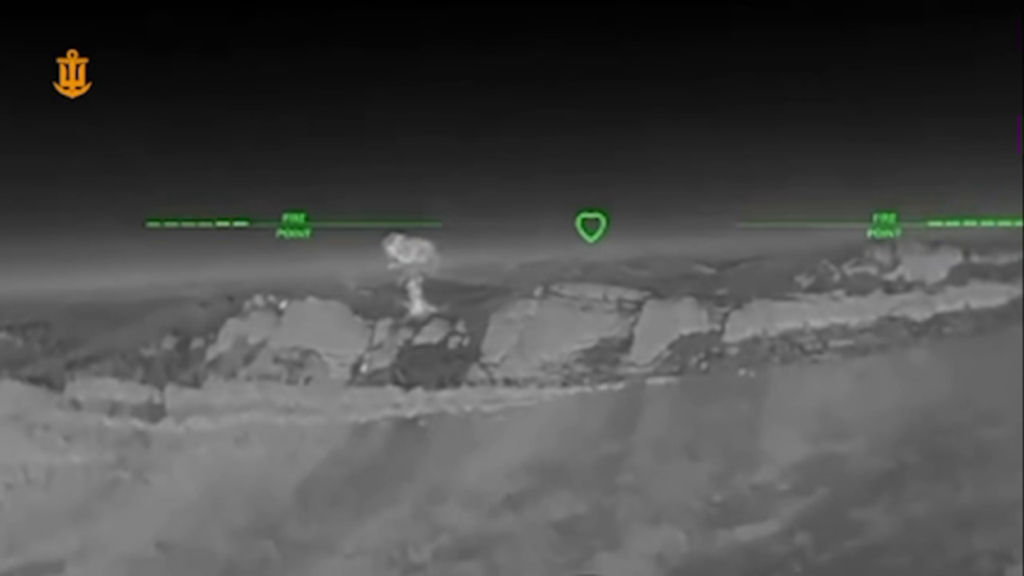
Smoke rises from a Russian Bastion missile system position in occupied Crimea after a Ukrainian strike on 16 August 2026. Screenshot from video: Ukrainian Navy

Ukraine’s Navy said its forces struck the launch positions and deployment site of a Russian Bastion coastal missile system in occupied Crimea overnight on 16 August, reportedly inflicting significant losses in equipment and personnel.

Russia has regularly used Crimea as a launch platform for strikes against Ukraine, making its missile systems there a priority target for Ukrainian forces seeking to reduce Russia’s ability to attack Ukrainian territory.

The Navy said the final Russian losses were still being assessed and did not provide details on the weapons or personnel destroyed.

Bastion systems used to strike Ukraine

The Bastion is a costly and scarce Russian coastal missile system that can launch P-800 Oniks cruise missiles. Russia has used Oniks missiles launched from occupied Crimea to attack targets across southern and other regions of Ukraine.

Oniks is a supersonic anti-ship cruise missile that Russia has adapted for strikes against ground targets in Ukraine, including Odesa Oblast. The missile can travel at more than 3,000 km/h, making it difficult for air defenses to intercept. Its standard range is about 300 kilometers, while upgraded variants can reportedly reach up to 800 kilometers and carry a 300-kilogram warhead. Russia launches ground attacks with Oniks from mobile Bastion systems based in occupied Crimea.

The Navy also said Russia uses Bastion systems to launch Zircon hypersonic missiles against Ukraine.

The Zircon is a newer hypersonic cruise missile designed to reach speeds of roughly Mach 5–9. Russia has used it against Ukrainian cities, including Kyiv, with launches previously reported from Bastion systems in occupied Crimea. Its officially claimed range exceeds 1,000 kilometers, although analysts question that figure; Ukrainian analysts have estimated a lower effective range.

Bastion launchers in Crimea are a particularly important target for Ukraine: they give Russia a mobile platform for striking targets across southern Ukraine and, with Zircon, deep into the country. Ukraine’s air defenses have struggled to intercept these missiles, making strikes on the launchers an important way to reduce the threat before the missiles are fired.

The Ukrainian Navy said the strike was part of ongoing efforts to reduce Russia’s combat potential in the Black Sea region.

Several Ukrainian strikes recorded overnight

The Crimea strike came amid a broader wave of Ukrainian attacks on Russian military, industrial, and logistics targets overnight on 16 August.

Ukraine’s General Staff reported a strike on the Kamensky Combine in Russia’s Rostov Oblast, where a fire was recorded. The plant produces solid rocket fuel for Russia’s Uragan, Smerch, and Tornado-S multiple-launch rocket systems, as well as components for other missile and aviation weapons.

In Moscow Oblast, a Ukrainian drone struck a 250,000-square-meter Wildberries warehouse in Koledino, while another fire was reported at the Severnoye Domodedovo logistics complex. Ukraine’s Defense Ministry later confirmed the Wildberries facility had been put out of operation, saying it was the retailer’s largest warehouse by area.

The General Staff also confirmed the results of two earlier strikes. It said the ZapSibNeftekhim petrochemical complex in Tobolsk was shut down after its central gas-fractionation unit was struck on 10 August, while an 11 August strike damaged several processing units at the Orsknaftaorgsyntez refinery in Orenburg Oblast.

The strikes show the expanding reach of Ukraine’s campaign against the military and industrial infrastructure supporting Russia’s war, from missile systems and rocket-fuel production to oil, petrochemical, and logistics facilities.

  •  

“One of the most massive” Ukrainian drone attacks hits Moscow Oblast: two major warehouses ablaze

Wildberries warehouse burning in Russia's Koledino following a Ukrainian drone strike, 16 August 2026. Photo: Exilenova+

A drone hit a major Wildberries warehouse at Koledino near Moscow overnight on 16 August 2026 and set it ablaze, Moscow Oblast Governor Andrey Vorobyov said. Vorobyov described the overnight swarm as “one of the most massive drone attacks in recent times.”

It comes amid an expanding Ukrainian campaign against Wildberries, Russia's largest online retailer with a vast network of warehouses and logistics centers, that has reached warehouses from Moscow Oblast to the Urals. Ukrainian authorities say Wildberries facilities are used to supply components for Russian drone production and navigation equipment, making them part of Russia’s wartime logistics network.

The Koledino fire puts a major part of Wildberries’ storage and sorting capacity at risk. At about 250,000 square meters, the complex is one of the retailer’s largest logistics hubs. Ukrainian sources say the marketplace has moved drone parts and other military-linked goods. Wildberries denies supporting Russia’s military. 

Wildberries’ parent company, RWB, confirmed the fire, saying workers had been evacuated and deliveries rerouted. 

Unlike the 28 July fire at Koledino industrial park, the latest blaze was confirmed at Wildberries’ own Koledino warehouse. Initial reports in July had also pointed to Wildberries, but open-source investigators later identified the burning building as a neighboring warehouse run by a third-party logistics company.

The entire Wildberries logistics hub in Koledino, Moscow Oblast, is engulfed in flames following today’s attack.

The complex covers around 250,000 m² and has long been one of Wildberries’ largest and most important logistics centers. https://t.co/qqrrsLFB3Y pic.twitter.com/YivkijfyeT

— Special Kherson Cat 🐈🇺🇦 (@bayraktar_1love) August 16, 2026

A second fire broke out at Warehouse No. 15 in MLP Severnoye Domodedovo, a multimodal logistics complex near one of Moscow’s main airports. Vorobyov said the warehouse stores medications.

Vorobyov claimed an 83-year-old man was killed after a drone fell on a private home in the Ramenskoye district, while at least six other people were injured across the region.

Moscow Mayor Sergei Sobyanin claimed that Russian air defenses destroyed 201 drones approaching the region.

Ukraine confirms Wildberries warehouse was targeted

Ukraine’s Defense Ministry confirmed that the Wildberries logistics hub in the Koledino industrial park was put out of operation during the overnight drone attack.

The ministry said the facility, which covered 250,000 square meters, was Wildberries’ largest warehouse by area. It also said Ukraine has now disabled seven of the company’s 10 largest logistics centers.

Ukraine’s campaign against Wildberries keeps growing

Ukraine’s campaign against Wildberries began on 18 July 2026, when drones struck warehouses in Elektrostal and Kotovsk. Reported attacks have since reached the retailer’s sites across Russia, including a newly opened hub near Voronezh and a warehouse in Tver targeted three times in two weeks.

By 14 August, Agentstvo had counted fires at more than 20 Wildberries sites. The sustained attacks had already prompted Wildberries to prohibit warehouse workers from bringing smartphones to work, citing concerns that photos and videos taken during drone alerts could pose a security risk. 

The effects on Russia’s economy

The number and geographic spread of Ukraine’s strikes have put sustained pressure on the retailer’s nationwide warehouse network and Russia’s economy at large. 

Earlier fires destroyed goods belonging to independent sellers, The Moscow Times reported. Wildberries said it was considering compensation, although its contracts do not require the company to cover losses caused by drone attacks. 

In response to Ukraine’s strikes, the company has also reportedly sought additional storage in Kazakhstan, giving local warehouse operators greater leverage as it tries to replace capacity lost in Russia.

The physical disruption was followed on 15 August by a Ukrainian cyberattack targeting Wildberries’ payment and customer service systems. The hackers said customers could not make payments or reach the company through its main online support channel. 

  •  
❌