Vue lecture

Poles protest in 22 cities as attacks on Ukrainians escalate
poland

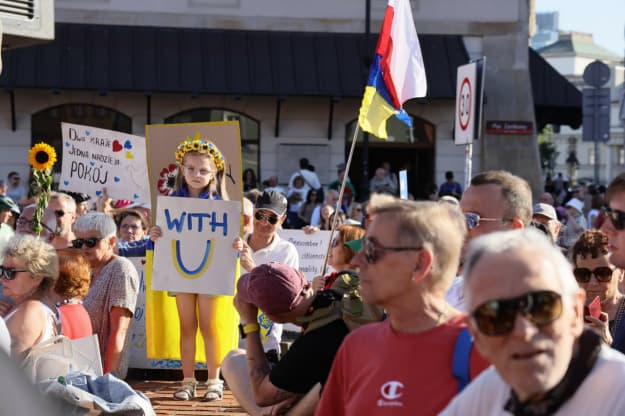
Demonstrators gathered in 22 Polish cities on Sunday, 9 August, to protest a rise in violence against Ukrainians, with most rallies beginning after 17:00, RMF24 reported.

The Sunday rallies followed a demonstration two days earlier, on Friday, 7 August, under the slogan "My Poland doesn't hit, insult, or incite," when organizers submitted a petition signed by more than 11,000 people to the prime minister's office and the Ministry of Interior and Administration, demanding decisive measures against violent attacks on Ukrainian citizens.

Nationwide campaign led by pro-democracy group

The Committee for the Defense of Democracy organized the nationwide campaign. Organizers said the demonstrations respond to increasingly frequent verbal and physical attacks on people targeted because of their origin, language, or appearance. The rallies were also meant to show solidarity with those experiencing violence and discrimination.

A slogan from Auschwitz

The phrase that became the demonstrations' slogan, "Don't be indifferent," was spoken by Marian Turski on 27 January 2020, during commemorations of the 75th anniversary of the liberation of the Auschwitz-Birkenau concentration camp. Turski, a former prisoner of the camp, used the speech to urge people not to accept cruel treatment of minorities, violations of human rights, and historical falsehoods.

Recent incidents

The number of attacks on Ukrainians in Poland has sharply increased in recent weeks. In Kraków, a 39-year-old man who had verbally insulted two people of Ukrainian nationality turned himself in at a police station on 8 August and was detained, according to reporting cited a day before the Sunday protests.

Separately, Tobiasz Bocheński, a member of the European Parliament and former candidate for mayor of Warsaw, said that if the Law and Justice party came to power, it would ensure the deportation of Ukrainian men of conscription age who are not legally employed in Poland. Poland's Ministry of Interior and Administration said such statements amount to populism.

  •  

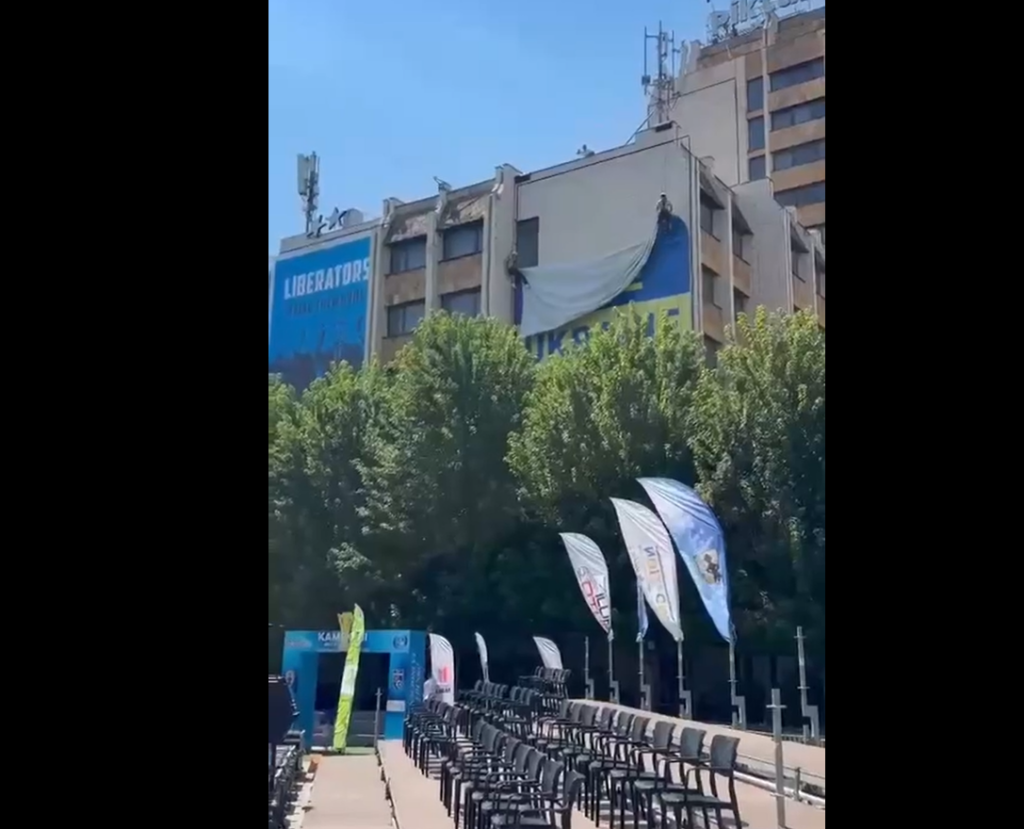
Zelenskyy’s Kosovo comments in Belgrade prompt flag removal in Prishtina

The flag came down from a building in central Prishtina on 9 August, Mayor Përparim Rama said in a Facebook post, after President Volodymyr Zelenskyy remarked on Kosovo during his visit to Serbia. Rama said "the state of Kosovo must be respected."

    "Our compassion and solidarity will always be on the side of peoples facing war, violence, and persecution," Rama wrote. "Because we, better than many others, know what it means to fight for freedom, dignity, and the right to exist as a state."

    What Zelenskyy said in Belgrade

    The exchange was reciprocal: Zelenskyy reaffirmed Ukraine's refusal to recognize Kosovo's unilateral declaration of independence, while Vučić reiterated Serbia's backing for Ukraine's territorial integrity, including Crimea.

    At the 8 August joint news conference in Belgrade, Zelenskyy said Ukraine's position had not shifted. "Our position on what you said, about the unilateral declaration of Kosovo's independence, remains unchanged," he said. "We have always emphasized this, and Ukraine's policy has not changed. Likewise, we are grateful to our partners for respecting Ukraine's territorial integrity and sovereignty, including, of course, Crimea's belonging to Ukraine. This position of Serbia is also unchanged, including in the UN General Assembly."

    Vučić's position

    Vučić, in turn, tied his support for Ukraine's territorial integrity to Serbia's own stance on Kosovo. "We support the UN Charter, UN resolutions, and that means the territorial integrity of all UN members, which means the territorial integrity of Ukraine as well," he said. "Likewise, we are very grateful to Ukraine for supporting the territorial integrity of the Republic of Serbia. And as far as we are concerned, we will continue this principled policy. There are no 'buts' about this. This is being stated very clearly and firmly now."

    Kosovo's recognition status

    Kosovo is a partially recognized state on the Balkan Peninsula, in the Kosovo and Metohija region, with a population of about 1.7 million, according to Suspilne. Its capital and largest city is Prishtina. Kosovo is recognized by 22 of the European Union's 27 member states. Ukraine does not recognize Kosovo's independence.

    •  

    Russia plans to make upcoming winter unsurvivable for Ukrainian civilians: Moscow is hitting Ukraine’s gas extraction sites to make heating impossible in cold

    Blaze at Ukrainian gas facility following Russian strike, 3 October, 2025

    Russia is trying to knock out Ukraine's gas production before the cold comes. Russia carried out massive strikes on the assets of the Naftogaz Group in eastern, western, and central Ukraine, the company reported.

    The strikes target Ukraine's ability to produce the gas it needs for winter. The Russians aim to inflict maximum damage on Ukrainian production and other critical infrastructure to make preparation for the heating season impossible, acting Naftogaz chairman Serhii Fedorenko said, calling the intensity of attacks on oil-and-gas infrastructure sharply higher in recent days.

    The strikes hit extraction across the country

    Russia targeted the sites where Ukraine pulls gas from the ground. On the night of 9 August, the extraction assets of Ukrnafta and a company drilling site came under massive attack, with Russian forces using dozens of strike drones against the extraction infrastructure.

    The damage stopped production. There is substantial destruction at the site; part of the equipment has been put out of commission, and the asset's operation has been halted. However, safety measures meant that workers at the attacked facilities were unhurt.

    Fuel stations and production sites were also hit

    The campaign extended to Naftogaz's retail and production network. On 7 and 8 August, seven UKRNAFTA filling complexes in Dnipropetrovsk, Zaporizhzhia, and Mykolaiv oblasts came under drone attack, and a worker at one station was injured and is in hospital receiving care.

    Central Ukraine was struck, too. On 8 August, Russia attacked Naftogaz production facilities in the central part of the country with jet-powered drones, and the facility suffered serious destruction, though staff were in shelter at the time of the strike.

    The target is the heating season

    The strikes match the warning from First Deputy Prime Minister and Energy Minister Denys Shmyhal, who has said Russia's aim this winter is to destroy the systems Ukrainians need to survive the cold, from power to water, Politico reported. Damaging gas production now, months before winter, is meant to leave Ukraine unable to heat itself when temperatures drop, turning the coming season into another front against civilians in Russia's war.

    •  

    Des mots sur un carnet à Paris [en]

    [en]

    C’est moche pour l’accessibilité, je sais.

    Transcription IA non vérifiée (22.07.2026):

    1er juillet 2026, 21h15

    Ça fait longtemps que je n’écris plus à la main. Encore plus longtemps que je n’écris plus à la main avec soin. Depuis mes TMS en 2002 ou 2003, ce n’est pas confortable. Ça crampe, ça tétanise. Je regarde un peu de haut ces exercices qui disent de faire à la main. Je tape à l’aveugle plus vite que mon ombre. Bref : se passe-t-il vraiment autre chose dans mon cerveau quand j’écris à la main ? Avec mes “petits problèmes linguistiques” depuis mon accident, je me pose la question, à nouveau, de l’utilité de ce genre d’exercice. Pourquoi pas. Écrire à la main, c’est me reconnecter à un rapport plus primitif de mon rapport à l’expression écrite : le seul que j’avais jusqu’au milieu de mon adolescence, quand j’ai appris à taper ; et le principal, jusqu’à la fin de mes études, justement autour de 2002-2003. C’est moins rapide et moins confortable, mais en ces temps post-commotion, je me réconcilie — tant bien que mal — avec le temps lent.

    Je suis à Paris. Une semaine pour deux journées de formation à l’IGB. La dernière était aujourd’hui. Mon cerveau est cuit [?], et c’était fascinant et ultra riche, comme toujours à l’IGB. C’est le genre de formation où je prends des notes à la main, relativement illisibles, parce que les schémas de boucles interactionnelles entre les différents protagonistes des situations abordées, c’est quand même assez galère à faire à l’ordi. Avec ma logo la semaine dernière, j’ai évoqué ce que je ressens un peu comme une récalcitrance à l’effort cognitif, parfois. Il y a des articles un peu pointus que je veux lire, mais je rechigne à la perspective de cet effort. Un peu peur d’en faire trop, aussi, bien sûr. On s’est dit que ce serait peut-être un exercice utile de m’y mettre, de façon contrôlée : limité dans le temps, lentement, et — sa suggestion — en surlignant les points clés ou prenant des notes. Ça m’a parlé — et travaillé.

    J’ai passé une décennie de ma vie à lire en prenant des notes — quand j’étais aux études. Je prenais aussi des notes de livres que je lisais “en plus”, par intérêt. Prendre des notes m’aide à comprendre. Quand j’écoute aussi, d’ailleurs. C’est ce qui m’a amenée à live-bloguer, en fait. Je peinais à rester concentrée sur des conférences (le TDAH était très loin d’être sur mon radar !) et j’ai fait l’expérience, un peu par hasard, qu’en prenant des notes ça allait beaucoup mieux. Pas très étonnant en fait, après avoir fait ça quasi quotidiennement sur les bancs de l’uni.

    Alors oui, si on se dit que je dois peut-être “ré-entraîner” mon cerveau à certaines choses, lire en prenant des notes pourrait être une pratique intéressante à revisiter.

    Ce qui est marrant, c’est que je n’ai pas arrêté de lire des choses “difficiles”, après mes études. Mais j’ai lâché la discipline de la prise de notes, en partie je pense car elle n’était plus forcément nécessaire en vue des raisons par lesquelles je lisais, aussi un peu en partie parce que c’est un effort en plus, et parce qu’avec les supports numériques dans lesquels on peut “rechercher”, les notes semblent un peu moins utiles — en tant que résumé permettant d’accéder au contenu.

    Mais le travail cognitif de tri de l’information, de synthèse, d’organisation des idées, il se produit. Et au fil de toutes ces dernières années, j’ai parfois senti, en toile de fond, que je pourrais perdre un peu en rigueur, que les choses que j’avais lues et comprises finissaient par manquer de précision, qu’avec le temps il me manquait quelques bouts — rien de très grave — et qu’évidemment je n’allais que rarement replonger dans la source (si tant est que j’étais capable de la retrouver, malgré les miracles de la loupe et des images…)

    Alors oui, écrire comme exercice, prendre des notes, pourquoi pas. Je me dis que je pourrais mettre au propre mes notes IGB par exemple. Il y a quelques articles écrits par un psychologue français sur la question de “l’énergie” dans le TDAH qui m’intéressent et qui méritent une lecture attentive, d’autant plus que je suis aux prises avec ces questions de “gestion de l’énergie” de façon criante depuis mon accident — je suis d’ailleurs au milieu d’un programme en ergothérapie sur la gestion.

    “Journaler”, c’est aussi une pratique que je souhaite reprendre. Ma mémoire épisodique est souvent un peu confuse, et c’est pire depuis mon accident. Prendre quelques notes en fin de journée m’aide à ne pas me sentir en dérive temporelle. Il y a dix-huit mois, quand j’ai pris deux semaines de vacances pour réaménager mon chez-moi, j’ai eu envie de me mettre au scrapbooking. Peut-être qu’il y a une idée à creuser là. Écrire à la main, c’est peut-être aussi quelque chose qui pourrait être pour moi une forme de “repos”. Le rythme plus lent, la linéarité, je sens en effet que c’est différent de taper ou dicter sur l’ordi ou le tél. Chaque mot écrit est écrit.

    On verra.

    J’étais partie pour faire une page. J’en ai fait cinq. J’arrête là pour aujourd’hui.

    •  
    ❌