Vue lecture

As mathematicians grapple with AI, divisions are multiplying

This story first appeared as the cover story in Issue 4 of The Atlas, a new global publication by Coda Story and The Continent. Sign up to the newspaper here.

In late July, at the International Congress of Mathematicians (ICM) in Philadelphia, the mathematician Jacob Tsimerman was awarded one of four Fields Medals – the highest honour in mathematics.

A few hours later, Tsimerman announced that he was joining OpenAI.

Tsimerman’s departure from theoretical mathematics, while at the absolute peak of his powers, highlights the fault line in a debate that is upending the normally quiet world of higher mathematics. “What a dick move,” said one mathematics professor, speaking to The Atlas off the record.

Tsimerman, who has written extensively about his fear of “omnicidal futures involving artificial intelligence” – a fear that AI could wipe out humanity, closely associated with the AI “doomer” community – has said he will work on OpenAI’s safety team.

Tsimerman and OpenAI did not respond to a request for comment.

In recent months, OpenAI has announced proofs of various longstanding mathematical problems, solved with one of the company’s latest large language models. Other companies have also made advancements: RedNote, a Chinese AI model, obtained a perfect score at the International Mathematical Olympiad in Shanghai in July.

Human mathematicians, at all levels of the profession, are reeling from the implications. Tim Gowers, a professor at the University of Cambridge who helped to verify one of OpenAI’s proofs, has written that even if AI models fail to progress further, “we have still probably entered an era where it will become very difficult for humans to compete with AI at solving mathematical problems”.

This is a startling assessment – and a marketing coup for the likes of OpenAI.

“Mathematicians actually have a special role in this,” said Joshua Grochow, an associate professor in Computer Science and (by courtesy)Mathematics at the University of Colorado Boulder. “The AI companies’ PR pitch is essentially to say, ‘Look, we have solved math. the intellectually hardest thing ever, therefore we can solve everything.’ ”

LLMs have not solved math – far from it. Nonetheless, Grochow added, recently some capabilities have improved. “They are legitimately able to produce real math, new math that they had not produced before. So you can’t deny that utility. You can deny the extent of that utility, but you can’t say it’s all BS.”

Miek Messerschmidt, a senior lecturer in mathematics at the University of the Witwatersrand in Johannesburg, recently used Anthropic’s Claude to take a crack at a problem that had stumped him. Claude solved it within 30 minutes. “How did I feel? You mean emotionally? I was relieved, because I didn’t have to go down this dead end any more. But I was also disconcerted by what this entity could do in such a short amount of time.”
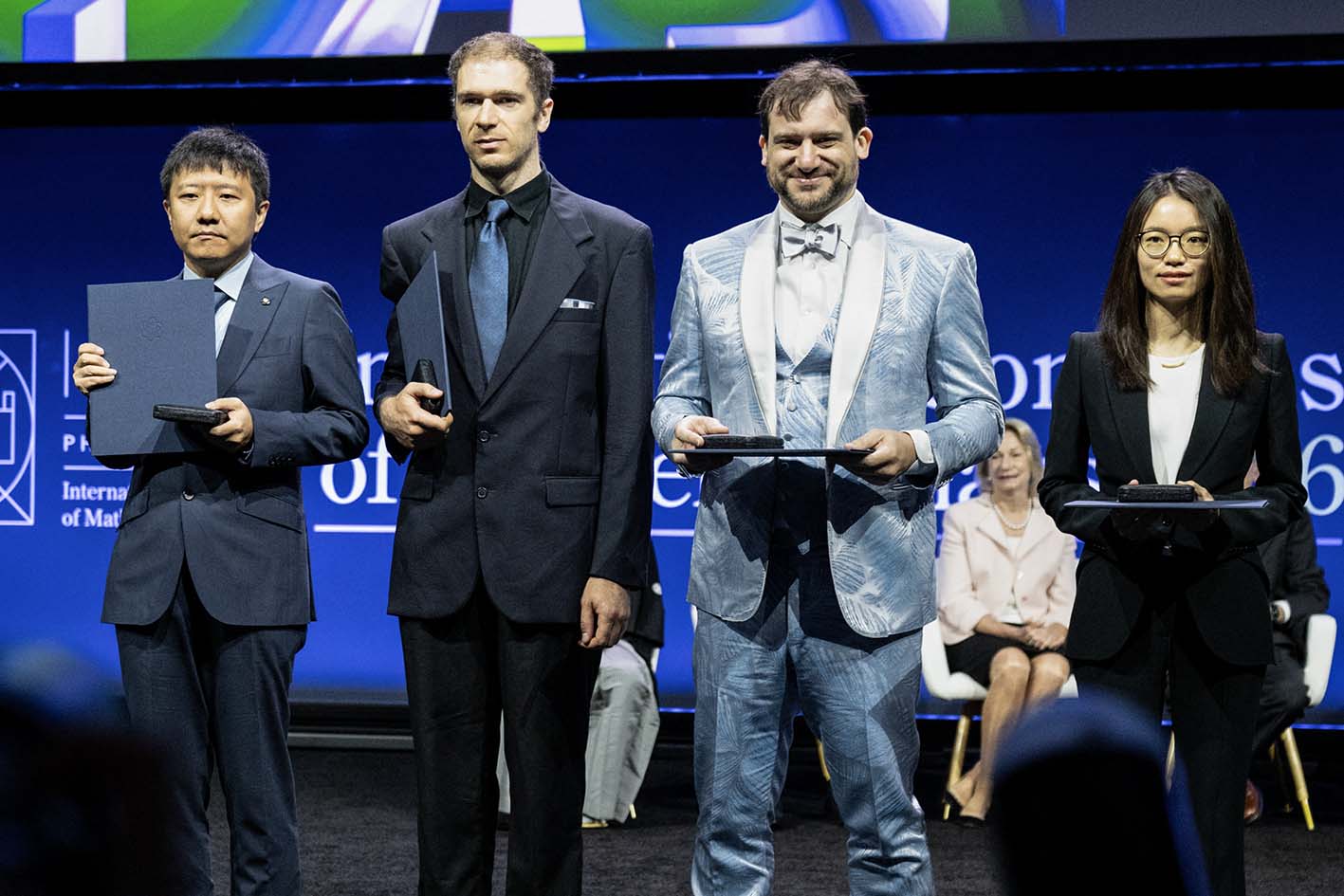
This year’s Fields medallists: mathematicians Yu Deng (China), John Pardon (US), Jacob Tsimerman (Canada) and Hong Wang (China). Photo: Erin Blewett / AFP.

NEW VARIABLES

Mathematics has been disrupted by technological leaps before. The abacus. The mechanical calculator. The blackboard, even, which played an instrumental role in standardising training and mathematical notation (“It’s hard to research, because most of what’s written on blackboards doesn’t stay there very long,” said mathematics historian Michael Barany).

But AI is a different kind of disruption. Where previous advances helped mathematicians expand the frontiers of their knowledge, large language models threaten the livelihoods, and purpose, of mathematicians themselves.

“Our place in society at developing new ideas has been quite unthreatened for quite some time,” said Tim Chartier, a Professor in the Department of Mathematics and Computer Science at Davidson College. “For a long time, the frontier of mathematics could only be expired by the mathematicians themselves. There were no tools that could push into that boundary, except the research mathematician…At this current time, it’s not like we don’t need research mathematicians – but the landscape has changed so quickly, it’s hard to know what that will look like a year from now, two years from now.”

This matters for everyone: for thousands of years, mathematics has been considered to be the foundation of scientific knowledge. There is no physics without mathematics. No astronomy without mathematics. And there is no computer science – or AI – without mathematics. What happens if there are cracks in the foundation?

“I think that LLMs pose an existential threat to the mathematical community,” wrote Tasmin Chu, a PhD student at the California Institute of Technology, in an essay published on 2 August – the day after OpenAI released a set of ten new mathematical results, resolving or making progress on various problems.

“This is a polemic, not a press release,” Chu continued. “I know that others feel the same way; I have spent today crashing out and learning that top mathematicians I know are crashing out.”

Some of what mathematicians are worried about is the same as what everyone else is worried about: that AI will take their jobs; that AI companies have absorbed everyone’s work, and are reproducing it without attribution or compensation; that students aren’t learning properly any more; and that there won’t be jobs for them when they graduate.

But some worries are more specific to the field. Like the fear that, if mathematics becomes too reliant on particular AI models, then AI companies will have the power to restrict access to a select few – or make it prohibitively expensive. That promising young mathematicians, instead of turning to research, will use their talents instead to refine proprietary algorithms, which may or may not be used for the common good. That there will be no one left to understand, let alone vouch for, the mathematics produced by the machines. That objective truth, or anything close to it, is going to be much harder to prove – a fear shared with journalists, incidentally, who find it increasingly difficult to verify whether a photograph is real or fake.
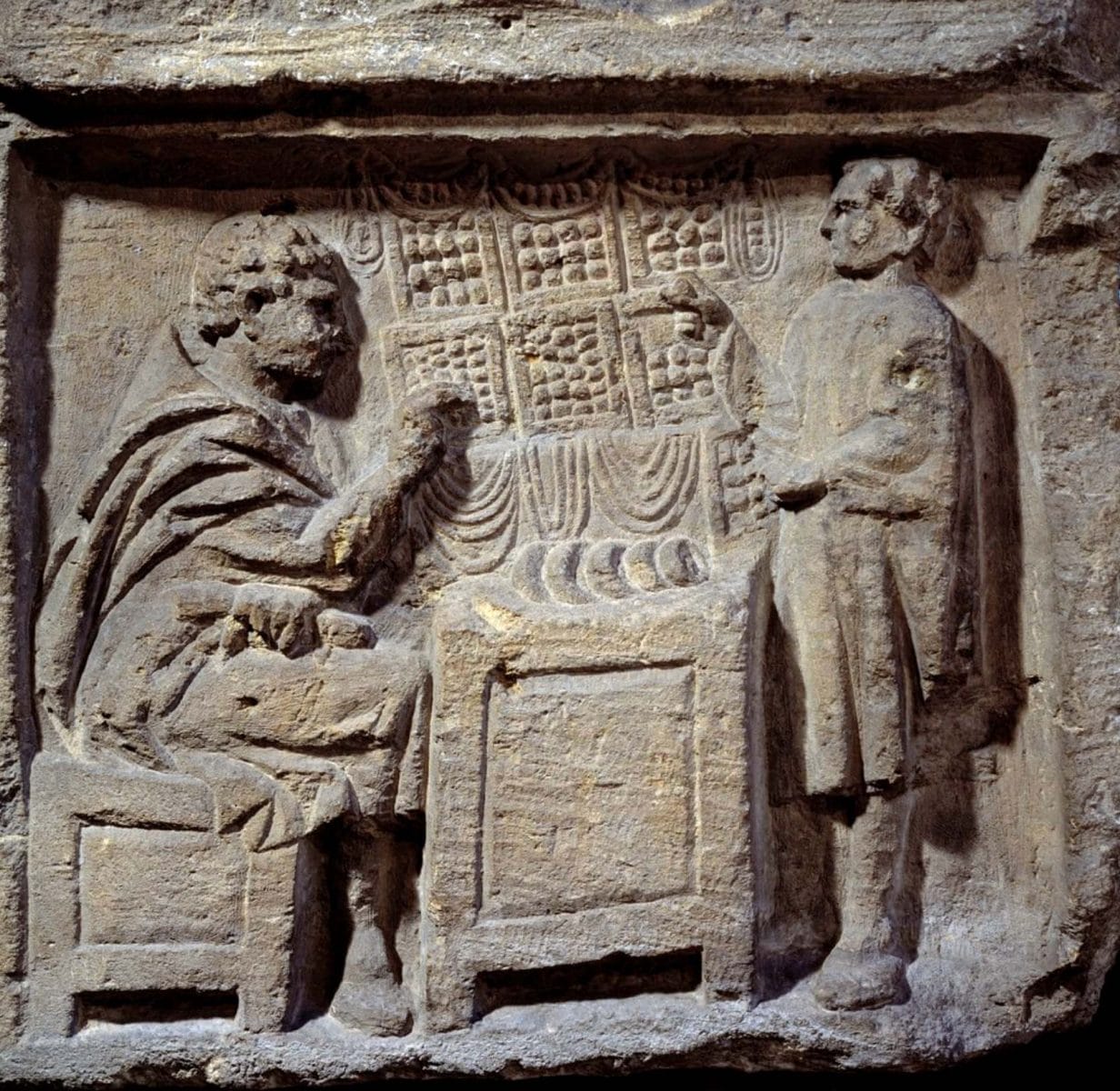
2nd Century relief of a merchant using an abacus. Photo: Musée de La Cour d’Or - Metz Métropole.

MATHEMATICIAN IN THE LOOP

After speaking with more than a dozen leading mathematicians from around the world, The Atlas can confirm that Chu is not alone with her fears: it’s all anyone is talking about. The crisis is existential – and mathematicians are looking to one man in particular to guide them through it.

There are no working mathematicians who are truly famous. The closest anyone gets is Terence Tao, a professor at UCLA, who is often referred to as the world’s greatest living mathematician. A prodigy, Tao skipped five grades of school, receiving his masters degree at age 16. By 21, he had earned a PhD from Princeton, and was awarded the Fields Medal just ten years later, in 2006, for his pioneering work with Ben Green on prime number theory.

But what sets Tao apart, in a field infamously incomprehensible to outsiders, is his ability to communicate to both mathematicians and laypeople alike. This has made him a de facto spokesperson for the mathematics community – and extremely influential in setting its norms. “From all accounts he’s a lovely man,” said one researcher, speaking anonymously.

“But the social pressure to agree with Terry Tao is really strong.”

On July 24, the day after Jacob Tsimerman joined OpenAI, Tao gave a public lecture at the ICM titled “Mathematics in the Age of AI”. In it, he presents his “working hypothesis”: that AI tools for mathematics, which he already uses in his own research, will keep getting better. This will allow for collaboration on a vastly greater scale than has ever been possible before, Tao argues, and speed up the pace of research – revealing new, previously unimagined frontiers.

But it will also change, fundamentally, the role of human mathematicians. There will be little point in problem-solving – the computers will handle that. But the humans will still have to do the really hard work: understanding why AI-generated proofs are correct, and explaining this to others. The sooner they embrace this and plan accordingly, Tao concludes, the better.

The Atlas reached out to Terence Tao to request an interview. His human assistant, UCLA media relations officer Holly Ober, declined the request, making a referral instead to a “living document” which is maintained by Tao’s Claude AI assistant, on his website. This document synthesises Tao’s current thinking on AI, based on his public writings and talks, even “interviewing” Tao with follow-up questions.

As per his AI assistant, Tao believes that the topic of AI in mathematics is too important to be left to just a small number of spokespeople – and that his own “influence on this discussion should diminish as the rest of the community steps up.”
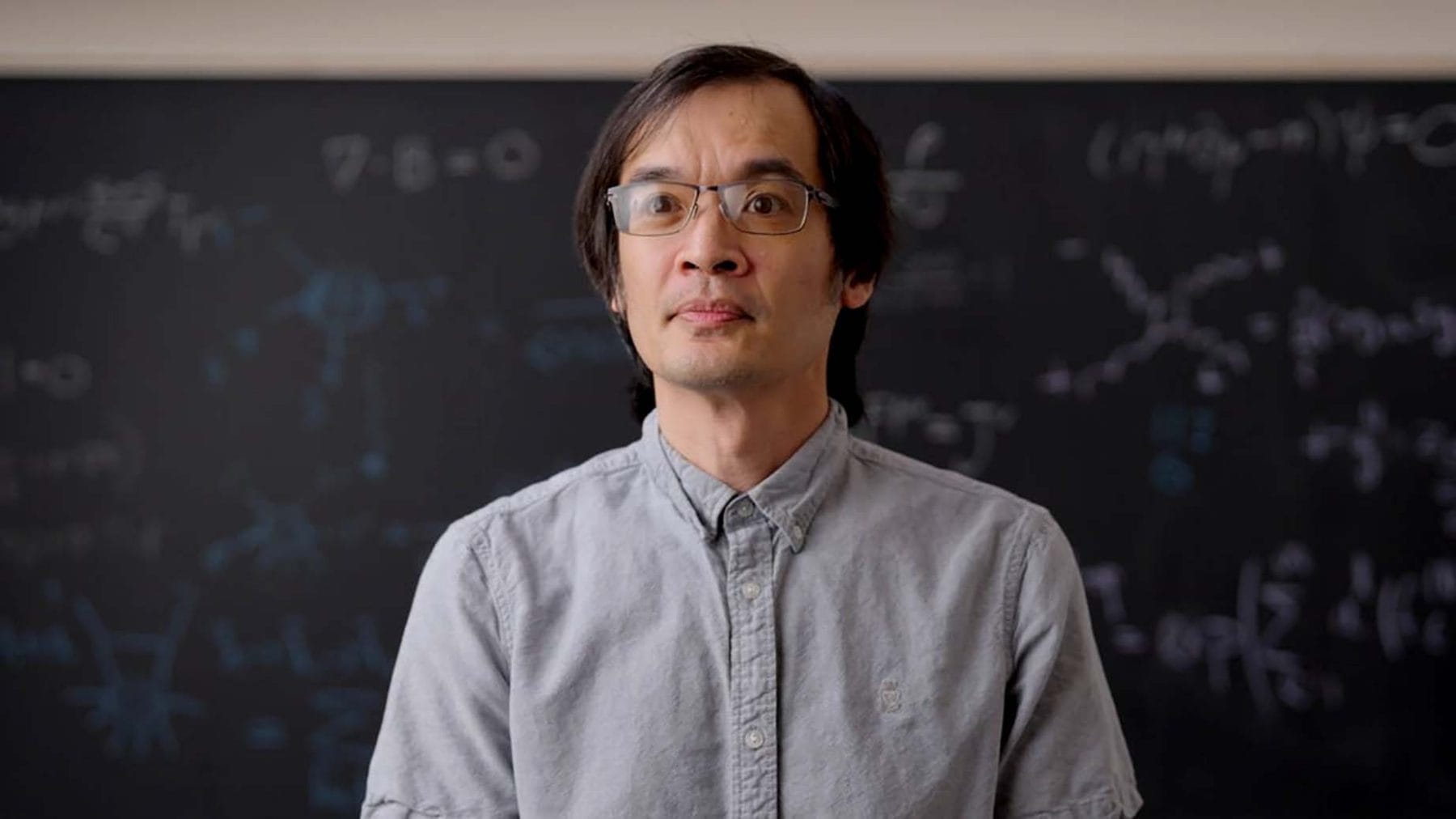
Terence Tao, often referred to as the world’s greatest living mathematician. Photo: OpenAI Academy.

AN UNSOLVED EQUATION

Not everyone believes in the inevitability of AI defining the future of mathematics. According to several sources, both organisers and funders were disappointed with the turnout at the ICM in Philadelphia. Despite the gravity of the occasion, the congress was not at capacity.

Ila Varma and Tarik Aougab, associate professors at the University of Toronto and Haverford College respectively, may have had something to do with that. In March, they launched a petition to boycott the ICM due to the ongoing war in Iran, increasing authoritarianism in the United States and the risks faced by visiting academics – if they were even allowed in. “AI companies were invited, but most African mathematicians who tried to attend couldn’t get visas,” Varma said.

More than 2,600 people signed the petition. For Varma, this is evidence that mathematicians may yet use their status to resist the influence – and the cash – of the big AI companies.

“There’s an idea that the positionality of mathematics in society is to decide who’s smart, who’s worthy of the most lucrative career opportunities and the privileges that go along with it. And now we are being asked to take this technology that is likely to be extremely unhealthy for users, that’s bad for the environment, this thing built on unethical labour, and our discipline is being used against many of our wishes to tell society that this thing is intelligent, and that you should let it do your thinking for you.”

Michael Harris, a professor at the Institut de Mathématiques de Jussieu in Paris, was at the ICM in Philadelphia. “The talks I attended on AI, starting with Tao’s public lecture, took pains to insist on the need for human mathematicians to make sense of anything produced in the name of the discipline, by machines or by humans,” he said. “There is a growing resistance to any use of AI whatsoever in mathematics, especially among young people, and this will become evident over the next few months.”

One of the clearest voices of dissent belongs to Max Weinreich, Assistant Professor of Mathematics at the City University of New York.

In an essay published earlier this month, Weinreich makes the case against what he describes as “artificial mathematics”: “Mathematicians do not need to use AI, nor should we use AI; soon, I argue, you will not want to have your name associated with AI. Instead, we should use our intellectual authority to oppose its development.”

His opposition is about more than mathematics, he told The Atlas. In his view, the environmental and financial implications of the AI boom pose major societal risks – and mathematicians, given their privileged position, are one of the few groups of people who can do anything about it.

As John Fletcher, a theoretical physicist and mathematician, observed: “There is a lot of power in being perceived as the smartest people in the world.”

Po-Shen Loh, a professor at Carnegie Mellon and former coach of the US International Mathematical Olympiad team, backs mathematicians to figure it out – by treating it like a maths problem. “AI is making mathematicians engage with the real world. They are smart enough to realise they have an existential crisis. They’re quickly racing down to discover all the dead ends, to see what works and what doesn’t.”

And when they figure it out, maybe they’ll let the rest of us know. 

A version of this story, edited for length, first appeared in The Atlas newspaper.  Additional reporting by: Shougat Dasgupta, Masho Lomashvilli, Irina Matchavariani.
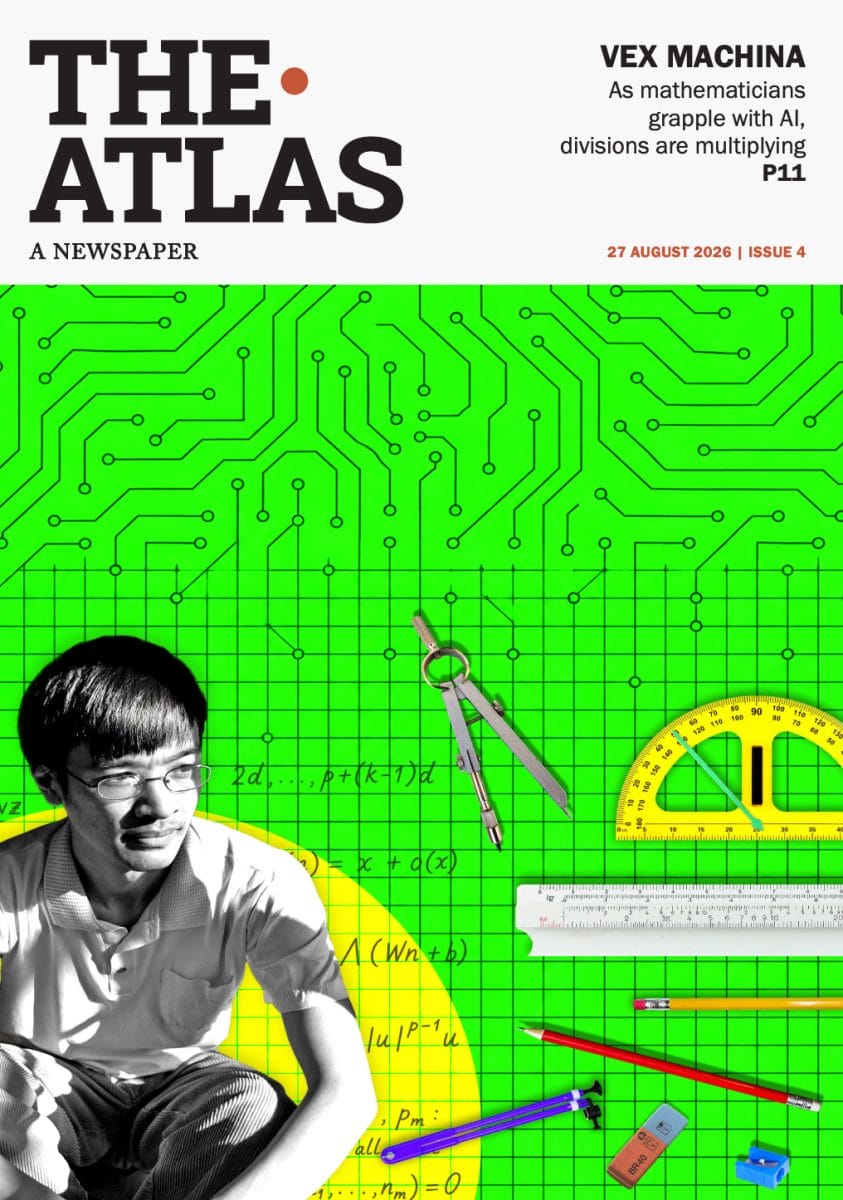
The Atlas - Issue #4 - 27 August 2026

The post As mathematicians grapple with AI, divisions are multiplying appeared first on Coda Story.

  •  

Darkness is losing its war with the light

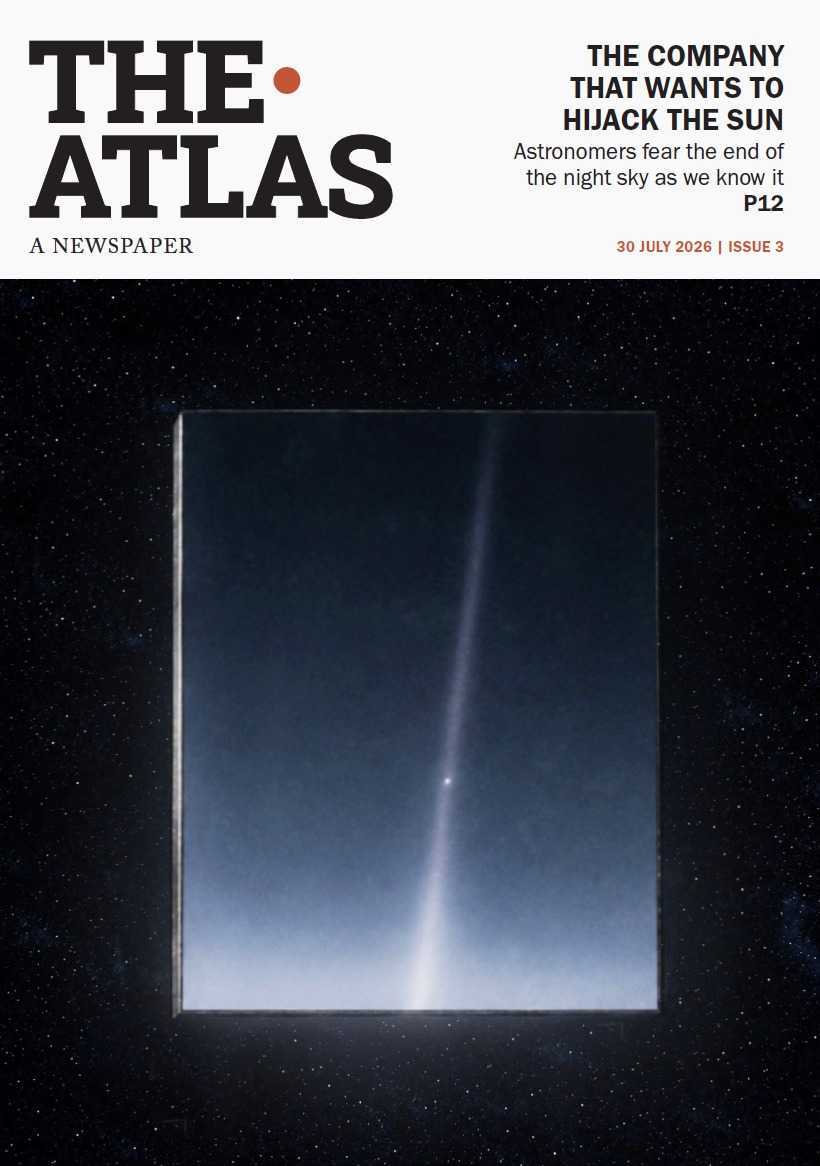
Astronomy, our window into the rest of the universe, happens in the dark. Planets, stars and galaxies – all the mysteries of the cosmos – only reveal themselves at night. But the night sky may be getting much brighter, thanks to an American company with a plan to conquer darkness itself by sending 50,000 giant mirrors into space.

What you are reading first appeared as a cover story for The Atlas, our new global publication with The Continent. Sign up here to get the next edition delivered to your inbox on August 27.

Astronomers are panicking.

It is an “existential threat” to optical astronomy, says the European Southern Observatory. A “disastrous” idea that will “permanently scar” the night sky, according to the Royal Astronomical Society. The American Astronomical Society told Nature it “would probably mean the end of ground-based astronomy, or optical astronomy, at least.”

Sthabile Kolwa agrees. “It will take away a very crucial part of our civilization,” she tells The Atlas. Kolwa, a senior lecturer in astronomy at the University of South Africa, studies the life cycles of galaxies, but today her concerns are more immediate. “It might come to this, that we just have to find them in the parking lot and say, ‘Hey, what are you guys doing? You’re going to ruin science for us.’ ”

Like Uber, but for the sun

The parking lot in question is in Hawthorne, California, outside the headquarters of Reflect Orbital. They call themselves The Sunlight Company. The start-up is celebrating: Earlier this month, the United States Federal Communications Commission (FCC) approved the launch of Eärendil-1, likely in a few months time.

This satellite, named for a character in JRR Tolkien’s The Silmarillion, will unfurl an 18m x 18m mirror in low Earth orbit. It’s designed to reflect sunlight onto the dark side of the earth, lighting a 5km2 patch of land with the strength of four full moons.

It is a proof of concept.

By 2035, Reflect Orbital wants 50,000 of its mirrors in space, delivering illumination “comparable to daylight” on demand to paying customers (“sunlight is the new oil,” says chief executive Ben Nowack). The company says this will allow solar panels to generate clean energy overnight; provide “safer, evenly-lit streets” to cities that pay for it; and keep construction sites and farms working 24/7.

There will be an app, of course, offering “sunlight as a service” – lighting up the night will be as easy as ordering an Uber.

Clean, renewable energy is at the heart of the company’s vision, a spokesperson told The Atlas in a statement. Reflect Orbital declined to respond to specific queries and said it is in constant dialogue with astronomers, scientists and environmental researchers to mitigate the impact of the light pollution: “We are able to dim the brightness of the service and turn it off at any stage. We control where the light shines when serving an authorised customer. Most people and most places will never see this light. It is precise, targeted and customers will require permits to receive the service.”

Circadian arrhythmia

A new research paper, published in May, challenges Reflect Orbital’s position. Its author, the European Southern Observatory’s Oliver Hainault, concluded that the company’s 50,000 satellites would increase the background brightness of the sky by 300% – even when their mirrors are pointed somewhere else. This, coupled with a proposal from Elon Musk’s SpaceX to build vast data centres in space, would go “beyond the limit” of what astronomy can withstand.

What that means, in practice, is that the images from ground-based telescopes will be dramatically less useful, marred by streaks of light from passing satellites. The most distant light sources won’t be visible at all.

This will obscure evidence of other galaxies, hinder research into black holes and other cosmic phenomena, and potentially prevent early warnings of asteroid approaches. Cutting-edge astronomy will only be possible from space-based telescopes like the James Webb and the Hubble – access to which is already massively oversubscribed, and subject to political interference.

The night sky will look different to the naked eye, too. “The next time you’re away from urban light pollution, spend some time outdoors after dark and enjoy the view of the Milky Way and the constellations that have inspired awe since humankind woke to consciousness. Chances are those views are not here to stay forever,” wrote journalist Tereza Pultarova for Space.com.

Anna Jibladze

Running out of space

The night sky is already a lot brighter than it was 150 years ago, when light bulbs started to become commonplace. According to Dark Sky International, a US-based nonprofit that advocates against light pollution, 80% of Earth’s human population already lives under some form of sky glow, most of which is generated on land. This has forced astronomers to seek out “dark sky places,” like the Atacama Desert in Chile or the Upper Karoo in South Africa, for their telescopes.

Humans can adapt to less darkness. But it is much harder for animals and ecosystems that have evolved alongside predictable rhythms of day and night. Nocturnal predators lose the ability to hunt; sea turtle babies can’t find their way to the sea; migratory birds are thrown hopelessly off course; and moths expend all their energy helplessly chasing artificial light sources.

“It’s almost like we are on a mission to obliterate natural darkness from earth,” said Ruskin Hartley, Dark Sky’s chief executive. “And now rather than do it street by street and bulb by bulb, let’s do it from space.”

Space is, in theory, protected by the Outer Space Treaty, a 1967 agreement signed by 110 countries, including all the major space superpowers. It states that “space is the province of all mankind." But that’s not what’s actually happening, Hartley argues. “In the US, it’s the most wealthy, most powerful individuals who are gobbling up as much of that orbital space as they can before someone else can get that opportunity” – with China, Russia and Europe all scrambling too for a greater presence in low Earth orbit.

“Who gets to choose that we light up the night sky? Who gets to make that decision?” Ruskin asks. In the US, it is the FCC’s job to decide what satellites are allowed in space. But it has said that assessing the impact of light pollution or environmental damage is not within its remit. Instead, it wants to slash regulation so American companies can take advantage of the “space industrial revolution.”

And Reflect Orbital has rich and powerful backers. Earlier this year, it secured a $1.5-million contract from the US air force, hinting at possible military applications for its mirrors. Last year, it raised $20-million from three venture capital firms, including Sequoia Capital, one of the biggest investors in Silicon Valley. Sequoia also owns a multibillion-dollar stake in SpaceX, which has its own plans for low earth orbit.

There are already more than 10,000 Starlink satellites up there, giving Elon Musk unprecedented influence over global communications. The company wants to launch one million more satellites over the next few years to build a network of space-based data centres. In addition to the light pollution, astronomers worry the potential for collisions will increase dramatically, as will risks to the ozone layer.

A brighter future

On her blog Higher Dimensions, the astronomy professor Janna Levin contemplates our brighter future. “It is quite possible that the hot glow of the swarm of data satellites will saturate the night, washing out the stars from our perspective on Earth. We’ll look up into the sky and instead of Zeus transformed into a swan outlined in a constellation of a few stars, the machine gods will literally loom above us, glowing with radiant heat, making declarations, predicting the weather, forecasting then determining our fate.”

Kolwa, the South African astronomy lecturer, offers a different metaphor: that of empires “colonizing low Earth orbit.” This was an ambition of one of the most infamous imperialists of them all, Cecil John Rhodes, who said that he looked up at the stars and thought: “I would annex the planets if I could; I often think of that. It makes me sad to see them so clear and yet so far.”

But it hasn’t been colonized just yet.

“I’m still trying to figure out what we can do, what responsibility we have as scientists,” says Kolwa. “How could we engage our communities to stand up to these corporations and say no? We must keep our night skies dark, as dark as possible.”

The post Darkness is losing its war with the light appeared first on Coda Story.

  •  

The AI-powered ‘forever wars’ start now

Between them, the United States and Israel struck more than 2,000 targets within the first 24 hours of their war with Iran.

For even the largest militaries, it is an almost impossible task to identify, select and then precisely locate such a high volume of targets. But the U.S. military had some help. Claude, the “next generation AI assistant” built by Anthropic, was used in the planning of ‘Operation Epic Fury’. This, even though the Department of War recently labeled Anthropic a “supply chain risk”.

Anthropic is one of the world’s leading AI companies. Together with Palantir, another Big Tech company, it has been working since 2024 with the Pentagon to embed its systems in military decision-making – creating what is arguably the operating platform of present-day U.S. warfare and intelligence. Even though secretary of defense Pete Hegseth said the company “delivered a master class in arrogance and betrayal” and that the government would “cease all use of Anthropic's technology,” the company is too integrated into modern U.S. warfare for it not to be essential to the U.S. attack on Iran. The question might be not whether companies like Anthropic can ringfence their tech but whether the Pentagon might just commandeer it. 

Craig Jones, an academic who studies automated kill chains at the University of Newcastle, has told reporters that “the AI machine is making recommendations for what to target, which is actually much quicker in some ways than the speed of thought.” Similar AI systems have been used by Israel to coordinate its bombing campaign in Gaza, which is among the most destructive in human history. 

Among the first hits in the United States and Israel’s aerial bombardment of Iran was the Shajarah Tayyebeh primary school for girls, in the southern town of Minab. It was a Saturday morning, and school was in session. According to Iranian state media, at least 165 people were killed, mostly young girls between the ages of seven and 12. Another 96 were severely injured. Eyewitness and open source intelligence reports corroborate the claims of mass civilian casualties. Both Iran and Israel have denied responsibility. The United States has said it is “looking into” allegations that the school was destroyed by one of its missiles. Maybe, given the volume of the bombardment, they’ve lost track. 

It is too soon to know why the school was targeted – or whether it was an error. Either way, the U.S. military’s reliance on AI raises difficult questions.

AIs get things wrong all the time. Maybe it’s an extra finger in an AI-generated image, or a ‘hallucinated’ reference in a research report. Or, maybe, an algorithm sends a missile to the wrong address. That’s why Anthropic CEO Dario Amodei has said that weapons “that take humans out of the loop entirely and automate selecting and engaging targets” are simply not reliable enough. That position — along with Anthropic’s refusal to allow Claude to be used for mass domestic surveillance (although they are just fine with foreign surveillance) — led to the Pentagon cancelling a $200-million contract with the company on Friday, the day before the attacks on Iran began. The Department of War immediately signed a new deal, minus any ethical guardrails, with OpenAI.

Anthropic’s confrontation with the Pentagon has burnished its reputation as an “ethical” AI company. But it may have found its ethical backbone too late. Critics argue that even within Anthropic’s “red lines”, there is enormous potential for abuse, while a “human in the loop” does not necessarily prevent mistakes — raising questions about who, exactly, is responsible when these mistakes result in fatalities. Francesca Albanese, the United Nations special rapporteur for Palestine, accused Amazon, Google and Microsoft in a 2025 of being “complicit in genocide” for providing cloud storage systems to the Israeli military. Anthropic’s integration into the U.S. military has been much deeper.

While Israel and the U.S. are waging an AI-powered war, Iran is responding with a technological revolution of its own. The Islamic Republic has pioneered the production of low-cost one-way attack drones, most notably the Shahed-136, which costs just $34,000 to produce and as much as $4 million to shoot down. These are battle-tested: Russia has launched an estimated 57,000 Shahed-type drones in its war against Ukraine. Despite U.S. reliance on its own high-tech AI-powered systems, an American version of the Shahed also made its debut, alongside Claude, in the attack on Iran. 

In response, Iran has aimed more than 1000 drones at neighboring Gulf states since the war broke out on Saturday. Hundreds have been shot down, but even the most sophisticated air defences struggle with this sheer volume, and dozens have struck their targets, threatening to prolong this war and cause more damage to U.S. allies than anticipated. It is significant that these targets included at least three Amazon data centers in Dubai and Bahrain. Just last month, Amazon announced that it was making Anthropic’s Claude available to its Middle Eastern customers. Claude experienced two global outages this week — it is not clear if these were related to the data center attacks. 

Tech evangelists promise that artificial intelligence will, one day, cure cancer, end poverty and greatly increase our quality of life. But the new technology’s most obvious impact has been on warfare. For those with access to them, AI systems like Claude make it dramatically easier to bomb hundreds of targets at the same time — and much harder to figure out who is accountable when something goes wrong. On Truth Social, Donald Trump — who has promised to stop wars, not start them — posted approvingly that technology and munitions now mean Wars “can be fought ‘forever,’ and very successfully.” 

As the bombing of Iran continues, we are not far from a time when AI not only parses data to select targets, it actually chooses when to pull the trigger. And advanced AI models have far fewer qualms, for instance, about deploying nuclear weapons than humans faced with similar scenarios. One day, when — if — war crimes investigators are able to pin down exactly who is responsible for killing dozens of young girls in Minab, tech bosses may find themselves implicated alongside military and political leaders. “The AI did it” can’t be their defense.


A version of this story was published in this week’s Coda Currents newsletter. Sign up here.

The post The AI-powered ‘forever wars’ start now appeared first on Coda Story.

  •  
❌