❌

Vue lecture

Russia kills 30 in strike on two passenger buses in Kramatorsk

russia kills 33 strike two passenger buses kramatorsk · post aftermath shelling 8 2026 illia andreiev / ukraine news ukrainian reports

Russian forces struck the eastern Ukrainian city of Kramatorsk on the morning of 8 October, hitting two route buses carrying residents and killing dozens of civilians. The Donetsk Oblast prosecutor's office opened a war-crimes investigation.

Russia has turned everyday movement in frontline Donetsk Oblast into a lethal risk, striking city buses, ambulances, and cars in places its army has not been able to capture.

A route bus run turned deadly

The attack came at around 10:00, catching two route buses in the impact zone. The prosecutor's office said the attackers likely used a UMPB D-30SN. HUR, Ukraine's military intelligence, describes it as a guided glide bomb that can fly up to 100 km when released from an altitude of 12–15 km and carries a warhead equal to a FAB-250 aerial bomb.

30 people were killed and 18 injured after a Russian bomb hit two passenger buses carrying civilians in Kramatorsk, Donetsk Oblast.

The buses caught fire, and the force of the attack also damaged nearby homes and cars. Some victims were so badly burned that police had to recover… pic.twitter.com/FqLdM0HN1B

— Euromaidan Press (@EuromaidanPress) October 8, 2026

The toll rose through the day, from 12 dead in the first reports to 30 killed and 20 wounded by 14:55, Donetsk Oblast head Vadym Filashkin said. Across Donetsk Oblast, Russian attacks killed 33 people that day, including the 30 in Kramatorsk and three in nearby Bilenke, the State Emergency Service said. Ukrainian President Volodymyr Zelenskyy said the strike would not go unanswered.

Buses pulled off the roads

Filashkin ordered the Kramatorsk and Sloviansk city military administrations to suspend public transport, citing the sharp deterioration in security. Buses had become an attractive target for Russian forces, he said, and the authorities could not risk the lives of passengers and drivers. He also urged everyone still in Donetsk Oblast to leave for safer parts of Ukraine. Kramatorsk is a frequent target of Russian attacks. Russia had not commented on the strike as of publication.

Aftermath of the shelling of Kramatorsk on 8 October 2026
Aftermath of the shelling of Kramatorsk on 8 October 2026. Photo: Illia Andreiev/Kramatorsk Post

The city has been under daily fire. On 5 October, Russian FPV drones hit ambulances and an apartment block in Kramatorsk, killing a woman and wounding four, the prosecutor's office reported. Over the previous day, Russian forces shelled Donetsk Oblast settlements 31 times and 256 people left the front line, Filashkin said.

  •  

Ukraine’s civilian casualties 55% higher in first eight months than in the same period in 2025, UN says

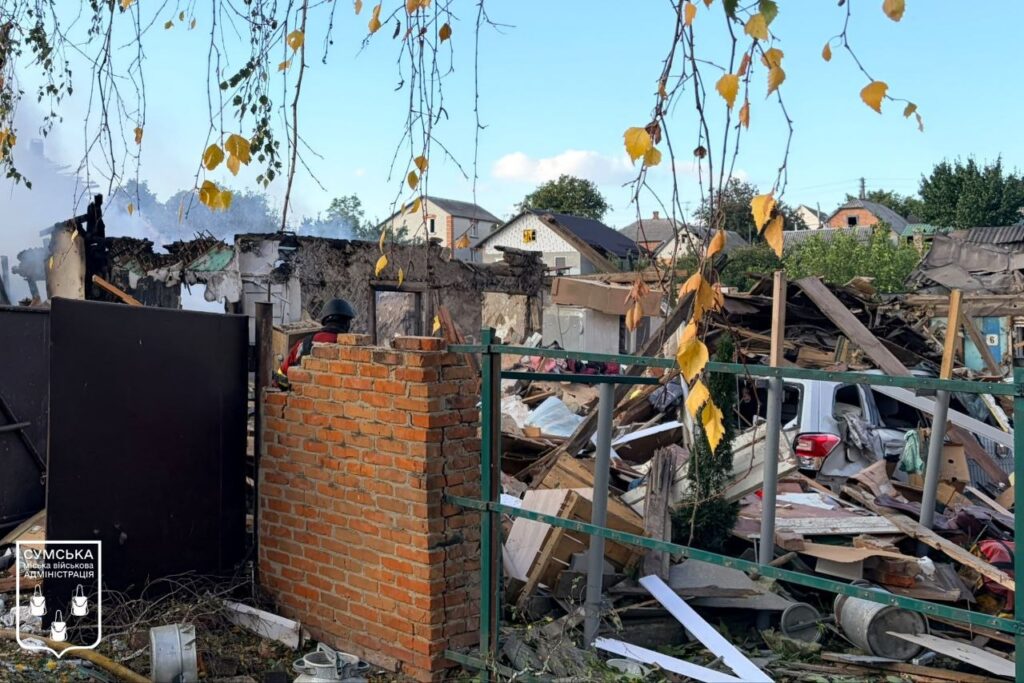
A house in Sumy destroyed in a Russian attack on 29 September.

The UN Human Rights Office verified some 15,280 civilian casualties in Ukraine during the first eight months of 2026, 55% more than in the same period last year, UN High Commissioner for Human Rights Volker Türk said on 2 October.

Türk's statement comes as Russia has begun its Winter 2026-2027 campaign of long-range strikes against Ukrainian energy infrastructure. The Institute for the Study of War (ISW) said Russian forces began the campaign in late September. Damage to energy infrastructure disrupt electricity, heating, and water supplies during the winter, increasing the risks to civilians.

Russian glide bombs killed and injured nearly 2,500 civilians in Donetsk, Kharkiv, Sumy, and Zaporizhzhia oblasts during the first eight months of the year, 62% more than in the same period last year, according to UN figures.

"As winter approaches, Ukrainians fear the worst is yet to come," Türk said.

On 4 October, Russia's Defense Ministry announced that it was intensifying strikes on infrastructure in Kyiv City and Oblast and across Ukraine, according to ISW.

Why Russia is turning to long-range strikes

ISW said Ukraine's 2026 battlefield successes "appear to be forcing" Russian President Vladimir Putin to shift focus from advances on the battlefield toward a winter campaign intended to compel Ukraine to surrender.

A week earlier, ISW assessed that Putin was likely attempting to force Ukraine to capitulate before spring 2027, with his theory of victory heavily relying on cheap, jet-powered Geran-type drones.

A toll rising all year

The 15,280 figure extends a trend the UN has tracked all year. Over the first seven months of 2026, its monitoring mission verified 1,839 civilians killed and 10,638 injured. In September, UN Under-Secretary-General Rosemary DiCarlo told the Security Council that more civilians were killed or injured in the first eight months of 2026 than in all of 2025.

  •  

Ai-Petri’s maker began building EW gear after Russia took Crimea in 2014. It’s now shown system, named for peninsula’s highest peak, at Polish expo

Ai-Petri, an electronic-warfare system that jams drones and can even disrupt Russian glide bombs at Poland's MSPO 2026 expo. Source: Oboronka

Ukraine has shown its Ai-Petri, an electronic-warfare system that jams drones and can even disrupt Russian glide bombs at Poland's MSPO 2026 expo. It was named after the highest peak in occupied Crimea, a representative of its maker, Storkway, told the outlet Oboronka. The company began developing electronic-warfare gear in 2014, the year Russia annexed Crimea.

Ai-Petri takes on two of its hardest jobs at once. It jams the control links that strike and reconnaissance drones need to fly and see, and it can interfere with the guided glide bombs, or KABs, that Russia drops on Ukrainian positions from a distance.

The company says roughly 400 are already deployed along the line of contact. The scale matters as much as the specifications, because coverage is what turns a jammer into a shield.

Ai-Petri jams drones and glide bombs

Ai-Petri's tactical versions have gone to the front since 2024, working with the 12th Special Purpose Center, the representative said.

The system can scan a full 360 degrees and detect targets 20 to 30 kilometers out, depending on terrain, across radio bands from 300 to 6,000 megahertz.

A pickup carries the whole system

Ai-Petri comes in fixed and mobile forms. The mobile one is carried on a pickup and set up by two crew in about 10 minutes.

It is built around a rotating platform of jamming modules, each with two channels, plus a detection antenna and a radar that listens for the radio signatures of approaching drones. In detection mode, it draws 250 watts, with jamming a target pushing that to 2,000.

The maker patches it like an antivirus

The pitch is adaptability, the company's representative said.

"If Russia invents a virus, we immediately make an antivirus," the Storkway representative said, describing how feedback from troops informs new jamming profiles that are quickly built to counter each new Russian system.

The company wrote its own software for Ai-Petri around a situational-awareness tool called Lira, which pulls in data from other radars to build a single picture for spotting and countering aerial threats.

  •  
❌