Vue lecture

Russia stops mass-producing Kinzhals amid accuracy problems, but 50 missiles remain ready for Ukraine

hits harm russia’s 5 hypersonic kinzhal strike ukraine bomber base fails russia's kh-47m2 air-launched ballistic missile attached mig-31k during 2018 victory day parade moscow kremlinru 1750px-2018_moscow_victory_day_parade_66 evening russia launched two

Russia suspended mass production of its Kinzhal air-launched ballistic missiles in April, but still has around 50 in its arsenal, according to Ukraine’s Defense Intelligence Directorate (HUR), Ukrainska Pravda reported.

Russia has repeatedly used Kinzhal air-launched ballistic missiles to strike targets across Ukraine, including during major attacks on Kyiv and other Ukrainian cities. The missile is launched from aircraft and travels at high speed, making it particularly difficult for Ukraine to defend against.

Ukrainska Pravda reported the figures on 20 August, citing HUR data as of July. The intelligence agency said Russia has suspended mass production of the Kinzhal in part because of accuracy problems with the missile. Moscow is instead redirecting production resources toward other ballistic and cruise missiles that can be produced and used more reliably.

Russia shifts production toward other missiles

According to HUR, Russia has redirected rocket fuel, funding, and components toward producing more accurate ballistic and cruise missiles.

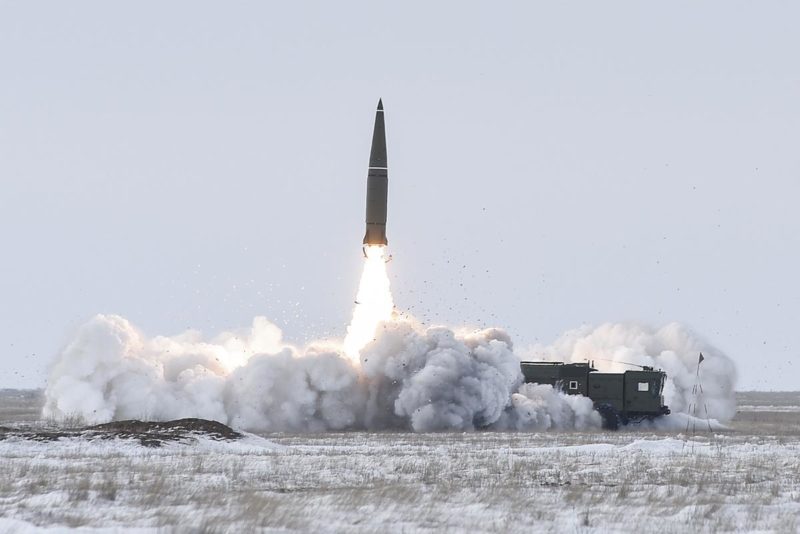
The shift is helping Moscow increase production of missiles for the Iskander-M system, HUR said.

“Redirecting production resources towards missile systems enables Russia to maintain the required production rates and ensure the regular use of missiles against Ukraine,” the agency said, as quoted by Ukrainska Pravda.

The production shift suggests Russia is prioritizing missile types it can produce and use more efficiently, rather than maintaining mass Kinzhal production.

all 20+ russian kinzhal hypersonic missiles targeting kyiv intercepted patriot since may 2023 russia's mig-31k aircraft carrying missile illustrative mounted mig-31
Explore further

Putin’s Mach-10 wonder weapon misses by 30 meters. Russia stopped building it in April.

Russia has sharply increased its use of ballistic missiles against Kyiv and other Ukrainian cities in recent months, adding heavier ballistic barrages to its large-scale drone and cruise missile attacks. The escalation has put greater pressure on Ukraine’s air defenses, particularly because ballistic missiles are harder to intercept and can reach their targets within minutes.

Kinzhal remains in Russian arsenal despite production halt

The suspension of mass production does not mean Russia has stopped using Kinzhal missiles, according to HUR.

HUR said Russia still had around 50 Kinzhals as of July, while also holding around 50 North Korean KN-23-series ballistic missiles, including KN-24 and KN-30 variants.

The intelligence agency also said the Kinzhal is undergoing further development to improve issues with its accuracy.

‼ Russian voenkors publishes satellite images from the Starokostiantyniv area!

🚀⚠ The photo shows craters from missiles that did not reach their targets. In some cases, the Kinzhals' deviation was up to 144 meters. pic.twitter.com/qvameRj5t8

— MAKS 26 🇺🇦👀 (@Maks_NAFO_FELLA) November 10, 2025

This means that while Russia has paused mass production, it retains a substantial reserve of Kinzhals that can still be used against Ukraine.

HUR's assessment also highlights a key limitation of the Kinzhal: despite being a high-speed air-launched ballistic missile, it has faced accuracy problems. Russia is therefore shifting production capacity toward missile systems it considers more reliable and easier to produce at scale.

  •  

Putin’s Mach-10 wonder weapon misses by 30 meters. Russia stopped building it in April.

Par : David Axe

all 20+ russian kinzhal hypersonic missiles targeting kyiv intercepted patriot since may 2023 russia's mig-31k aircraft carrying missile illustrative mounted mig-31

  • As more Russian missiles rain down on Ukrainian cities, one munition is curiously absent
  • The Mach-10 Kinzhal, an air-launched ballistic missile, has been missing in action for months now
  • Ukrainian intelligence says the Kremlin halted production in April because the missile kept missing by 30 meters

Russia's Kinzhal air-launched ballistic missile, a version of the ground-launched Iskander, travels as far as 2,000 km at a claimed 10 times the speed of sound while packing a 500-kg warhead. It was one of a clutch of purported super-weapons that Russian Pres. Vladimir Putin revealed in a dramatic announcement in 2018.

Launched in mid-air by specially modified Mikoyan MiG-31 interceptors in order to boost its speed and range, the Kinzhal is, in theory, a powerful deep strike munition capable of blasting right through all but the best and rarest air defenses.

In a recent interview, Deputy Chief of Ukraine’s Defence Intelligence Major General Vadym Skibitskyi made a series of interesting claims about Russian missile and drone production rates.

According to him, Russia is producing the following missiles at these rates:

- Iskander-M…

— AMK Mapping 🇳🇿 (@AMK_Mapping_) August 11, 2026

In practice, it kept missing. Russia stopped building the $4.5-million missile in April, Maj. Gen. Vadym Skibitskyi, Ukraine's deputy chief of defense intelligence, told RBC-Ukraine—and the rocket fuel and components that had gone into Kinzhals now go into Iskanders, sea-launched Kalibr cruise missiles, and air-launched Kh-101 cruise missiles instead.

A missile of this class needs to land within five to seven meters of its aim point to be worth firing. The Kinzhal, according to Skibitskyi, lands within 30 meters or more. "We can hardly recall a single instance where this missile hit the target precisely," he said. Satellite imagery of the Ukrainian air base at Starokostiantyniv, a favorite Kinzhal target, shows the craters ringing the airfield rather than sitting on it.

‼ Russian voenkors publishes satellite images from the Starokostiantyniv area!

🚀⚠ The photo shows craters from missiles that did not reach their targets. In some cases, the Kinzhals' deviation was up to 144 meters. pic.twitter.com/qvameRj5t8

— MAKS 26 🇺🇦👀 (@Maks_NAFO_FELLA) November 10, 2025

The Kolomna Machine Building Design Bureau reportedly contracted 44 Kinzhals in 2024 and 144 in 2025, Militarnyi reported from Russian defense ministry documents. The line climbed for two years and then stopped dead.

The Kinzhal isn't the only munition reportedly getting the ax. The Kremlin is also halting production of the Kh-32 air-launched cruise missile, which Russian engineers repeatedly failed to improve before the program was sent back for further work. "This would explain why Russia has not launched any Kinzhals for multiple months, and very few Kh-32s," AMK Mapping noted.

At least one analyst anticipated this development years ago. Way back in 2022, then-CNA analyst Michael Kofman wrote that he didn't "understand the interest in Russian use of Kinzhal. There's nothing special or particularly exciting about this system." It is, according to Kofman, just an Iskander but with a more complicated and expensive launch method.

It may have taken the Russians a few years to come to the same conclusion. The last Kinzhal strike might have been on 14 May, when the Russians launched three Kinzhals as part of a wider strike on Ukrainian cities involving 731 missiles and drones.

The purported Kinzhal shutdown, if true, could orphan the boutique fleet of around two dozen MiG-31K/I interceptors whose main role is to haul a Kinzhal to high altitude before launch. The Kinzhal carriers account for around 20% of the wider MiG-31 fleet, whose main mission is air defense over the vast Russian interior.

The MiGs may end up as victims of ruthless efficiency-seeking. If Skibitskyi is right, the Kremlin simply can't afford to keep every munition in production as it seeks to escalate its bombardment of Ukrainian cities amid growing economic losses from Ukrainian deep strikes targeting Russian strategic industries.

It's possible the only way the Russians can boost production of their best deep strike munitions is to cut production of the underperforming ones. According to the pro-Ukrainian Conflict Intelligence Team, the savings in fuel, components, and funds from the suspended Kinzhal and Kh-32 assembly lines "were redirected to other types of missiles."

Cutaway rendering of a Russian Kinzhal hypersonic missile shown on Ukraine's TrophyLab platform
A cutaway rendering of a Russian Kinzhal hypersonic missile, as shown on Ukraine's TrophyLab platform. Illustrative image: TrophyLab/Ukraine's Defense Ministry

Production winners and losers

That's how, in July, Russia reportedly produced 65 Iskanders, surpassing its target of 60 by nearly 10%. Meanwhile, production of Kh-101s reached 140% of the monthly target. Kalibr production 111%. Across its main missile lines, Russian industry is running at 110 to 120% of plan. Certain Russian munitions may soon disappear from the sky over Ukraine, if they haven't already. But only because more copies of better munitions are taking their place.

Ironically, the Kinzhals and their carriers are fading away at the same time Ukraine's own deep strike forces may have landed their most powerful blow against the aerial hypersonic strike force. On 15 August, a barrage of Ukrainian drones and cruise missiles struck a range of targets deep inside Russia.

The MICH 2000 drone can fly up to 2,000 km and carry a warhead weighing up to 60kg. Photo courtesy of the manufacturer
Explore further

Ukraine’s new Tu-95 killer is a $48,000 copy of a drone China refused to sell

Among the targets was Savasleyka air base, in Nizhny Novgorod around 785 km from Ukraine. "Direct hits and fires reported," WarTranslated noted.

Among other aircraft, Savasleyka air base hosts some of the MiG-31Ks that carry Kinzhal missiles. Or once carried them, if Skibitskyi is correct and the missile has fallen out of use. It's unclear whether the attack on Savasleyka damaged or destroyed any MiG-31s.

Even if the Kinzhal launchers burned to the ground, it may be too late to matter. The Russians may have rendered the planes and their missiles irrelevant before the Ukrainians could drone them.

  •  
❌