Bruce Blakeman, the Republican nominee for New York governor, posted an AI-generated video imagining New York City Mayor Zohran Mamdani and Governor Kathy Hochul hanging out, bizarrely gardening together, riding bikes, and vaguely colluding about making the state unaffordable.
".@KathyHochul and @ZohranKMamdani think they can cure New York’s cost-of-living crisis with excuses, empty promises, and 'delusion pills.' The real side effects of their policies aren't a joke: 48 utility rate hikes, higher taxes, uncontrollable government spending, and businesses fleeing our state every single day," Blakeman wrote in the post on Tuesday. "I have a different plan for New York. As Governor, I will deliver zero state income tax on your first $50,000, $100,000 for joint filers, cut your utility bills in half, and end the government waste."
ABC News10 reported that the New York State Democratic Party filed a complaint asking the Board of Elections to investigate Blakeman's use of AI in political communication materials, claiming that he's violating the state's election law that requires "materially deceptive" content to be labeled as AI-generated.
The law states: "A person, firm, association, corporation, campaign, committee, or organization that distributes or publishes any political communication that was produced by or includes materially deceptive media and has actual knowledge that it is materially deceptive shall be required to disclose this use." The law requires a disclosure displayed directly on the media in an easily readable font saying, "This (image, video, or audio) has been manipulated."
The law carves out exceptions for "satire or parody." Blakeman seems to be invoking that clause, and told News10 that he thinks people like it. “People find it humorous. They like satire,” he said. “We’ve been using humor and satire in politics since the inception of our nation 250 years ago.”
In January, Hochul said she'd move to ban AI generated depictions of candidates in political ads within 90 days of an election. In 2025, disgraced New York governor and then-mayoral candidate Andrew Cuomo's official campaign account posted an AI-generated video that showed a barrage of racist, Islamophobic stereotypes, including of his then-opponent for mayor, Mamdani. That video was labeled as AI.
About Blakeman's AI video, Hochul’s campaign told News 10 in a statement: “While Blakeman’s resorted to straight up lying to New Yorkers, Team Hochul doesn’t need AI ads to tell them about him jacking up property taxes on Long Islanders more than once, letting violent crime hit decade highs on his watch, or running an armed MAGA militia that undercuts local cops – he did all that in real life.”
If elected, Blakeman says he'll end New York's status as a sanctuary state and increase the state's collaboration with Immigration and Customs Enforcement. In 2024, as Nassau County Executive, Blakeman signed a bill, which he wrote, into law that banned transgender athletes from playing in women and girls' sports at county-owned athletic facilities. In 2025, courts halted that law in response to the New York Civil Liberties Union's legal challenge calling it a violation of antidiscrimination laws.
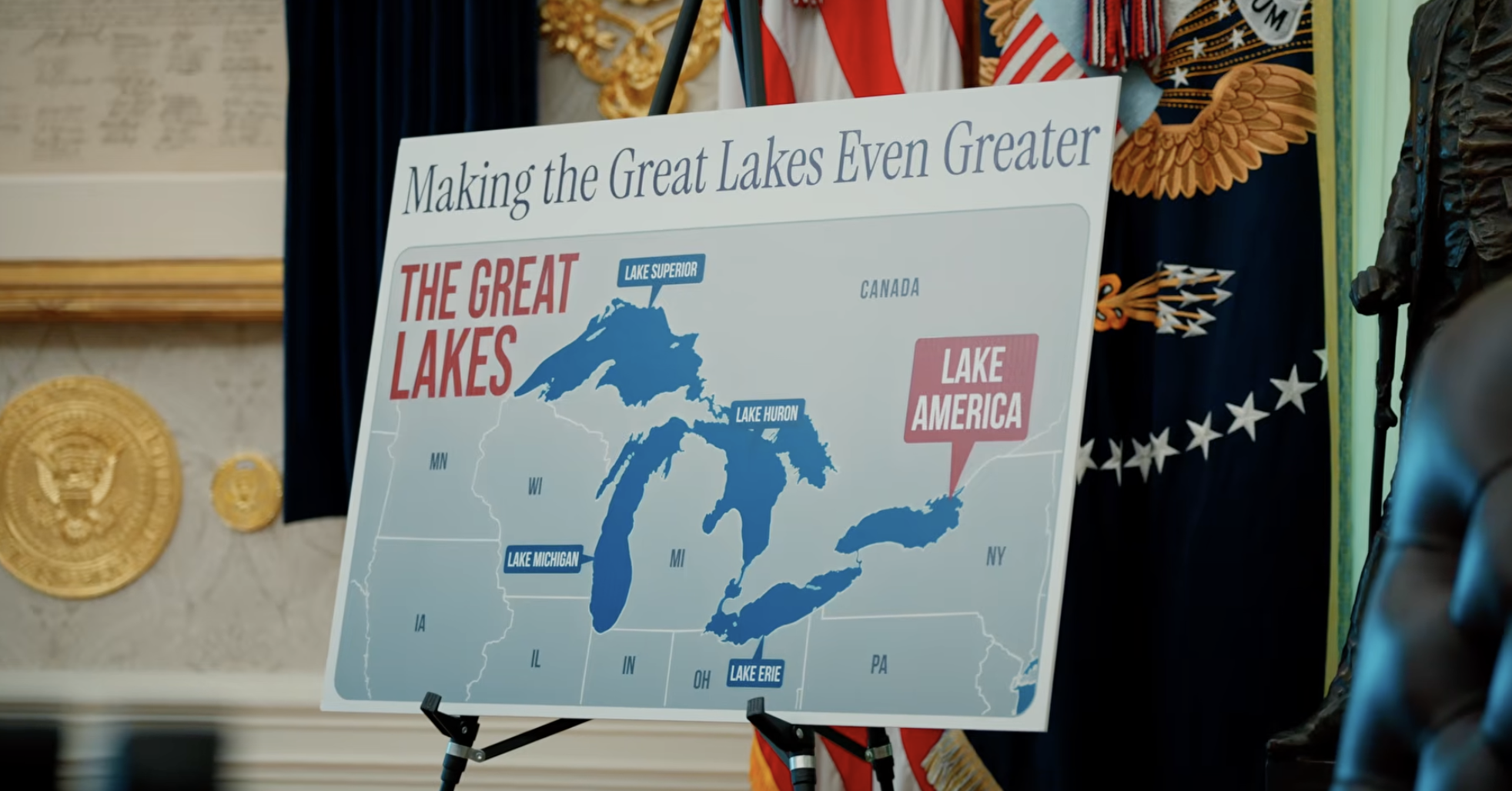
On Thursday, Trump signed an executive order demanding Lake Ontario be renamed to Lake America. At the signing of the order, he sat next to a big poster board map of the Great Lakes, with a big red arrow labeling Lake Ontario as "Lake America," with the words "Making the Great Lakes Even Greater."
The Canadian province of Ontario borders the north, west, and southwest sides of the lake, with New York State on the south and east.
Tech companies want you to believe that the chatbots they profit from are the always ready, never judgmental, constantly affirming friend in our pockets. But are the people using them as companions under some kind of deep self-delusion? Or are they seeking something else?
In this week’s interview episode, I was joined by journalist Bridget Todd. Among many other projects and accomplishments, Bridget is the creator and host of the award winning podcast There Are No Girls on the Internet, is a Fellow at the MacArthur Foundation, and an affiliate at Harvard University's Berkman Klein Center for Internet & Society. Her new audiobook, Love at First Prompt: AI and the Future of Intimacy, launched in July with coauthor Michael Amato.
We talk about her work interviewing people who use chatbots to fill an emotional need, how people who engage in romantic, intimate and erotic roleplay with LLMs are mocked for it, and how tech companies are implicated in all of this. In her new book, you’ll hear from experts in the field of AI companionship, but also from people who have nuanced, interesting interactions with chatbots every day.
For Bridget, Love at First Prompt was inspired in large part by her own use of LLMs in the face of extreme stress and tragedy after her parents died – her dad after a long illness, and her mom more suddenly after. “It was like having to relearn how I fit into my existing social dynamic,” she told me. “I was incredibly isolated. I wasn't really talking to my friends. I wasn't really talking to anybody. I wasn't really returning any emails. I was completely overwhelmed in all the ways somebody can be overwhelmed.” She’d been using ChatGPT to keep track of medical notes, but soon that changed, almost without her realizing it.
“My use of ChatGPT had gone from just looking up things that my dad's doctor would say, or researching how to get care and how to pay for care – it was a lot of that because I was getting hit with a lot of complex medical jargon that I never heard – to then, I found myself late at night telling ChatGPT, ‘I'm so overwhelmed. This is so overwhelming. I'm so exhausted. I'm so worried about my dad. I'm so anxious.’ And so there wasn't any particular black and white light switch that flipped where [I thought] now I'm going to start speaking emotionally to ChatGPT. It happened without me really even noticing it.”
This made her curious about other people’s usage of chatbots, especially in a time when so many tech companies are pushing “AI companions” as the frontier of connection.
In the book, she breaks down how real people use LLMs to fill an emotional need, and connects their experiences to how tech executives are cashing in. “All of these things that we used to think of as sacrosanct are now just up for grabs by these tech companies. And so the question that I asked people who were experiencing intimacy with AI was, are you comfortable with something as intimate as these connections that are romantic or sexual being owned and controlled by companies who don't give a shit about you, who we know cannot be trusted, who do horrible things without even thinking about it? Even beyond that, who will change as the wind blows?” Bridget said in our conversation. “Like Sam Altman saying, ‘We're gonna start doing erotic role play. Oh, just kidding. Never mind.’ The whiplash with which [execs] say things and then take it back and then operate as if they never said that, it's almost like gaslighting. Do you want your most intimate human connections being mediated by an unreliable gaslighter? And that's what we have in these tech companies.”
Bridget’s book is her most vulnerable work yet. She unpacks and critiques her own use of ChatGPT during a crisis, and reveals what she learned about herself, her friendships and real-life relationships, and what it means to maintain human connections in an era tech companies are constantly trying to exploit our innermost worlds.
Anthony Ralphs has been showing up to San Diego City Council meetings to speak against Flock's presence in his city for a year. At first, he took the podium during public comment in business casual — dress shirts, pants, suits, "respectable" clothing — to voice his concerns about the city's deal with the surveillance company.
"I did all the right things. I wore the suits. I said all the correct talking points. I made all the compelling arguments," Ralphs told me in a phone call. He cited Supreme Court precedent, like Chatrie v. United States, which challenged the constitutionality of geofence warrants where police could collect location history data from cell phones.
"It seemed like no matter how many cases I brought up, no matter how many violations of the Constitution this technology breaks, no matter how many constituents, no matter how many organizations, no matter how well I dress, no matter how fine my talking points, they weren't listening," he said. "That was when I realized, you know, you can't spell activism without 'act,' right? And I decided, well, maybe I'll try something different."
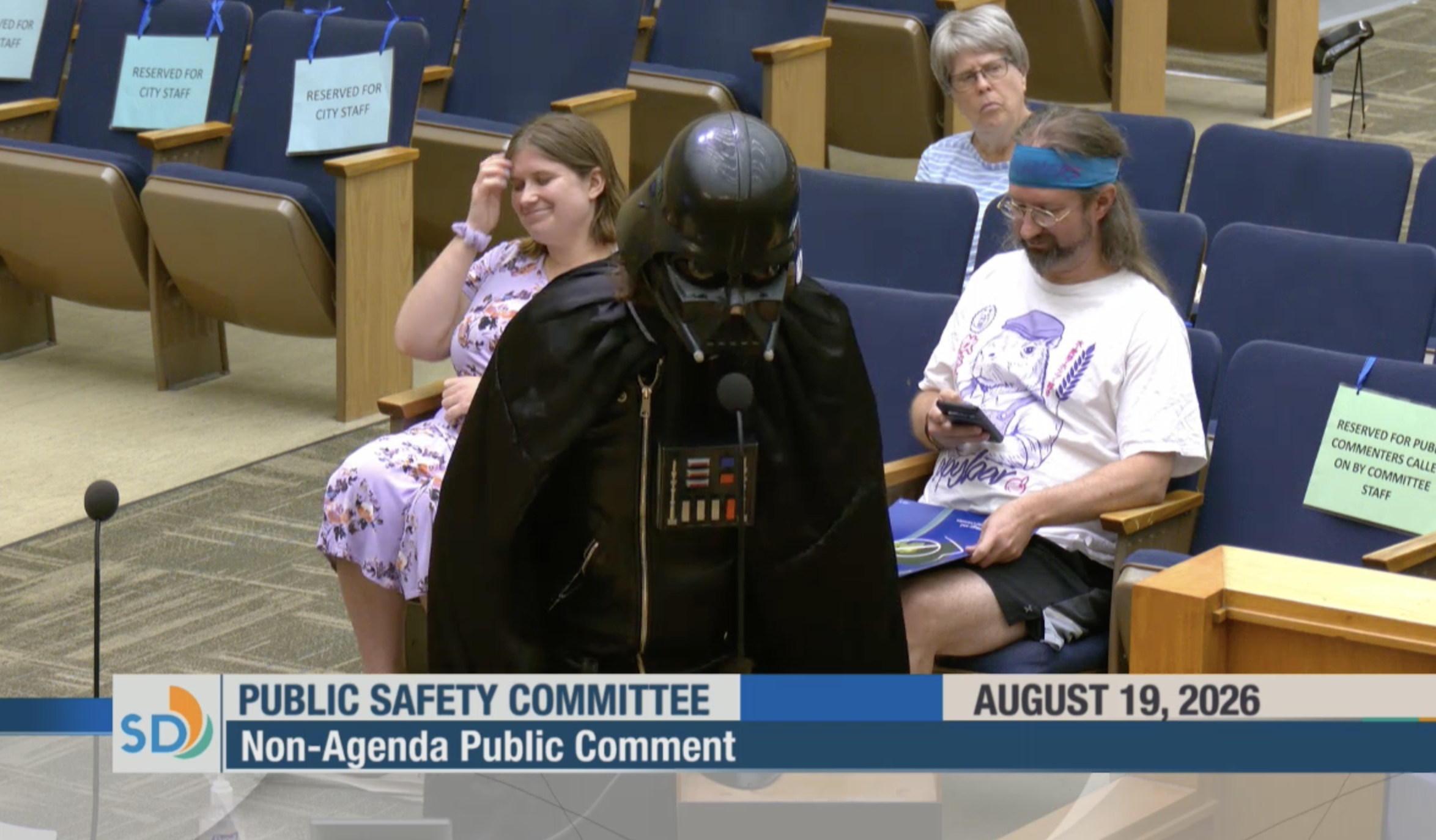
On August 19, Ralphs stood before city council members in a Darth Vader cape and mask, complete with mechanized breathing and voice changer. "The emperor is a fan of Flock," he began, and, speaking as the Dark Lord, laid out in three minutes why the Empire depends on Flock's warrantless network of automatic license plate readers and surveillance cameras. The video went extremely viral; after our coverage of Ralph's comments, every news outlet on the planet seemingly wrote about the mysterious San Diegan Vader. Coverage of his speech was published in Singapore and translated to Spanish and Arabic.
Ralphs is an event producer and has been hosting raves and music festivals in the area for the last 13 years. He founded an event space, Eden Art Garden, about an hour outside of the city. He recently started DeFlock San Diego and works with the Transparent and Responsible Use of Surveillance Technology San Diego (TRUST SD) Coalition as well as other anti-surveillance and privacy rights groups to educate people and organize more widely. "But now we need the musicians, we need the artists, we need the painters, the actors, we need the thespians to bring this together and get some wheels on the movement to help it gain traction," he said.
"I think it's a character that resonates. He's like an archetype for evil. He's an archetype for the Empire," Ralphs said. "Vader is always a servant of the Empire, right? So [Flock] is nothing but tools for the servants of the Empire. Framing it into that context, I think was what was needed to bring this conversation into like a theatrical global component is really framing it in that kind of good versus bad framework. It is such an Orwellian technology being utilized by such comic book villain forces of evil trying to do dastardly things."
One of Ralphs' first city council meetings was in December 2025, when hundreds of people spoke in person, attended via Zoom, or sent comments online opposing Flock. After six hours of deliberation and debate, and despite the vast majority of public comment coming from constituents who wanted Flock out of San Diego, the council voted to continue the program.
"After that meeting, where city council decided that none of their constituents' opinions mattered and that they were going to vote how they wanted to vote regardless... After that, the movement was so discouraged, and all of us were so deflated that it was really hard to summon the collective energy and to muster the kind of the vitality that we needed to keep pushing forward," Ralphs said. He came back to another city council meeting a week later, and was "shocked and really disappointed," he said, to see the chamber was completely empty of members of the public. In that moment, he said, he realized he had an opportunity to attend as many city council meetings as he could — once every two weeks, then once a week, then twice and week and eventually every council and subcommittee meeting by spring 2026. "Then by May and June, I was so familiar with the process of giving public comment, of looking at the agenda items ahead of time to know what was going to be discussed, knowing how to cede time and get time ceded to you, I started organizing people to join me to speak to city council."
After Vader's appearance went viral around the world, Ralphs wondered if he'd let the character remain anonymous or take ownership of it. "But I think that it's a good time now to follow up with what the intention was, and what the reason and method was behind it," he said. "I think it's important for people to know this wasn't just some antic from somebody who just decided to show up one day and make some noise. This was a thought out plan that was exacted only after cumulative frustration from hundreds of people being ignored and months and months and months of trying things quote unquote the right way and it not working."
On Monday afternoon, Ralphs returned to San Diego City Council. He carried the mask to the podium with it wheezing on its own, and sat it down on the table. "I think we know who the bad guy is now. But I think what the whole world wants to know is who wants to be the good guy," he said. "I have requests to be interviewed this entire week. And what I would like to ask is, of the five council members that voted for Flock: When will this end? When will you listen to the vast majority of your constituents?"
During the public comment portion of a recent San Diego city council meeting, the council called for the next comment to take the podium: "Darth Vader?" As he approached the microphone in his black helmet and cape, his heavy breathing reached the mic before he did.
At the Public Safety and Livable Neighborhoods Committee Meeting on August 19, Vader — whose identity is not revealed during the meeting — spoke passionately in support of Flock in San Diego.
💡
Are you the Dark Lord of the Sith in question? I would love to hear from you. Using a non-work device, you can message me securely on Signal at sam.404. Otherwise, send me an email at sam@404media.co.
Pornhub's parent company will pay $120 million to settle claims that its platforms violated federal sex trafficking and child sexual abuse imagery laws.
The deal settles two 2021 class action lawsuits in California and Alabama that claim Mindgeek, which has since rebranded to Aylo, profited off of child abuse material allegedly posted by abusers to its platforms. In the California case, a woman alleged that her ex-boyfriend posted child sexual abuse videos of her when she was 16 years old to Pornhub. In the Alabama case, two women claimed to have been trafficked as minors and that their trafficker uploaded videos to Mindgeek's sites; one of the women claimed she was drugged and raped at 16, and that her abuser profited off of the videos of her abuse through Pornhub's Modelhub program.
The class includes anyone who was under the age of 18 "when they appeared in a video or image that has been made available for viewing" on a Mindgeek-owned or operated website between February 12, 2011 and December 6, 2024.
Mindgeek was bought by Ethical Capital Partners and rebranded to Aylo in 2023. Aylo will pay into the settlement fund with an initial $25 million in 2026 followed by six annual installments over the next six years. In a press release, Aylo noted that the settlement "resolves the matter with no admission of liability or wrongdoing by Aylo and remains subject to court approval."
In addition to paying $120 million, Aylo agreed to a series of content moderation terms, including verifying that all of the models in uploaded content are over the age of 18, human and automated review of content to prevent child sexual abuse material from going up on its sites, and reporting suspected abuse material to the relevant authorities. Aylo's sites have implemented many of these injunctive reliefs agreed to in the settlement for years.
In late 2020, following allegations of abuse material on the site and being dropped by major credit card processors including Visa and Mastercard, Pornhub overhauled its trust and safety measures to ban downloads, restrict uploads to verified users, and expand its moderation processes. It also launched its “Trusted Flagger Program" — mentioned as part of this settlement's terms — which allows a group of non-profit internet and child safety organizations around the world to immediately disable content it flags as abusive. In early 2021, Pornhub implemented biometric identity verification for uploaders through Yoti, and in 2024, it started requiring written proof of consent from everyone in every video.
The attorney for the plaintiff class did not immediately respond to a request for comment.
“Over the years, we have put in place robust measures to help protect our platform from abuse. Only verified content creators can publish on our platform, and every upload is subject to a combination of technological tools and human review by trained moderators before it goes live, to confirm that it complies with our Terms of Service, Community Guidelines and related Policies," Aylo management said in a statement. "Many of the commitments in this settlement reflect practices we already have in place. Trust and Safety should be a priority for every online platform, and we all share responsibility for a safer online experience. Every day, our trust and safety and engineering teams work alongside law enforcement, advocacy groups and other stakeholders to prevent online abuse and to hold those abusers to account.”
Twitch is going to train Amazon’s AI models on streamers’ content unless they deliberately go into their settings and opt out, potentially sweeping up a wealth of streamers who either don’t hear about the announcement or follow steps stop it.
On Wednesday Twitch announced a new setting that lets streamers opt-out of the training. The announcement confirms rumors that have percolated over the last week: It is using streamers to train Amazon’s AI models.
The new toggle says, "Allow your channel content to train generative AI content models at Amazon." All users are opted in by default. It's located at the bottom of users' security settings page.
Instagram is full of first-person videos of men harassing women in public. They follow a similar script: A man walks up to a woman or group of women in a store, sitting outside a cafe, or walking home from a bar, and delivers a pickup line. The women almost always nervously laugh, react with barely-veiled disgust, or say "fuck off" while he stalks her or refuses to walk away. The men recording these videos capture them with Meta's smart glasses, which are designed to discreetly capture interactions like these and upload the videos to Meta's platforms where the women in the videos are turned into content for "pickup artist" accounts.
New research reveals this ecosystem works, and how pickup artists (PUA) influencers are using Meta's products, including its smart glasses and social media platforms, to perpetuate a culture of harassment against women.
University of Sydney researchers Joanne Gray, Milica Stilinovic, Marcus Carter, and Ben Egliston watched hundreds of these videos to learn how pickup artist content creators use smart glasses, and what specific forms of gendered harms these recordings cause. They published their research paper, "Harm Through the '#RizzCam': Smart Glasses, Ambient Capture and Invisible Harassment," online this week as a preprint article.
This is Behind the Blog, where we share our behind-the-scenes thoughts about how a few of our top stories of the week came together. This week, we discuss Flock blogging, "rare" books, and Jesus Christ.
The story has gone mega viral on X, but mostly in the form of a post from an engagement farming account that both misrepresented my article and didn’t properly link back to our website. This is frustrating because it means a lot of other people siphoned traffic from our site and also because it caused a fair bit of confusion about what is happening.
On Wednesday morning, Ted Cruz’s Senate Commerce Committee will convene on five bills aimed at age verification and “child safety.” The bills each have their own issues when it comes to privacy, data collection, parental rights, and free speech. But one bill, the partisan Republican SCREEN Act, is a Christian nationalist nightmare.
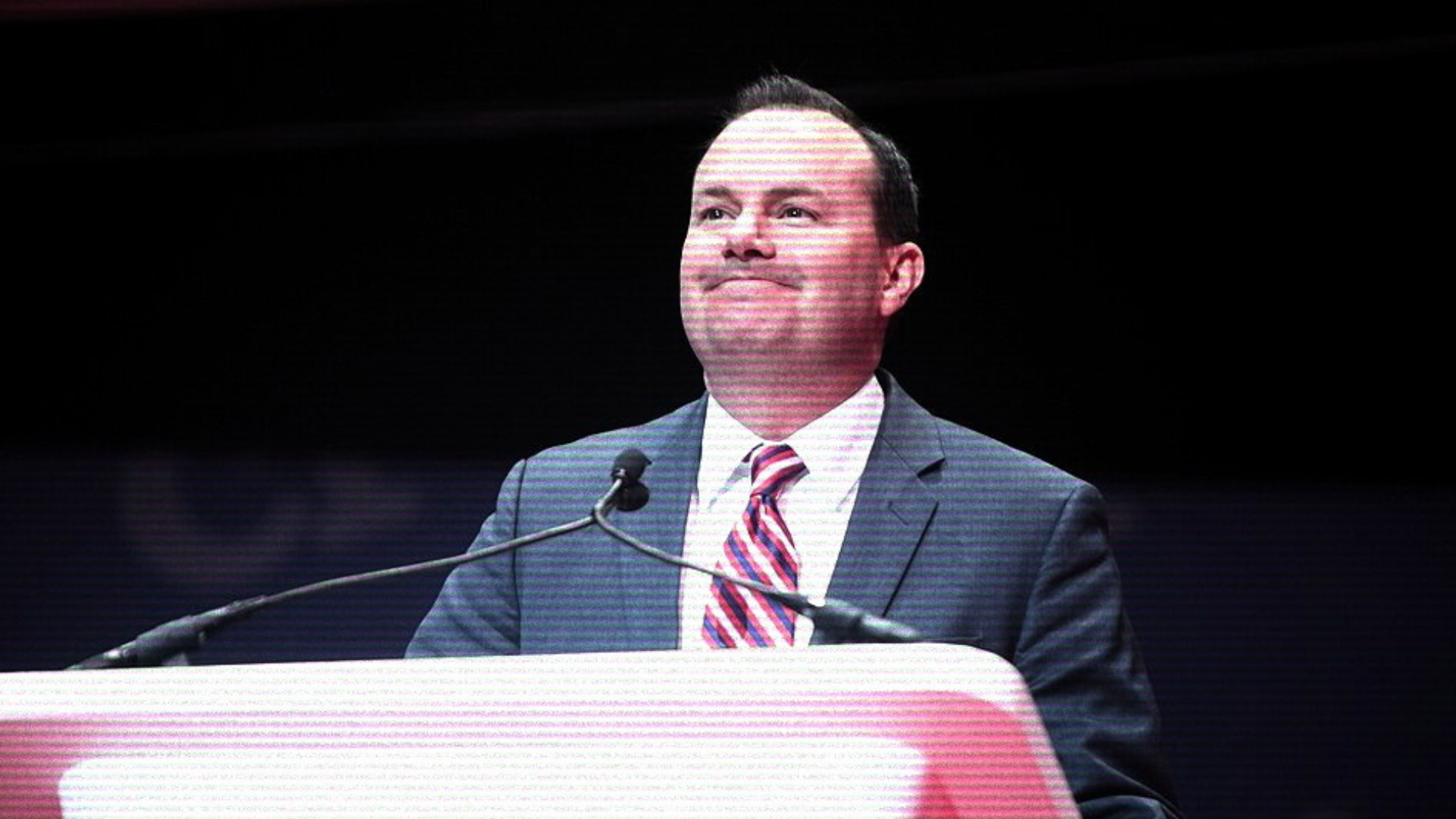
Utah Senator Mike Lee introduced the Shielding Children's Retinas from Egregious Exposure on the Net (SCREEN) Act in February 2025, alongside exclusively Republican cosponsors and supporters Senators John Curtis, Jim Banks, and Representative Mary Miller.
The SCREEN Act would require every website that includes even one piece of what the legislation describes as “harmful to minors” to verify visitors’ ages. It defines “harmful to minors” as content that “depicts, describes, or represents, in a patently offensive way with respect to what is suitable for minors, an actual or simulated sexual act or sexual contact, actual or simulated normal or perverted sexual acts, or lewd exhibition of the genitals;” is “obscene” or “child pornography;” or “appeals to the prurient interest in nudity, sex, or excretion.”
Unlike the many laws now in place around the U.S. that apply to sites made up of at least one third adult content, like porn sites and some social media platforms, SCREEN would place the burden and risk of verifying users’ ages to every website on the internet that falls under the law, which would be most sites with user-generated content and also mainstream entertainment platforms like Netflix. It also attacks virtual private networks (VPNs) by requiring sites to verify based on IP addresses; many people in states that have age verification laws in place use VPNs to get around submitting sensitive personal data like ID and biometrics to a smattering of third-party websites in use today. Critics say the SCREEN Act would be a privacy and free speech disaster.
And the agenda of its sponsors is clear: “Internet pornography has infected our culture and corroded the vulnerable minds of America’s kids, with the average age of initial exposure being 12 years old. That’s appalling,” Banks said in Lee’s press release.
A number of religious, conservative, Christian nationalist, and anti-pornography groups are in support of the bill, according to the press release from Lee’s office. They include the National Center on Sexual Exploitation (which recently represented a Kansas mother who sued multiple porn sites because her son found her old laptop and used it to watch Chaturbate), the National Decency Coalition, the Ethics and Public Policy Center (which is “working to apply the riches of the Jewish and Christian traditions to contemporary questions of law, culture, and politics,” according to its website), the Family Policy Alliance (whose stated mission is to “advance biblical values through civic engagement”), the Family Research Council (whose “mission is to serve in the kingdom of God by championing faith, family, and freedom in public policy and the culture from a biblical worldview”), and many more.
Heritage Action, a conservative lobbying group and one of the organizations Lee lists in support of the SCREEN Act, is a sister organization to the Heritage Foundation, which authored Project 2025. Heritage Action “works with lawmakers to implement Heritage Foundation solutions,” according to the Heritage Foundation website. This is important because of how Project 2025, the playbook for right-wing and extremist conservative leadership, has influenced policies and lawmaking in America in the last few years of the Trump Administration. That stretches from attacks on programs that promote diversity, equity and inclusion, to attacks on trans and queer people, to turning the FBI into a political entity.
One of Project 2025’s stated goals is to redefine and eradicate pornography: “Pornography, manifested today in the omnipresent propagation of transgender ideology and sexualization of children, for instance, is not a political Gordian knot inextricably binding up disparate claims about free speech, property rights, sexual liberation, and child welfare. It has no claim to First Amendment protection,” the playbook says, calling for imprisonment of pornographers but also educators and librarians. “And telecommunications and technology firms that facilitate its spread should be shuttered.”
The Senate Commerce Committee will also debate and mark up the text of the Youth AI Privacy Act which would require chatbots to disclose they’re not human among other features like limiting data retention; the CHATBOT Act which would require AI companies to build “family account” systems where parents can monitor kids’ activity; the Children’s Artificial Intelligence Toy Safety Act which would create a federal study into toys that include AI components; and the Kids Online Safety Act (KOSA).
KOSA would impose a legal “duty of care” on social media platforms to prevent and mitigate promotion of suicide, eating disorders, substance abuse, sexual exploitation, and advertisements for products like tobacco. KOSA has been introduced, and failed, multiple times since its first introduction in 2022; it has bipartisan lawmaker support but is extremely unpopular across all sides of the political spectrum among groups that care about freedom of speech because of its potential to increase censorship.
“Whatever disclaimers and exceptions the bill includes, the practical effect is unchanged,” the Electronic Freedom Foundation recently wrote about KOSA. “When platforms face liability for content that someone later claims contributed to harms like anxiety, eating disorders, or substance use, the safest response is to remove lawful speech or shut down forums discussing those topics altogether.”
Unlike KOSA and many of the other age verification laws that have spread across the country, the SCREEN Act does not have bipartisan support. It’s the latest in Lee’s repeated attempts to criminalize content he and his co-sponsors personally consider immoral. Last year, Lee introduced the now-stalled Interstate Obscenity Definition Act (IODA) for the third time. IODA would change the 1973 “Miller Test” for determining what qualifies as obscene, and seeks to make all pornography illegal at the federal level. “Obscenity isn’t protected by the First Amendment, but hazy and unenforceable legal definitions have allowed extreme pornography to saturate American society and reach countless children,” Lee said in a press release. “Our bill updates the legal definition of obscenity for the internet age so this content can be taken down and its peddlers prosecuted.”
This is Behind the Blog, where we share our behind-the-scenes thoughts about how a few of our top stories of the week came together. This week, we discuss going into the woods, a "he admit it" moment, and a tofu sandwich.
JOSEPH: Thank you to everyone who came to Thursday’s FOIA Forum. It was a great turnout with a ton of really good questions. We spoke mostly about mining city council meetings for tips or context you can then use to fuel your public records requests. I’ll upload the video soon and put it on the site for everyone to watch.
The other 404 Media co-founders have been writing in Behind The Blog about disconnecting recently. I’m doing something related to that shortly: going to an Airbnb in the woods to do a makeshift ‘silent retreat’.
YouTube banned a wave of ASMR artists this week for violating the platforms’ rules against “sexually gratifying” content, leaving creators confused and angry.
Several creators received the same notice from YouTube about their channels being removed on Wednesday and Thursday. “We have reviewed your content and found severe or repeated violations of our sex and nudity policy. Because of this, we have removed your channel from YouTube,” the email said.
So far, YouTube creators affected by the wave of bans who’ve spoken publicly about YouTube removing their channels include ItsBunniiASMR, Slight Sounds, Nananightray, Roseasmr, Simoneasmr, and Janina Wilhelmsen, all of whom had significant followings on the platform. There are still many ASMR creators on YouTube, making the bans even more confusing.
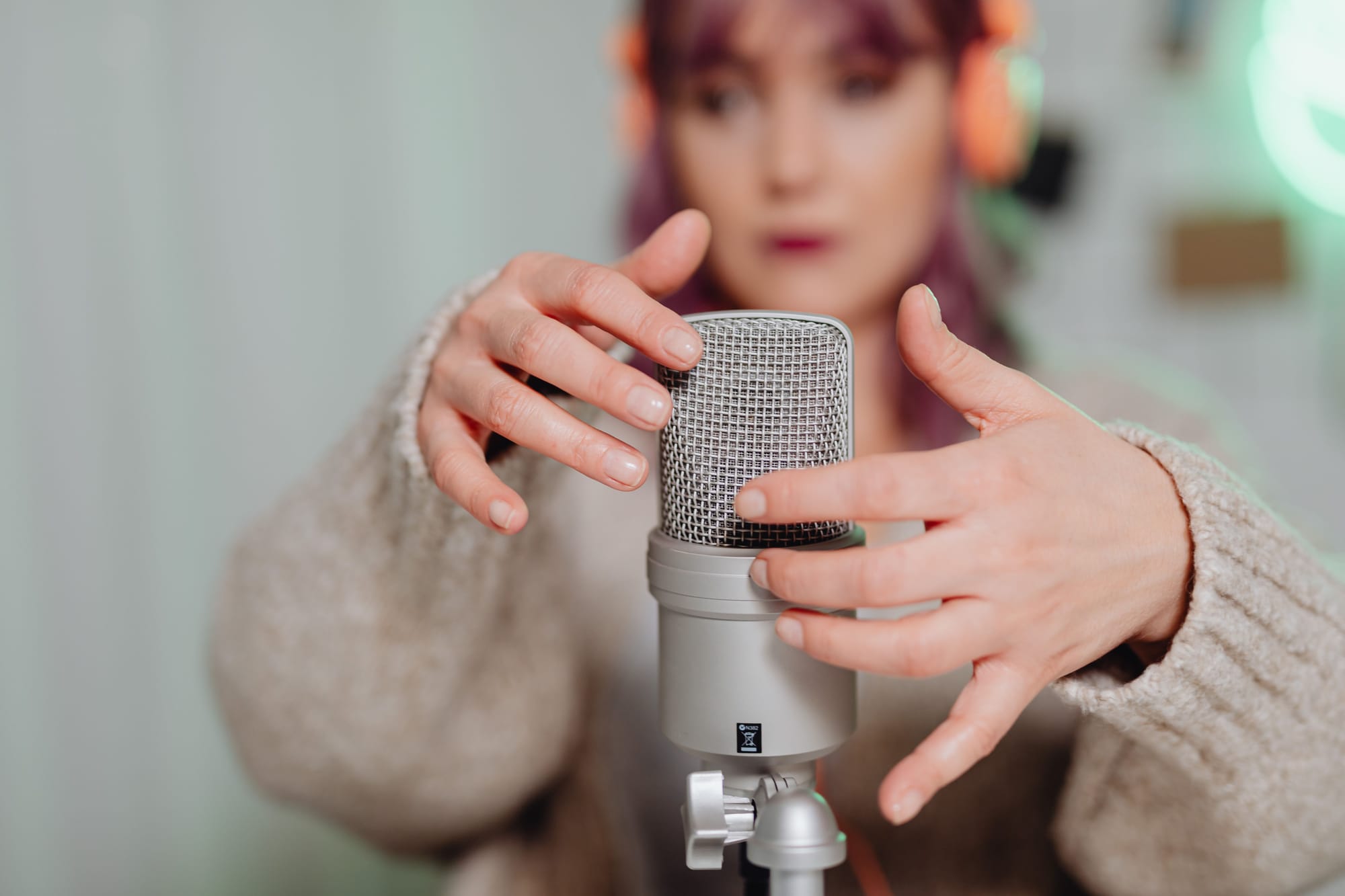
ASMR, or Autonomous Sensory Meridian Response, describes the tingling feeling that some people get when hearing certain sounds; it’s become shorthand for a genre of content where ASMR artists whisper, brush, tap or make other sounds near a microphone. A lot of ASMR content is meant for relaxation, mindfulness, and sleep.
“YouTube deciding to ban my account and many others feels like they are siding with gross sexualization of ASMR from people outside the community."
"We terminated these channels for linking to content that violates our nudity and sexual content policy," a spokesperson for YouTube told 404 Media in a statement. "Our external link policies apply equally to all creators across YouTube, and this action was taken in accordance with our long-standing policies, not as a change in policy or targeting of ASMR content."
Following 404 Media’s reporting that book database company ISBNdb claimed to source printed books to then sell to AI companies for AI training, the company deleted the part of its website offering the service and walked back claims that it would train AI models, and instead called it “a test of market interest.”
On July 30, nine days after 404 Media’s reporting, ISBNdb added a note to its homepage and an update on its news page about the change. “We've seen the recent coverage about a marketing landing page on our site, and we understand the concern it raised. The facts: ISBNdb has never purchased, scanned, or sold a book — for AI training or anything else,” ISBNdb wrote. “We don't train AI models, and we never have. The page was a test of market interest; no such service was ever brought to life. We've taken the page down. Our job is helping people find books. For more than two decades, ISBNdb has been the card catalog of the book world — the data behind how bookstores, libraries, and reading apps connect readers with titles. Data about books, not the books themselves. That hasn't changed.”

 Connexion