❌

Vue normale

  • ✇Euromaidan Press
  • Azov says it struck more than 100 Russian trains in occupied Donbas in four months, in part thanks to donations
    Fighters of the 1st Corps of the National Guard of Ukraine "Azov" struck more than 100 Russian trains carrying fuel and other supplies for occupying forces, the corps reported on social media on 28 October. The strikes disabled locomotives, fuel tank cars, and other equipment, the statement said. Russian President Vladimir Putin claimed on 16 October that seizing all of Donetsk Oblast remains one of Russia's main tasks. Azov notes that these strikes help "destroy" Russia's offensive cap
     

Azov says it struck more than 100 Russian trains in occupied Donbas in four months, in part thanks to donations

30 octobre 2026 à 11:54

The moment a Ukrainian UAV prepares to strike a Russian train, likely carrying military supplies, 2026. Screenshot from a video released by Azov

Fighters of the 1st Corps of the National Guard of Ukraine "Azov" struck more than 100 Russian trains carrying fuel and other supplies for occupying forces, the corps reported on social media on 28 October. The strikes disabled locomotives, fuel tank cars, and other equipment, the statement said.

Russian President Vladimir Putin claimed on 16 October that seizing all of Donetsk Oblast remains one of Russia's main tasks. Azov notes that these strikes help "destroy" Russia's offensive capabilities.

Small Ukrainian drones strike Russia's 100-ton locomotives

Azov emphasizes that neither mobile fire groups nor electronic warfare systems can protect Russian logistics routes.

"The enemy is doing its utmost to create an image of successfully capturing settlements, but is unable to protect key railway stations through which the fuel supply chain runs toward the front," Azov said.

The rail hubs hit had carried Russian military trains to the fighting in Donbas and southern Ukraine, Defense Express reported on 29 October. The count of more than 100 trains covers Azov's operations over the past four months, the outlet said.

The mass of any diesel locomotive exceeds 100 tons, yet the Ukrainian military struck these large Russian targets using small UAVs, the outlet also notes.

Donations helped make the strikes possible

Donations and the work of the Come Back Alive foundation contributed to the operation's results, Azov said. In particular, the foundation provided the military with 440 Starlink Mini terminals, the corps added.

War on Credit: Over 100 Trains Hit

The enemy is doing all it can to create the image of successfully capturing settlements, yet it cannot protect the key railway stations through which its fuel supply chain toward the front runs. Neither mobile fire groups nor electronic warfare… pic.twitter.com/QpqEQHyxvp

— First Corps Azov of the National Guard of Ukraine (@azov_media) October 28, 2026

Azov announced Operation Hell back in the summer

On 2 July, the Azov Corps announced Operation Hell and released the first footage of strikes on Russian railway equipment. The video shows a strike on a diesel locomotive that was likely used by Russian forces for military logistics.

Operation "Inferno." Coming soon.

This wasn't just about our distaste for old Soviet cartoons. Demilitarization is the priority. Decommunization's just a bonus.

So what's happening in the video? This isn't a random hit — it's part of a carefully planned operation by First Corps… pic.twitter.com/feNc72isUk

— First Corps Azov of the National Guard of Ukraine (@azov_media) July 2, 2026

The corps said the strike was part of a carefully planned operation and promised details soon.

  • ✇Euromaidan Press
  • Shadows, roofs, job ads give Ukrainian arms plants away to Russian analysts, Ukrainian experts warn
    Russian analysts can locate Ukrainian weapons plants from details in published photos and TV footage, Ukrainian defense outlet Oboronka reported on 29 October. Open-source researchers told the outlet how to hide those details. Ukraine plans to build 7 million drones this year, and Russia is hunting the plants that make them. In June, the Security Service of Ukraine (SBU) said Russia’s GRU military intelligence was gathering data to prepare air strikes on defense plants and attacks on th
     

Shadows, roofs, job ads give Ukrainian arms plants away to Russian analysts, Ukrainian experts warn

30 octobre 2026 à 08:31

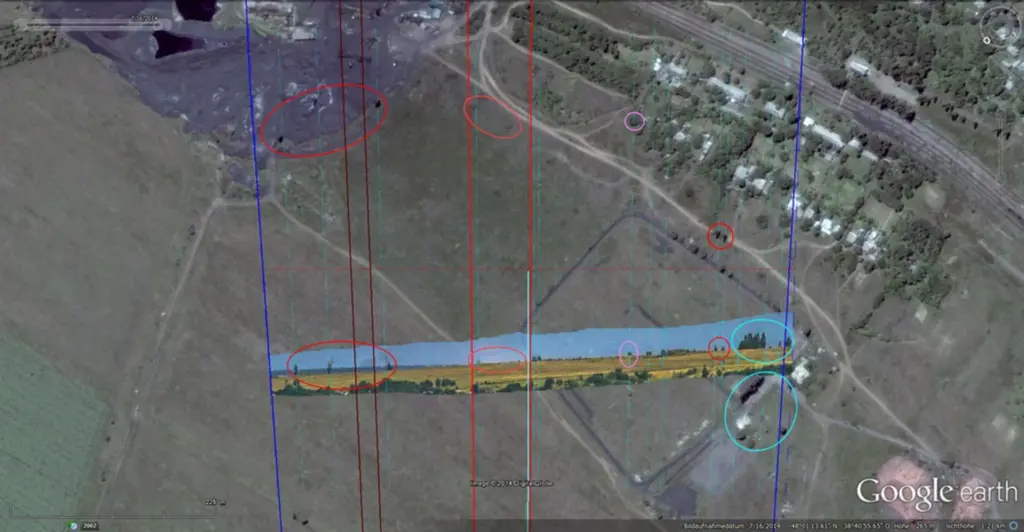
Screenshot from Bellingcat’s investigation into the downing of MH17

Russian analysts can locate Ukrainian weapons plants from details in published photos and TV footage, Ukrainian defense outlet Oboronka reported on 29 October. Open-source researchers told the outlet how to hide those details.

Ukraine plans to build 7 million drones this year, and Russia is hunting the plants that make them. In June, the Security Service of Ukraine (SBU) said Russia’s GRU military intelligence was gathering data to prepare air strikes on defense plants and attacks on their engineers.

A TV clip, then missiles

On 7 April 2022, Ukrainian channel 1+1 aired a report from a workshop at the Kyiv Armored Plant converting captured Russian military equipment for Ukraine’s forces. On 14 April, Rybar, an anonymous pro-Russian Telegram channel, posted the factory’s location. Russian missiles hit the workshop on 16 April, killing at least three civilians, the Centre for Information Resilience (CIR) found.

A frame from the 1+1 report filmed at the Kyiv Armored Plant, aired on 7 April 2022
A frame from the 1+1 report filmed at the Kyiv Armored Plant, aired on 7 April 2022. Screenshot: Centre for Information Resilience

Retracing the likely method, CIR wrote that wall colors, window size, and ceiling height could single out the plant, and Google Earth imagery the workshop. InformNapalm researcher Andrii Lisitsyn told Oboronka that matching a frame with old photos, satellite images, job ads, or staff profiles quickly narrows the search.

A Gaussian blur smears pixels but keeps part of the information, Oboronka wrote. In a 2020 blog post, aerospace engineering student Gonçalo Raposo showed it can be fully reversed if the exact filter and edge handling are known. Pixelation fails too: a 2022 neural network reconstructs plausible faces from pixelated images. Lisitsyn advises cropping or fully opaque masking instead, plus checking file metadata.

Leaks beyond photos

Some Ukrainian defense enterprises still keep accounts and procurement records in Russian 1C software, Oboronka wrote. Since 6 January 2026, 1C products have been on the State Special Communications Service’s list of banned software. The ban covers systems with state information resources and critical information infrastructure owned or managed by state bodies, state enterprises, and local governments, the service said.

Oboronka also wrote that days before the full-scale invasion, Spanish journalist Pablo González photographed production lines at engine maker Motor Sich. Poland held him from February 2022 until a prisoner swap sent him to Russia in August 2024. Prosecutors then indicted him under both his names, Pablo González and Pavel Rubtsov, for spying for Russian military intelligence.

❌