❌

Vue normale

Robots won’t replace armored vehicles, says Ukrainian company that builds both. It reveals one job they can’t do
30 septembre 2026 à 17:48

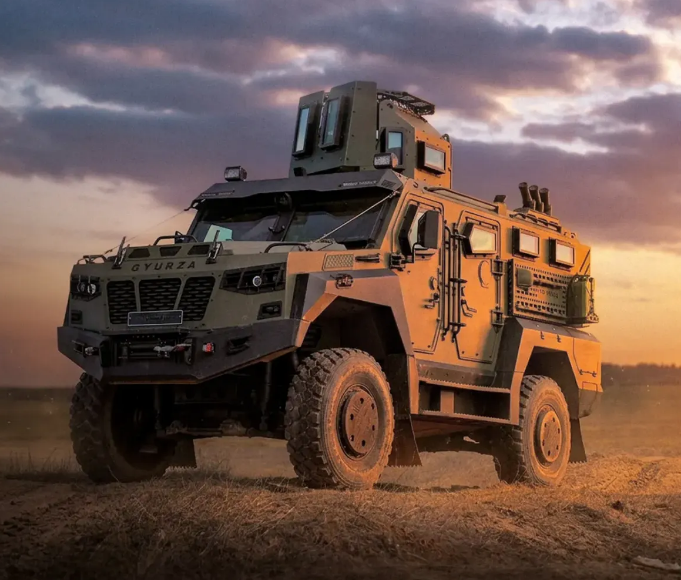
Ukraine's Gyurza-2 armored vehicle. Source: The Ukrainian Defense Ministry

Robots will not replace armored vehicles on the battlefield, says a company that builds both. Ground robots are a new tool that lets Ukraine distribute risk more smartly, but they cannot do everything a crewed armored vehicle can, above all pulling wounded soldiers out under fire, says Ukr Armo Tech's chief executive Hennadii Khirhii, in an interview with RBC-Ukraine.

Ukraine has a serious shortage of armored vehicles, from evacuation carriers to tracked fighting vehicles, with the focus shifting to hulls that offer heavy mine protection and built-in electronic warfare. For medical-evacuation armor alone, Khirhii says, the deficit is often put at 80 percent.

Robots can ease some of that, hauling ammunition and supplies to the front without risking a crew, but they are a complement, not a substitute, a view frontline commanders also confirm.

Robots share the load, not replace it

Where a robot can do the job, Khirhii says, there is no sense sending in heavy armor and the people inside it to face danger. For carrying ammunition or food, unmanned ground vehicles are useful. But evacuating the wounded is different: that usually needs, at least for the second leg, a protected medical vehicle in which care can begin on the move, with room for transfusions and resuscitation that a robot's capsule cannot provide.

"A UGV doesn't cancel the armored vehicle, just as the drone didn't cancel artillery," he says.

The limits show at evacuation

Ukraine has leaned hard into robotic logistics and casualty evacuation, running more than 100,000 such missions this year to keep medics and crews off exposed roads, but the robots themselves now draw Russian drone and artillery fire, and they cannot replace medical personnel.

One commander has called ground robots too slow for evacuation and easy targets, arguing brigades still need staffed evacuation teams and light-armored vehicles.

Commanders want both

The lesson from the front is not robots instead of armor, but robots alongside it. What matters, Khirhii says, is a smart combination of machines for each mission, with people's safety and the task's practicality first. The front today needs both armored vehicles and ground robots, he continues, and it needs a great amount of both.

Ukrainian combat simulator, used to train more than 500,000 troops, can now be ordered from NATO’s supply catalogs by single code

30 septembre 2026 à 15:12

L7 founder Ihor Bielov. Source: L7 Simulators

A Ukrainian combat simulator can now be found and ordered in NATO's supply catalogs by a single code. L7 Simulators, whose trainers have prepared more than 500,000 Ukrainian troops, has had its entire lineup NATO-codified, with each device assigned a 13-digit NATO Stock Number, Defender Media reports.

L7's more than 50 trainers, from the Browning M2 to the Stinger to the NLAW, now carry those codes, and the company can codify new ones itself, opening the door to government procurement in Ukraine and across the alliance. It is another Ukrainian defense maker stepping toward NATO's standards and supply chain.

Every trainer gets a NATO number

A NATO Stock Number is a unique 13-digit code, a kind of military barcode for supplies, that lets defense logistics systems across the alliance identify, catalog, and purchase equipment. Every simulator in L7's catalog now has one, and the firm has also won the status to assign numbers to its future products directly, rather than starting the process over for each one.

The code identifies, not certifies

The company is careful about what the step does and does not mean. Codification is not a certification that the product meets NATO's technical standards, L7 stresses, but rather a mechanism for unambiguously identifying an item within the shared defense-logistics system.

The firm entered that system in December 2024, when its UNITS training platform, already cleared for use by Ukraine's Defense Ministry, received the first number.

Half a million have trained on them

L7's range runs to more than 50 types of trainers, tied together in a single ecosystem the company calls UNITS: fire-training systems, anti-tank and air-defense simulators, and trainers for unmanned aircraft, with models for the Stinger, NLAW, Carl Gustaf, RPG-7, and SPG-9 among them.

The simulators are used by the armed forces, the National Guard, and other security agencies, and more than 500,000 service members have trained on them, with over 70,000 of them free of charge at the company's own training center.

  • ✇Euromaidan Press
  • Most drone interceptors ram or explode. This Ukrainian one just throws a net—six shots to a module
    A Ukrainian defense company has shown a new way to knock FPV drones out of the sky, unveiling a net-firing interceptor at the IT Arena tech conference in Lviv, dev.ua reported. The system, called Mangal and developed by Phantom Defense, is still a prototype—the company says the first production units could reach the market in a few months. Ukraine's counter-drone work has turned into a crowded contest, with firms racing to field jammers, interceptor drones, and net-throwers that can blu
     

Most drone interceptors ram or explode. This Ukrainian one just throws a net—six shots to a module

30 septembre 2026 à 06:31

Modular FPV drone interceptor “Mangal” by Phantom Defence. September 2026.

A Ukrainian defense company has shown a new way to knock FPV drones out of the sky, unveiling a net-firing interceptor at the IT Arena tech conference in Lviv, dev.ua reported. The system, called Mangal and developed by Phantom Defense, is still a prototype—the company says the first production units could reach the market in a few months.

Ukraine's counter-drone work has turned into a crowded contest, with firms racing to field jammers, interceptor drones, and net-throwers that can blunt Russia's growing use of cheap FPVs.

What Mangal does

Phantom Defense designed the modular launcher to defend positions, vehicles, and other targets against enemy drones. It fires a special net weighted with sinkers. The net opens the moment it fires, tangling the drone and dragging it down. One module holds six charges. Two cameras give the crew a clearer view, and the system can detect targets on its own, which speeds up how fast an operator spots a threat. Crews can fix Mangal in place to guard checkpoints, trenches, or infrastructure, or bolt it onto a vehicle.

Why a net

FPV drones—aircraft a pilot flies straight into a target—have become a routine danger along the front. A small, fast drone is hard to hit with a single round. A net spreads as it travels, so it is more forgiving to aim. Neither Phantom Defense nor the outlets covering the launch have said how far Mangal's net can reach.

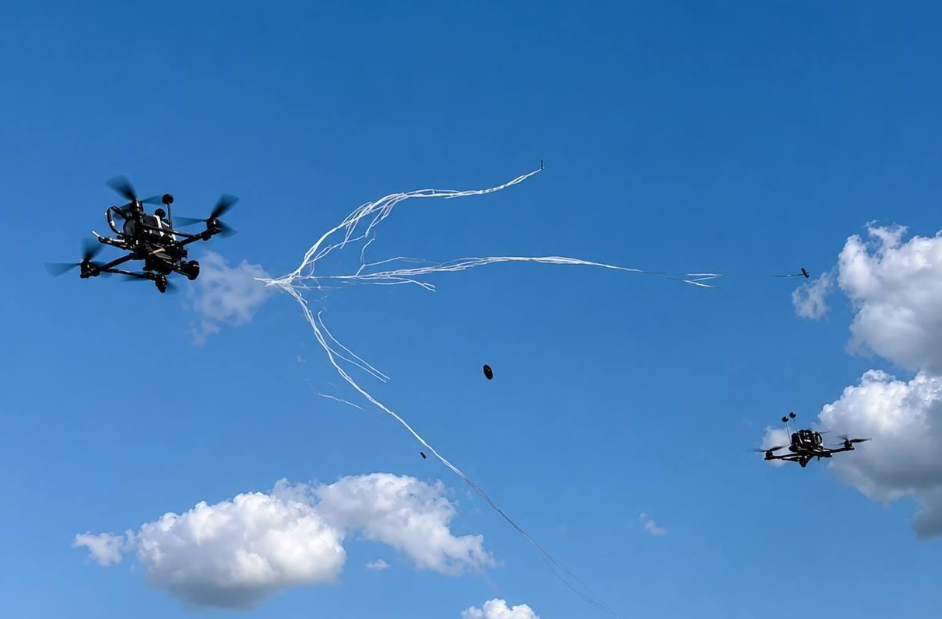
he Ukrainian company WINFLY unveiled the WINFLY Spider, an interceptor equipped with a net-launcher. Source: Militarnyi
Explore further

Ukraine’s newest interceptor doesn’t ram its target. It nets it for $27, then flies home to catch another

Other net-based counters

Other developers are turning to nets too. The WINFLY Spider is an interceptor drone that snares a target in a net and returns to its launch point intact, at about $27 a shot. That lets one aircraft make repeated intercepts instead of being spent on a single kill. Scan Horizon comes from Postup Solutions, a firm registered in Wrocław, Poland, and pairs a net launcher from Ukrainian company Ptashka Drones. Its net reaches about 30 meters. Contra Drone, meanwhile, has shown interceptor missiles that can reportedly carry net warheads alongside other options.

❌