Vue normale

  • ✇Euromaidan Press
  • Russian propagandists fake Polish newspaper claiming Ukraine faces famine
    Russian propagandists used the Matryoshka disinformation network to circulate a digitally altered front page of the Polish regional weekly Przegląd Regionalny warning of a “hungry fall and winter” in Ukraine, the country’s Center for Countering Disinformation reported. The fake turns genuine anxiety over Russian attacks on warehouses and food logistics into an unsupported prediction of mass starvation. The Center said Matryoshka routinely disguises fabricated material a
     

Russian propagandists fake Polish newspaper claiming Ukraine faces famine

2 septembre 2026 à 10:08

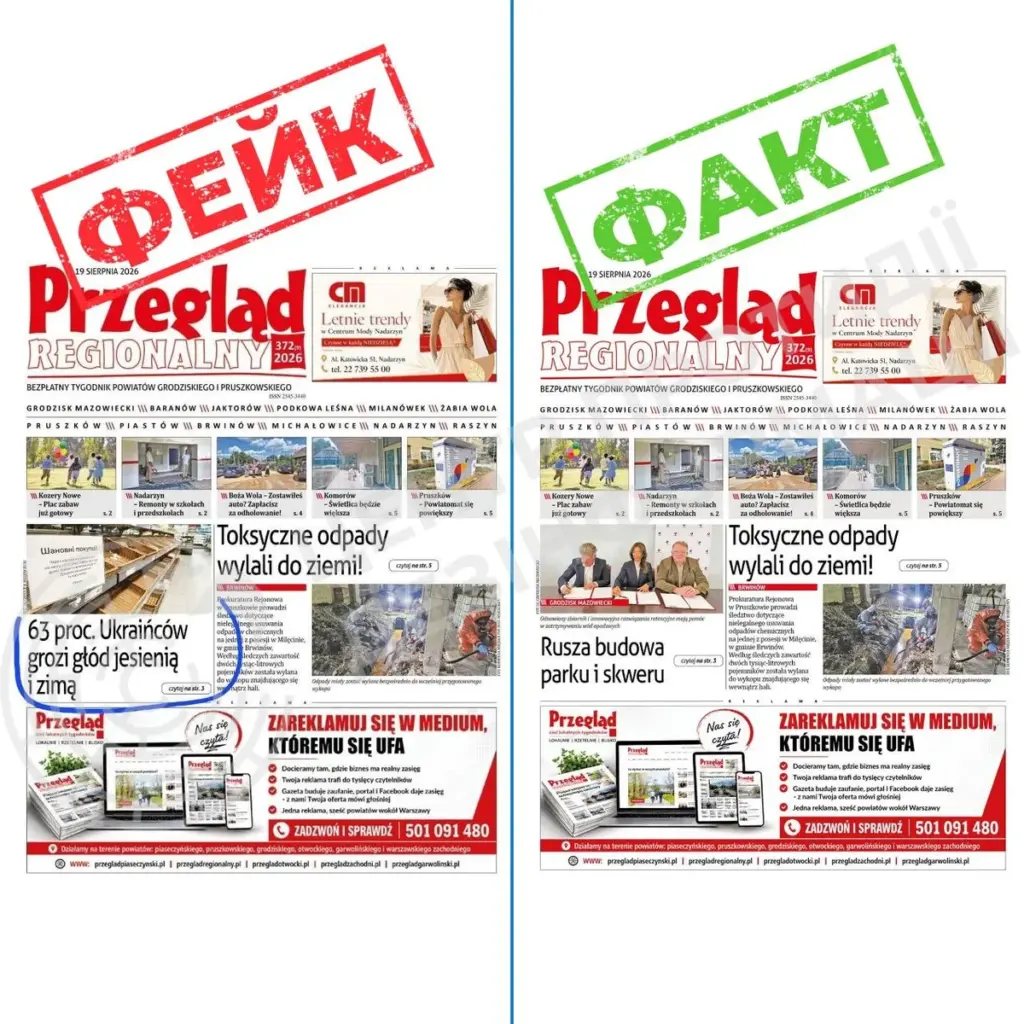
Side-by-side comparison of a fabricated Polish newspaper front page claiming 63% of Ukrainians face hunger and the genuine front page without the claim.

Russian propagandists used the Matryoshka disinformation network to circulate a digitally altered front page of the Polish regional weekly Przegląd Regionalny warning of a “hungry fall and winter” in Ukraine, the country’s Center for Countering Disinformation reported.

The fake turns genuine anxiety over Russian attacks on warehouses and food logistics into an unsupported prediction of mass starvation. The Center said Matryoshka routinely disguises fabricated material as reporting by established Western outlets, lending Russian narratives borrowed credibility while creating the impression that foreign media consider Ukraine’s situation hopeless.

The fabricated Przegląd Regionalny front page claimed Russian strikes would push 63% of Ukrainians to the brink of famine over a “hungry autumn and winter.” No such article ran—the real front page of that issue looked entirely different, and the circulated image was built using graphics-editing software, the Center said.

The image spread through Matryoshka, a network that dresses invented content in the mastheads of recognized Western outlets. In this case, the campaign was meant to frighten Ukrainians and weaken public confidence, according to the Center.

Although it impersonated a Polish outlet, the Center described Ukrainians—not Polish readers—as the campaign’s target: the Polish masthead supplied an apparently independent foreign voice for a Russian narrative.

The fake works because the disruption it points to is real. Russian attacks on warehouses and food logistics had destroyed up to 90% of Ukraine’s modern food storage capacity, and suppliers were moving stocks and changing delivery routes and storage methods in response, Agriculture Minister Taras Vysotskyi said on 28 August 2026, according to Interfax-Ukraine.

Supermarket chain ATB has temporarily capped purchases of certain essential goods at 6 units of any single product per customer, citing both Russian strikes and resellers buying in bulk.

What the fake predicts, though, is not what officials expect. Presidential defense-technology adviser Serhii “Flash” Beskrestnov urged Ukrainians not to panic and said a systemic food shortage was not expected, ZN.UA reported.

How Russia spreads disinformation in Poland

Russia has repeatedly exploited Poland’s information space to turn political, economic, and security anxieties against Ukraine. Polish Deputy Prime Minister Krzysztof Gawkowski said Russian intelligence had offered Poles €3,000–€4,000 ($3,500–$4,600) to spread disinformation before the 2025 presidential election.

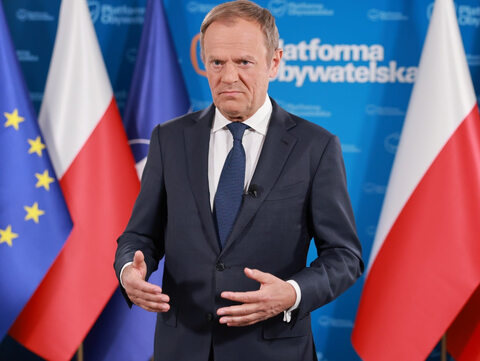
After Russian drones entered Poland that September, Prime Minister Donald Tusk said the Kremlin was using real fears and emotions to fuel anti-Ukrainian sentiment. False claims about Ukrainians living off Polish taxpayers have also fed hostility as bilateral relations frayed.

  • ✇Euromaidan Press
  • A masked figure got into a Polish drone-parts plant—Poland now suspects a foreign spy service set the fire
    A fire at a Polish plant that makes drone parts for Ukraine's and Poland's militaries is being investigated as possible sabotage by a foreign intelligence service, Militarnyi reported. Poland's National Prosecutor's Office opened the case on two counts: foreign-intelligence activity against the country and a terrorist offense. Fires and break-ins like this fit a widening pattern — the factories and supply lines that keep Ukraine armed are increasingly targets far from t
     

A masked figure got into a Polish drone-parts plant—Poland now suspects a foreign spy service set the fire

2 septembre 2026 à 09:13

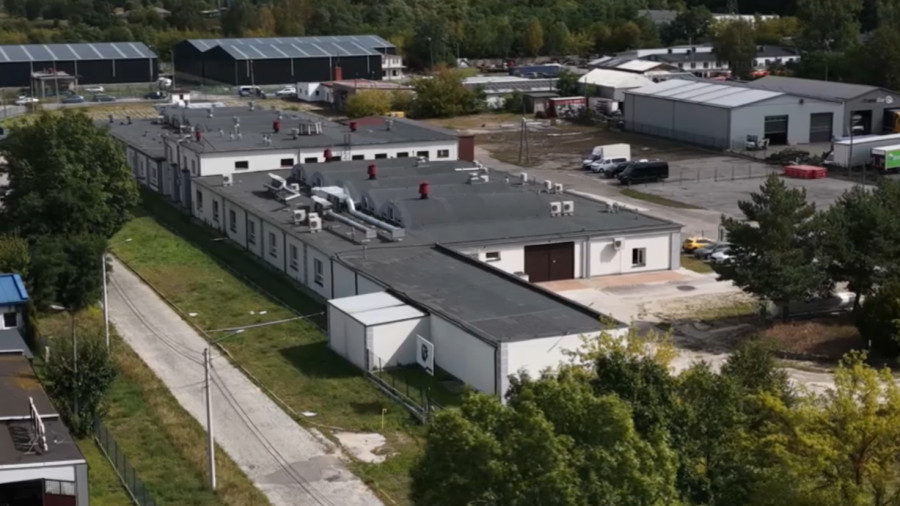
View of the WB Group factory building in Skarżysko-Kamienna, Poland. August 2026.

A fire at a Polish plant that makes drone parts for Ukraine's and Poland's militaries is being investigated as possible sabotage by a foreign intelligence service, Militarnyi reported. Poland's National Prosecutor's Office opened the case on two counts: foreign-intelligence activity against the country and a terrorist offense.

Fires and break-ins like this fit a widening pattern — the factories and supply lines that keep Ukraine armed are increasingly targets far from the front line. Across the continent, prosecutors keep opening the same kind of arson case against plants tied to Ukraine's defense.

A masked intruder and a two-hour fire

The fire started shortly after midnight on 31 August in the assembly hall of the WB Electronics plant in Skarżysko-Kamienna and spread to the storage rooms. Five crews put it out in under two hours. No one was hurt, but the storage rooms were destroyed, leaving at least 15 million zloty ($4 million) in damage. The plant had no permanent guards on site; a security company monitoring it remotely reported the fire.

Prosecutors say the blaze was set deliberately with a planted charge of flammable material, and no one has been charged. Security cameras recorded a masked person who climbed a fence and got onto the site.

Why Poland is looking at Moscow

Czesław Mroczek, deputy head of Poland's Interior Ministry, told RMF FM radio that many signs point to arson, and that a Russian trail is the obvious inference. An attack on the defense industry can suggest Russian involvement, he said, since European states have faced sabotage for years while backing Ukraine. Mroczek said protection plans for key defense plants must be richer than what this site had. No one has been detained, and investigators are still tracing how the intruder got in and who may have ordered it.

tusk polish prime minister
Explore further

After CIA head’s visit to Moscow, Poland’s PM warns Russia is preparing to escalate war. He puts critical window at seven or eight months

What the plant actually makes

WB Electronics is the core of WB Group, Poland's biggest private arms holding, whose firms build reconnaissance and strike drones such as the FlyEye and the Warmate. The Skarżysko-Kamienna site itself makes drone components for unmanned systems, used by both Polish and Ukrainian forces. Ukraine received FlyEye drones back in 2022 under its Army of Drones program, and in 2025 WB Group launched drone production inside Ukraine.

❌