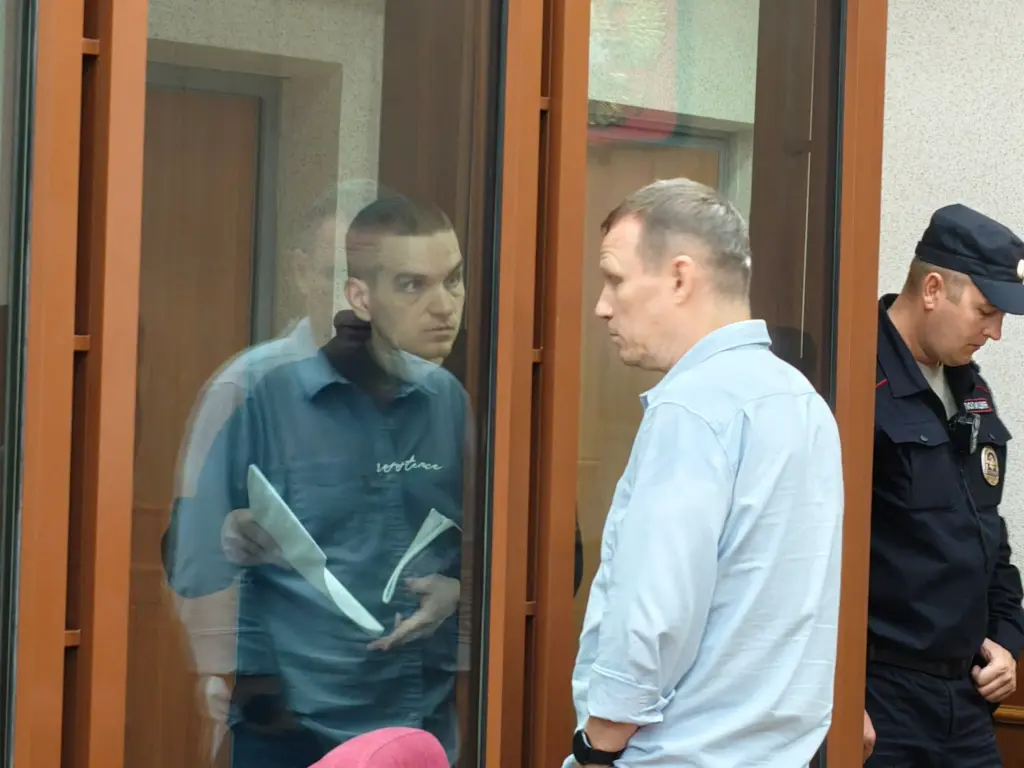
The Sverdlovsk Regional Court sentenced Ivan Stolbov, a 34-year-old Russian citizen who lived in Ivano-Frankivsk, Ukraine, to 13 years in a high-security penal colony.
The court sentenced Stolbov over 11 alleged donations of about 100 hryvnias (about $2.23) each to an unidentified Ukrainian organization, Mediazona reported on 10 August 2026. Born in Sarapul, Russia, Stolbov worked as a procurement manager before his arrest.
Since 2022, Russian courts have imprisoned
The Sverdlovsk Regional Court sentenced Ivan Stolbov, a 34-year-old Russian citizen who lived in Ivano-Frankivsk, Ukraine, to 13 years in a high-security penal colony.
The court sentenced Stolbov over 11 alleged donations of about 100 hryvnias (about $2.23) each to an unidentified Ukrainian organization, Mediazona reported on 10 August 2026. Born in Sarapul, Russia, Stolbov worked as a procurement manager before his arrest.
Since 2022, Russian courts have imprisoned Russians and Ukrainians under treason, terrorism, and other national-security laws over donations to Ukrainian causes. Penalties depend on the charge: high treason, used against Stolbov, has a 12-year minimum. The Kharkiv Human Rights Protection Group (KHPG) reports that Russian officials threaten up to eight years in prison for donations to organizations Moscow labels extremist, regardless of the amount (this includes Ukrainian organizations).
Authorities detained him at Yekaterinburg's Koltsovo International Airport in July 2025. Stolbov had traveled to Yekaterinburg to visit relatives.
The verdict said he was not registered in Russia. Court records reviewed by Mediazona showed that Stolbov then received three consecutive administrative arrests, two imposed as he left the detention center, before prosecutors filed the treason charge.
KHPG has reported cases in which Russian authorities used surveillance to detect such transfers.
KHPG has documented defendants ranging from teenagers and pensioners to travelers and residents of occupied Ukraine.
Small transfers, decade-long sentences
Stolbov’s case is one of several in which Russian courts have imposed decade-long terms over alleged donations to Ukraine.
Two women from Russian-occupied Enerhodar received 14 years each after allegedly transferring $120 and $57 to Ukrainian forces.
In May, a Russian court sentenced Ukrainian citizen Polina Kuzmina to 12 years and Russian citizen Vladimir Grabovetsky to 14 years. Prosecutors accused them of making 78 transfers to fund Ukraine’s Armed Forces.
KHPG documented a 14-year sentence for a Melitopol mother of two over alleged donations to Ukraine’s military and the Freedom of Russia Legion. KHPG also reported that Viktor Nikitenko, 58, received 12 years for alleged transfers and Ukrainian war bonds.
Stolbov’s 13-year term sits just above the minimum for high treason under Russian law. Article 275 provides for 12 to 20 years or life imprisonment.
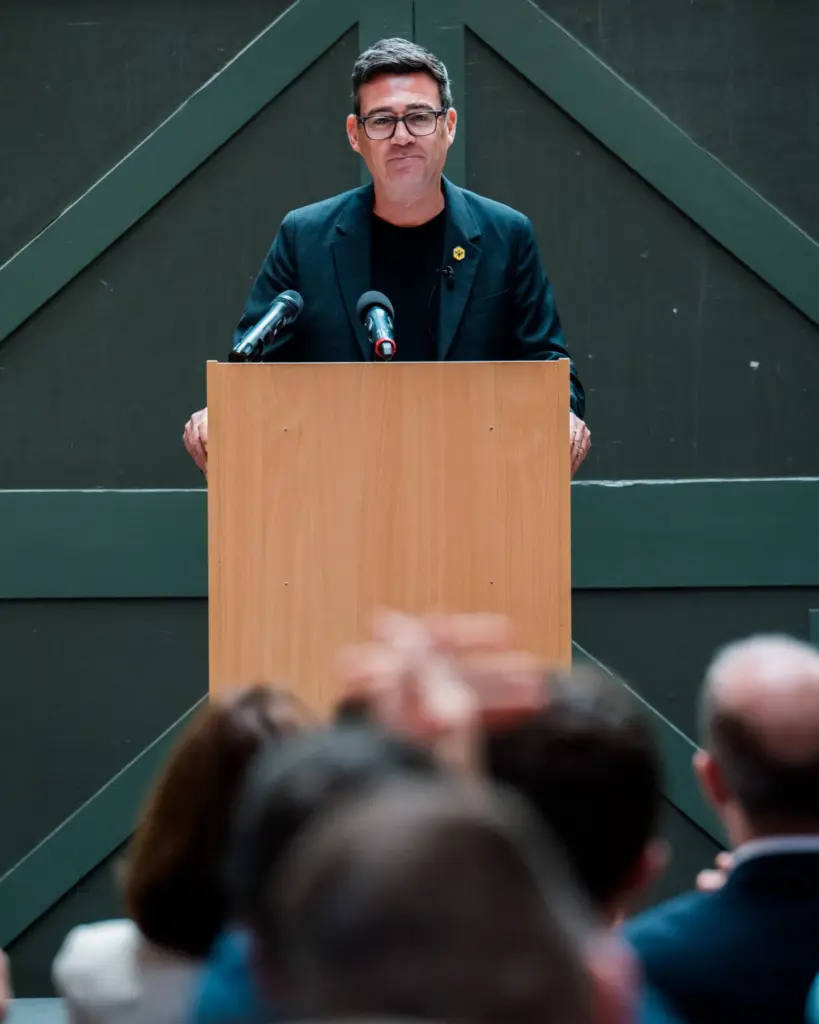
A plan presented to the UK's new Prime Minister, Andy Burnham, would extend Britain's nuclear umbrella to Ukraine and other non-NATO European states. In exchange, Britain would regain access to the EU single market for goods, The Telegraph reported on 9 August.
The proposal comes as European governments question whether they can rely on US protection and struggle to turn moral support for Ukraine into troops and weapons. Russia's invasions, despite the assurances Kyiv r
A plan presented to the UK's new Prime Minister, Andy Burnham, would extend Britain's nuclear umbrella to Ukraine and other non-NATO European states. In exchange, Britain would regain access to the EU single market for goods, The Telegraph reported on 9 August.
The proposal comes as European governments question whether they can rely on US protection and struggle to turn moral support for Ukraine into troops and weapons. Russia's invasions, despite the assurances Kyiv received from the US and the UK when it surrendered its nuclear arsenal under the Budapest memorandum, have also revived calls for nuclear-backed guarantees.
Former Conservative MP Nick Boles drafted the plan. He proposes a "European Confederation" that combines single-market access with NATO-style mutual defense commitments.
For Ukraine, it would provide protection modeled on NATO Articles 4 and 5 while Kyiv pursued full EU membership.
Ukraine would maintain a large army as Europe's bulwark against Russia and share defense technology with other members of the Confederation. Britain would raise defense spending to 3.5% of GDP, while both countries would gain full access to the EU's single market for goods.
Boles said Europe needed a new security model because neither US President Donald Trump nor a future US president could be guaranteed to "defend Europe as if it were Kansas."
Boles's plan is not Burnham government policy. Nevertheless, it has circulated among officials, including National Security Adviser Jonathan Powell, as London considers deeper cooperation with the EU.
Britain's support bumps against Europe's political limits
Prime Minister Burnham entered Downing Street as a firm supporter of Ukraine. He assured Ukrainian President Volodymyr Zelenskyy that British support remained unchanged and pledged to preserve aid levels.
Britain also co-leads with France the Coalition of the Willing, which plans to deploy forces in Ukraine after a ceasefire to deter another Russian attack.
The Coalition has brought together representatives of 40 countries. Still, members remain divided over how far to support Ukraine.
Britain and France have formally declared their intention to deploy forces after a potential ceasefire in Ukraine. Yet Poland offered logistical support but ruled out troop deployment, while Bulgaria has withdrawn from the Coalition. Europe has promised deterrence, but key deep-strike missiles may not arrive until 2029.
Boles's plan would pair Britain's nuclear deterrent with Ukraine's conventional military strength. Unlike the Coalition’s voluntary plans, Boles's proposed European Confederation would place its defense guarantees in a treaty. NATO would initially be responsible for carrying them out.
From surrendered weapons to a nuclear shield
Ukraine inherited the world's third-largest nuclear arsenal after the Soviet collapse, including about 1,900 strategic warheads.
Kyiv relinquished them under the 1994 Budapest Memorandum after receiving security assurances from Russia, Britain, and the US. Despite these promises, Russia invaded Ukraine in 2014 and launched its full-scale war in 2022.
Russia's invasions have revived calls among Ukrainian lawmakers for nuclear-backed security guarantees. Politician Roman Kostenko has called for guarantees that could include British and French nuclear retaliation in the event of another Russian attack.
Under Boles's proposal, Ukraine would not regain its own warheads. It would instead come under Britain's nuclear shield.
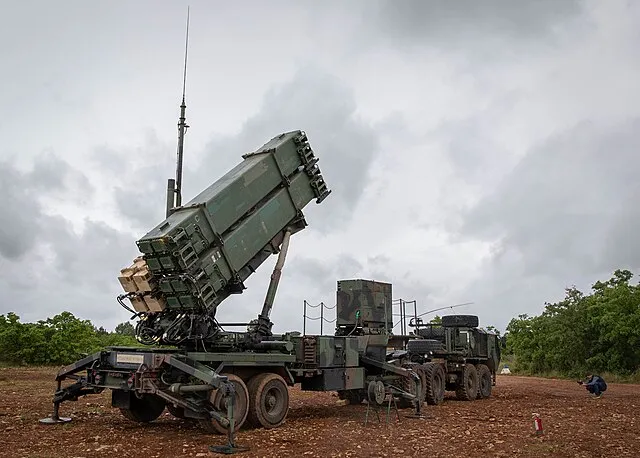
An unnamed Republican official in Washington said fears of Ukrainian competition may be obstructing a Patriot license, The Atlantic reported on 9 August. RTX’s Raytheon and Lockheed Martin may worry Ukraine would improve Patriot interceptors and make them faster and cheaper than US production lines, he said.
The official said the manufacturers would frame their concerns around intellectual-property theft and technology transfer. Their deeper concern, he claimed, is that
An unnamed Republican official in Washington said fears of Ukrainian competition may be obstructing a Patriot license, The Atlantic reported on 9 August. RTX’s Raytheon and Lockheed Martin may worry Ukraine would improve Patriot interceptors and make them faster and cheaper than US production lines, he said.
The official said the manufacturers would frame their concerns around intellectual-property theft and technology transfer. Their deeper concern, he claimed, is that Ukraine could eventually outcompete them. Neither company has publicly confirmed that motive.
Meanwhile, Russia’s missile threat is growing. July was Ukraine’s deadliest month for civilians since 2022, while Moscow can reportedly launch 77 ballistic and cruise missiles at once and aims to raise that capacity to 200. Ukrainian intelligence separately said Russian plants reached 110–120% of their July missile-production targets and are unlikely to pause their attacks.
Why the Patriot license remains unfinished
US President Donald Trump promised the license at NATO’s 8 July summit. Yet Lockheed Martin and RTX had not been informed, and by 23 July, both described the process as only beginning.
On 8 August, Ukrainian President Volodymyr Zelenskyy said Trump had agreed to grant Ukraine Patriot production licenses, but paperwork was delaying their issuance.
Current interceptor supplies are also failing to keep pace with Russian attacks. After a 5 August strike killed 17 people, Zelenskyy said Ukraine had received three times fewer anti-ballistic missiles since the beginning of 2026. He suggested the reduction might partly be intended to make Kyiv more compliant.
At their 28 July White House meeting, Zelenskyy asked Trump for 300 Patriot interceptors before winter, Axios reported. Trump declined, citing depleted US stocks and demand for interceptors in the Middle East.
Why Ukraine might look like a competitor—and why it is also part of the solution
Ukraine’s expanding defense industry is testing Western allies’ willingness to strengthen a potential competitor.
In January, French President Emmanuel Macron warned that French arms manufacturers faced “fierce competition” from Ukrainian and other European rivals. By July, Le Monde reported that many European allies remained torn between helping Ukraine and creating a new continental competitor.
Yet Kyiv has also proven willing to cooperate with its partners on mutual defense. Ukrainian military specialists have already helped the US counter Iranian-designed Shahed drones and protect American bases in the Middle East. After Washington requested assistance in March, Kyiv sent interceptor drones and military specialists to Jordan the following day.
Kyiv has also spearheaded the ten-country FREYJA initiative, combining Ukrainian launchers and interceptors with European radars and sensors to counter Russian ballistic missiles. Zelenskyy said the system could eventually protect countries across Europe.
Industrial cooperation extends to the Pentagon’s Drone Dominance Program. Kyiv approved its first export of finished combat drones after F-Drones’ F10 placed sixth among 25 competitors. The company won a prototype order for 2,000 drones and plans to open a factory in Ohio.
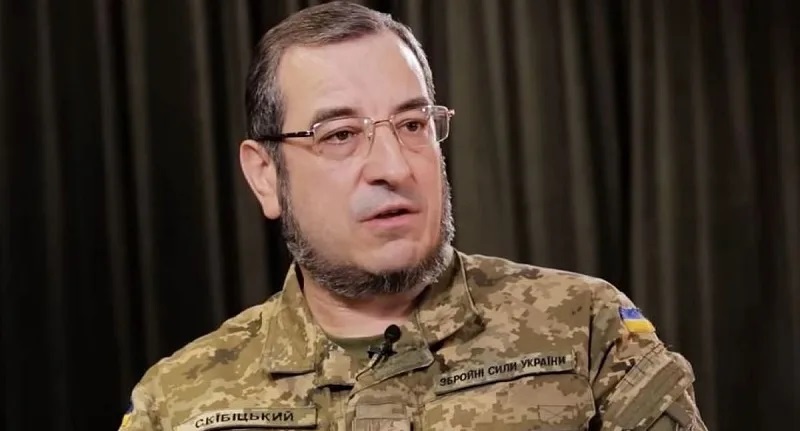
Russia fired 198 ballistic and hypersonic missiles at Ukraine in July, its highest monthly total of 2026, alongside 153 cruise missiles, as its factories ran their main missile lines at 110 to 120% of plan, the deputy head of Ukraine's Defense Ministry intelligence directorate (HUR), Major General Vadym Skibitskyi, told RBC-Ukraine in an interview published on 10 August.
The volume reflects a production run, not a drawdown of reserves. Moscow has spent recent months bui
Russia fired 198 ballistic and hypersonic missiles at Ukraine in July, its highest monthly total of 2026, alongside 153 cruise missiles, as its factories ran their main missile lines at 110 to 120% of plan, the deputy head of Ukraine's Defense Ministry intelligence directorate (HUR), Major General Vadym Skibitskyi, told RBC-Ukraine in an interview published on 10 August.
The volume reflects a production run, not a drawdown of reserves. Moscow has spent recent months building and firing more of exactly the weapons most likely to penetrate Ukrainian defenses, as Kyiv runs short of the Patriot interceptors that are its only reliable counter to ballistic missiles. On 5 August, Ukraine failed to intercept any of 28 Russian missiles, including 24 ballistic ones.
Launches climbed through the summer
Ballistic launches rose steadily before July's peak: 61 in April, 107 in May, and 134 in June, Skibitskyi said. Attack intervals shortened from roughly one strike every 10 days to weekly, then tighter. "Everything depends on the quantity of weapons produced," he said.
Russia is meeting its monthly plans for the main missile types at 110 to 120% and, by 3 August, had already fulfilled its full-year plan for the Zircon hypersonic and modernized Onyx missiles, building 33 Zircons and 60 Onyx in seven months. That output, Skibitskyi said, makes a lasting pause in strikes unlikely.
A downed Russian Kh-101 missile. Illustrative photo by Ukraine's Air Force
Plans overfulfilled, reserves untouched
Output for individual systems ran well above target. The July plan for the Kh-101 cruise missile was met at 140%, the Kalibr at 111%, and the Kh-35 at 200%, according to HUR figures. In absolute terms, Russia planned 72 Kh-101s and built 87. It planned 26 Kalibrs and built 29.
Its stockpile of 9M723 ballistic missiles for the Iskander-M stood at about 130 as of 5 August, against a monthly plan of 60, though July output reached 65, Skibitskyi said. For the RM-48U, a Mach 6 surface-to-surface missile launched from the S-400, the August plan is about 40 units on estimated reserves of 400.
"They are not really going into reserves. Right now almost everything for use comes off the assembly line," Skibitskyi said.
An Iskander-M short-range ballistic missile launcher with its missile raised, at the Army-2016 military expo near Moscow, Russia, 8 September 2016. Photo: Vitaly V. Kuzmin
Newly built Kalibrs now largely go to equip Russia's new warships and submarines, he added, and Ukraine intercepts nearly all the Kalibrs fired when it has the surface-to-air missiles to do so.
Kinzhal and Kh-32 output halted since April
Part of the ballistic surge came from stopping other programs. Russia suspended production of the hypersonic Kinzhal and the Kh-32 cruise missile in April, redirecting their propellant and components to missiles it considers more effective, Skibitskyi said. The Kh-32, a modernized Kh-22, had failed repeated attempts to improve its accuracy and was returned to development.
The Kinzhal has a similar problem.
"We can hardly recall a case when this missile hit the target precisely," Skibitskyi said. "For an effective missile the deviation from the target should not exceed 5 to 7 meters, and theirs is 30 meters and more."
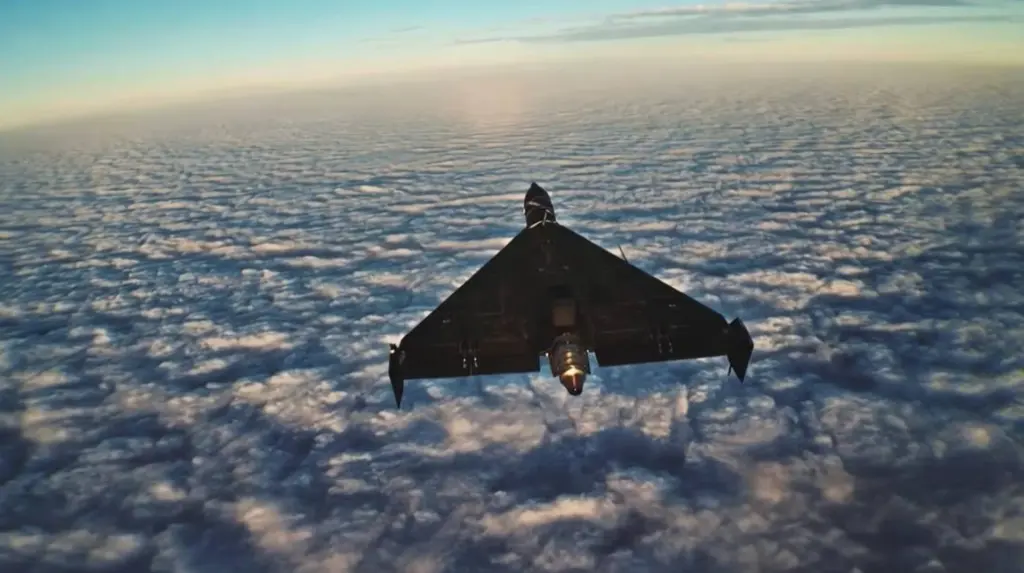
The Geran-3 jet-powered Russian attack drone. (Photo: Wild Hornets)
A shift to jet-powered drones
Russia's August plan for strike drones, across the Geran, Gerbera, and Harpia families, is 11,000 units, Skibitskyi said. Production dipped in July as plants retooled toward the turbojet Geran-4 and Geran-5, which already made up half of one recent attack and require faster interceptors to stop.
The engines remain a bottleneck. Russia depends on China for the turbojets, pays about $35,000 to $40,000 apiece, and is trying to build its own, Skibitskyi said.
Targets: defense plants, logistics, and Black Sea shipping
Russia concentrates its strikes on Ukraine's defense-industrial complex, centered on Kyiv, Zaporizhzhia, Dnipro, and Kharkiv, and on logistics, including railways, ports, and shipping, Skibitskyi said. He described a methodical campaign against civilian vessels in the Black Sea: "This is an unprecedented situation, when civilian vessels are not simply struck but methodically finished off and destroyed, to deny us the ability to conduct trade."
Energy sites tied to ports and logistics are also targeted, he said, along with other infrastructure meant to sow panic and destabilize the country.
North Korea, Iran, and a Starlink analog
North Korea has transferred 40 more KN-23 and KN-24 missiles after an initial batch of about 100, Skibitskyi said. One recent North Korean missile strayed roughly 15 kilometers from its target and killed a family. Iranian cooperation has narrowed since 2022 and 2023, as Russia now builds its own strike and FPV drones.
Moscow is also fielding Rassvet, a Russian analog of Starlink, faster than planned. Sixteen satellites reached orbit in March 2026, with a planned constellation of 292 by 2027 and 924 by 2035. For now, it works only in fragments, as each satellite passes over Ukrainian territory.
A pause looks unlikely
Russia may cut the number of missiles sent at a single target but is unlikely to stop, Skibitskyi said. The tempo will depend above all on how much it can produce. "They will be able to reduce the number of missiles flying at one target, but they are unlikely to make a pause," he said.

 Connexion