Vue normale

Ukraine reported hitting warships and an oil terminal in a Russian port city whose mayor claimed only falling debris
9 septembre 2026 à 08:09

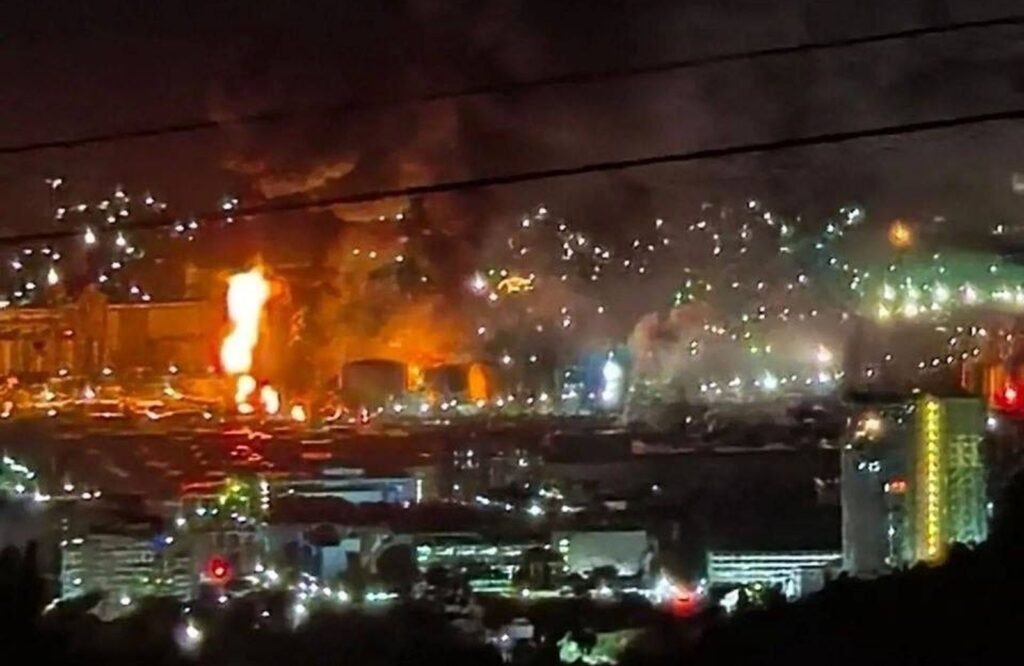
ukraine reported hitting warships oil-shipping terminal where local authority only fires falling debris · post fire port novorossiysk russia 9 2026 пожежа в порту новоросійська вересня джерело exilenova+ news ukrainian

Ukrainian drones set a fuel-oil terminal on fire in the port of Novorossiysk again overnight on 9 September, monitoring channels reported. Novorossiysk's mayor claimed drone debris came down on enterprise grounds in the Russian city. Ukraine's military later reported strikes on the naval base there, including on warships that carry cruise missiles.

Russia keeps attacking Ukrainian cities and the power grid with missiles and drones as winter closes in, and because Ukraine's air defenses cannot stop every ballistic salvo in its final seconds, the launch platforms and the fuel and export money that sustain them sit among the few targets Kyiv can act on directly.

Analysts placed the fire on a fuel-oil terminal

Ukrainian defense news outlet Militarnyi located the strike through geospatial intelligence (GEOINT) analysis, which matches published photos and video against satellite imagery and maps. That work showed drones hitting the mazut (fuel-oil) terminal inside the port in Krasnodar Krai. Fire broke out on the terminal grounds, and at least one storage tank took damage. Around midnight, residents began reporting the sound of drones overhead, Russian air defense fire, and explosions.
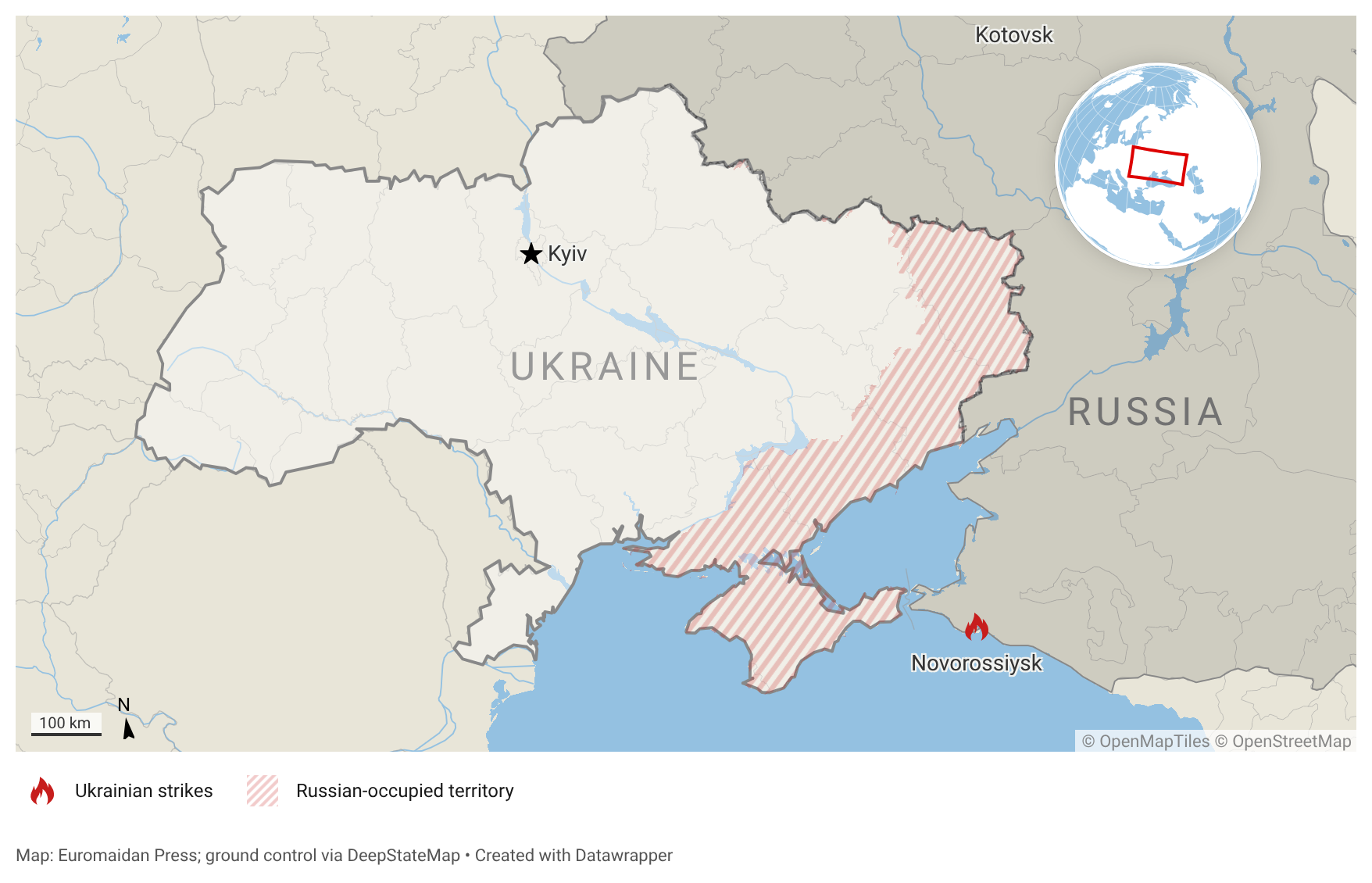
novorossiysk on the map

The Ukrainian Telegram channel Exilenova+ started posting videos of the attack on the port around midnight, further into the morning sharing more footage of the fire at the fuel-oil terminal. Russian news Telegram channel Astra wrote of fires on the grounds of several enterprises and near a residential building, with a column of dark smoke in eyewitness video. Its analyst then established from that footage that the burning object was the Novorossiysk Fuel Oil Terminal. Astra called the work open-source intelligence (OSINT) analysis, meaning conclusions drawn from publicly available imagery and records.

Satellites feeding NASA's Fire Information for Resource Management System (FIRMS), which flags heat sources from orbit, recorded several seats of fire in Novorossiysk after the night raid. An OSINT reading of eyewitness video also placed a fire at an apartment building in the city.

ukraine reported hitting warships oil-shipping terminal where local authority only fires falling debris · post geolocation strike port infrastructure novorossiysk russia 9 2026 based nasa firms data esri геолокація ураження
Geolocation of the strike on port infrastructure in Novorossiysk, Russia, 9 September 2026, based on NASA FIRMS data and an ESRI map. Map: Militarnyi

Novorossiysk mayor Andrei Kravchenko claimed overnight that air defenses were still fighting off the drone attack. He stated that drone debris had come down at several enterprises and near a residential building, and claimed that preliminary information showed no casualties. Kravchenko later acknowledged hits on enterprises while describing the cause as "falling debris."

Night fires in Novorossiysk during the UDF attack. pic.twitter.com/Jr85ypYrOz

— Exilenova+ (@Exilenova_plus) September 9, 2026

Ukrainian drones and missiles hit the same naval base overnight on 12 August, damaging Kalibr-carrying frigates and stopping all three of the port's grain terminals.

Ukraine's account named ships, the harbor, and the terminal

Robert Brovdi, callsign Madyar, commands Ukraine's Unmanned Systems Forces, the military branch that runs the country's drone units. He said Ukrainian Defense Forces struck the Russian naval base at Novorossiysk in a combined operation overnight, and that the Russians lost several military vessels there, missile carriers among them.

Ukrainian President Volodymyr Zelenskyy confirmed strikes on Novorossiysk and Krasnodar Krai around midday. He said Ukraine hit a terminal used for shipping oil, military harbor facilities, and warships, including carriers of Kalibr cruise missiles.

No independent assessment of damage to the vessels had emerged by midday, and Russia's defense ministry did not address the naval base.

Novorossiysk after the night attack. Locals report a large number of attackers at night, and the port infrastructure has been destroyed. pic.twitter.com/junTmDn0tp

— Exilenova+ (@Exilenova_plus) September 9, 2026

The port Ukraine keeps returning to

The targeted terminal stores and transships fuel oil, a heavy refinery product, along with light petroleum products, and its throughput runs to about 4 million tons a year. It belongs to the Novorossiysk Commercial Sea Port, the largest seaport in Russia, and counts among the leading enterprises of the city's transport hub.

Novorossiysk has come under repeated drone attack as one of Russia's biggest export gateways, whose work directly funds the war against Ukraine. Disruption there has already pushed oil supplies from Russia's western ports 15% below plan. Russia's fleet sheltered in the port after Ukrainian strikes pushed it out of occupied Crimea. Novorossiysk lies more than 300 km from the front line.

  • ✇Euromaidan Press
  • Ukraine’s prosecutor general resigns as the watchdogs he was appointed to leash close in
    Ukraine's Prosecutor General Ruslan Kravchenko resigned on 7 September, hours after publicly defending himself, as anti-corruption investigators closed in on an alleged criminal organization operating inside his own office. "I do not want the position of prosecutor general to be used as an instrument of political confrontation," Kravchenko said, announcing his departure on Telegram. "My position regarding the charges remains unchanged"—a denial he has held throughout, i
     

Ukraine’s prosecutor general resigns as the watchdogs he was appointed to leash close in

8 septembre 2026 à 12:40

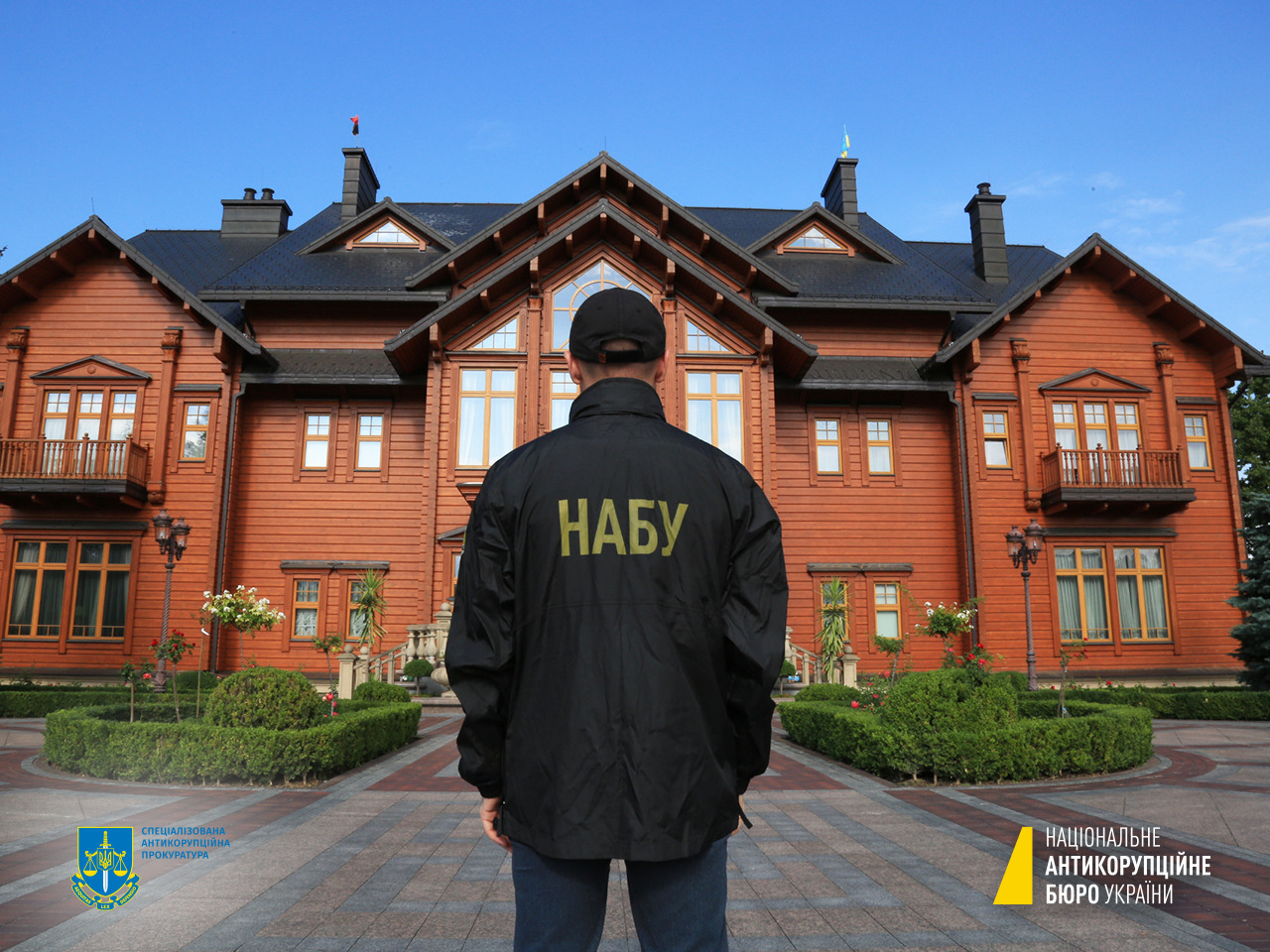
Ukraine's Prosecutor General Ruslan Kravchenko has resigned. Photo: Facebook

Ukraine's Prosecutor General Ruslan Kravchenko resigned on 7 September, hours after publicly defending himself, as anti-corruption investigators closed in on an alleged criminal organization operating inside his own office.

"I do not want the position of prosecutor general to be used as an instrument of political confrontation," Kravchenko said, announcing his departure on Telegram. "My position regarding the charges remains unchanged"—a denial he has held throughout, including in a 6 September statement rejecting any role in protecting the call centers.

President Volodymyr Zelenskyy confirmed the resignation on the evening of 7 September. "I had a fairly long meeting with the prosecutor general; he submitted the relevant resignation letter, and the submission will be sent to the Verkhovna Rada," Zelenskyy said, adding that he had spent the day on personnel matters and had also met the heads of the National Anti-Corruption Bureau (NABU) and the Specialized Anti-Corruption Prosecutor's Office (SAPO). The resignation is not final until parliament acts on it.

It reads as a scandal. It is closer to the opposite.

Kravchenko was appointed in June 2025, as the anti-corruption agencies were pressing toward figures close to the president—and his appointment came alongside the draft law, No. 12414, that would have put NABU and SAPO under his control. That law triggered the first street protests since Russia's invasion; within ten days, parliament reversed the part stripping the agencies' independence.

The provisions handing Kravchenko a personnel monopoly over the prosecution service were never repealed.

national anti-corruption bureau of Ukraine
Explore further

Ukraine’s anti-corruption cops just beat the president—but the fight’s not over

Since then, those agencies have forced out Andriy Yermak, the second-most-powerful man in the country. Now they have reached the prosecutor general—whose office kept, even after the capture law was reversed, a personnel monopoly over the prosecution service.

The corruption is not new. What is new is that it is being caught, and that being caught now costs the powerful their offices. The story of the past year is not that Ukraine is coming apart, but that its watchdogs have stopped being toothless.

What Operation Carthage found

On 5 September, NABU and SAPO announced they had uncovered a criminal organization run, investigators say, by a department head inside the Prosecutor General's Office. Its members allegedly took regular bribes from fraudulent call centers—operations that defraud victims in Ukraine and abroad—in exchange for shielding them from prosecution, then laundered the money through property, assets registered to other people, and associates' bank accounts.

The group was formed in mid-2025 and recruited serving prosecutors and associates, NABU and SAPO said. Over 20 million hryvnias (about $449,000) went on property, jewelry, and other high-value assets, according to NABU.

NABU described the organization as run by the head of a department inside the Prosecutor General's Office. Sources told Ukrainska Pravda that the official is Serhii Kropyva, deputy head of the office's International Legal Cooperation Department. He was remanded in custody on 6 September with bail set at 120 million hryvnias (about $2.7 million).

In recordings released by NABU, a figure using the codename "Chancellor," reported to be Kropyva, is described as protected by a "boss." Two details identify that boss: the patronymic "Andriiovych," and a previous job leading the State Tax Service. Ruslan Andriiovych Kravchenko ran the State Tax Service from December 2024 until he became prosecutor general in June 2025. The investigation understands the "boss" to be Kravchenko, the Kyiv Independent reported.

NABU has not publicly named Kravchenko as a suspect. He denies instructing anyone to protect illegal call centers or using his office to shield them. He resigned nonetheless.

nabu
Explore further

Ukraine’s anti-corruption agencies target Prosecutor General’s Office official linked to fraudulent call centers

The searches, and the surveillance files

NABU searches also reached the offices of Kravchenko himself, his deputy Mariia Vdovychenko, and the head of the Odesa Regional Military Administration, Oleh Kiper. Kravchenko defended the handling of those searches at a 7 September press conference—the same day he resigned.

The investigation into the Prosecutor General's Office is the latest in a widening confrontation between Ukraine's anti-corruption bodies and the institutions around the presidency. When NABU announced the case, it described a senior official running a criminal ring from inside the office meant to prosecute exactly such crimes.

Why it matters

The Prosecutor General's Office is one of the institutions Kyiv relies on to supervise—and, critics say, to restrain—NABU's investigations into figures close to the president. That an investigation reached the prosecutor general himself is a measure of how far the anti-corruption bodies have pushed against that restraint, not a sign they have failed.

It caps a run of accountability cases since July 2025 that would have been unthinkable earlier in the war.

In June 2025, NABU charged Deputy Prime Minister Oleksiy Chernyshov—the only official at Zelenskyy's private birthday during lockdown—with a $24 million land scheme, the first case to reach the president's "family."

The attempt to capture the agencies came weeks later, and failed: in November, Operation Midas exposed a $100 million scheme that forced out Zelenskyy's chief of staff and two ministers, one of them later detained at the border. Other resonant cases include Operation Forest Gump, targeting officials inside the President's Office. Now Carthage has reached the prosecutor general himself.

The pattern that looks like a government in crisis is also a state where stealing at the top is no longer safe—and where the public has twice in a year come into the streets over how power is used: in July 2025 to defend NABU and SAPO, and in July 2026 for a sacked minister.

Kravchenko took office in June 2025. He is the second prosecutor general to leave under a cloud in three years, after Andriy Kostin.

nabu
Explore further

First real crash test for Ukraine’s anti-corruption institutions

❌