Vue normale

Russia straps two small attack drones to wings of its long-range Gerans and releases them deep inside Ukraine. It rarely works, Flash says
3 septembre 2026 à 10:26

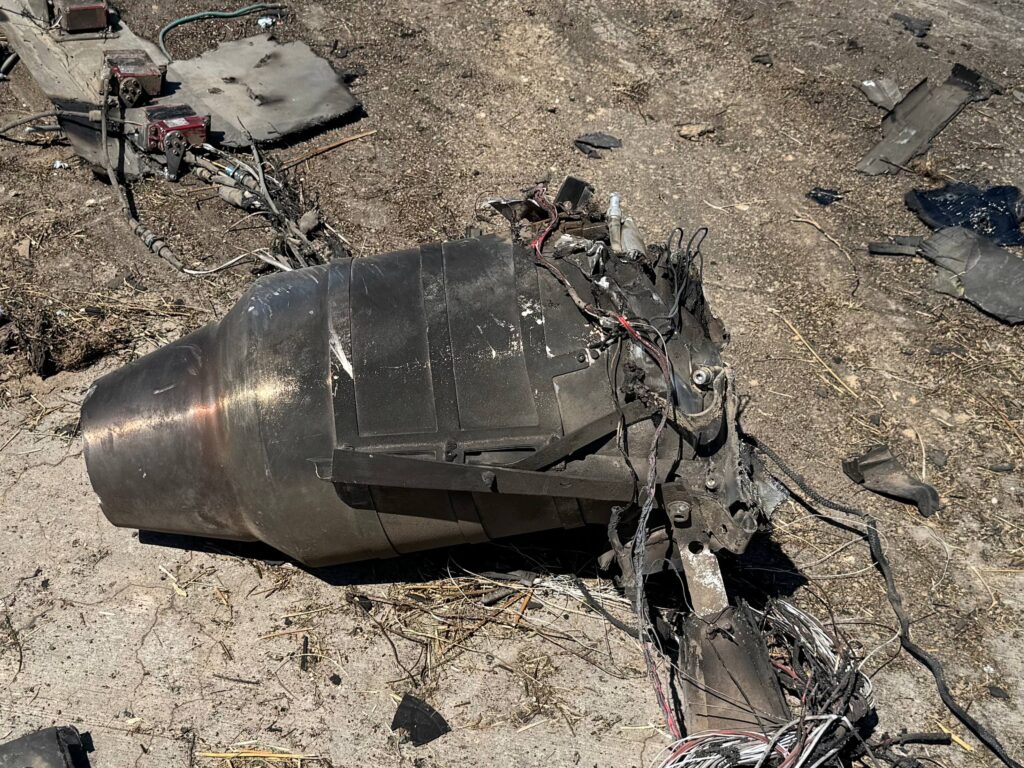
The image shows a fragment of a Russian drone Geran-4 in Kyiv Oblast. Source: Serhii "Flash" Beskrestnov

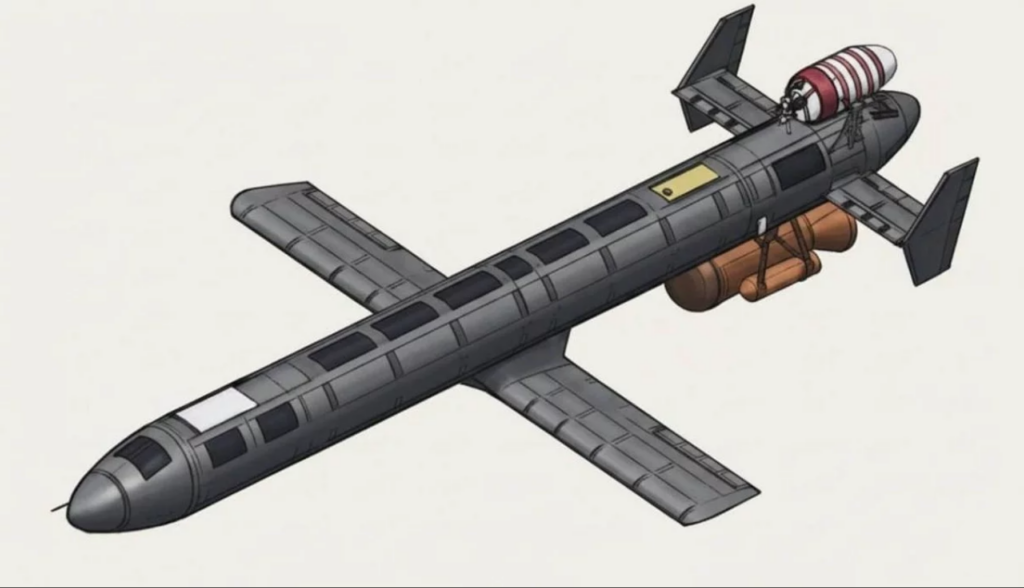
Russia has been bolting small FPV attack drones to the wings of its long-range Gerans and releasing them deep inside Ukraine, far behind the front. The tactic may now have reached Kyiv Oblast, where an FPV drone was recently recorded, though it is not confirmed that a Geran delivered it, Serhii "Flash" Beskrestnov, the president's adviser on defense technologies, told UNIAN. A Geran drop is one of the versions being weighed.

A Geran (the Russian-built version of Iran's Shahed-136) can fly hundreds of kilometers, so bolting short-range FPVs to its wings carries them far past the front line before release. Russia has done the same with its Molniya and Gerbera drones, and in May Euromaidan Press reported FPVs delivered this way, turning up dozens of kilometers from the border, on the ground, and even on the roofs of apartment buildings.

A year-old experiment, still rare

"The Russians have been running these experiments for a while. They attach two FPVs above the wings and drop them," Beskrestnov said.

He last recorded the tactic a week ago in Konotop, in Sumy Oblast, where Russian forces held two such drones on a carrier's wings and released them.

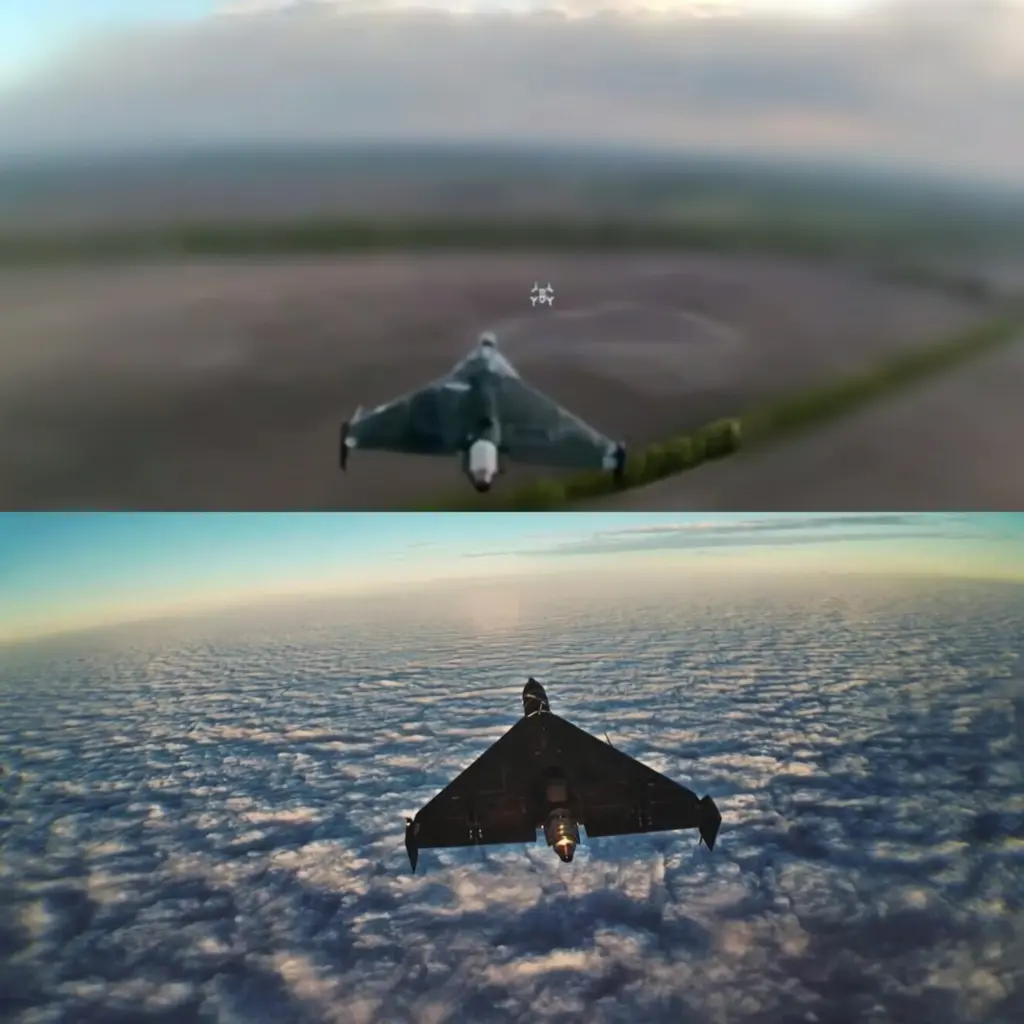
Until now, he added, it had shown up only on conventional Gerans. Holding an FPV on a jet-powered Geran is far harder because the speed is too high for a clean release, "but technologically it's entirely possible," Beskrestnov believes.

Ukrainian air defenders have brought at least one carrier down: in March, the Darknode anti-Shahed unit destroyed a Geran carrying two wing-mounted FPVs over Ukrainian airspace before it could release them, Militarnyi reported.

Low yield, mostly a scare tactic

Russia uses the tactic sparingly, and by its own measure, it does not work well.

"If you look at the number of successful strikes they've had with these FPVs, it's small," Beskrestnov explained, because controlling a drone dropped this way is difficult.

The FPVs carry no large warhead, and the launches often serve mainly to terrorize civilians, he said.

The dropped drones are usually flown over ordinary mobile networks rather than through a relay mounted on the carrier.

"There's an ordinary SIM card, and they control the FPV through it," Beskrestnov said, adding that Ukraine has been recording the practice on and off for about a year.

  • ✇Euromaidan Press
  • Russia now hunts Kyiv by daylight too, Flash explains why
    Russia has started launching its strike drones during the day, not only after dark. The reason is the new jet-powered Geran drones, which fire groups cannot take down, so for Russia there is no longer any difference between attacking by day or by night, Serhii "Flash" Beskrestnov, President Zelenskyy's adviser on defense technologies, told Glavcom. The near-hourly daytime raids are the new face of a campaign that culminated on 1 September, Knowledge Day, when Russia hit
     

Russia now hunts Kyiv by daylight too, Flash explains why

3 septembre 2026 à 06:07

geran-5

Russia has started launching its strike drones during the day, not only after dark. The reason is the new jet-powered Geran drones, which fire groups cannot take down, so for Russia there is no longer any difference between attacking by day or by night, Serhii "Flash" Beskrestnov, President Zelenskyy's adviser on defense technologies, told Glavcom.

The near-hourly daytime raids are the new face of a campaign that culminated on 1 September, Knowledge Day, when Russia hit Kyiv and its region with ballistic missiles and jet-powered drones and killed 12 people. That strike culminated a six-day assault on the capital that began on 27 August, two days after CIA Director John Ratcliffe arrived in Moscow. However, even after that, the attack continued. Sirens now sound across Kyiv and the surrounding oblast roughly once an hour, around the clock.

Why the shift to daylight

The daytime raids carry an added economic and psychological weight, he said. The threat of strikes forces shops and businesses to open and close unpredictably, snarls transport, and can halt rail service.

"They understand perfectly well that daytime attacks hurt the population and business," Beskrestnov said, adding that the state railway Ukrzaliznytsia is paralyzed.

Keeping the defenders on their feet

A further aim is to hold Ukraine's air defense in a permanent state of readiness, Beskrestnov said. Round-the-clock attacks mean radar stations and generators must run without pause.

"Radar stations and generators run constantly, and that also puts a strain on our troops," he added.

Kyiv remains a Russian prime target because it carries symbolic as well as military weight, as the capital houses the government, business, and warehouses, and a strike there would resonate far more than terrorizing a small town.

Russian forces first concentrated on districts nearer the drones' launch corridors — Kyiv's Left Bank, and the Brovary and Boryspil raions — before switching to the other bank to hunt for targets. As the cold season approaches, he expects Russia to intensify strikes on the energy infrastructure it has so far spared.

Russia’s new jet Shaheds run on turbojets from one Chinese company. It deleted them from its English website

27 août 2026 à 01:12

Geran-4" is an evolution of the earlier "Geran-3" model

China is helping Russia build a faster Shahed. Russia has begun using upgraded Shahed drones with Chinese-made turbojet engines that fly at speeds close to three times those of earlier versions, the Wall Street Journal reported.

The Shahed jet is designed to beat Ukraine's air defenses. Ukrainian interceptors have downed about 90 percent of the older piston-engine drones, which cruise at roughly 180 kilometers per hour, so Russia switched to the jet-powered Geran-4, which cruises at around 500 kilometers per hour.

The engines come from one Shenzhen firm

The turbojets come from Telefly Telecommunications Equipment, founded in Shenzhen in 2010. The company chiefly makes computer hardware and communications equipment, but also sells its own line of micro-turbojets for drones.

China has long been the main clearinghouse for Shahed parts, including engine components, servomotors, and gyroscopes, the newspaper reported.

The company scrubbed its own website

After Ukraine publicized the discovery of Telefly engines in Russian drones, the turbojet section disappeared from the English-language pages of the company's website. The pages in Chinese and other languages still carry them.

China's foreign ministry, which did not respond either, has previously said it strictly regulates exports of dual-use components and rejects unilateral US sanctions on such trade.

Western parts fade as Chinese parts arrive

Downed Shaheds once carried microcontrollers from Texas Instruments in the US and linear regulators from STMicroelectronics, which the newspaper lists as being based in Switzerland. Over time, the Western components are disappearing even as the drones gain better navigation and attack systems, because US Treasury investigations found nearly all the Western parts were being diverted through Chinese intermediaries, often shell companies in Hong Kong.

Ukrainian government researcher Colonel Oleksandr Zaruba said in June that Shaheds now hold more antennas, modems, and SIM cards to correct their flight paths through local mobile networks, and that the components increasingly come from China.

❌