Vue normale

  • ✇Euromaidan Press
  • Precision missiles hit the coordinates. Investigators ask who was still standing there

    Ukrainian investigators have published a framework that challenges Russia’s standard justification for missile strikes on civilian places: that a precision weapon hit a legitimate military target. Precision settles nothing, they argue, when the missile takes 10 minutes or more to arrive, and the target is a gathering of people who can leave, disperse, or be warned before it lands.The report, titled “Out of Control” and published on 28 July by the documentation group Truth
     

Precision missiles hit the coordinates. Investigators ask who was still standing there

29 juillet 2026 à 11:10

report out of control by the truth hounds

Ukrainian investigators have published a framework that challenges Russia’s standard justification for missile strikes on civilian places: that a precision weapon hit a legitimate military target. Precision settles nothing, they argue, when the missile takes 10 minutes or more to arrive, and the target is a gathering of people who can leave, disperse, or be warned before it lands.

The report, titled “Out of Control” and published on 28 July by the documentation group Truth Hounds and Project Expedite Justice, builds the argument on four strikes and calls the pattern a “moving target attack.”

The report reaches a war crime conclusion for only one of the four—the 2023 strike on a Kramatorsk cafe. The other three are offered as variations on the same problem, not as verdicts. The framework itself is new: a test the authors want courts and investigators to apply to a kind of attack that existing law, they say, has addressed without enough rigor.

A missile can hit its programmed coordinates exactly and still land where no military objective remains.
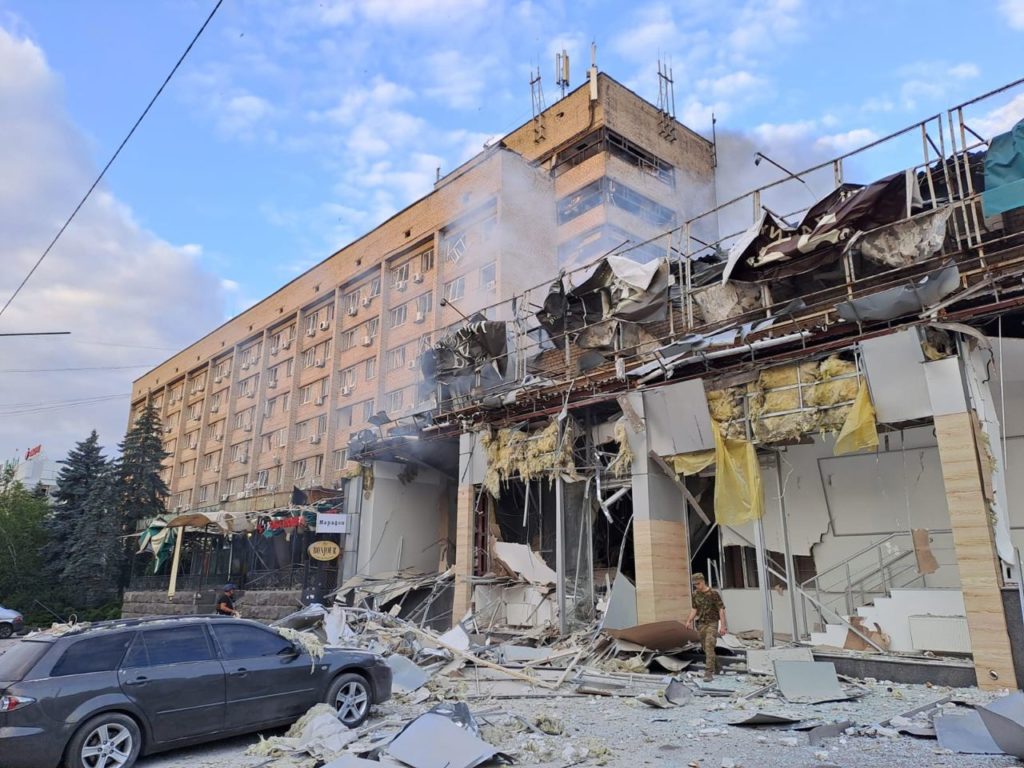
pizzeria destroyed in kramatorsk on 27 june 2023
Pizzeria in Kramatorsk destroyed by a Russian missile strike on 27 June 2023. Photo: Donetsk Oblast Administration.

The two hours before the pizzeria

The diagnostic case is the strike on the Ria Lounge cafe in central Kramatorsk on 27 June 2023, which killed 13 people and injured 60. A Russian informant last watched the site at around 17:00. The missile arrived at 19:29, after a flight of nine to 15 minutes. In the interval, no one on the Russian side could see who was inside, and once the missile was launched, no one could call it back.

Russia’s Defense Ministry said it had destroyed a temporary command post of the 56th Motorized Infantry Brigade, killing two generals, up to 50 officers, and up to 20 foreign mercenaries.

The evidence describes an ordinary pizza restaurant instead: 40 to 50 customers, around half civilians and half off-duty soldiers in mixed dress, unarmed, out with friends and family. A basement room had been booked a month ahead for an officer’s birthday. No one outside could tell the place was military.

The missile struck the public level. The basement that Russia said it was aiming at came through essentially intact. Of the 13 killed, two were serving soldiers. Among the dead was Victoria Amelina, a novelist who had retrained as a war crimes documenter and worked with Truth Hounds itself. The organization concluded in 2023 that the strike was a war crime in the form of an indiscriminate attack under the Rome Statute.

victoria amelina
Explore further

Award-winning Ukrainian writer who uncovered Russian atrocities dies in missile attack

The gap the weapon leaves open

The framework turns that single case into a test. A moving target attack, as the authors define it, combines three features: a military rationale resting on a temporary presence of personnel, a location of civilian character where civilians are foreseeably present, and a weapon whose flight time is long enough that the situation on the ground can change before impact.

A missile can hit its programmed coordinates exactly and still land where no military objective remains.

The authors selected three further strikes that met the same criteria and examined them through open sources.

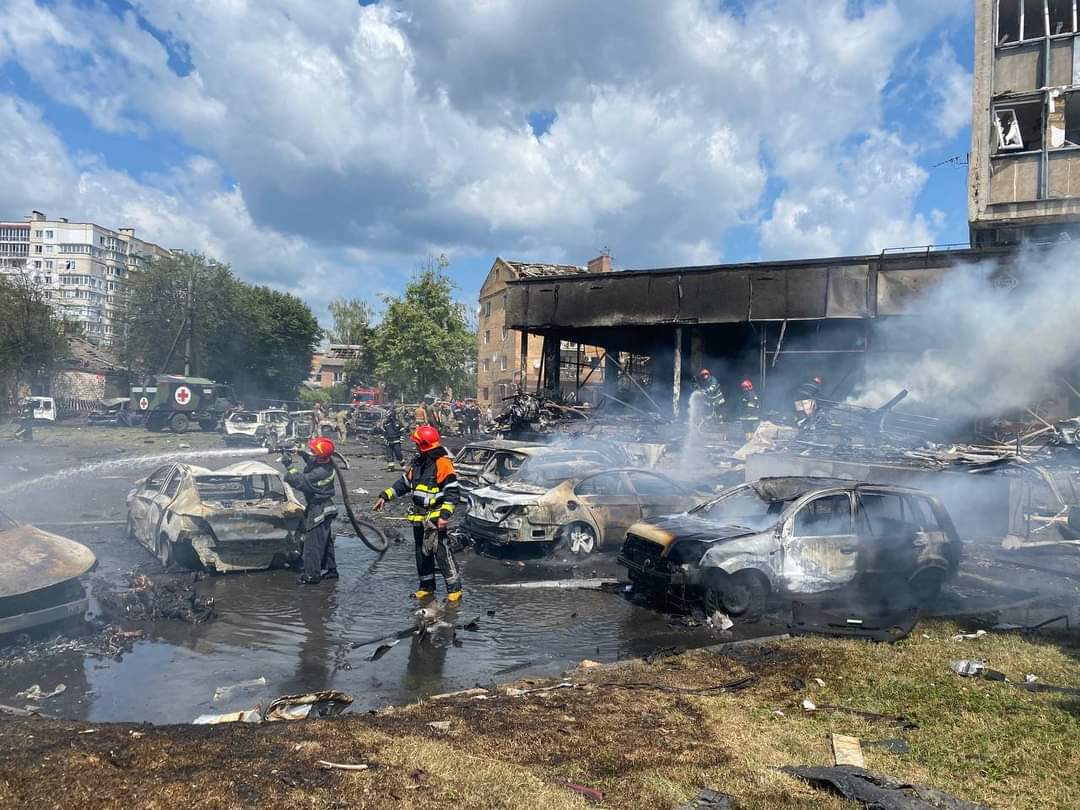
In Vinnytsia on 14 July 2022, the report finds, three Kalibr missiles killed 29 people, including three children and five servicemen, and wounded at least 154. Russia said the target was a scheduled Air Force command meeting. The air raid alert sounded at 10:12; the missiles hit at 10:41, about 40 to 50 minutes after launch.
Explore further

Ukraine calls to brand Russia a terrorist state after missile strike kills 21 in Vinnytsia

In Zlatopil on 4 July 2023, the report documents, a missile landed 800 meters from a serviceman’s funeral, in a residential area, wounding 42 civilians including 12 children. Organizers had asked mourners to shelter from the heat about 10 minutes earlier, leaving the square nearly empty.

In Chernihiv on 19 August 2023, a missile fitted with a proximity fuse detonated in the air above the Drama Theatre, where NGOs were running a defense-tech exhibition inside. All seven people killed were outside the building.

For these three, the report states that the evidence does not support conclusions equivalent to Kramatorsk.

International Criminal Court
The International Criminal Court in The Hague, Credit: Marina Riera/Human Rights Watch

What the report asks investigators to do

The recommendations run to the International Criminal Court, the ICRC, the UN human rights office, and prosecutors working under universal jurisdiction.

They ask that the launch-to-impact interval be treated as a working indicator, that technical precision no longer be read as evidence that a strike was lawful, and that the presence of soldiers in a civilian place not be taken to strip it of protection.

One question the report raises and declines to settle is whether the four strikes are a run of targeting failures or a method. Answering it needs orders and targeting packages that only investigators with coercive powers can reach—at a moment when Truth Hounds is working on a budget cut by a third after the US withdrew funding, Reuters reported in May.
  • ✇Euromaidan Press
  • Russia is bombing Kostiantynivka to rubble while pushing its infantry into it on foot
    Russian troops are working deeper into Ukraine's last fortified cities in Donetsk Oblast, pushing infantry into Kostiantynivka while wrecking the towns behind it, the Ukrainian monitoring and analytical project DeepState reported. The US-based think tank Institute for the Study of War (ISW) recorded fresh Russian movement inside the city over the same days. Over the past several years, Moscow's main objective in its invasion of Ukraine has been to capture the rest o
     

Russia is bombing Kostiantynivka to rubble while pushing its infantry into it on foot

29 juillet 2026 à 09:31

russia bombing kostiantynivka rubble while pushing its infantry foot · post kramatorsk donetsk oblast ukraine news ukrainian reports

Russian troops are working deeper into Ukraine's last fortified cities in Donetsk Oblast, pushing infantry into Kostiantynivka while wrecking the towns behind it, the Ukrainian monitoring and analytical project DeepState reported. The US-based think tank Institute for the Study of War (ISW) recorded fresh Russian movement inside the city over the same days.

Over the past several years, Moscow's main objective in its invasion of Ukraine has been to capture the rest of Donetsk Oblast. Its key demand pressed at previous US-brokered ceasefire talks was for Ukraine to cede the rest of Donetsk Oblast. That is where Ukraine's fortified cities anchor its eastern defenses, which made the demand predictably unacceptable to Kyiv. Now, Russia's 2026 offensive has been buying that ground at a steeply rising cost in casualties per kilometer.

Kostiantynivka: Russian infantry keeps slipping in

Russian forces keep up constant infiltration attempts on Kostiantynivka, DeepState said. Their aim is to entrench inside the city, mass infantry there and take control of the ground. One of their main tasks is to take control of the part of the city between the settlements of Illinivka and Novodmytrivka. If Russian troops take Novodmytrivka, the entire Ukrainian grouping defending Chasiv Yar faces encirclement, DeepState noted. Supply into Chasiv Yar has been difficult for a long time, because Russian drone numbers hand Moscow the advantage in the air. Alongside the infantry, Russian forces use artillery and guided glide bombs to destroy the city.

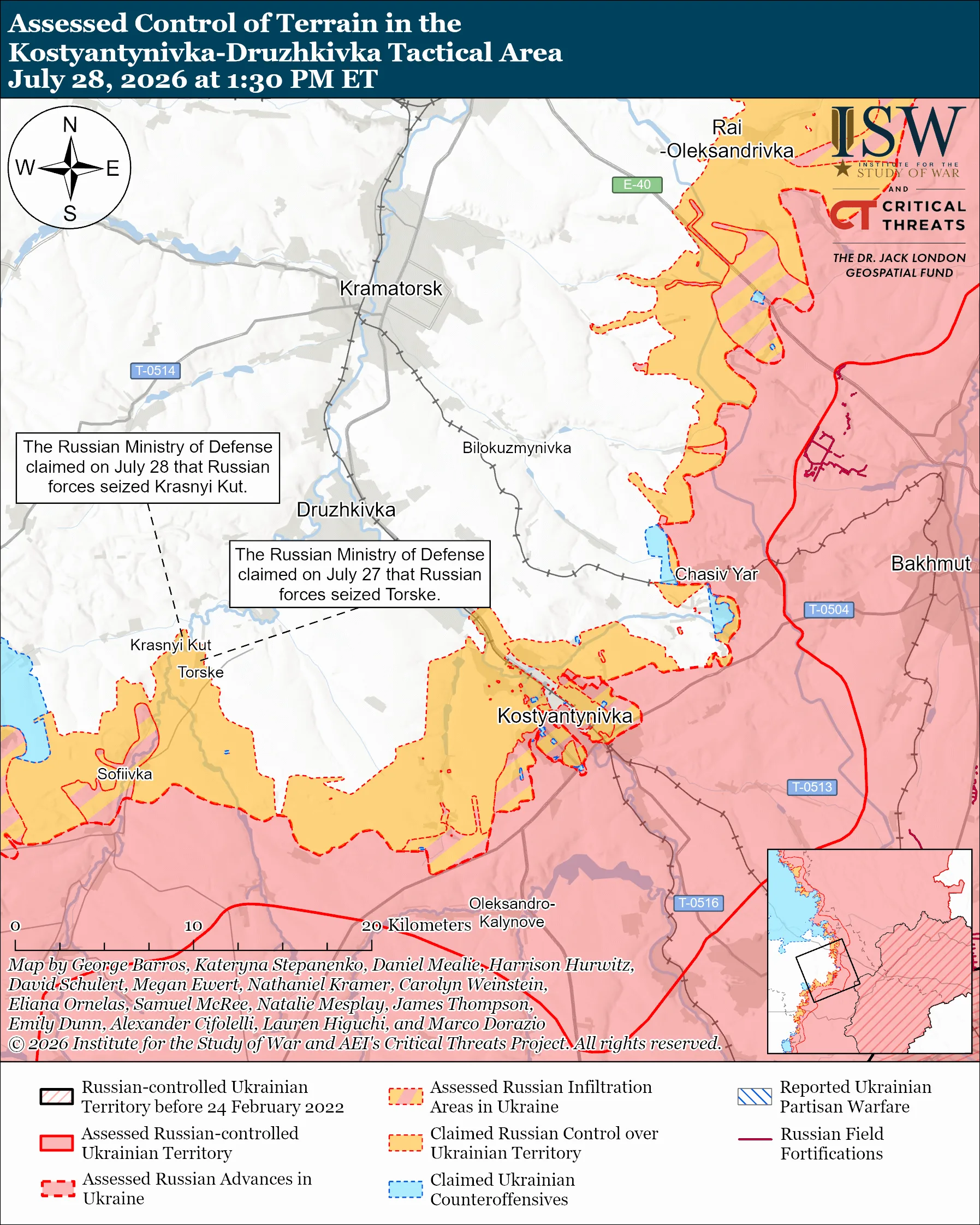
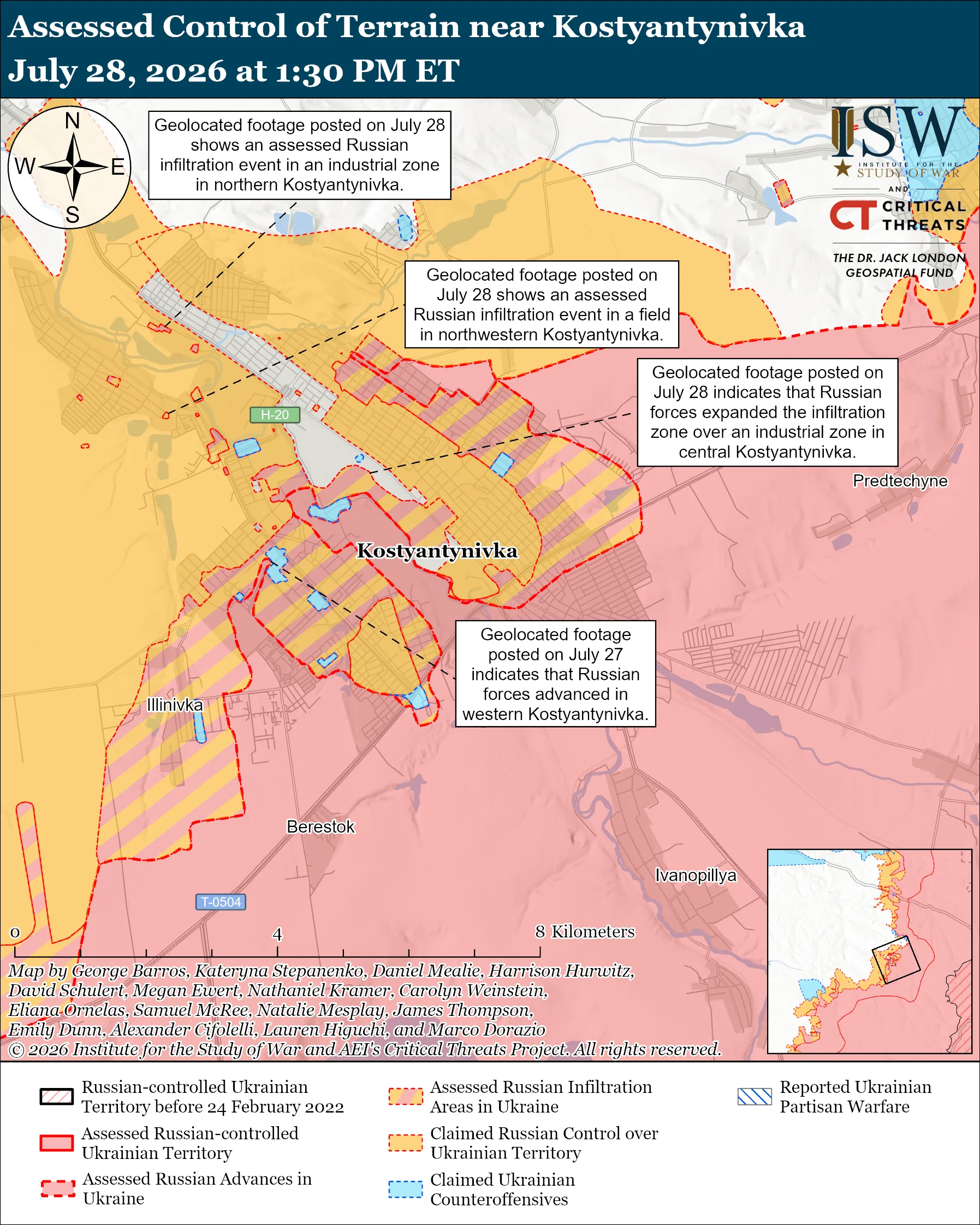
ISW assessed on 28 July that Russian forces recently advanced in Kostiantynivka and kept up infiltration missions inside it. Geolocated footage from 27 July points to a Russian advance in the city's west, ISW said. Video published a day later shows Ukrainian troops hitting Russian positions in the north and center of Kostiantynivka, after what ISW assesses were infiltration missions.

russia bombing kostiantynivka rubble while pushing its infantry foot · post assessed control terrain near donetsk oblast 28 2026 kostyantynivka-july-28-2026 ukraine news ukrainian reports
Assessed control of terrain near Kostiantynivka, Donetsk Oblast, as of 28 July 2026. Map: ISW

Unnamed soldiers from units defending the city told Hromadske that the situation there is getting worse. Ukraine's General Staff counted 31 Russian attacks on the Kostiantynivka axis over the past day.

russia massing dobropillia again using quad bikes motorcycles ukraine's national guard says · post pokrovsk sector donetsk oblast 26 2026 russian-occupied areas direction assaults pushing north toward above ruins situation
Explore further

Russia is massing for Dobropillia again using quad bikes and motorcycles, Ukraine’s National Guard says

Druzhkivka and the towns behind the front are turning to ruins

The whole agglomeration around Kostiantynivka is suffering. DeepState said Druzhkivka and neighboring Oleksiievo-Druzhkivka are gradually turning into ruins under constant shelling, and staying there is extremely dangerous. Russian forces fired 1,243 times at the front line and residential areas of Donetsk Oblast on 28 July, Ukraine's National Police recorded.

russia bombing kostiantynivka rubble while pushing its infantry foot · post assessed control terrain kostiantynivka-druzhkivka tactical area donetsk oblast 28 2026 kostyantynivka-druzhkivka-tactical-area-july-28-2026 ukraine news ukrainian reports
Assessed control of terrain in the Kostiantynivka-Druzhkivka tactical area, Donetsk Oblast, as of 28 July 2026. Map: ISW

Russian pressure is rising on the stretch running roughly from Yampil to Minkivka further north, which may become the next main axis after Kostiantynivka, DeepState said. Russian artillery is already destroying mine barriers along the routes it would use, and Russian drones are working against Ukrainian logistics there.

Sloviansk and Kramatorsk under fire 40 km deep

Russian forces are leveling Sloviansk and Kramatorsk—the northern anchors of the Fortress Belt—with guided glide bombs, rocket artillery, Shahed attack drones and small first-person-view drones that hunt people and cars in the streets. DeepState noted that Russian fire control runs about 40 km deep from the contact line. The agglomeration is gradually becoming an isolated place, where travel will soon be possible only out of critical necessity, in order to fight.

russia bombing kostiantynivka rubble while pushing its infantry foot · post assessed control terrain eastern zaporizhzhia oblast 28 2026 eastern-zaporizhia-oblast-july-28-2026 ukraine news ukrainian reports
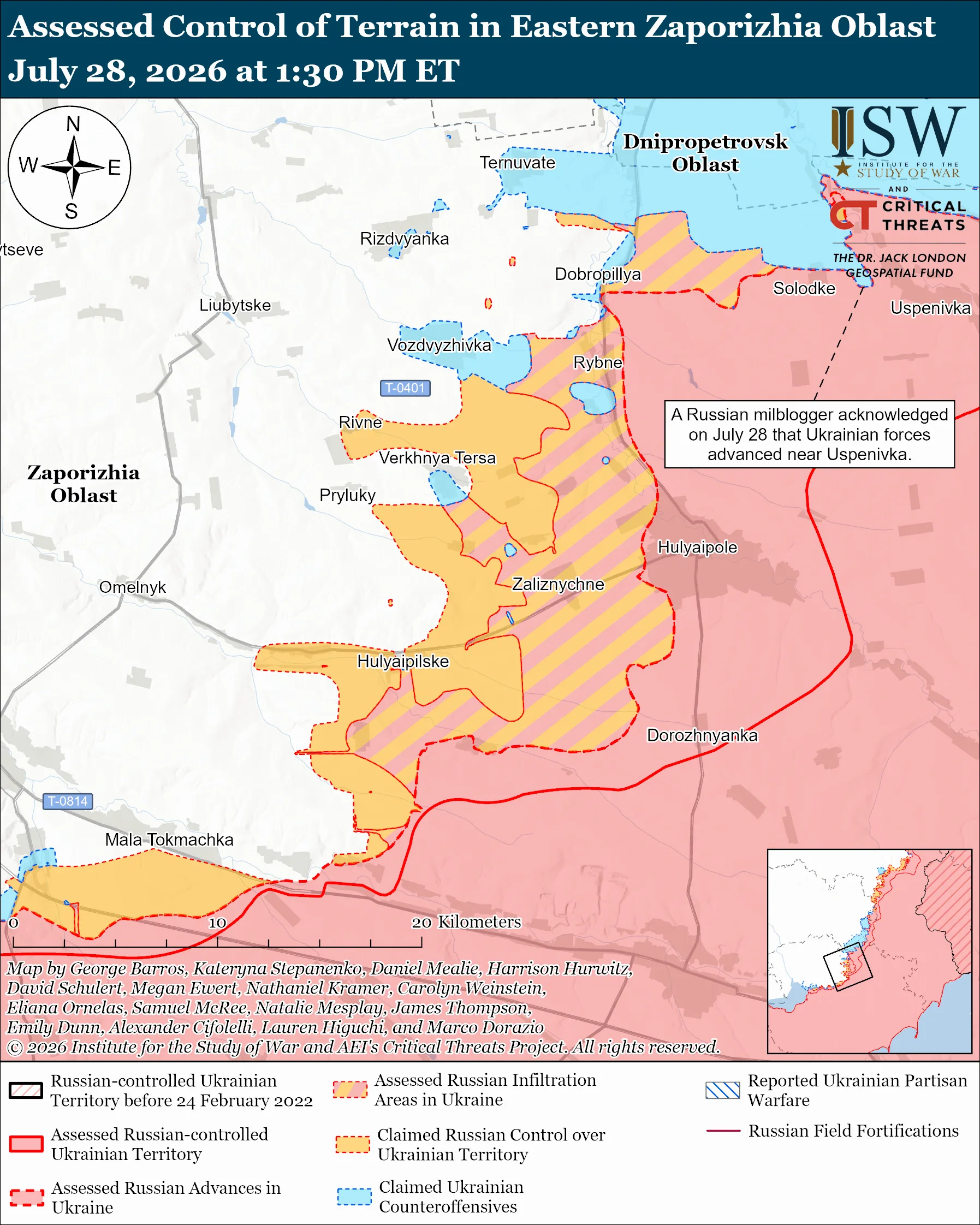
Assessed control of terrain in eastern Zaporizhzhia Oblast as of 28 July 2026. Map: ISW

ISW noted that Ukrainian troops have recently advanced farther south, toward Huliaipole in Zaporizhzhia Oblast. A Russian milblogger acknowledged the Ukrainian gains near the town on 28 July.

  • ✇Euromaidan Press
  • Russia took the cages off its newest tanks. The new Arena-M shield bought them a few minutes.
    Russian tanks attacked toward the free city of Kramatorsk this week Tank attacks are vanishingly rare owing to the threat from tiny drones The tanks carried a new anti-drone shield instead of the usual welded cages The shield bought them minutes, not survival Overeager to break through Ukrainian defenses and march on the city of Kramatorsk from the south, the Russian Center Group of Forces got desperate and sloppy this week. They paid for their desperation
     

Russia took the cages off its newest tanks. The new Arena-M shield bought them a few minutes.

24 juillet 2026 à 15:05

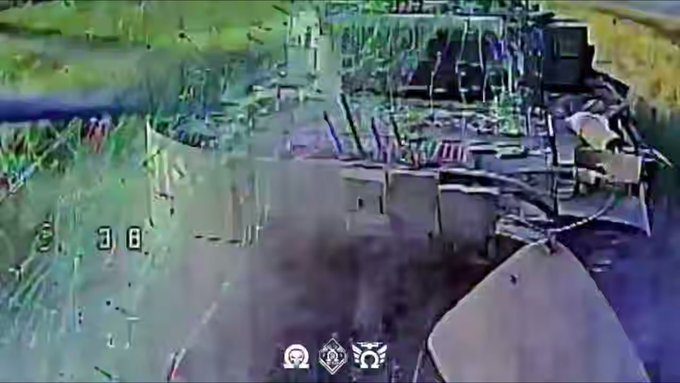
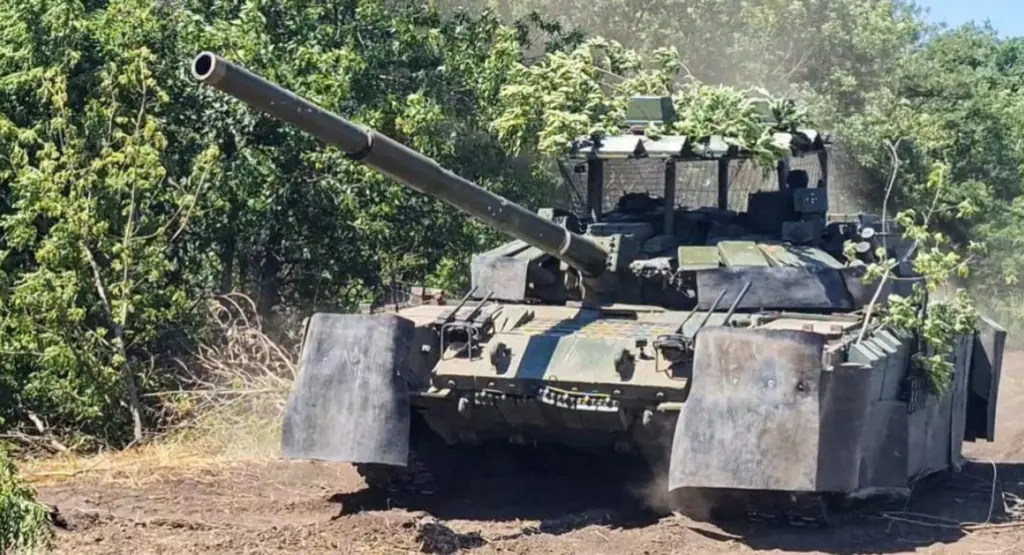
A T-72B3A the moment before a Ukrainian drone strikes.

  • Russian tanks attacked toward the free city of Kramatorsk this week
  • Tank attacks are vanishingly rare owing to the threat from tiny drones
  • The tanks carried a new anti-drone shield instead of the usual welded cages
  • The shield bought them minutes, not survival

Overeager to break through Ukrainian defenses and march on the city of Kramatorsk from the south, the Russian Center Group of Forces got desperate and sloppy this week. They paid for their desperation and sloppiness in lives and metal. The tanks were carrying a brand-new anti-drone shield, and they had left the welded scrap metal at home.

That combination is the news. For more than a year, Russian commanders have kept their armor off the roads because Ukrainian drones kill tanks faster than factories can rebuild them. The Arena-M active protection system is the fix that was supposed to let the tanks come back—reliable enough, the Kremlin's own press said 10 days ago, to make the improvised cages unnecessary. This week it went out on a road in Donetsk Oblast without them.

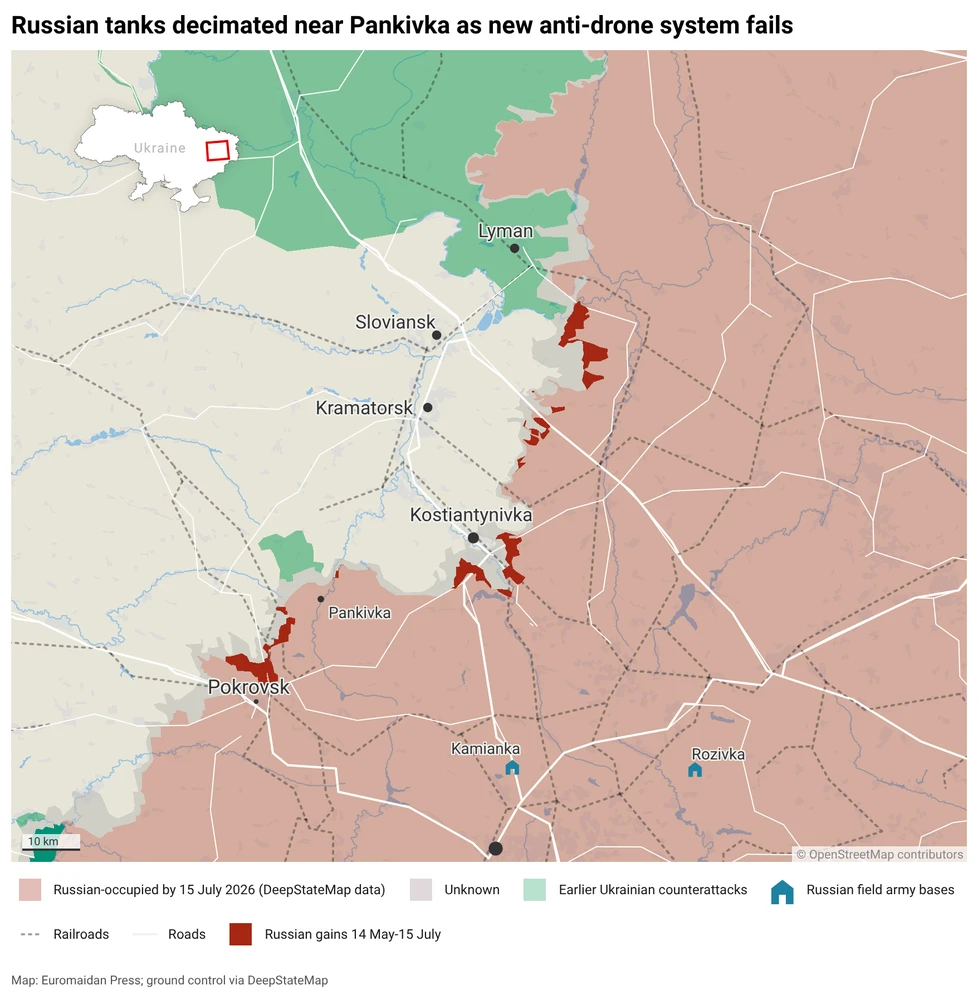
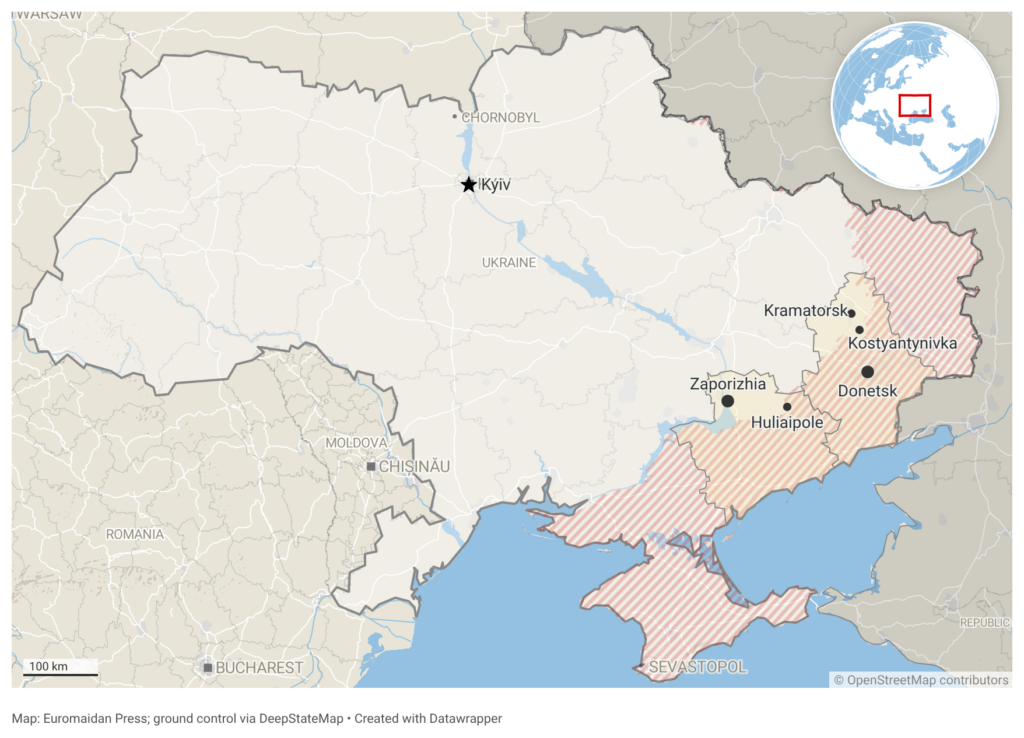
Pankivka on a map. Image: Euromaidan Press

On and around 23 July, the Russians rolled tanks along the road through the village of Pankivka, roughly 36 km southwest of Kramatorsk and its twin free city of Sloviansk in eastern Ukraine's Donetsk Oblast. Ukrainian drones spotted the tanks coming, and attacked.

When the smoke and dust cleared, the Russians had lost at least 9 tanks. Ukrainian tank kills were already running hot: the general staff in Kyiv claimed Ukrainian forces took out 28 Russian tanks across the 1,200-km gray zone in the two days before, 21–22 July. "It was a good day," wrote Dimko Zhluktenko, a soldier with the Ukrainian Unmanned Systems Forces' 413th Regiment.

The mechanized assault was unusual for its rarity. For more than a year now, the Russian army of occupation in Ukraine has mostly parked its armored vehicles, and instead attacked on foot or on motorcycles or other light vehicles. The pause in mechanized assaults has bought time for the Kremlin to ramp up vehicle production and bring battered regiments and brigades back to up to their full allotment of tanks and other armored vehicles.

But those vehicles aren't necessarily being used in Ukraine. Ukrainian tiny explosive drones are everywhere all the time, and Russian forces have few ways of reliably defeating them. Russian commanders correctly concluded that small groups of infantry stand a better chance of slipping past Ukraine's undermanned defenses than big, easy-to-detect tanks do.

Infantry infiltrations work. They're how Russian assault groups have ground their way into the city of Kostiantynivka, 24 km southeast of Kramatorsk. Moscow claimed the city on 3 July. Ukraine's general staff says it still holds it. And infiltration is how the Russians are gradually creeping around the city of Lyman, 21 km northeast of Sloviansk. The infiltrations are slowly closing a vice around Kramatorsk and Sloviansk, the last free big cities in Donetsk Oblast.

National guard Omega SOF fpv strikes a russian t-72 tank
48.41418, 37.31780 (0:23)
Mayak, Donetsk@UAControlMap @GeoConfirmed https://t.co/qyYCXFsXh6 pic.twitter.com/ma1hXAWmuP

— imi (m) (@moklasen) July 23, 2026

Costly attacks

But the infantry action is costly. The Kremlin recruits around 30,000 fresh troops every month but, if the Ukrainian general staff's tallies of killed and wounded are accurate, loses roughly that many troops every month. Ukraine is desperately short of infantry. Russia isn't nearly as desperate, but that doesn't mean it's got infantry to spare.

Last month, analyst Jompy predicted that if infantry casualties spiked or recruitment slipped, Russian commanders "could also be forced to go back to mechanized warfare." That may be why the Center Group of Forces pivoted back to tank-led assaults in their south-to-north push toward Kramatorsk.

The shield that replaced the scrap metal

Without so-called "active defenses" that can shoot down incoming drones, "it is currently very easy to throw a tank battalion into [an] assault and lose it all without achieving anything," analyst Jakub Janovsky explained. The Arena-M is Russia's answer. It uses a Doppler radar to spot incoming rockets, missiles, and drones, and 12 launchers ringed around the turret fire tiny charges meant to shred the threat a few meters out.

Twelve is the whole magazine. And the system does not run itself: the commander switches it on when reconnaissance or a drone detector warns him, the Russian state newspaper Izvestia reported on 13 July, in a dispatch from a training range where crews of the Center grouping's 90th Tank Division were learning the new machines.

T-72B3A tank equipped with the Arena-M active protection system (APS). Photo: iz.ru/Dmitry Astrakhan

That dispatch is worth reading for what the reporter noticed was missing. No turtle armor. No tsar-mangal. No dreads, no cages, no hedgehogs—none of the welded scrap the Russian army has bolted onto its armor for two years. A company commander told Izvestia the system had shown high effectiveness against drones on the range, and that the tanks would reach the line of contact within days. Russian industry has been calling the Arena-M the first system in the world able to protect armor from FPV drones and loitering munitions. Israel's Rafael announced drone-interception upgrades to its Trophy system in January 2025.

Ten days later the tanks were on the road, without the cages, and Ukrainian drones found them. Footage published by Ukraine's border guards and by the National Guard's Omega unit shows a T-72B3A taking a hit to the rear, then two more drones finishing it. A second tank—this one wearing a conventional mangal cage—was leading it and was immobilized too. Both Russian answers to the drone problem were on that road. Neither one came off it.

What the shield actually did is contested, and the argument is worth following. One Russian armor specialist watching the video saw no reaction at all—countermeasures still sitting in their launchers, no attempt to engage. Observer Matt Drew, watching the same footage, read it the other way: a puff of smoke off the turret in the opening seconds, an explosion to the side, and several drone feeds that cut out before reaching the tank—which is what an interception looks like from the drone's camera. Only after the tanks were disabled and abandoned could the drones close in and linger, and it took bomber drones to finish the hulks. "Probably not the success the Russians were hoping for," Drew wrote, "but it definitely worked for a while."

A while is the problem. Twelve charges is a finite number and Ukrainian drone crews do not attack in twelves. A shield that intercepts the first drones and runs dry against the tenth turns a tank into a slower target, not a surviving one. And the latest push toward Kramatorsk failed.

That doesn't mean Kramatorsk and Sloviansk are safe. Hurling tens of thousands of troops and, occasionally, a few armored vehicles against Ukrainian defenses, the Russian Center Group of Forces is making very, very slow progress toward the twin cities from both the south and the north.

But every assault the Ukrainians defeat delays the day when Kramatorsk and Sloviansk come under direct siege and infiltration. The cities are most vulnerable from the north around Lyman, mapper Clément Molin noted. "The current situation is not very good for Ukraine in this direction."

At the current rate of advance, the Russians may be able to slip their first infiltrators into Sloviansk from the north some time next year, Molin concluded.

❌