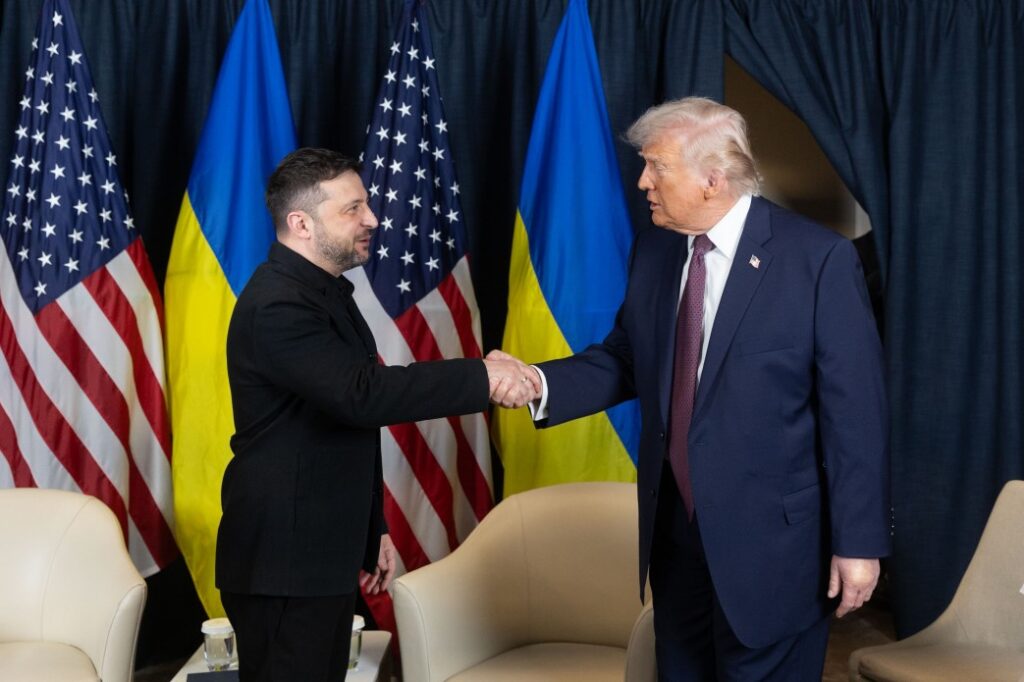
Ukrainian President Volodymyr Zelenskyy has called wartime elections unfair to soldiers who cannot vote and floated online voting as a possible way out, he told German broadcaster ZDF. He also said he had asked Washington to secure a winter ceasefire from Moscow, which would protect power and water and open a window for a vote. At home, critics warn that remote voting carries heavy risks, and Ukrainian law makes no room for it.
Russia is heading into another winter of strikes on Ukraine
Ukrainian President Volodymyr Zelenskyy has called wartime elections unfair to soldiers who cannot vote and floated online voting as a possible way out, he told German broadcaster ZDF. He also said he had asked Washington to secure a winter ceasefire from Moscow, which would protect power and water and open a window for a vote. At home, critics warn that remote voting carries heavy risks, and Ukrainian law makes no room for it.
Russia is heading into another winter of strikes on Ukraine's power plants, substations, and pumping stations. This week, one of its largest barrages on the grid left Kyiv without running water. Washington keeps pressing Kyiv for a vote and a deal, while Moscow's stated price for peace is still more Ukrainian land. Any Ukrainian election therefore depends on a pause that only the Kremlin can grant, and Putin has already rejected a ceasefire on Ukraine's grid.
Why Kyiv calls a wartime vote unfair
Zelenskyy spoke to German satirist Jan Böhmermann on ZDF Magazin Royale, aired on 4 November. A vote under martial law, he argued, would shut out soldiers at the front, about nine million Ukrainians abroad, and millions living under Russian occupation. Under martial law, imposed on 24 February 2022, elections are banned. The troops themselves oppose a vote they could not take part in, he said.
“Allowing elections but not giving soldiers a chance to vote is unfair. It is 100% unfair. We can think about online elections. That may be realistic, but then parliament has to look for and find a solution,” Zelenskyy said, Radio Svoboda reported.
He added that elections split society, and that this is a particular challenge for a country at war.
Explore further
After Trump, Musk tells Ukraine’s president to go. Zelenskyy says he won’t resign and will never accept Ukrainian land as Russian
A winter truce as the window for a vote
Zelenskyy said he had urged Washington to work out a winter truce with Moscow, Kyiv Post reported. He hinted that some in Washington would like him gone, yet said a vote only counts if Ukrainians can actually take part.
“I told the Americans: You can reach an agreement with the Russians for a ceasefire during winter. Then people will have electricity and water, and during that time we can also hold elections,” he said.
Asked why Ukraine would not give up land for peace, Zelenskyy pointed at Moscow. “Putin does not want to end the war. Putin does not accept a ceasefire,” Zelenskyy said, noting that Kyiv had backed ceasefire proposals that Moscow turned down. In excerpts from the interview he posted on Telegram, he said Ukraine would do everything to end the war, “but end it with dignity for us.”
Explore further
US Congress turns blue, Trump keeps the veto—and Ukraine’s balance sheet in Washington gets both wins and losses
The request answers mounting US pressure. On 10 October, US President Donald Trump said it was time for Ukraine to get a new president. Zelenskyy offered elections if Russia agreed to a full 60-day ceasefire. The Kremlin countered with a halt to strikes on voting day alone. US envoys have also pitched Russian gas transit as a reward for an energy truce before winter, and Moscow rebuffed it. Trump has since met Kremlin envoy Kirill Dmitriev and predicted a “big agreement” ahead of US-Russia-Ukraine talks in Abu Dhabi next week.
No legal path to voting from a trench
Ukraine's Electoral Code requires every voter to vote in person, with ballots handed out by election commission members. In February 2025, Central Election Commission head Oleh Didenko said the commission had long dropped electronic voting and called postal voting wide open to interference. Online, it may be hard or impossible to check that a voter casts a ballot in person and without coercion, Radio Svoboda noted. Estonia, which has voted online since 2005, deals with coercion by letting each new vote cancel the last, so citizens can recast their ballot until polls close.
Ballot boxes at a polling station in Ukraine at the start of voting in the presidential election, 31 March 2019. Photo: Tohaomg/Wikimedia Commons
Political scientist Oleksii Koshel went further on Radio NV, saying the president had been “set up.” He warned that online elections would have catastrophic consequences and noted that the Central Election Commission does not support electronic voting. Because Zelenskyy gives so many interviews, Koshel said, it is hard to tell where he meant to send a signal to the West and where he simply said too much. He urged the president's team to cut back his media appearances.
A phalanx of lawyers, observers and campaign officials are watching the counting of votes in the race for Senate, where a Democratic challenger has a slim lead.
A phalanx of lawyers, observers and campaign officials are watching the counting of votes in the race for Senate, where a Democratic challenger has a slim lead.
An analysis shows Mary Peltola is likely to keep her lead in the Senate race in part because of ballots she’d accumulate in ranked-choice tabulation from supporters of the other Dan Sullivan.
An analysis shows Mary Peltola is likely to keep her lead in the Senate race in part because of ballots she’d accumulate in ranked-choice tabulation from supporters of the other Dan Sullivan.
Voters in Alaska are able to rank the candidates. If no candidate receives more than 50 percent of the first-choice votes, the race advances to ranked-choice tabulation.
The court’s ruling came just hours after administration lawyers asked the justices to immediately order California to set aside 20,000 mail-in ballots.
The court’s ruling came just hours after administration lawyers asked the justices to immediately order California to set aside 20,000 mail-in ballots.
Voters dropping their ballots off in San Francisco last month. The Trump administration’s legal challenge to 20,000 California ballots is part of a broader effort to argue that the elections could be marred by illegal votes by noncitizens.
It’s a small pleasure, but receiving an “I Voted” sticker after casting my ballot is one of my favorite parts of the whole voting process. I slap the sticker on my chest and spend the rest of the day feeling like I accomplished a little something. I participated in democracy and everyone who sees me will know it. Artificial intelligence robbed me of that small joy this year and replaced it with a small horror. My “I Voted” sticker is AI-generated slop. Getting a little sticker when you vote h
It’s a small pleasure, but receiving an “I Voted” sticker after casting my ballot is one of my favorite parts of the whole voting process. I slap the sticker on my chest and spend the rest of the day feeling like I accomplished a little something. I participated in democracy and everyone who sees me will know it. Artificial intelligence robbed me of that small joy this year and replaced it with a small horror. My “I Voted” sticker is AI-generated slop.
Getting a little sticker when you vote has been a tradition in the US since the 1980s. It’s a symbol of the election cycle. People take selfies and post them or share them with friends. It’s a celebration of democracy and a small way to pressure people into going to the ballot box.
The voting sticker has been subject to every kind of discourse imaginable. Are “I Voted” stickers worth the cost? Wondered Marketplace in 2020. A cemetery in New York has spent time and money tending to the grave of Susan B Anthony because voters coat it in stickers during voting season. In 2008, companies like Starbucks and Ben and Jerry’s ran afoul of election laws for offering free treats to people who showed their “I Voted” stickers.
It’s appropriate but depressing that I got an AI slop “I Voted” sticker in 2026, the year it feels like the mainstream began to reckon with AI.
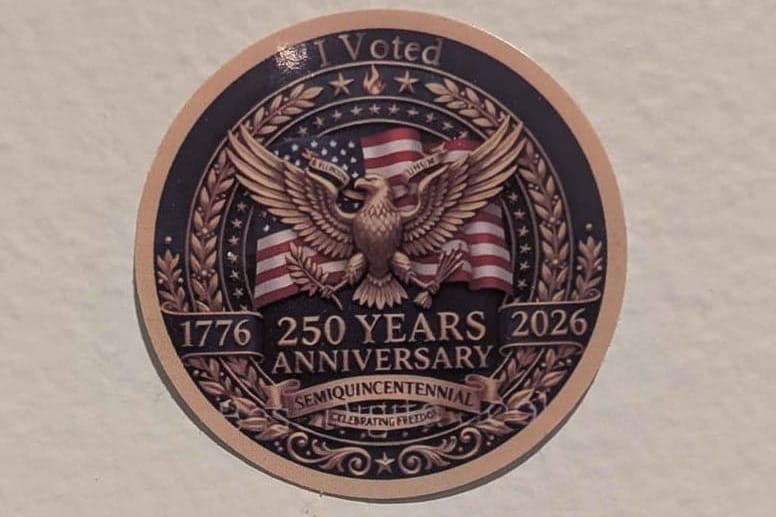
My sticker is ugly. It’s a busy circular nightmare. “I Voted” is spelled out in small bronze text at the top of the ring. Bronze laurels encircle a bronze bald eagle that stretches atop the American flag. Below this is more text: “250 YEARS ANNIVERSARY” and "SEMIQUENCENTENNIAL.” Below that, another line reads — as best I can tell — “CEKEVPATIVG EDELDOA.” I assume this was meant to say “CELEBRATING FREEDOM," but whoever churned out this slop wasn’t using the latest models and the fine detail is lost.
I put the sticker on reluctantly, but I was not proud. I sent a photo of the offending sticker to journalist friends with my face cropped out. They immediately noticed it was AI-generated. I did not post my sticker online. I shared it with no one else. My democratic joy turned to shame.
A few hours later, a friend sent me a selfie. He’d just left the voting booth. His sticker was beautiful, tasteful, a testament to the subtle art of the “I Voted” sticker. A red ring enclosed a blue field. The crescent and palmetto (symbols of South Carolina) sat elegantly behind a bold white “I VOTED.”
His sticker catches the eye. Passers-by will know exactly what the sticker says. They know he voted. Anyone looking at my sticker will wonder how I spilled some bronze paint on my chest. I trembled with indignation. One town over from me they’re giving out the good stickers and I’m stuck with slop. First my town of 12,000 installs 33 Flock cameras and now this?
I spent some time scrolling through social media to see other “I Voted” stickers. So many are so beautiful. Michigan runs a contest where students can submit their own idea for a sticker and the state will print up the winners. Kentucky, Albany, and several other places around the country do the same. Louisiana commissions local artists to produce gorgeous stickers. My mouth hung up in a jealous scowl as I stared at pictures of New Orleanians bedecked with a sticker showing a hand drawn trumpet blasting out “I Voted” alongside Mardi Gras beads.
Only Denton, Texas (another place I’ve lived, weirdly) seems to also have AI-generated slop stickers. Denton’s sticker is, at least, personalized. The city’s court house is in the corner looking more or less correct. The “I Voted” is large and centered in the sticker itself. Like mine, the image is too busy. Too much text, too many fireworks, and the inclusion of the Liberty Bell clutters the whole thing up. The central message — “I Voted” — is bright white. It doesn’t sink into a busy bronze soup like on my sticker.
Complaining about AI-slop “I Voted” stickers may seem trivial in a world where AIs are choosing targets in warzones and vibecoders are reverse-engineering every piece of software ever written. But these little things are important. These small annoyances pile up until things like ChatGPT flyers are so ubiquitous that you don’t notice them anymore. The AI drive-thru works well enough and one day you stop worrying about it so much. You get an ugly AI slop “I Voted” sticker and you slap it on or toss it out. Enough of these build up until you don’t notice that AI all around you. And then, one day, it’s all normal.
Right now we’re figuring out where our AI lines are. Society is negotiating what the future will look like. We’re fighting data centers, figuring out how to burn tokens to keep our bosses happy, and learning what we will and won’t abide.
Me? I draw the line at AI-generated “I Voted” stickers.
In a 2-to-1 vote, an appeals court panel declined to order the state to set aside more than 20,000 mail-in ballots, calling the notion plainly unconstitutional.
In a 2-to-1 vote, an appeals court panel declined to order the state to set aside more than 20,000 mail-in ballots, calling the notion plainly unconstitutional.
In the legal tangle between the Justice Department and California, a federal judge on Tuesday deferred a ruling but said the government already had a remedy it could use after the election.
In the legal tangle between the Justice Department and California, a federal judge on Tuesday deferred a ruling but said the government already had a remedy it could use after the election.

 Connexion