❌

Vue normale

  • ✇Euromaidan Press
  • Civil society is Ukraine’s superpower. A free course traces how it grew from Euromaidan to the front
    I remember the day Euromaidan started. For months before it, the country had felt like it was going the wrong way, and I felt powerless to stop it. My life was one rally after another: against the pressure on small entrepreneurs, in defense of the Ukrainian language, against the plan to turn Hostynnyi Dvir, a historic arcade in Kyiv, into a shopping mall. The authoritarian pressure kept rising, and so did the helplessness. Then, on 21 November 2013, the journalist Mustafa Nayem wrote a
     

Civil society is Ukraine’s superpower. A free course traces how it grew from Euromaidan to the front

20 novembre 2026 à 20:38

Ukrainian civil society euromaidan official art

I remember the day Euromaidan started. For months before it, the country had felt like it was going the wrong way, and I felt powerless to stop it. My life was one rally after another: against the pressure on small entrepreneurs, in defense of the Ukrainian language, against the plan to turn Hostynnyi Dvir, a historic arcade in Kyiv, into a shopping mall. The authoritarian pressure kept rising, and so did the helplessness.

Then, on 21 November 2013, the journalist Mustafa Nayem wrote a Facebook post calling people to the square after President Viktor Yanukovych's government suspended preparations to sign the association agreement with the EU. Nobody knew how to stop what was happening. But we knew we had to act.

Thirteen years later, a free online course, Ukraine: History of Civil Society, tells the story of what was born on that square: a civil society that has carried Ukraine through revolution and war. Among its authors is Oleksandra Matviichuk, who co-founded Euromaidan SOS; one of its presenters, the researcher Kateryna Zarembo, now serves as a combat medic.

A country inside a country

Explore further

Meet the Hard-Working Ukrainians Helping to Keep Euromaidan Alive

The regime's reach felt total. It extended to the courts and the police; we even wondered whether it extended to the army. It was like tentacles spreading everywhere, and you were one small, frightened person watching them close in. But then you get together with others and start thinking, and start doing even silly little acts of resistance. That is what the Maidan was: a microcosm of resistance, a city inside a city, a country inside a country.

It was an alchemist's laboratory where initiatives were born, some funny, some silly, some very useful. The Maidan had its own newspaper and its own self-defense: guys trained by former security officers to patrol its edges and by former army officers to hold defensive formations behind wooden shields. Farmers delivered food so the protesters would have something to eat, and one man boiled a huge pot of borscht every day. Artists formed their own art sotnia, a unit named after the Cossack "hundreds" the protest was organized into. There was an Open University of the Maidan with lectures on civil society, and a library. Girls dressed as angels handed flowers to the Berkut riot police, to warm their hearts.

Euromaidan SOS searched for the protesters who went missing: abducted, jailed, or dragged through the courts. AutoMaidan drivers rescued activists from hospitals, because the regime could order hospitals to hand over anyone with visible signs of a Berkut beating. Volunteer medics built a parallel health care system. And there were the initiatives to tell the world what was happening, one of which became Euromaidan Press.

If you came, you found a job. First I cooked and brought food, made sandwiches. Then I started in the kitchen, got bored, and found my way to a translating job. At Christmas, I took my small daughter to the Maidan, and we sang carols to the activists in the tents.

I didn’t think of it then, but I was doing what the course’s last lecture describes: passing it on. The course follows Myroslava Barchuk, who went to the Revolution on Granite in 1990 as a student with her mother, then to the Orange Revolution, and whose son Nestor came to the Euromaidan chanting “Ukraine is Europe!” Freedom in Ukraine, the course argues, is carried from one generation to the next, often by hand.

A hand-painted poster from the Euromaidan protests reading "I am a drop in the ocean which will change Ukraine"
"I am a drop in the ocean which will change Ukraine." Art that kept the spirits of the protesters up during the 2013-2014 Euromaidan Revolution

Everyone brought what they could. "I am a drop in the ocean," went one of the mottos. We didn't know what to do, but we knew we had to do something, and suddenly there was this acute sense that it depends on you. Even if you're one drop, your effort matters.

The more pressure there was, the more people came. In January 2014, the activist Ihor Lutsenko was abducted together with Yurii Verbytskyi. Lutsenko was beaten and left in a forest; Verbytskyi was found dead. And still more people came.

The course’s lecture on the Revolution of Dignity describes what we lived through from the outside.

Its lecture on the Revolution of Dignity describes what we lived through. After the failed attempt to clear the square on 11 December, it says, the Maidan turned into "Maidan Sich," a fortified island "with its own system of governance," from security to garbage collection. "For thousands of Ukrainians, for whom the state had become a threat and an instrument of violence, the Maidan became a space of security."

Explore further

Eleven films about Euromaidan you can watch online

Not self-expression, but survival

Yevhen Hlibovytskyi, director of the Frontier Institute

This is what the West tends to miss about Ukrainian civil society, says Yevhen Hlibovytskyi, director of the Frontier Institute and one of the course's authors, whom I interviewed for Euromaidan Press.

"The state in Ukraine is far more threatening, it carries more dangers, and the relationship between the citizen and the state is far more strained. It is mostly a zero-sum game," he says. "That is why civil society in Ukraine flourished as an instrument of security, an instrument to protect society from the arbitrariness of the state."

Seen through Western eyes, he says, it looks baroque, a strange, unnecessary splendor. "In Ukraine, this splendor was a requirement of life, a condition of survival."

The West, he says, doesn't understand why Ukraine needs its civil society at all, "or that activism is not a form of self-expression. Activism is rather a form of service. It is a need, not some optional leadership."

Ukrainians are still too traumatized by their past to hand the state full power, he says: "We want the state to be weaker, more limited, so that if at some point it becomes arbitrary, it cannot harm people or take their lives."
Explore further

13 years since Euromaidan sparked Ukraine’s fight for Europe

From the Maidan to the front

For many years, Ukrainians had lived in a passive belief that they could not change anything. The course opens on that problem: countries that lived through totalitarianism, it says, "might have millions of residents but not many citizens." In 2013, the lecture says, only 8% of Ukrainians said they were involved in public affairs.

After the Euromaidan Revolution, that changed. Activists lobbied for the anti-corruption institutions that exist today. Lawyers keep pushing judicial reform. Come Back Alive, founded in 2014 to buy helmets and body armor, is now one of the largest charities supplying the army. In 2017, the course notes, over half of Ukrainians trusted volunteers, against 5.3% who trusted parliament.

Not all the reforms are done. What keeps them going are the people who feel they cannot stop.

Many of those people went into the state itself.

  • Mustafa Nayem, whose post started it all, and Ihor Lutsenko both served in parliament.
  • Tamila Tasheva, founder of CrimeaSOS to help those displaced by Russia's occupation of Crimea, became the president's representative in Crimea and is now an MP.
  • Maria Tomak, who began on the Maidan as a volunteer with Euromaidan SOS and co-founded the Media Initiative for Human Rights, headed the department of the Crimea Platform at the president's mission for Crimea.
  • Olha Reshetylova, a journalist who co-founded Come Back Alive in 2014, became Ukraine's first military ombudsman in December 2024.
  • Oleksandra Matviichuk, co-founder of Euromaidan SOS, heads the Center for Civil Liberties, which received the Nobel Peace Prize in 2022.

Some stopped. Many kept going, all these 13 years, exhausted to the bone. They make themselves by building the Ukraine they want to see.

Christine Eliashevsky-Chraibi was one of them. Her mother survived Ravensbrück, the Nazi concentration camp for women, where she was imprisoned as a young Ukrainian political activist; the family later settled in Canada. Christine answered the call for translators on the Maidan and never left. She stayed with Euromaidan Press for 12 years, because she felt it was her duty to keep telling the world what she could about Ukraine. She died this year. We wrote about her in our tribute.

Many others now defend Ukraine with their lives. Lutsenko, the activist who was almost killed during the Euromaidan Revolution, is serving his fifth year in this war, in drone units, and now helps train new drone pilots. Kateryna Zarembo, too, traded research for a medic’s kit.

Roman Ratushnyi was beaten by the Berkut on the first night the police attacked the protesters. He went on to defend the Protasiv Yar neighborhood in Kyiv from illegal construction, and was killed near Izium in June 2022. "The less people fight for changes, the less they are citizens," he said, in words the course's final lecture quotes. His older brother Vasyl was killed in February 2025. Their father is still serving, and their mother is left without her sons.
Explore further

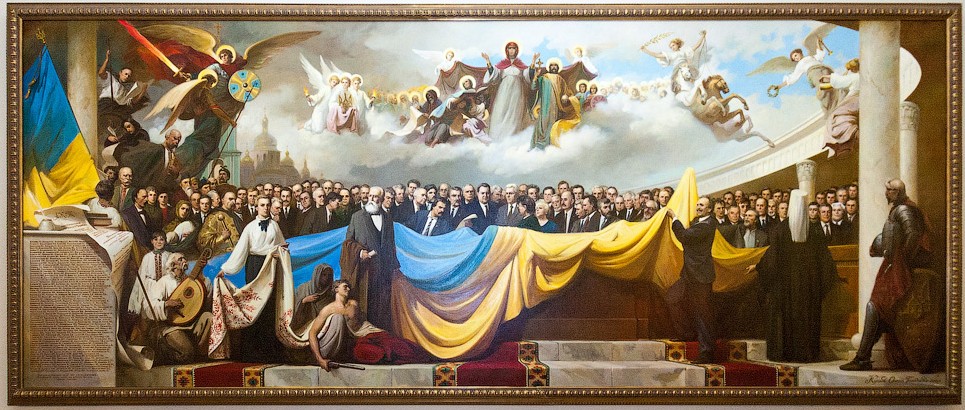
Ukraine: from the middle ages to a new world

What the West could learn

Hlibovytskyi's point now reads less like theory than like a warning. "The Western world has learned to combine freedom and a high quality of life," he says. "Ukraine adds resilience to this mix. And this resilience will be needed in the West too, in time. The world has become dangerous. The sense of security turned out to be deceptive."

It doesn't matter which ocean you live behind, he says, "if cyberterrorists are acting against you or identity politics is destroying solidarity." Look at Russia's hybrid warfare spreading across Europe: disinformation, drones over airports, sabotage. Ukrainians didn't wait for their government to act.

In the West, governments work, so criticizing them can be a form of self-expression. In Ukraine, you have to build the state yourself. "No state can protect citizens who do not want to be protected," Hlibovytskyi says. "The state of democracy depends directly on how citizens carry out their duties."

Bruised, but not broken

Ukraine is taking blow after blow. Millions have left, and many have been killed. We are exhausted. And still the drive keeps going forward, still it tries to reform, even as so many reformers are at the front and the pace has slowed. It is bleeding and bruised, but it is still there: the drive toward a life in which justice and dignity are honored. It is the soul of the country.

That is what is underestimated. Euromaidan is too often described as a product of outside forces. That is a lie. What fed it was the quest for justice and dignity that drove all those people onto the square. "Justice is a fundamental archetypal feature of Ukrainians," the dissident Myroslav Marynovych says in the course's final lecture. "If it is violated, Ukrainians rise to revolt."

About the course

Ukraine: History of Civil Society is free on Coursera: 12 lectures of 9 to 13 minutes, from the Revolution on Granite through Euromaidan to the full-scale war. It was created by the East Europe Foundation and the Ukrainian Institute with EU funding. Its authors include Oleksandra Matviichuk, Olha Onuch, Sevgil Musayeva, and Yevhen Hlibovytskyi, and it is presented by Kateryna Zarembo and Tymofii Brik.

A Russian handler courted a Colombian ex-soldier from a Kyiv teen’s account and arranged the date, police say. Then the teen allegedly poured the poison for a promised $1,000, filmed him dying, and fled

19 novembre 2026 à 09:38

A police officer with the 19-year-old suspect after her detention.

A 19-year-old Kyiv woman is suspected of fatally poisoning a Colombian citizen who had served in Ukraine’s army, the Kyiv City Prosecutor’s Office said on 18 November. A handler working for Russian special services had offered her $1,000 for the job, Kyiv police said.

By mid-August, police were already investigating 11 poisonings of soldiers that year for links to Russian recruitment. Foreigners serve in Ukraine’s military too. In August, Military Ombudsman Olha Reshetylova put their number at about 16,000, nearly 40% of them from Latin America.

How the handler set up the meeting

The woman gave the handler access to her messenger account, police said. He used it to court the 32-year-old Colombian for over a month, invited him to Kyiv for a date, and asked him to rent an apartment. The man’s army contract had ended several months before his death. On the eve of his arrival in Kyiv, the handler sent her to collect a bottle of unknown liquid from an agreed location, police said. The bottle was hidden in a park in Kyiv’s Obolon district, prosecutors said.

The suspect, right, and a man in a shop, in surveillance footage released by Kyiv police.
The suspect and a man in a shop, in surveillance footage released by Kyiv police. Photo: National Police of Ukraine

During the date, she poured the liquid into his glass of alcohol, and he died within an hour, police said. “All this time, the girl filmed the victim on video for a report to the enemy special services,” their statement added. She filmed the man after he showed no signs of life and sent the video to whoever ordered the killing, prosecutors said.

She then took money from his pockets, locked the apartment, and fled, police said. Police found her hiding in an abandoned house in a settlement in Cherkasy Oblast. A forensic examination found that he died of poisoning.

On 7 November, prosecutors notified her that she is suspected of intentional murder for gain, committed to order. The offense carries 10 to 15 years or life in prison. She is in custody without bail and had previously been held liable for drug possession, prosecutors said. Investigators are still identifying who ordered the killing, prosecutors added.

Police officers in an apartment, in a photo Kyiv police released with the case
Police officers in an apartment. Photo: National Police of Ukraine

Russia’s handlers recruit for arson and for murder

Russian handlers have recruited young Ukrainians on Telegram to burn military vehicles and railway equipment. Now they also use fake dating profiles to lure soldiers to prepared locations, where they try to kill them with bombs or poison. By early August, the Security Service of Ukraine (SBU) had foiled more than 50 such attempts since the start of 2026.

In February, two underage girls in Kharkiv poisoned a National Guard serviceman with methadone for a promised $5,000 while a Russian handler watched by video link, the head of the Kharkiv Oblast Prosecutor’s Office, Yurii Papusha, told Ukrinform in July. Both suspects were then in custody and admitted the killing, he said.

Ivan Vyhivskyi, then the national police chief, said in June that police had recorded six contract-killing cases against service members since the start of 2026, ordered by Russian handlers through Telegram, including an attempt that was prevented. The handlers find young women through messaging apps and send them money for apartments and alcohol, as well as the locations of methadone stashes, he said.

Ukraine’s most unusual counteroffensive: foreign volunteers crawl 15 km through ice-cold pipe in gas masks, past Russian corpses to rout the rest

11 novembre 2026 à 08:42

Aerial photo of Kupiansk in Ukraine’s Kharkiv Oblast, August 2026. Photo: 41st Separate Mechanized Brigade

Ukraine opened a second front against Russia, inside a gas pipe the Russians were using to slip into Kupiansk. Colombian volunteers of Ukraine’s Khartiia corps crawled more than 15 kilometers through the pipeline and routed the Russians inside, in what the corps calls the first large-scale underground counteroffensive of the war, Khartiia said.

Russia wants Kupiansk as a logistics node and a springboard for pushing deeper into Kharkiv Oblast. Just outside the city sits the Kupiansk-Vuzlovyi station, a key rail hub whose capture would let Russian forces move supplies and equipment far more easily.

A pipe with no way to dodge

Hamlet Avagyan, who commands the 23rd Separate Assault Regiment, paired the underground push with a surface assault on the pipe’s known entry and exit points.

“Because in the pipe, if contact happens there, it’s a 100% loss: nowhere to dodge, nowhere to hide,” he said.

He picked his shortest soldiers and trained them for weeks in a pipe of the same diameter, in gas masks and oxygen tanks. Sappers had mined the approaches, and the group pushed through the narrow tunnel in zero visibility and freezing water.

Barricades built from the dead

Colombian volunteers led the way. The barricades turned out to be much longer than we assumed at first, about 200 meters of rubble.

"The Russians even used their own dead, those who died or perished inside the pipe, and stacked their bodies into this barricade like sandbags," said a volunteer, callsign Agihon, who spent about a month underground.

After dragging the corpses away by hand in the dark, he said, the fighters heard Russian voices a few meters ahead.

One man, alone, in the dark

The hardest push fell to a volunteer, callsign Cuervo, who went in alone. He dropped his body armor and helmet, which would have snagged in the pipe, and crawled 40 to 50 meters on his belly, forbidding his comrades from following.

“If we had all gone together, a single Russian, firing a burst into the darkness of the pipe, would have laid us all down. So I chose to risk my own life for the guys. I crawled right up close, opened fire, and was able to complete the combat task,” he recalled.

Routed on their own route

As the underground team advanced, Khartiia units stormed the pipe exits and Russian strongpoints above, pinning the enemy with artillery, electronic warfare, and drones, preventing it from reinforcing.

More than 100 Russians were killed, and more than 30 captured, Khartiia said, ending its bid for Kupiansk’s rear.

Ukraine’s anti-corruption agencies team up with top volunteer whose fund bought 299,365 drones. $1.25 million from their previous deals goes to army

6 novembre 2026 à 06:31

FPV drone view of two Russian soldiers in Pokrovsk moments before a strike, February 2026. Photo: Telegram channel Sternenko donetsk oblast

The charity fund of top Ukrainian volunteer Serhii Sternenko, which has bought 299,365 FPV drones for the Ukrainian army, has signed a Memorandum of Cooperation with the National Anti-Corruption Bureau and the Specialized Anti-Corruption Prosecutor’s Office, bodies created as a mandatory condition of Ukraine’s European integration and the fight against top-level corruption, the two agencies said.

Under the Memorandum, the two sides will continue regular exchanges of information on pricing and procurement in the defense sector. The document also establishes a mechanism for reporting on military purchases made with funds directed to defense under plea agreements, from bail, and through other legally provided mechanisms, with the Specialized Anti-Corruption Prosecutor’s Office regularly publishing those reports on its own resources.

Money from corruption cases, turned into weapons

The point of the arrangement is to route money recovered through anti-corruption cases into arming the front. The two bodies “are already working together so that funds from anti-corruption cases help supply the Defense Forces with the necessary weapons and property,” the Specialized Anti-Corruption Prosecutor’s Office said.

The memorandum formalizes and details that cooperation. So far, the fund has received $1.25 million to make purchases for Defense Forces units under such agreements.

Sternenko: “every hryvnia” used transparently

Sternenko, a volunteer long targeted by Russia for supplying drones to the front, said his fund values the anti-corruption bodies’ trust and called the signing an added incentive to do better.

“Thank you to the anti-corruption agencies for their extremely important work, both in fighting corruption and in helping the army,” he wrote after the signing of the Memorandum.

His fund, he stressed, runs on donations and keeps nothing for itself.

"Every hryvnia of donations is used as efficiently as possible, every purchase is made transparently. The fund does not take a single percent for administrative activity from donations for the army,” he said.

Transparency as a shared priority

The anti-corruption agencies, whose independence Ukrainians fought to protect last year, framed the deal as an extension of their own accountability. Public reporting by the Sternenko Community was and remains integral to the fund’s work, the prosecutors said, noting that the organization’s website contains detailed information about its purchases.

“Transparency and accountability in the use of funds from agreements with the investigation are our shared priority,” the Specialized Anti-Corruption Prosecutor’s Office added.

Kyiv plans new National Guard center to recruit foreigners. Front-line commander wants it built fast: half of them still come on donations

2 novembre 2026 à 07:22

Yurii Butusov, a drone-company commander in the 23rd Assault Regiment, said that despite a deepening manpower shortage, Ukraine’s Defense Ministry pays little attention to recruiting foreign volunteers. According to him, about half of those who arrived in 2026 came on private donations rather than state money, he told Apostrophe TV.

Foreign volunteers have fought for Ukraine since 2022, but who brings them in, trains them, and pays for it has largely been left to the units and to private donors. It matters as Ukraine struggles to fill its ranks and leans on every available source of troops, even as, Butusov says, neither the ousted reform team nor the current minister has shown up to help.

A regiment that fights on foreign volunteers, with no one from the ministry in sight

Butusov pointed to his own unit as the example: the 23rd Assault Regiment, he said, is the largest assault unit fighting with foreign volunteers, yet no one has come to it either from the team of ousted defense minister Mykhailo Fedorov, who had planned reforms on recruiting foreigners, or from the current minister, Yevhenii Khmara.

“Every day, for many months, we have been conducting assault operations with foreign assault groups across a wide front. We had no representatives, not from Fedorov’s team, which was planning the reforms on bringing in foreigners, however unfunny that looks. And there are still no representatives from Khmara,” Butusov said.

The ministry, he argued, neither treats the matter as a priority nor grasps how much foreign volunteers could add to the Defense Forces.

Brought in on donations, not state money

Despite the strain on mobilization, Butusov stressed that the Ukrainian military leadership is not taking the steps needed to draw in foreign volunteers and alleviate the shortage of Ukrainians in the army.

“To this day, half of the foreigners brought in in 2026 were brought in with private money, with donations from Ukrainian volunteers and philanthropists. Not with state funds,” he said.

He added that he hopes decisions already taken by the Supreme Commander-in-Chief’s Headquarters, Ukraine’s top wartime command body, will be carried out: they set the task of standing up a new recruiting center for foreigners in the National Guard, as fast as possible, and funding it.

❌