❌

Vue normale

  • ✇Euromaidan Press
  • A Ukrainian ground robot hauls up to 500 kg—and tows broken robots back for repair
    Ukrainian company NUMO Robotics has unveiled LOKO, a heavy wheeled ground robot designed for supply runs and evacuating the wounded, Militarnyi reported on 3 November. NUMO Robotics CEO Anatolii Maksymchuk says units asked for a platform that carries more per run and cuts the number of logistics trips. On the most dangerous stretches of the front, Ukrainian ground robots now deliver ammunition, water, and food in place of soldiers, the Defense Ministry said on 7 September. In August alo
     

A Ukrainian ground robot hauls up to 500 kg—and tows broken robots back for repair

5 novembre 2026 à 05:09

LOKO unmanned ground robotic system by NUMO Robotics.

Ukrainian company NUMO Robotics has unveiled LOKO, a heavy wheeled ground robot designed for supply runs and evacuating the wounded, Militarnyi reported on 3 November. NUMO Robotics CEO Anatolii Maksymchuk says units asked for a platform that carries more per run and cuts the number of logistics trips.

On the most dangerous stretches of the front, Ukrainian ground robots now deliver ammunition, water, and food in place of soldiers, the Defense Ministry said on 7 September. In August alone they ran over 25,000 supply and evacuation missions, 3.3 times January’s count. The ministry aims to move as much frontline logistics as possible onto robots. That scale makes the robots targets. Russia has drone units that hunt supply routes, ground robots included, and more robots at the front mean more hits, a battalion commander from Ukraine’s 125th Heavy Mechanized Brigade told Liga in April. Each run a heavier robot saves is one fewer chance for those drones to hit it.

Fewer runs, bigger loads

NUMO Robotics showed LOKO at the Iron Halloween Party 2026 exhibition in Ukraine. The company built it as a platform for carrying ammunition, food, and other cargo into areas where sending people or regular vehicles carries high risk. It takes up to 500 kg (about 1,100 lb) per trip, the company says. Fold-down sides and an extra logistics module enlarge the deck for bulky loads.

Maksymchuk says units also wanted a platform that could support other ground robots, including by evacuating damaged equipment. A tow hitch lets LOKO drag damaged or stuck robots to a repair site. If needed, a smaller robot can ride on its cargo bed instead. The company says LOKO has been tested in combat, and its developers changed its design and functions based on soldiers’ feedback.

LOKO unmanned ground robotic system by NUMO Robotics.
LOKO unmanned ground robotic system by NUMO Robotics. Photo: NUMO Robotics

NUMO Robotics is now preparing LOKO for codification, the Defense Ministry’s procedure that clears equipment for military use. Under its former name, Tankove Biuro, the company had its tracked NUMO robot codified in October 2025.

Specs and support

Four 1.5 kW electric motors give LOKO up to 20 km/h (about 12 mph) on hard surfaces and 12 km/h (about 7.5 mph) off-road. The maker lists an 80 km (about 50 miles) range and up to five hours of continuous work, depending on conditions. Operators can control it over Starlink, LTE, or Wi-Fi.

The company supplies a spare parts kit with its robots, so troops can replace some core components right where they operate. NUMO Robotics also promises round-the-clock support, with service infrastructure in frontline regions. It says more than 60 military units currently use its ground robots.

Most Ukrainian brigades are short of troops. One that filled its ranks is helping push Russia back in Operation Vivaldi.

Par : David Axe
31 octobre 2026 à 19:11

A T-64 tank in service with the 125th Heavy Mechanized Brigade.

  • Ukrainian brigades tend to suffer from low manning and equipment shortages
  • One key brigade bucked the trend
  • The 125th Heavy Mechanized Brigade says its main units are nearly fully manned, with tanks and infantry fighting vehicles to match

In four months of deft maneuver, the Ukrainian 3rd Army Corps cleared Russian troops from 277 sq km of northern Donetsk Oblast, inflicting—according to the corps—8,000 casualties on the Russian 20th and 25th Combined Arms Armies and chasing the armies back across a key terrain feature, the Zherebets River.

There are many reasons for the success of the 3rd Army Corps' Operation Vivaldi—which the corps declared finished on 19 October, though elements reportedly keep pushing across the Zherebets to the river's eastern bank.

Operation Vivaldi may continue as Ukrainian troops spotted east of Zherebets
Map: Euromaidan Press

But one reason is becoming clearer. Bucking a worrying trend, the 3rd Army Corps under its former commander Brig. Gen. Andrii Biletskyi actually managed to nearly fill out at least one of its five line brigades. The 125th Heavy Mechanized Brigade's main units—three infantry and tank battalions, which make up around half the overall brigade—have filled between 95% and 100% of their allotted billets, the brigade says.

That means the brigade rolls into battle with as many as 1,500 infantry and vehicle crew. (A battalion typically has around 500 personnel.)

3rd Army Corps troops.
Explore further

Ukraine may already be pushing Operation Vivaldi across the Zherebets River. It’s a risky gamble

That's highly unusual. Almost all of the roughly 150 ground combat brigades in the Ukrainian armed forces have too few infantry. “Ukraine faces manpower shortage and still does not have a single brigade that is fully manned,” analyst Giorgi Revishvili wrote in June. Some brigades are effectively battalions given their stubbornly low manning.

The 125th Heavy Mechanized Brigade—commanded by Maj. Volodymyr Fokin—may be one exception to that truism. And if you believe the brigade's own claims, the unit not only has nearly all of its allotted infantry, it also has an abundance of heavy equipment including American-made M2 Bradley infantry fighting vehicles and German-made Leopard tanks. (It's unclear whether they're Leopard 1s or heavier Leopard 2s.) The 125th Heavy Mechanized Brigade's line battalions should possess around 90 armored vehicles between them.

"3rd Army Corps is built different," observer Moklasen quipped. The corps grew out of the 3rd Assault Brigade, whose soldiers described it as a new army modeled on the freedom-loving Cossacks rather than on the regulations.

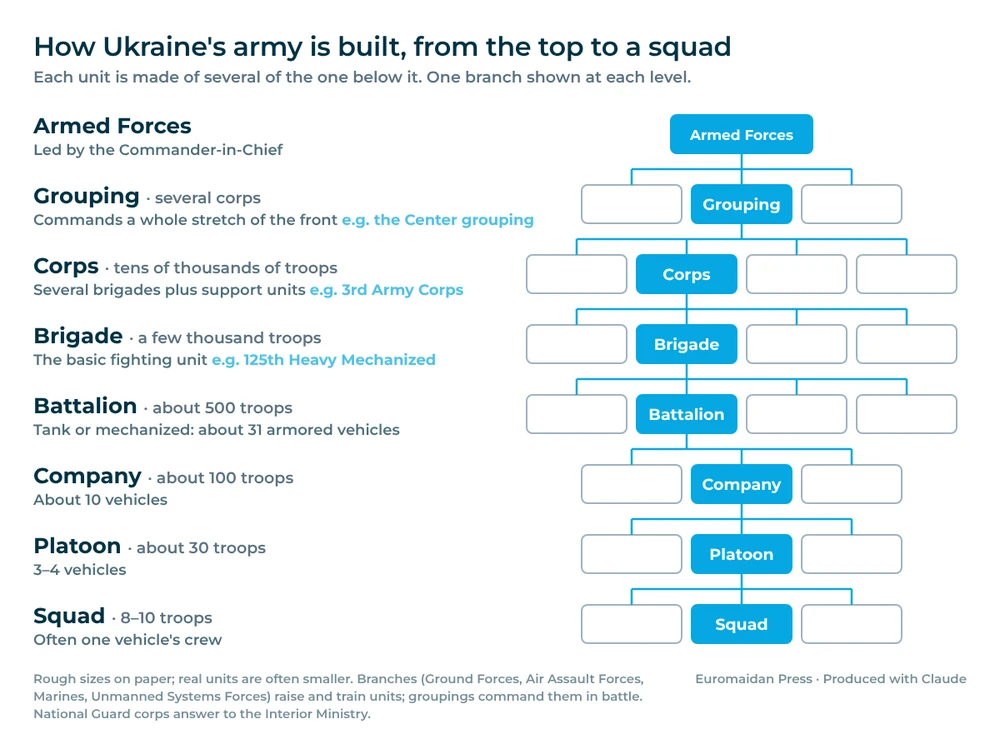
Tree diagram of how Ukraine's army is organized, from the Armed Forces down: operational groupings, each commanding a stretch of the front (for example the Center grouping); corps of tens of thousands of troops (for example 3rd Army Corps); brigades of a few thousand, the basic fighting unit (for example the 125th Heavy Mechanized); battalions of about 500, with about 31 armored vehicles in a tank or mechanized battalion; companies of about 100; platoons of about 30; and squads of 8 to 10, often one vehicle's crew.
Graphic: Euromaidan Press

Turnaround

The brigade wasn't always so fit. Indeed, as recently as a year ago it was just 17% manned and lacked heavy equipment, the brigade says, making it more typical of the younger Ukrainian brigades including the notoriously "poor" 29th Heavy Mechanized Brigade.

The 125th Heavy Mechanized Brigade stood up in 2022 as a lightly equipped territorial defense brigade, transferred to the army in 2024 as a mechanized brigade and thereafter underwent reorganization to the new vehicle-centric heavy mechanized structure.

But it took Fokin's strong leadership to actually fill out that structure, the brigade stated. Fokin and his staff "started changing things instead of looking for excuses," according to the brigade's official Telegram account.

"Within just one year, the unit has risen to the top ranks in terms of enemy attrition, mine-laying, artillery operations, air defense, unmanned ground systems, and reconnaissance. Among heavy mechanized brigades, it has held the top spot for three consecutive months."

The defenders from Ukrainian 125th Brigade. Source: Ukraine’s 125th Brigade
Explore further

“We were told brigade couldn’t be saved”: Ukraine’s 125th grew its manning 430% and won back 1,500 absent soldiers in one year

Success bred success. Increasingly confident in the 125th Heavy Mechanized Brigade's leadership, some 1,500 troops who had gone absent without leave returned and rejoined the fight, according to the brigade. That helped drive a 430% increase in unit manning, by the brigade's count, until its main units were essentially fully manned.

"The unit no longer fights with unarmed personnel," the 125th Heavy Mechanized Brigade reported. "Today, the brigade is active and conducting successful offensive operations. Its arsenal ranges from unmanned systems, unmanned ground vehicles and electronic warfare assets to armored personnel carriers, armored combat vehicles and artillery. It also boasts high-quality medical support, robust rear-echelon logistics, and a cadre of professional commanders."

Brigade troopers and their vehicles and drones underwent a baptism of fire as part of Operation Vivaldi. Robots led the way, but armored vehicles and infantry followed. The 125th Heavy Mechanized Brigade and the other assault and mechanized brigades under the 3rd Army Corps banner advanced steadily, exploiting gaps in the overextended 20th and 25th Combined Arms Armies and pushing back the bigger Russian formations.

"Operating as part of the corps, our units are once again liberating Ukrainian territory, safeguarding their personnel and continuing to evolve," the 125th Heavy Mechanized Brigade stated. Its success, the brigade says, began with strong leadership that inspired confidence in its rank-and-file soldiers—and motivated them to stay and fight.

3rd Army Corps troops disembark from an armored vehicle.
Explore further

Armored assaults aren’t dead. Robots got the credit, but it was Ukrainian infantry in armored trucks that reversed a year of Russian gains near Lyman

❌