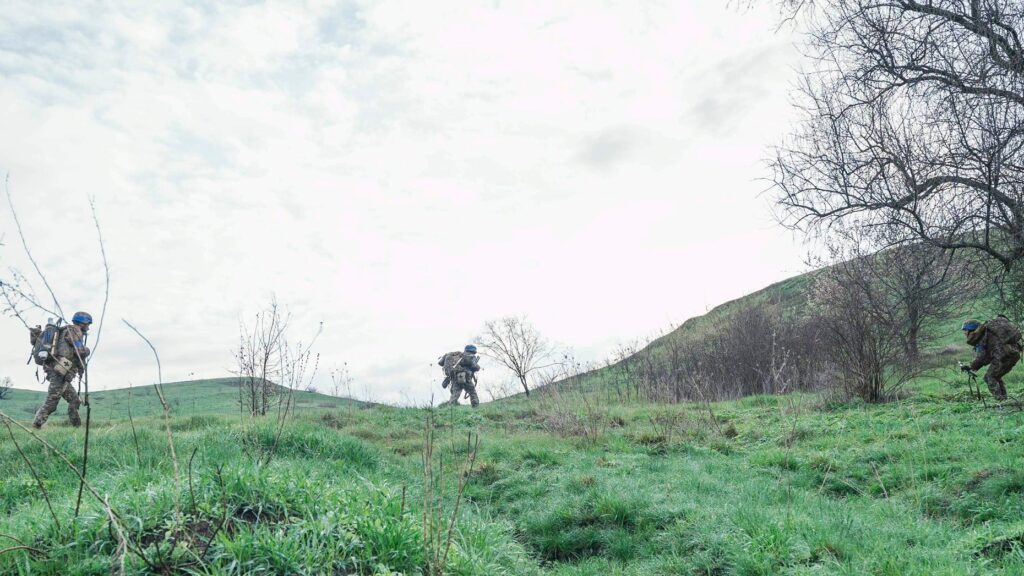
Russian ruler Vladimir Putin claimed in late June that his forces are "just over 10 kilometers" from the city of Sumy in Ukraine. The figure corresponds to nothing on the map, ArmyInform reports.
Ukraine's Defense Forces have held Russian troops more than 20 kilometers from the regional center for over a year, and according to DeepState, Russian advances over that year measured in hundreds of meters, not kilometers. Near one village of Kindrativka, Ukrainian forces even pus
Russian ruler Vladimir Putin claimed in late June that his forces are "just over 10 kilometers" from the city of Sumy in Ukraine. The figure corresponds to nothing on the map, ArmyInform reports.
Ukraine's Defense Forces have held Russian troops more than 20 kilometers from the regional center for over a year, and according to DeepState, Russian advances over that year measured in hundreds of meters, not kilometers. Near one village of Kindrativka, Ukrainian forces even pushed the occupiers back toward the border.
The claim is significant because it illustrates how the Kremlin uses exaggerated battlefield narratives to shape perceptions of the war.
Sumy city sits about 24 kilometers from the Russian border. The deepest Russian penetration into the oblast — near villages of Hrabovske and Myropilske — reaches roughly three to four kilometers inside it, according to a Ukrainian military personnel representative.
How line got there, and stayed there
Russia's push into Sumy Oblast began in the spring of 2025, after the collapse of Ukraine's Kursk salient freed Russian units to attack across the border. By late June 2025, Ukrainian forces had halted the advance and dug in along the four village line along the border.
The front runs near those same settlements today. Russia has not attempted a broad offensive push since.
What it has done instead is claim ground it does not hold. On 24 June, after Russian channels announced the capture of the village of Ivolzhanske, Ukraine's Group of Forces "Kursk" refuted the report, calling it the work of Russian staff officers who pick Ukrainian unit names at random and draw offensive arrows across maps. The only territory Russia reliably controls, the statement noted, is"their own news feed."
Putin's Sumy claim fits a pattern the Institute for the Study of War has documented all year: inflated battlefield announcements timed to convince Western audiences the front is collapsing when it is not.
He attempted to use it as useful leverage as talks over how the war ends grind on, and Moscow refuses to freeze the current line.
What Russia is actually doing
Through 2026, Russia has traded broad assault for attrition and infiltration. Small groups of infantry probe routes rather than storm them. Artillery is used less, while FPV and reconnaissance drones are used more. The tactic is expensive. Ukrainian drone crews engage the groups within minutes of their emergence.
"They come out and die in about 10 to 15 minutes," the drone commander said in April.
DeepState and ISW both assess that the activity, while real, amounts to no operational breakthrough.
The wider arithmetic matches. ISW assessed on 1 July that Russian forces seized just 30 square kilometers across all of Ukraine in June 2026, which is sixteen times less than in June 2025, at nineteen times the casualties per kilometer. The spring–summer offensive has produced no operationally significant gains anywhere on the front.
Sumy city remains under regular Russian air attack, with guided bombs and drones striking the regional center and communities across the oblast. But the ground threat Putin described does not exist at the distance he named. In a year, the map moved by meters, and in one place, it moved the other way.
Sport has spent four years quietly letting Russia and Belarus back in, usually through a “neutral athlete” side door that widens until the ban is gone. Chess just did the opposite.On 11 June 2026, the International Chess Federation (FIDE) suspended the Russian Chess Federation, though individual Russians may still compete under a neutral flag—the first time it has stripped its most powerful member of its membership rights.
FIDE is led by Arkady Dvorkovich, in office wh
Sport has spent four years quietly letting Russia and Belarus back in, usually through a “neutral athlete” side door that widens until the ban is gone. Chess just did the opposite.
On 11 June 2026, the International Chess Federation (FIDE) suspended the Russian Chess Federation, though individual Russians may still compete under a neutral flag—the first time it has stripped its most powerful member of its membership rights.
FIDE is led by Arkady Dvorkovich, in office when Russia annexed Crimea, and he stands for re-election at the FIDE General Assembly in Samarkand on 26–27 September.
And yet a former Russian deputy prime minister still runs world chess. FIDE is led by Arkady Dvorkovich, in office when Russia annexed Crimea, and he stands for re-election at the FIDE General Assembly in Samarkand on 26–27 September.
Malcolm Pein—the English Chess Federation’s delegate, the de facto leader of chess’s anti-Russian camp, and now the candidate for deputy president on Jan Henric Buettner’s ticket—argues the suspension is one win in a much longer fight to break Russia’s grip on the game.
Pein is standing against Dvorkovich’s machine and makes no secret of wanting it gone. Euromaidan Press sought him out precisely because that investment makes him one of the sharpest readers of how the capture works—and where it is vulnerable.
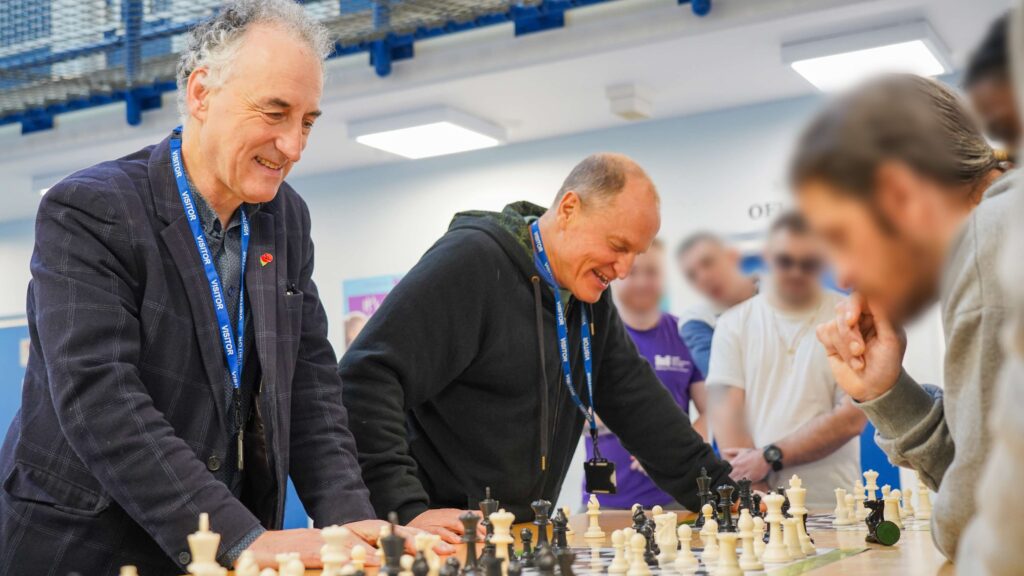
Malcolm Pein with actor Woody Harrelson at Wormwood Scrubs prison in London. Photo: HMPS
Peeter Helme:Chess has often presented itself as a world apart—a game of ideas, concentration and personal talent, something supposedly above day-to-day politics. Has Russia’s war against Ukraine made that view impossible?
Malcolm Pein: Your question is framed in a historically inaccurate way, because chess has always been extremely important—to the old Soviet Union above all—and it has always been a metaphor for geopolitics.
The difference now is that instead of being a metaphor, chess is actually a political weapon.
Go back to Reykjavik in 1972, or to Kasparov playing Karpov, the new Soviet Union against the old, and you see that the West, too, has always treated chess as a bellwether. The difference now is that instead of being a metaphor, it is actually a political weapon. It has never before been used that directly—in sporting boycotts of Russian teams, or anything else. That is the new situation.
Helme:Seen from Ukraine, this is far from abstract. Some Ukrainian players have lost relatives, homes, careers.
Pein: Some have been killed—there are Ukrainian chess players who have been killed. And there are others heavily involved on the front line. Grandmaster Igor Kovalenko has done his full military service, and Grandmaster Oleksandr Sulypa, the captain of the Ukrainian team, has volunteered in the armed forces. And there are countless others.
Explore further
Russia’s war kills 644 Ukrainian athletes. Chess Federation’s response: Restore Russian flags and host events in Belarus
Helme:Has international chess really listened to what Ukrainian players have to say?
Pein: Not everybody. There is a strong constituency of Western nations that have fought the good fight and continue to do so. But chess is no different from many other sports.
In Latin America, the Russian invasion of Ukraine does not resonate, people do not care.
In Latin America, the Russian invasion of Ukraine is not really a news story—it does not resonate, people do not care. And, most unfortunately, that is true for most of Africa and most of Asia. Which makes it all the more important that those of us in Western Europe, with a worldview that seeks democracy and a rules-based order, fight this fight as hard as we can.
Helme:There is an argument that athletes should not pay for the actions of their governments. What is your view?
Pein: Wherever possible, individual athletes should not be sanctioned—I would not punish people simply for being Russian, because you do not know what they feel about the war. But where someone has spoken out in favor of the war, or taken part in propaganda—and here I would point to the Grandmasters Sergey Karjakin or Denis Khismatullin—then those people I would certainly sanction.
I would not go out of my way to make their lives harder.
The average Russian player just trying to make a living has seen his opportunities seriously limited, and rightly so. But I would not go out of my way to make their lives harder. If anything, those people have my sympathy.
Helme:Why is the pressure to bring Russian and Belarusian players back growing now? The war and the occupation are still going on—nothing has changed.
Pein: There is a certain fatigue—it is hard to keep something at the top of the agenda when there is no radical development, a kind of stalemate. And Russia is trying nonstop, devoting considerable diplomatic resources to getting these bans reversed.
In some sports, things have gone backwards, and Russia has regained influence—fencing is one, boxing another.
But despite the best efforts of Dvorkovich, we recently scored a very big win at the Court of Arbitration for Sport in Lausanne, and got the Russian Chess Federation suspended. That is an absolutely fantastic and unprecedented success. In some sports, things have gone backwards, and Russia has regained influence—fencing is one, boxing another. In chess, we have held the line.
Explore further
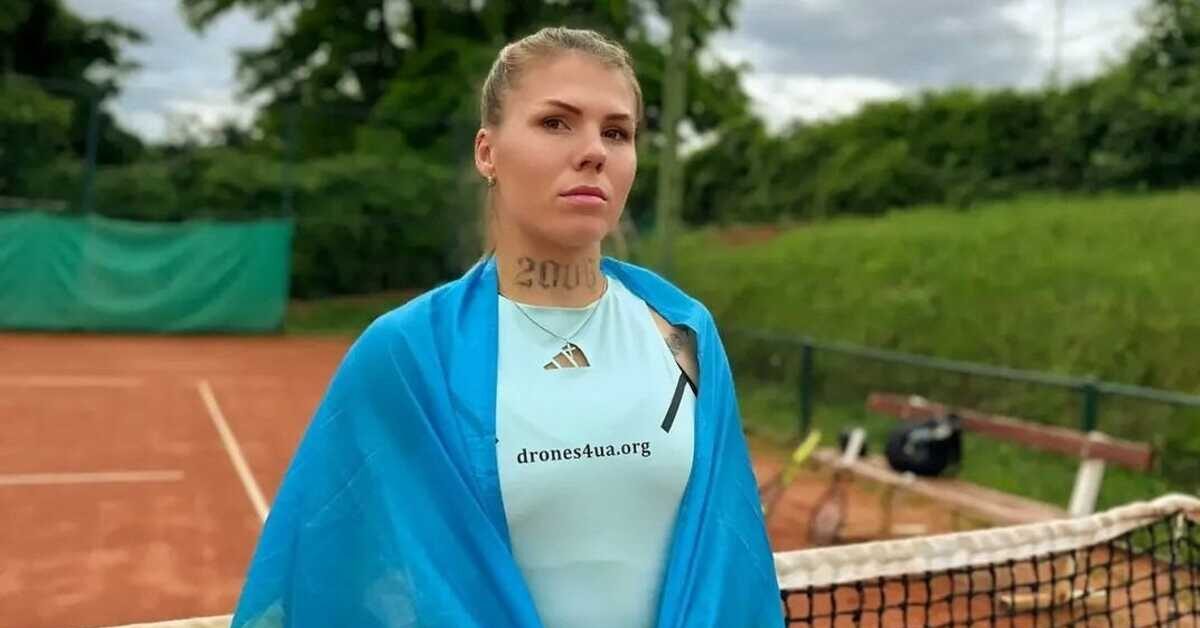
Sport is letting Russia back in. This Ukrainian tennis player says no.
Helme:Distinctions are often drawn between individual players and national teams—so-called neutral players under a neutral flag. What do you make of that?
Pein: I am not in favor of banning Russian players for being Russian. I am in favor of banning Russian teams for being Russia—that is the distinction.
In the Russian press this morning, there was an article claiming that, if elected, I would ban all Russian players.
In fact, in the Russian press this morning (2 July 2026—EP), there was an article claiming that, if elected, I would ban all Russian players. That is absolutely not true. I would not change the status quo unless the IOC took further action against Russia.
Helme:Why should the return of Russian teams be seen as politically significant, rather than a niche sporting question?
Pein: First, chess is no longer niche—it is a hugely popular global sport. But the real reason it matters is that it matters to Russia. The unwritten arrangement between the Russian state and its citizens was: life is hard, we are not as wealthy as the West, but we are a great country, we compete, and we win.
Chess is embedded in the culture and history of the Soviet Union and Russia.
Chess is one of those achievements—embedded in the culture and history of the Soviet Union and Russia. Taking it away is significant, and the regime knows it. Arguably, it matters to them more than the success of their football or volleyball team.
Helme:You would not punish players for being Russian, but you would bar Russian teams. What would a fair, principled policy look like?
Pein: The policy we fought for—with a great deal of help from Oleksandr Kamyshin—was the one we defended in September 2024, when the FIDE General Assembly voted to keep sanctions on Russian teams.
No flags, no anthems, no officials, no teams, and any players competing under a neutral flag. That, to me, is the policy. I campaigned very hard to maintain it, and we succeeded.
Helme:Is there, in your eyes, a difference between the Russian and Belarusian teams and athletes?
Pein: No—Lukashenka cooperates with Putin. I know the IOC has removed its recommendation to restrict Belarusian athletes and teams.
I would like FIDE to be aligned with the IOC as far as possible.
I would prefer to keep Belarusian teams out for the moment. But generally, I would like FIDE to be aligned with the IOC as far as possible, so it may be something I would eventually comply with.
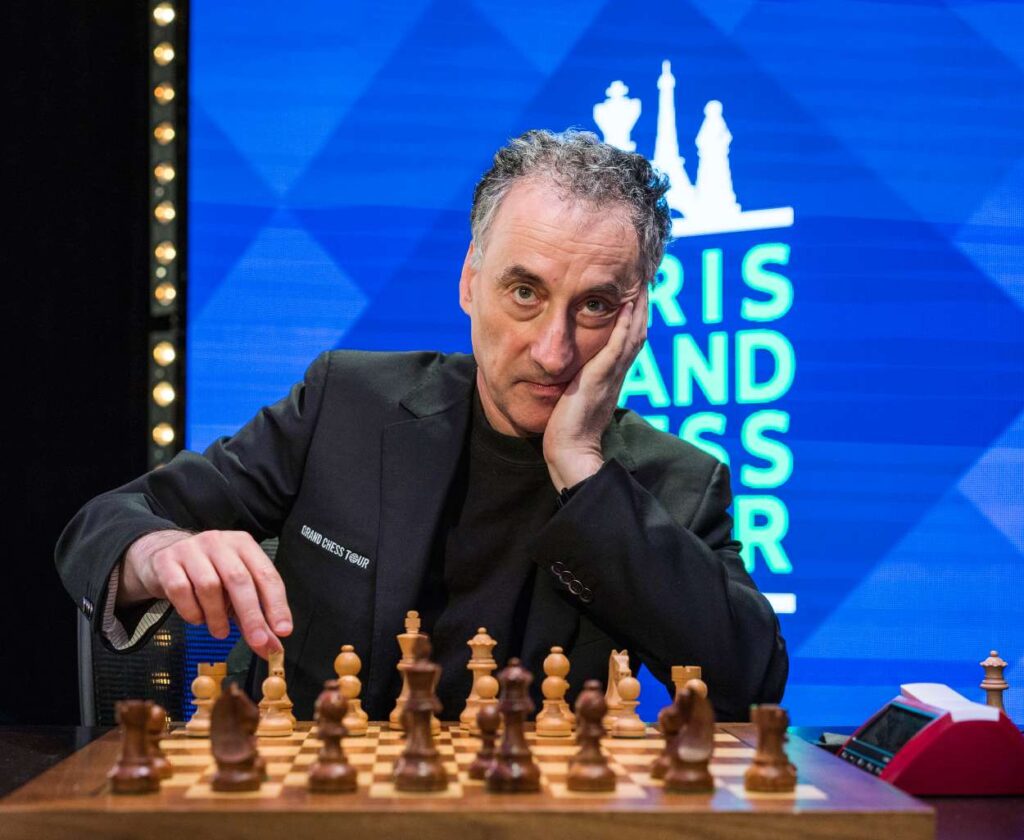
Malcolm Pein at the Grand Chess Tour in Paris. Photo: Lennart Ootes
Helme:Should there be safeguards when the president of an international federation presides over decisions that affect his own country’s national federation?
Pein: It is a colossal conflict of interest. Russia has basically hijacked FIDE—just go to the FIDE website and look at where the employees come from: Russian head of PR, Russian head of legal, and so on.
Helme:Beyond Ukraine—what argument travels in Africa, Asia, and Latin America, where the war does not resonate?
Pein: You campaign on other issues. The main one is that when Dvorkovich came in, he said the most important thing he wanted people to know was that presidents would no longer serve unlimited terms—there would be term limits.
There is plenty to campaign against him on that resonates more widely than something Ukraine- or Russia-specific.
And then he had that overturned. So there is plenty to campaign against him on that resonates more widely than something Ukraine- or Russia-specific.
Helme:You are standing for deputy president on Jan Henric Buettner’s ticket. Who else is in the race, and what concerns you about the field?
Pein: There are three tickets in this election so far. Dvorkovich is running with Timur Turlov, who heads a Nasdaq-listed finance company and the Kazakhstan federation, and who was formerly Russian before becoming Kazakh, which itself raises a question.
He was born in Ukraine and seems to have extensive connections in Russia.
Another ticket is headed by Wadim Rosenstein, who has sponsored a great deal of chess recently but is hard to pin down—much of his business history has been erased. He was born in Ukraine and seems to have extensive connections in Russia. Our concern is that he is really the Kremlin’s plan B—or plan A, if the EU sanctions Dvorkovich.
We are setting up our ticket as an alternative to 30 years of Russian domination of FIDE—one that would bring in money from wider sources than Russian or Russian-linked oligarchs.
This interview is part of Euromaidan Press’s series on how international sport is negotiating sanctions and Russia’s war on Ukraine.

 Connexion