On September 30, I walked out of a three-hour medical appointment to dozens of missed calls. They were from colleagues: the entire newsroom of Matsadaash, an independent fact-checking platform, had been arrested. Six journalists, five of them trainees in their early twenties, all picked up in less than 24 hours.
I didn’t know any of them. It didn’t matter. An entire newsroom taken in a day, then disappeared: that was enough. I don’t need to know someone to stand with them. If they are journalists arrested for doing their job, I am with them.
For five days, no one knew where they were. Their families and lawyers filed 18 complaints in that time, according to the Egyptian Initiative for Personal Rights (EIPR), which represents them. The Interior Ministry called Matsadaash an unlicensed, foreign-run page, and linked it to the Muslim Brotherhood, which Egypt designated a terrorist organization in 2013. The Matsadaash founder, Abdelrahman Mansour, denies any affiliation.
When the six journalists were finally produced before state security prosecutors, some, according to their lawyers, said they had been blindfolded, bound, stripped, beaten and given electric shocks. State prosecutors said forensic examinations found no injuries. The journalists were charged with joining and financing a terrorist group, reporting fake news and using social media to spread it. On October 13, their pretrial detention was extended for another 15 days. Their salaries, which EIPR and the Egyptian Journalists Syndicate say were paid under employment contracts filed with Egyptian banks, were described, in the prosecution’s words, as “monthly funding in foreign currencies.”
Over three days, each of the six journalists was interrogated for nearly 30 hours. According to EIPR, not one was confronted with a single report they had written that could be called false. Instead, the prosecution’s own statement accused them of “highlighting shortcomings — and nothing else — in state institutions,” belittling officials and amplifying people’s grievances.
But that is precisely our job. It is what we sign up for as journalists — to ask questions of those in power. On October 4, another colleague was summoned for questioning; thankfully, she was released the same day.
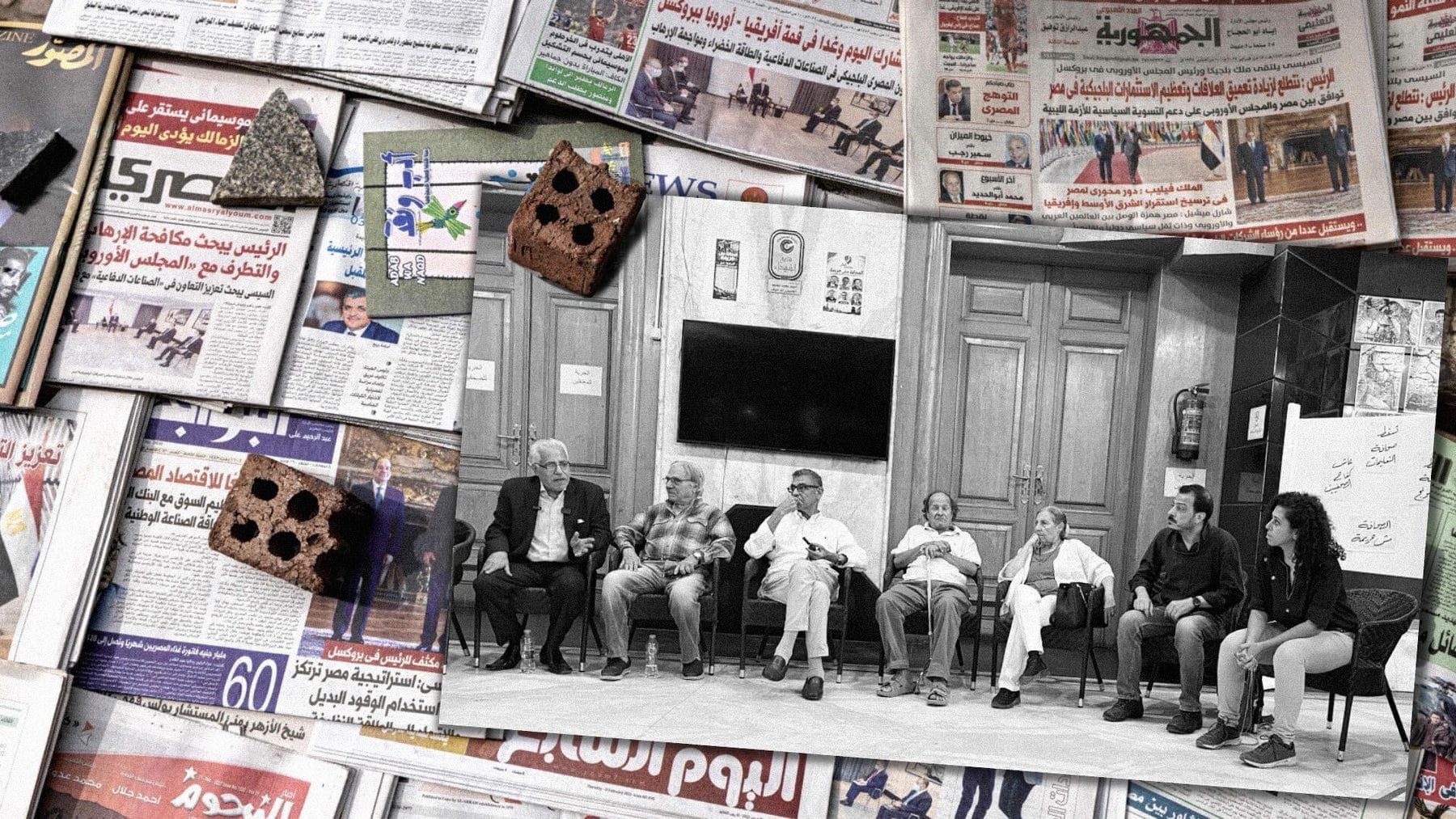
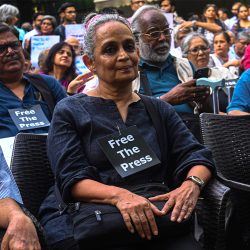
Word spread the way it does now, through social media posts, journalists’ pages and a knot of phone calls I can no longer untangle. Colleagues were gathering at the Journalists Syndicate every day. So I went too. The Syndicate is a union with a long history of standing up for us, and I joined my colleagues there in solidarity with those who had been detained. Not everyone could come every day, but there was always someone — on some days just four, on others more than 20.
Even our older colleagues, in their 60s, 70s and 80s, showed up. Ustaz Mohamed Abdel Kouddous, who once headed the Syndicate’s freedoms committee, is recovering from an accident and could not be there in person, but he was with us through his voice and his written messages. For as long as I can remember, he has been there for every struggle: at Al-Ahram, arguably Egypt’s most prominent daily newspaper; and at the Syndicate, with his megaphone, firing us up. He and I don’t share the same politics, but it has never mattered.
In 2008, on the day of a nationwide strike, plainclothes officers dragged him from his car in broad daylight and held him until nightfall. He asked the Syndicate to demand an investigation, though he expected nothing to come of it. “We do what we need to do,” he said then. It could be the motto of our sit-in today.
Many of us feel embarrassed to eat or to have a cup of tea, not knowing whether our colleagues inside have the same luxury. When I kiss my girls goodnight, I feel ashamed that my colleagues in jail cannot do the same.
Illustration: Anna Jibladze, using images by Lina El Wardani and Getty Images
I keep thinking about how we got here.
Under Egypt’s former president Hosni Mubarak, the red lines were clear. You did not touch the head of state, his wife and his sons, or a certain institution (the military). But everything else was fair game. We knocked ourselves out writing about poverty and corruption, labor rights and children’s rights, domestic violence, sexual harassment and female genital mutilation.
Then came 2011, and a revolution unlike any other. In Tahrir Square, we rejected violence, and our chant was “selmeya, selmeya” (peaceful, peaceful).
When we brought Mubarak down, he didn’t flee like the Tunisian “strongman” Zine al-Abidine Ben, and we didn’t lynch him like Muammar Gaddafi in Libya. We put Mubarak on trial, in a courtroom. It was dignified. It was the revolution of the dreamers.
In those few years, Egyptian journalists lived with freedoms we had never known. But dreamers are not politicians.
We had lived for decades with no politics: no real political parties, no real elections, no way to learn how power works. So when the door was opened, we didn’t know how to build what we had dreamed of. People kept asking, “What is the alternative?” We had the dream, but not the tools.
What followed our revolution was the opposite of what we fought for: restrictions on a scale we had never seen. The red lines blurred and multiplied, until no one knew where they were anymore. The story of our country, of our revolution and of our journalism is the same story. We are not organized. We are not politicized. But we dare to dream.
Today, at least 25 journalists are behind bars in Egypt, says the Committee to Protect Journalists, almost all of them in pretrial detention. That period is technically limited to two years, but prosecutors file new charges and renew detentions. Some, like the photojournalist Hamdy al-Zaeem, have spent a decade in and out of detention without a single conviction. My colleague Haidar Kandil was taken in June, after documenting arrests of Egypt’s Shia minority.
On the evening of October 14, the lobby of the Syndicate’s headquarters in downtown Cairo was filled with banners and cartoons. Three colleagues and I sat down to write letters to our jailed colleagues: 26 names in total. We fussed over how to organize the letters: how to arrange the names, whether the envelopes should be open or closed, which color went with which name. Colleagues with beautiful handwriting wrote each name in calligraphy. Then we realized we couldn’t spend the whole evening rearranging the deckchairs. At some point, we had to start writing.
But our minds were blank. What could we say? “Why are you inside, and why are we free?” “We feel guilty that we are free and you are paying the price. Maybe we should have paid it instead.”
Of the 26, the only one I have worked with is Haidar. He had a good eye for a story. Like most of the young journalists I work with, he needed guidance, but he was always responsive to edits, to make changes and turn in better copy. We spoke on the phone and exchanged emails and texts, but we had never met. I only know his face from photos online, and here I am pinning his photo on the noticeboard in the syndicate with a #FreeThemAll banner.
In the end, all I wrote was: “I miss you, Haidar. I hope to see you soon. Hang in there. Love, Lina.”
Whenever I feel small, I remind myself that this Syndicate has always fought the good fight. That same evening, the veteran journalist Medhat El-Zahed told us how, during the 1989 Iron and Steel workers’ strike, he and his leftist colleagues were arrested and tortured. The Syndicate’s head at the time, Makram Mohamed Ahmed, was close to the authorities. Still, he protested over the treatment of journalists and visited them in prison.
Today, for the first time, the head of our Syndicate is one of us. Khaled El-Balshy is a dreamer. Eman Ouf, who heads the freedoms committee, is one of us too. The Syndicate has pledged to defend all six Matsadaash journalists. It has asked the Attorney General to investigate the abuse allegations. Its statement chose every word with care, stressing its commitment to the law and to the country’s higher interests, and asked only that our colleagues be released on the Syndicate’s guarantee, or any other, given their young age. It was the most modest of requests. Even that was too much for some.
The tide is so high, and we are so low.
After more than two weeks, we have suspended the sit-in. We are not leaving the Syndicate, and we are not giving up. In our statement, we promised to keep standing with our colleagues through other events, because the battle for press freedom “needs a long breath.”
On October 18, eight independent news outlets from Egypt, Lebanon, Tunisia and Syria, among them Mada Masr and Al-Manassa, announced a joint newsroom to fact-check “Egypt Forum 2026,” the government’s “achievements conference.” The summit runs from October 19 through to October 24 – six days for six journalists. The eight newsrooms have united under the slogan: “Until they return, the fact-checking continues.” The dreamers are learning to organize.
We journalists and dreamers, like those of us who gather in the Syndicate, are stubborn. Many are behind bars of some kind: real ones, imaginary ones, or the bars of a censored internet. But we always walk towards the light. Journalism is how we live and breathe. If we don’t fight for it now, there will be nothing left to fight for tomorrow. No profession, no dignity, and no Syndicate.
This story was published in collaboration withEgab.
In May, William Tharien, a 19-year-old student, made his second attempt at passing NEET, India’s national entrance exam for would-be medical students. Passing the test was the only way William would be eligible to study to be a doctor, surgeon, dentist or vet and he was competing with about 2.2 million other students for one of about 130,000 places in medical schools around the country. What makes the test even more nerve-wracking is that only half of these places are available at heavily subsidized state-run colleges, rather than expensive private institutions.
It can take students up to two years to prepare for these exams, with parents going into debt to pay fees at tuition centers entirely devoted to cracking the test. Days after William, and millions of others, took the test on May 3, authorities discovered that the paper had likely been leaked and circulated on social media platforms like Telegram. The results were voided.
Around the same time, the Chief Justice of India’s Supreme Court compared young people “who don’t get any employment and don’t have any place in a profession” to cockroaches and parasites. In a country with the largest population of 15- to 29-year-olds in the world (nearly 370 million people) and high levels of youth unemployment, particularly amongst the educated, the judge’s remarks struck a raw nerve.
It led to the formation of the Cockroach Janta Party — a mocking reference to India’s governing Bharatiya Janata Party, led by prime minister Narendra Modi — initially as a satirical meme. But the cancellation of NEET gave the Cockroach Janta Party real-life relevance and made it an outlet to channel the extensive frustration and anger of India’s youth.
In neighboring Nepal, Bangladesh and Sri Lanka, so-called Gen Z protests between 2022 and 2025 had toppled governments.
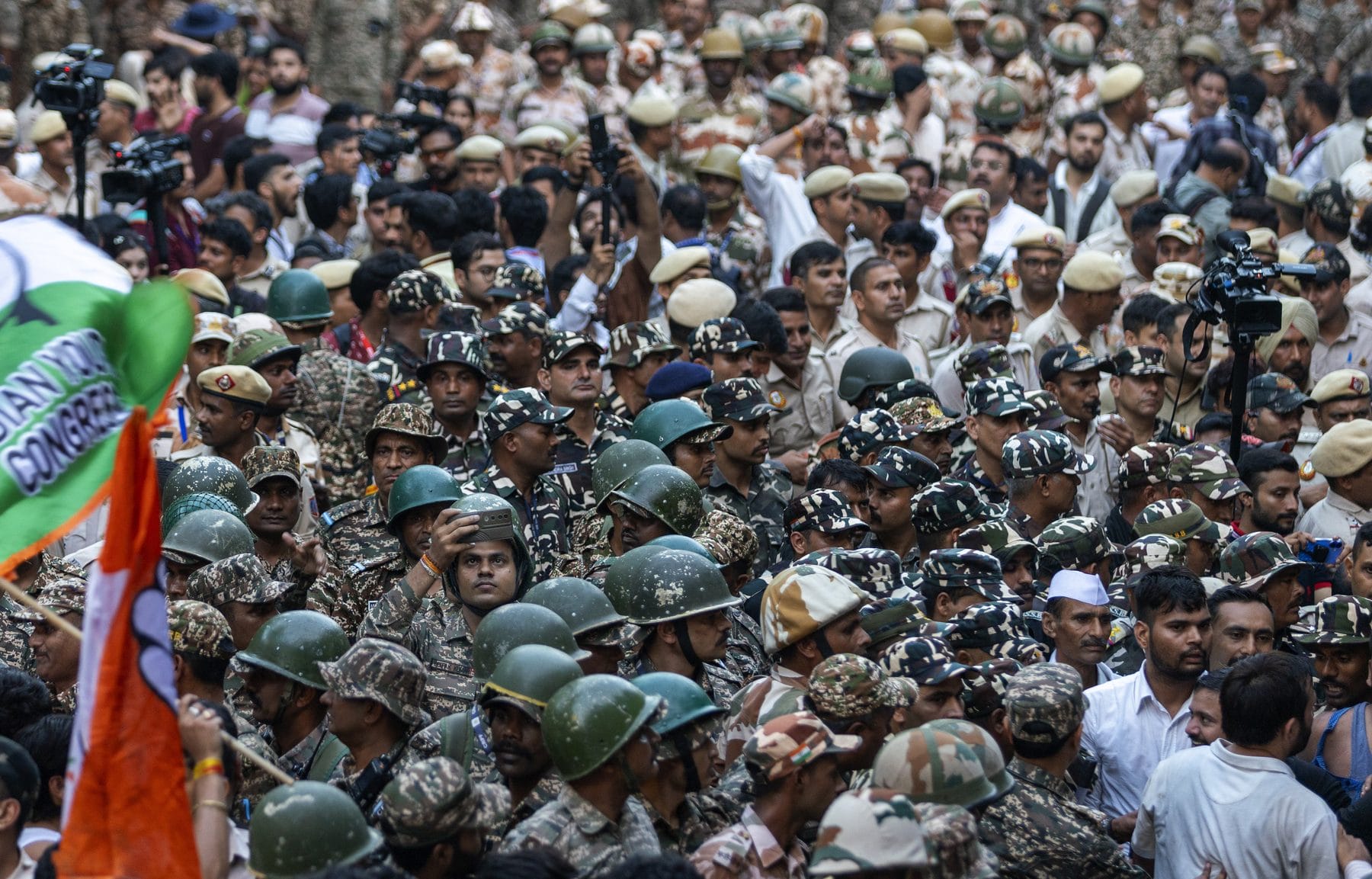
In June, William joined tens of thousands of students in Jantar Mantar, an iconic venue for public protest in the Indian capital Delhi, to call for the resignation of Minister of Education Dharmendra Pradhan over the NEET debacle. The demonstrations lasted for weeks, even as the Delhi Police resorted to tear gas, pellet guns, electric shock devices, and lathis (nearly six-foot-long bamboo sticks) to disperse the crowds. William was a regular.
“I always felt watched,” he told us. At metro stations, on his way to the protests, he said he repeatedly encountered the police. “They made sure that we saw them and that we should feel intimidated by their presence and their numbers.”
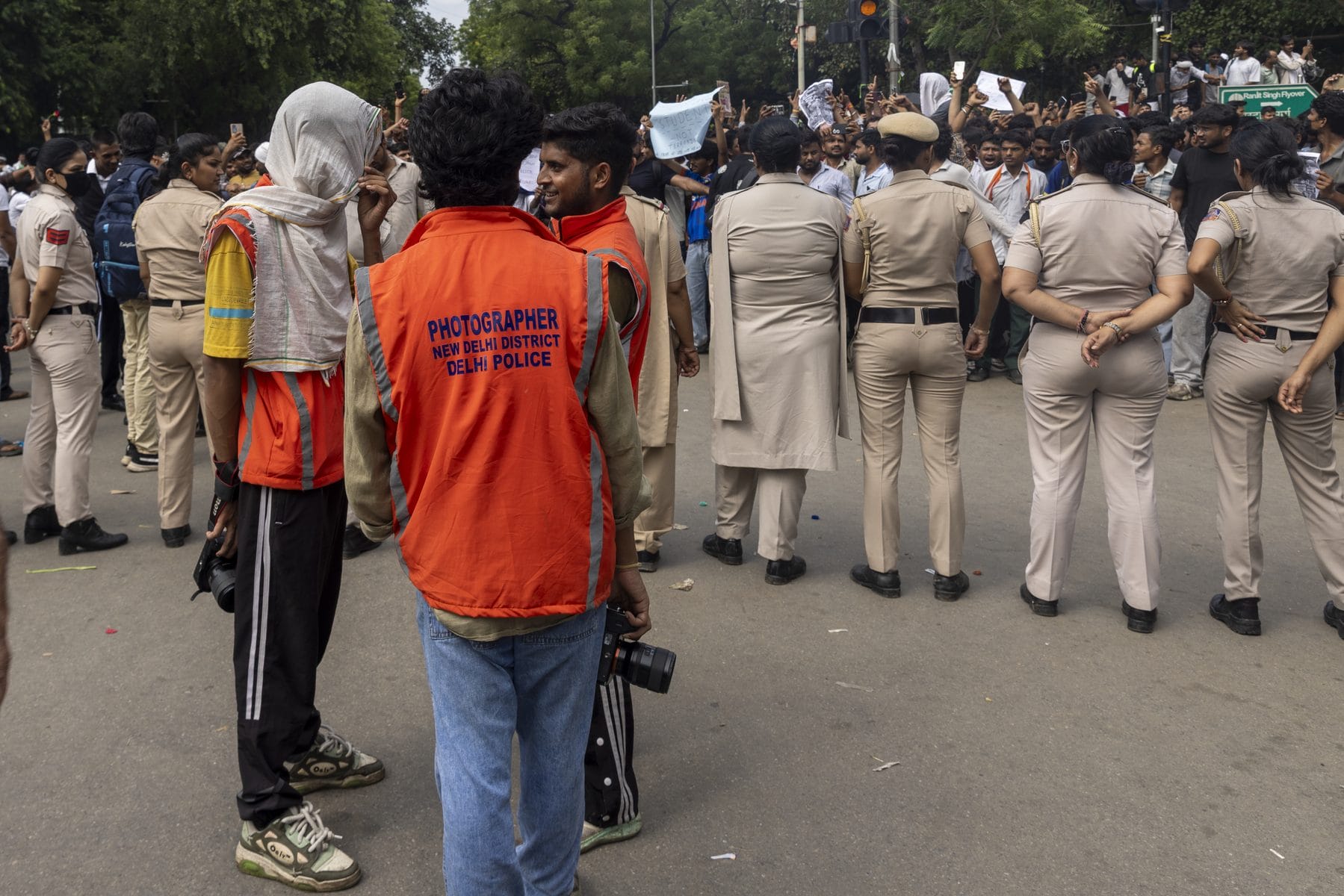
As journalists, we covered the June-July protests, including on July 20 when the police brutality reached an ugly peak as protesters marched towards the Indian parliament. Artificial intelligence-enabled CCTV cameras installed under Delhi’s “Safe City” project lined the streets in and around Jantar Mantar. A permanent surveillance tower stood at the center of the protest site, recording around the clock. Multiple drones circled overhead. Photographers hired by the police moved through the crowd. Some officers carried body cameras, and at least one police officer was seen wearing Ray-Ban Meta smart glasses.
Two police surveillance vehicles were parked just outside the entrance to Jantar Mantar. One was Ikshana (the Sanskrit for, literally, the act of seeing), an AI-powered police van with eight cameras that used facial recognition technology to match faces to police databases in real time. The other was a mobile command center.
According to William, the surveillance was not limited to the protest site. “I saw police detaining students at the metro station,” he said. “They were recognizing students from footage, identifying them by their bags, or style of mask or sunglasses.”
Even after the protests stopped, with the July 25 resignation of Pradhan, the education minister, William said the police paid visits to students in their neighborhoods. They were tracking down protesters. On August 3, he said, two police officers showed up at his lodgings. He was alone. “We have photos of you,” the police told him, “in colour. You’ve been seen going to the protest site on multiple days and also seen at the metro station.” Insisting that attending protests was a democratic right, William refused to let the police into his room without a warrant.
According to the Indian Express, the Delhi Police used surveillance footage accrued during the NEET protests in the summer to identify at least “2,800 people with a criminal background” who would be be prevented from protesting against Gyanesh Kumar.
Aishe Ghosh, a prominent student activist and national office holder at the left-wing Students’ Federation of India, has challenged the Indian government and the Delhi Police in court over the indiscriminate use of surveillance technology. Not only were the authorities documenting the protests, she alleges, they were using the footage to threaten protesters with public exposure.
Long an object of surveillance, Ghosh, who was a leader of the NEET protests, said the police entered the Communist Party of India (Marxist) headquarters in Delhi to arrest her in August on the basis of protests she had attended five years earlier in 2021. Describing the attempt to arrest Ghosh as a “continuing witch hunt against student protesters,” the CPI(M) added that it was evidence of “the Modi government’s escalating assault on democratic rights.”
Ishan Tankha
Modi’s surveillance state
Hearing Ghosh’s litigation, the Delhi High Court appeared to suggest that the urgency to examine her specific allegations had dissipated since the NEET protests had concluded. The judges suggested that she file a more general petition.
The NEET protests proved only to be the start of the Cockroach Janta Party’s precipitous rise as serious, youth-led opposition to the Modi government, in power since 2014 and seemingly determined to use every arrow in its quiver, from opaque sources of funds to the takeover of independent institutions to the use of surveillance technology, to stifle dissent. In October, the “cockroaches” poured into Delhi’s streets again.
This time, they wanted the resignation of Gyanesh Kumar, India’s Chief Election Commissioner, a constitutional role meant to be entirely independent, apolitical and focused on maintaining the integrity of the Indian electoral process. An investigation by the Indian Express newspaper revealed that despite 14 objections in the last 10 months from the two other members of the election commission, Kumar had allegedly illegally taken unilateral decisions that resulted in voters being left off electoral rolls. India is currently undertaking an extensive revision of its voter lists that has controversially already disenfranchised 130 million people and potentially swayed state elections in favour of the governing BJP.
Kumar has not directly addressed the Indian Express’s findings. And while Modi too has remained typically silent — in his 12 years as prime minister, he has yet to call a single press conference — the Delhi Police has once again used violence and arbitrary arrests to crack down on still ongoing protests. Jantar Mantar, the de facto site of protests in Delhi since 1993, has been officially shut down. Prominent protesters, including Aishe Ghosh and the founders of the Cockroach Janta Party, have been detained. The opposition led by Congress Party scion Rahul Gandhi — the son, grandson and great-grandson of former Indian prime ministers — has been galvanized.
But India’s next general election is not until 2029 and the next major state legislative election is not until February 2027 at the earliest. Maintaining momentum is a task Gandhi has yet to show he can manage.
Meanwhile, the BJP continues to use friendly mainstream television media, alongside its heavy-handed policing, to argue that the protests are marginal, paid for by foreign sources and disliked by the large majority of Indians.
Fallible facial recognition tech
Technology researcher Srinivas Kodali told Coda that India’s efforts to modernise its policing system were stepped up after terrorist attacks in Mumbai in November 2008. Police stations across the country were connected, with access to criminal records and a tracking database. If someone attends a protest somewhere in India, Kodali explained, and has a police report filed against them, that information will be available to every police department in the country. He described the approach as “360-degree profiling,” pulling data together from facial recognition technology, surveillance towers, phone records, social media activity, and government databases including electoral records.
Delhi Police has said its use of technology and AI is meant to maintain law and order and identify people who already have a criminal record and not to randomly profile protesters. However, privacy researchers and lawyers warn that sophisticated surveillance systems can make participation in protests traceable long after the crowds have dispersed.
Much of the technology for this work is supplied by a growing group of private companies. Ikshana, the AI-powered police van used to monitor protesters in Jantar Mantar back in July, is one example. Rahul Bhardwaj, the Chief Growth Officer at analytics firm Intozi based in Gurugram, a tech hub on the outskirts of Delhi, said the company provides the software layer behind Ikshana’s system. Intozi processes video feeds through AI applications designed for tasks including crowd monitoring, detecting weapons and identifying people against police databases.
Intozi has previously deployed its facial-recognition technology for government security operations at high profile international summits in Delhi. Asked specifically whether its technology was used at Jantar Mantar this summer, though, Bhardwaj cited confidentiality obligations.
The company said that its role ends after its system is installed on police infrastructure, and that it does not retain the database or continue to access the system once it has been handed over to the police. “Images of people who are not in the police database,” Bhardwaj said, “are automatically blurred within seconds, while records associated with people already registered in police databases are retained by the police.”
That places responsibility for the technology and its subsequent use with the police.
Innefu Labs, whose AI Vision facial-recognition software has been used by Delhi Police in criminal investigations, declined to answer questions about data retention, legal safeguards or its operational relationship with police.
Another company, AjnaLens, confirmed its direct role in live policing. Kuldeep Pathak, Associate Director at AjnaLens said the company had supplied AI-enabled smart glasses to Delhi Police, first used in January 2026 in security operations during India’s Republic Day celebrations. The company confirmed that its glasses were used again during the NEET protests in Jantar Mantar. According to Pathak, their system was given access to a police database containing around 65,000 people with criminal records. He said 14 people were arrested after being recognized through the glasses.
Experts we spoke to questioned what authorises private vendors to access and process police databases, or whether an independent authority audits the system.
Ishan Tankha
Surveillance without accountability
“What statutory regime operates in this context?” asked Menaka Guruswamy, a senior lawyer who is involved in litigation in the Supreme Court over the use of facial recognition technology at Jantar Mantar. “Where is this information hosted? Is it hosted by the private vendor, the state or the police? We know nothing.”
Guruswamy said tenders and contracts between the state and private companies should make it possible to establish what data each party is permitted to access and retain.
Disha Verma, AI researcher at Tech Global Institute and Ashoka University, claims these private vendors get access to police datasets that help them train their AI systems. “They (vendors) did not need to buy training datasets from anywhere,” she says. “They didn’t need to test their product anywhere else. They ended up with a curated, very accurate facial-recognition system.” The data provided by the police, she added, would help vendors sell their product for profit to other companies that want to make use of surveillance technology.
“What I am most concerned about is how much impunity and data and power this gives the private vendors,” Verma said, calling it a “parallel police state.”
And then there’s the accuracy of the technology, little of which has been subject to question or scrutiny.
In response to Right to Information requests made by the digital rights group Internet Freedom Foundation (IFF) in 2022, the police said it considered facial-recognition results with an accuracy score of 80 percent or above as a positive match. Only results below the 80 percent threshold were “subject to further verification using corroborative evidence.”
But the distinction between technical facial recognition matches and actual verified identifications became harder to ignore after the NEET protests in Jantar Mantar in the summer. Delhi Police said its facial recognition system identified 2,873 people with previous criminal records at the protest between July 20 and 26. But at least 25 of those people were actually in jail at the time they were supposed to be protesting.
Intozi’s own description shows why that distinction is not always straightforward. Bhardwaj told us that the company’s recognition threshold is “generally kept above 70 to 80%” and once that threshold is crossed, “it is a 100 percent match for us.” This is why, argues Guruswamy, the Supreme Court lawyer, a statutory framework is necessary. “There is no foolproof system,” she said. “That is why you need accountability, a legal regime, data protection and safeguards governing how these interactions take place.”
Nearly six years ago, Ahmed* (name changed on request) experienced the pitfalls of the Delhi Police’s then fledgling facial recognition technology and surveillance system. He was identified by AI-assisted video analysis as being present during deadly communal violence in northeast Delhi in 2020. Ahmed spent around 18 months in jail, accused of killing a police official during the riots. He insisted that the man seen in the footage used as clinching evidence was someone else.
“My hair was cropped short, and I had different shoes. Only the white shirt and dark trousers matched. But that does not make anyone wearing those clothes me,” Ahmed told us. He said he had shut his shop around noon on the day of the violence and gone home. Footage from one security camera showed him near the lane where he lived. But police later said it had used Amped FIVE, a video and image analysis tool, and AI Vision, facial recognition software made by Indian company Innefu Labs, to place Ahmed at the scene of the crime.
In September 2021, Ahmed was released on bail. The court noted that several people in the area wore similar clothes to those shown in the footage and that the video analysis identifying Ahmed across different recordings would have to be tested at trial.
By then, though, the damage to Ahmed’s life had already been done. Before his arrest, Ahmed ran a garments shop and employed a couple of workers. The shop did not survive his incarceration and, while on bail, he now works at a street stall, barely surviving on his meagre income.
Facial recognition systems turn facial features into numerical data and compare them with stored images, producing a similarity score or a list of possible matches. In a one-to-many search, a single face from a protest can be compared against an entire database.
“It's able to recognize a face the way an iPhone camera might,” Disha Verma, the Ashoka University researcher said. An iPhone's front camera works because everyone looks at it from roughly the same angle in consistent light, she added; but a police station is often dimly lit, angles vary, and the camera used to take the photo might be old and pixelated. "The system the police are using usually has a very large error rate, just inherently," Verma said.
Katie Kinsey, Chief of Staff and Tech Policy Counsel at the New York University School of Law’s Policing Project, told us that broad accuracy claims tell little about how a facial recognition system might work once it leaves controlled testing conditions. “A model tested on one dataset may behave differently when the cameras, lighting, image quality and population change,” she said.
Live video presents an additional difficulty because the images are less controlled and officers may be acting on alerts as events unfold. Kinsey said systems should be tested under the actual conditions in which police intend to use them.
Verma also raised concerns about biases affecting facial recognition systems. “If the police think a criminal looks like a dark-skinned bearded young man,” Verma said, “that is the data they will collect and that is what will train the AI.” It would, she added, create a feedback loop in which technology does not remove police prejudice but reproduce and legitimise it instead.
India has constitutional privacy protections and general data protection legislation, but no dedicated law for the use of facial recognition technology. Basically, “you won’t know you are on a watch list,” researcher Srinivas Kodali told us.
We reached out to the Delhi Police Cyber Cell with questions about the use of live facial recognition technology and other surveillance systems during protests, but did not receive a response.
Some jurisdictions have tried to place clearer limits on this type of power. For example, under the European Union’s AI Act, real-time remote biometric identification by law enforcement in public spaces is generally prohibited, with narrow exceptions. Even then, its exceptional use is subject to necessity and proportionality requirements and generally requires prior judicial or independent authorization.
Police in India have long maintained categories of people they consider suspects or potential troublemakers. For instance, in the south Indian state of Telangana, police have a category called “rowdy sheets” for people considered habitual offenders or threats to public order. With facial recognition technology, these categories have only widened.
Lawyer Menaka Guruswamy wondered what might happen when someone photographed at one protest is then seen at another protest. “Are we being criminalized simply for attending protests?”
Verma said that one of the significant shifts that she has witnessed over the years is how the technologies once associated with borders and the military have moved to civilian policing. The militarization of the Delhi Police has been evident as paramilitary personnel dressed in camouflage have been assaulting and detaining protesters.
Still, the protesters come.
William Tharien told us that despite being a known face to the Delhi police, despite his fears and struggles with his mental health, despite the monitoring of his social media, he is not going to stop protesting.
And with Delhi’s cockroaches still calling for the resignation of India’s chief election commissioner, still warning of the danger posed to Indian democracy by the Modi government’s authoritarian tendencies, how, William said, could he give up the fight now?
On 19 November 2025, Indian police raided the ‘Kashmir Times’ in Jammu. They said they were on an “anti-terror” operation. The offices had been shut since 2022 and were in dilapidated condition, the equipment largely defunct. Yet, the police claimed to have recovered a “pistol and live AK-47 cartridges.”
Since 2018, only five journalists have faced cases under India’s draconian anti-terror Unlawful Activities (Prevention) Act. Trials rarely start, leaving journalists in a state of perpetual purgatory, even if they are out on bail under onerous conditions.
Before the police came charging into these unused offices last year, the ‘Kashmir Times’, founded by my father in 1954, had long suffered sustained persecution – the seizure of records, of equipment, the harassment of staffers, the use of social media to spread slurs, trumped up charges of tax evasion and the embedding of spies.
The first ever copies of Kashmir Times, initially a weekly, were seized by the government. In 1983, my father survived a murderous assault with serious injuries inflicted by a Hindu nationalist mob. I joined the newspaper in 1989, as the armed militancy, the ‘insurgency’ against the Indian state, became widespread, and experienced firsthand the struggle to report the news accurately and truthfully. The government would frequently withdraw its advertising, which was the main source of funding for most news outlets. We were besieged on several fronts, facing down the state, militants and aggressive Hindu nationalists.
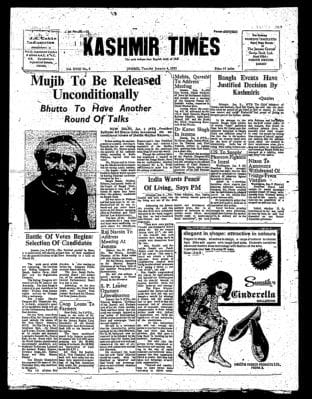
Kashmir Times front page, January 1972. Image courtesy of Kashmir Times / Anuradha Bhasin digitized by Stanford Libraries.
In 2019, as Indian prime minister Narendra Modi began his second term in office, his government removed the special autonomous status granted to Jammu and Kashmir and protections that had existed for nearly 70 years. Once a state, Jammu and Kashmir was split into two federally governed territories. The Indian-administered part of Kashmir – the subject of several military conflicts between India and Pakistan, with both countries claiming the entire disputed territory while controlling a portion of it – had effectively become a police state and control of the media was a critical component of this transformation.
As Executive Editor of the ‘Kashmir Times’, one of the oldest newspapers in the region and the largest, with four editions, I petitioned India’s Supreme Court against the six-month-long internet shutdown that the Modi government imposed in 2019. But by 2020, three editions of the ‘Kashmir Times’ had shut down and the fourth only limped along, a once daily newspaper that was now only occasionally published. By February 2022, even this edition was shut down. I left India with my husband Prabodh Jamwal, the editor of the ‘Kashmir Times’, and revived it as a digital newsroom in exile in the United States in November 2023.
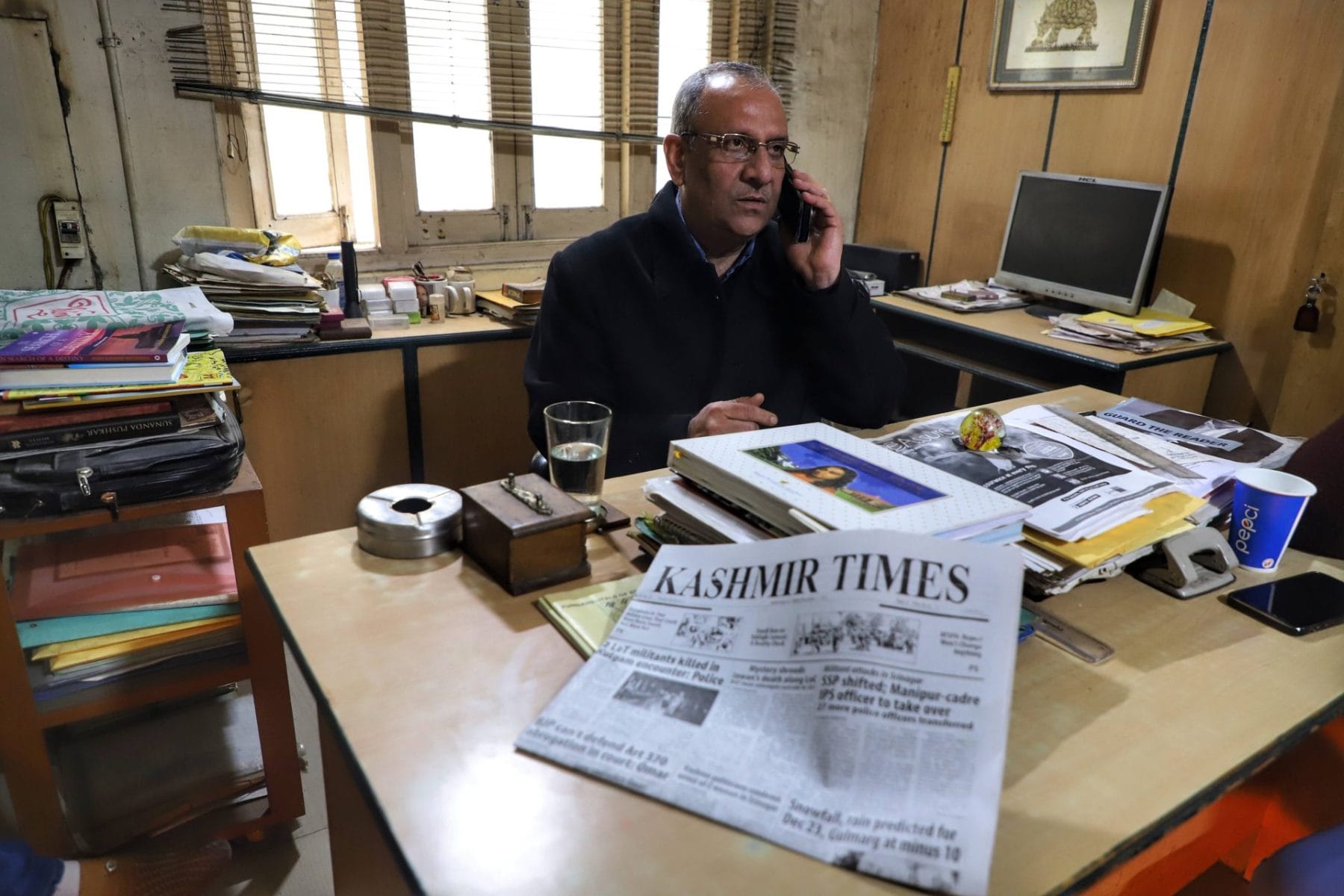
Prabodh Jamwal, Editor of The Kashmir Times, at his office in Srinagar in early 2020. Nasir Kachroo/NurPhoto via Getty Images.
But, as the so-called terror investigation and the mysterious discovery of weapons in our long disused office in 2025 showed, the ‘Kashmir Times’ remained a thorn in the side of the Modi government. The Indian prime minister has frequently presented India on the international stage as the “mother of democracy” and the “Vishwaguru”, a moral exemplar and teacher to the world. Just last week, between September 12 and 13, Delhi hosted Vladimir Putin, Xi Jinping and Iranian president Masoud Pezeshkian as part of the annual BRICS meeting, the global group founded initially by Brazil, Russia, India, China and South Africa (hence the acronym) that is increasingly being presented as an alternative power centre to the American-led Western alliance. For an India seeking to portray itself as not just an emerging superpower but as a democratic force, it is vital that Kashmir remain repressed, hidden away from global scrutiny.
It’s why, even as a newsroom in exile, we continue to be pursued by an Indian government seeking to tarnish our credibility, to deny us the right to report on Kashmir. We are being subject to a vendetta and it represents what has happened to journalism in Kashmir. Journalists have been silenced by the Modi government, Kashmiri voices strangled, and the local media industry deliberately destroyed.
What is happening to journalism in Kashmir is a harbinger of what lies ahead for the rest of India.
A model of suppression
Geeta Seshu of Free Speech Collective, which monitors press freedoms in India, argues that Kashmir is a laboratory where every strategy of media suppression is tested and perfected for use elsewhere. India, which once had a noisy, argumentative press, now ranks at a lowly 157 out of 180 countries in the World Press Freedom Index. Reporters Without Borders, which compiles the ranking, says “press freedom is in crisis” in Modi’s India.
The 2023 Digital Personal Data Protection Act provided a “dangerous framework for expansion of surveillance and censorship” across the country. It empowered the government to demand data from any entity, including journalists, effectively requiring them to reveal their sources. The amendments to the 2020 Information Technology Rules already burden intermediaries with harsh obligations and have been used to arrest journalists, block websites and compel social media platforms to restrict content. Recently, Instagram restricted posts about reports of Kashmiris shot by Indian security forces using pellet guns on unarmed protestors.
Seshu’s fear that what happens in Kashmir will be replicated in the Indian mainland has largely been borne out. For example, in 2023, nearly 50 journalists associated with the portal ‘NewsClick’ – some only vaguely – were subject to arrests and interrogations. Many had their devices seized without due process. Their alleged crimes were essentially guilt by association, charges manufactured not from evidence but from a, frankly, lazy piece of journalism published in the ‘New York Times’ about NewsClick’s funding. The charges were eventually quashed by an Indian court.
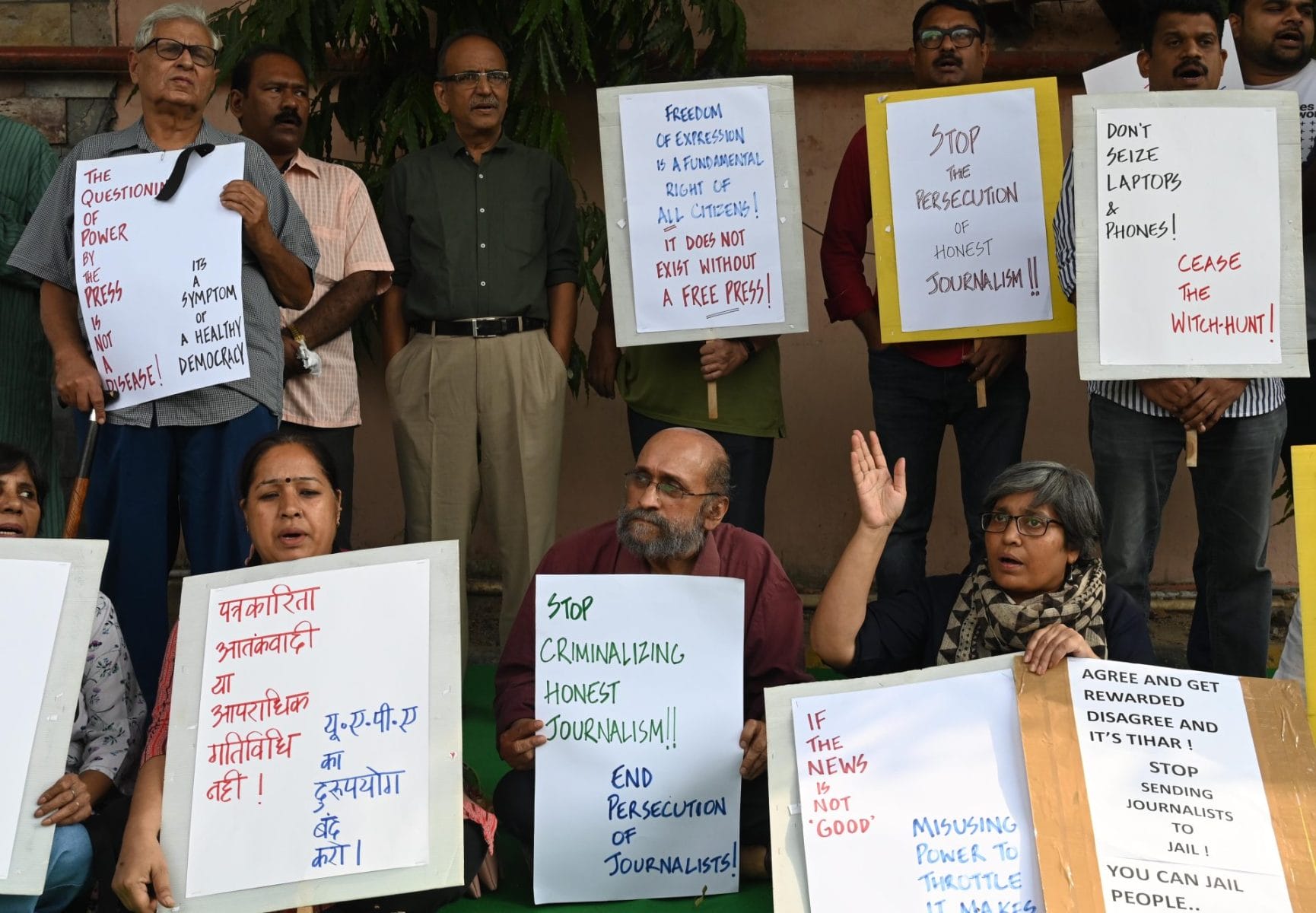
The "To Defend Journalism" protest at New Delhi's Press Club of India, October 2023. Vipin Kumar/Hindustan Times via Getty Images.
Such court rulings are less likely in Kashmir. As a Kashmiri journalist based in Delhi says, “unlike the rest of India, Kashmir is a police state, and state control requires any independent journalism to be shut down.”
In Kashmir, the Indian state has engineered a sophisticated edifice of control through securitization, surveillance and interrogation. It is invisible, intangible, and all-pervasive, a model that extracts quiet surrender and obedience. Unlike the targeted killings of journalists in Gaza, in Kashmir the control of information is seamlessly embedded in everyday life, requiring no enforcement, no traces of brutality. The journalists are essentially cowed into submission.
It began with the world’s longest internet shutdown – a complete lockdown for six months and a partial one for another year. What the shutdown created, despite a court verdict restoring communications, was fear among journalists compelled to work out of a government-surveilled computer facility, and then a perpetuation of that fear through consistent localized and temporary digital shutdowns. So commonplace are these shutdowns that they no longer warrant reporting or commentary.
In June 2020, the Modi government introduced a 53-page document called ‘J&K's Media Policy’ which gave the authorities sweeping powers to monitor, judge, and punish journalists, branding critical reporting as “fake news”, “unethical”, or “anti-national”. The authorities would also routinely remove government advertising from cash-strapped outlets and provide accreditation only to journalists deemed loyal, thus turning bureaucrats into arbiters of what constitutes news and who gets to report it. The effect is chilling.
And then there’s the monitoring of communications.
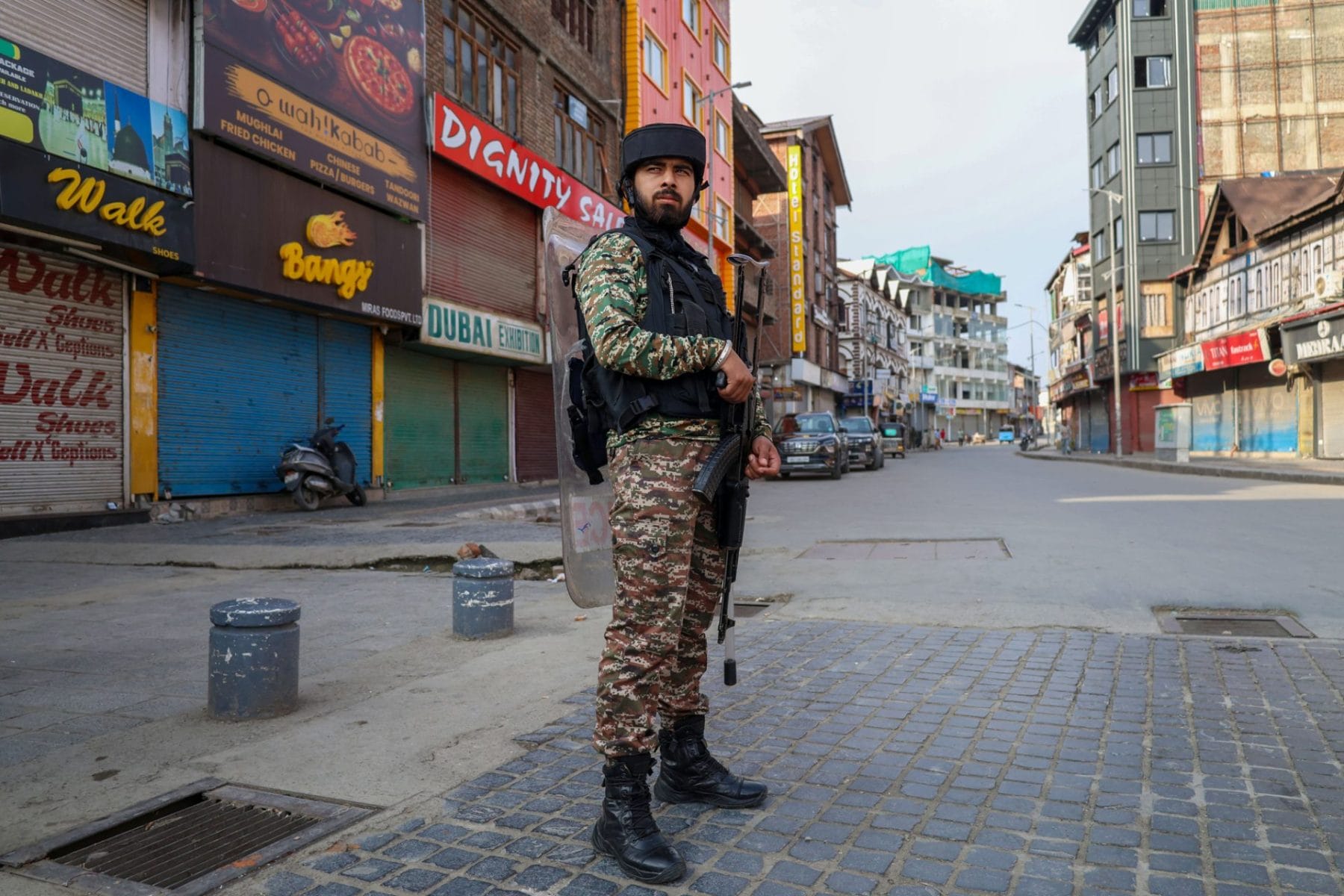
An Indian security personnel in Srinagar, Jammu and Kashmir, August 2026. Firdous Nazir/NurPhoto via Getty Images.
“I can’t say if they’re using Pegasus or some other spyware or technology,” a journalist told me about being interrogated over emails sent to an editor, “but they knew everything about our conversations.” In a 2021 leak, it turned out the Indian government was using Pegasus to spy on at least 40 Indian journalists, only one of who was Kashmiri.
But, a Kashmiri journalist says, “officials have told us ‘nothing in Kashmir is end-to-end encrypted’ and digital activity is clearly being constantly monitored.” No Kashmiri journalist I spoke to for this story, including those who contribute to the ‘Kashmir Times’, have the encrypted messaging Signal app, used worldwide by journalists, on their phones. Devices are routinely checked when journalists are summoned to police stations in Kashmir for questioning. Some said their devices were returned after being tampered with. “You face humiliation and beatings for using Signal and VPNs,” many journalists said. “You can only get away with it if you’re not on their radar,” said one.
In November 2025, the Indian government issued a directive insisting on verifying the “bona fides” of journalists working in Jammu and Kashmir, and the police followed up by requiring journalists to part with personal information including biometrics and bank statements. In January this year, senior journalist Basharat Masood of The Indian Express spent seven hours at a Srinagar police station, then was summoned for three more days and told to sign a bond promising not to “repeat his mistake” – for reporting on the surveillance of mosquea surveillance, even as officials had already admitted to large-scale data collection and verification.
Surveillance normalized
Police also surveil Kashmiris through the use of drone cameras, a network of 1,000 electronic cameras installed at major traffic junctions, and through unrestricted access to people’s social media activity across platforms ostensibly to track anti-India activity. During an illegal “Census 2024” drive, the police collected residents' personal data and GPS-tagged coordinates of homes. And the soon-to-be-rolled-out Jammu and Kashmir-specific digital identity cards that collects the data of entire households, purportedly to ensure the smooth rollout of welfare schemes, has also sparked local anxieties.
Still, as pervasive as the surveillance is, it is journalists that find themselves in the firing line. Any critical word warrants a summons to a police station, interrogation, intimidation and even detention. This happens repeatedly, with journalists never aware of what specific “offence” might trigger a police summons. The reflex, after several such visits to police stations, is self-protection and self-censorship.
A Kashmiri journalist told me that the language the police use to summon journalists for questioning is particularly sinister. It is almost as if the police are enjoying instilling fear. “Aaj dastarkhan par aapki dawat hai”, for instance, is a typical summons. You are invited to a feast, the police say cynically, knowing a journalist is likely to be harshly questioned, even beaten.
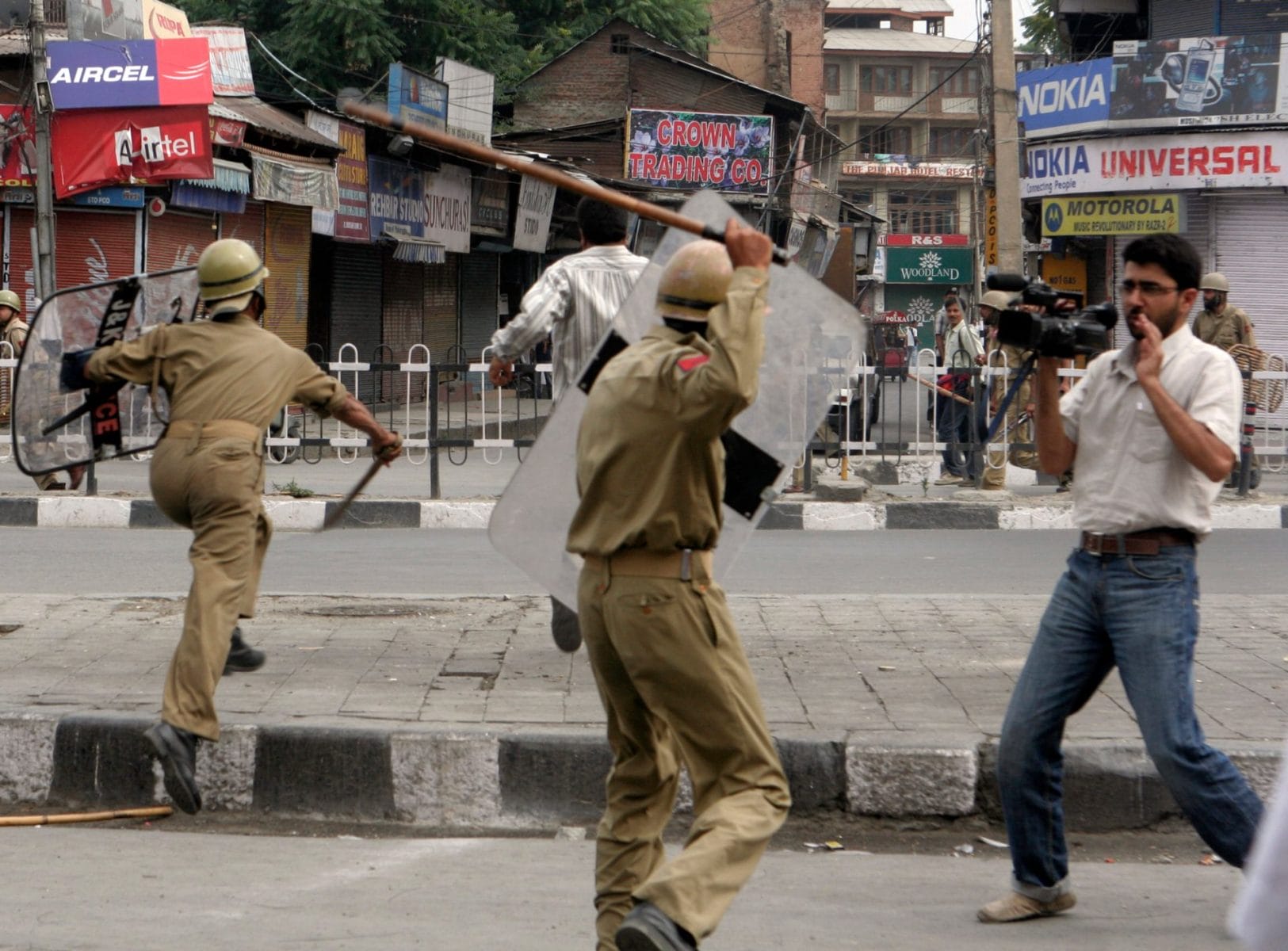
Indian police confront journalists and civilians during a protest on July 10, 2009 in Srinagar in the Indian Administered Kashmir. Yawar Nazir/Getty Images.
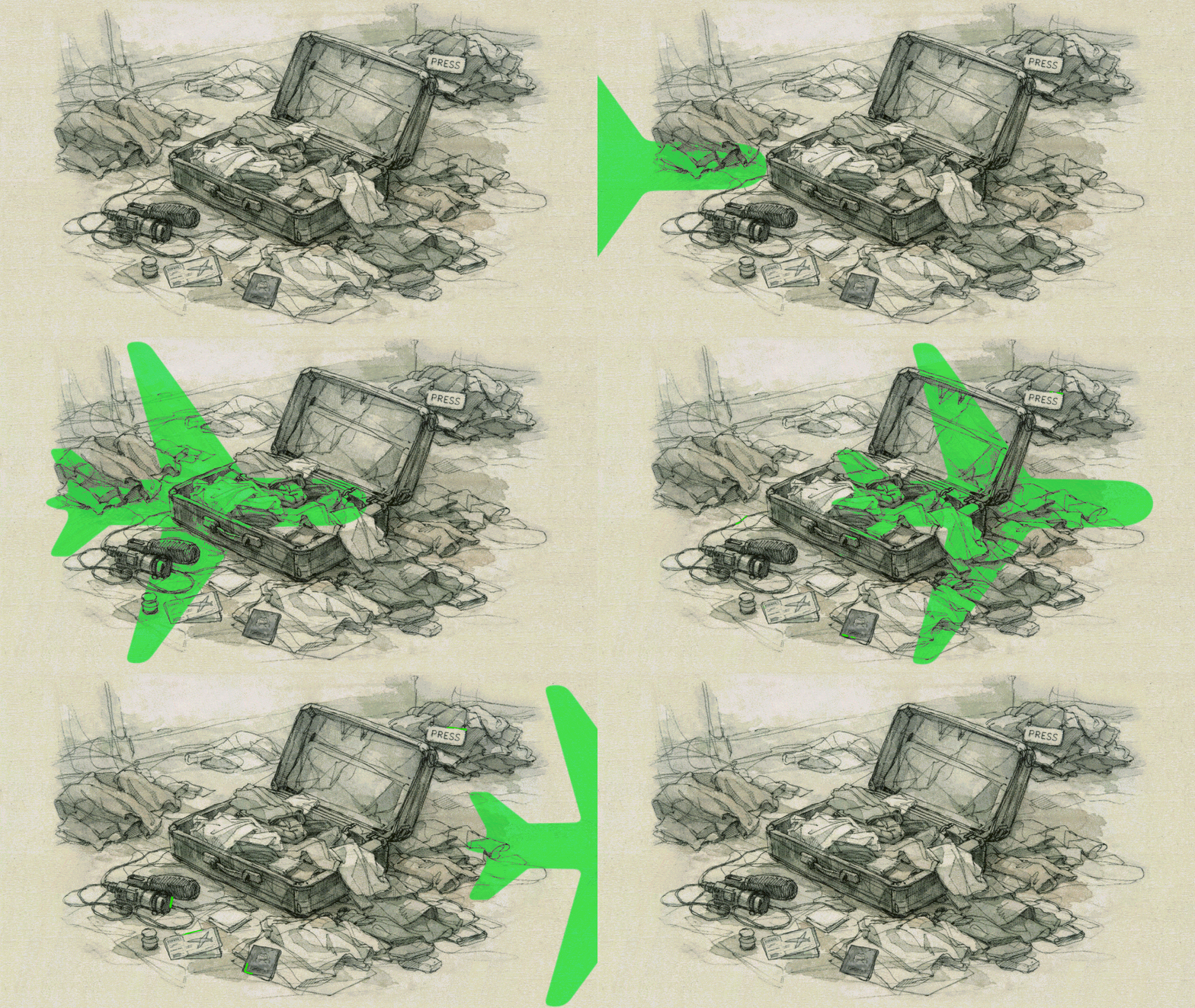
Often, Kashmiri journalists, without notice, are placed on no-fly lists. Sanna Irshad Mattoo, a Pulitzer Prize-winning photojournalist, was twice prevented from travelling abroad for exhibitions and award ceremonies, a pointed message that even international recognition offers no protection. At least twelve journalists have had their passports revoked; two of them were already abroad at the time, rendering them stateless.
The Free Speech Collective filed a Right to Information (RTI) query in March 2024 to ascertain exactly how many Kashmiris had had their passports revoked or cancelled. The plea was rejected by the government on grounds of “national security”.
As India continues to press its case as a formidable, if still rising power, citing its 7.8% growth rate over the past quarter, it continues to be defensive and secretive about Kashmir. Foreign journalists are largely barred, or at least heavily restricted, from reporting from both Indian and Pakistani-administered Kashmir. In May, last year, India and Pakistan exchanged air strikes after a terrorist attack in Indian-administered Kashmir and Modi fell out with Donald Trump over the latter’s claim to have stopped both nuclear powers from accelerating towards a disastrous war.
Despite Kashmir being a long-standing issue that merits global attention, reporting from the region has reduced to a trickle.
Mohammad Amin Lara outside his shop in Sopore, Jammu and Kashmir. The shop, once a fully occupied newspaper store, is now a grocery store due to the decline in newspaper sales. Nasir Kachroo/NurPhoto via Getty Images.
A Google search of Kashmir-related news floods your screen with links, but it is bulk without substance. Articles read like a log of official announcements and statements, punctuated by the occasional piece on a shrinking water body, a development project, a political tussle over a non-issue, or unemployment figures. Each report floats like a loose, individual particle suspended in air, packaged and presented as definitive. No investigation into context. No excavation of the past. No interrogation of contributing factors. A story about an alleged terrorist’s hair transplant and cosmetic dentistry, based entirely on police sources, is passed off as an investigation into Kashmiri insurgency. A superficially detailed piece on anti-encroachment drives or home demolitions will carry little beyond the grief of the displaced, or the remarks of a politician whose interest in the community begins and ends with votes. A terrorist’s hair transplant story, based on the police version, passes off as an investigation into Kashmir’s complex insurgency dynamic.
Kashmir fell off the radar a long time ago, says Free Speech Collective’s Geeta Seshu.
Even mundane stories are difficult to report. No one wants to be quoted. A university professor said he could once “talk to journalists and trust they understood the context. Now, a single sentence can be pulled out, circulated on WhatsApp, and suddenly I’m either an anti-national or a government stooge. Both sides will use the same quote to attack you differently. Why would I take that risk?”
Tarushi Aswani, an Indian journalist, told me that “a curtain has been pulled over Kashmir by silencing journalists who ask questions.” Instead, she added, “press release journalism fills the vacuum, erasing the truth about Kashmir, its history, its politics, its development, environment and aspirations.” Kashmir is no longer looking at a mirror. The lack of truthful reporting means nothing is reflected back. Instead, Kashmiris are looking into the lens of a surveillance camera.
*The eight Kashmiri journalists interviewed for this story spoke on condition of anonymity.
On the night of January 16, 2024, Egana Djabbarova was awoken by her wife and told that she needed to leave the country immediately. Djabbarova, her wife said, had been denounced by pro-war activists and framed as an enemy of the country. She had recently published her novel, “My Dreadful Body,” with a small, indie press that had been praised by mainstream critics, unexpectedly propelling her into the public eye. One of the book's central themes is surveillance: growing up in a community with strict behavioural codes, the protagonist's every move is under scrutiny.
In a dark echo of her work, Djabbarova was now under online surveillance herself. “I was just the perfect enemy,” she tells me, “because I’m queer, I’m not Slavic, I worked on decolonial and feminist projects… So boom, it happened.”
She is speaking to me from Hamburg, where she now lives. Djabbarova is part of the so-called fifth wave of writers exiled from Russia, alongside Maria Stepanova, Lyudmila Ulitskaya, and Maxim Osipov to name a few. Her upbeat tone during our call gives little indication of the arduous journey she has endured since fleeing Russia. Upon receiving a humanitarian visa from Germany, she spent months in a refugee camp. She lived, she says, “in a container house, literally a shipping container. You feel like you're not a subject, not a human being.”
More permanent accommodation has provided a degree of safety and stability, but a sense of precariousness lingers. She describes her position as an exile as “strange” — on the one hand she has been welcomed into Germany’s cultural elite in winning the Hamburger Literaturpreis; on the other, she feels like a “ghost,” unable to express herself in German and often bewildered by the unfamiliarity of everyday tasks in a new country, and in a new city which, she tells me jokingly, is quaint and polite like the well-behaved boy next door.
But there’s a deeper, historical layer to Djabbarova’s story of exile. Her father was a refugee from the region of Nagorno-Karabakh, while her mother was forced out of her family home. “Homelessness and exile — this is my heritage,” she says. Being othered became a common theme of Djabbarova’s childhood, as a child of Azeri parents living in Yekaterinburg. “In Russia you are constantly reminded that you're not Russian,” she says. “Then during the summer you visit your relatives in Azerbaijan and they laugh because you cannot speak Azerbaijani properly.”
This sense of double estrangement is mirrored in “My Dreadful Body”(published in Russian in 2023 and recently translated into English by Lisa Hayden). At only a touch over 100 pages, it is a slim but powerful account of the pressures on one woman growing up among the strict codes of an Azerbaijani family living in Russia. A sense of surveillance and conditional belonging defines the narrator’s upbringing: “In the world where I grew up,” she writes, “gazes penetrated every little corner. The evil eye, the neighbors’ eyes, the relatives’ eyes, the random pedestrian’s eyes, the unscrupulous men’s eyes, the women’s unhappy eyes. Life in the community was reminiscent of a reality show with constant video surveillance: no action, word, or undertaking went unnoticed.”
The story is based on Djabbarova’s own life. “Maybe 70-80% of this story is absolutely true”, she confirms. The narrator is named Egana, she grows up in an Azerbaijani family in Russia, too Russian for the family, not Russian enough for her friends at school. She also, like Djabbarova, suffers from a debilitating autoimmune disorder that is eventually diagnosed as dystonia, a neurological disorder that causes involuntary muscle contractions. During one episode, she describes her body as resembling “willow branches gone mad from a strong wind” — a potent image of struggle against external forces. Djabbarova describes the book as a way to reclaim her body through language. “I was trying to tell this story in a poetic way. I wanted to change my body into poetry.”
Each chapter of “My Dreadful Body”begins with a different body part (“Eyebrows,” “Eyes,” “Hair” and so on), like the poetic blazons spun by Renaissance poets. Where those poems encouraged an idealized, sensationalized reading of each body part, Djabbarova’s chapters are more sober explorations of the physical limits — and personal and cultural stories — these body parts contain.
In one of many poignant scenes, the narrator’s head is shaved in preparation for a procedure. She cries on seeing her “shorn scalp,” but the sadness is not aesthetic, it’s ancestral; the act marks a symbolic rupture with her lineage. “My past,” she writes, “the past of all the women in my family, the memory of my ancestors, the history of a single body — all that now lay on the cold floor.” After this scene, her grandmother’s dictum that only long hair was considered beautiful, rings even more sharply.
Illness then emerges as another form of exile, from one’s sense of self, from what’s perceived as “normal” in society, from the culture and community one belongs to. “They do not see you as a subject, as a human being, and they do not recognize your existence… I realized if I wanted to be seen as a subject, I needed to do it myself.” Djabbarova is talking about the plight to be believed about her symptoms here, but she could easily be talking about the often dehumanizing experience of exile. In both instances there is something fundamental under question, or as Djabbarova puts it, “You’re trying to prove that you have the right of being. You’re trying not to be erased.”
We often talk about exile in the context of loss, but how might exile liberate? Paradoxically, Djabbarova tells me, her diagnosis became a form of liberation. “I always felt I had so many expectations on me as a girl, as a woman, so when I was finally diagnosed it was a liberation because my parents realized I would never be this type of girl.” Exile breeds a particular creative liberation, too, evidenced by the fact Djabbrova wrote the novel from Taiwan where she was briefly teaching Russian. “Here I had enough distance from my own life and my own experience,” she says. “Maybe it’s easier to write about your story being on an island in the Pacific Ocean.”
Writing is arguably the real heroine of Djabbarova's novel. For the narrator Egana, it is a place free from surveillance and a source of protection, “like an invisible amulet.” Poetry, she told me “was the only safe space for me because nobody was asking anything of me. It's the only place where I don't feel judged. I don’t feel ashamed. I don’t feel questioned.”
The chapter “Hands” opens: “The most important parts of a woman’s body were her hands: they prepared food, rocked children, did laundry, ironed men’s shirts, sewed clothes, swept, washed the floor, and dusted.… Any woman in our family knew that her hands were not given to her for writing.” To use her hands, then, to write becomes both a symbolic and quite literal form of resistance against such gendered codes.
Notably, Djabbarova is not alone in invoking the body as a space to explore the upheavals of exile. In Maria Stepanova’s autofictional work “The Disappearing Act” — recently translated into English by Sasha Dugdale — the narrator attempts to purge herself by volunteering to be cut in half as part of a circus trick. Djabbarova’s approach to reclaim identity and agency through the body is less literal, and more personal, but through this specificity she has landed somewhere indisputably universal.
“I realized the only way I can write this novel is through my body,” she says. “Because the only way I can rehabilitate my being, my agency, my subjectivity is through my body. And that's why I wanted every reader to feel my body… It's really important for all of us not to forget that this right of being is basic. It's not given. It's something you have from birth."
At the end of our conversation, Djabbarova (who has been speaking in English) struggles to recall a word and jokes that learning German is slowly pushing her English out. “Certain words I only remember in German!” she laughs. Is this the beginnings of a kind of homemaking for Djabbarova, a sign that the seeds she has scattered in her new country are taking root? Like her protagonist, who finds solace and safety in words, it seems that Djabbarova’s most trusted tool for survival, for managing the condition of exile, is language.
The Age of Exile
This story is part of our Age of Exile series, which explores how displacement has evolved from historical punishment into a defining condition of our time—one that reveals profound transformations in how we construct identity, maintain community, and exercise power across borders. In an era where digital connection enables presence without physical proximity, exile has become more complex, more global, and more central to understanding our world. Explore The Age of Exile series

 Connexion