
 Connexion
A bottle of flammable liquid in Poland, a nuclear option on a Russian wish-list—the hunt for Starlink widens
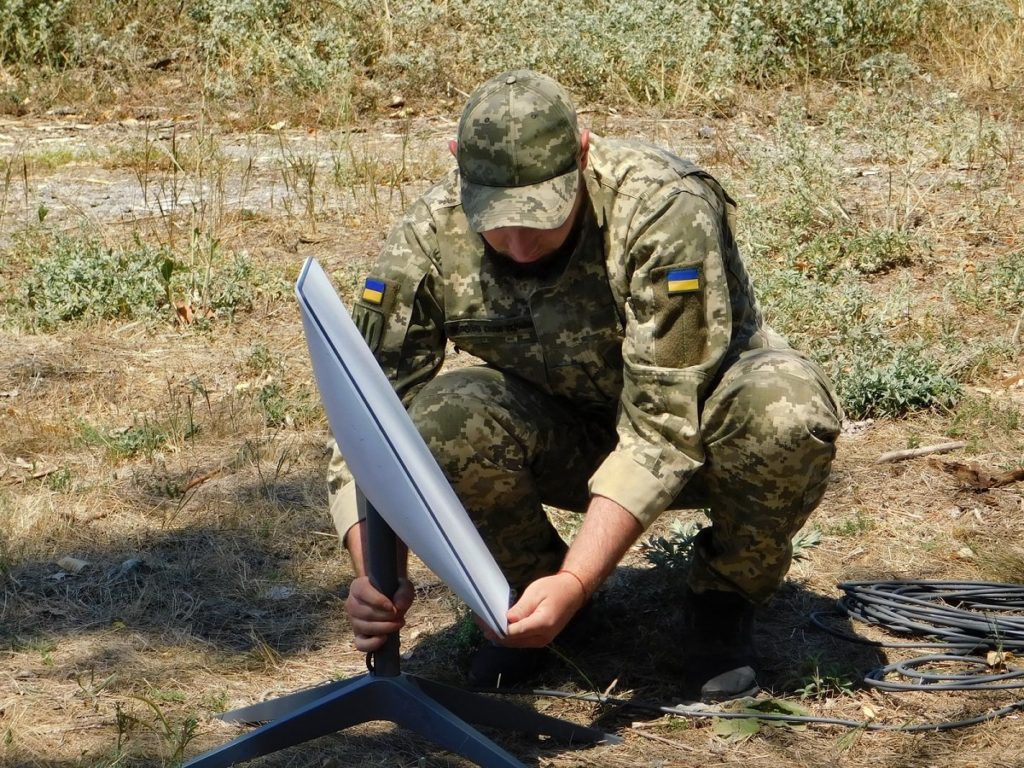
A Russian academic and an ultranationalist media owner have drawn up a menu of ways to knock out Starlink, the satellite network keeping Ukraine's drones and troops online, the Ukrainian defense outlet Militarnyi reported. The ideas run from jamming to a nuclear blast in space, and come as Poland investigates a suspicious fire at a Starlink ground station serving Ukraine.
Satellite internet is the nervous system of the drone war. Since a terminal cutoff early this year gutted Russian frontline coordination, Moscow's search for a workaround has widened from the spectrum to orbit—and from the battlefield toward the infrastructure that keeps the network alive.
The scenarios
Sergei Glazyev of the Russian Academy of Sciences and Konstantin Malofeyev, founder of the Russian outlet Tsargrad, laid out the proposals. Glazyev's list runs from cutting communication cables on land and undersea to crippling data centers and downing reconnaissance and command aircraft, whatever their nationality. Without American and British spotters, planners, and analysts, he claims, Ukraine's army would go blind. Glazyev's core argument is that Starlink satellites are not geostationary—nothing hangs over Ukraine, so the entire constellation must be struck at once.
For electronic warfare, they push wider use of the Volna Kupol Garant, a roughly $1.5 million system that beams a signal to briefly deafen a passing Starlink satellite over what its developers claim is up to 20 km². Kinetic options follow—the A-235 Nudol and S-500 Prometheus interceptors—though they call spending one costly missile on one cheap satellite "insane extravagance." A third idea scatters metal pellets to spark what the authors call the Kessler effect—a debris cascade that would destroy everything at that altitude.
The bluntest proposal detonates a nuclear device in space, its pulse frying electronics on low-orbit satellites. The authors admit this would also wreck Russia's own Rassvet network, which orbits at a similar altitude. "We can no longer hit Musk's creation for free," they write, "but it's still the optimal option. The legal consequences are unimportant."

Russia’s answer to Starlink was written off as a failure—its satellites are still climbing
A station burns in Poland
On 23 September, fire destroyed the distribution panel of a ground Starlink station in Wola Krobowska that feeds Poland and Ukraine. Poland's Deputy Prime Minister Krzysztof Gawkowski said sabotage could not be ruled out and that the pattern matched Russian services' modus operandi. A bottle of flammable liquid was found beside the burned distribution panel, according to sources cited by RMF24. Exatel, which the minister named as the station's operator, said it only subleases the land and transmits data there, and neither operates nor owns the infrastructure.
