Connexion

This is how Ukraine finally blew up the Kerch Bridge

- Ukraine finally dropped part of the strategic Kerch Bridge on 17 November
- The complex strike operation involved several new capabilities
- Now Russian logistics into occupied southern Ukraine are partially throttled
After years of trying, Ukrainian forces finally dropped a portion of the strategic Kerch Bridge connecting southern Russia to occupied Crimea over the narrow Kerch Strait overnight on 17 November, a day after a first strike knocked one of its arches askew.
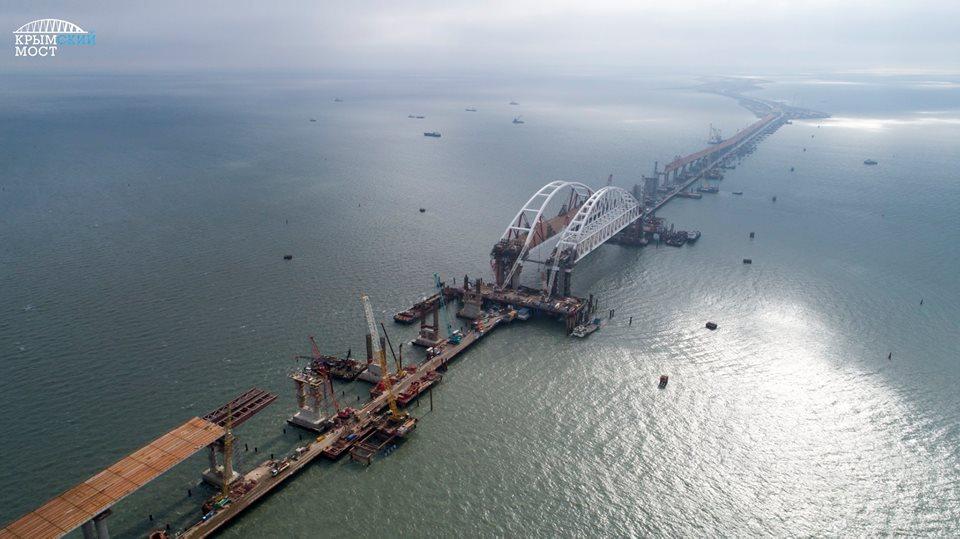
Parallel spans carry—or carried—vehicles and trains back and forth, helping feed, fuel, and supply Russian forces in Crimea. There are other supply lines for Russian forces in occupied southern Ukraine, but the 19-km bridge—which Russia built after seizing Crimea in 2014 and opened in 2018, at a cost of about $3.7 billion—is or was one of the main ones.
Now it's half wrecked, with the vehicle span severed in the middle, the train span damaged, and wreckage blocking the ship channel beneath the bridge for as long as it takes for Russia to mount a major repair and salvage effort. An effort that the Russians may have to attempt under further Ukrainian attack.
Grateful to the Security Service of Ukraine, all units of Ukraine’s Defense Forces involved, Ukraine’s Minister of Defense, the Commander-in-Chief of the Armed Forces of Ukraine and the General Staff, and all our weapons manufacturers for an unprecedented operation in response to… pic.twitter.com/pgUxGrE61K
— Volodymyr Zelenskyy / Володимир Зеленський (@ZelenskyyUa) November 17, 2026
"Today, everyone can see the consequences for the main military crossing from Russian territory into our Ukrainian Crimea," Ukrainian President Volodymyr Zelenskyy wrote. "This is the result of the seventh stage of an operation carried out over several weeks, developed and coordinated by the Security Service of Ukraine together with the General Staff of the Armed Forces of Ukraine."
Ukraine has attacked the Kerch Bridge at least once a year every year since 2022, striking with a truck bomb, drones, missiles, and underwater explosives. None of those attacks inflicted nearly as much damage as the 16 and 17 November strikes. For the most recent and most successful raid, Ukraine mobilized many of its best deep strike forces, including some brand-new capabilities such as jet-propelled drones and operator-guided cruise missiles.

New drones and missiles
Three stand out:
- the new Ruta cruise missile from Dutch firm Destinus
- a new jet-propelled version of Ukrainian firm Antonov's An-196 Liutyi attack drone
- and a new variant of Kyiv-based Fire Point's FP-5 Flamingo cruise missile that a remote operator directly steers via a low-lag radio signal.
In all, various drone units from the Ukrainian army, navy, and special services may have launched hundreds of drones and missiles over a period of nearly a month in order to first clear a path through Russian air defenses—and then strike the bridge.
"Our warriors gradually destroyed air defense systems, radars, electronic warfare equipment, and other designated targets on the way to the final objective," Zelenskyy wrote. For this, the president added, they used 11 different kinds of drone and missile, including Palianytsias, Mich-2000s, Rutas, Neptunes, and the jet-propelled Liutyis, also known as An-197s.
Once the Russian defenses were sufficiently degraded, drones and missiles took aim at the bridge. "At the key stage, the Palianytsia drones performed exceptionally well, striking the road section of the bridge," Zelenskyy wrote, "while Neptune missiles, Ruta drones, and FP-5 drones struck the railway section."
Official videos revealed that the FP-5s weren't the usual versions of the heavyweight cruise missile, which hauls a 1,150-kg warhead as far as 3,000 km. Normally, the Flamingo navigates by way of an internal inertial system that, while helpfully self-contained, tends to drift over long distances—and also results in the missile cruising at an altitude of several hundred feet, high enough to make it an easy target for Russian air defenses.

Missile-drones, cruise missiles, and a Flamingo guided to the last second: Kyiv’s account of the night Russia’s Kerch bridge lost its road
The Flamingos that struck the Kerch Bridge were steered by remote operators seeing what the missiles saw through forward-looking cameras. That makes the missiles more accurate, and probably helps them fly lower—and past Russian defenses. The downside of direct remote control is that it demands a stable and low-lag radio connection, possibly via a mesh radio network made up of many interconnected drones receiving and sending signals.
The apparent mesh radio network did its job. "Using Flamingo, our warriors carried out a precision-guided strike—and the communications uplink worked flawlessly until the very last seconds," Zelenskyy stated.
What happens next depends on how quickly the Russians can begin repairing the bridge, and whether the Ukrainians continue striking. In any event, "the destruction of the Kerch Bridge will save many Ukrainian lives, both on the front and in the occupied territories," mapper Ukraine Control Map noted.