Donald Trump defended defense secretary Pete Hegseth, who is facing an impeachment resolution from Republican senator Thomas Massie, saying Hegseth 'won two wars'. The president, who said he had spoken to Nvidia CEO Jensen Huang, said he was 'amazed' by claims Huang conducted an affair with an alleged Chinese spy, and that the FBI was now looking into the issueJensen Huang’s image has been shattered. Could he be pushed out at Nvidia?Republican Thomas Massie moves to force vote to impeach Pete H
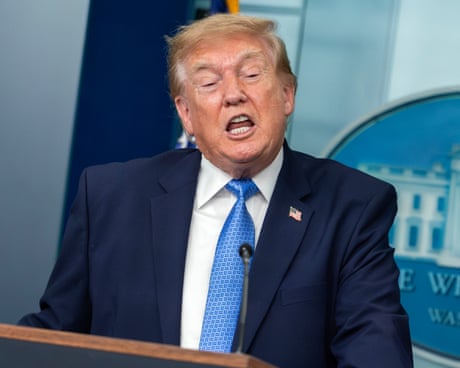
Donald Trump defended defense secretary Pete Hegseth, who is facing an impeachment resolution from Republican senator Thomas Massie, saying Hegseth 'won two wars'. The president, who said he had spoken to Nvidia CEO Jensen Huang, said he was 'amazed' by claims Huang conducted an affair with an alleged Chinese spy, and that the FBI was now looking into the issue
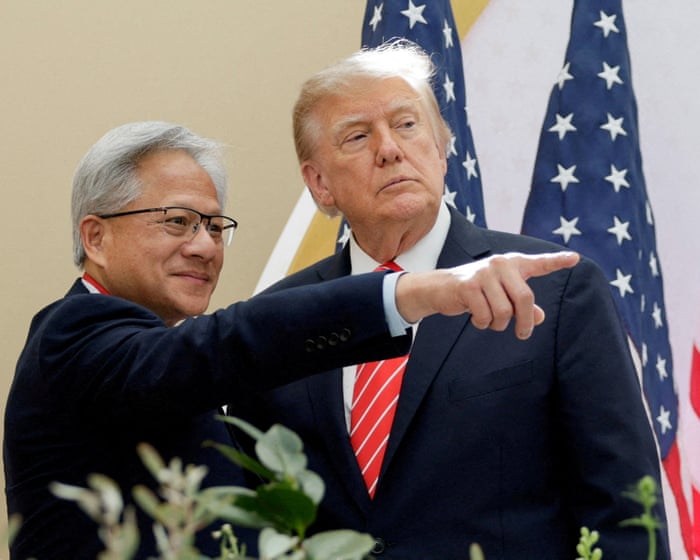
The AI chip boss’s actions raise urgent questions about corporate influence, national security and the US president’s willingness to listen to intelligence warningsIt could be the plot of a spy thriller. One of the most powerful figures in the AI revolution admitted to having an affair with a Chinese businesswomen said to have passed intelligence to Beijing. When Donald Trump was briefed about the Nvidia co-founder Jensen Huang’s liaisons with Alice Huang, he took no action. Perhaps he thought o
The AI chip boss’s actions raise urgent questions about corporate influence, national security and the US president’s willingness to listen to intelligence warnings
It could be the plot of a spy thriller. One of the most powerful figures in the AI revolution admitted to having an affair with a Chinese businesswomen said to have passed intelligence to Beijing. When Donald Trump was briefed about the Nvidia co-founder Jensen Huang’s liaisons with Alice Huang, he took no action. Perhaps he thought only marriage vows had been broken. Or perhaps Mr Trump was willing to overlook the conduct of a friend who championed his unpopular datacentre expansion, whose company donated to his White House ballroom and who echoed his opposition to AI safeguards against expert advice.
Nvidia became the cornerstone of AI by supplying brute computing power. As tech giants scrambled for the firm’s graphics processing units (GPUs), Mr Huang sold the picks and shovels for the AI gold rush – and amassed a $160bn fortune. When China joined the race for tech supremacy, Nvidia’s microchips became a national security issue. In October 2022, the US slapped export controls on GPU sales to China. Thirty months later, Nvidia was effectively banned from selling to Beijing. Mr Huang lobbied for looser controls. Such was his sway with Mr Trump that the White House scrapped Biden-era global AI chip restrictions and then permitted sales of Nvidia’s prized H200 processors to Chinese customers.
Do you have an opinion on the issues raised in this article? If you would like to submit a response of up to 300 words by email to be considered for publication in our letters section, please click here.
The same technical limits that prevent superintelligence make these systems dangerous. But we know how to regulate themMany Silicon Valley leaders believe superintelligence is an imminent threat to society. The White House even published an accord about it. This isn’t enough.Geoffrey Hinton, the godfather of AI, estimates the risk of human extinction is at least 10% within the next few decades. The Anthropic CEO, Dario Amodei, argued that unchecked AI “could outrun our ability to understand and
The same technical limits that prevent superintelligence make these systems dangerous. But we know how to regulate them
Many Silicon Valley leaders believe superintelligence is an imminent threat to society. The White House even published an accord about it. This isn’t enough.
Geoffrey Hinton, the godfather of AI, estimates the risk of human extinction is at least 10% within the next few decades. The Anthropic CEO, Dario Amodei, argued that unchecked AI “could outrun our ability to understand and control these systems”. In response, 1,300 leaders and employees from many leading AI companies signed a letter calling to “deliberately pace” development.

 Connexion