Vue normale

This Ukrainian border town has served as Russia’s testing ground for new weapons of terror since 2023. Then, it turns them on rest of Ukraine
29 juillet 2026 à 10:52

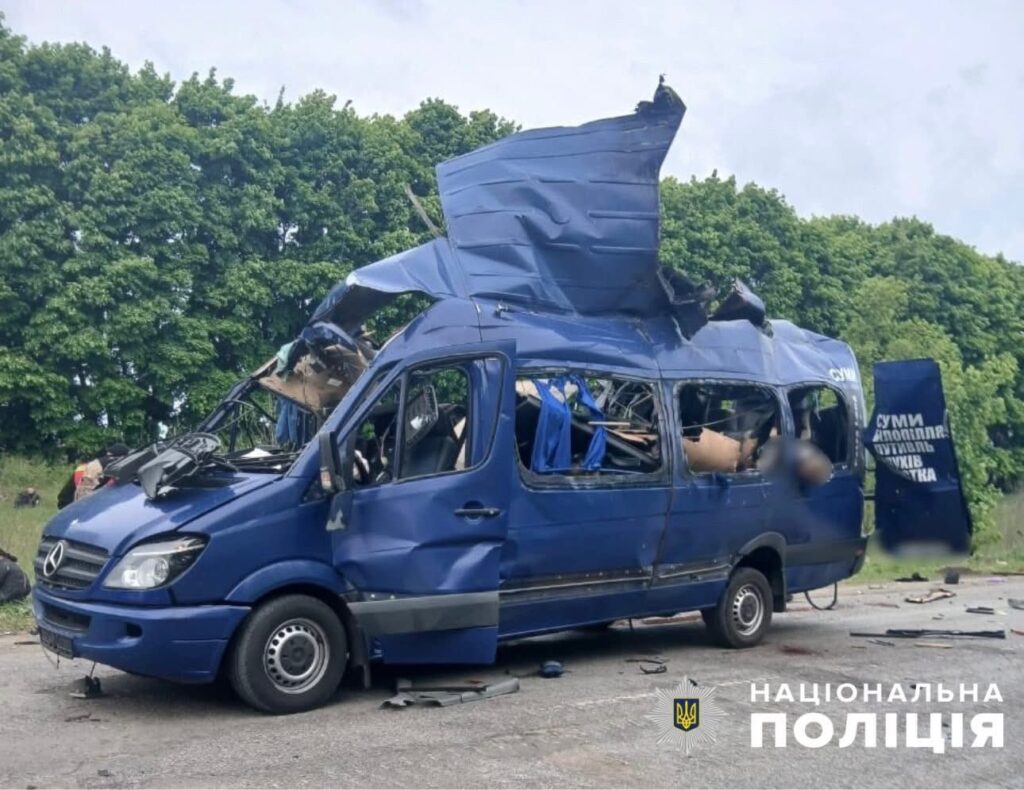
russian drone blows up civilian shuttle bus leaving nine dead sumy border town mini-bus bilopillia-sumy struck morning 17 2025 killing 9 passengers 498016779_1056136843323012_6351334390770892022_n civilians were killed seven injured early hours

Russia is treating Ukrainian border towns as its testing ground, regardless of the civilians who live there. The occupiers have for several years used the Bilopillia community in Sumy Oblast to test new types of weapons, first deploying the KAB glide bomb there and later fiber-optic drones that now also strike Sumy, said Nataliia Kalinichenko, a deputy of the Bilopillia city council, according to Espreso.

The pattern Kalinichenko describes is a border community used to debut weapons before they spread deeper into Ukraine. Bilopillia sits close to the Russian border in Sumy Oblast, and it was there that the first KAB glide bomb in the oblast fell on 23 March 2023, killing two people and damaging more than 40 residential and non-residential buildings, a school, and the district police department.

A year ago, residents of the community encountered fiber-optic drones when almost no one knew such a weapon existed, and today, she said, both weapons reach Sumy city, roughly 40 kilometers from the border.

The town saw the KAB and the fiber-optic drone first

Kalinichenko's account traces two weapons from their first appearance in Bilopillia to their spread across the oblast. The first was the glide bomb, in March 2023.

"The first KAB in Sumy Oblast fell precisely on Bilopillia on 23 March 2023. At that time, we did not even understand the enormous destructive power this weapon has," she said.

The strike killed two people and damaged more than 40 residential and non-residential buildings, a school, and the district police department.

"We learned what a KAB is," she recalled.

The glide bomb, a Soviet-era aerial bomb fitted with a guidance kit and wings that lets Russian jets release it from tens of kilometers away, has since become one of the deadliest weapons of the war, with Russia dropping thousands a month and using them to systematically level Sumy border villages into "buffer zones."

The second weapon was the fiber-optic drone.

"We already saw this fiber-optic web lying across Bilopillia. Today, unfortunately, all these types of weapons are already used against Sumy too. They reach the regional center," Kalinichenko said.

The tangled cables the drones left behind became a visible marker of the town's role as the place where the weapon first appeared.

The fiber-optic drone is dangerous because it cannot be jammed

Kalinichenko explained why the fiber-optic drone is so hard to stop, and it matches what Ukraine's specialists have documented. The drones are especially dangerous because they are practically impossible to suppress with electronic warfare, and the optics mounted on them let operators make out the smallest details, including license plates or elements of clothing, she said.

The weapon's design is what makes it immune to jamming. A fiber-optic drone is guided by a thin glass fiber that unwinds during flight rather than by radio signal, so it emits nothing for Ukraine's electronic warfare to detect or disrupt. When the first such drone reached Kharkiv in February 2026, Defense Ministry adviser Serhii Beskrestnov called it a serious technological challenge, because radio-electronic reconnaissance is useless against a drone that broadcasts no signal.

That the same weapon appeared in Bilopillia even earlier fits the town's role as the leading edge of Russia's deadly experiments.

The border communities are the war's early-warning system

Bilopillia's experience is a preview of what the rest of Ukraine faces next. Weapons that debut against the border communities migrate inward as Russia scales them and extends their range, so what a Bilopillia council deputy describes today is often what a larger city reports months later.
  • ✇Euromaidan Press
  • Russia is bombing Kostiantynivka to rubble while pushing its infantry into it on foot
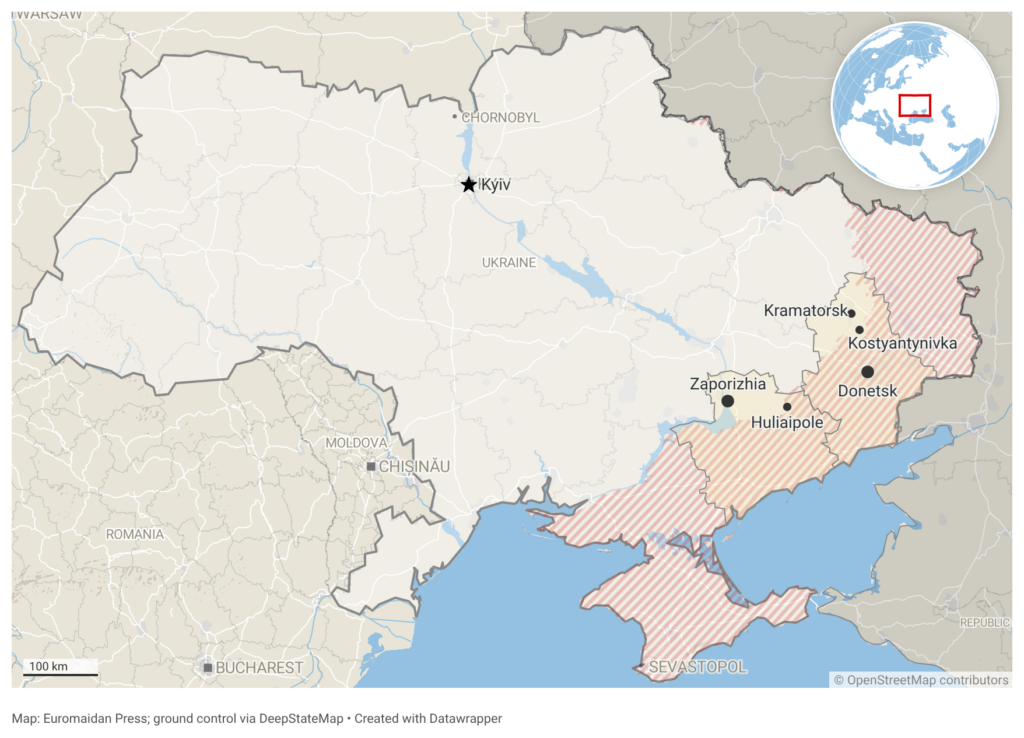
    Russian troops are working deeper into Ukraine's last fortified cities in Donetsk Oblast, pushing infantry into Kostiantynivka while wrecking the towns behind it, the Ukrainian monitoring and analytical project DeepState reported. The US-based think tank Institute for the Study of War (ISW) recorded fresh Russian movement inside the city over the same days. Over the past several years, Moscow's main objective in its invasion of Ukraine has been to capture the rest o
     

Russia is bombing Kostiantynivka to rubble while pushing its infantry into it on foot

29 juillet 2026 à 09:31

russia bombing kostiantynivka rubble while pushing its infantry foot · post kramatorsk donetsk oblast ukraine news ukrainian reports

Russian troops are working deeper into Ukraine's last fortified cities in Donetsk Oblast, pushing infantry into Kostiantynivka while wrecking the towns behind it, the Ukrainian monitoring and analytical project DeepState reported. The US-based think tank Institute for the Study of War (ISW) recorded fresh Russian movement inside the city over the same days.

Over the past several years, Moscow's main objective in its invasion of Ukraine has been to capture the rest of Donetsk Oblast. Its key demand pressed at previous US-brokered ceasefire talks was for Ukraine to cede the rest of Donetsk Oblast. That is where Ukraine's fortified cities anchor its eastern defenses, which made the demand predictably unacceptable to Kyiv. Now, Russia's 2026 offensive has been buying that ground at a steeply rising cost in casualties per kilometer.

Kostiantynivka: Russian infantry keeps slipping in

Russian forces keep up constant infiltration attempts on Kostiantynivka, DeepState said. Their aim is to entrench inside the city, mass infantry there and take control of the ground. One of their main tasks is to take control of the part of the city between the settlements of Illinivka and Novodmytrivka. If Russian troops take Novodmytrivka, the entire Ukrainian grouping defending Chasiv Yar faces encirclement, DeepState noted. Supply into Chasiv Yar has been difficult for a long time, because Russian drone numbers hand Moscow the advantage in the air. Alongside the infantry, Russian forces use artillery and guided glide bombs to destroy the city.

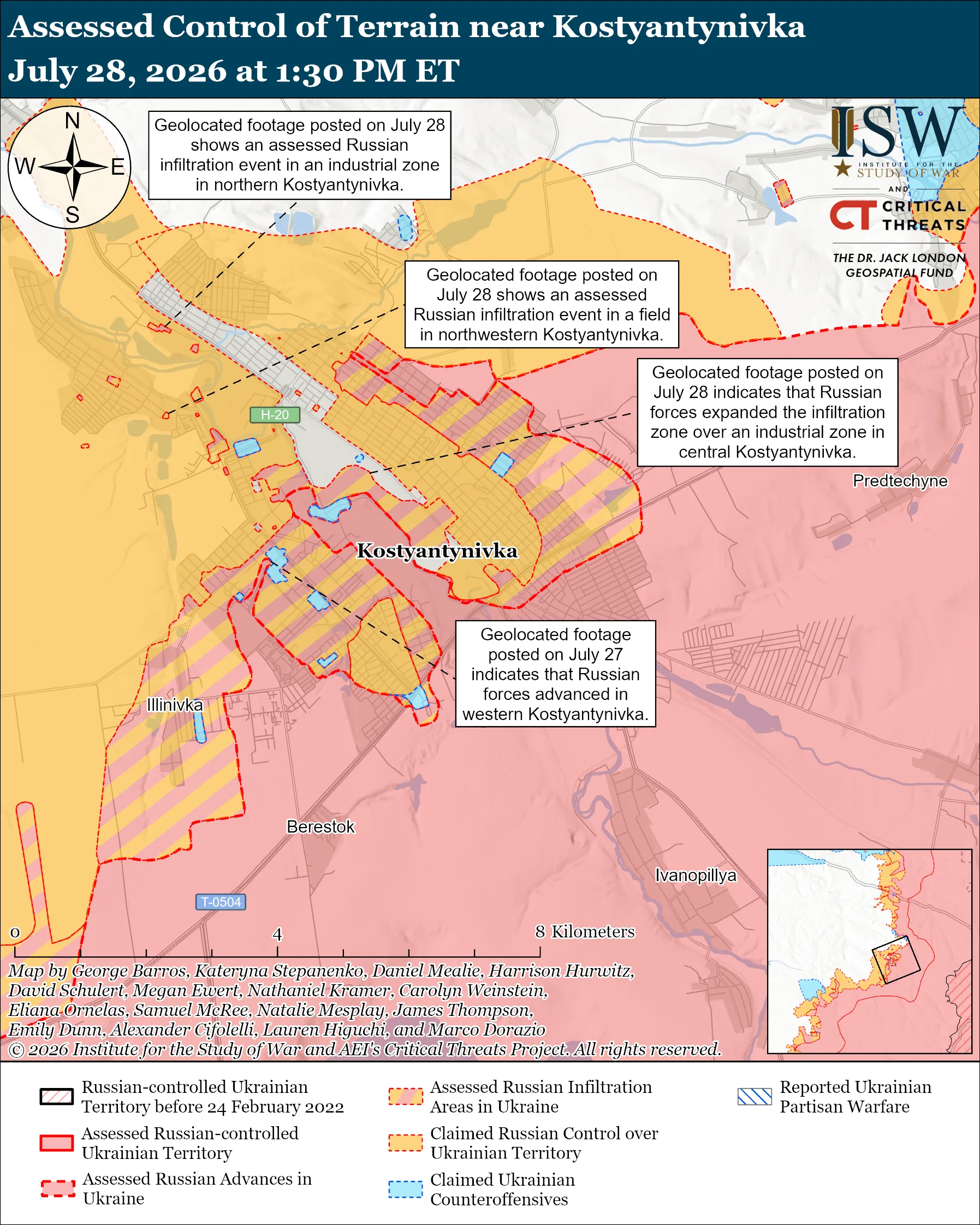
ISW assessed on 28 July that Russian forces recently advanced in Kostiantynivka and kept up infiltration missions inside it. Geolocated footage from 27 July points to a Russian advance in the city's west, ISW said. Video published a day later shows Ukrainian troops hitting Russian positions in the north and center of Kostiantynivka, after what ISW assesses were infiltration missions.

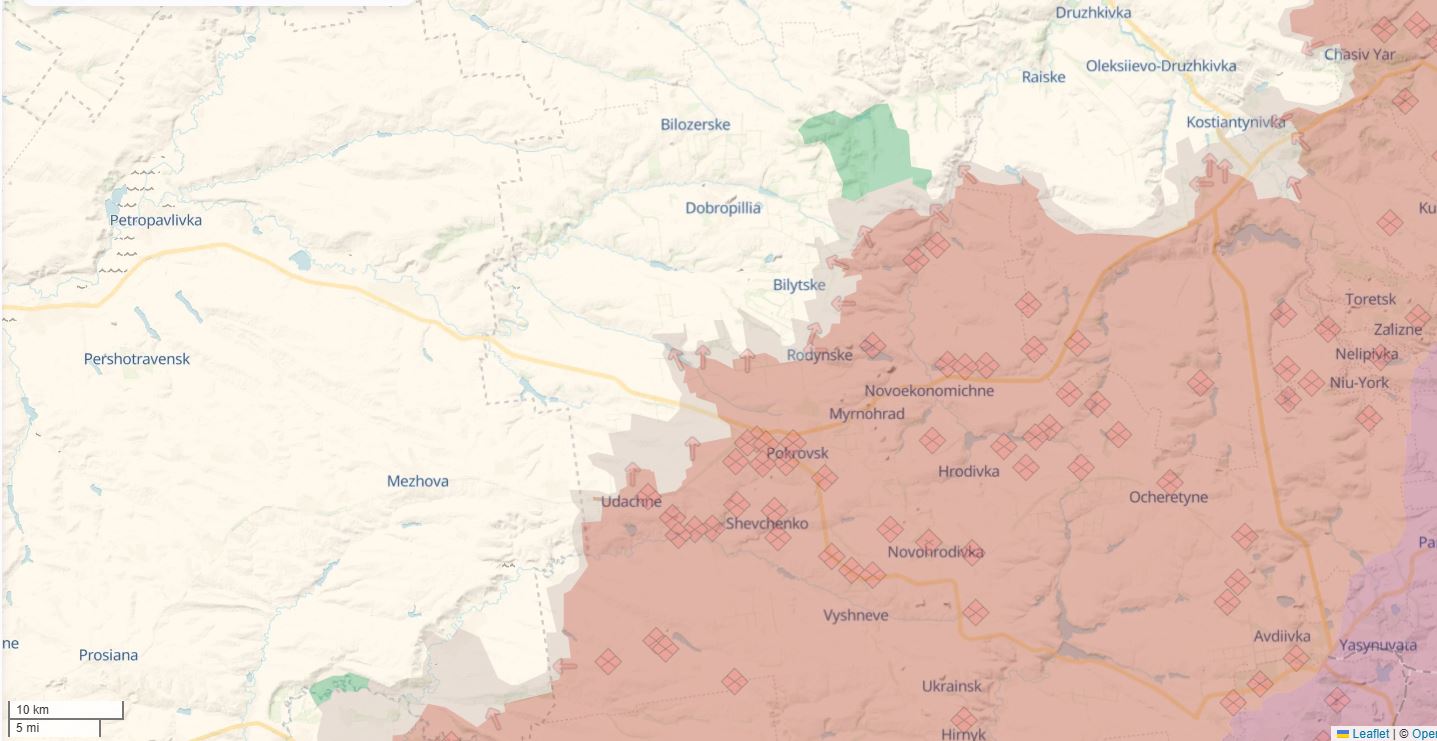
russia bombing kostiantynivka rubble while pushing its infantry foot · post assessed control terrain near donetsk oblast 28 2026 kostyantynivka-july-28-2026 ukraine news ukrainian reports
Assessed control of terrain near Kostiantynivka, Donetsk Oblast, as of 28 July 2026. Map: ISW

Unnamed soldiers from units defending the city told Hromadske that the situation there is getting worse. Ukraine's General Staff counted 31 Russian attacks on the Kostiantynivka axis over the past day.

russia massing dobropillia again using quad bikes motorcycles ukraine's national guard says · post pokrovsk sector donetsk oblast 26 2026 russian-occupied areas direction assaults pushing north toward above ruins situation
Explore further

Russia is massing for Dobropillia again using quad bikes and motorcycles, Ukraine’s National Guard says

Druzhkivka and the towns behind the front are turning to ruins

The whole agglomeration around Kostiantynivka is suffering. DeepState said Druzhkivka and neighboring Oleksiievo-Druzhkivka are gradually turning into ruins under constant shelling, and staying there is extremely dangerous. Russian forces fired 1,243 times at the front line and residential areas of Donetsk Oblast on 28 July, Ukraine's National Police recorded.

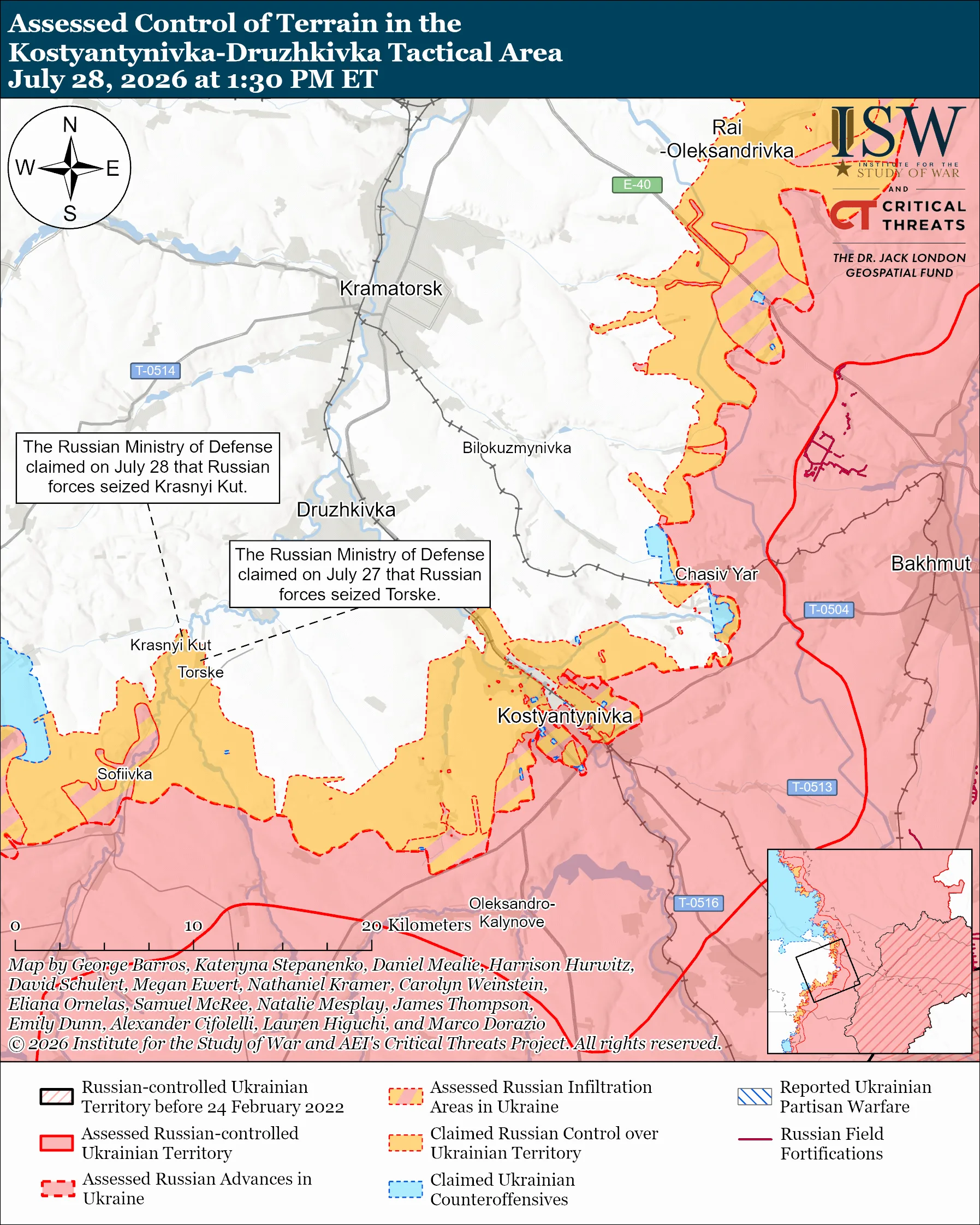
russia bombing kostiantynivka rubble while pushing its infantry foot · post assessed control terrain kostiantynivka-druzhkivka tactical area donetsk oblast 28 2026 kostyantynivka-druzhkivka-tactical-area-july-28-2026 ukraine news ukrainian reports
Assessed control of terrain in the Kostiantynivka-Druzhkivka tactical area, Donetsk Oblast, as of 28 July 2026. Map: ISW

Russian pressure is rising on the stretch running roughly from Yampil to Minkivka further north, which may become the next main axis after Kostiantynivka, DeepState said. Russian artillery is already destroying mine barriers along the routes it would use, and Russian drones are working against Ukrainian logistics there.

Sloviansk and Kramatorsk under fire 40 km deep

Russian forces are leveling Sloviansk and Kramatorsk—the northern anchors of the Fortress Belt—with guided glide bombs, rocket artillery, Shahed attack drones and small first-person-view drones that hunt people and cars in the streets. DeepState noted that Russian fire control runs about 40 km deep from the contact line. The agglomeration is gradually becoming an isolated place, where travel will soon be possible only out of critical necessity, in order to fight.

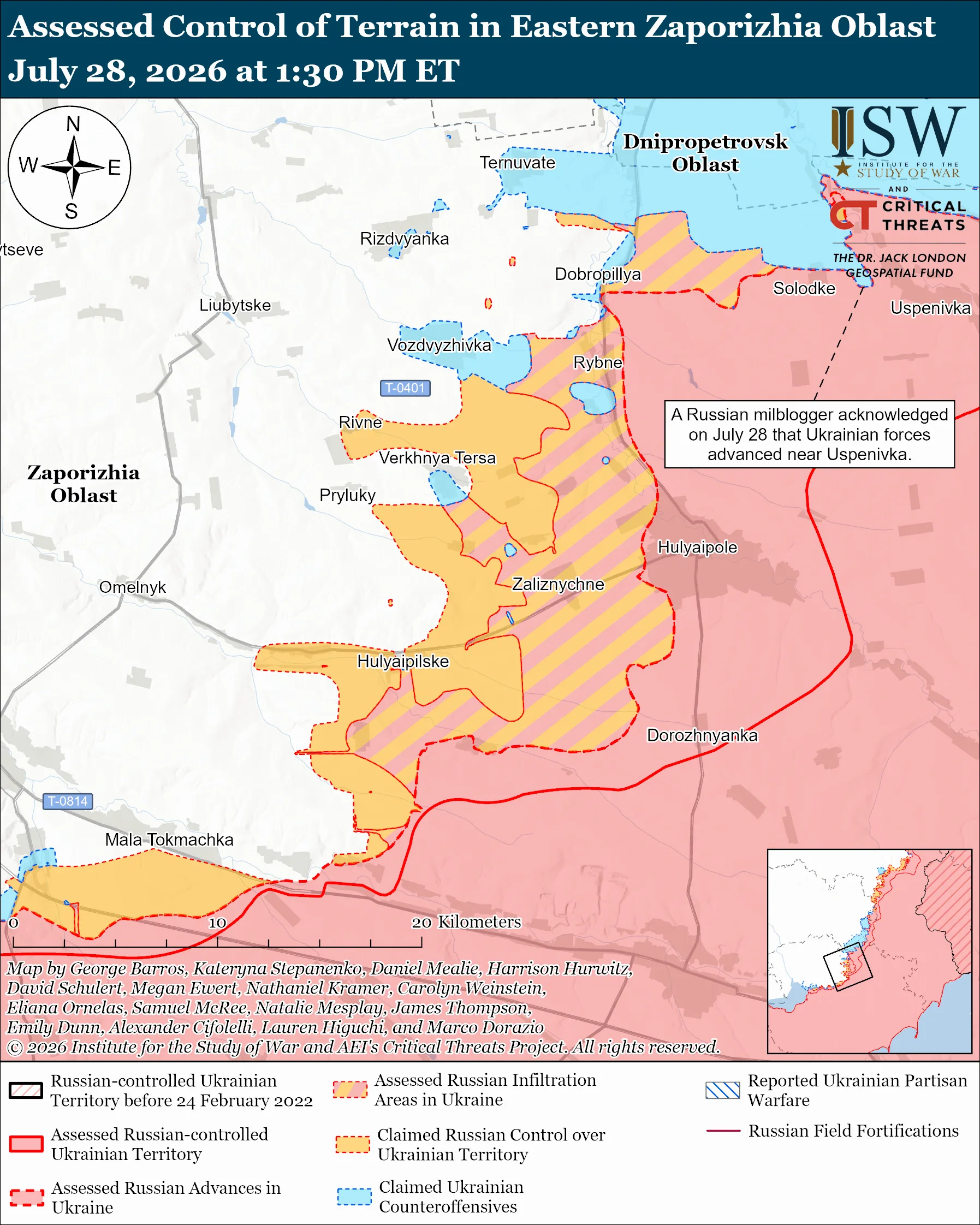
russia bombing kostiantynivka rubble while pushing its infantry foot · post assessed control terrain eastern zaporizhzhia oblast 28 2026 eastern-zaporizhia-oblast-july-28-2026 ukraine news ukrainian reports
Assessed control of terrain in eastern Zaporizhzhia Oblast as of 28 July 2026. Map: ISW

ISW noted that Ukrainian troops have recently advanced farther south, toward Huliaipole in Zaporizhzhia Oblast. A Russian milblogger acknowledged the Ukrainian gains near the town on 28 July.

❌