❌

Vue normale

  • ✇Coda Story
  • Darkness is losing its war with the light
    Astronomy, our window into the rest of the universe, happens in the dark. Planets, stars and galaxies – all the mysteries of the cosmos – only reveal themselves at night. But the night sky may be getting much brighter, thanks to an American company with a plan to conquer darkness itself by sending 50,000 giant mirrors into space. What you are reading first appeared as a cover story for The Atlas, our new global publication with The Continent. Sign up here to get the next edition delivered to
     

Darkness is losing its war with the light

13 août 2026 à 08:29

Astronomy, our window into the rest of the universe, happens in the dark. Planets, stars and galaxies – all the mysteries of the cosmos – only reveal themselves at night. But the night sky may be getting much brighter, thanks to an American company with a plan to conquer darkness itself by sending 50,000 giant mirrors into space.
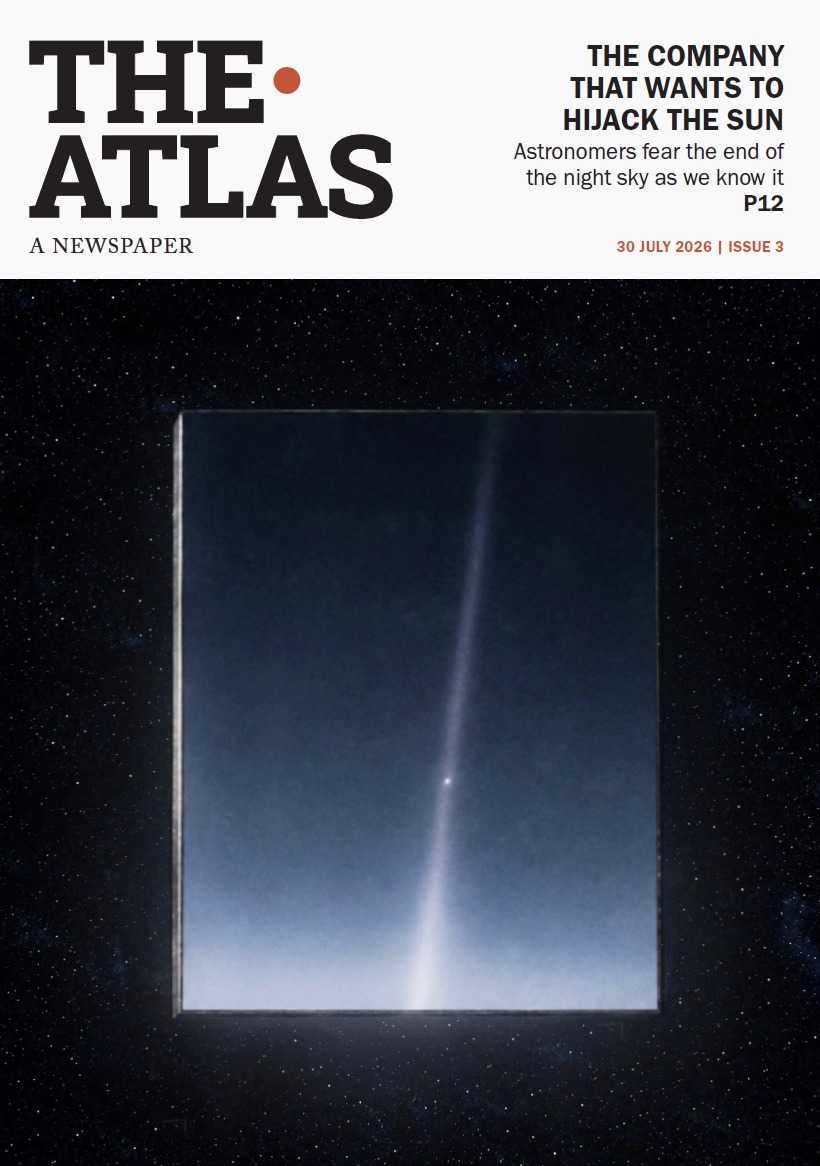
What you are reading first appeared as a cover story for The Atlas, our new global publication with The Continent. Sign up here to get the next edition delivered to your inbox on August 27.

Astronomers are panicking.

It is an “existential threat” to optical astronomy, says the European Southern Observatory. A “disastrous” idea that will “permanently scar” the night sky, according to the Royal Astronomical Society. The American Astronomical Society told Nature it “would probably mean the end of ground-based astronomy, or optical astronomy, at least.”

Sthabile Kolwa agrees. “It will take away a very crucial part of our civilization,” she tells The Atlas. Kolwa, a senior lecturer in astronomy at the University of South Africa, studies the life cycles of galaxies, but today her concerns are more immediate. “It might come to this, that we just have to find them in the parking lot and say, ‘Hey, what are you guys doing? You’re going to ruin science for us.’ ”

Like Uber, but for the sun

The parking lot in question is in Hawthorne, California, outside the headquarters of Reflect Orbital. They call themselves The Sunlight Company. The start-up is celebrating: Earlier this month, the United States Federal Communications Commission (FCC) approved the launch of Eärendil-1, likely in a few months time.

This satellite, named for a character in JRR Tolkien’s The Silmarillion, will unfurl an 18m x 18m mirror in low Earth orbit. It’s designed to reflect sunlight onto the dark side of the earth, lighting a 5km2 patch of land with the strength of four full moons.

It is a proof of concept.

By 2035, Reflect Orbital wants 50,000 of its mirrors in space, delivering illumination “comparable to daylight” on demand to paying customers (“sunlight is the new oil,” says chief executive Ben Nowack). The company says this will allow solar panels to generate clean energy overnight; provide “safer, evenly-lit streets” to cities that pay for it; and keep construction sites and farms working 24/7.

There will be an app, of course, offering “sunlight as a service” – lighting up the night will be as easy as ordering an Uber.

Clean, renewable energy is at the heart of the company’s vision, a spokesperson told The Atlas in a statement. Reflect Orbital declined to respond to specific queries and said it is in constant dialogue with astronomers, scientists and environmental researchers to mitigate the impact of the light pollution: “We are able to dim the brightness of the service and turn it off at any stage. We control where the light shines when serving an authorised customer. Most people and most places will never see this light. It is precise, targeted and customers will require permits to receive the service.”

Circadian arrhythmia

A new research paper, published in May, challenges Reflect Orbital’s position. Its author, the European Southern Observatory’s Oliver Hainault, concluded that the company’s 50,000 satellites would increase the background brightness of the sky by 300% – even when their mirrors are pointed somewhere else. This, coupled with a proposal from Elon Musk’s SpaceX to build vast data centres in space, would go “beyond the limit” of what astronomy can withstand.

What that means, in practice, is that the images from ground-based telescopes will be dramatically less useful, marred by streaks of light from passing satellites. The most distant light sources won’t be visible at all.

This will obscure evidence of other galaxies, hinder research into black holes and other cosmic phenomena, and potentially prevent early warnings of asteroid approaches. Cutting-edge astronomy will only be possible from space-based telescopes like the James Webb and the Hubble – access to which is already massively oversubscribed, and subject to political interference.

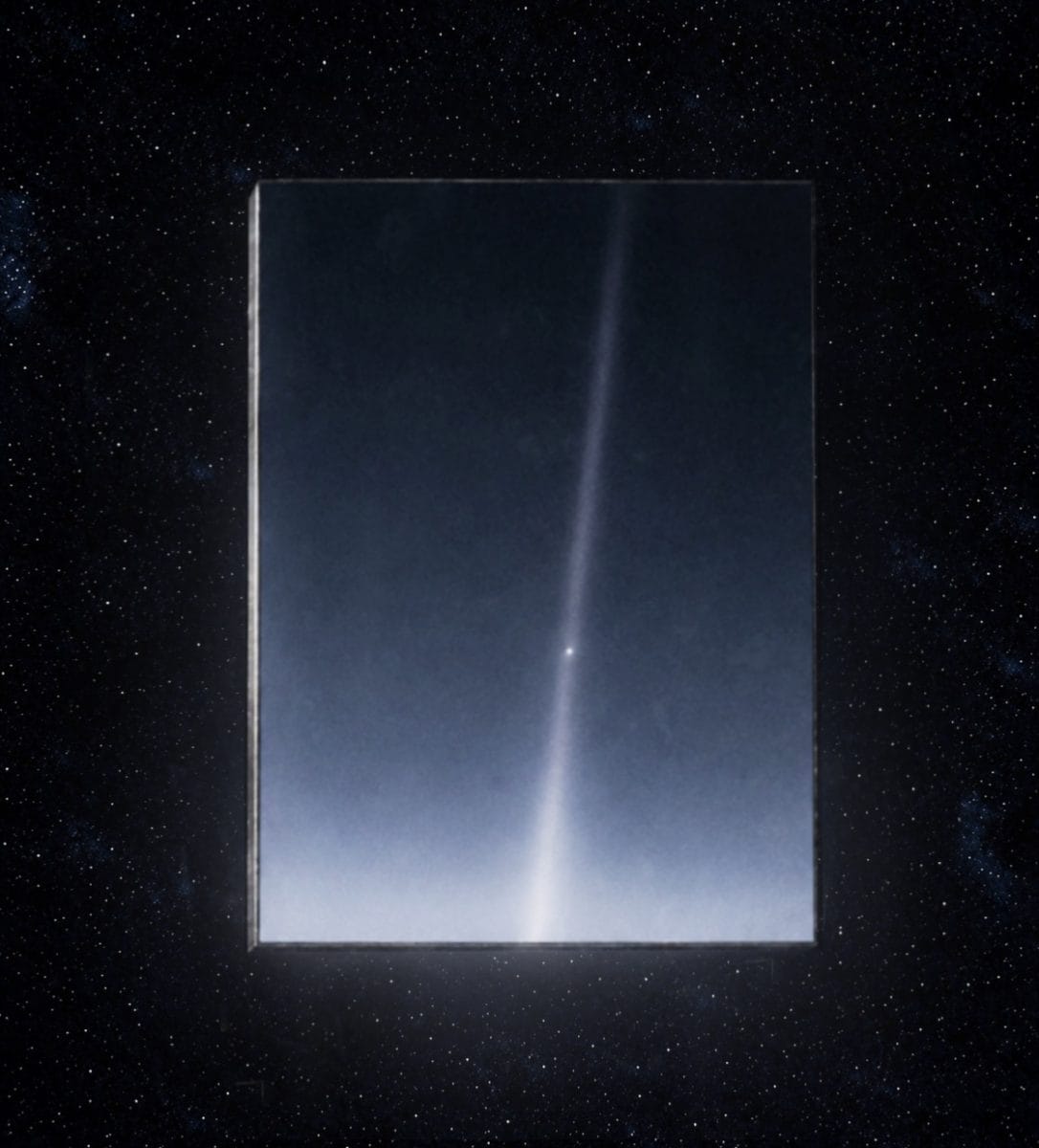
The night sky will look different to the naked eye, too. “The next time you’re away from urban light pollution, spend some time outdoors after dark and enjoy the view of the Milky Way and the constellations that have inspired awe since humankind woke to consciousness. Chances are those views are not here to stay forever,” wrote journalist Tereza Pultarova for Space.com.
Anna Jibladze

Running out of space

The night sky is already a lot brighter than it was 150 years ago, when light bulbs started to become commonplace. According to Dark Sky International, a US-based nonprofit that advocates against light pollution, 80% of Earth’s human population already lives under some form of sky glow, most of which is generated on land. This has forced astronomers to seek out “dark sky places,” like the Atacama Desert in Chile or the Upper Karoo in South Africa, for their telescopes.

Humans can adapt to less darkness. But it is much harder for animals and ecosystems that have evolved alongside predictable rhythms of day and night. Nocturnal predators lose the ability to hunt; sea turtle babies can’t find their way to the sea; migratory birds are thrown hopelessly off course; and moths expend all their energy helplessly chasing artificial light sources.

“It’s almost like we are on a mission to obliterate natural darkness from earth,” said Ruskin Hartley, Dark Sky’s chief executive. “And now rather than do it street by street and bulb by bulb, let’s do it from space.”

Space is, in theory, protected by the Outer Space Treaty, a 1967 agreement signed by 110 countries, including all the major space superpowers. It states that “space is the province of all mankind." But that’s not what’s actually happening, Hartley argues. “In the US, it’s the most wealthy, most powerful individuals who are gobbling up as much of that orbital space as they can before someone else can get that opportunity” – with China, Russia and Europe all scrambling too for a greater presence in low Earth orbit.

“Who gets to choose that we light up the night sky? Who gets to make that decision?” Ruskin asks. In the US, it is the FCC’s job to decide what satellites are allowed in space. But it has said that assessing the impact of light pollution or environmental damage is not within its remit. Instead, it wants to slash regulation so American companies can take advantage of the “space industrial revolution.”

And Reflect Orbital has rich and powerful backers. Earlier this year, it secured a $1.5-million contract from the US air force, hinting at possible military applications for its mirrors. Last year, it raised $20-million from three venture capital firms, including Sequoia Capital, one of the biggest investors in Silicon Valley. Sequoia also owns a multibillion-dollar stake in SpaceX, which has its own plans for low earth orbit.

There are already more than 10,000 Starlink satellites up there, giving Elon Musk unprecedented influence over global communications. The company wants to launch one million more satellites over the next few years to build a network of space-based data centres. In addition to the light pollution, astronomers worry the potential for collisions will increase dramatically, as will risks to the ozone layer.

A brighter future

On her blog Higher Dimensions, the astronomy professor Janna Levin contemplates our brighter future. “It is quite possible that the hot glow of the swarm of data satellites will saturate the night, washing out the stars from our perspective on Earth. We’ll look up into the sky and instead of Zeus transformed into a swan outlined in a constellation of a few stars, the machine gods will literally loom above us, glowing with radiant heat, making declarations, predicting the weather, forecasting then determining our fate.”

Kolwa, the South African astronomy lecturer, offers a different metaphor: that of empires “colonizing low Earth orbit.” This was an ambition of one of the most infamous imperialists of them all, Cecil John Rhodes, who said that he looked up at the stars and thought: “I would annex the planets if I could; I often think of that. It makes me sad to see them so clear and yet so far.”

But it hasn’t been colonized just yet.

“I’m still trying to figure out what we can do, what responsibility we have as scientists,” says Kolwa. “How could we engage our communities to stand up to these corporations and say no? We must keep our night skies dark, as dark as possible.”

The post Darkness is losing its war with the light appeared first on Coda Story.
  • ✇Coda Story
  • Exiled at midnight
    On the night of January 16, 2024, Egana Djabbarova was awoken by her wife and told that she needed to leave the country immediately. Djabbarova, her wife said, had been denounced by pro-war activists and framed as an enemy of the country. She had recently published her novel, “My Dreadful Body,” with a small, indie press that had been praised by mainstream critics, unexpectedly propelling her into the public eye. One of the book's central themes is surveillance: growing up in a community with st
     

Exiled at midnight

7 avril 2026 à 08:55

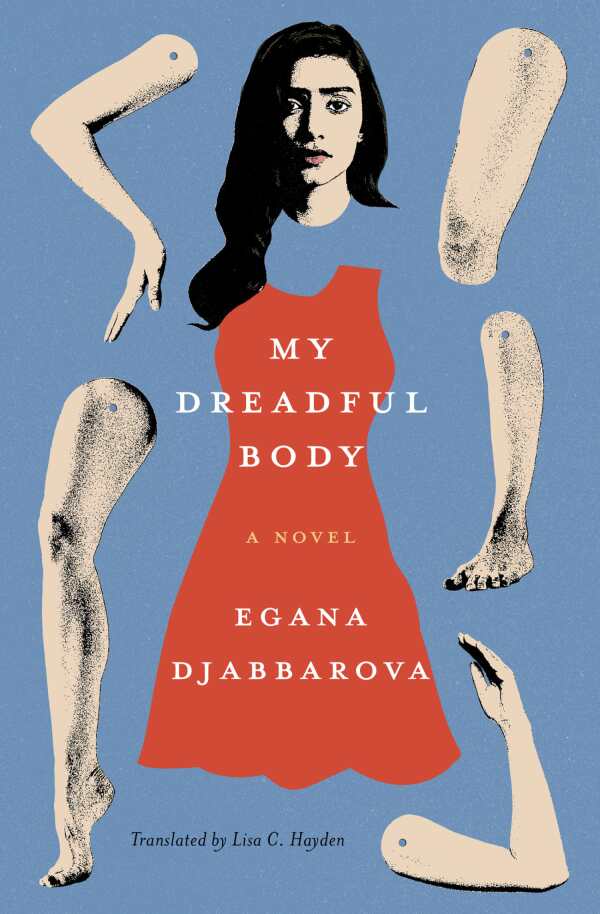
On the night of January 16, 2024, Egana Djabbarova was awoken by her wife and told that she needed to leave the country immediately. Djabbarova, her wife said, had been denounced by pro-war activists and framed as an enemy of the country. She had recently published her novel, “My Dreadful Body,” with a small, indie press that had been praised by mainstream critics, unexpectedly propelling her into the public eye. One of the book's central themes is surveillance: growing up in a community with strict behavioural codes, the protagonist's every move is under scrutiny.

In a dark echo of her work, Djabbarova was now under online surveillance herself. “I was just the perfect enemy,” she tells me, “because I’m queer, I’m not Slavic, I worked on decolonial and feminist projects… So boom, it happened.”

She is speaking to me from Hamburg, where she now lives. Djabbarova is part of the so-called fifth wave of writers exiled from Russia, alongside Maria Stepanova, Lyudmila Ulitskaya, and Maxim Osipov to name a few. Her upbeat tone during our call gives little indication of the arduous journey she has endured since fleeing Russia. Upon receiving a humanitarian visa from Germany, she spent months in a refugee camp. She lived, she says, “in a container house, literally a shipping container. You feel like you're not a subject, not a human being.” 

More permanent accommodation has provided a degree of safety and stability, but a sense of precariousness lingers. She describes her position as an exile as “strange” — on the one hand she has been welcomed into Germany’s cultural elite in winning the Hamburger Literaturpreis; on the other, she feels like a “ghost,” unable to express herself in German and often bewildered by the unfamiliarity of everyday tasks in a new country, and in a new city which, she tells me jokingly, is quaint and polite like the well-behaved boy next door. 

But there’s a deeper, historical layer to Djabbarova’s story of exile. Her father was a refugee from the region of Nagorno-Karabakh, while her mother was forced out of her family home. “Homelessness and exile — this is my heritage,” she says. Being othered became a common theme of Djabbarova’s childhood, as a child of Azeri parents living in Yekaterinburg. “In Russia you are constantly reminded that you're not Russian,” she says. “Then during the summer you visit your relatives in Azerbaijan and they laugh because you cannot speak Azerbaijani properly.”

This sense of double estrangement is mirrored in “My Dreadful Body” (published in Russian in 2023 and recently translated into English by Lisa Hayden). At only a touch over 100 pages, it is a slim but powerful account of the pressures on one woman growing up among the strict codes of an Azerbaijani family living in Russia. A sense of surveillance and conditional belonging defines the narrator’s upbringing: “In the world where I grew up,” she writes, “gazes penetrated every little corner. The evil eye, the neighbors’ eyes, the relatives’ eyes, the random pedestrian’s eyes, the unscrupulous men’s eyes, the women’s unhappy eyes. Life in the community was reminiscent of a reality show with constant video surveillance: no action, word, or undertaking went unnoticed.”

The story is based on Djabbarova’s own life. “Maybe 70-80% of this story is absolutely true”, she confirms. The narrator is named Egana, she grows up in an Azerbaijani family in Russia, too Russian for the family, not Russian enough for her friends at school. She also, like Djabbarova, suffers from a debilitating autoimmune disorder that is eventually diagnosed as dystonia, a neurological disorder that causes involuntary muscle contractions. During one episode, she describes her body as resembling “willow branches gone mad from a strong wind” — a potent image of struggle against external forces. Djabbarova describes the book as a way to reclaim her body through language. “I was trying to tell this story in a poetic way. I wanted to change my body into poetry.” 

Each chapter of “My Dreadful Body” begins with a different body part (“Eyebrows,” “Eyes,” “Hair” and so on), like the poetic blazons spun by Renaissance poets. Where those poems encouraged an idealized, sensationalized reading of each body part, Djabbarova’s chapters are more sober explorations of the physical limits — and personal and cultural stories — these body parts contain. 

In one of many poignant scenes, the narrator’s head is shaved in preparation for a procedure. She cries on seeing her “shorn scalp,” but the sadness is not aesthetic, it’s ancestral; the act marks a symbolic rupture with her lineage. “My past,” she writes, “the past of all the women in my family, the memory of my ancestors, the history of a single body — all that now lay on the cold floor.” After this scene, her grandmother’s dictum that only long hair was considered beautiful, rings even more sharply. 

Illness then emerges as another form of exile, from one’s sense of self, from what’s perceived as “normal” in society, from the culture and community one belongs to. “They do not see you as a subject, as a human being, and they do not recognize your existence… I realized if I wanted to be seen as a subject, I needed to do it myself.” Djabbarova is talking about the plight to be believed about her symptoms here, but she could easily be talking about the often dehumanizing experience of exile. In both instances there is something fundamental under question, or as Djabbarova puts it, “You’re trying to prove that you have the right of being. You’re trying not to be erased.” 

We often talk about exile in the context of loss, but how might exile liberate? Paradoxically, Djabbarova tells me, her diagnosis became a form of liberation. “I always felt I had so many expectations on me as a girl, as a woman, so when I was finally diagnosed it was a liberation because my parents realized I would never be this type of girl.” Exile breeds a particular creative liberation, too, evidenced by the fact Djabbrova wrote the novel from Taiwan where she was briefly teaching Russian. “Here I had enough distance from my own life and my own experience,” she says. “Maybe it’s easier to write about your story being on an island in the Pacific Ocean.”

Writing is arguably the real heroine of Djabbarova's novel. For the narrator Egana, it is a place free from surveillance and a source of protection, “like an invisible amulet.” Poetry, she told me “was the only safe space for me because nobody was asking anything of me. It's the only place where I don't feel judged. I don’t feel ashamed. I don’t feel questioned.”

The chapter “Hands” opens: “The most important parts of a woman’s body were her hands: they prepared food, rocked children, did laundry, ironed men’s shirts, sewed clothes, swept, washed the floor, and dusted.… Any woman in our family knew that her hands were not given to her for writing.” To use her hands, then, to write becomes both a symbolic and quite literal form of resistance against such gendered codes.

Notably, Djabbarova is not alone in invoking the body as a space to explore the upheavals of exile. In Maria Stepanova’s autofictional work “The Disappearing Act” — recently translated into English by Sasha Dugdale — the narrator attempts to purge herself by volunteering to be cut in half as part of a circus trick. Djabbarova’s approach to reclaim identity and agency through the body is less literal, and more personal, but through this specificity she has landed somewhere indisputably universal. 

“I realized the only way I can write this novel is through my body,” she says. “Because the only way I can rehabilitate my being, my agency, my subjectivity is through my body. And that's why I wanted every reader to feel my body… It's really important for all of us not to forget that this right of being is basic. It's not given. It's something you have from birth." 

At the end of our conversation, Djabbarova (who has been speaking in English) struggles to recall a word and jokes that learning German is slowly pushing her English out. “Certain words I only remember in German!” she laughs. Is this the beginnings of a kind of homemaking for Djabbarova, a sign that the seeds she has scattered in her new country are taking root? Like her protagonist, who finds solace and safety in words, it seems that Djabbarova’s most trusted tool for survival, for managing the condition of exile, is language. 

The Age of Exile

This story is part of our Age of Exile series, which explores how displacement has evolved from historical punishment into a defining condition of our time—one that reveals profound transformations in how we construct identity, maintain community, and exercise power across borders. In an era where digital connection enables presence without physical proximity, exile has become more complex, more global, and more central to understanding our world. Explore The Age of Exile series

The post Exiled at midnight appeared first on Coda Story.

❌