Vue normale

Russia’s biggest weapons maker has been under EU sanctions since 2022. Its 482 subsidiaries are the loophole.
12 août 2026 à 19:54

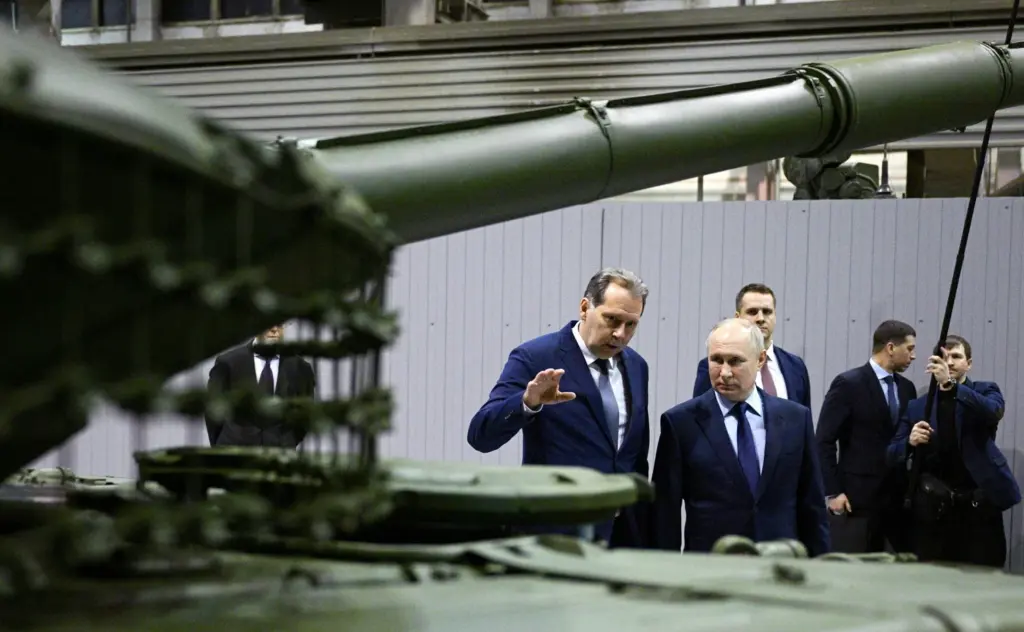
Vladimir Putin tours the Uralvagonzavod tank plant in Nizhny Tagil, part of Russia’s state-owned Rostec defense conglomerate, on 15 February 2024. Credit: Ramil Sitdikov/RIA Novosti via Kremlin.ru

At the G7 summit in Évian-les-Bains, France, in June, the leaders of the world's most powerful states again declared their intent to help Ukraine and to pressure Russia economically: "We commit to increase the pressure on the Russian war economy. In this context, we will strengthen our sanctions." But while G7 governments negotiate another round of political statements, the assembly lines of Russia's military-industrial complex keep turning out missiles and drones—from Western components and electronics.

A new analysis of Rostec—the giant of Russia's military-industrial complex—by the Independent Anti-Corruption Commission (NAKO) shows that the strategy of targeted strikes has reached a dead end. To make restrictive measures more effective, allies should consider wider use of export-control mechanisms against structures tied to Russia's defense-industrial complex. In many cases, export control can be a faster and more flexible instrument than full sanctions regimes.

Sanctions against Rostec
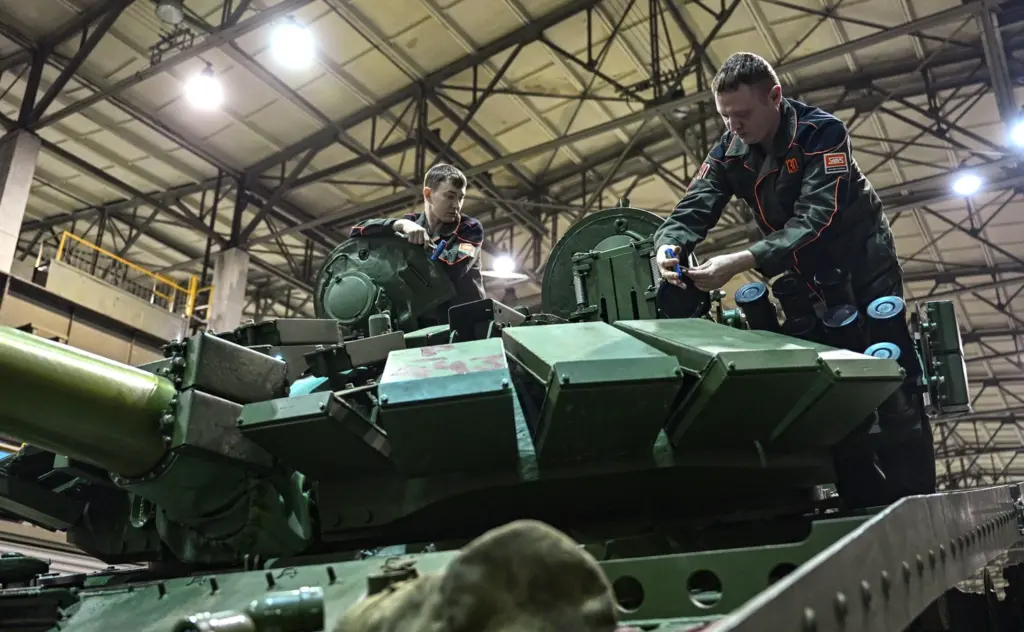
Workers assemble a T-72B3-series tank at Uralvagonzavod in Nizhny Tagil, part of Russia’s state-owned Rostec defense conglomerate, on 15 February 2024. Credit: Ramil Sitdikov/RIA Novosti via Kremlin.ru
What is Rostec?
  • Russia's largest defense and industrial holding, 100% state-owned
  • Its enterprises produce 80% of military equipment Russia uses in its war on Ukraine, Russian officials say
  • Accounts for about half of Russia's defense procurement
  • Employs 500,000–700,000 people at roughly 700–800 enterprises

Hitting the tip of the iceberg is not enough. Sanctions have been placed on Rostec itself, on its best-known holdings, and on individual plants caught manufacturing weapons. But this giant has many branches, visible and hidden, and the sanctioning process itself takes years. The result is that sanctions policy often looks ineffective—and it is easy to see why.


NAKO's analysts traced and identified 482 key legal entities within Rostec's structure. This is the most complete map of the conglomerate that currently exists, and even it covers only part of the concern. A vast network of subsidiaries operates in total secrecy: they hide financial reporting, classify tenders, and mask beneficial owners behind chains of fictitious founders.
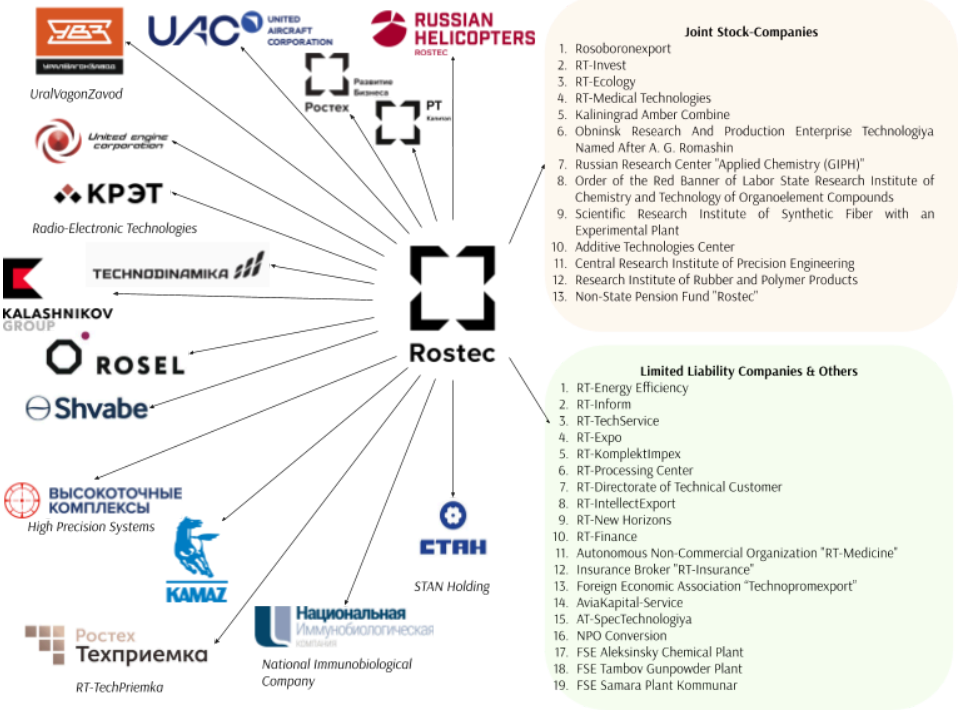
Rostec subsidiaries identified by NAKO
Rostec subsidiaries identified by NAKO. Screenshot from NAKO report

And while the West spends months assembling evidence against a single plant, Rostec quickly spins up new "clean" shell firms or brings new enterprises and factories under its control.

Ukraine has imposed sanctions on 72% of the identified Rostec enterprises. The United States covers 45%. And here it gets interesting: the European Union has managed to sanction only 23% of the conglomerate's companies. The United Kingdom takes an even more "selective" approach.

The EU has sanctioned only 23% of Rostec's companies.

The analysis also found a huge asymmetry between jurisdictions. The US, the EU, the UK, Switzerland, and Asian states apply entirely different approaches. What is blocked in the EU can operate freely under British or Japanese law. And while sanctions from even one jurisdiction are a significant red flag for banks, manufacturers, and regulators, the legal gap itself lets Russia keep access to technology.

How Russia gets around the sanctions

This lack of coordination among allies, combined with a complex, multi-layered corporate structure, keeps feeding Russian weapons with Western microelectronics. A vivid example is KRET (Radio-Electronic Technologies Concern), which produces the electronic-warfare systems Russia uses to jam Ukrainian drones at the front. London has sanctioned not a single enterprise in this holding—and there are at least 40 of them.

The result? Legally, these smaller companies fall under restrictions purely by belonging to Rostec. In practice? British manufacturers or distributors are unlikely to spend time tracing the link between Rostec and one of its hundred-odd enterprises buried in corporate layers; seeing no risk, they simply sign the deal with an unremarkable plant.

Another example is the Shvabe holding, whose sights and thermal imagers sit on Russian equipment. It ships its products to international exhibitions in the UAE without difficulty.
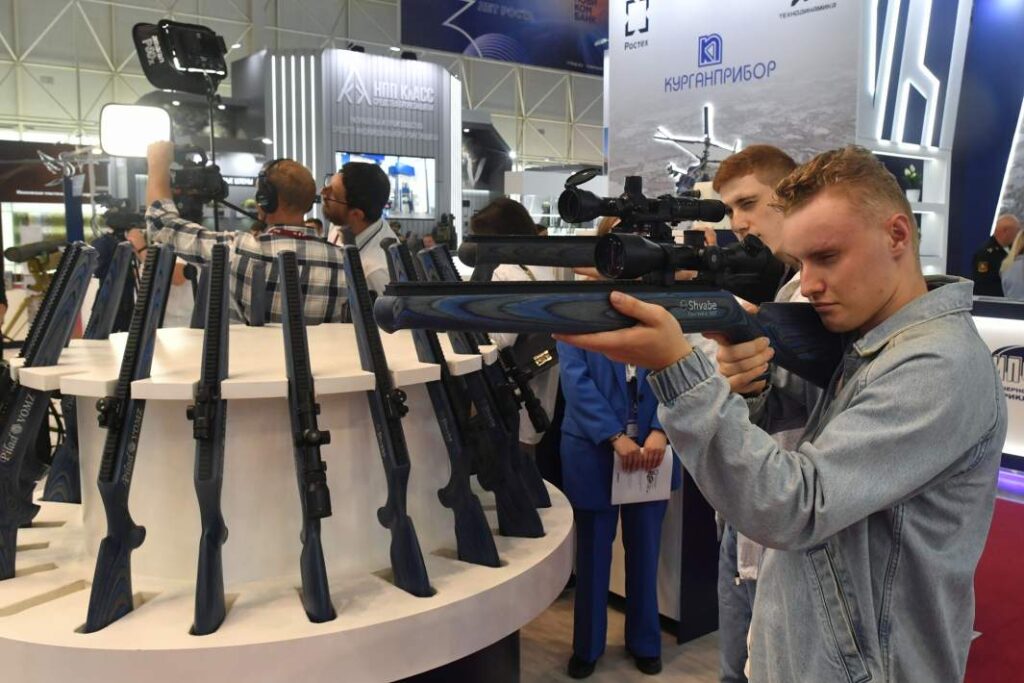
Small-arms sights on display at the booth of Russia’s Shvabe Holding, part of state-owned Rostec, at the MILEX-2025 arms exhibition in Minsk, Belarus. Credit: Mikhail Voskresensky/RIA Novosti

Other enterprises and whole holdings are frequent guests at exhibitions in China and India—steadily present and visible to a range of countries that could be subject to secondary sanctions. With those same countries Russia signs deals to sell another batch of helicopters, or shows off upgraded drones that have "proven their effectiveness on the battlefield against Ukraine." And it is through such countries that Western components keep reaching Russia.

This matters because Russia's import-substitution program—including in microelectronics—has never worked. Not yet, at least. Ukrainian military institutes examining captured missiles and downed drones report that Russian high-tech electronics simply are not there, sources that study the missiles have told NAKO. What they find are chips from American, European, and Japanese giants.

What is more, even these foreign components are usually nothing remarkable technologically. Yet as of today Russia still cannot produce even these—certainly not at scale—so it works the gaps in sanctions, export control, and "business as usual" with great finesse.

The next step: strengthening export control

The direction is already shifting. On 23 July 2026, the European Union adopted its 21st sanctions package—its largest batch of individual listings in four years. Fifty-six of them target Russia's military-industrial complex, 37 tied directly to long-range drones, and 51 more entities, many in China, Kyrgyzstan, Türkiye, and the United Arab Emirates, were placed under tighter export controls for feeding Russia the microelectronics and CNC machine tools its weapons depend on. It is the right target. The limit is that it still proceeds one entity at a time—and Rostec is built to outrun exactly that.

Banning the supply of certain critical goods to Kyrgyzstan—where such exports suddenly grew by more than 800%—or issuing regular financial warnings to intermediaries in the UAE and China are the right steps, and they force Russia to pay more. More than that: over four years, sanctions policy has repeatedly caused delays in the production and delivery of weapons and military equipment. But it has not stopped that production—as Ukraine keeps seeing with its own eyes during every mass strike.

The main conclusion that follows from our map of 482 key Rostec entities is the need to change the very logic of restrictive measures against Russia's defense-industrial complex.

Sanctions remain an important instrument, but they often prove slow, selective, and politically difficult to implement. A far wider use of export-control mechanisms, by contrast, could cut off access to international technology, equipment, and components faster and more effectively.

There should no longer be any need to prove separately the role of every nominal LLC somewhere near Chelyabinsk in Russian military production.

If an enterprise is part of Rostec's production, procurement, or technological chains—or those of other structures in Russia's defense-industrial complex—it should automatically become a candidate for export-restriction lists.

This approach would make it substantially harder for Russian defense enterprises to reach Western technology and would narrow the room to evade restrictions through subsidiaries, intermediaries, or formally civilian structures. Western banks, exporters, and compliance teams should not have to identify each new shell firm on their own. Instead, they should get a clear signal: involvement in the production or supply chains of Russia's military-industrial complex means elevated regulatory risk and the need to apply restrictive measures.

Economic pressure on Russia's defense sector must stop being fragmentary and reactive. It has to become systematic, predictable, and capable of outpacing the adaptive mechanisms of Russia's war economy.

Viktoriia Vyshnivska
Viktoriia Vyshnivska is a Senior Researcher at the Independent Anti-Corruption Commission (NAKO). Her work mainly focuses on supply chains delivering critical components to Russia, the use of foreign technologies in weapons production, and the impact of sanctions regimes on the defence capabilities of aggressor states. Her additional focus also includes Ukraine’s state-owned defense industry and democratic resilience.
Kateryna Biesiedina
Kateryna Biesiedina is Communications Manager at the Independent Anti-Corruption Commission (NAKO), specialising in strategic communications and media with a professional background in journalism and television production.

  • ✇Euromaidan Press
  • Ukraine funds its war from wages, and a 1971 law keeps millions of women from earning them
    For more than 30 years, Ukraine's Labor Code has prohibited women from working night shifts, except in those sectors where the Cabinet of Ministers permits it — and the Cabinet has never approved the list of those sectors, so the exception has no content and the prohibition has no limit. Ukraine's State Labor Service confirms the list was never adopted, and labor lawyers describe the provision as declarative — a rule that cannot be applied in practice. What it can do
     

Ukraine funds its war from wages, and a 1971 law keeps millions of women from earning them

12 août 2026 à 18:20

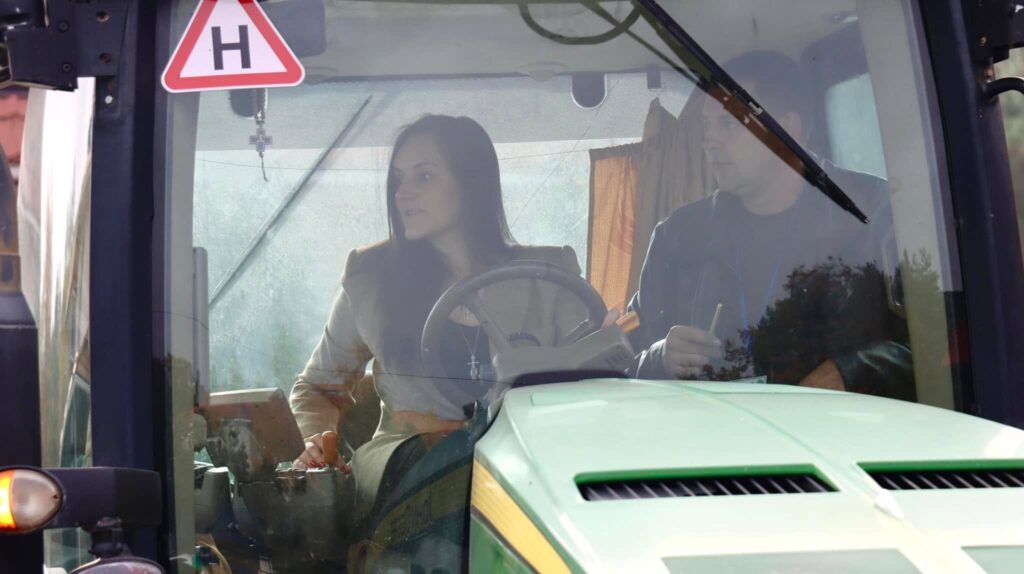
A woman drives a tractor in Ukraine. Then-Deputy Economy Minister Tetyana Berezhna said agricultural companies in Poltava Oblast had begun ordering state-funded tractor training for women as part of a program opening traditionally male-dominated professions to female workers. Photo: Tetyana Berezhna/Facebook

For more than 30 years, Ukraine's Labor Code has prohibited women from working night shifts, except in those sectors where the Cabinet of Ministers permits it — and the Cabinet has never approved the list of those sectors, so the exception has no content and the prohibition has no limit.

Ukraine's State Labor Service confirms the list was never adopted, and labor lawyers describe the provision as declarative — a rule that cannot be applied in practice. What it can do is make employers in shift industries cautious, because the safer option, when the law is unclear and the inspectorate is not, is to hire a man.

This is happening in an economy that, by the Economy Ministry's count, is short roughly 4.5 million workers. Around 700,000 men are serving in the Defense Forces, some 5.3 million Ukrainians are abroad, most of them of working age, and the State Employment Service reports that the vacancies hardest to fill are precisely those traditionally considered male—industry, construction, transport, and logistics. Meanwhile, 81% of Ukraine's registered unemployed are now women, up from 55% before the full-scale invasion. The people looking for work and the jobs that need filling are, increasingly, on opposite sides of a legal line drawn in Soviet times.

The vacuum, and how employers use it

Article 175 of the Labor Code prohibits night work for all women except in sectors where it is "required by special necessity and permitted as a temporary measure." The Cabinet of Ministers was to approve the list of those sectors, and in more than three decades it never has.

Hospitals, the police, railways, and the State Emergency Service employ women on night shifts anyway, under special laws regulating service in those sectors. Under the hierarchy of legislation, codes and laws have equal status, so a specialized law takes precedence over a conflicting general one.

In other sectors, however, the ambiguity has consequences. Employing women at night may lead to inspections by labor safety authorities and the imposition of fines, which means employers in industries that depend on night work can point to the legal uncertainty as a justification for not hiring women at all. The prohibition does its damage not because it is enforced, but because it has been left unresolved.

The Law on the Organization of Labor Relations under Martial Law temporarily lifted the restrictions related to night work, leave, rest periods, and overtime. But once martial law ends, the previous rules will return unless Parliament adopts a new Labor Code—and the one draft that would have done so has since been withdrawn.

What the draft code would change

The draft code—bill No. 14386, submitted by the Cabinet in January 2026 and recommended for adoption by the parliamentary social policy committee the following month—would have abolished the general prohibition on women's night work. Pregnant women and women who have recently given birth and are breastfeeding would remain exempt from night shifts until the child reaches 18 months of age, provided they submit the appropriate documentation to their employer. All other female employees would work on equal terms with men.

The draft also addresses the second barrier employers cite: parental leave. At present, leave runs until a child turns three, and employers are required to keep the position open while receiving no compensation for doing so.

For small businesses, which account for 74% of all jobs in Ukraine, this can be financially burdensome, and it is a reason employers may prefer not to hire women of childbearing age. Instead of protecting women specifically, the draft proposes equal rights for both parents, providing each with two months of paid leave while retaining the option of unpaid parental leave. Protection against dismissal would apply to both parents of children under 18 months, and employers would be required to provide written justification if they deny flexible work arrangements to pregnant employees or parents of children under eight.

The draft code also gives pregnant women and mothers of children under 18 months the right to request remote work, and employers may refuse only if the job cannot physically be performed remotely. Bakers and surgeons cannot work from home because they lack the necessary tools and equipment, while accountants and editors can. In other words, refusal would no longer be a matter of employer discretion; it would have to be justified.

None of it came to pass. The draft drew objections—the Federation of Employers warned of risks, and the Atomic Energy Workers' Union argued that several provisions contradicted the very principles the code claimed to advance—but it never reached a vote. Parliament was scheduled to take up the bill in a first reading on 30 June 2026, but did not get to it.

Two weeks later, the government resigned, and bill No. 14386 was withdrawn along with other government bills that had not passed a first reading. A new government may resubmit it under a new number; at this stage there is no way to know whether or when. For now, the draft that would have lifted the ban does not exist, and even had it passed, it would have taken effect only six months after martial law ends—so the vacuum in Article 175 outlasts both the war and the transition that follows it.

Where the law works

The picture is not one of obstruction alone. Just a few years ago, a woman could legally be denied a job because she sought employment in one of more than 450 prohibited occupations, ranging from truck driving to mining. The list was approved in 1993 as a measure intended to protect women's reproductive health, but in practice, it restricted their access to the labor market. In 2017, the list was abolished, and women can now enter any profession provided a medical examination shows the job does not pose significant health risks. Ukraine has also allowed women to serve in the military on equal terms with men.

Women have taken advantage of these opportunities. Today, nearly 75,000 women serve in the Armed Forces of Ukraine — about 20% more than in 2022. In 2025, almost 1,000 women completed the State Employment Service's retraining program in 31 "non-traditional" occupations, ranging from machine operators to tractor drivers. Meanwhile, nearly one-third of the graduates of the Kyiv School of Economics' ProfTech program were women who trained in welding, electronics assembly, and machine operation.

These are small numbers set against a reserve of 3.5 million women who, according to VoxUkraine's research, would like to work. But they suggest that the obstacle is not a shortage of willingness on the part of women, where a legal pathway into these occupations has been opened, women have used it.

Where the law fails

Ukrainian legislation explicitly prohibits discrimination. The Law on Advertising imposes a fine of UAH 86,470 for discriminatory language in job postings, such as "looking for a woman under 30." Article 184 of the Labor Code also prohibits employers from refusing to hire women because they are pregnant or have children.

However, while violations in the first case are relatively easy to identify and punish because job advertisements are usually public, proving discrimination in hiring is virtually impossible. Employers can always claim they found a better candidate, and women have no way of comparing their qualifications with those of other applicants. According to Work.ua data for March 2026, 25% of women have experienced discrimination related to motherhood—in most cases not outright refusal to hire or dismissal, but psychological pressure, inappropriate questions, or attempts to force them to quit.

Equal pay is also required by law, under the Law on Remuneration and the Law on Equal Rights and Opportunities for Women and Men. According to official data, in 2023 — the year Ukraine adopted its strategy for overcoming the gender pay gap — the average gap stood at 18.6%. Among women aged 19–29 it reaches 41.4%, according to estimates by the Institute for Demography of the National Academy of Sciences, based on Pension Fund data. The average in the European Union is 11.1%.

One of the problems in this area is the lack of detailed statistics, which makes it difficult to determine whether wage differences are driven by women and men holding different positions — which would point to a "glass ceiling," whereby women are less likely to be hired into managerial roles—or whether women and men are actually paid differently for the same work. Ukraine does not require employers to report wage data broken down by gender, and as a result three-quarters of companies do not systematically monitor gender pay equality. Without such reporting requirements, tracking whether the gap is closing will remain difficult.

Laws alone are not enough

The new Law on Preschool Education, adopted in 2024, guarantees all children the right to preschool education and allows children to remain in daycare facilities around the clock. However, not all facilities have bomb shelters, and 24-hour childcare is available primarily in private institutions, because public facilities often lack funding for overnight staff.

The shortage of childcare places is not a legal issue. Still, it directly determines whether women can work at all: 67.5% of women outside the labor market are engaged in caregiving and household work. The war has further increased this burden. During the war years, the share of women who are the primary breadwinners in their families rose from 7% to 23%, while the amount of care work—including caring for children and sick or injured family members—also increased. That is why access to childcare is no longer a matter of convenience; it is a condition for families' survival.

A new Labor Code could one day abolish every prohibition it contains, and that would improve the chances of employment for the 3.5 million women who say they want to work. It would not, on its own, give them anywhere to leave their children.

Oleh Ivanov
Oleh Ivanov is an analyst at Vox Ukraine

❌