Vue normale

Some Ukrainian farmers sell wheat below cost as Black Sea disruption stops ore operations
5 août 2026 à 10:05

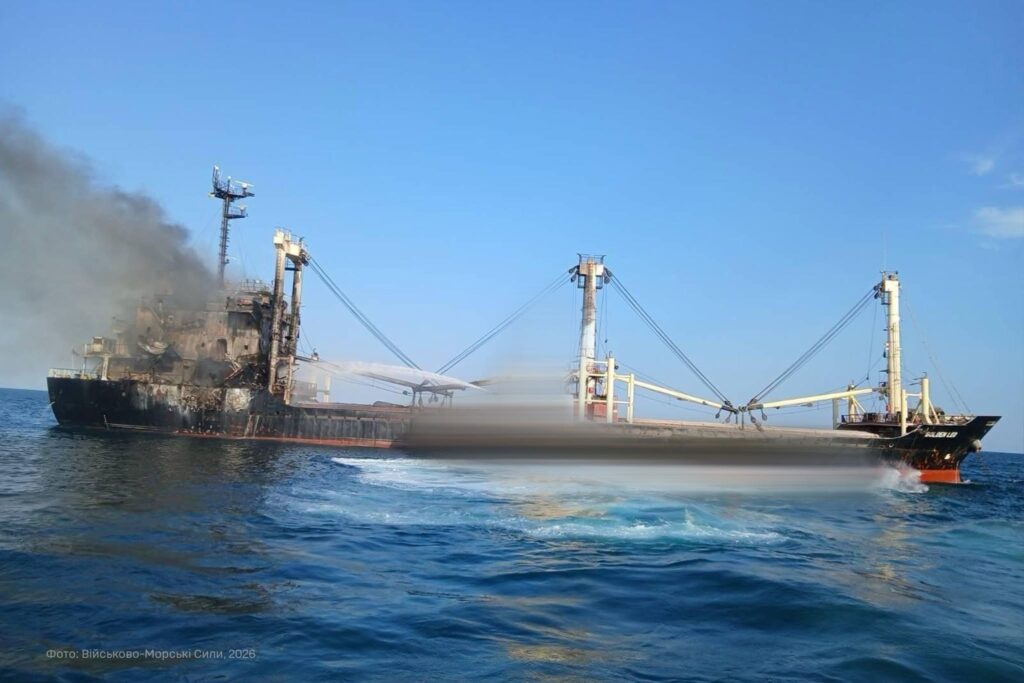
ten dead russia strikes turkish-owned bulk carrier off odesa · post civilian golden leo ablaze after russian missiles hit left cargo corn black sea 19 2026 ukraine's navy struck foreign-flagged

Two weeks ago, Russian strikes drove the ships out of Ukraine’s Black Sea ports, and Euromaidan Press reported that grain was piling up with nowhere to go. Now the bill is coming in.

ten dead russia strikes turkish-owned bulk carrier off odesa · post burned smoking superstructure golden leo after russian missile strike black sea 19 2026 ukraine's navy struck foreign-flagged civilian cruise
Explore further

Russia’s strikes stopped Ukraine’s grain ships. Its farmers are the ones paying

First to the farms. With no ships to load, traders have stopped buying, and the price they offer has dropped so far that Ukrainian farmers are, in places, selling wheat for less than it costs to grow. Port prices fell another 12–15% this week.

Grain buyers pay the world price, and when it suddenly costs far more to move Ukrainian grain out by rail than by sea, they hand that extra cost back to the farmer as a lower offer. That is how the head of Ukraine’s main association of agricultural producers, Oleh Khomenko, explained it.

Ukraine’s central bank has now measured the loss: $2.5 billion in export income gone in the second half of this year.

When the ships stop, the mines stop too

Ukraine mines iron ore and exports it by ship, just as it exports grain. The blockade has now spread into heavy industry. Ferrexpo, one of the country’s large ore producers, has suspended operations at its plant in central Ukraine—no point in digging ore that cannot leave the country.

After a Russian drone hit a vessel carrying its cargo, the company warned it will run out of cash by mid-September without fresh money. Metinvest, the steel group owned by Ukraine’s richest man, Rinat Akhmetov, has idled one of its own mines.

The image shows Pivdennyi Mining and Processing Plant (Pivdennyi GZK), one of Ukraine's largest iron ore producers. Source: UGOK
Explore further

Plant can’t mine because it can’t ship: Russia’s attacks on merchant vessels idle 4,480 workers at Ukrainian iron ore giant

Together, that is a country losing its two biggest foreign-currency earners. Ukraine’s central bank has now measured the loss: $2.5 billion in export income gone in the second half of this year, and almost a full percentage point—0.9%—knocked off the whole economy for 2026.

It could have been worse. An economist at the Kyiv School of Economics who tracked the 2022 blockade found that one cost Ukraine six times as much of its output. The sea lanes are not completely shut this time.
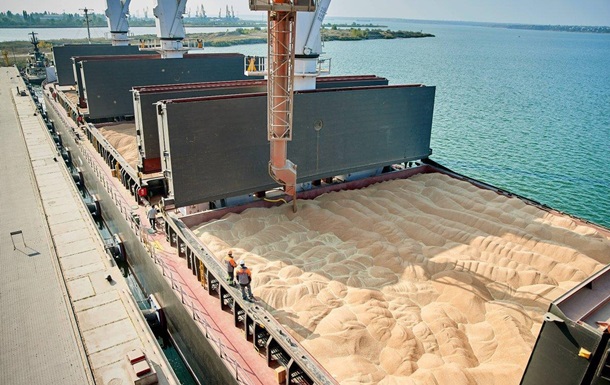
Ukrainian grain being loaded on a ship
Ukrainian grain on the move: Despite a 33% drop in 2025 shipments, Ukraine remains a vital global food supplier as EU integration advances. Photo: Ukrainian Grain Association

Abroad, the price moves the other way

For the rest of the world, the strikes cut the other way. As grain gets cheaper inside Ukraine, it gets dearer everywhere else, because buyers can no longer be sure the wheat will arrive. The UN’s political affairs office told the Security Council that world wheat prices have climbed 20% since the start of July.

Ukraine ships about 7% of the wheat sold across the world’s borders, USDA figures show, most of it bound for the Middle East and North Africa, where buyers have few other places to turn.

The real danger is that everything converges on one month. The corn harvest arrives in mid-September, with nowhere to store it. Ferrexpo’s cash runs out in mid-September. And the Danube—the shallow river route carrying what little the ports cannot—drops too low to help the month after. None of those alternatives replaces a deepwater port.


  • ✇Euromaidan Press
  • Russia’s strikes stopped Ukraine’s grain ships. Its farmers are the ones paying
    Russian strikes on Black Sea shipping have brought Ukraine’s grain corridor to its first full stop since it opened in August 2023, Ag Bull Trading reported. The freeze is splitting the price of wheat in two, pushing it down on Ukrainian farms even as it climbs abroad, Latifundist’s analysis found.Rapeseed now sells for about $70 a ton less than it did a week earlier, and wheat at the farm is fetching roughly a fifth less than last autumn. Some buyers are cutting their offe
     

Russia’s strikes stopped Ukraine’s grain ships. Its farmers are the ones paying

28 juillet 2026 à 04:49

ten dead russia strikes turkish-owned bulk carrier off odesa · post burned smoking superstructure golden leo after russian missile strike black sea 19 2026 ukraine's navy struck foreign-flagged civilian cruise

Russian strikes on Black Sea shipping have brought Ukraine’s grain corridor to its first full stop since it opened in August 2023, Ag Bull Trading reported. The freeze is splitting the price of wheat in two, pushing it down on Ukrainian farms even as it climbs abroad, Latifundist’s analysis found.

Rapeseed now sells for about $70 a ton less than it did a week earlier, and wheat at the farm is fetching roughly a fifth less than last autumn. Some buyers are cutting their offers overnight, market participants reported.

With ships no longer calling, traders have stopped buying, and grain that would have sailed has nowhere to go; the near-total halt of seaport trade has pushed prices down at the ports. More than 90% of Ukraine’s farm exports move through three deepwater Odesa ports.

ukraine grain
Explore further

Russia’s port strikes leave Ukraine’s grain with almost nowhere else to go

Carriers pull out as world prices climb

Maersk suspended service at a terminal in Chornomorsk’s fishing port and rerouted cargo to Romania’s Constanta, while the main ports and the corridor itself stayed open, as ThePublic reported; Hapag-Lloyd also paused its Chornomorsk calls.

On world exchanges, the same grain is moving the other way: Chicago wheat has jumped about 16% in July as attacks on Black Sea shipping stoke supply fears. Egypt, Algeria, and Indonesia together buy about 60% of Ukraine’s wheat, USDA figures show.

The freeze is splitting the price of wheat in two, pushing it down on Ukrainian farms even as it climbs abroad.

Grain piles up with nowhere to go

Seaborne farm exports have all but stopped, and with about 10 million metric tons of grain unsold from last season already competing for storage with the new crop, prices for growers keep sliding. The strain on the farm sector could turn critical within two to three months, the All-Ukrainian Agrarian Council’s deputy head Denys Marchuk warned.

The state has imposed no restrictions—shipowners paused their own calls after a run of Russian strikes on civilian cargo ships, Agriculture Minister Taras Vysotskyi told Latifundist.

He urged growers who can afford it to hold off selling, and said Ukraine may need to store an extra 10 to 12 million metric tons of grain it cannot ship, appealing to international partners for temporary storage capacity. The strikes went to the UN Security Council on 27 July, a session convened at Kyiv’s request.

Explore further

Russia’s ship strikes stall Ukraine’s grain corridor. The damage is moving inland

Growers face rising costs of their own—fuel, fertilizer, and equipment—and some are buying diesel on credit at about 87 hryvnias ($1.93) a liter, leaving little room to hold grain off a falling market.

Yet nothing has been formally closed. The deadliest strike came on 19 July, when Russian missiles hit the Golden Leo, a Turkish-owned bulk carrier, as it left Odesa loaded with grain, a strike killing 10. The corridor remains officially open. The harvest has fewer ways out.

❌