
 Connexion

The drones that wrecked the road to Kramatorsk are still hunting. Ukraine’s answer: a Frankenstein bulldozer bristling with spikes

- The road to Kramatorsk from the south is clogged with wrecked vehicles
- It's the job of the engineers from the Ukrainian 100th Mechanized Brigade to clear those wrecks
- For that, the engineers ride in a special armored bulldozer
The Ukrainian army's 100th Mechanized Brigade holds positions in or around Oleksiievo-Druzhkivka, which straddles the H20 highway threading between the ruins of Kostiantynivka northwest through Druzhkivka toward Kramatorsk, one of the last two big free cities in eastern Ukraine's Donetsk Oblast.
This axis is arguably the locus of the most intensive fighting in Ukraine right now as the Russians throw troops and vehicles at Ukrainian defenses in the hope of breaking through to Kramatorsk and neighboring Sloviansk from the south. It should come as no surprise that the H20 and adjacent roads are choked with the burned-out husks of Russian and Ukrainian vehicles.
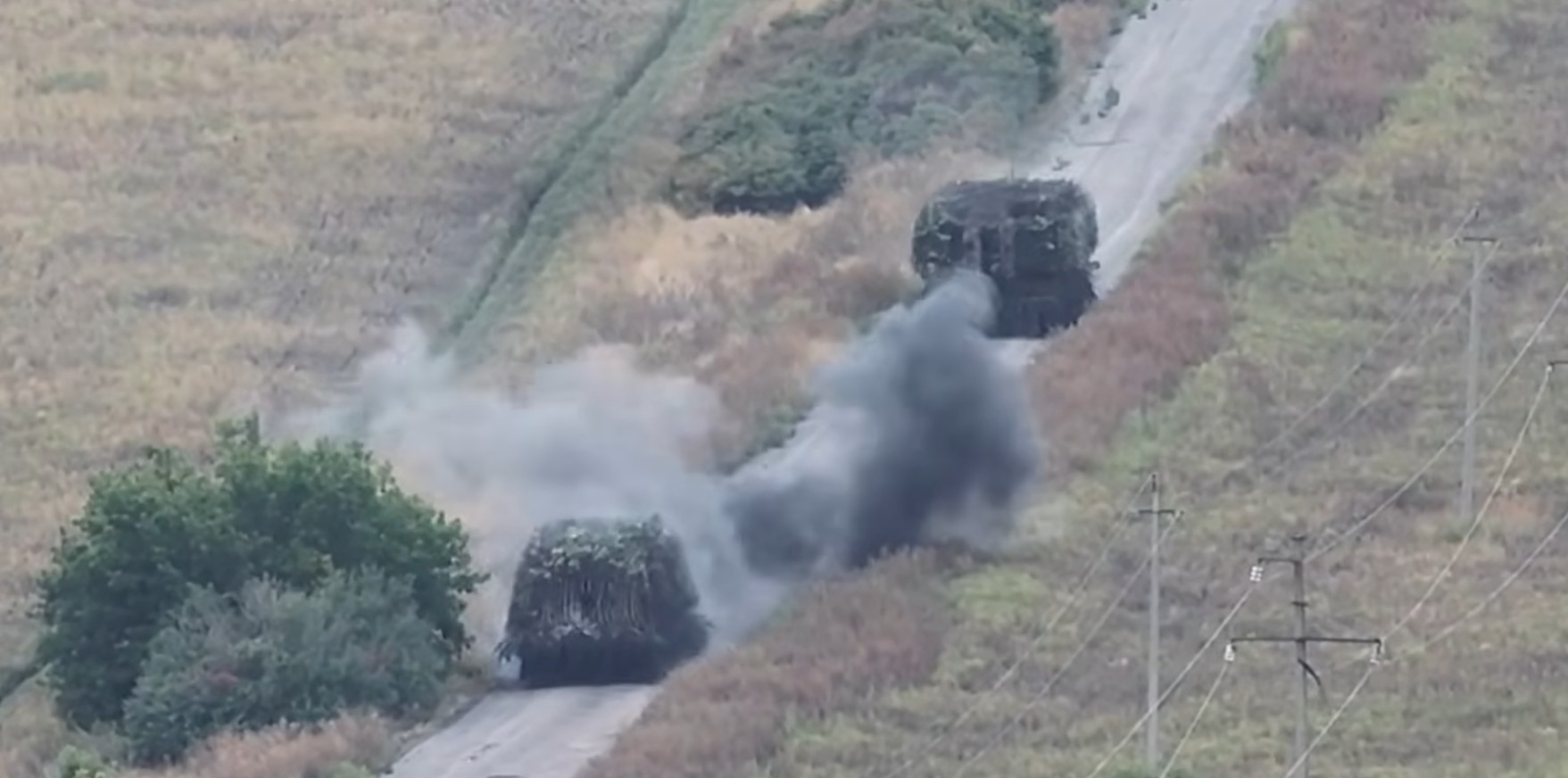
It's a problem, and the 100th Mechanized Brigade is solving it with sheer brute force. The brigade has attached a dozer blade to one of its drone-proofed armored vehicles, and is deploying the vehicle as a combat bulldozer. The dozer "push[es] the most difficult obstacle from the road and clears the way for other equipment," the 100th Mechanized Brigade stated.
— MAKS 26
An armored combat vehicle from the 100th Brigade of the Ukrainian Armed Forces, converted into a bulldozer for clearing roads of damaged ground drones and vehicles. pic.twitter.com/m2L9pLFzh3
(@Maks_NAFO_FELLA) November 4, 2026
Danger is constant. The same drones that littered the roads with destroyed vehicles also threaten the engineers whose job it is to clear the scorched hulks.
The 100th Mechanized Brigade is proud of its road-clearing engineers. It recently posted a drone video depicting the dozer in action in Druzhkivka, motoring out from under the partial protection of overhead anti-drone netting to shove destroyed vehicles off the H20.
The 100th, like many Ukrainian mechanized brigades, has an engineer battalion that supports its infantry and tank battalions. The engineers ride in an array of specialized vehicles for digging trenches, clearing earthen obstacles and mines, and towing damaged vehicles. And they can also convert practically any armored vehicle into a do-it-yourself combat engineer vehicle, or CEV, by attaching a dozer blade, like the one made by U.K. firm Pearson Engineering.
Pearson's General Purpose Blade "is suitable for clearing obstacles, urban roadblocks and rubble and it can also be used to move earth and fill craters," the company explained.
It's hard to say on the basis of one grainy drone video what kind of vehicle the 100th Mechanized Brigade fitted with a dozer blade for road-clearing duty. The brigade rides in Marder and M-2 infantry fighting vehicles, YPR-765 armored personnel carriers, and T-64, T-72, and T-80 tanks, among other types.

Special vehicles
If the unit has specialized CEVs, it's unclear what kind. The most common CEVs in Ukrainian service include the German Wisent and the Soviet IMR-2. The Ukrainians received a number of newer CEVs in the lead-up to their failed 2023 counteroffensive, including American Assault Breachers and Finnish Leopard 2Rs. But these vehicles suffered heavy losses while trying to lead tanks and fighting vehicles across dense Russian minefields. It seems no Assault Breachers or Leopard 2Rs are left in Ukrainian service.
Combat engineer vehicles, whether purpose-made or improvised, are in high demand on both sides of Russia's wider war on Ukraine. To take some of the pressure off, and safeguard human crews, the Ukrainians in particular are migrating some of the traditional tasks of a CEV to unmanned systems.
Ukraine is now sending its tanks into battle with drone escorts: they can drive into a Russian kill zone and come back alive
These capabilities were dramatically on display when the Ukrainian 3rd Army Corps launched Operation Vivaldi, its ultimately successful effort to push back a pair of Russian field armies along the northern approach to Sloviansk and Kramatorsk, back in the spring.
Where before, engineering vehicles may have cleared the Russian minefields, the 3rd Army Corps sent in heavy ground robots equipped with mine-clearing metal flails. Other Ukrainian units have experimented with aerial drones as de facto route-clearance systems. Heavy bomber drones have flown ahead of vehicle columns, dropping grenades to clear Russian ambush drones that sit on the road, waiting to take off and ambush passing vehicles.
But no aerial drone can shove a multi-ton wreck off a road. And while remote-controlled heavy vehicles may eventually be up to the task, they're still fairly rare in the Ukrainian inventory. So for now, it takes a crewed bulldozer to scrape wreckage off the most important roads faster than drone strikes can add to the wreckage.
