Vue normale

  • ✇Euromaidan Press
  • Russia’s oil money is drying up—so its own people are paying for the war
    Russia’s war budget got a brief respite this spring, when the Iran war pushed oil prices up. By July, it was gone. A single month swung from a rare surplus to an $8.8 billion deficit, leaving the seven-month shortfall already bigger than the entire deficit Russia ran last year, with five months still to run.As oil money drains away, the Kremlin is covering the gap by taxing ordinary Russians harder and eyeing their savings. Moscow will not run out of cash soon, but it i
     

Russia’s oil money is drying up—so its own people are paying for the war

12 août 2026 à 10:57

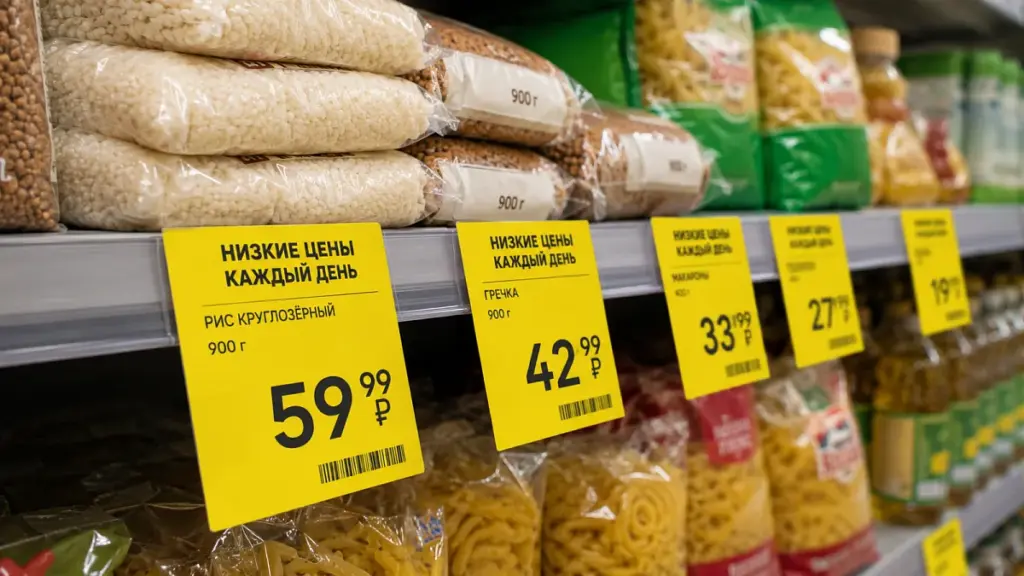
grocery prices in russia, may 2026

Russia’s war budget got a brief respite this spring, when the Iran war pushed oil prices up. By July, it was gone. A single month swung from a rare surplus to an $8.8 billion deficit, leaving the seven-month shortfall already bigger than the entire deficit Russia ran last year, with five months still to run.

As oil money drains away, the Kremlin is covering the gap by taxing ordinary Russians harder and eyeing their savings.

Moscow will not run out of cash soon, but it is running out of politically affordable ways to raise it.

Oil-and-gas income, long the war’s financial engine, fell by about a sixth from a year earlier to 4.6 trillion rubles ($56 billion), Finance Ministry figures show. Spending outpaced revenue, with state procurement up by nearly two-fifths.

The hole was plugged by value-added tax, whose receipts jumped by a quarter after Moscow raised the rate to 22% at the start of the year—a tax levied on ordinary Russians’ spending, not on oil prices or economic growth.
russian finance minister anton siluanov
Anton Siluanov, Russian Finance Minister. Photo: vedomosti.ru

One month of relief, then the gap reopened

The reprieve proved brief. July’s deficit followed June’s surplus even though spring’s higher oil prices should have cushioned the books, Bloomberg calculations showed.

Much of the windfall never reached the budget: it went to subsidizing oil firms whose refineries Ukrainian drones keep hitting, Gaidar Institute economist Ilya Sokolov wrote in a July monitoring paper.
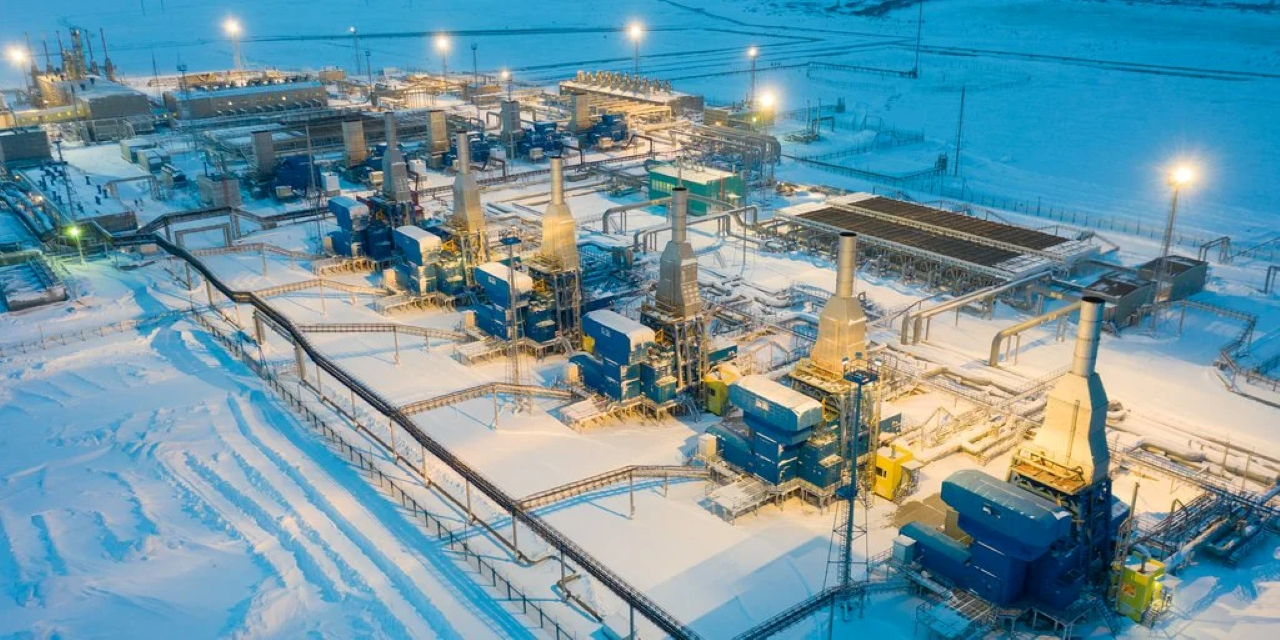
yamburg gas field in the yamalo-nenets ao in russia
Explore further

Russia’s oil revenues collapse 24% as global prices slide further (INFOGRAPHICS)

With the economy barely growing in the first half, a second-half recession could knock out another chunk of tax revenue just as the shortfall widens. Yaroslav Kabakov of the Finam brokerage expects the full-year deficit to approach double last year’s by year-end. Even as revenue shrinks, the military reportedly wants roughly 40% more than planned.

Borrowing, the other fallback, is jamming too. Russia suspended government bond auctions in July after investors balked and it could no longer raise money cheaply at home, even as Finance Minister Anton Siluanov vowed to shield defense and social spending.

Moscow shifts the burden to households

The burden is shifting onto households. The VAT rise alone will raise about $13 billion a year—barely a month of military spending—yet, unlike seizures aimed at billionaires, it reaches nearly every Russian, columnist Agathe Demarais wrote in Foreign Policy.

A draft law would allow the state to move around $40 billion from private pension accounts, and Communist leader Gennady Zyuganov has urged Vladimir Putin to tap the savings Russians hold in banks. Moscow will not run out of cash soon, Demarais argued, but it is “running out of politically affordable ways to raise it.”

Ordinary Russians are already moving their money. Through the first half of 2026, they withdrew cash from the banking system at the fastest pace since the pandemic, and the Central Bank has begun allowing banks to flag and freeze “suspicious” withdrawals, Euromaidan Press reported.
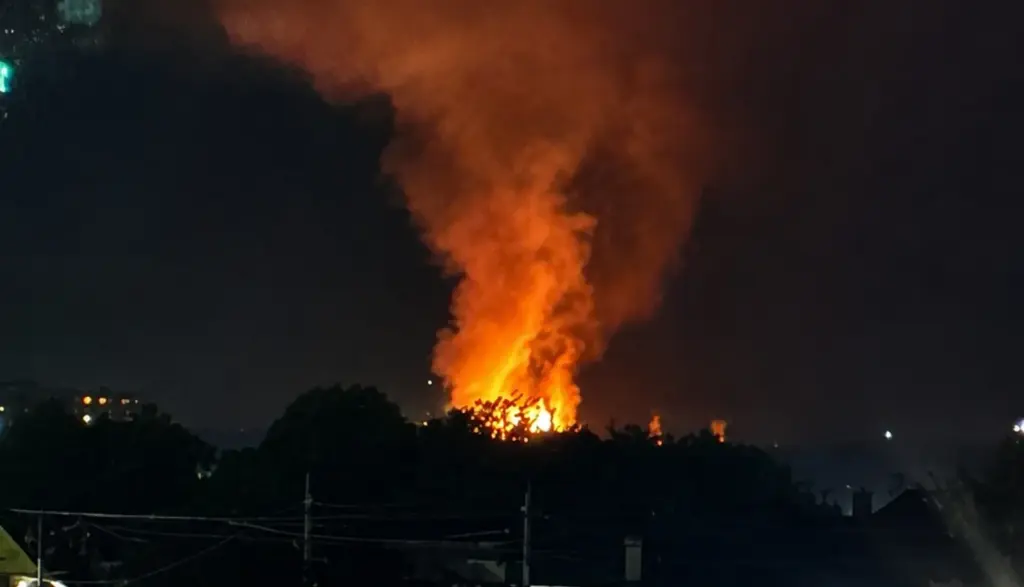
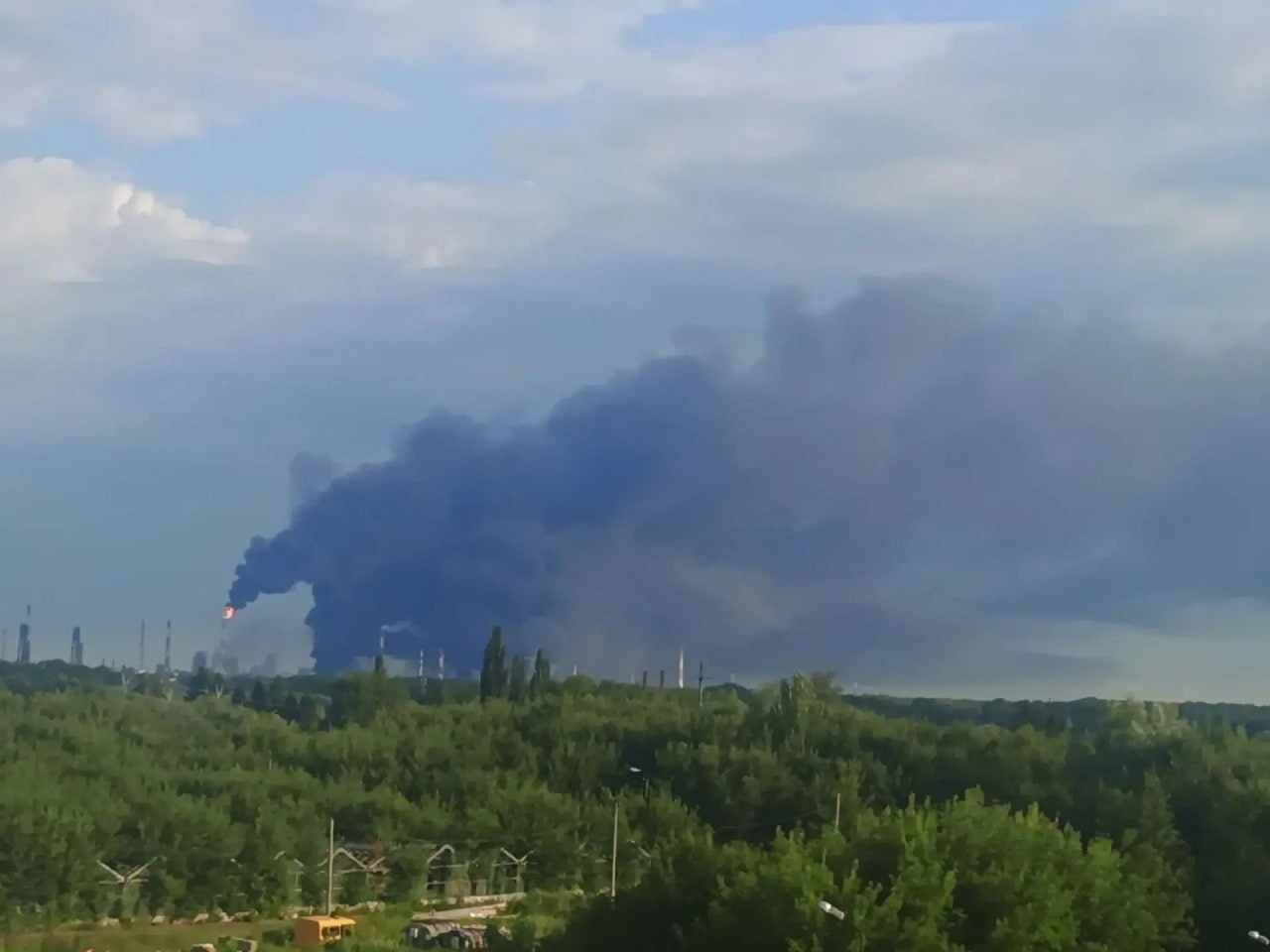
A plant making 150 products from gasoline to polyethylene caught fire 1,300 km from the war zone—Ukraine hits two refineries overnight

14 juillet 2026 à 04:13

plant making 150 products gasoline polyethylene caught fire 1300 km war zone—ukraine hits two refineries overnight · post blazes afipsky oil refinery after ukrainian drone attack krasnodar krai russia 14

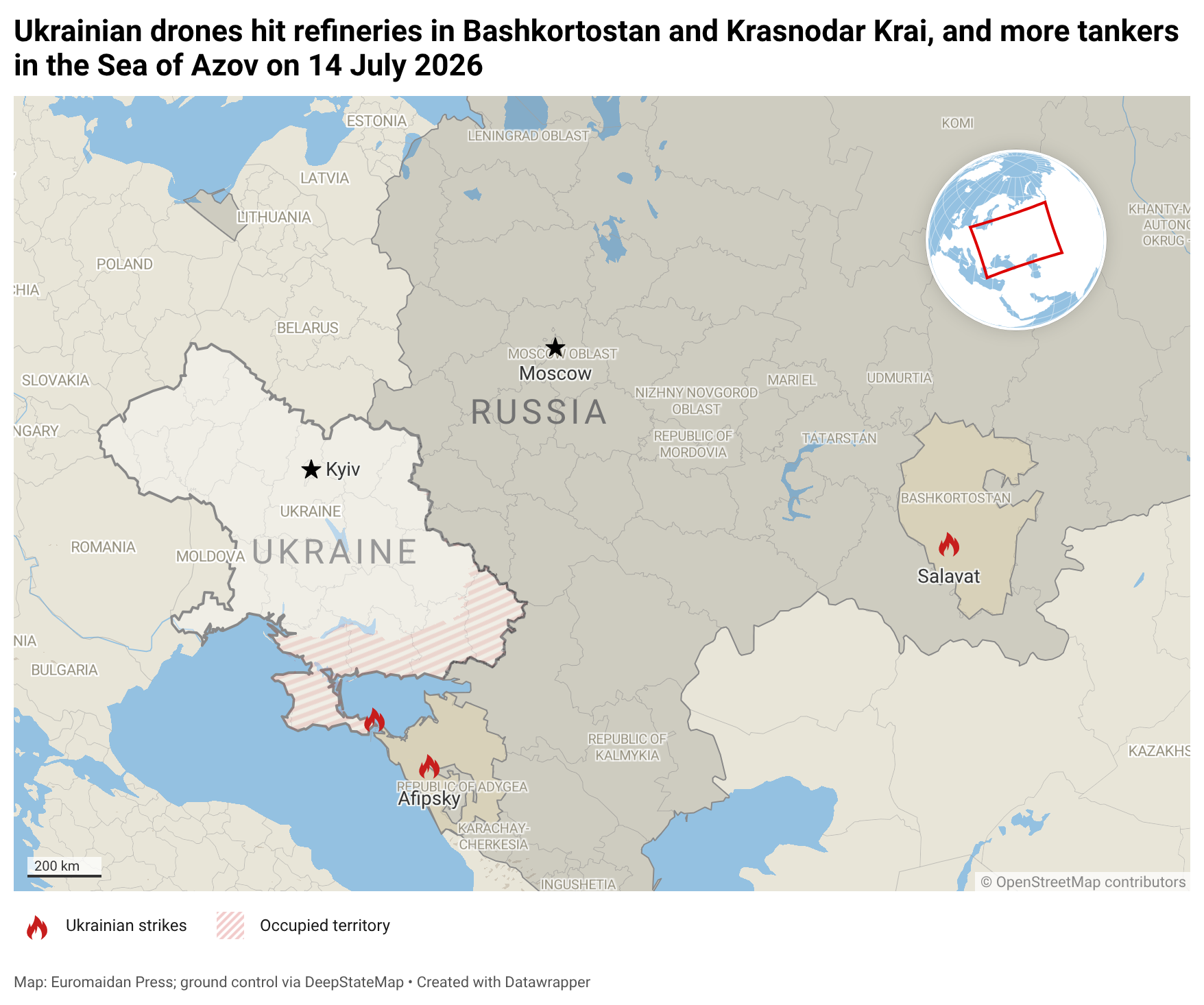
Ukrainian drones set fires at two Russian oil facilities at opposite ends of the country overnight on 14 July, according to monitoring channels and Russian regional authorities. The Gazprom Neftekhim Salavat petrochemical complex burned in Bashkortostan, some 1,300 km from the war zone, while the Afipsky refinery caught fire in Krasnodar Krai, around 400 km from the front. A Rosneft oil depot next to the Salavat plant was likely hit as well.

Ukraine's deep-strike campaign has idled more than 40% of Russia's refining capacity and pushed processing to its lowest level in two decades, forcing Moscow to ration gasoline in dozens of regions and smuggle fuel to the front hidden in grain trucks. With Omsk hit 2,500 km away and now Salavat burning, no major Russian gasoline producer sits beyond drone range anymore, and every repeat strike on plants like Afipsky resets repairs faster than Russia can finish them — a shortage of 400,000-600,000 tons a month that Belarusian and Kazakh supplies cover only halfway.

The last big gasoline producer still standing

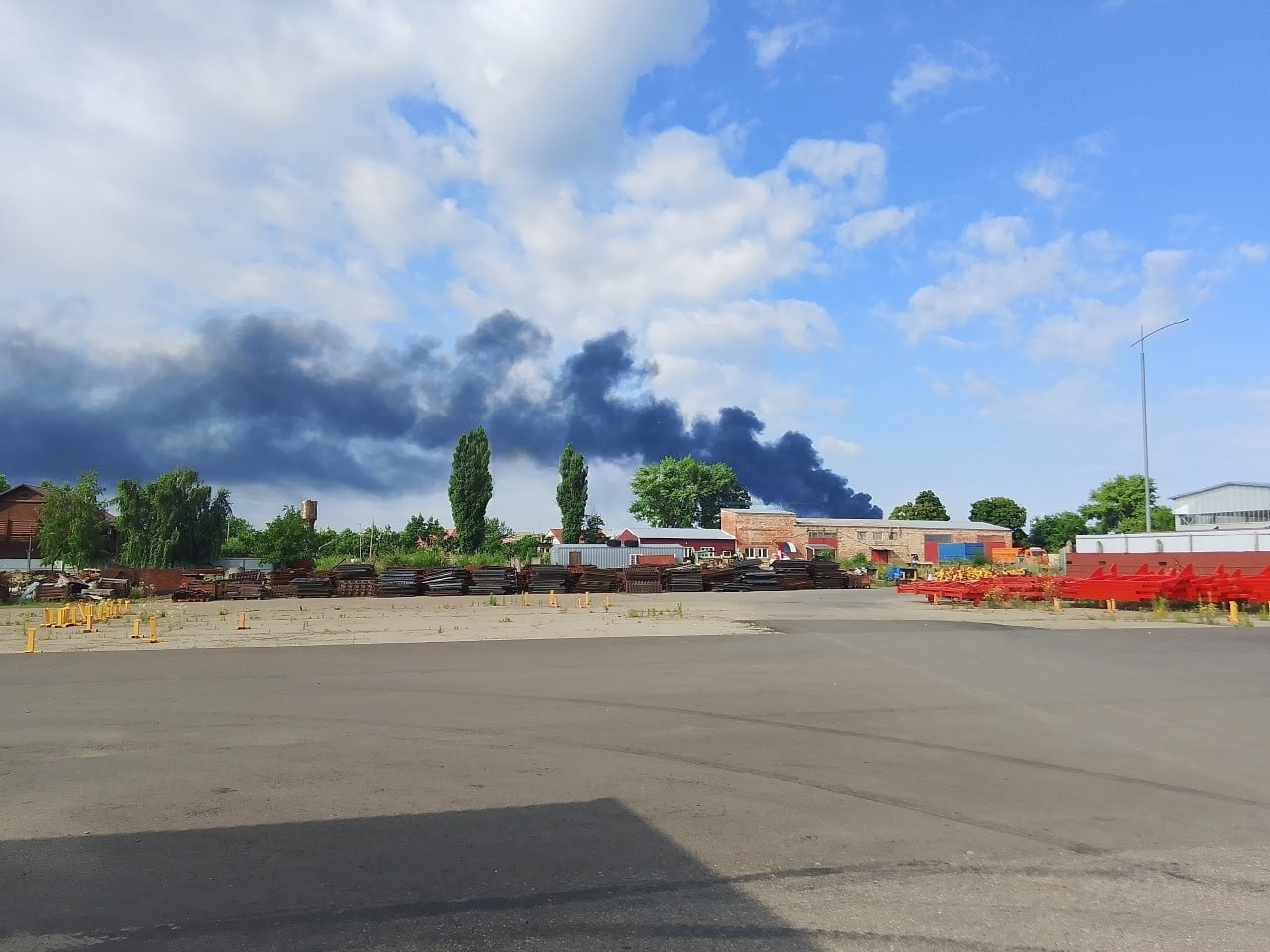
Residents of Salavat heard a series of explosions in the early hours, then watched thick black smoke climb over the industrial zone, visible across the city. Ukrainian monitoring Telegram channel Exilenova+ published footage of the fires. Russian news Telegram channel Astra confirmed through its OSINT analysis that the Gazprom Neftekhim Salavat complex was struck and burning.

plant making 150 products gasoline polyethylene caught fire 1300 km war zone—ukraine hits two refineries overnight · post black smoke rises over gazprom neftekhim salavat complex after ukrainian drone strike
Black smoke rises over the Gazprom Neftekhim Salavat complex after the Ukrainian drone strike, Salavat, Bashkortostan, Russia, 14 July 2026. Photo: Exilenova+
The plant is one of Russia's largest refining and petrochemical complexes. It processed 7.2 million tons of crude in 2024 — 2.7% of Russia's total refining — and produced 1.5 million tons of gasoline, 2.5 million tons of diesel, and 0.7 million tons of fuel oil, Reuters reported, citing industry sources. Its design capacity reaches 10 million tons a year, and it makes some 150 kinds of products, from jet fuel to polyethylene, ammonia, and plasticizers.

The complex was the last major gasoline producer that strikes had not yet touched in 2026. Its loss means roughly 11,000 tons of daily fuel deliveries gone from the Russian market — about 5% of domestic demand. Drones already struck the plant twice in September 2025, after which the regional head insisted it worked on as normal.

Preliminary damage: primary unit and polyethylene workshop

Ukrainian monitoring channel Supernova+ reported preliminary hits on the AVT-6 primary oil distillation unit and workshop No. 20, which produces high-density polyethylene. Nothing leaves a refinery without primary distillation, so damage there stops the whole production chain.

The strike likely reached beyond the complex itself. The Rosneft-Opt oil depot nearby probably caught fire too, according to Astra.

Bashkortostan head Radiy Khabirov claimed a "massive attack" of drones on Salavat's industrial zone was repelled. He attributed the "pockets of smoke" to falling debris of downed drones and stated nobody was hurt. Russia's aviation authority restricted operations at the Ufa airport during the attack.

Drones struck a refinery 1,300 km from the war zone: Gazprom Neftekhim Salavat is burning in Russia

Overnight on 14 July, residents of Salavat in Bashkortostan heard the explosions, then watched the smoke climb over a plant that refines 7.2 million tons of crude a year and makes… pic.twitter.com/emkIb4L3A1

— Euromaidan Press (@EuromaidanPress) July 14, 2026

Afipsky burns again at the other end of the fuel map

In Krasnodar Krai, the first explosions near the Afipsky refinery sounded around midnight, and a powerful fire followed, Ukrainian monitoring channel Krymsky Veter reported. The blaze rose near the plant's tank farm, according to Astra's analysis of witness footage. The Krasnodar Krai operational headquarters confirmed the fire at the refinery after the drone attack.

fires both ends russia's fuel chain lukoil depot stavropol krai ferry port facing kerch · post smoke oil fire drifts over industrial area near russia 13 2026 4a4773de-e3fe-4db0-a597-58f2dd5605cd ukraine news
Explore further

Fires at both ends of Russia’s fuel chain: a Lukoil depot in Stavropol Krai and a ferry port facing Kerch

The export-oriented plant runs two primary distillation units with capacities of 9,786 and 8,829 tons per day and does not currently make gasoline or diesel for the domestic market, Reuters reported. Together with the affiliated Krasnodar refinery, it processed 7.2 million tons in 2024 and 3 million tons in the first half of 2025. Ukraine's General Staff puts its share at about 2.1% of Russia's refining.

Drones have hit Afipsky at least eight times since May 2023, including a March 2026 strike that damaged the AT-22/4 primary processing unit and the previous attack on 11 June.

❌