Ms. Slemmer was killed in 1995 by Christa Pike, whose execution in Tennessee was botched on Wednesday. Her family celebrated what would have been her 51st birthday last month.
Ms. Slemmer was killed in 1995 by Christa Pike, whose execution in Tennessee was botched on Wednesday. Her family celebrated what would have been her 51st birthday last month.
Mike Stanfield standing in the area reserved for people opposed to the death penalty outside Riverbend Maximum Security Institution in Nashville before the planned execution of Christa Pike on Wednesday.
Christa Pike was convicted of murdering a classmate in 1995. It was not clear what went wrong in the execution or what her current medical condition was.
Christa Pike was convicted of murdering a classmate in 1995. It was not clear what went wrong in the execution or what her current medical condition was.
A federal court on Wednesday had ordered a pause on the execution of Christa Pike, convicted of the murder of a classmate in 1995, just hours before she was set to die by lethal injection in Nashville.
Christa Pike could be the first woman executed in Tennessee in more than 200 years. Her supporters say she has changed in isolation; her victim’s family wants her to die.
Christa Pike could be the first woman executed in Tennessee in more than 200 years. Her supporters say she has changed in isolation; her victim’s family wants her to die.
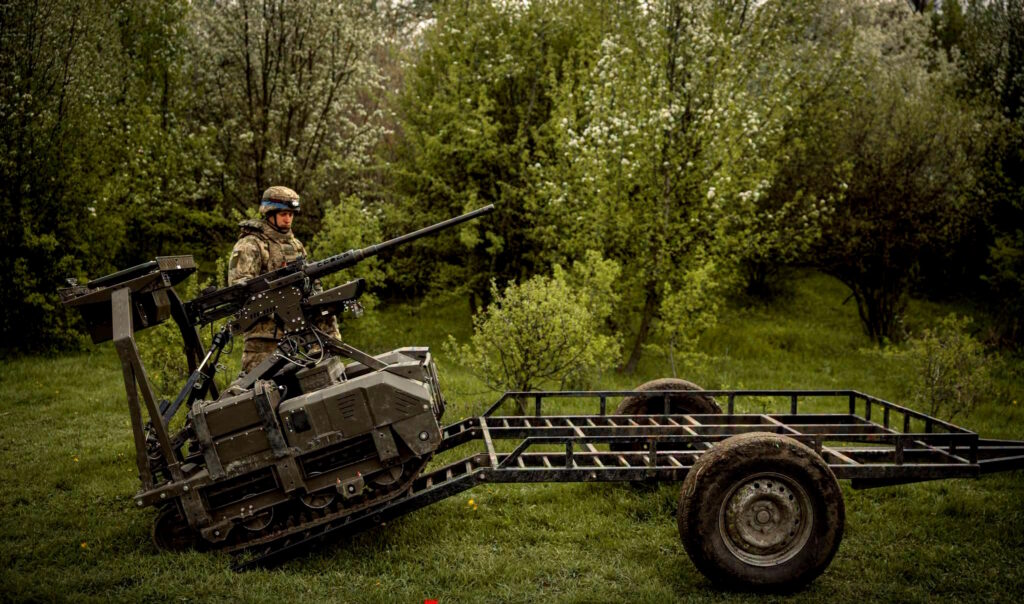
Ukraine has employed a new tactic during its major Operation Vivaldi in Donetsk Oblast. During the 3rd Army Corps' offensive, fighters from the world's first experimental unit of unmanned ground-strike vehicles, "NC13", have upgraded their kamikaze ground drones with grenade launchers.
Vivaldi is the counteroffensive the corps is running near Lyman in northern Donetsk Oblast. Over its first two "seasons," the 3rd Army Corps and attached units have retaken more than 125 square kilometer
Ukraine has employed a new tactic during its major Operation Vivaldi in Donetsk Oblast. During the 3rd Army Corps' offensive, fighters from the world's first experimental unit of unmanned ground-strike vehicles, "NC13", have upgraded their kamikaze ground drones with grenade launchers.
Vivaldi is the counteroffensive the corps is running near Lyman in northern Donetsk Oblast. Over its first two "seasons," the 3rd Army Corps and attached units have retaken more than 125 square kilometers, half of it de-occupied outright, and inflicted more than 3,000 casualties on Russian forces.
Through this offensive operation, the 3rd Army Corps, commanded by Brigadier General Andrii Biletsky, disrupted Russian forces' plans to encircle the fortress-belt cities in Donetsk Oblast from the north and south. Among them are Sloviansk, Kramatorsk, Druzhkivka, and Kostiantynivka. These cities have helped hold back Russian forces since 2014.
From intensive training to the world-first operations
The NC13 unit has been through Bakhmut, Avdiivka, and other of the toughest sections of the front.
Among its achievements: the world's first robotic assault carried out without infantry involvement, resulting in the capture of two Russian soldiers, a sabotage operation in the enemy's rear — blowing up a crossing and disrupting an offensive — using UGVs alone, and Ukraine's first fully robotic defense of a position for 45 days without involving infantry.
"No one in the history of warfare has used this kind of tactic before," the soldiers commented on the offensive.
The defenders say that a lack of combat experience is no barrier to joining the unit. Every recruit goes through an intensive training course led by experienced instructors.
Grenade launchers were developed based on the Soviet RPG-22
During the operation, UGVs equipped with two Bullspike grenade launchers attacked Russian positions, then detonated directly inside their shelters. The occupiers believed they were being attacked by an entire assault group. In reality, they were being torn apart by robots from the 3rd Assault Corps.
Ukrainian troops armed ground robots with grenade launchers and sent them to storm Russian positions during Operation Vivaldi near Lyman
The robots fired into Russian shelters at close range, then detonated inside them 3rd Army Corps, NC13 Unit pic.twitter.com/rjekIYxPbA
"Yes, the UGVs carry out three tasks at once: they strike, they exert psychological pressure, and they clear the position. And most importantly, this happens without risk to our infantry," the force says.
The Bullspike grenade launchers were developed based on the Soviet RPG-22 anti-tank grenade launcher, which was previously manufactured under license by a Bulgarian defense company.
According to data from the manufacturer's website, the Bullspike RPG has a maximum aimed firing range of 350 meters, a direct-fire range of 150 meters, and armor penetration of 400 mm, Militarnyi reports.
The total weight of the launch unit, together with the 72.5 mm PG-22 grenade, is 3.4 kg. The length of the launcher is 780 mm.
The manufacturer states that the Bullspike-AT round is designed to destroy tanks, self-propelled artillery, and other armored vehicles, as well as to target enemy personnel located in bunkers, field fortifications, and urban-type brick fortifications.
The robots were controlled by operators from a safe shelter dozens of kilometers from the line of contact.
Earlier, for the first time in the world's history, the 3rd Army Corps dropped ground robots behind Russian lines from the air. The soldiers behind the mission say their heavy drones delivered kamikaze unmanned ground vehicles more than 10 kilometers into the Russian rear during the "second season" of Operation Vivaldi, letting Ukrainian troops flank them and clear another 40 square kilometers.

 Connexion


 3rd Army Corps, NC13 Unit