❌

Vue normale

  • ✇404 Media
  • Two New Birds Louder Than Jackhammers Just Dropped

    Scientists have identified two new contenders for the world’s loudest bird—the bare-throated bellbird and the red-legged seriema—both of which can exceed 120 decibels, which is louder than a jackhammer, according to a study published on Tuesday in Evolution. These two bird species are now in the same league as the white bellbird, which shattered the record for loudest bird in 2019 after its bizarre call was first measured and reported by Jeff Podos, a professor in the department of biology at
     

Two New Birds Louder Than Jackhammers Just Dropped

29 septembre 2026 à 13:04
Two New Birds Louder Than Jackhammers Just Dropped

Scientists have identified two new contenders for the world’s loudest bird—the bare-throated bellbird and the red-legged seriema—both of which can exceed 120 decibels, which is louder than a jackhammer, according to a study published on Tuesday in Evolution. 

These two bird species are now in the same league as the white bellbird, which shattered the record for loudest bird in 2019 after its bizarre call was first measured and reported by Jeff Podos, a professor in the department of biology at the University of Massachusetts Amherst. It’s worth taking a moment to listen to the bellbird’s otherworldly call, which the males unleash over their remote habitat in the northern Amazon rainforest.

In the new study, Podos and former UMass Amherst graduate student João C.T. Menezes report that the bare-throated bellbird and the red-legged seriema occupy the same decibel range as the white bellbird. It's tough to declare a clear winner among the three birds due to differences in measurement techniques and individual variations within each species. 

Regardless, this trio is a special class that is much louder than the fourth runner-up, the screaming piha, which tops out around 116 decibels. In addition to identifying the ear-splitting avians, the team captured unprecedented measurements of vocal amplitude in 123 bird species, an effort that represents “a step forward in uncovering what enables birds to produce the loudest acoustic signals of all terrestrial fauna,” according to the study. 

“We were interested in a pretty basic question that's still out there because we know so little about amplitude,” said Menezes in a call with 404 Media. “We were basically interested in finding out why some species sing louder than others. For that, the more diverse the sample, the better.” 

“We wanted to know the softest species we could get, and the loudest species we could get, and everything in between,” he continued. “The more variation, the better for answering this type of question. Of course, along the way, we found the two new contenders for loudest species, and that's super cool. But every species in the sample has their value for us to answer the actual question.”

Given the remarkable diversity of avian calls, it is no surprise that birdsong is one of the most well-researched topics in behavioral ecology. But unlike call features like tempo or frequency, vocal amplitude has been notoriously difficult to measure in the wild because it is dependent on distance to the animal, which can be tough to figure out in remote field environments, such as the Amazon rainforest. 

Menezes and Podos were able to overcome this longstanding hurdle with the same laser rangefinders used by golfers to gauge the distance to holes.

“The laser rangefinders help us determine the distance between the recorder and the bird, which is important in our report as it allows us to correct our recordings of amplitude for distance,” Podos told 404 Media in an email. “But the actual recordings and thus readings of amplitude are made with another kind of device, a Sound Level Meter (normally used in industrial acoustics, but that can also serve in working with animals!).”

Using this new approach, the researchers were able to record the first clear amplitude measurements for dozens of species, from hummingbirds at the low end of the decibel range to the three loudest belters.  

“I've been a bird watcher since childhood, so it was just adding another layer to bird-watching.” Menezes said. “And since amplitude is known for so few species, we could basically go anywhere and we could have like a new amplitude for a new species, even from my window here in São Paulo, or Jeff's backyard” in Massachusetts. 

When they began their field research, Menezes and Podos predicted that the loudest birds in their measurements would have bigger bodies and wider beak openings, which proved true in the most deafening birds. But they were surprised to discover that there was no clear link between extreme loudness and ecological factors, like habitat or sexual behavior. 

🌘
Subscribe to 404 Media to get The Abstract, our newsletter about the most exciting and mind-boggling science news and studies of the week.

The two bellbird species live in dense forest and are highly polygamous, so only the male bellbirds make loud calls to attract females. In contrast, the red-legged seriema lives in open habitats, including pastures, and forms long-term monogamous pair bonds.  

“If you look at the top three birds, we can see perfect counterexamples for each of those factors,” Menezes said. “That was definitely a surprise—those parallel routes to extreme loudness.” 

Menezes plans to keep delving into the particular ecological factors that lead to high vocal amplitudes in his future research. While he thinks that other birds may be capable of calls over 120 decibels, it would be unexpected to find even louder birds, as that volume seems to be an upper limit across terrestrial animals.

“There does seem to be a ceiling with terrestrial animals about the 120 to 125 [decibel] mark,” Menezes said. “Elephants can't go beyond that. There are really loud bats that use vocalization for echolocation, and they also don't go beyond that.”

“Based on that, my hunch is that we're not going to find a much louder bird, but I do think we'll find others that fall in that same category,” he concluded.

  • ✇404 Media
  • Surveillance Finds a Way
    A thing I’ve been saying over and over is that surveillance companies can’t be trusted to regulate themselves or to make privacy decisions themselves, because one company’s red line is another company’s business opportunity. Today we’re investigating a company that saw Flock was not offering facial recognition and saw a challenge. Also: Some dudes are letting ChatGPT drive a car in a parking lot in San Francisco, a data center company promises to cut people big checks if their data center gets a
     

Surveillance Finds a Way

29 septembre 2026 à 10:05
Surveillance Finds a Way

A thing I’ve been saying over and over is that surveillance companies can’t be trusted to regulate themselves or to make privacy decisions themselves, because one company’s red line is another company’s business opportunity. Today we’re investigating a company that saw Flock was not offering facial recognition and saw a challenge.

Also: Some dudes are letting ChatGPT drive a car in a parking lot in San Francisco, a data center company promises to cut people big checks if their data center gets approved, and the Muse backlash has begun. Welcome back to our new experiment with daily newsletters. If you like this, subscribe here. -Jason

Surveillance Company Wants to Add Facial Recognition to Flock Cameras

As Flock continues to be the center of a nationwide conversation about automatic license plate reading cameras, the company has said that it doesn’t, and won’t, do facial recognition: “We will not add facial recognition to our devices,” Flock CEO Garrett Langley said in a recent video. But other, third-party companies are telling cops that they are willing to add facial recognition to data gathered by Flock cameras in order to “close that gap.” 

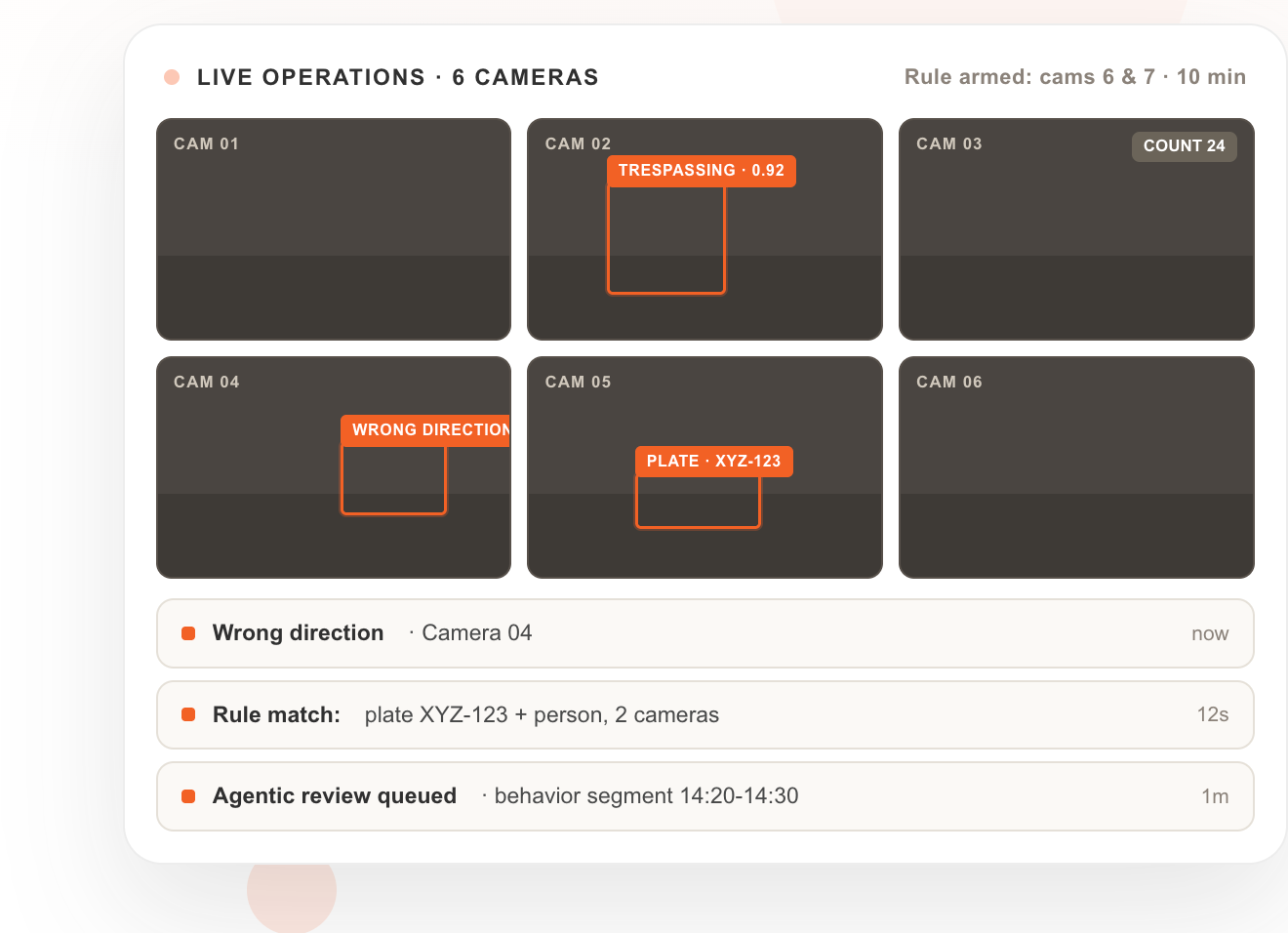
A company called VIDIZMO is advertising the capability to export footage from FlockOS to its own platforms that do facial recognition, behavior prediction, and racial and gender analysis on live camera feeds. VIDIZMO is a several decades-old video analysis and database company that has started offering facial recognition technology to cops within the last six months. In a May email to Johnson City, Tennessee, deputy police chief Michael Adams, a salesperson from VIDIZMO wrote that the company’s product could do facial recognition on both Flock and Axon data in “one searchable platform.”

  • ✇404 Media
  • Surveillance Company Tells Cops It Wants to Add Facial Recognition to Flock Cameras
    As Flock continues to be the center of a nationwide conversation about automatic license plate reading cameras, the company has said that it doesn’t, and won’t, do facial recognition: “We will not add facial recognition to our devices,” Flock CEO Garrett Langley said in a recent video. But other, third-party companies are telling cops that they are willing to add facial recognition to data gathered by Flock cameras in order to “close that gap.” A company called VIDIZMO is advertising the capa
     

Surveillance Company Tells Cops It Wants to Add Facial Recognition to Flock Cameras

29 septembre 2026 à 09:53
Surveillance Company Tells Cops It Wants to Add Facial Recognition to Flock Cameras

As Flock continues to be the center of a nationwide conversation about automatic license plate reading cameras, the company has said that it doesn’t, and won’t, do facial recognition: “We will not add facial recognition to our devices,” Flock CEO Garrett Langley said in a recent video. But other, third-party companies are telling cops that they are willing to add facial recognition to data gathered by Flock cameras in order to “close that gap.” 

A company called VIDIZMO is advertising the capability to export footage from FlockOS to its own platforms that do facial recognition, behavior prediction, and racial and gender analysis on live camera feeds. VIDIZMO is a several decades-old video analysis and database company that has started offering facial recognition technology to cops within the last six months. In a May email to Johnson City, Tennessee, deputy police chief Michael Adams, a salesperson from VIDIZMO wrote that the company’s product could do facial recognition on both Flock and Axon data in “one searchable platform.”

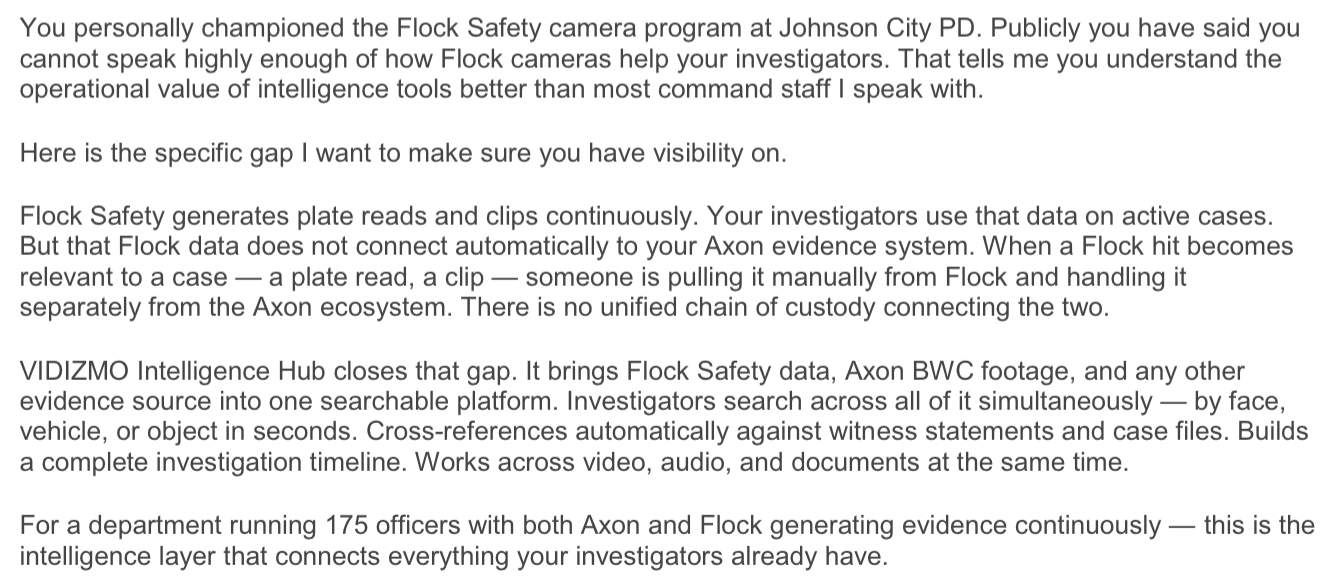
“Flock Safety generates plate reads and clips continuously. Your investigators use that data on active cases. But that Flock data does not connect automatically to your Axon evidence system,” the salesperson wrote. “VIDIZMO Intelligence Hub closes that gap. It brings Flock Safety data, Axon body worn camera footage, and any other evidence source into one searchable platform. Investigators search across all of it simultaneously —  by face, vehicle, or object in seconds.” The email was obtained using a public records request by DeFlock Johnson City and was shared with 404 Media. The Johnson City PD told 404 Media in a statement that it did not take a call with the company.

Surveillance Company Tells Cops It Wants to Add Facial Recognition to Flock Cameras
An excerpt from the email. Full email embedded below

VIDIZMO’s CEO, Nadeem Khan, told 404 Media on a video call that the company has not yet started running facial recognition tech on footage from Flock cameras, and that it has not actually built the specific tool that would export data from Flock’s system to its own platform (though the company advertises this capability online, and the company already sells other facial recognition products). But Khan said VIDIZMO “would love to do the integration,” and that he believes facial recognition “is the way the world is going, the way the world will have to be,” and that he thinks Flock should offer the capability itself in a way that “balances privacy, security, and the freedom that we enjoy in this country.” 

“It is completely in line with what we want to do,” Khan said. “All of these technologies are already implemented [in the real world]. I think Flock is trying to get out of the way rather than trying to implement the technology right [correctly] by saying they will not do recognition. But this is the way the world is going, it is the way the world will have to be, but with the right sort of technologies where privacy and security are balanced.” 

In marketing material and technical documentation available online, VIDIZMO does claim that it can ingest data from Flock’s automatic license plate reader (ALPR) and livestream cameras into several of its own products, which do further AI analysis on the data. “An agency can import plate reads or clips that it has exported under its own authorized access,” Khan said in an email. “Flock has not been involved in or informed of this.” VIDIZMO’s online documentation for customers has extensive information about its facial recognition and AI analysis products, and contains a page about integrating data from FlockOS — Flock’s “real time crime center” product — into AI Live Insight, Nexus, and AI Intelligence Hub, which are three different VIDIZMO products. 

“Detection tells you a person is in frame,” VIDIZMO says. “Face recognition tells you which person. It is the capability that takes a face seen on a live camera and matches it against the people you enrolled in the Object Library, so the moment someone on your watchlist walks past a camera, the system names them, on the video, in the event feed, and in the recording, without an operator having to recognize the face themselves.”

The company’s “AI Live Insight” page also claims that it can detect “situations” such as trespassing, or “behavior” by individual people, “turning raw video into behavioral and situational understanding.” 

“Instant alerts fire from the live pipeline with snapshots attached. A second layer runs your queries over recorded events: a plate and a person together,” VIDIZMO’s website says. “Enrolled people and objects recognized on live feeds, with named alerts and snapshots for review.” 

VIDIZMO already works with several police departments and government agencies, according to its website. The company’s documentation says that police departments need to upload individual faces as “objects” in the software’s library, which can be added to a “watchlist” that automatically triggers tracking and recording when they are detected by a camera. “With faces enrolled and recognition on, the camera starts naming people as they appear,” the documentation says. “The recognized person’s name appears on the bounding box around their face […] if you turned on Create Recording, a clip is captured around each recognition.” The company says that police can set a “Match Threshold,” which is a numerical confidence score about the person’s identity. 

The company also tells cops that it can automatically try to classify faces by “age, gender, and race,” and that cops can search by these categories, which are notoriously inaccurate in facial recognition systems.

Surveillance Company Tells Cops It Wants to Add Facial Recognition to Flock Cameras

“By running face detection, you can search for and identify specific individuals in your media or evidence via attribute filters […] You can identify individuals from seven races: White, Black, Indian, East Asian, Southeast Asian, Middle Eastern, and Latino Hispanic,” VIDIZMO says on its website. The company adds, “Law enforcement agencies can save time analyzing security, CCTV, or dashcam footage. If they have a description of the suspect, such as their supposed age, gender, or race, they can utilize attribute filters to yield effective results.” 

VIDIZMO says that in other contexts, cities or stores can also use its products to quietly do “demographic analysis,” for marketing purposes, by determining which races or ages of people are showing up to specific events or to specific stores: “By analyzing the activity in their store, sellers can determine which group spends the most time and makes the most purchases of their products. Getting insights such as these can aid them in tuning their marketing strategy.”

Surveillance Company Tells Cops It Wants to Add Facial Recognition to Flock Cameras
A VIDIZMO booth at a conference. Image: VIDIZMO

The facial recognition product it offers is “appalling,” according to Chris Gilliard, a privacy expert and author of the upcoming book Luxury Surveillance. 

“I’m appalled at the willingness of VIDIZMO to tout their capabilities to filter along the lines of race, age, and gender. There’s decades of scholarship that show why this is not possible, and even more so not desirable,” he told 404 Media. “Particularly in the case of race and gender, which are not static categories to be determined by a computer.”

The fact that a third-party company is advertising that it wants to do facial recognition on Flock data highlights a common trend in the surveillance space. When one company draws a line in the sand, saying they are unwilling to do a certain type of surveillance, other lesser-known startups try to differentiate themselves by offering that functionality. Because of this recurring phenomenon, it is exceedingly difficult to build and scale a surveillance apparatus and then have companies themselves, in this case Flock, dictate what it can be used for. VIDIZMO’s Khan said, “As a small company who is running without a VC, we have to provide alternatives to the industry. What we are doing is providing that alternative.”

Khan claimed that his technology could also be used to preserve privacy; facial recognition, he said, can be used to redact bystanders faces from footage automatically. He said that cops cannot use the system without a specific case number, that all of their actions in the system are recorded for potential audits, and that VIDIZMO collects no data itself. "Much of the harm your reporting has documented comes from implementation choices, not from the technology itself," Khan said. "Those choices include pooling data into a nationwide network, allowing searches without a case, keeping audit logs no one can meaningfully inspect, and treating an AI match as an answer."

Gilliard said that the fact that facial recognition and other AI analysis can be added to existing surveillance cameras highlights the importance of not building such systems in the first place.

“What Flock says about their capabilities is to some degree irrelevant because they have built the infrastructure for mass surveillance. Their entire existence provides the foundation for other perhaps even more invasive technologies to be built on top of it,” Gilliard said. “Flock itself needs to be understood as part of the surveillance ecosystem that exists in this country. This is why discussions of guardrails for a particular system are inadequate because another company can (and will) come along to assemble another layer of surveillance on what has already been established.”

Flock and Axon did not respond to a request for comment.


  • ✇404 Media
  • These Tech Workers Made ChatGPT Drive a Toyota Corolla
    Some tech workers in San Francisco hooked up ChatGPT to a Toyota Corolla and got it to drive around a parking lot. This may not sound impressive in the age of the self-driving car until you realize that the LLM driving the car was a general purpose chatbot running on a laptop and not the purpose-built driving system based on millions of hours of training data used by Waymo or Tesla.The people behind the stunt call themselves DrivingBench and they’ve posted their code, their prompts, and video
     

These Tech Workers Made ChatGPT Drive a Toyota Corolla

29 septembre 2026 à 09:06
These Tech Workers Made ChatGPT Drive a Toyota Corolla

Some tech workers in San Francisco hooked up ChatGPT to a Toyota Corolla and got it to drive around a parking lot. This may not sound impressive in the age of the self-driving car until you realize that the LLM driving the car was a general purpose chatbot running on a laptop and not the purpose-built driving system based on millions of hours of training data used by Waymo or Tesla.

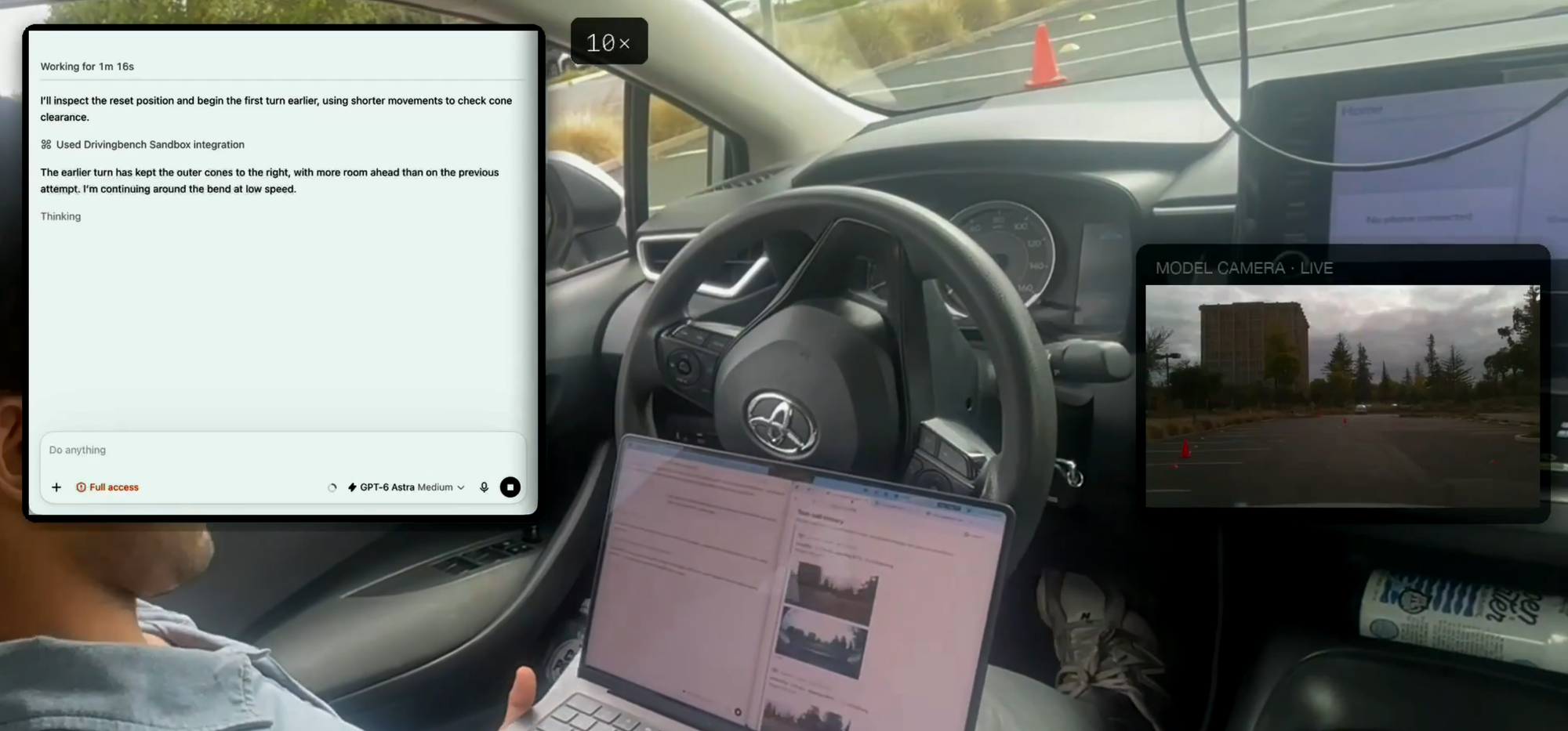
The people behind the stunt call themselves DrivingBench and they’ve posted their code, their prompts, and videos of the experiment online. In the experiment, DrivingBench hooked up GPT-6 Astra, Claude Fable 5.1, Grok 4.6, and GPT-5.6 Sol to a Toyota Corolla and gave the LLMs control over the car’s steering, accelerator, and brakes. Then they set up a small cone course in a public parking lot and prompted the chatbots to navigate the space.

The goal, they said, was to find out if untrained, off-the-shelf frontier AIs can drive a real car. The results were mixed. Grok, Sol, and Fable only drove a few meters and didn’t finish the course. GPT-6 Astra, however, did eventually learn to navigate the course and complete it. But not without a lot of troubleshooting.

DrivingBench is Aditya Ramabadran, Tobias Gessler, and Simon Mahns — three Bay Area tech workers who met at their day job at Axiom Math, an AI math startup. During a call with all three members of DrivingBench, Ramabadran told 404 Media that the idea for hooking up chatbots to a car happened when the three of them were hanging out at an ice cream shop one weekend. 

“This is after we saw a bunch of demos of Astra and models like Fable being able to do a lot of robotic things that LLMs can not do out of the box before, such as do a painting or move objects or even some 3D and Blender demos that showed a level of spatial reasoning we hadn’t seen from LLMs before,” he said. “We just thought: ‘Is there a way we can get LLMs to drive a car now?”

Why driving a car? To prove that it’s possible and, they said, to create a new benchmark for LLMs performing tasks in the real world. “The point wasn't to show that it's practical for you to plug ChatGPT into your car and have it drive you places. It's probably very unlikely that the labs have trained specifically for this or have IRL environments that involve both the models driving a real car,” Ramabadran said. “It would be pretty shocking, I think, for people to see that these models are good enough now that they can actually drive a vehicle in real life, even if it's just on some cone course at low speeds in a parking lot.”

After brainstorming at the ice cream shop, they decided to get a car and sent Gessler to rent a Toyota Corolla. They didn’t tell the rental car company they planned to hook chatbots up to the vehicle and drive it through an obstacle course. The team used Comma — an off-the-shelf system that allows users to install a self-driving system on unsupported cars — to get the car to communicate with a laptop running the LLMs. Comma had two cameras pointed at the road feeding data back to the Chatbot.

“It’s pretty easy to install. The Toyota Corolla is one of the most popular for this Comma kit, that’s why we chose it,” Gessler said. “The good thing about their system is that it’s open source [...] so it’s easy for us to go in and modify it because we need to hook up the car somehow to our LLMs.”

Comma looks like a dashcam.. Users attach it to their windshield and it continually watches the road, recording video, integrating with the car’s electrical systems and sensors, and providing a rudimentary kind of self-driving. The National Highway Traffic and Safety Administration announced an investigation into Comma last week after two car crashes involving the system killed three people.

For DrivingBench, Comma was an easy way to get their car talking to a chabot. “We had one person on the driver's seat with the laptop or a passenger seat prompting the LLM,” Gessler said. “And then the person who drives it has to press a button on the steering wheel to give the car the command to start, and then from there it's basically just monitoring the car and checking that the model doesn't crash into a wall or something.”

“And we have the foot over the brake, just in case,” Mahns cut in.

We gave ChatGPT, Claude, and Grok control of a real Toyota Corolla 🚗, steering/gas/brakes, no human driving (just a foot over the brake).

Only one model was able to complete our entire driving course. Introducing DrivingBench. 🔥⌛️🏁 pic.twitter.com/HhukXrByus

— DrivingBench (@DrivingBench) September 21, 2026

DrivingBench’s prompt is on its website and runs fewer than 600 words. “Your objective is to drive through the course (in a backwards-U-shaped parking lot) and stay between the cones,” the prompt said. “Your finish line is a wide "parking spot" marked by numerous BLUE mini-cones at the very end; finish by parking in this area. You will be evaluated primarily by how far you get in the course (without leaving the boundaries/collisions), but a secondary objective is to complete the course in less time.” The rest of the prompt is made up of specific instructions about the physical limitations of the Corolla and the parking lot.

The problems with the project started before the car had moved an inch. When the LLMs recognized the team had prompted them to drive a car, most refused. “Specifically with Astra, it would refuse to drive the car in a lot of situations and we would have to change our prompt and rename things through hours of iteration to get it to consistently drive the car,” Ramabadran said.

“We tried calling it a simulation, which worked like some percentage of the time, but then other times they would see the images and see, oh, ‘I'm in a real parking lot, these people are just lying to me,’” he said. “We ended up having to call everything a sandbox. And with that prompt, it's able to consistently drive the car and like never refuse to do that.”

Other problems were more pedestrian and led to delays which forced Gessler to extend the rental on the Corolla. Finding a parking lot held them up several times. “We went to high schools, churches, and community centers. We got kicked out a couple of times,” Mahns said. 

The first place to ask them to leave was a church. “Rightfully so. We just commandeered the entire parking lot and they had an event starting. So they were like: ‘Hey, you get permission to do this? And then we're like: ‘We can pack up right now,’” Mahns said.

They also got kicked out of the parking lot of an office building. “We took a corner and then a security guard was like: ‘Hey, you’re taking like one quarter of the parking lot. Do you have permission?’ And then we’re like: ‘Not really.’ So then we’d pack up. We didn’t try to cause any issues,” Mahns said.

“The people that kicked us out were super chill about it,” Ramabadran added.

Coding the software also slowed things down. The first time DrivingBench set out to do this, they vibe coded the bridging software between the LLMs and Comma. “A true and funny story is that we tried to get Astra to one shot some code and then it was pure slop. So we had to restart from a new design,” Mahns said, adding that this pointed to the limits of these frontier models. “It can’t just autonomously do this because it made thousands and thousands of lines of slop.” They said that Astra’s first attempt at writing the software created a 200,000 line repository.

Parking lots were scarce, the software was vibe coded, the chatbots fought the experiment, and only one of them completed the course. But Mahns is still excited about the results. “It's an interesting demonstration of potential emergent capabilities,” he said. “It can fail a turn, and then the next turn, next try, it will be able to do that turn and other turns that it hasn't seen before. Not necessarily saying LLMs are gonna put Waymo out of business or something, just an interesting demonstration of where things are, and things are just moving fast.”

Mahns added that these kinds of experiments are good because LLMs will increasingly affect things in the real world and not just on our screens. “Most people that are familiar with ChatGPT have used it in this white collar, kind of like in the computer, and it's definitely imminent to the point that this capability will start having more impact in the physical world,” he said. “So I think seeing the sparks of this happening, the shift of this utility coming into the physical world, is also somewhat exciting.”

Focusing on latency and testing high consequence tasks were key for Ramabadran. “These models [...] it can take like 20 seconds to think and give a response. And if you imagine, even if you're driving at like 2mph, which is like one meter per second, if you take 10 seconds to think, you've moved like 10 meters. And if you're driving 10 meters blind, that's pretty bad,” he said. “And I think it's cool that we have a benchmark where latency is part of the benchmark.”

❌