Vue normale

Reçu — 8 juillet 2026 Euromaidan Press
  • ✇Euromaidan Press
  • Russia is hitting Ukrainian fuel stations 20 times a week. Ukrainian law tells them exactly where each one is
    Russia has struck or damaged Ukrainian fuel stations at a rapidly accelerating pace since April 2026. According to Radio Liberty, the campaign combines attacks on civilian infrastructure with a propaganda effort aimed at Russian domestic audiences. A fuel market expert warns that Ukrainian licensing law embeds the exact address, ownership, and throughput of every registered station in each license—data that, even from a nominally closed registry, Russia can obtain through l
     

Russia is hitting Ukrainian fuel stations 20 times a week. Ukrainian law tells them exactly where each one is

8 juillet 2026 à 08:15

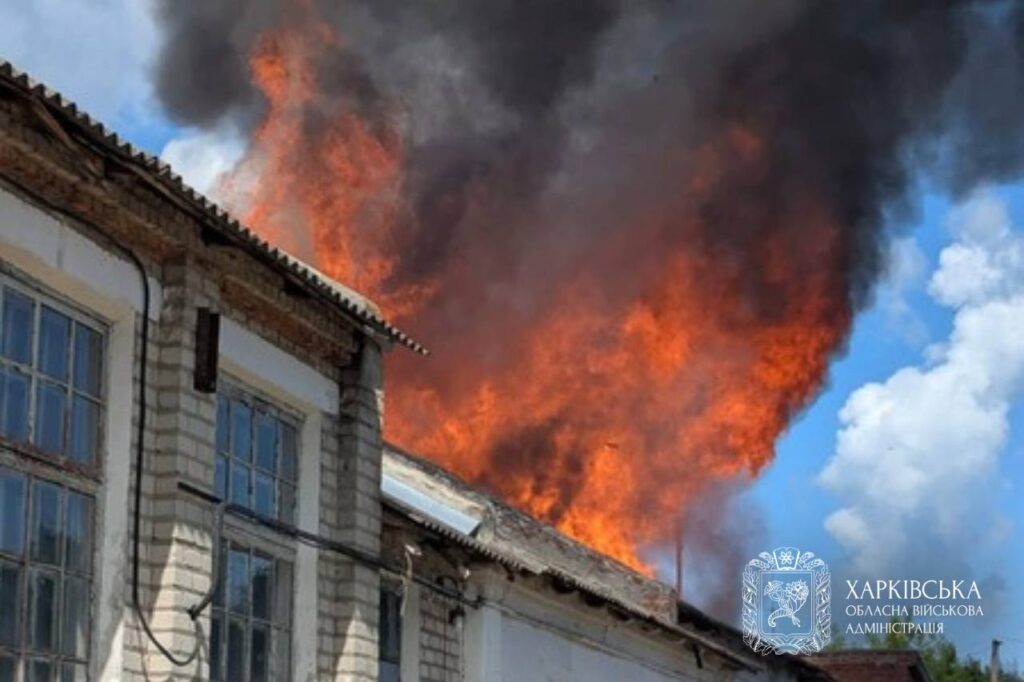
Attacked fuel station in the village of Savyntsi

Russia has struck or damaged Ukrainian fuel stations at a rapidly accelerating pace since April 2026. According to Radio Liberty, the campaign combines attacks on civilian infrastructure with a propaganda effort aimed at Russian domestic audiences. A fuel market expert warns that Ukrainian licensing law embeds the exact address, ownership, and throughput of every registered station in each license—data that, even from a nominally closed registry, Russia can obtain through leaks.

Russia's campaign against Ukrainian civilian infrastructure has evolved across the full-scale war from power grids and heating systems toward any combustible civilian object that produces visible footage—a pattern where the propaganda value of the strike, not its military effect, increasingly drives the targeting logic.

The targeting campaign

Fuel-industry outlet Naftorynok recorded three to four Russian strikes on Ukrainian fuel stations per week through April 2026. The rate climbed to 13 per week by mid-June, then reached 20 per week by early July. Since April, Russia hit or damaged 186 fuel stations—concentrated in frontline oblasts including Kharkiv, Sumy, Donetsk, Dnipropetrovsk, Zaporizhzhia, and Mykolaiv.

The corridor between Dnipro and Kharkiv now has no intact station, Leonid Kosianchuk, former president of the Association of Petroleum Market Operators, told Radio Liberty.

The targeting intelligence problem

Ukraine's licensing law requires each license to state the exact address, ownership, and throughput of the registered facility. The licensee database is nominally closed to public access, but Kosianchuk said he cannot guarantee against data leaks—and called for the register to be sealed for the duration of the war.

"Russians don't even need to strain their intelligence services. "They can clearly understand at which kilometer of which highway a given station is located, who owns it, what volumes it sells" Kosianchuk said.

He is calling for the licensing law to be amended to remove the address requirement from licenses—not just restricting access to the database, but eliminating the data from the license itself.

Why Russia is doing it

The campaign serves two functions, Serhii Bratchuk, spokesman for the Ukrainian Volunteer Army, said. The first is domestic propaganda—producing footage of burning Ukrainian fuel infrastructure to mirror Ukrainian coverage of Russian refinery strikes.

"The pictures of our burning fuel stations are actively being used by the enemy to create the illusion of a fuel collapse in Ukraine," Bratchuk said.

Russia simultaneously circulates fake and outdated footage of queues at Ukrainian stations to trigger panic buying. Mykolaiv Oblast Military Administration Head Vitalii Kim described the targeting logic as producing smoke for television. Ukraine's military, he noted, does not refuel at commercial stations.

The second function is operational. Russia is concentrating strikes in frontline oblasts to complicate fuel access for civilian transport, medical workers, volunteers, and light military vehicles.

"Russia wants to paralyze civilian transport, our medics, volunteers, and complicate refueling of light military vehicles—pickups, buggies, quad bikes that operate along the front line," Bratchuk said.

Consequences and adaptation

Destroying one modern fuel station causes damage of over $1 million, specialists estimate—large national networks can absorb such losses, but regional operators face serious financial risk, Bratchuk noted. On 5 July, Sumy Oblast Military Administration Head Oleh Hryhorov warned residents to avoid fuel stations entirely after Russia signaled further strikes.

The Trostyanets city council in Sumy Oblast launched mobile fuel distribution points on 2 July, announcing vehicles would move locations "to prevent targeting by the aggressor." Zaporizhzhia Oblast has been covering stations with anti-drone nets since June. Mobile fuel distribution currently operates outside Ukrainian law, Kosianchuk noted, and he is calling for two legislative changes: amendments allowing mobile fuel retail, and repeal of the retail fuel tax.

Economy Minister Oleksii Soboliev told parliament on 3 July that there is no fuel deficit for the civilian sector—the market is supplied, and import contracts are being signed on time. The legal framework for distribution, however, has not caught up with the operational reality on the ground.

  • ✇Euromaidan Press
  • Kostiantynivka: Why one city in Donbas matters so much that Putin lies about having captured it
    I want to tell you about a city that used to make glass. Not weapons, not steel — glass. Windows, bottles, mirrors. Kostiantynivka, in Donetsk Oblast, sits on the Kryvyi Torets River, and about 67,000 people lived there before Russia's full-scale invasion. By the spring of 2026, only2,500 remained — mostly elderly people who had decided that dying in their own homes was preferable to leaving them. On the evening of 3 July, Vladimir Putin appeared in military uniform at a co
     

Kostiantynivka: Why one city in Donbas matters so much that Putin lies about having captured it

8 juillet 2026 à 06:12

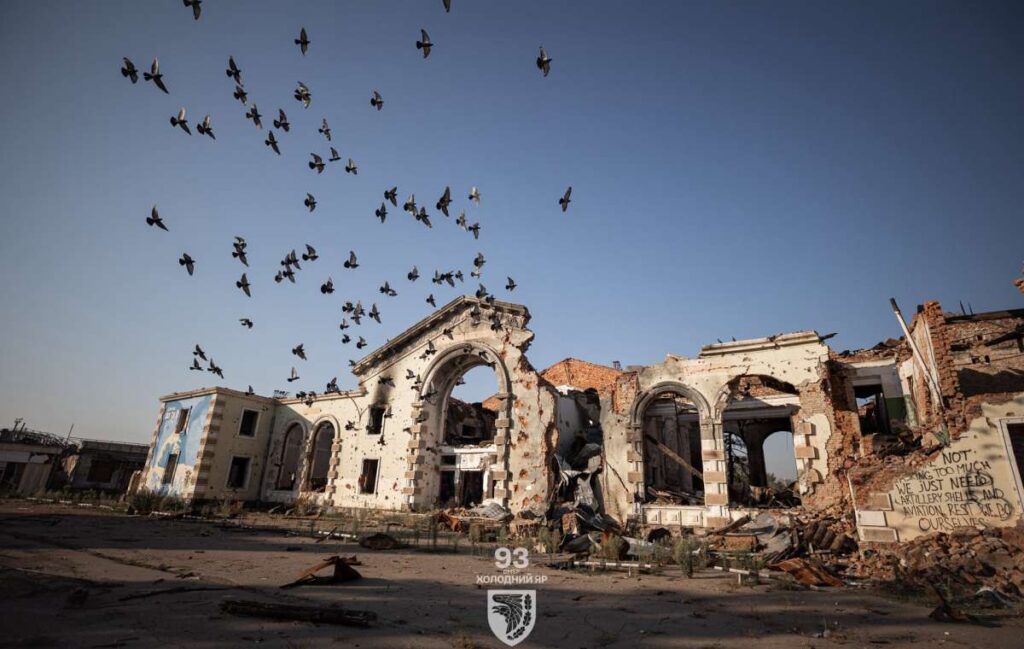
Destroyed Kostiantynivka

I want to tell you about a city that used to make glass.

Not weapons, not steel — glass. Windows, bottles, mirrors. Kostiantynivka, in Donetsk Oblast, sits on the Kryvyi Torets River, and about 67,000 people lived there before Russia's full-scale invasion. By the spring of 2026, only2,500 remained — mostly elderly people who had decided that dying in their own homes was preferable to leaving them.

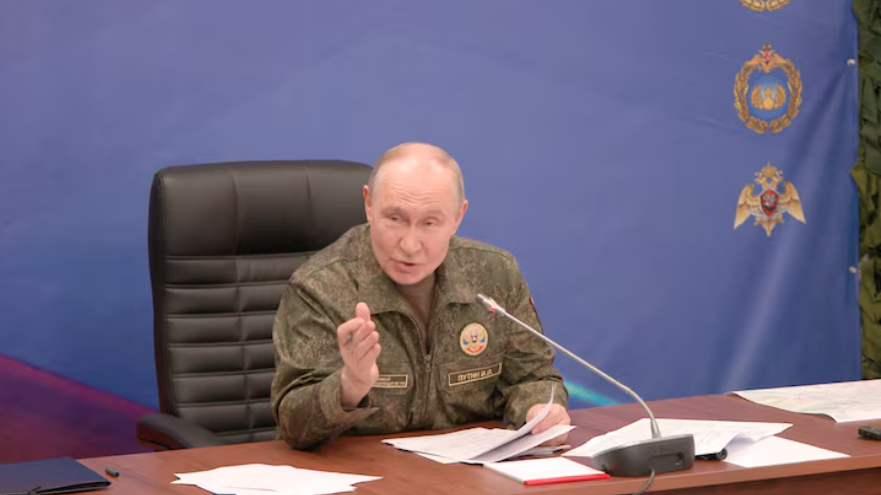
On the evening of 3 July, Vladimir Putin appeared in military uniform at a command post and announced that Russian forces had "completely captured" Kostiantynivka. Flag photos circulated on Russian Telegram channels and the Kremlin called it an important strategic achievement. But there was just one problem — the city had not fallen.

Russian President Vladimir Putin chairs a meeting at a military command post
Russian President Vladimir Putin chairs a meeting at a military command post Screenshot from video

Ukraine's General Staff called the announcement a fabrication, stating that units of the Eastern Grouping were continuing defensive operations inside Kostiantynivka.

“Of course, that is not true. It is just another Russian lie, an attempt to generate some kind of a news story. If Kostiantynivka were under Russian control, then perhaps Putin would have no problem meeting me there to find a diplomatic way to finally end this war.” President Volodymyr Zelenskyy dismissed it on social media.

I spoke with German Chancellor Merz @bundeskanzler. I’m grateful for the support and assistance to our people and our country. Germany is one of the world's leaders in protecting lives, and we deeply value that.

The key priority now is missiles for the Patriot systems – to…

— Volodymyr Zelenskyy / Володимир Зеленський (@ZelenskyyUa) July 4, 2026

DeepState, the Ukrainian OSINT monitoring project, continued to show Russian forces present in parts of the city but not in control of it. 

The Institute for the Study of War went further. It assessed that Putin had likely staged the late-night meeting to shape Western coverage ahead of the US July 4 holiday — a choreographed announcement in a documented series of inflated battlefield claims ISW describes as cognitive warfare. The institute had already flagged several of the Russian flag-raising videos from Kostiantynivka as likely AI-altered. 

The last link in the chain

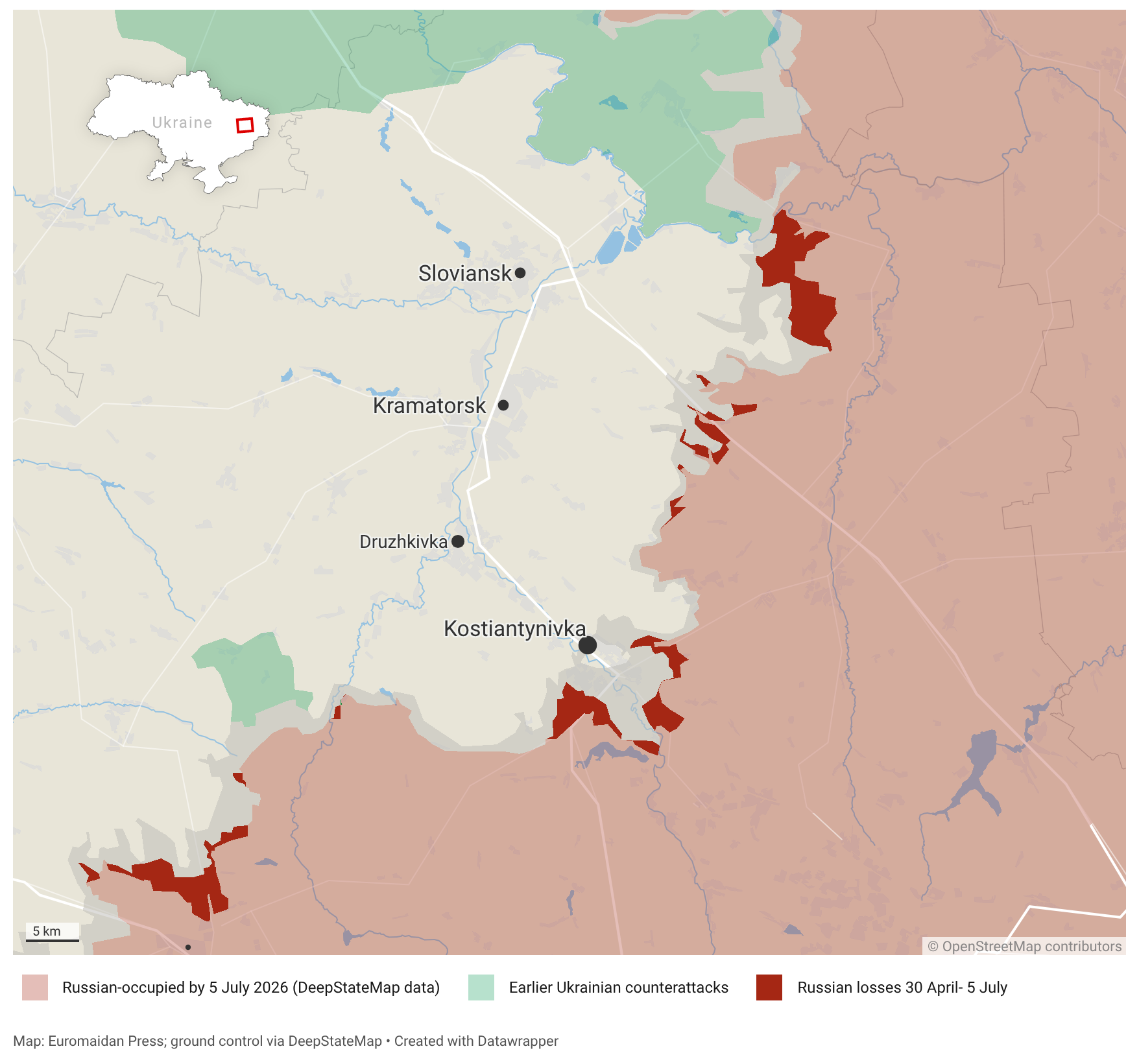
Picture four cities strung along a single road running north through a valley in eastern Donetsk Oblast: Kostiantynivka, then Druzhkivka, then Kramatorsk, then Sloviansk. Analysts call this chain the Fortress Belt — the last fortified line between Russia and control of the whole oblast. 

Fortress Belt of Donbas
Fortress Belt of Donbas. Map: Euromaidan Press

Kostiantynivka is the southernmost link, the gate. Kramatorsk, at the far end, is the nerve center of everything Ukraine still holds in Donetsk: the headquarters, the logistics, the main hospital. Everything flows through that one road.

Putin has stated openly that full control of Donetsk is a central war aim and a precondition for any ceasefire. As of April, his own spokesman put roughly 18% of the oblast still outside Russian hands.

 A false announcement of Kostiantynivka's capture serves that narrative directly — it moves the claim of precondition from aspiration toward apparent fact, in Western news cycles, before the ground truth catches up.

“Inside” is not the same as “captured”

Russian forces first entered Kostiantynivka in October 2025. Through the winter and spring they ground forward block by block, and by June they were pushing in from several directions at once. Ukrainian military sources reported 100–250 Russian troops operating inside the city — not on the outskirts, inside. As of 23 June, Ukrainian soldiers still outnumbered Russian ones within the city limits. 

But inside is not the same as captured. 

ISW's June assessments put Russian forces in control of or infiltrated into roughly 37% of Kostiantynivka — and that single city accounted for 77% of all Russia's June gains across the entire front. What Russia has achieved, at enormous cost, is to turn the city into a continuous gray zone where neither side holds clean ground. 

What Russia has achieved, at enormous cost, is to turn the city into a continuous gray zone where neither side holds clean ground. The advances are real — and not liberation.

Destroyed Kostiantynivka
Destroyed Kostiantynivka. Photo: the Ministry of Internal Affairs of Ukraine

The city sits inside what reporters described as a kill zone ruled by drones. The road north is so exposed that the wounded and the dead are carried out on foot — evacuation vehicles cannot use it. 

According to ISW, Russian forces seized or infiltrated just over 30 square kilometers across the entire front in June 2026 — compared to roughly 481 square kilometers in June 2025. Russia's rate of advance has fallen to one-sixteenth of last year's pace, at nineteen times the casualties per kilometer. 

Once Ukrainian counterattacks are subtracted, Russia ended June with a net territorial loss.

Why drones are not enough 

In 2026, Ukraine's long-range drones have hit oil refineries on the outskirts of Moscow and choked Crimea's supply lines with mounting intensity. Those are real achievements, and they have bought Ukraine military, political, and symbolic momentum.

But Kostiantynivka is where that advantage runs out. Russia's method here is to funnel very small infantry groups — the ones who survive the approach — into the city, moving under summer foliage and through basements and rubble.


This tactic could be very useful because in an open field, a drone sees everything, but in a ruined city, the equation is older and grimmer: infantry, cellars, building by building.

The drone that dominates the steppe is far less decisive in a stairwell.

Pokrovsk was the rehearsal

The world has seen this method before, in Pokrovsk, the city to the west of Kostiantynivka that Russia spent months taking in early 2026 — no lightning assault, just small groups seeping in, logistics strangled, and eventually a choice between mounting losses and withdrawal. 

But Pokrovsk also showed the ceiling. After Russia took it, it could not convert the capture into a breakthrough. Russian forces sit in the ruins eyeing tens of kilometers of mined, fortified, drone-patrolled terrain stretching between them and the next major objective. 

The people who stayed

For months, reporting from inside the city documented how it dies without surrendering: the elderly carried down darkened stairwells, water hauled up by hand because the utilities are gone, evacuees who know they will not come back. 

Vladyslav Samusenko, who runs a small evacuation group, walked eight kilometers into the city to carry out an elderly couple — a woman and a paralyzed man. "There are many bodies there, in the backyards and on the streets," he told DW. "You can smell them when you walk past a house." 

Those who remain live, in the words of a 28th Brigade spokesman, "in basements, burn wood, and scavenge garbage, like in the Middle Ages." 

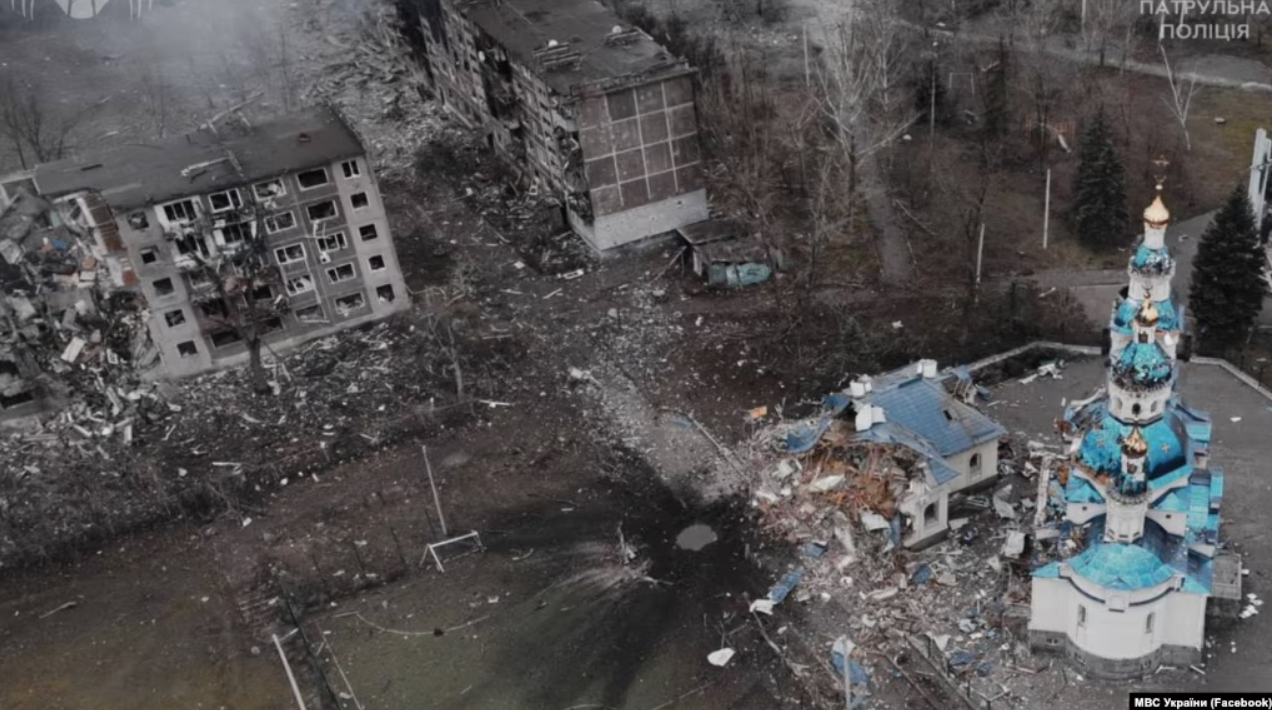
Destroyed Kostiantynivka
Destroyed Kostiantynivka. Photo: 24th Separate Mechanized Brigade

The negotiating table, not the battlefield

Watch what Russia did in the 72 hours after it declared Kostiantynivka taken. It proposed a six-hour ceasefire on 6 July, framed as humanitarian — an offer to hand over the bodies of fallen Ukrainian soldiers. The assault continued throughout: Russia's own pattern of using ceasefires as operational cover, documented across 26 violations between 2014 and 2020. 

When Zelenskyy challenged Putin to meet him in Kostiantynivka if it was truly under Russian control, Kremlin spokesman Dmitry Peskov replied that Kostiantynivka was "already a part of Russia" and that Moscow's standing invitation for Zelenskyy to come to the Russian capital remained open. 

If Kostiantynivka were under Russian control, Putin would have no problem meeting me there.

Volodymyr Zelenskyy

Zelenskyy's answer was not only a denial. In one sentence, he turned the lie into a verification test — and Moscow, which insists any summit be held in the Russian capital, failed. 

Every day the city holds, the precondition Putin needs goes unmet — which is why, when Kostiantynivka would not fall, he announced that it had.

The fight for it now runs on two fronts: the streets where a few thousand people are still trying to survive alongside Ukrainian soldiers trying to hold on, and the coverage in Western capitals where pressure to end this war is being measured out.

❌