Vue normale

  • ✇404 Media
  • How the Hell Did an Island Suddenly Appear, Then Vanish?

    An island that appeared to suddenly materialize, then vanish, on Williston Lake in British Columbia over the summer was rediscovered on the massive reservoir on Monday. Once you’ve taken that all in, let’s ask the important question: How the heck did that happen? The existence of the disappearing island—a floating mass of trees and vegetation that measures about 230 feet by 460 feet—sparked international attention last month after Rocky Avery, a local resident, posted a viral video of it that
     

How the Hell Did an Island Suddenly Appear, Then Vanish?

2 septembre 2026 à 14:43
How the Hell Did an Island Suddenly Appear, Then Vanish?

An island that appeared to suddenly materialize, then vanish, on Williston Lake in British Columbia over the summer was rediscovered on the massive reservoir on Monday. 

Once you’ve taken that all in, let’s ask the important question: How the heck did that happen? 

The existence of the disappearing island—a floating mass of trees and vegetation that measures about 230 feet by 460 feet—sparked international attention last month after Rocky Avery, a local resident, posted a viral video of it that was sent to him by one of his boater friends, according to CBC News.

Bob Gammer, a spokesperson for BC Hydro, was initially suspicious that the video might be AI, but confirmed it was authentic after spotting the island drifting about 60 miles west of the W.A.C. Bennett Dam in satellite images taken on July 21. In satellite images from August 5th and circulated last week, it was no longer visible, sparking a search over the past few days that led to its rediscovery about 20 miles northwest of where it had previously been spotted.

“We had some earlier satellite imagery that confirmed that this wasn't just a hoax or some kind of AI thing, and that it really was real,” Gammer told 404 Media in a call. “Since then we've had more photos from people on their boats on the water sailing right up to this island, and additional satellite imagery that puts it all together to say that this is a real thing. It’s a sizable island.”

How the Hell Did an Island Suddenly Appear, Then Vanish?
Satellite images provided by BC Hydro to CBC. Image: BC Hydro

As it turns out, this isn’t a new phenomenon—though Gammer said it hasn’t been reported on Williston Lake before. Floating islands form on shorelines over many years, as natural rafts made of driftwood can allow plants and trees to grow above the water. These platforms can then detach in certain conditions, such as stormy weather or flooded shores, allowing them to meander into the water. 

Williston Lake is a reservoir created by the massive W.A.C. Bennett Dam, which stands more than 600 feet high. Due to high snowpack and precipitation, the dam was opened in June and July, filling the reservoir for the first time in 14 years, according to Gammer. These high water levels, in addition to strong winds, likely dislodged the island, allowing it to float freely in the water.

“This is all brand new to us,” Gammer said. “We've never seen anything like this on the reservoir.”

BC Hydro is urging boaters to keep their distance and not to step on the island. Despite its size, the forested mass is structurally flimsy and hazardous to walk on. Other than birds, no animals have been spotted on the island. However, animals have accidentally been swept away on these natural rafts; indeed, many species have crossed oceans and reached new continents this way.

The island doesn’t pose any risk to the dam or vessels, and its journey around the lake is now being monitored by BC Hydro through satellite images and eyewitness reports. This waterborne woodland may disintegrate over time, or become reattached to the shoreline. If it survives until winter, it could be frozen into the ice and perhaps thaw out again in spring.

“It's a break from everyday reality, and so it's really captured a lot of attention,” Gammer said. “There's a lot of media interest, and it's been great to be able to tell the story. And who knows how long this will last? I mean, in terms of its news value, I'm sure it'll disappear within a few days. But the island will be there for a while. We'll be monitoring it, and if there's anything exciting about it, we may be able to tell that story too.”


  • ✇404 Media
  • A16z Says You Actually Love Social Media, Enshittification Isn’t Real
    Yesterday a16z published an article in which NYU Professor of Design, AI and Media Theory Ruby Thelot argued that “enshittification,” or the concept that technology platforms get worse after they lock in users, isn’t real. In reality, Thelot says, people use social media more than ever and report that they are satisfied with it. Thelot argues that, enshittification, a term coined by Cory Doctrow which has become one of the stickiest ideas of our era to explain the current state of technology
     

A16z Says You Actually Love Social Media, Enshittification Isn’t Real

2 septembre 2026 à 12:04
A16z Says You Actually Love Social Media, Enshittification Isn’t Real

Yesterday a16z published an article in which NYU Professor of Design, AI and Media Theory Ruby Thelot argued that “enshittification,” or the concept that technology platforms get worse after they lock in users, isn’t real. In reality, Thelot says, people use social media more than ever and report that they are satisfied with it. 

Thelot argues that, enshittification, a term coined by Cory Doctrow which has become one of the stickiest ideas of our era to explain the current state of technology and capitalism, is a misdiagnosis of what he describes as “platform narcissism.” The idea is that people, namely older people like Doctrow and western geratric millennials who used to get a lot of value out of Facebook, selfishly think platforms should continue to cater to their needs even though they aged out of them and should be focused on raising their kids. The platforms are actually popular and well liked, but by younger people who are using Instagram and deriving value from it in a way older people can’t understand, or by people in other countries and contexts than their own. Additionally, Thelot argues, the theory of enshittification allows users who should log off an excuse to stay on platforms that it is fashionable to hate. They spend time there, but say they hate it and can’t leave because they are trapped. 

“Perhaps the reason why the platform seems worse is because your life has changed,” Thelot says. “Over the same period of time, your goals have changed, and they no longer fit with the platform’s new features. Why the hell would a fifty-five year-old be watching Reels? Go take care of your kids.”

The indisputable fact of Thelot’s argument is that various social media platforms have more users and are more profitable than ever. This data is readily available from reliable market surveys, polls, and quarterly earning reports from the companies themselves. It’s important to note that companies like Meta have a history of juking the numbers, and that despite this it recently reported its first ever decline of 20 million users, but Thelot’s point stands: Instagram, Facebook, and TikTok are massively popular. 

I will also cosign Thelot’s advice that people should log off. There are many reasons why some people can’t, present company included, but it’s never not good advice and even if you have to be on social media you can probably reduce your time scrolling. 

Thelot’s argument falls apart when he tries to prove people are actually satisfied with their time on these platforms. To prove this, he points to research from American Customer Satisfaction Index, a private company which surveys customers’ satisfaction with various products and services. In its ACSI Entertainment Study 2026 it surveyed 30,886 customers and found that overall satisfaction with social media rose by 1 percent to a score of 75 out of 100. If satisfaction with social media is rising instead of falling and doesn’t have a terrible score, it’s doing the opposite of enshittifying and people don’t actually hate it, he argues.

Kudos to Thelot for finding data that appears to contradict the human civilization-wide backlash to social media and nearly the only political issue that a deeply divided country can agree on, but this is cherry picking. 

Here are the type things customers are asked to evaluate with a score of 0-100 in the survey this rising satisfaction score for social media: “Quality of mobile app, reliability of mobile app (minimal down time, crashes, lags), loading speed and reliability, ease of navigation, ease of using the site on different devices, speed and reliability of video clips, variety of services and information, freshness of content, relevance of content, ability to use site without disruption, personal relevance of ads seen.”

Customers scored all these aspects of social media highly (between 68 and 84), and I agree with their evaluation. Instagram loads really fast. I can scroll videos on TikTok very quickly. I watched one YouTube Short about Warhammer 40,000 lore, and then was served more than a dozen other YouTube Shorts about Warhammer 40,000 lore that were both fresh and relevant. I do not contest any of this and I don’t think that is why both my friends in the DSA and my Trump supporting family members agree that Instagram is bad. 

If we wanted to find out why Americans have negative feelings about social media or why we think these platforms are enshittifying, we might ask questions like: Does using Instagram make you feel good? Do you think children younger than 13 should have unlimited access to TikTok? Has Facebook been a net positive for your family?

Let’s look at some other data. A recent survey from The Searchlight institute found that voters “overwhelmingly believe social media has a negative impact on society.” Last year, anEmerson College poll found that Americans have low confidence in information they get from social media and that social media platforms are most responsible for the creation of “fake news.” In 2021, the Cato Institute found that 75 percent of Americans don’t trust social media to make fair content moderation decisions. In August, a Reuters/Ipsos poll found that three in five Americans support stronger oversight of social media companies. 35 percent said social media stressed them out. 52 percent said they spend too much time on social media. A Pew poll in July found that 6 in 10 Americans supported a social media ban for kids under 16. 

These opinions, especially as they relate to the impact social media has on younger people, has nothing to do with how fast videos load on Instagram or how effective the ads are. The apps function well technically and the ads are making money, this is self-evident and the reason we have a problem. The reason people feel like social media is enshittifying is that these companies promised to connect people across the world but in reality have chased engagement, catering to basest the human urges to hold our attention. Kids especially feel socially pressured to use these apps because that’s what every other kid is doing and where they feel their community is. It is such a clearly awful and obvious result of the way these apps have enshittified that in August Meta agreed to pay $17 billion dollars in penalties and finally curb the most dangerous aspects of its platforms over claims it endangered children. 

People need to be on Linkedin to find jobs. Municipalities and news organizations share important updates on social media first. You might be pulled onto Facebook or WhatsApp against your will because your local school or community of parents congregate there. That doesn’t mean they like it. It is possible to hate something with your entire being and still participate in it.

There are Warhammer and cute cat videos, but every scroll is a spin of a slot machine that cycles between hate, fear, jealousy, disgust, and horniness. We all see it and no amount of pro big tech propaganda, funded by the same firm that invested in these companies is going to convince anyone otherwise. 

  • ✇404 Media
  • Texas Police Used AI to Write Report About Using Flock to Search for Woman Who Had Abortion
    The Texas sheriff’s office that used Flock to search more than 80,000 cameras nationwide for a woman who had a self-administered abortion used Axon’s Draft One AI tool to help write a police report about the incident, documents shared with 404 Media show. The tool was used in part to summarize a discussion of “the legal implications of the situation.”404 Media first reported on the incident in May 2025 in which the Johnson County Sheriff’s Office in Texas searched Flock’s nationwide network for
     

Texas Police Used AI to Write Report About Using Flock to Search for Woman Who Had Abortion

2 septembre 2026 à 11:57
Texas Police Used AI to Write Report About Using Flock to Search for Woman Who Had Abortion

The Texas sheriff’s office that used Flock to search more than 80,000 cameras nationwide for a woman who had a self-administered abortion used Axon’s Draft One AI tool to help write a police report about the incident, documents shared with 404 Media show. The tool was used in part to summarize a discussion of “the legal implications of the situation.”

404 Media first reported on the incident in May 2025 in which the Johnson County Sheriff’s Office in Texas searched Flock’s nationwide network for the whereabouts of a woman who self-administered an abortion, highlighting the threat of this AI-powered surveillance system being used to criminalize or track women seeking reproductive healthcare. The use of both Flock and Axon’s Draft One, which uses audio from body camera footage to automatically draft police reports using artificial intelligence, shows how quickly police departments have come to use AI surveillance tools even in critically sensitive cases. 

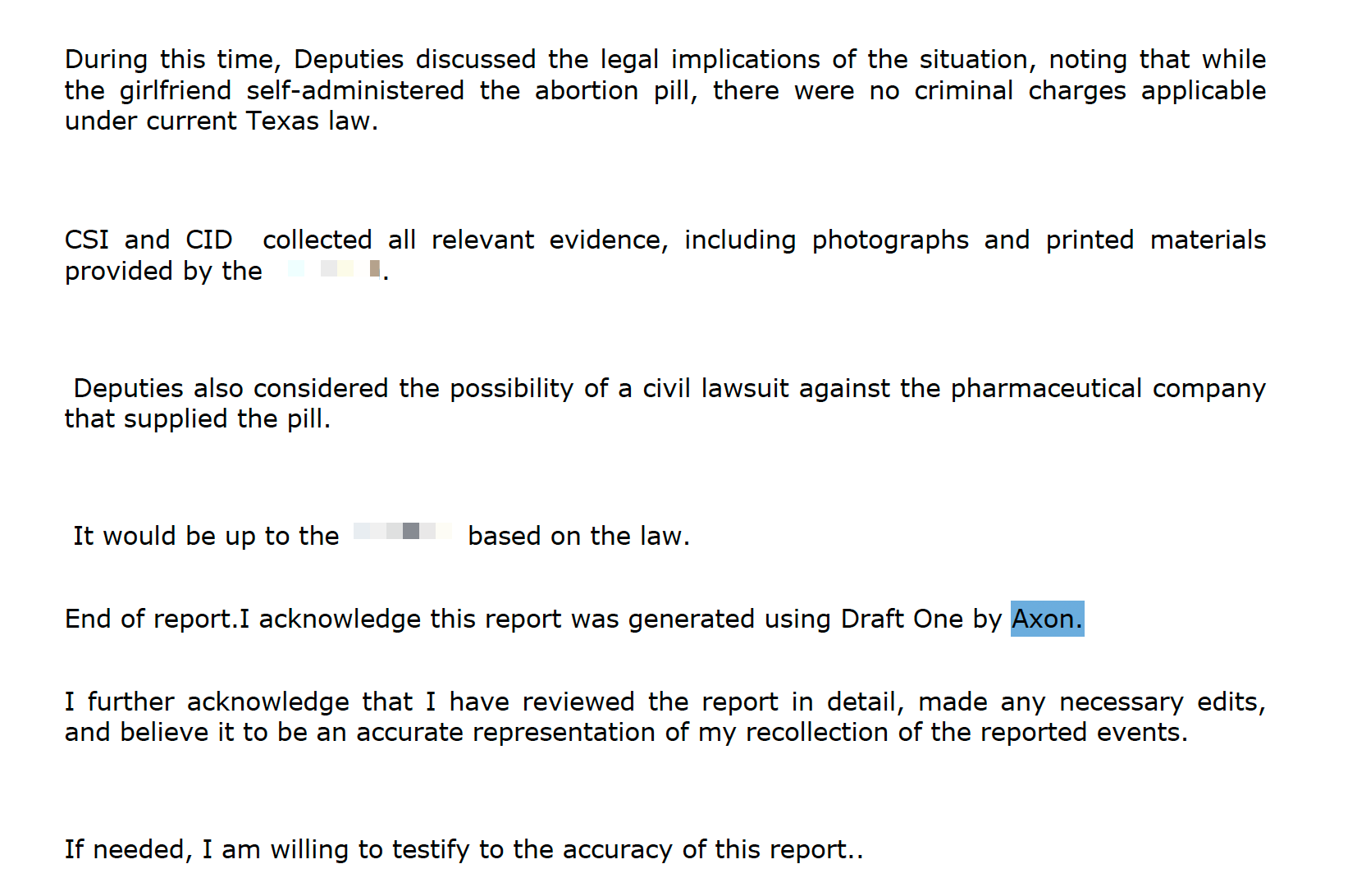
“I acknowledge this report was generated using Draft One by Axon,” a section of the report reads.

Texas Police Used AI to Write Report About Using Flock to Search for Woman Who Had Abortion
Redactions by 404 Media, who is not naming the woman.

The abortion case has since become a flashpoint in the controversy over the use of Flock automated license plate reader (ALPR) cameras. Flock’s CEO, Garrett Langley, has repeatedly and erroneously suggested that 404 Media misreported the case and that the search was done only for the woman’s safety because her family was worried about her. 404 Media previously reported that the entire police investigation was done at the behest of the woman’s abusive partner and that police discussed whether they were allowed to charge her with a crime: “It was discussed at the time with the District Attorney’s office and learned the State could not statutorily charge [the woman] for taking the pill to cause the abortion,” a police report previously obtained by the Electronic Frontier Foundation and shared with 404 Media said. Concern from her family is never mentioned in that earlier police report or in the AI-generated police report used to write this article. 

The AI-generated incident report was obtained by journalist Cameron Probert of the Tri-City Herald and shared with 404 Media. The report shows there is extensive body camera and audio evidence that would clarify what happened in the case, and that at least one police officer, sergeant Damien Bethel, used Draft One to write his report on the incident. Parts of a police incident report show that Draft One was used to summarize a discussion between police over “the legal implications of the situation” and other investigative aspects of the case. The Johnson County Sheriff’s Department has repeatedly refused to release body camera footage from the case, including in response to 404 Media’s public records requests.

“Deputies discussed the legal implications of the situation, noting that while the girlfriend self-administered the abortion pill, there were no criminal charges applicable under current Texas law,” Bethel’s report states, providing no more details about the specifics of the discussion. “Deputies also considered the possibility of a civil lawsuit against the pharmaceutical company that supplied the pill.”

Bethell’s Draft One report further states, “There is digital multi-media evidence from Body Worn Camera footage of this call for service in the AXON Evidence Library. There is digital multi-media evidence of In-Car Camera footage of this call for service in the AXON Evidence Library or the WatchGuard Evidence Library. There were digital images captured while on the scene.” The Johnson County Sheriff’s Department has thus far refused to release even redacted versions of this evidence that the EFF and 404 Media have separately requested.

Leaked audio of Langley obtained by 404 Media, recorded by Signal Akron, shows that as recently as earlier this month, Langley was still lying about the specifics of the case to law enforcement customers of Flock. “She was in an abusive relationship and the family was concerned that she was in danger. They were trying to find her because they were worried her life was at risk,” he said. There is no mention of the woman’s family being concerned about her in any of the police reports; the only person who expresses concern about her in the police narratives is her abusive partner, who told police that the abortion happened weeks prior to their investigation. So-called “welfare checks” have repeatedly been used by abusers to harass women who have gotten abortions and, in Wisconsin, a police officer allegedly illegally used Flock to see if his ex-girlfriend had gone to an abortion clinic.

Another section of the report detailing the Flock searches shows that the officer who did the Flock searches never went to the woman’s house, and looked her up in a credit card header database system called TLO to find her addresses and vehicle information. His section of the report describes his searches as being for her safety because he worried that the man who reported her (her abusive partner) could have hurt her. He does not mention doing the search at the behest of her family. 

“I began to believe the victim may have been hurt by the RP [reporting person] due to the call and it not making sense. I wanted to use resources available to help find where the victim and her children could be to make sure they were okay,” the officer wrote. “I entered the vehicle into FLOCK to see if we could see where the victim and her children might be at due to multiple different locations being given for the victim and her children. Deputies had attempted to try and contact the female, but were unsuccessful. The FLOCK hit showed the victim had been in Dallas prior but nothing recent. The reason for the FLOCK search was to find out what city the victim and her children might be in and give us an idea of where to look for them, due to the large area of where the victim and her children cold [sic] be at.” 

When contacted for comment, the Johnson County Sheriff’s Office would not provide more details about the case or the use of Draft One to write portions of the police report to 404 Media. Keven George of the sheriff’s office said, “Draft One works by uploading and transcribing body‑camera audio once an incident concludes. Within about five minutes, a preliminary narrative based on that transcript is generated. Officers remain fully in control of the final report: they review and edit the draft, fill in missing details, and approve it before submission. Safeguards, such as placeholder ‘insert’ prompts, help ensure accuracy and prevent the system from guessing details it cannot verify.” He added, “the Deputy has to digitally sign before the narrative can be used.”

Paris Lewbel, public relations manager at Flock, told 404 Media “As Garrett said, the case report from Johnson County details that authorities explicitly stated she could NOT be charged with a crime.”

Forbes recently reported Axon’s AI tools sometimes introduce errors that officers then need to spend time removing. 

  • ✇404 Media
  • The Republican Nominee for New York Governor Made a Creepy, AI-Generated Video of Mamdani and Hochul
    Bruce Blakeman, the Republican nominee for New York governor, posted an AI-generated video imagining New York City Mayor Zohran Mamdani and Governor Kathy Hochul hanging out, bizarrely gardening together, riding bikes, and vaguely colluding about making the state unaffordable.".@KathyHochul and @ZohranKMamdani think they can cure New York’s cost-of-living crisis with excuses, empty promises, and 'delusion pills.' The real side effects of their policies aren't a joke: 48 utility rate hikes, hi
     

The Republican Nominee for New York Governor Made a Creepy, AI-Generated Video of Mamdani and Hochul

2 septembre 2026 à 11:09
The Republican Nominee for New York Governor Made a Creepy, AI-Generated Video of Mamdani and Hochul

Bruce Blakeman, the Republican nominee for New York governor, posted an AI-generated video imagining New York City Mayor Zohran Mamdani and Governor Kathy Hochul hanging out, bizarrely gardening together, riding bikes, and vaguely colluding about making the state unaffordable.

".@KathyHochul and @ZohranKMamdani think they can cure New York’s cost-of-living crisis with excuses, empty promises, and 'delusion pills.' The real side effects of their policies aren't a joke: 48 utility rate hikes, higher taxes, uncontrollable government spending, and businesses fleeing our state every single day," Blakeman wrote in the post on Tuesday. "I have a different plan for New York. As Governor, I will deliver zero state income tax on your first $50,000, $100,000 for joint filers, cut your utility bills in half, and end the government waste." 

ABC News10 reported that the New York State Democratic Party filed a complaint asking the Board of Elections to investigate Blakeman's use of AI in political communication materials, claiming that he's violating the state's election law that requires "materially deceptive" content to be labeled as AI-generated. 

x.com

The law states: "A person, firm, association, corporation, campaign, committee, or organization that distributes or publishes any political communication that was produced by or includes materially deceptive media and has actual knowledge that it is materially deceptive shall be required to disclose this use." The law requires a disclosure displayed directly on the media in an easily readable font saying, "This (image, video, or audio) has been manipulated."

The law carves out exceptions for "satire or parody." Blakeman seems to be invoking that clause, and told News10 that he thinks people like it. “People find it humorous. They like satire,” he said. “We’ve been using humor and satire in politics since the inception of our nation 250 years ago.”

In January, Hochul said she'd move to ban AI generated depictions of candidates in political ads within 90 days of an election. In 2025, disgraced New York governor and then-mayoral candidate Andrew Cuomo's official campaign account posted an AI-generated video that showed a barrage of racist, Islamophobic stereotypes, including of his then-opponent for mayor, Mamdani. That video was labeled as AI. 

About Blakeman's AI video, Hochul’s campaign told News 10 in a statement: “While Blakeman’s resorted to straight up lying to New Yorkers, Team Hochul doesn’t need AI ads to tell them about him jacking up property taxes on Long Islanders more than once, letting violent crime hit decade highs on his watch, or running an armed MAGA militia that undercuts local cops – he did all that in real life.”

If elected, Blakeman says he'll end New York's status as a sanctuary state and increase the state's collaboration with Immigration and Customs Enforcement. In 2024, as Nassau County Executive, Blakeman signed a bill, which he wrote, into law that banned transgender athletes from playing in women and girls' sports at county-owned athletic facilities. In 2025, courts halted that law in response to the New York Civil Liberties Union's legal challenge calling it a violation of antidiscrimination laws. 

  • ✇404 Media
  • Cops Are Asking Axon to Make Their Cameras Look Different From Flock So People Don't Destroy Them
    Axon says cops are asking it to make its automatic license plate readers (ALPRs) look different from Flock cameras because Flock vandalism has become so widespread, according to comments Axon’s CEO made in a now deleted webinar.The comments highlight how Axon is trying to take advantage of sustained opposition against Flock's license plate cameras, with one law enforcement customer suggesting a camera redesign would “help with the optics while we batten down the hatches” as the backlash sprea
     

Cops Are Asking Axon to Make Their Cameras Look Different From Flock So People Don't Destroy Them

2 septembre 2026 à 10:02
Cops Are Asking Axon to Make Their Cameras Look Different From Flock So People Don't Destroy Them

Axon says cops are asking it to make its automatic license plate readers (ALPRs) look different from Flock cameras because Flock vandalism has become so widespread, according to comments Axon’s CEO made in a now deleted webinar.

The comments highlight how Axon is trying to take advantage of sustained opposition against Flock's license plate cameras, with one law enforcement customer suggesting a camera redesign would “help with the optics while we batten down the hatches” as the backlash spreads.

💡
Do you work at Axon or Flock? I would love to hear from you. Using a non-work device, you can message me securely on Signal at joseph.404 or send me an email at joseph@404media.co.

As 404 Media has reported, some towns and cities are switching from Flock to Axon’s cameras after cops did lookups for ICE in Flock, tracked a woman who self-administered an abortion, and have repeatedly abused their access to stalk ex-spouses. ALPRs constantly scan the license plate, brand, model, and other identifying features of all vehicles that drive past the camera and then make this timestamped log of activity searchable by law enforcement without a warrant.

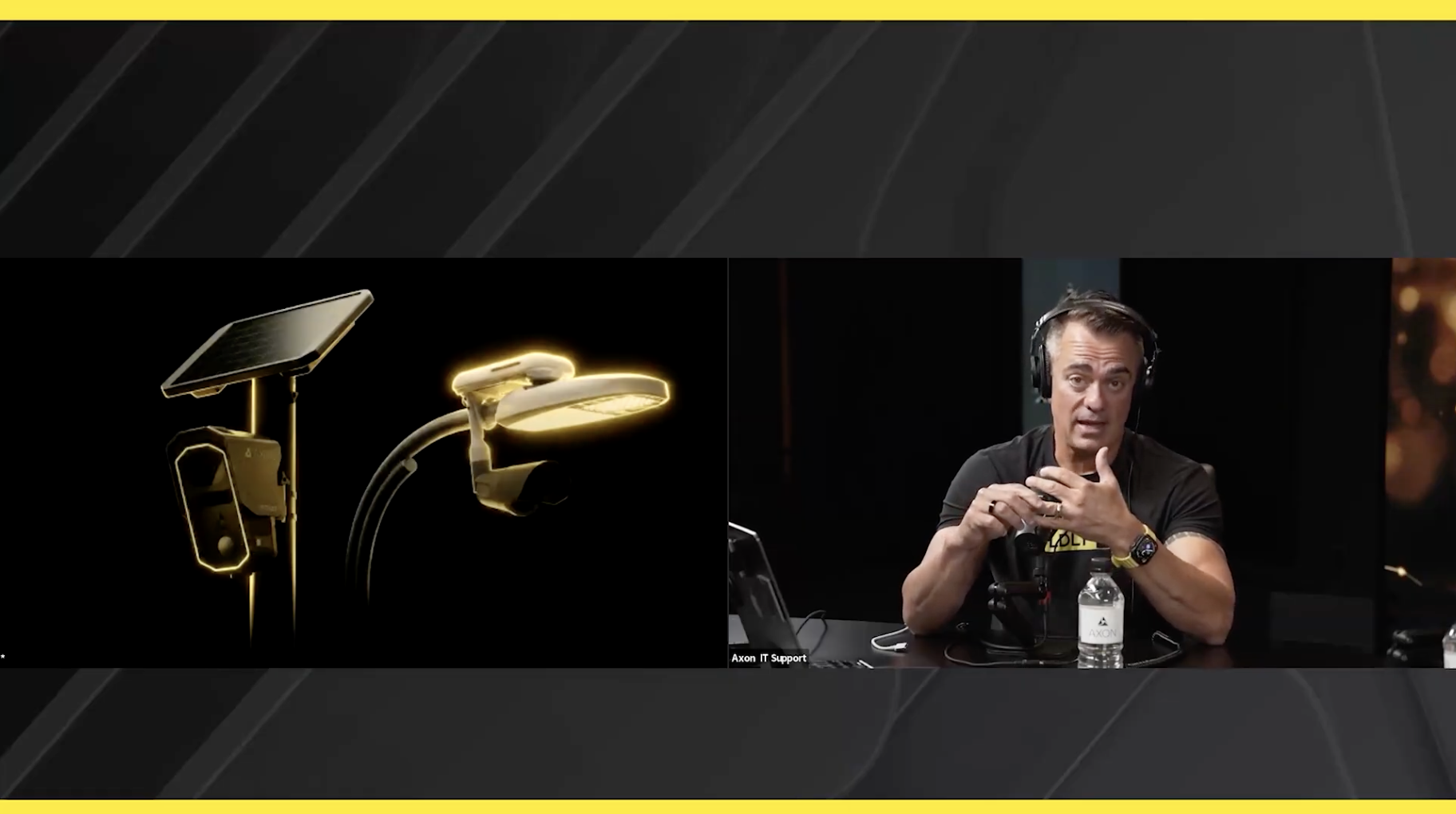
In an August 26 webinar that was hosted on Axon’s official Vimeo page called “From backlash to trust,” Axon Chief Customer Officer Mike Wagers took a question from the remote audience and asked, “is there any talk — and there has been talk — to redesign Outpost, our fixed ALPR camera, to not look exactly like a Flock camera?”

“We are looking at [...] do we change the general shape,” Rick Smith, Axon’s CEO, replied.

At another point in the webinar, Smith brought up Axon’s Lightpost product, which is an ALPR and AI-powered camera that attaches to an existing streetlight. “Frankly, we’ve had a lot of customers saying, hey, we’d like something that looks different because there is all this blowback. ​​It's harder to vandalize because it's up higher,” he said.

Smith also said, “We’ve had some people say they’d like to see us make just a different camera, because our ALPR camera looks like an ALPR camera.” Another idea Smith brought up, pending customer feedback, is to go in the other direction and make ALPRs more explicit, with signs showing where they are located and a description of the city’s ALPR policies. 

MegaraMedia, a YouTuber, downloaded a copy of the webinar before it was removed and shared it with 404 Media.

Cops Are Asking Axon to Make Their Cameras Look Different From Flock So People Don't Destroy Them
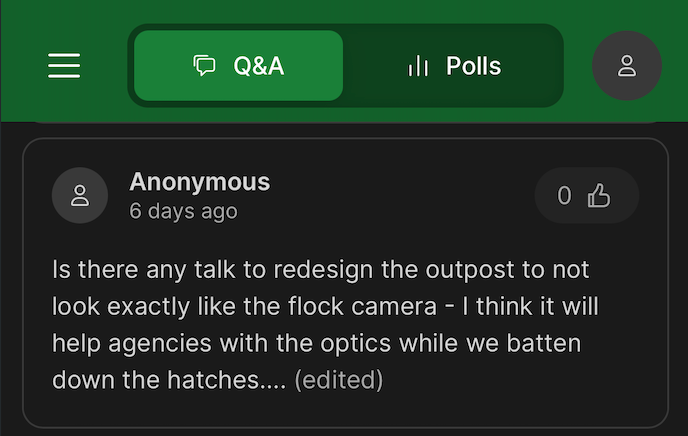
A screenshot of one of the questions during the webinar.

During the webinar, Axon asked its law enforcement customers to chime in with questions and answer a customer survey. 404 Media scanned the QR code displayed during the webinar to view those questions. One, which appears to be the one Wagers paraphrased, read, “Is there any talk to redesign the Outpost to not look exactly like the Flock camera — I think it will help agencies with the optics while we batten down the hatches…”

Axon did not respond to a request for comment.

Around the country people have destroyed Flock cameras, including tearing them down, backing trucks into them, or spray painting over their lenses. Authorities have arrested and charged multiple people in connection with that vandalism. In one case, a cop made a fake, 3D-printed Flock camera to essentially act as bait; authorities then charged a man who broke the fake camera with three felonies.

One explicit reason some cities have ditched Flock for Axon is Flock’s national network. This allows a cop on one side of the country to search cameras not only in their own jurisdiction or state, but in another state entirely. When reporting on how local cops were performing Flock lookups for ICE, 404 Media found that some police departments did not know or understand their cameras were accessible by other agencies.

Smith said of the backlash against Flock and ALPR more generally: “This has been a hell of a storm.”

  • ✇404 Media
  • Podcast: We Spoke to an Amazon Worker Destroying Books for AI
    We start this week with Emanuel’s follow-up to his Amazon book scanning story, in which he spoke to someone who worked in the Amazon warehouse which destroys books to train Amazon’s AI products. After the break, Emanuel and Sam tell us about the same few names appearing in LLM output over and over again. In the subscribers-only section, Joseph tells us why ICE is buying loads of data about ‘voter fraud’. Listen to the weekly podcast on Apple Podcasts, Spotify, or YouTube. Become a paid sub
     

Podcast: We Spoke to an Amazon Worker Destroying Books for AI

2 septembre 2026 à 08:47
Podcast: We Spoke to an Amazon Worker Destroying Books for AI

We start this week with Emanuel’s follow-up to his Amazon book scanning story, in which he spoke to someone who worked in the Amazon warehouse which destroys books to train Amazon’s AI products. After the break, Emanuel and Sam tell us about the same few names appearing in LLM output over and over again. In the subscribers-only section, Joseph tells us why ICE is buying loads of data about ‘voter fraud’.

Listen to the weekly podcast on Apple Podcasts, Spotify, or YouTube. Become a paid subscriber for access to this episode's bonus content and to power our journalism. If you become a paid subscriber, check your inbox for an email from our podcast host Transistor for a link to the subscribers-only version! You can also add that subscribers feed to your podcast app of choice and never miss an episode that way. The email should also contain the subscribers-only unlisted YouTube link for the extended video version too. It will also be in the show notes in your podcast player.

❌