
 Connexion
Individuals now drive nearly half of Ukraine’s bankruptcy cases

Nearly half of the bankruptcy cases now moving through Ukraine’s commercial courts—45% of over 6,107—involve individuals and sole proprietors rather than companies, the Ministry of Justice reported on 30 July. Individuals could not legally file for bankruptcy in Ukraine until 2019.
Ukraine’s bankruptcy law is being rebuilt around the European Union’s “second chance” principle: that an honest debtor, company or individual, should get a supervised route back to solvency. Kyiv is introducing that framework—out-of-court settlement, preventive restructuring—as an EU accession commitment, even as the war continues.
Moscow is moving the other way. In July, the Russian State Duma rushed through its largest bankruptcy overhaul in decades, handing the Kremlin power to decide which firms survive as corporate debt there swells past the country’s entire annual output.
A system built from nothing
Personal insolvency is new to Ukraine. Parliament first allowed individuals to declare bankruptcy under the 2019 Bankruptcy Code, and in that first year, court records show, just 22 people used it.
Filings rose sharply afterward, reaching several hundred annually by 2023, as consumer borrowing spread and the war strained household finances. Most who file are between 25 and 45, and close to half are women.
The rescue culture the law promises is still mostly on paper. Of debtors currently in proceedings, 76% are already at the liquidation stage, and only 5% are in financial recovery.
Nearly half of the bankruptcy cases now moving through Ukraine’s commercial courts involve individuals and sole proprietors rather than companies.
The new preventive-restructuring procedure, meant to save viable businesses before they fold, has drawn just nine enterprises so far, with six more plans approved. In the first half of 2026, courts opened 1,250 new cases and closed 767—the backlog fills faster than it drains.
Lawyers who work the procedure caution that the climbing numbers reflect financial distress rather than easier access—the procedure stays costly and complex, and reaches only a fraction of those in serious debt.
The confidence that never reaches the courtroom
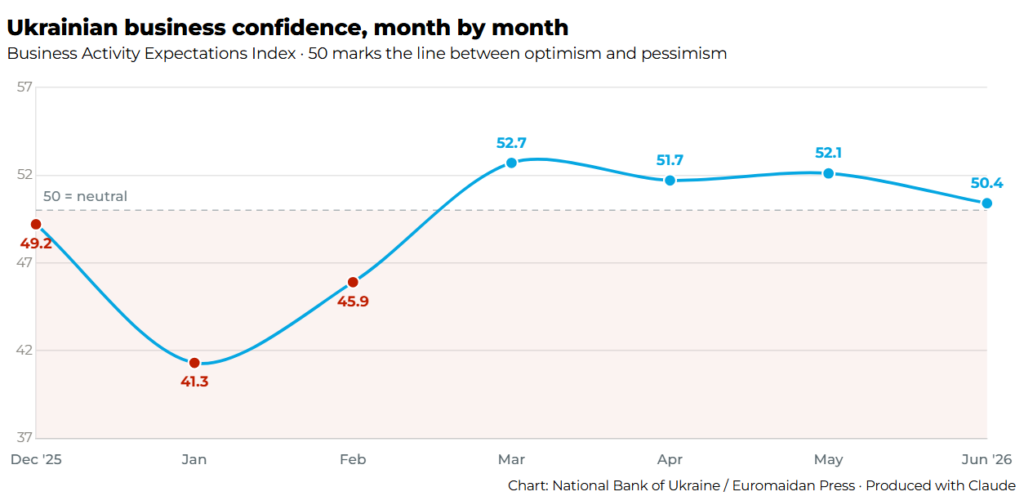
None of this shows in how Ukrainian businesses feel. In June, firms rated their own prospects positively for the fourth month running, with the National Bank’s expectations index at 50.4, above the neutral 50 line. The survey polled 587 companies that were still trading.
The people turning up in bankruptcy court are the ones the survey does not count—and more and more, they are individuals, not firms.
