Vue lecture

Putin’s Mach-10 wonder weapon misses by 30 meters. Russia stopped building it in April.

Par : David Axe

all 20+ russian kinzhal hypersonic missiles targeting kyiv intercepted patriot since may 2023 russia's mig-31k aircraft carrying missile illustrative mounted mig-31

  • As more Russian missiles rain down on Ukrainian cities, one munition is curiously absent
  • The Mach-10 Kinzhal, an air-launched ballistic missile, has been missing in action for months now
  • Ukrainian intelligence says the Kremlin halted production in April because the missile kept missing by 30 meters

Russia's Kinzhal air-launched ballistic missile, a version of the ground-launched Iskander, travels as far as 2,000 km at a claimed 10 times the speed of sound while packing a 500-kg warhead. It was one of a clutch of purported super-weapons that Russian Pres. Vladimir Putin revealed in a dramatic announcement in 2018.

Launched in mid-air by specially modified Mikoyan MiG-31 interceptors in order to boost its speed and range, the Kinzhal is, in theory, a powerful deep strike munition capable of blasting right through all but the best and rarest air defenses.

In a recent interview, Deputy Chief of Ukraine’s Defence Intelligence Major General Vadym Skibitskyi made a series of interesting claims about Russian missile and drone production rates.

According to him, Russia is producing the following missiles at these rates:

- Iskander-M…

— AMK Mapping 🇳🇿 (@AMK_Mapping_) August 11, 2026

In practice, it kept missing. Russia stopped building the $4.5-million missile in April, Maj. Gen. Vadym Skibitskyi, Ukraine's deputy chief of defense intelligence, told RBC-Ukraine—and the rocket fuel and components that had gone into Kinzhals now go into Iskanders, sea-launched Kalibr cruise missiles, and air-launched Kh-101 cruise missiles instead.

A missile of this class needs to land within five to seven meters of its aim point to be worth firing. The Kinzhal, according to Skibitskyi, lands within 30 meters or more. "We can hardly recall a single instance where this missile hit the target precisely," he said. Satellite imagery of the Ukrainian air base at Starokostiantyniv, a favorite Kinzhal target, shows the craters ringing the airfield rather than sitting on it.

‼ Russian voenkors publishes satellite images from the Starokostiantyniv area!

🚀⚠ The photo shows craters from missiles that did not reach their targets. In some cases, the Kinzhals' deviation was up to 144 meters. pic.twitter.com/qvameRj5t8

— MAKS 26 🇺🇦👀 (@Maks_NAFO_FELLA) November 10, 2025

The Kolomna Machine Building Design Bureau reportedly contracted 44 Kinzhals in 2024 and 144 in 2025, Militarnyi reported from Russian defense ministry documents. The line climbed for two years and then stopped dead.

The Kinzhal isn't the only munition reportedly getting the ax. The Kremlin is also halting production of the Kh-32 air-launched cruise missile, which Russian engineers repeatedly failed to improve before the program was sent back for further work. "This would explain why Russia has not launched any Kinzhals for multiple months, and very few Kh-32s," AMK Mapping noted.

At least one analyst anticipated this development years ago. Way back in 2022, then-CNA analyst Michael Kofman wrote that he didn't "understand the interest in Russian use of Kinzhal. There's nothing special or particularly exciting about this system." It is, according to Kofman, just an Iskander but with a more complicated and expensive launch method.

It may have taken the Russians a few years to come to the same conclusion. The last Kinzhal strike might have been on 14 May, when the Russians launched three Kinzhals as part of a wider strike on Ukrainian cities involving 731 missiles and drones.

The purported Kinzhal shutdown, if true, could orphan the boutique fleet of around two dozen MiG-31K/I interceptors whose main role is to haul a Kinzhal to high altitude before launch. The Kinzhal carriers account for around 20% of the wider MiG-31 fleet, whose main mission is air defense over the vast Russian interior.

The MiGs may end up as victims of ruthless efficiency-seeking. If Skibitskyi is right, the Kremlin simply can't afford to keep every munition in production as it seeks to escalate its bombardment of Ukrainian cities amid growing economic losses from Ukrainian deep strikes targeting Russian strategic industries.

It's possible the only way the Russians can boost production of their best deep strike munitions is to cut production of the underperforming ones. According to the pro-Ukrainian Conflict Intelligence Team, the savings in fuel, components, and funds from the suspended Kinzhal and Kh-32 assembly lines "were redirected to other types of missiles."
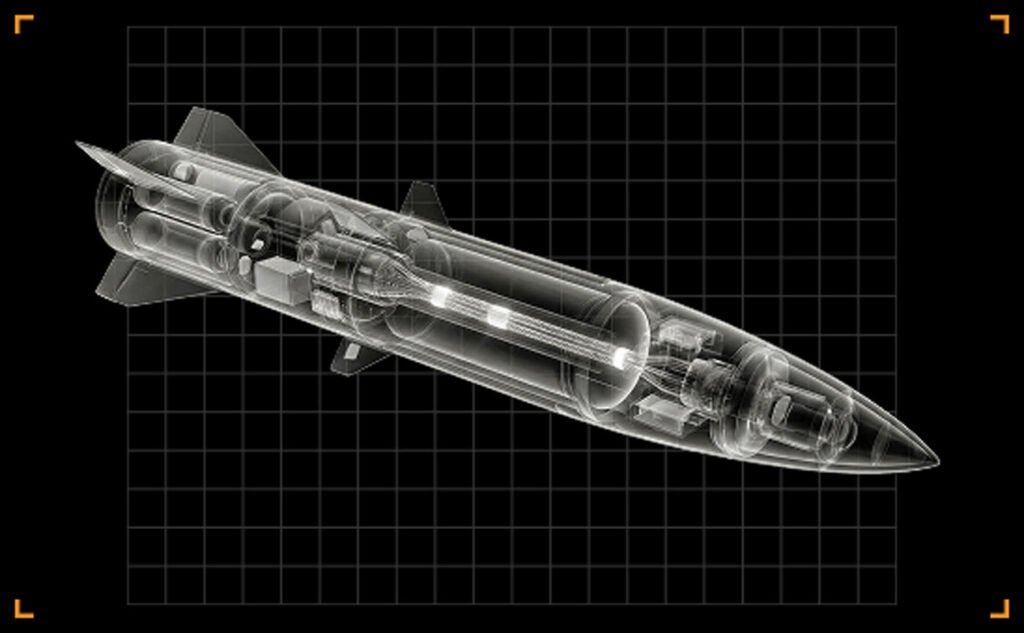
Cutaway rendering of a Russian Kinzhal hypersonic missile shown on Ukraine's TrophyLab platform
A cutaway rendering of a Russian Kinzhal hypersonic missile, as shown on Ukraine's TrophyLab platform. Illustrative image: TrophyLab/Ukraine's Defense Ministry

Production winners and losers

That's how, in July, Russia reportedly produced 65 Iskanders, surpassing its target of 60 by nearly 10%. Meanwhile, production of Kh-101s reached 140% of the monthly target. Kalibr production 111%. Across its main missile lines, Russian industry is running at 110 to 120% of plan. Certain Russian munitions may soon disappear from the sky over Ukraine, if they haven't already. But only because more copies of better munitions are taking their place.

Ironically, the Kinzhals and their carriers are fading away at the same time Ukraine's own deep strike forces may have landed their most powerful blow against the aerial hypersonic strike force. On 15 August, a barrage of Ukrainian drones and cruise missiles struck a range of targets deep inside Russia.
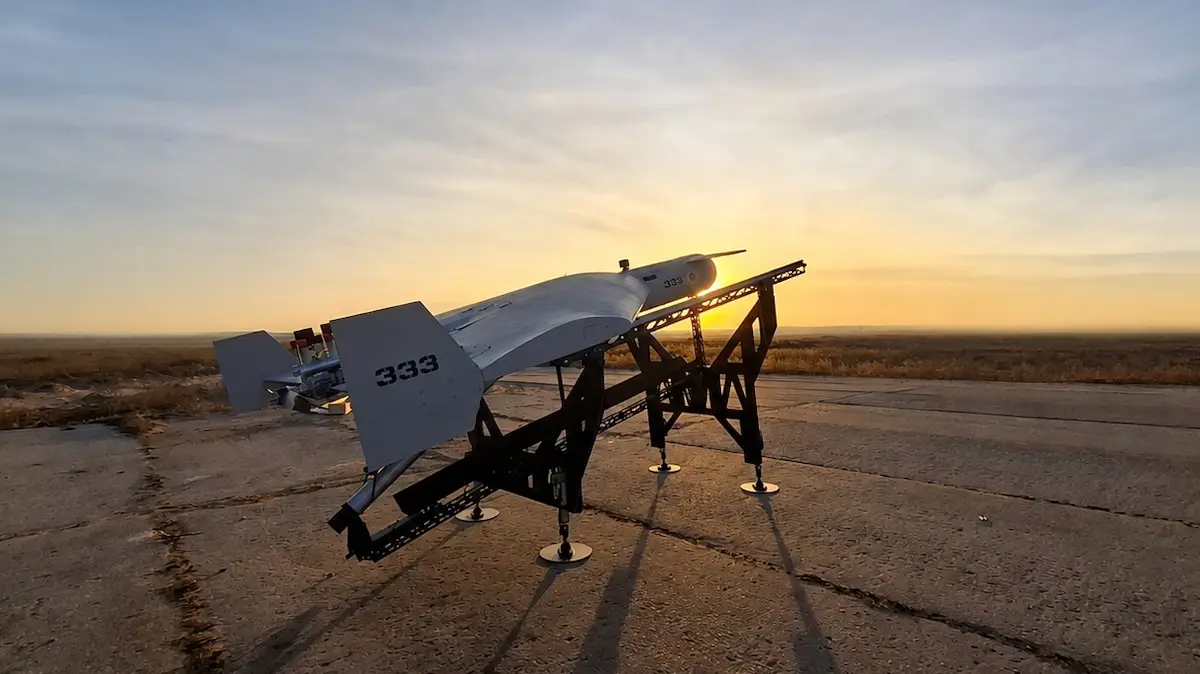
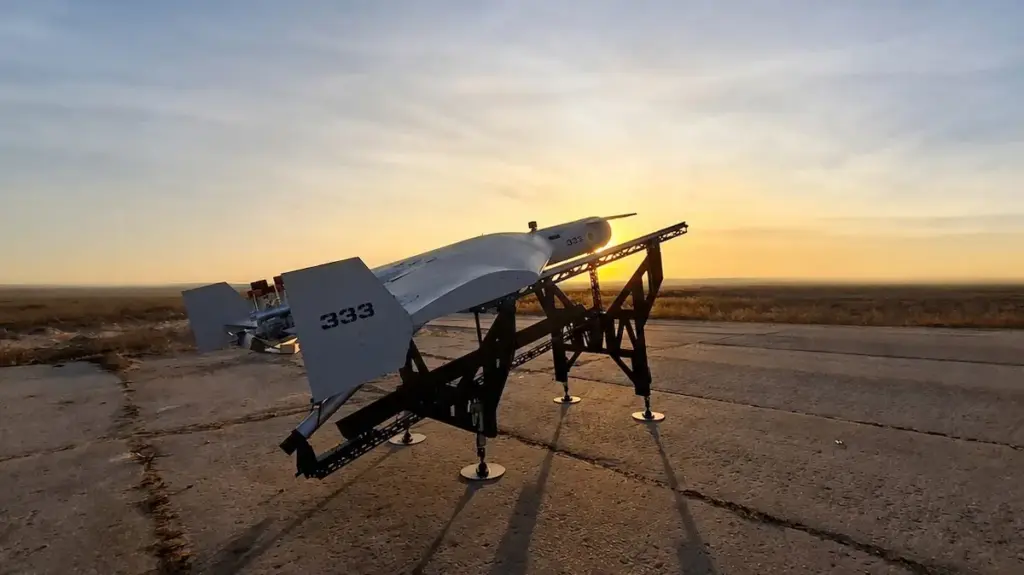
The MICH 2000 drone can fly up to 2,000 km and carry a warhead weighing up to 60kg. Photo courtesy of the manufacturer
Explore further

Ukraine’s new Tu-95 killer is a $48,000 copy of a drone China refused to sell

Among the targets was Savasleyka air base, in Nizhny Novgorod around 785 km from Ukraine. "Direct hits and fires reported," WarTranslated noted.

Among other aircraft, Savasleyka air base hosts some of the MiG-31Ks that carry Kinzhal missiles. Or once carried them, if Skibitskyi is correct and the missile has fallen out of use. It's unclear whether the attack on Savasleyka damaged or destroyed any MiG-31s.

Even if the Kinzhal launchers burned to the ground, it may be too late to matter. The Russians may have rendered the planes and their missiles irrelevant before the Ukrainians could drone them.
  •  

Russia has thousands of tanks it can’t risk. One drone shield decides whether they roll

Par : David Axe

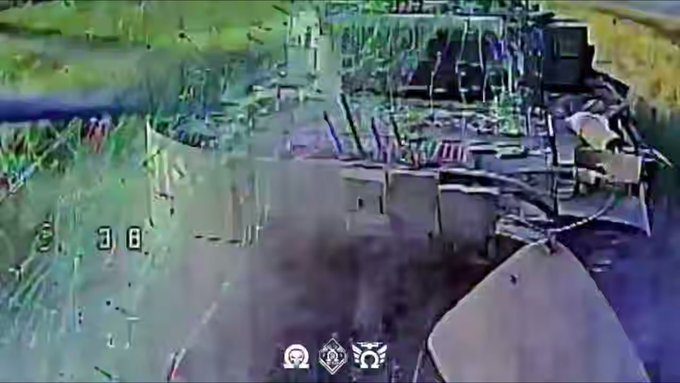
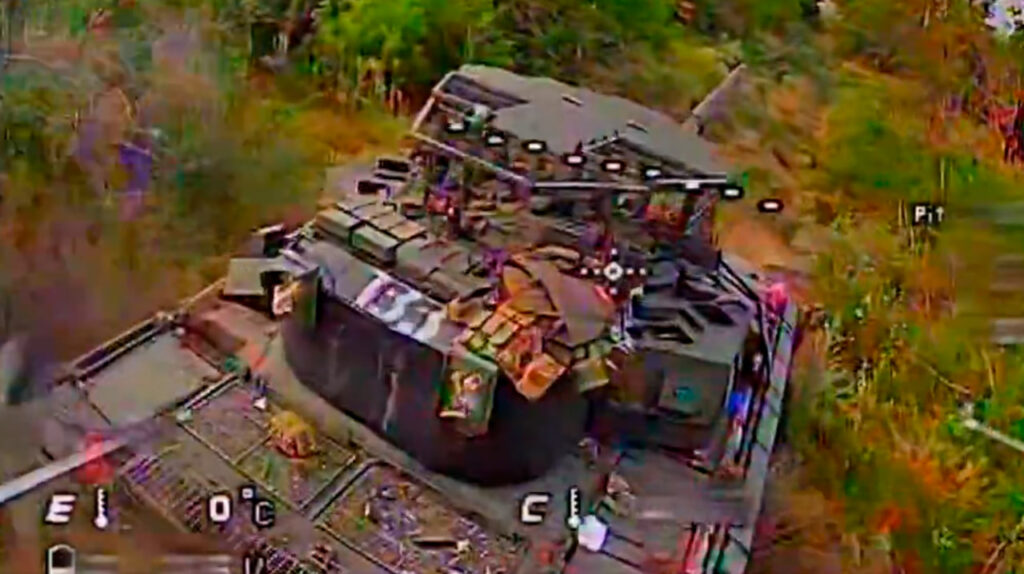
An Arena-M tank right before a drone strike.

  • Russia's new Arena-M anti-drone shield can shoot down FPVs—but tanks still burn
  • One fielded Arena-M reportedly carried 12 charges. Ukrainian crews used 15 to 20 drones per tank in one assault
  • More rounds could help—if ammunition is really the binding constraint

Russian forces may have finally found a way to protect their tanks from Ukrainian first-person-view drones. And it's not the usual add-on armor applications that have defined mechanized combat in Ukraine since the early months of Russia's wider war.

No, the Russians have begun deploying tanks fitted with the Arena-M active protection system (APS), which detects incoming FPVs and automatically fires a small projectile at them. The first few assaults by Arena-M-equipped tanks ended in defeat for the Russians, but limited combat footage shows the system can destroy incoming FPVs.

At least one Arena-M did work against FPVs—it just did not work long enough to save the tank. Observer Andrei_bt stressed that a reported 12-round loadout "does not match modern realities." Footage published on 7 August showed Ukrainian FPVs attacking an Arena-M-equipped T-72B3M near occupied Volodymyrivka, though the Institute for the Study of War assessed that it likely showed the late-July mechanized assault. Ukrainian drone operator Dmytro Putiata reported that one Arena-M shot down seven FPVs before Ukrainian forces destroyed the tank.

That is a smaller problem than the one the Russians had a month ago, and it is why the burned-out tanks along the road in Donetsk Oblast are not the whole story. Russia has spent three years accumulating tanks it cannot safely send anywhere—thousands of them, rebuilt and parked for want of a defense against $500 drones. An Arena-M that does not run dry halfway to the objective is the thing that would let those tanks out of the yard.

The good news for Russian mechanized forces is that developers now know Arena-M needs a bigger ammo loadout. The bad news is that packing more projectiles into the system could prove extremely difficult. The main problem: adding any further bulk to the turret-mounted projectile launchers could block a tank's engine compartment, preventing access for maintenance.

A Ukrainian drone targets a Russian vehicle during a 19 March clash around Lyman.
Explore further

Russia’s tanks are back after a year in hiding. Thursday was a massacre.

If there's a workaround, it may involve redesigning the Arena-M to fire smaller but more numerous projectiles.

Ammunition may not even be the binding constraint. Ukrainian aviation expert Anatolii Khrapchynskyi put the Arena-M's engagement range at 20 to 30 meters and its detection range at around 50—numbers that leave very little time against a drone diving from above, however many charges are in the launchers.

The Institute for the Study of War, for its part, assesses that the Arena-M alone is currently insufficient to protect Russian mechanized assaults from Ukrainian drones because the system can be saturated, though it raises the cost and effort required of Ukrainian forces.

An Arena-M with more rounds could be the development Russian commanders were waiting for as they continue stockpiling new and refurbished tanks and fighting vehicles. Doubling down on production of T-90 and T-72 tanks, the Kremlin has more than made good its combat losses in the first 54 months of the wider war.

Tank-led assaults have been rare in the last year of fighting as Russian forces have pivoted to infantry-led infiltration tactics. That may change as infantry losses deepen and commanders gain confidence in the Arena-M to protect tanks from drone attack.

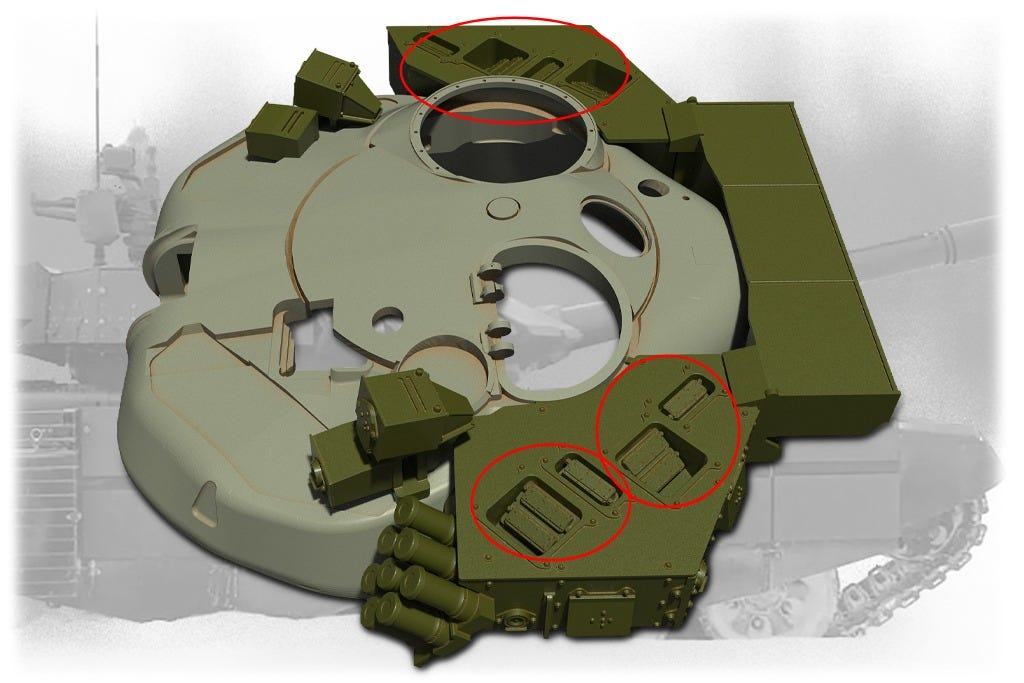
Diagram of the Russian Arena-M active protection system showing the projectile launchers ringed around a tank turret
The Arena-M design, with projectile launchers circled. Kolomna Engineering Design Bureau art

Combat debut

The Arena-M, designed by the Kolomna Engineering Design Bureau, uses Doppler radar to spot incoming rockets, missiles, and drones, and counter-munitions meant to shred a threat shortly before impact. The concept is old: the Soviets fitted the Drozd system to modernized T-55ADs in the 1980s, and Russian designers have been chasing active protection since their tanks were mauled in Chechnya.

Three decades on, the Russian government daily Rossiyskaya Gazeta conceded on 7 August that there is still no generalized battlefield data on how the Arena-M performs, and that its potential against threats attacking from above needs further study.

Anti-Drone Armor Evolution
Evolution of Russia's anti-drone protection of tanks
From crude cages to shooting back—four years of trial and error
Russian tank with cope cage anti-drone armor, 2022
2022
Cope cage
Metal slats or mesh bolted over turrets to block incoming FPV drones
Russian turtle tank wrapped in metal shell, 2023
Spring 2023
Turtle tank
Entire vehicles wrapped in drone-blocking metal shells
Russian porcupine tank with rebar spines welded on armor, 2025
Spring 2025
Porcupine
Hundreds of thick rebar spines welded to cope cages and shells
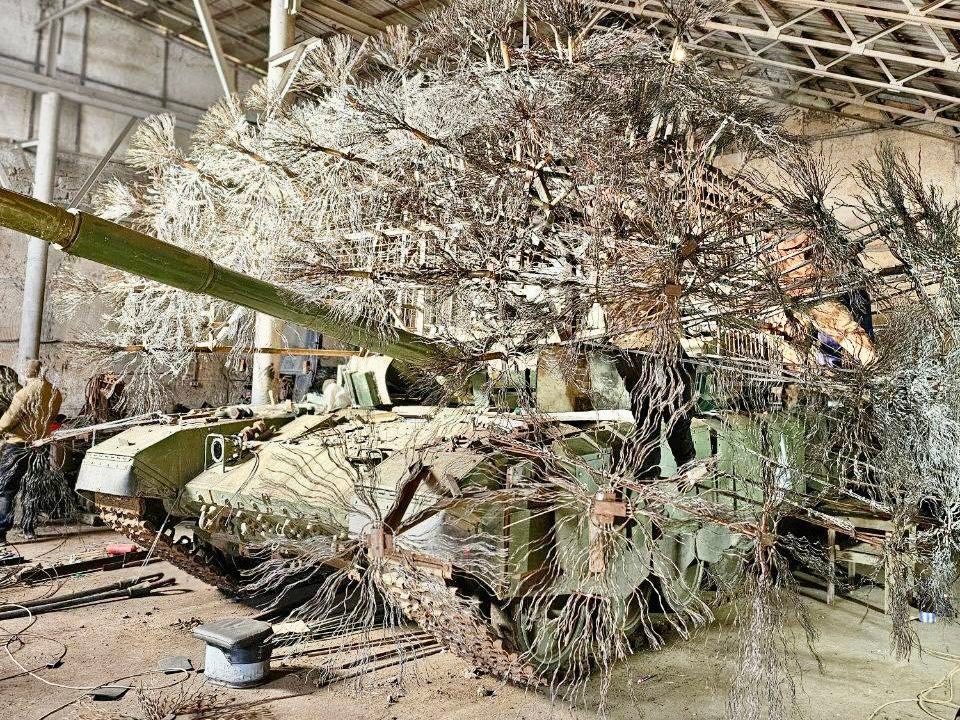
Russian dandelion tank with branching aluminum hairs and Kevlar mesh, 2025
Autumn 2025
Hedgehog & dandelion
Thousands of thin aluminum hairs; branching stalks with Kevlar mesh
Russian T-72B3A fitted with the Arena-M active protection system
July 2026
Arena-M
Radar-cued charges shoot drones down instead of blocking them—reported fielded loadout: 12 rounds
Chart: Euromaidan Press

The system had its major combat debut in Ukraine on and around 23 July, over several days of Russian mechanized attacks in the Dobropillia sector of eastern Ukraine's Donetsk Oblast. The Russian Center Group of Forces rolled a large mechanized assault group along the road through the village of Pankivka, roughly 36 km southwest of Kramatorsk and its twin free city of Sloviansk.

Ukrainian drones spotted the tanks coming, and attacked. When the smoke and dust cleared, the Russians had lost at least nine tanks. Reportedly seven of them were T-72B3A models with Arena-M installations.

The losses belie the Arena-M's effectiveness. The protection systems shot down drone after drone, and only stopped shooting down drones when they ran out of projectiles. "In general, it took from 15 to 20 FPV drones to destroy a tank," Ukrainian drone operator Dmytro Putiata reported.

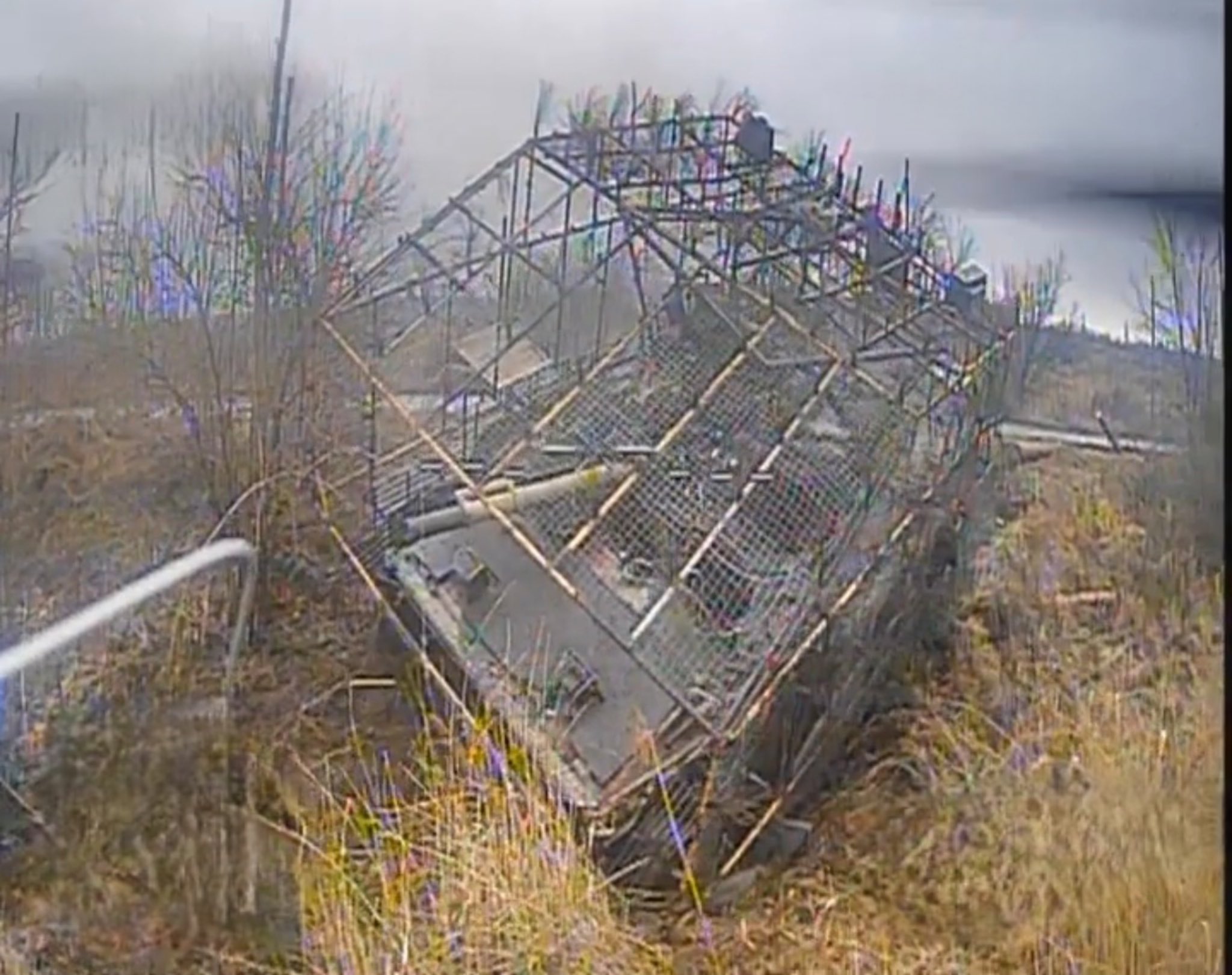
While some of the best-protected turtle, porcupine, and hedgehog tanks have been able to withstand more than 20 FPVs before being immobilized, the add-on metal plates and bars that comprise turtle, porcupine, and hedgehog installations are extremely heavy—and tend to ruin a tank's transmission, weigh on its mobility, and prevent it from rotating its turret and aiming its main gun.

A T-72B3A the moment before a Ukrainian drone strikes.
Explore further

Russia took the cages off its newest tanks. The new Arena-M shield bought them a few minutes.

In other words, the add-on armor prevents tanks from fighting like tanks—using their speed and firepower to close with and destroy the enemy.

The Arena-M installation is bulky but it's not heavy. With Arena-M, a tank can defend itself from drones without sacrificing its mobility. If an Arena-M had, say, 24 rounds instead of just 12, an attacking tank might be able to fend off drones long enough to reach its objective across the disputed gray zone.

But only barely. "15 to 20 FPV drones to destroy a tank is a perfectly viable rate," Czech analyst Jakub Janovsky noted in a comment on Putiata's social media. "At those numbers, Russia could throw its entire [armored fighting vehicle] fleet at the Ukrainian front line over a few months without achieving much more than creating a future low-grade iron ore deposit."

What if the Russians could fit 36 rounds in an upgraded Arena-M installation? Would that be enough?

No one knows for sure until they try. What we do know is that "the Russian military is learning and is experimenting in how to employ armor on a drone-saturated battlefield," explained Rob Lee, an analyst with the Foreign Policy Research Institute in Philadelphia. "The Arena-M APS demonstrated effectiveness and will likely be improved."

And those improvements could unlock those thousands of tanks the Russians have parked for want of drone defenses.

A Russian T-90 dandelion tank.
Explore further

Russia mastered drone-proofing its tanks—Ukraine is copying its tricks

  •  

Ukraine’s new Tu-95 killer is a $48,000 copy of a drone China refused to sell

Par : David Axe

The MICH 2000 drone can fly up to 2,000 km and carry a warhead weighing up to 60kg. Photo courtesy of the manufacturer

  • Ukraine's state security service has its own special attack drone
  • The MICH 2000 is a highly evolved copy of a Chinese drone China refused to sell
  • There are at least eight versions of the 2,000-km drone, from $48,000

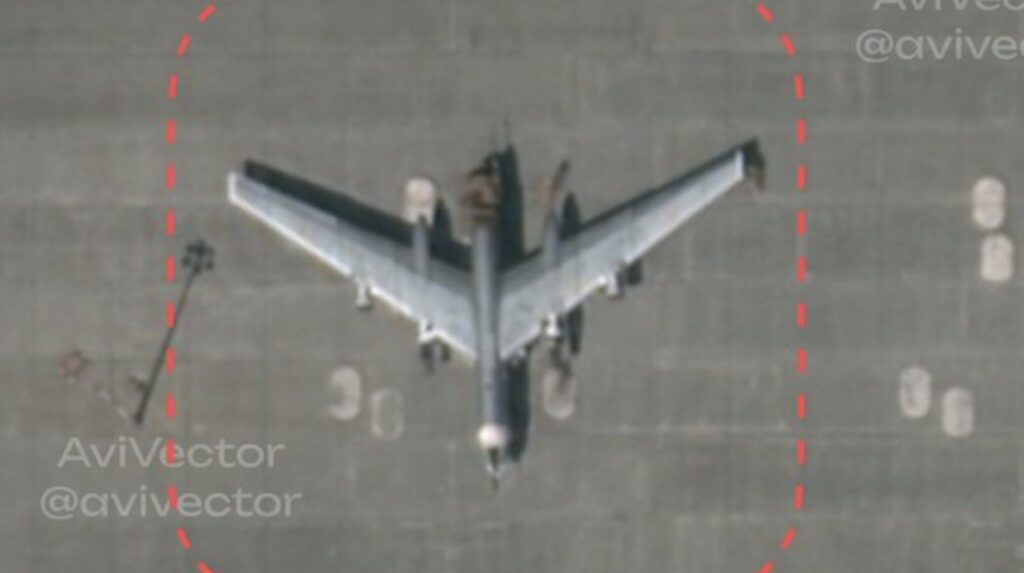
On 16 July, one-way attack drones from the Ukrainian state security service—the vaunted SBU—motored 800 km to strike Engels-2 air base in western Russia. At the time, there were reportedly five bombers on the ground at the base: four Tupolev Tu-22Ms and a single Tupolev Tu-95.

The drones struck the four-engine, propeller-driven Tu-95. "According to preliminary data, the plane suffered critical damage," the SBU claimed. "It completely tore off the tail part." That particular aircraft, the SBU added, had been used systematically to launch massed missile strikes on Ukraine. Satellite imagery later confirmed the bomber's destruction.

The destroyed Tu-95.
The destroyed Tu-95. Satellite imagery via AviVector.

Nearly a month later, we finally know which drone type the SBU flung at Engels-2 and its parked bombers. They were MICH 2000s—Ukrainian aircraft that began as copies of the Chinese ZTK-150, built after Beijing stopped selling. Ukrainian website Oboronka, which visited the factory, broke the news. "Today, the Mich' is no longer just a Chinese plane, but a drone that is exclusively used by the SBU Special Operations Center 'Alpha.'"

According to Oboronka, whose report was agreed in advance with the manufacturer and the SBU, the MICH 2000 flies as far as 2,000 km with a warhead weighing 25 to 60 kg. "The list of targets hit by this drone is updated every week," Oboronka noted. They include Russian ports, military and industrial sites around Moscow and Engels-2.

The Engels-2 raid might be the most immediately impactful. After the 16 July raid, the Russians may be down to 43 Tu-95s, only a dozen of which are usually active at any given time.

The mysterious Shahed like Ukrainian drone that has been repeatedly spotted during strikes deep inside Russia finally has a name: MICH 2000.

Until now, almost nothing was publicly known about it. The drone is used exclusively by the SBU’s Alpha unit, can fly up to 2,000 km and… https://t.co/yUHIXEjvLl pic.twitter.com/HT59LiigrI

— Special Kherson Cat 🐈🇺🇦 (@bayraktar_1love) August 12, 2026

The plane that came from China

The MICH 2000 started as someone else's drone. In the summer of 2023, Beijing restricted exports of the civilian aircraft Ukrainian units had been buying and converting into deep-strike munitions. At the end of that year, a team of Ukrainian developers flew to China to buy some anyway.

At the factory, they found dozens of ZTK-150s coming off the line—Shahed lookalikes distinguished mainly by a pair of forward canards. The Chinese intermediaries floated selling the production technology outright, and Ukrainian commanders liked the idea. But when the team came back ready to buy, the factory's management refused.

The intermediaries wanted the deal anyway. They offered to assemble the drones somewhere without export restrictions—and to train Ukrainian pilots. The team took the training. "We came there to teach pilots to fly Chinese drones," one member told Oboronka. "And in parallel with the training we photographed everything that was there. Everything from the production process to the arrangement of the shelves and cabinets." They flew home with trained pilots and eight Chinese drones.

Two years later, the Ukrainian version costs $48,000 in its basic configuration. The Chinese original costs $50,000. And according to the manufacturer, almost nothing of the Chinese drone survives in the MICH 2000 now except its outline.

Whittling down the bomber fleet

Ukrainian drones are slowly chipping away at the Tu-95 fleet. A 2022 drone raid badly damaged one of the lumbering turboprop bombers at Engels-2, potentially leaving no more than 51 intact Tu-95s in the Russian air force inventory at the time. Smuggling tiny explosive drones across Russia in trucks on 1 June, 2025, the SBU hit at least seven more Tu-95s as well as four Tu-22Ms, among other aircraft.

The 16 July raid is the more recent Ukrainian effort to shrink the Russian bomber force, but it surely won't be the last. The Russians' roughly 120 bombers—Tu-95s, Tu-22Ms and Tupolev Tu-160s—launch the cruise missiles that routinely blast Ukrainian cities and power plants.

Struggling to intercept all Russian deep strike munitions in the target zone, in part owing to a deepening shortage of the best air defense missiles, Ukrainian forces increasingly aim to prevent the Russian munitions from even launching—by smashing munitions factories or, yes, destroying irreplaceable bombers. Of the three Russian bomber types, just one—the Tu-160—is still in production, albeit at a rate of barely just one every year or two.

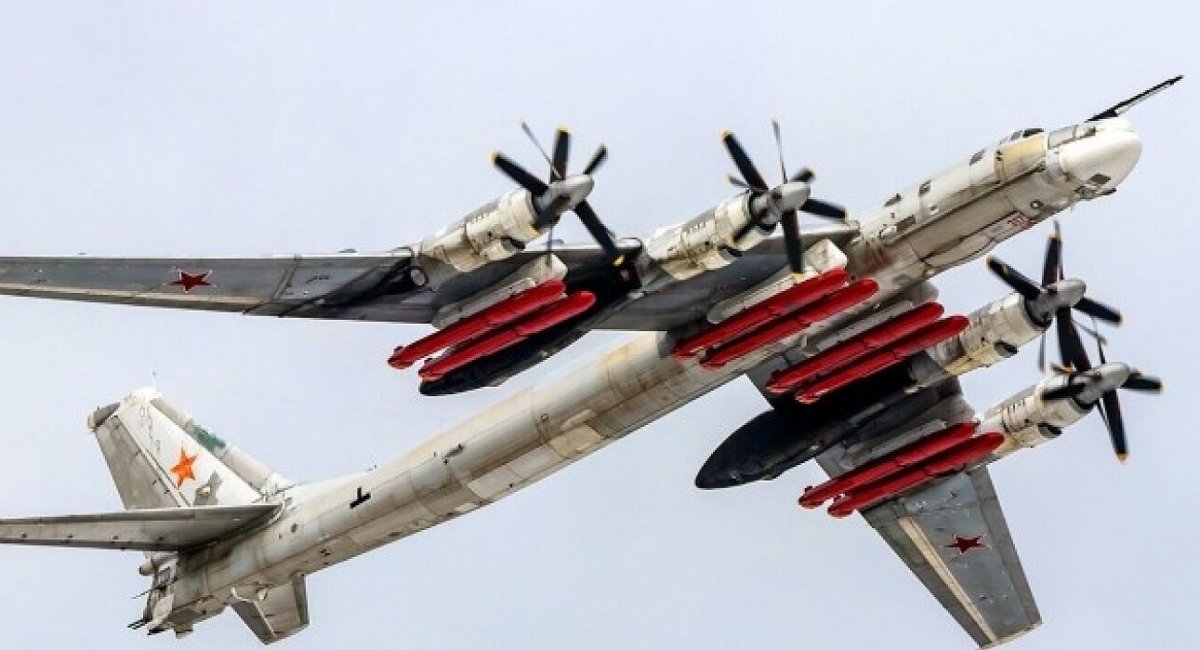
Russian strategic bomber TU-95 carrying Kh-101 missiles. Source: Defense Express
Explore further

Ukraine kills bomber inside Russia. Soviet Union stopped building them decades ago — so this one is gone for good

Expect more MICH 2000 raids. The type's anonymous builder churns out 6,000 MICH 2000s a year but aims to boost output to 10,000 a year. And the firm customizes the drones to suit particular missions.

According to Oboronka, there are eight main versions. "Fighters can choose what kind of communication they need: analog, digital or Starlink. They can choose the warhead, the size of the fuel tank, the possibility of additional guidance." The navigation system can be made more jam-proof by adding additional jam-resistant controlled reception pattern antennas.

flamingo vs oreshnik ukraine's genstaff now details damage russia's launch site · post fp-5 cruise missile targeting kapustin yar test range ukraine confirmed ballistic infrastructure previous strikes astrakhan oblast intermediate-range
Explore further

Russia has figured out how to stop Ukraine’s most powerful missile

Drone strikes by MICH 2000s and other drone types aren't the only ways Ukrainian forces are trying to blunt Russian attacks on Ukrainian cities and power plants. Ukrainian drone teams are also trying to take out the last five warships in the battered Russian Black Sea Fleet that can fire Kalibr cruise missiles.

On 11 August, drones struck at least three of the ships in the port of Novorossiysk in southern Russia. The frigates Admiral Essen and Admiral Makarov and the corvette Bykov all suffered visible damage.

  •  

Russia has figured out how to stop Ukraine’s most powerful missile

Par : David Axe

flamingo vs oreshnik ukraine's genstaff now details damage russia's launch site · post fp-5 cruise missile targeting kapustin yar test range ukraine confirmed ballistic infrastructure previous strikes astrakhan oblast intermediate-range

  • Russia has found a way to defeat Ukraine's Flamingo cruise missiles
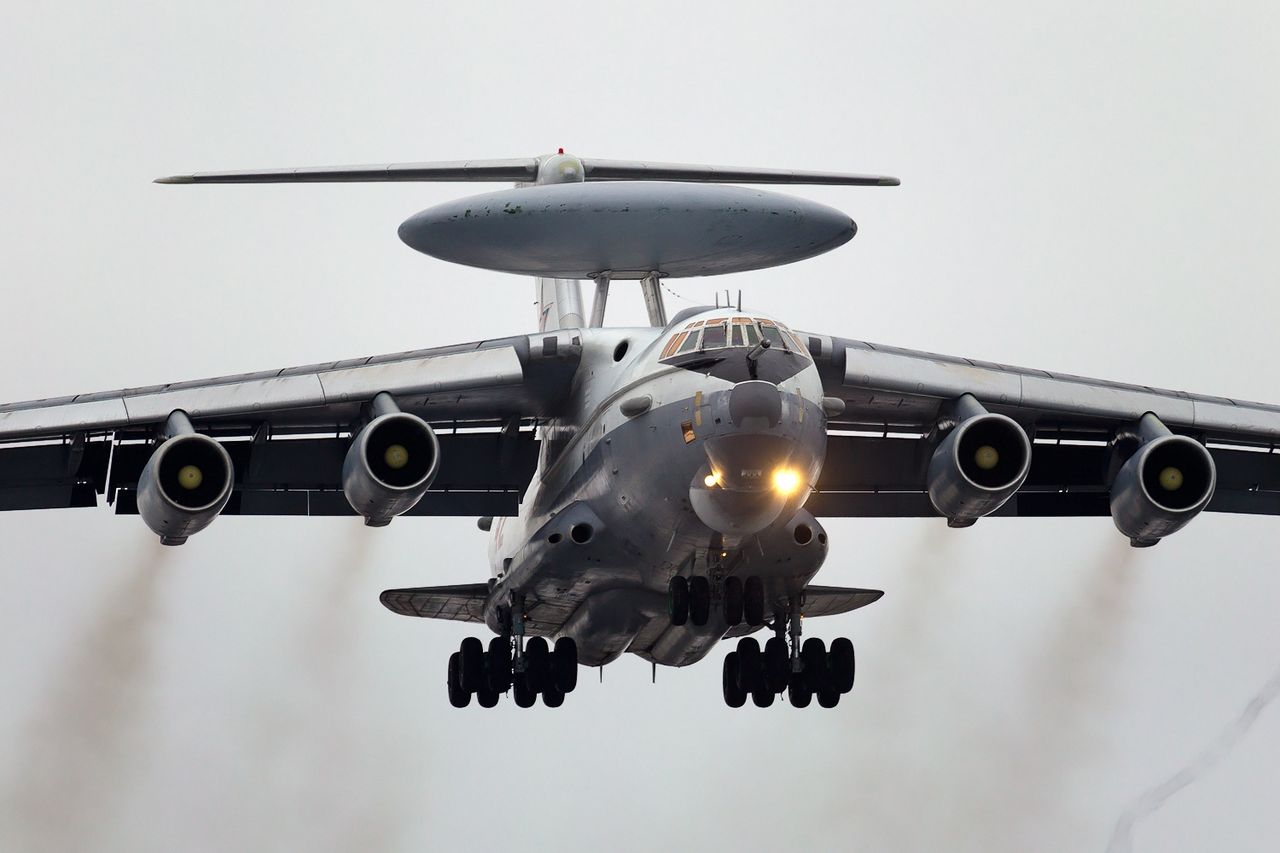
  • Russian air force A-50U radar planes see the missiles coming
  • One mapper counts 10 of the last 11 Flamingos shot down

Russia has been shooting down most of Ukraine's best long-range cruise missiles as fast as Ukraine can launch them. Just one or two of the $500,000 Fire Point FP-5 Flamingo missiles have hit their targets in recent weeks.

That means Russian air defenses are working for now. Whether they'll continue to work is the critical question for Ukrainian strike planners.

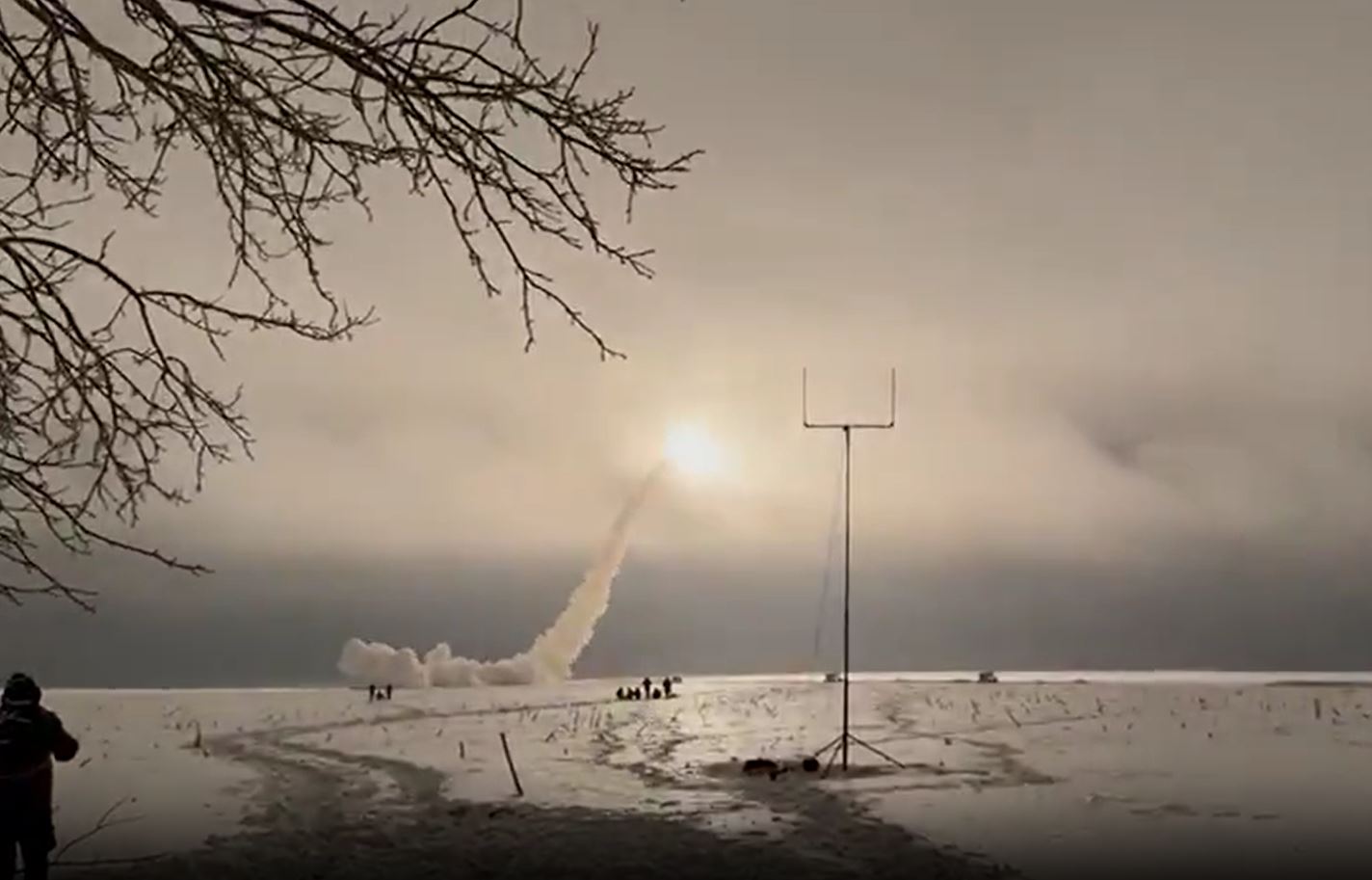
Under the cover of darkness on 6 August, the Ukrainian army's 19th Missile Brigade launched at least three of the six-ton, jet-propelled Flamingos toward Tyumen Oblast in western Siberia. The missiles traveled around 2,500 km before disappearing, according to mapper AMK Mapping.

The apparent shoot-downs capped a difficult week for Ukraine's deep strike campaign. AMK Mapping claimed the Russians shot down 10 of 11 launched Flamingos since 1 July. That count is one mapper's, based on open-source tracking, and no official Ukrainian or Russian figures exist to check it against.

Approximate flight route of the 5 Ukrainian FP-5 Flamingo cruise missiles.

They disappeared over Tyumen Oblast, likely after being shot down once again by Russian air defence.

Once again, the missiles followed the path of major rivers at low altitude in order to complicate… https://t.co/8xbymN3dap pic.twitter.com/Rc17wrQI1X

— AMK Mapping 🇳🇿 (@AMK_Mapping_) August 6, 2026

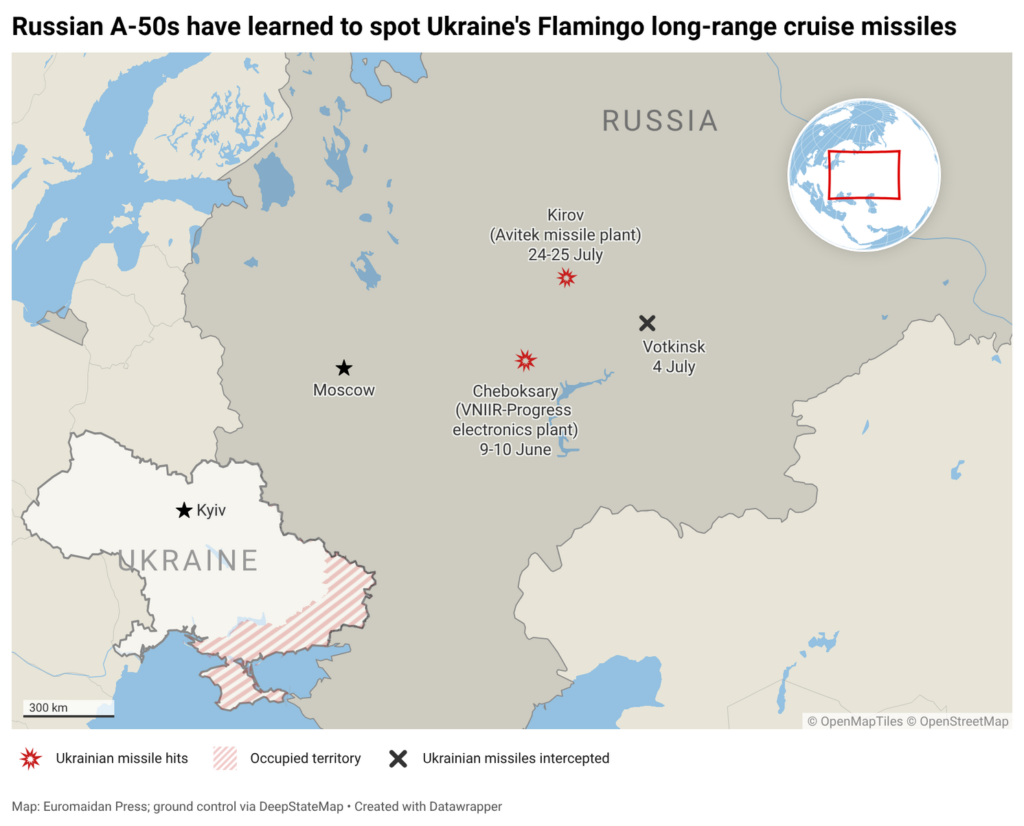
The mapper may be off by one. Between 24 and 25 July, at least one Flamingo struck the Vyatka Machine-Building Enterprise Avitek missile plant in Kirov Oblast 1,300 km from the border with Ukraine. Michael Bohnert, an analyst with the RAND think tank in California, concluded that two Flamingos hit the plant, causing visible damage.

A map of locations where Ukraine has struck with long-range Flamingo missiles and where they were intercepted
Map: Euromaidan Press

It was a potentially powerful blow. Among other things, Avitek produces parts for the Tor medium-range surface-to-air missile system. Slowing Tor production "will have the most impact," Bohnert explained. And the Ukrainian system that a Tor slowdown might benefit the most is ... the Flamingo.

After all, the Tor is one of the air defense systems the Russians could use to shoot down Flamingos. "Any slow-down in the production of these could greatly improve the prospects of FP-5 performance over time," Bohnert noted.

Ukrainian Firepoint FP-5 Flamingo missiles just smashed the Avitek plant in Kirov, Russia (July 24 and 25) — and the biggest hit is to SA-15 Tor production.

Here are the facts and why it matters

On July 24th and 25th, Ukrainian Firepoint FP-5 Flamingo Missiles hot the Vyatka… pic.twitter.com/Ii8VsJCumi

— Michael Bohnert (@mbohnert) July 26, 2026

Aerial defenses

At present, however, it seems that the Flamingo's biggest problem is in the air, not on the ground. Russia is shooting down most of the incoming FP-5s because it has eyes in the sky.

The Russian air force's fleet of lumbering Beriev A-50U radar early-warning planes now has one mission and one mission only: the A-50Us with their fuselage-mounted radars patrol over the likeliest flight paths for Flamingos motoring into the Russian interior to strike strategic industries.

The A-50Us are effective in the role. As recently as June, more Flamingos were getting through Russian defenses. Between 9 and 10 June, the 19th Missile Brigade launched five Flamingos at the VNIIR-Progress electronics plant in Cheboksary, in western Russia, 960 km from the Ukraine border.

Two missiles struck the plant, punching right through anti-drone protections and inflicting major blast and fire damage with their 1,150-kg warheads, the biggest on any Ukrainian deep strike munition.

Russia adapted fast. On 4 July, an A-50U helped missile batteries on the ground spot and shoot down five FP-5s flying toward Votkinsk, 1,360 km from Ukraine. From its perch thousands of feet in the air, the A-50U has a much longer detection range against low targets than any radar on the ground can manage.

A Russian A-50U.
Explore further

To catch Ukraine’s cruise missiles, Russia is risking the scarce A-50 radar planes it has no way to rebuild

Targeting A-50Us on the ground and in the air in a series of drone and missile ambushes, the Ukrainians have destroyed two A-50Us and damaged at least two others, reducing the fleet to no more than five. Russia has no way to build replacements. But those five planes are now fully committed to the anti-Flamingo fight.

On 7 July, the Russians reportedly launched four of the irreplaceable planes at the same time in order to coordinate the Flamingo shoot-downs. Now, almost all Flamingos go down in flames before they reach their targets.

Ukraine isn't powerless. Fire Point has been working hard to improve the Flamingo and make it harder to shoot down. Perhaps most importantly, it seems the company tweaked the missile's altimeter in order to help it fly lower. The lower a missile flies, the better chance it has of hiding among the radar clutter created by surrounding terrain.

But if a lower-flying Flamingo is harder to shoot down, the improvement hasn't yet registered in the statistics. For now, Russia has figured out how to take out almost all of Ukraine's heaviest deep-strike missiles.

A Russian A-50U.
Explore further

Russia is running out of its best eyes in the sky

  •  

How Russia built a jam-proof drone force—and the Chinese supply chain that could still break it

Par : David Axe

ukraine develops fiber-optic module fitting all drones integrates inertial navigation silkworm fiber optic drone unmanned systems forces shovkopryad ukraine’s testing universal designed types while firm installs its optical technology have

  • Ukrainian jamming worked too well: it compelled Russian drone developers to innovate
  • Now many Russian drones communicate via unjammable optical fiber or jam-resistant mesh radio
  • But the Russians can't make all the hardware themselves
  • Instead, they rely on Chinese imports

Frustrated by Ukrainian electronic warfare, Russia transformed its drone arsenal to be harder—or impossible—to jam.

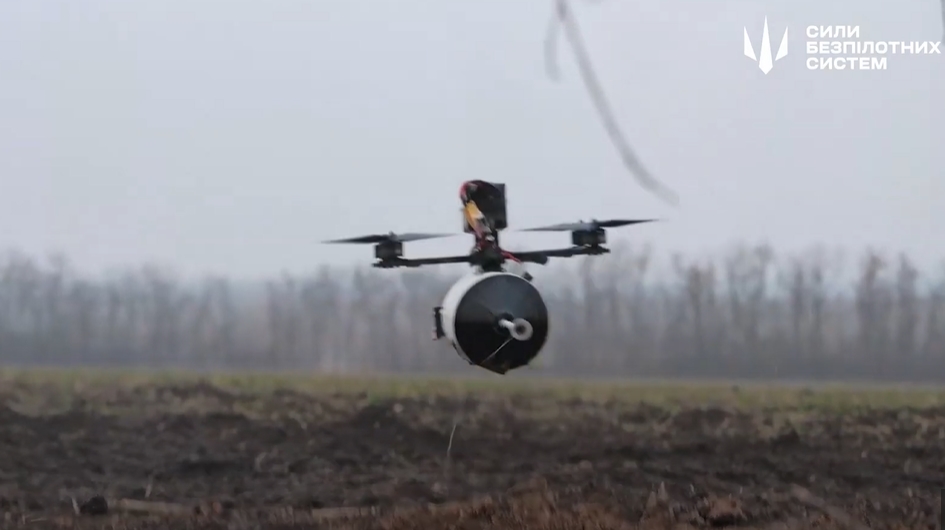
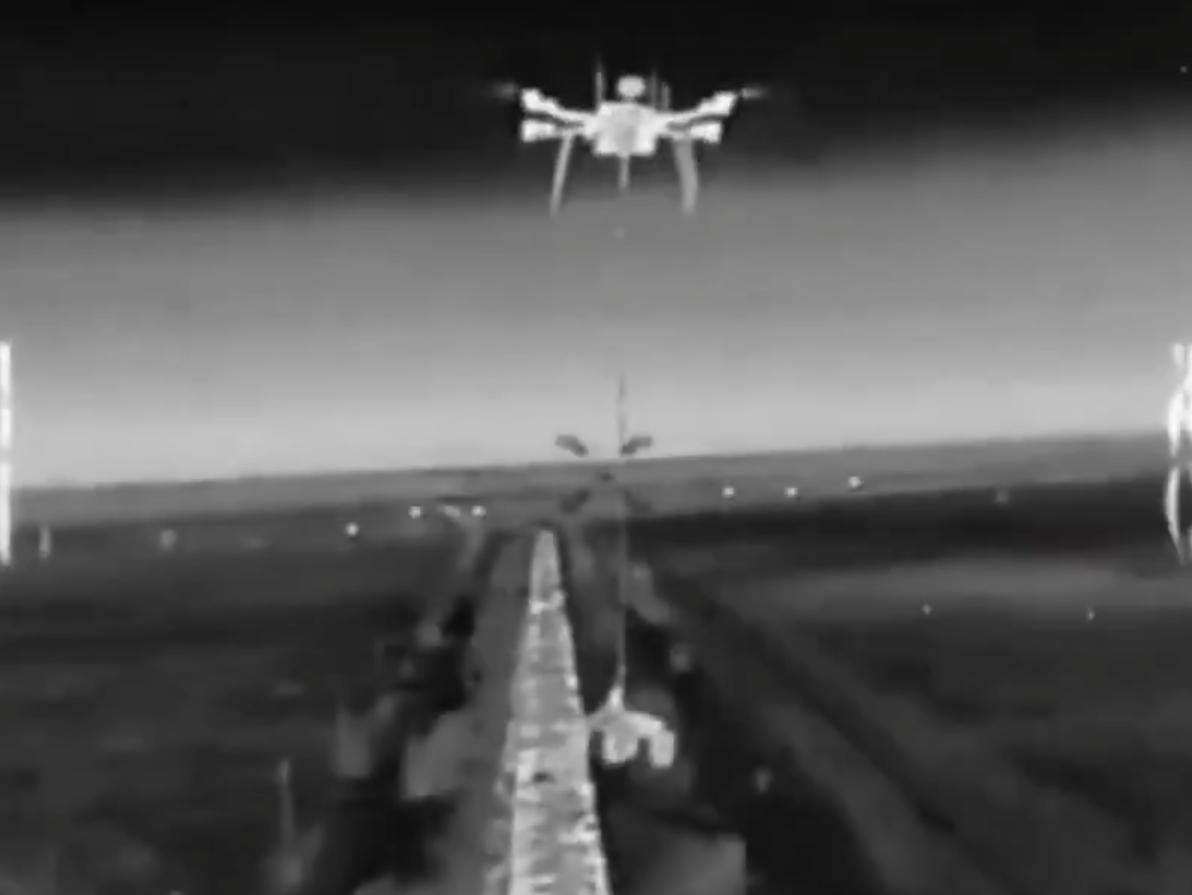
Most of Russia's tiny first-person-view drones now send and receive signals via jam-proof fiber optic cable instead of wireless radio. For heavier one-way attack drones that travel too far for fiber optics, the Russians have mostly switched to jam-resistant mesh radio networks made up of many interconnected senders and receivers.

In both cases, China is key. Chinese companies sell Russian companies the optical fibers and mesh modems that the Russians install in their drones. In other words, Beijing is the critical enabler in Moscow's ongoing aerial aggression.

That's the unsurprising yet sobering conclusion that Tatarigami, the founder of the Ukrainian Frontelligence Insight analysis group, reached in a recent investigation.

It's not enough for Ukrainian forces to shoot down or otherwise defend against Russian drones, or to fight back with their own drones. To win the drone war, Ukraine and its allies must "step up pressure on Chinese manufacturers," Tatarigami wrote.

Russia's response to electronic warfare wasn't a single solution. It evolved along two major paths: fiber-optic drones and mesh networks. This thread summarizes Frontelligence Insight analysis based on OSINT data and a report by the Center for Defense Reforms. Thread🧵 pic.twitter.com/k0v0ZeWKYB

— Tatarigami_UA (@Tatarigami_UA) July 30, 2026

As the drone war over Ukraine ramped up in 2022 and 2023, most Russian FPVs were wireless models. And most heavier one-way attack drones navigated via satellite. Both classes of drone could be jammed. A cottage industry of Ukrainian electronic warfare producers sprung up. Each firm offered some variation of a radio noisemaker that can ground or misdirect wireless and satellite-guided drones.

The jamming worked. Combined with kinetic defenses—guns and missiles—and add-on protections such as mesh, cages and netting, the jamming blunted the impact of Russia's drone arsenal. But the Russians adapted. The turning point came in the spring of 2025, when Russia's elite Rubicon Center drone group led the counterattack against Ukrainian troops occupying parts of Kursk Oblast in western Russia.

Rubicon's fiber optic FPVs wreaked havoc on Ukrainian forces in the Kursk salient, damaging or destroying hundreds of trucks and other vehicles in the span of a few weeks. Starving for supplies and in danger of being cut off, the Ukrainians retreated.

But the Russian adaptation was just beginning. The Russians are now launching 10,000 FPVs a day. And in certain key sectors, 60% of the FPVs were fiber optic models, according to Tatarigami. The Ukrainians can shoot down these drones and block them with armor, nets and earthworks. They can also strike at the Russian FPV teams before the Russians can launch their FPVs.

But there's one thing the Ukrainians can't do: they can't jam the drones.

Over the past six months, SBS has been able to narrow the drone usage gap. They started at 1 for every 3 Russian drones in February, after russia spiked to 9K strikes and are running at 1 for every 2 by August. pic.twitter.com/9GWrU0fx4W

— Vitaly (@M0nstas) August 4, 2026

Unjammable drones

Jamming continued to work against many one-way attack drones that must travel hundreds or even thousands of kilometers—too far for optical fiber. Another turning point came in February, when Elon Musk's Starlink bricked Russia's thousands of smuggled and stolen satellite terminals, some of which Russian forces used to control the approximately 5,000 Geran attack drones they launch every month.

The Starlink shutdown compelled Russian developers to accelerate the transformation of the one-way attack drone force. "Russia's second adaptation was mesh networking, routing data through mesh modems to keep communications alive across both short and long-range drones," Tatarigami explained.

It's possible to jam a mesh radio network, but it's hard. Every drone in a given network is a node. It's not enough to jam a few of them; you have to jam all of them.

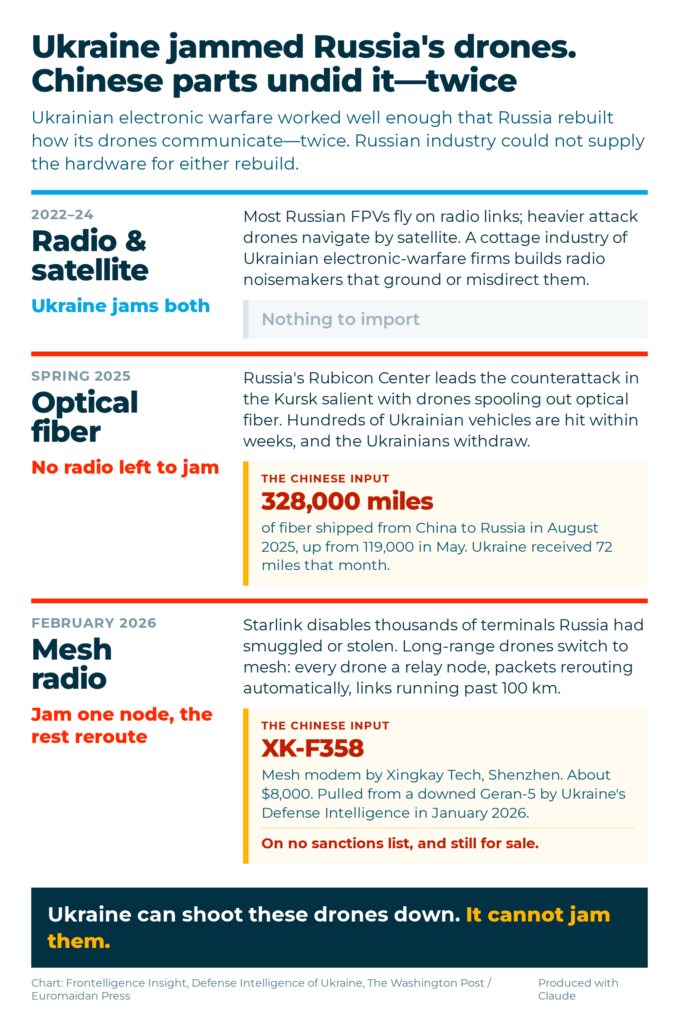
Chart tracking how Russian drones became resistant to Ukrainian jamming in three stages. From 2022 to 2024, Russian FPVs flew on radio links and heavier attack drones navigated by satellite, and Ukrainian electronic warfare could jam both. In spring 2025, Russia's Rubicon Center attacked the Kursk salient with fiber-optic drones that carry no radio signal to jam; China shipped Russia 328,000 miles of optical fiber in August 2025 against 72 miles to Ukraine. In February 2026, after Starlink disabled Russia's smuggled terminals, long-range drones switched to Chinese XK-F358 mesh modems, which carry no sanctions and remain on sale.
Chart: Euromaidan Press

If there's a constraint on Russia's switch to fiber optics and mesh networks, it's that Russian industry can't produce all the necessary hardware. "Unable to meet domestic demand, Russia turned to China," Tatarigami wrote.

The Washington Post reported Chinese optical fiber shipments to Russia growing from 119,000 miles in May 2025 to 328,000 miles that August. China sent Ukraine 72 miles the same month. For mesh networking, the Russians came to depend on XK-F358 modems from China's Shenzhen Xingkai Technology.

Ukraine's overstretched air defenses can't shoot down every Russian attack drone. Ukrainian troops and vehicle crews can't hide from 10,000 Russian FPVs a day. To defeat Russia's jam-proof drones, Ukraine and its allies must cut off the supply of Chinese parts, Tatarigami stressed.

They should extend export controls to modem-makers and producers of optical fiber, reels for the fiber and equipment associated with fiber production. "The recommendation is to expand sanctions beyond individual firms to the entire supply chain," Tatarigami advised.

All-robot air assault.
Explore further

Some Ukrainian bomber drones aren’t carrying bombs anymore. They’re carrying robots.

  •  
❌