❌

Vue lecture

Five refineries in a week: drones set Russia’s Ryazan fuel plant on fire

Aftermath of the attack on the Ryazan oil refinery. Photo: Exilenova+.

Drones struck Russia’s Ryazan oil refinery overnight on 5 November, and the plant caught fire, Ukrainian Telegram channel Exilenova+ reported. The Rosneft-owned plant is one of Russia’s largest refineries.

Russia’s war runs on fuel and oil money, and Ukraine’s drones go for refinery parts that sanctions make hard to repair. The Ryazan refinery supplies fuel to Moscow and central Russia, and the last raid already cost it capacity. After the 15 October strike, one of its primary crude units shut down, two industry sources told Reuters. No one has yet reported which parts of the plant this fire hit. Ryazan is the fifth Russian refinery struck since 30 October, when strikes resumed after about two weeks without a reported refinery fire.

Fire at the refinery

Exilenova+ posted video of strike drones breaking through to the refinery’s industrial zone. About half an hour later, the channel wrote that the refinery had been attacked and was burning. Russian Telegram channel Astra said its OSINT analyst confirmed that the refinery itself was on fire.

The Defence Forces are using strike UAVs to break through to the industrial zone of the Ryazan Oil Refinery. pic.twitter.com/8S5E0E7vkP

— Exilenova+ (@Exilenova_plus) November 5, 2026

Ryazan Oblast Governor Pavel Malkov claimed falling drone debris caused damage. Separately, he claimed fires broke out at industrial sites in Ryazan and damaged power lines cut electricity in part of the city. He also said an outbuilding caught fire in Rybnovsky district, private houses were damaged in Ryazan district, and a city school’s windows were blown out. One person was injured, he claimed. In a later update, Malkov claimed more than 200 drones attacked the region, power was restored, and the fires were out or contained.

Map of Ukraine and western Russia marking Ryazan

He did not name the refinery. Three weeks earlier, after the 15 October raid, Malkov named the plant when he reported a fire there.

Astra also reported that a large Wildberries online-retail warehouse in Ryazan was presumably burning. Its analyst based that on a reader’s photo and had not verified it.

More from Ryazan pic.twitter.com/G0Mm1dLb9b

— Exilenova+ (@Exilenova_plus) November 5, 2026

The refinery can process more than 17 million tons of crude a year, Exilenova+ noted. It makes gasoline, diesel, jet fuel, fuel oil, and bitumen. In its post on the fire, Astra also reported that the plant supplies Russia’s army, pointing to a 2014 Defense Ministry fuel batch and the TS-1 jet fuel it produces.

Four other refineries since 30 October

Drones hit Novokuibyshevsk in Samara Oblast on 30 October, the Bashneft-Novoil refinery in Ufa, Bashkortostan, on 31 October, and Lukoil’s Kstovo plant in Nizhny Novgorod Oblast on 1 November. Together, those three plants processed about 24 million tons of crude a year. That equals roughly 10% of Russia’s refining in 2024 and over 10% of its diesel. Overnight on 3 November, drones also struck the Slavneft-YANOS refinery in Yaroslavl. Yaroslavl Oblast Governor Mikhail Yevrayev said the attack damaged its infrastructure and wounded two workers. Crews were putting out a fire there, he added.

In Ufa, Astra’s analyst identified the burning plant as Bashneft-Novoil. Exilenova+ wrote that probably two Ufa refineries were attacked. Counting both, it calls Ryazan the sixth refinery hit in a week.

Linear Production and Dispatch Station (LPDS) “Samara.” Photo: Exilenova+
Explore further

Drones hit Russia’s Samara oil hub that blends Urals export crude—first strike there since 11 October

On 15 October, US President Donald Trump called Ukraine’s renewed refinery strikes “a disgrace.” In late October, The Wall Street Journal reported that Ukraine had paused them under US pressure until after the 3 November US midterms. The Novokuibyshevsk strike came hours later, and drones have hit four more refineries since.

  •  

Three Russian refineries hit since Friday handle roughly 10% of Russia’s refining and over 10% of its diesel

The Lukoil-Nizhegorodnefteorgsintez refinery in Kstovo, Nizhny Novgorod Oblast, Russia, after a drone attack, 1 November 2026

Drones set fire to Lukoil’s refinery in Kstovo, one of Russia’s largest, overnight on 1 November, Ukrainian Telegram channel Exilenova+ reported. The raid came days after a US newspaper reported a pause in Ukraine’s refinery strikes, though Zelenskyy said units never had an order to stop. Over the same weekend, Ukraine’s military reported striking a rocket-fuel plant in southern Russia, and drones also hit a refinery in Ufa.

Russia’s war runs on fuel and oil money, and refineries have been Ukraine’s main long-range target. Ukraine says its drones hit 12 Russian refineries in September alone. Strikes then went quiet after Washington declared an energy ceasefire in mid-October. US President Donald Trump later called Ukraine’s renewed refinery strikes “a disgrace.” Every new refinery fire revives a campaign Washington has pressed Kyiv to drop.

Fire burned past dawn at Lukoil’s Kstovo plant

Exilenova+ began posting footage of explosions over Kstovo shortly after 04:00 Kyiv time. The fire kept growing past dawn, sending up a huge plume of smoke. The channel suggested the blaze centered on the AVT-6 and AVT-5 crude units and a tar visbreaker, or on unit 35/11-600. Satellite images would give a clearer picture, it added.

A portal to hell has opened in Kstovo.

A little Halloween greeting from the Ukrainian Defense Forces. pic.twitter.com/vF7691oSFP

— Exilenova+ (@Exilenova_plus) November 1, 2026

Nizhny Novgorod Governor Gleb Nikitin claimed drone strikes caused “significant damage” to an “industrial enterprise” in Kstovo district, Russian Telegram channel Astra reported. He did not name the facility. The regional government later urged drivers to fill up “as needed, without creating a rush,” Astra added. Russia’s Defense Ministry claimed it downed 235 drones over 17 Russian regions overnight, Nizhny Novgorod Oblast among them. Ukraine’s General Staff had not commented on Kstovo by midday.

Smoke rises over the Lukoil-Nizhegorodnefteorgsintez refinery in Kstovo, Nizhny Novgorod Oblast, Russia, after a drone attack, 1 November 2026
Smoke rises over the Lukoil-Nizhegorodnefteorgsintez refinery in Kstovo, Nizhny Novgorod Oblast, Russia, after a drone attack, 1 November 2026. Photo: Exilenova+

Kstovo was the third Russian refinery attacked in three days, after Novokuibyshevsk and Ufa, Russian Telegram channel Agentstvo calculated. Together, the three plants process about 24 million tons of crude a year, roughly 10% of Russia’s refining, and make more than 10% of its diesel. Nikitin also claimed air defenses destroyed more than 100 drones over the region overnight and in the morning. Regional authorities said they were taking measures to keep gas stations supplied, Agentstvo Novosti noted.

The Lukoil-Nizhegorodnefteorgsintez plant can process 15 million to 17 million tons of crude a year, depending on the estimate. It supplies about 30% of Moscow Oblast’s gasoline. The plant sits about 780 km from Ukraine’s border. Ukraine has hit it repeatedly: in November 2025, in April, and in May, when a strike halted its main crude unit.

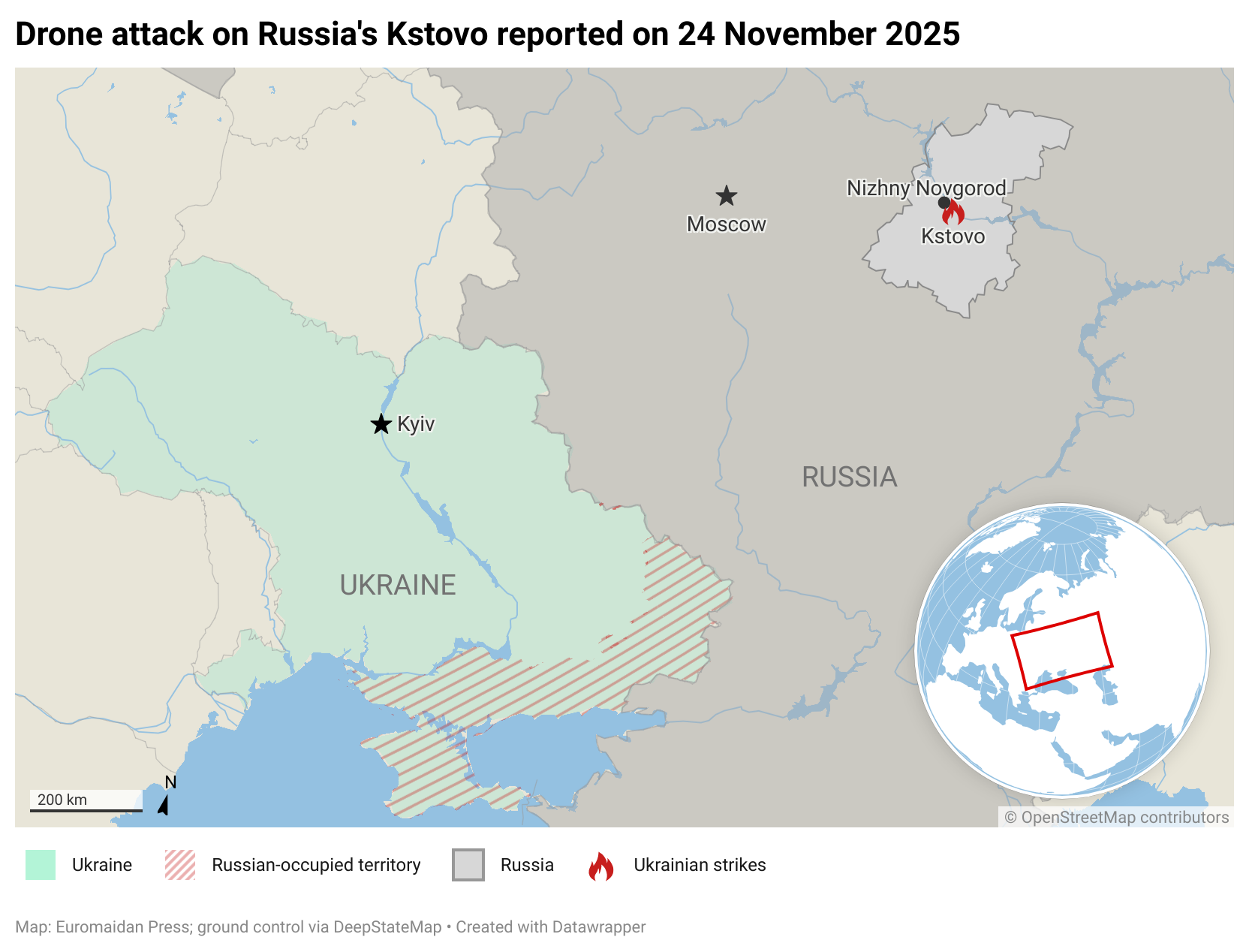
explosions rock russia's kstovo drone strikes target oil industry hub overnight · post dxrqs-drone-attack-on-russia-s-kstovo-reported-on-24-november-2025- series shook russian city drones possibly targeted its key petrochemical infrastructure nizhny novgorod airport temporarily halted
Explore further

Explosions rock Russia’s Kstovo as drone strikes target the oil industry hub overnight (MAP)

Days after a reported pause

On 29 October, The Wall Street Journal (WSJ) reported that Ukraine had paused refinery strikes under US pressure until after the 3 November midterms. Hours later, drones hit the Novokuibyshevsk refinery in Samara Oblast. Ukrainian President Volodymyr Zelenskyy wrote on 30 October that “every Russian strike on our cities and communities always gets our fully justified response.” Ukraine’s deep-strike units will also be expanded, he added. On 27 October, he told reporters that units had been “a little more careful” but “do not have an order” to stop, WSJ reported.

Fire at the Lukoil-Nizhegorodnefteorgsintez refinery in Kstovo, Nizhny Novgorod Oblast, Russia, overnight on 1 November 2026
Fire at the Lukoil-Nizhegorodnefteorgsintez refinery in Kstovo, Nizhny Novgorod Oblast, Russia, overnight on 1 November 2026. Photo: Supernova+

Neptune missiles and drones hit a rocket-fuel plant

Ukrainian forces struck the Kamensky Combine in Kamensk-Shakhtinsky, Rostov Oblast, overnight on 31 October, Ukraine’s General Staff reported. Strike drones and the Navy’s Neptune coastal missiles hit the plant together. The strike set a finished-goods warehouse on fire and damaged four workshops. The combine makes solid rocket fuel for Russia’s Uragan, Smerch, and Tornado-S multiple rocket launchers, Ukraine’s General Staff said.

Russia’s Defense Ministry claimed it intercepted four of Ukraine’s Flamingo cruise missiles and two Neptunes that night. Ukraine’s General Staff also reported hitting four Russian supply depots in occupied Ukraine. They sit near Khartsyzk and Dokuchaievsk in Donetsk Oblast, Novovasylivka in Zaporizhzhia Oblast, and Novoaidar in Luhansk Oblast.

Map of Ukrainian strikes on Kstovo, Ufa, Lipetsk, Kamensk-Shakhtinsky, and occupied areas of Donetsk, Luhansk, and Zaporizhzhia oblasts, 31 October–1 November 2026
Map of Ukrainian strikes on Kstovo, Ufa, Lipetsk, Kamensk-Shakhtinsky, and occupied areas of Donetsk, Luhansk, and Zaporizhzhia oblasts, 31 October–1 November 2026. Map: EP/Datawrapper

A refinery fire in Ufa

On the morning of 31 October, drones hit the Bashneft-Novoil refinery in Ufa, Bashkortostan, Astra’s OSINT analyst found from eyewitness photos. Local residents said two plants came under attack. By the afternoon, the fires had been contained, Ukrainian Telegram channel Supernova+ said. Ukraine’s drones struck Bashneft’s Ufa refineries in June, and a fire in the city’s refinery zone was last reported on 21 September, Astra noted.

Ufa’s oil refineries this morning, following a second consecutive day of successful strikes on the facilities. pic.twitter.com/Kqox83sWwM

— Exilenova+ (@Exilenova_plus) October 31, 2026

Lipetsk, Rostov, and the road to Crimea

Early on 1 November, agents of Atesh, a Crimean Tatar-Ukrainian partisan movement, reported explosions near the Lipetsk Tractor Plant during a mass drone raid. Atesh says the plant is Russia’s only maker of tracked chassis for air defense systems. Russian officials have not confirmed any damage.

Overnight on 1 November, locals reported attacks in Taganrog and six districts of Rostov Oblast, the Ukrainian Telegram channel of Petro Andriushchenko’s Center for the Study of Occupation said. Local sources also reported drone attacks on Pochep in Bryansk Oblast. Two Belgorod Oblast villages came under attack on the evening of 31 October. The results remain unknown.

Ukraine’s strikes on Russian logistics are also thinning traffic to occupied Crimea, the Institute for the Study of War (ISW) said on 31 October. Anatoly Tsurkin, head of the Russian-installed freight carriers’ association in Crimea, claimed daily truck traffic from Rostov Oblast fell from 2,000–3,000 to 600–800. He claimed the M-14 highway, which occupation officials call the R-280, is the only road trucks can use. Drone strikes have also scared off drivers, he claimed.

  •  
❌