
 Connexion

Russian drones watch the roads in Donetsk Oblast, but not the nearly 6 km route Ukraine has set up underground

Ukraine’s Air Assault Forces have set up an underground tunnel between two settlements in Donetsk Oblast, Colonel Dmytro Pishko, head of the Support Forces Directorate at the Air Assault Forces Command, told Ukrinform in an interview published on 3 November.
Drones have made the roads near the front deadly, and the underground war has so far been mostly about infiltration. Russian assault groups crawled through a gas pipeline into Sumy Oblast almost daily, Ukraine’s 71st Air Assault Brigade said, and it stopped every recorded attempt. In October, Ukraine said it had answered by advancing more than 15 km underground near Kupiansk. The Donetsk tunnel is a different use of the idea: a standing supply line rather than a route for sneaking assault troops behind enemy lines, disclosed on Ukraine’s Engineering Troops Day.
Pishko does not name the settlements or say how deep the tunnel runs
Pishko called the tunnel, almost 6 km long, “another achievement of our engineering ingenuity,” saying it allows “uninterrupted and camouflaged” movement and carries deliveries of food and ammunition.
Meanwhile, Russia has kept using pipes of its own, including one into Kupiansk that Ukraine says became an escape route. Asked about Russia’s own defensive lines, Pishko said its army “knows how to dig, loves it, and does it constantly.”
Nets stop the first drone but not the second
By early June, Ukraine had covered 822 km of frontline roads with anti-drone nets and other protection built since January. Pishko said such nets work only if they are maintained. A net withstands the first drone, but a second can fly through the hole, so dedicated units patrol and repair them daily.
“Closer to the front line, the most reliable protection is to dig as deep underground as possible,” Pishko said.
Open trenches, he said, are a thing of the past.
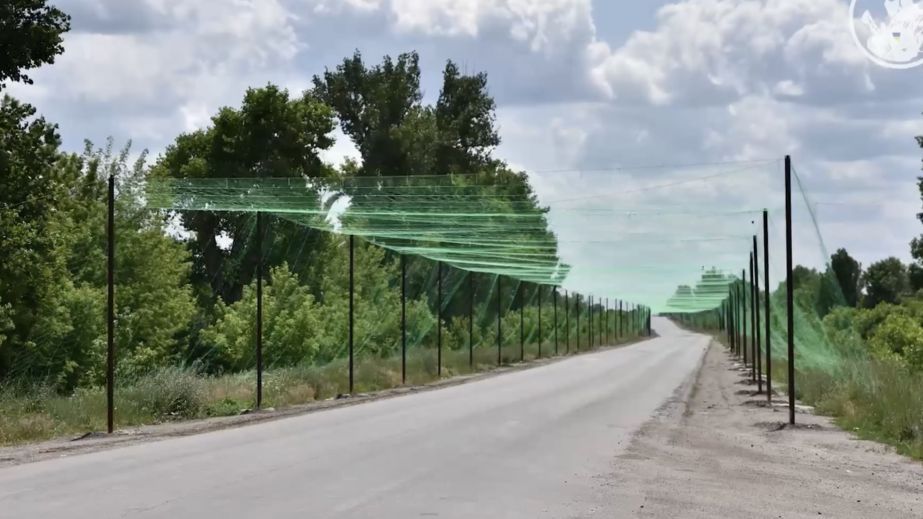
Ukraine makes its anti-drone road nets a national standard in a new strategy for defensive lines through 2028. It has already strung over more than 1,000 kilometers of road
A squad leader shot down two drones at an underground worksite
Even so, the work underground is not safe. Russian forces tried to attack one group with two FPV drones while it was setting up an underground tunnel, and squad leader Ivan Chokha shot down both, Pishko said.
Read also
-
From 5 km to 20 km a day: Ukraine triples anti-drone tunnel construction speed in two months
-
A one-meter gas pipe, a scooter, and a surrender: how a Russian assault group became POWs
-
Russia tries to drag a village north of Kupiansk into no-man’s-land after its losses in Ukraine’s underground operation
